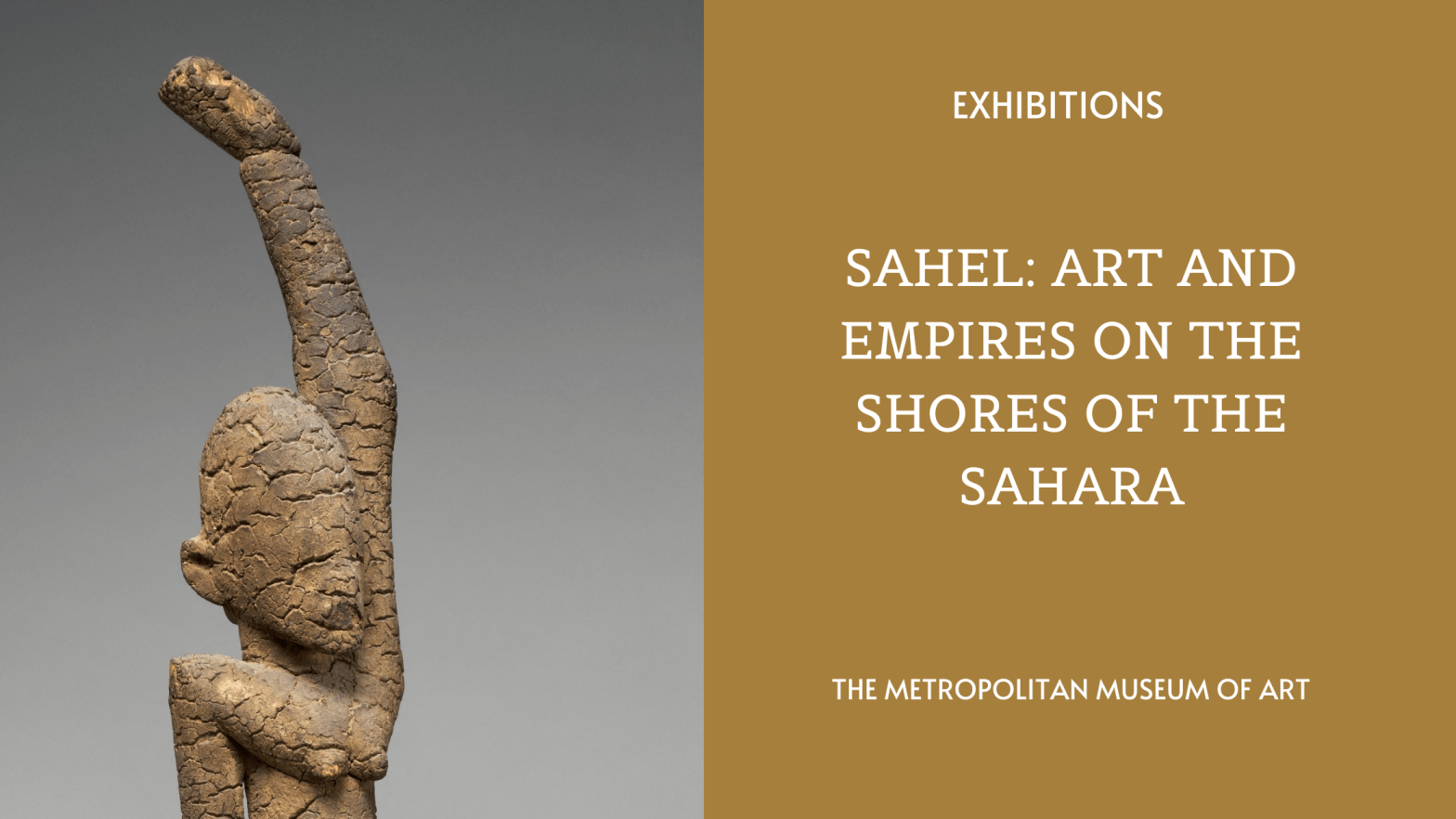
Exhibition: Sahel: Art and Empires on the Shores of the Sahara at The Met

The first exhibition of its kind, Sahel: Art and Empires on the Shores of the Sahara explores the art and history of the Sahel (a region of Western Africa comprised of modern-day Senegal, Mali, Mauritania, and Niger) from before the Common Era to the 19th century. The region was an active participant in global trade networks throughout the Middle Ages, and the exhibition explores these networks and the region’s relationship with Islam beginning in the 7th century.

An excerpt from the exhibition’s overview:

Sahel: Art and Empires on the Shores of the Sahara is the first exhibition of its kind to trace the legacy of [the Sahel] and what they produced in the visual arts. The presentation brings into focus transformative developments—such as the rise and fall of political dynasties, and the arrival of Islam—through some two hundred objects, including sculptures in wood, stone, fired clay, and bronze; objects in gold and cast metal; woven and dyed textiles; and illuminated manuscripts.

While the Met remains closed to the public in light of the coronavirus pandemic, several online resources allow you to virtually visit the exhibition. These include a virtual tour, an exhibition guide, a list of exhibition objects, and more.


Above image: Female Figure with Raised Arm, 15th–17th century, Mali, Ireli (?), wood (Ficus or Moraceae), organic materials, H. 17 5/8 × W. 3 1/4 × D. 4 7/8 in. (44.8 × 8.3 × 12.4 cm), The Metropolitan Museum of Art, 1979 (1979.206.64)

New Publication: The Ghent Altarpiece: Research and Conservation of the Exterior, Edited by Bart Fransen and Cyriel Stroo

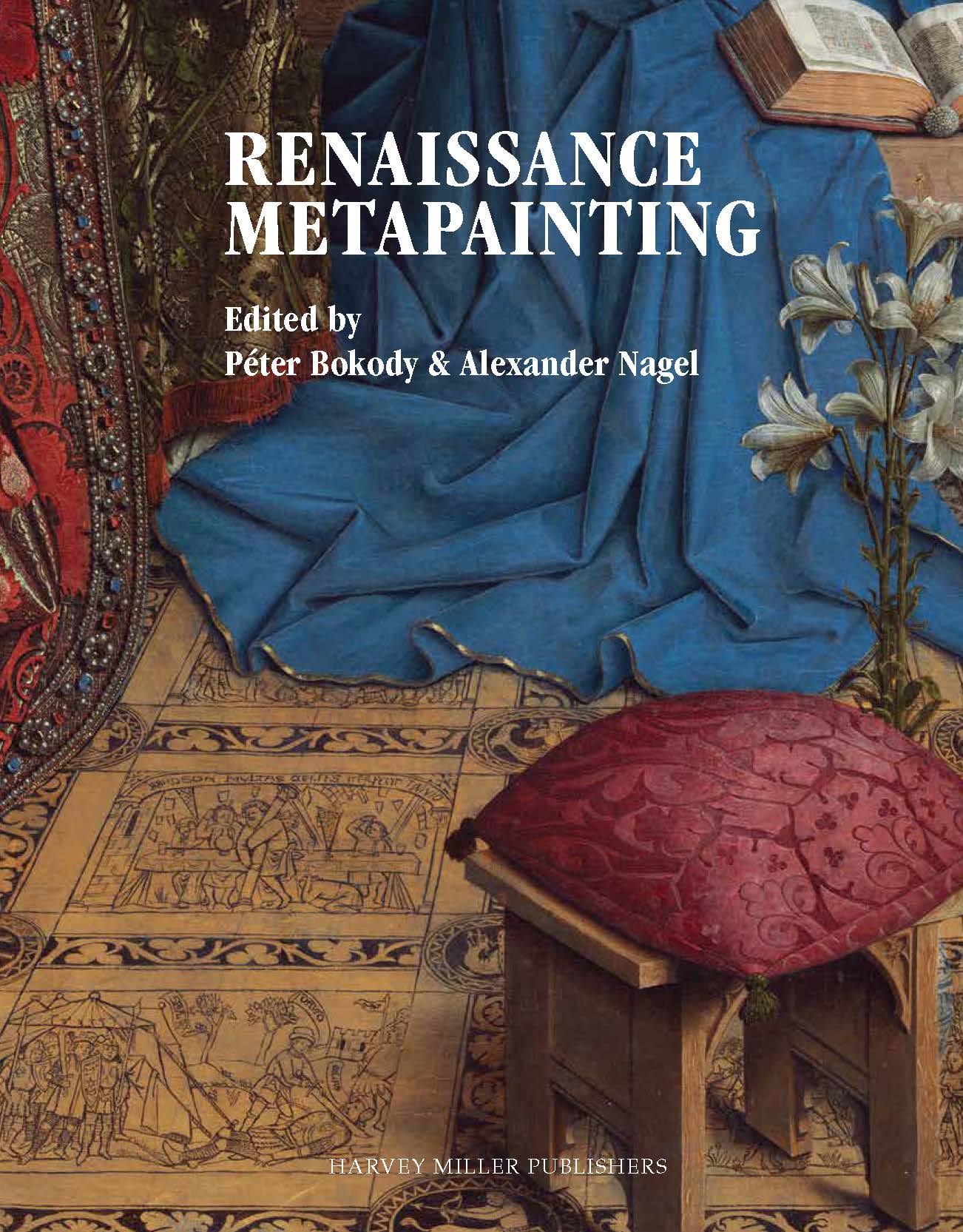
The outer panels of the Ghent Altarpiece had been overpainted to a considerable extent. The virtuosity of the Eyckian technique and aesthetics remained hardly visible. And yet, this had never been observed before the start of the conservation treatment. By removing the overpaint, the tonal richness and the coherent rendering of light and space once again came to the fore. Especially the suggestion of volumes and the spaciousness of the ensemble gained strength because of the virtuoso play of deep shadows and bright light accents, and not in the least because of the surprising trompe-l’oeil effect of the frames conceived as a stone framework. Or to put it in the words of the comments of one of the experts, dr. Maryan Ainsworth: The paintings live and breathe again in the time of the Van Eyck brothers. The sharp observation skills, the quick, accurate execution, the knowledge, curiosity and ingenuity about all the things that are depicted, are now unveiled after centuries. The profit for the knowledge of and further research into the essence of Eyckian aesthetics is considerable. And finally there is the discovery that the much-discussed quatrain was applied simultaneously with the polychromy of the frames: a real ‘coup de foudre’ in the discourse of the current art-historical research! The subtleties of the Eyckian technique could also be mapped out in more detail. How the Van Eycks managed to keep the final result and the desired effect in mind during every phase of the execution, from imprimatura to finishing touch. The artists made a statement about the art of painting, giving ‘technique’ as such a new prominence. The Ghent Altarpiece may be understood at some point as a major showpiece for a highly sophisticated pictorial technique. 

We hope that this publication of the results of the research and conservation campaign on the exterior of the altarpiece can help future researchers to ask better questions. Questions, and answers, that may produce a more balanced picture of Van Eyck’s techniques, methods and materials.

Click on the link ‘Online content’ for a preview of the book (21 pages) and a free copy of  Volume 15 The Ghent Altarpiece. A Bibliography (98 pages).

Buy the book here.

Table of Contents

Foreword – Ludo Collin

Preface – Hilde De Clercq, Christina Ceulemans

Introduction – Maximiliaan Martens, Christina Ceulemans, Ron Spronk, Anne van Grevenstein-Kruse

Transformations in the Sixteenth and Seventeenth Centuries -Hélène Dubois

Frames and Support: Technique and Structural Treatment – Jochen Ketels, Jean-Albert Glatigny, Anne-Sophie Augustyniak

Paint and Polychromy: Chemical Investigation of the Overpaints -Jana Sanyova, Geert Van der Snickt, H Koen Janssens, Peter Vandenabeele

Conservation and Restoration Treatment

The Painted Surface – Livia Depuydt-Elbaum, Fran

The Frames: In Search of Lost Unity -Anne-Sophie Augustyniak, Laure Mortiaux

The Van Eycks’ Creative Process

The Paintings: from (Under)drawing to the Final Touch in Paint – Marie Postec, Griet Steyaert

The Frames: an Exceptional Polychromy – Anne-Sophie Augustyniak, Laure Mortiaux, Jana Sanyova

The Authenticity of the Quatrain and the other Frame Inscriptions – Susan Frances Jones, Anne-Sophie Augustyniak, Hélène Dubois

Imagining the Original Display – Bart Fransen, Jean-Albert Glatigny

Restoring in the Public Eye – Bart Devolder

Epilogue: Implications and Perspectives – Cyriel Stroo, Maximiliaan Martens

Documentation

Photography before and after Treatment – Stéphane Bazzo, Jean-Luc Elias, Katrien Van Acker

Inscriptions on the Exterior – Susan Frances Jones, Marc H. Smith

The Quatrain: A New Reconstruction – Marc H. Smith, Susan Frances Jones, Anne-Sophie Augustyniak

Dimensions of Frames and Supports – Jochen Ketels, Jean-Albert Glatigny, Anne-Sophie Augustyniak

The Ghent Altarpiece: a BibliographyDominique Deneffe, Jeroen Reyniers

Bibliography
Project Participants
Photographic Acknowledgements
Abbreviations
Index of Names
Index of Works of Art

Fellowship: Teaching Fellow in History of Art, University of Edinburgh, deadline 7 August 2020 5pm

More information can be found here.

Applications are invited for a 0.4 FTE (14 hours per week) Teaching Fellow in History of Art to start on 1 August 2020, fixed term for 1 year.

We invite applications from specialists in the visual and material court culture of Northern Europe, c. 1400-1800. We welcome versatile applicants who have secondary interests in areas of high student need and who are able to incorporate material from the University’s Centre for Research Collections into their teaching.

A PhD or equivalent research experience is essential, as is evidence of excellent teaching. An understanding of ECA’s multidisciplinary ethos is important. Finally, the successful applicant may be expected to make a significant contribution to the teaching administration of the subject area.

This is a part time (14 hours per week) fixed term post.
Salary: £13,518 – £16,128 per annum (pro rated from £33,797 – £40,322 per annum)
Closing Date: 5pm (GMT) August 7th, 2020.

Informal enquiries concerning this post should be directed to Heather Pulliam, Head of History of Art, h.pulliam@ed.ac.uk.

1. Job Details

Job title: Teaching Fellow in History of Art

School/Support Department: History of Art, ECA

Unit (if applicable):

Line manager: Heather Pulliam

2. Job Purpose

We invite applications from specialists in the visual and material court culture of Northern Europe, c. 1400-1800. We welcome versatile applicants who have secondary interests in areas of high student need and who are able to incorporate material from the University’s Centre for Research Collections into their teaching.

Evidence of excellence in teaching and research-led teaching is essential. An understanding of ECA’s multidisciplinary ethos is important. Finally, the successful applicant may be expected to make a significant contribution to the teaching administration of the subject area.

3. Main Responsibilities

• Teaching of history of art at undergraduate all levels, including the supervision of dissertations and project work
• Teaching of history of art at masters level, including the supervision of dissertations and project work
• Developing, and updating course content for teaching at all levels
• Administration, assessment, presentation of work at examination period and periodic written feedback to students
• Undertake UG Honours level dissertation and postgraduate taught MSc and postgraduate research supervision
• Undertake administrative and management roles in the subject area as appropriate

4. Knowledge, Skills and Experience Needed for the Job

Essential
• PhD or equivalent research expertise in the History of Art or a cognate disciplin
• Demonstrable ability to teach at undergraduate and postgraduate level
• Demonstrable ability to devise and deliver new course materials
• Ability to develop good working relationships with a wide variety of groups – students, colleagues in the subject area, the University and partner institutions, industry practitioners and representative bodies, etc.
• Excellent verbal and written communication skills
• Good IT skills in relation to the history of art

Desirable
• Secondary teaching specialisms in theory/methodology, or cognate areas
• Flexibility and versatility in teaching

5. Dimensions

Further details on History of Art at the University of Edinburgh can be found here: http://www.eca.ed.ac.uk/history-of-art

6. Job Context and any other relevant information


Application Procedure

All applicants should apply online by clicking the apply link at the bottom of this page. The application process is quick and easy to follow, and you will receive email confirmation of safe receipt of your application. The online system allows you to submit a CV and other attachments.

You will be notified by email whether you have been shortlisted for interview or not.


Right to Work

In accordance with UK legislation the University of Edinburgh, as an employer, has a legal responsibility to prevent illegal working and therefore must check that all employees are entitled to work in the United Kingdom (UK).

To do so, the University requires to see original documents evidencing right to work in the UK before commencement of employment and this is normally carried out at interview. Details will be provided in any letter of invitation to interview.

For further information on right to work please visit our right to work website

In the circumstances where the vacancy does not meet the UK Visas and Immigration (UKVI) criteria for sponsorship the successful applicant must have the existing right to work in the UK or individual circumstances which enable permission to work to be obtained.

For further information about whether you require a visa and other visa routes please visit the GOV.UK website

  1. If you are an academic, researcher or technical specialist in the field of sciences; humanities; engineering; medicine; digital technology; or the arts, it may be possible for you to apply for a Global Talent visa. This route requires you to apply to be endorsed as an internationally recognised leader or emerging leader in your particular field by an endorsing body (Arts Council England, British Academy, Royal Academy of Engineering, Royal Society, Tech Nation, UK Research and Innovation (UKRI)). However, if you are applying for a senior academic role, e.g. Professor/Reader there is an accelerated route to endorsement. Further information can be found on the UKVI website

Conditions of Employment

Pension Scheme
This role is grade UE07 and therefore the post holder is automatically included in membership of the Universities Superannuation Scheme (USS), subject to the USS membership criteria, unless they indicate that they choose not to join the Scheme.

For further information please visit our Pensions website.

Salary

The role is grade UE07 and attracts an annual salary of £13,518 to £16,128 for 14 hours, part time, each week. Salary is paid monthly by direct transfer to your Bank or Building Society account, normally on the 28th of the month. Salaries for part-time staff are calculated on the full-time scales, pro-rata to the Standard Working Week.

The University reserves the right to vary the candidate information or make no appointment at all. Neither in part, nor in whole does this information form part of any contract between the University and any individual.

History of Art

Research in History of Art (http://www.ed.ac.uk/schools-departments/edinburgh-college-art/history-art) is of consistently internationally recognised quality and covers a wide variety of periods in numerous outputs.

Teaching and Research
All staff in History of Art are active researchers, working in a wide range of fields, and their research interests strongly inform their teaching, both undergraduate and postgraduate.

Breadth and diversity
History of Art has an unusually wide range of specialist expertise, covering early and late Medieval art, the Renaissance, the Early Modern/Baroque period, and art from Neoclassicism to the present-day, with a particular focus on late nineteenth-century art and contemporary art and theory. World cultures are another distinctive feature of our research and teaching, with full-time staff specialising in Islamic and Chinese art, architecture and visual culture. Our students are also able to take courses taught by specialists in visual culture in Classics, Architecture and Film Studies. History of Art at Edinburgh also encompasses a wide range of approaches and methods to the study of art and visual culture.

Edinburgh College of Art

Edinburgh College of Art is a large and diverse school within the University of Edinburgh’s College of Humanities and Social Science. It is comprised of the Schools of Art, Design, History of Art, Edinburgh School of Architecture and Landscape Architecture and the Reid School of Music.

Our mission is to promote world-leading critical enquiry across all these subject areas through scholarly research, teaching and creative practice.

Almost 3,000 students and 300 staff study and work at ECA and we enjoy strong relationships with museums, galleries, archives, practitioners and industry partners in Edinburgh, Scotland, the UK and internationally.

Edinburgh College of Art is committed to equal and fair treatment of all its employees and in recognition of the positive promotion of diversity and gender equality among staff and students, Athena SWAN granted the Edinburgh College of Art a Bronze Award in 2017.

College of Arts, Humanities and Social Sciences (http://www.ed.ac.uk/arts-humanities-soc-sci)

The College of Arts, Humanities and Social Sciences is a large and diverse part of the University. Led by Vice-Principal Professor Dorothy Miell, it has 13,800 undergraduates, 5,500 taught postgraduates, 1,300 research students and more than 3,800 academic and professional services staff. The College incorporates 11 Schools (Business; Divinity; Economics; Edinburgh College of Art; Education; Health in Social Sciences; History, Classics and Archaeology; Law; Literatures, Languages and Cultures; Philosophy, Psychology and Language Sciences; and Social and Political Science), the Institute for Advanced Studies in the Humanities and the Centre for Open Learning. The College is located on multiple sites across Edinburgh, with the majority of Schools and College Offices based close to the central George Square area. The College, which is recognised as one of the world’s leading centres for the arts, humanities and social sciences in research and teaching, has been growing and investing strongly in recent years.

Research Excellence Framework 2014 (REF2014)

The College operates at the highest levels of international quality across a very wide range of disciplines in the arts, humanities and social sciences and submitted the work of more than 750 staff to 23 Units of Assessment in the Research Excellence Framework 2014. The College achieved a superb result, combining a large-scale, broad and diverse submission with very high quality outcomes: 86% of its research impact and 76% of the overall quality profile were assessed as world-leading (4*) and internationally excellent (3*). Using the widely used Research Power index (which combines the submission’s overall score for 3* and 4* work with the volume of staff submitted), 12 of the College’s Units were ranked within the top five in the UK, and 18 were ranked first in Scotland. With an assessment of more than 95% at 3* and 4*, we’re particularly proud of the outstanding research environment we create for staff and research students.

The University of Edinburgh

For more than four centuries, our people and their achievements have rewritten history time and again. They’ve explored space, revolutionised surgery, published era-defining books, paved the way for life-saving medical breakthroughs and introduced to the world many inventions, discoveries and ideas from penicillin to Dolly the sheep. We have believed that anything is possible, we still do.
The latest Research Excellence Framework highlighted our place at the forefront of international research. This adds to our international reputation for the quality of our teaching and our student experience excellence. The University is proud of its success with online teaching initiatives, with 2550 students currently studying its online distance learning postgraduate programmes, and a total to date of more than 2 million enrolments for Edinburgh MOOCs.

As a member of staff, you will be part of one of the world’s leading universities, with 20 Schools spread over 3 Colleges that offer more than 1600 undergraduate and 600 postgraduate programmes to over 41,000 students each year. Professional services are critical to this success as well as our world-class teaching, research and student facilities. In fact, we are one of the top employers in Edinburgh, with over 14,500 people spread across a wide range of academic and supporting roles.

As a world-changing, world-leading university, we offer an exciting, positive, creative, challenging and rewarding place to work. We give you support, nurture your talent, develop and reward success and integrate academic, professional and personal career goals, as well as give your career the benefit of a great and distinguished reputation. In addition, our employees benefit from a competitive reward package and a wide range of staff benefits, which include generous holiday entitlement, a defined benefits pension scheme, staff discounts and much more. Access our staff benefits page for further information and use our reward calculator to find out the total value of pay and benefits provided.

The University of Edinburgh holds a Silver Athena SWAN award in recognition of our commitment to advance gender equality in higher education. We are members of the Race Equality Charter and we are also Stonewall Scotland Diversity Champions, actively promoting LGBT equality. The University has a range of initiatives to support a family friendly working environment, including flexible working and childcare vouchers. See our University Initiatives website for further information.

University Family Friendly Initiatives

Equality Networks:

Staff Pride Network for LGBT+ colleagues and allies
Disabled Staff Network

The University of Edinburgh is a charitable body, registered in Scotland, with registration number SC005336.

More information can be found here.

CFP: New Faces in Medieval Iberian Studies, IMC Leeds 2021 (5-6 July), deadline 15 september 2020

Organizer and Sponsor: The Association of Graduate and Early Career Scholars of Medieval Iberia (AGECSMIberia)

In 2019, three graduate students working on different aspects of Medieval Iberia met at a reception in Leeds and commiserated over the difficulties of studying Iberia as early career scholars. They realised how difficult it was to meet other Iberianists in the early stages of one’s career, make connections with scholars from different countries, and share their work with the field and one another. What began as a casual conversation led to the establishment of a new collaborative group, AGECSMIberia, dedicated to connecting graduate and early career Iberianists around the world and showcasing their new exciting work through sponsored sessions. The global pandemic has made the promotion of the work of early career Iberianists even more important in an infinitely more complex job market.

We seek papers for a multi-session series showcasing recent scholarship on medieval Iberia by graduate student and early career scholars. We especially welcome papers that:

  • Bridge Iberian and Anglo scholarship
  • Address Islamic or Jewish subjects
  • Are interdisciplinary in nature (and time period, Late Antique and Early Medieval
  • welcome!)
  • Demonstrate the importance of Iberian work for non-Iberian studies

Please submit an abstract 200-250 words (any references excluded from that count) for a 20 minute presentation to agecsmiberia@gmail.com by September 15 2020.

New Publication: Lexique des stalles médiévales / Lexicon of Medieval Choir Stalls, by F. Billiet and E. C. Block

This lexicon is an indispensable tool long awaited by researchers and students so they may better conduct and exchange the results of their research. It is also a guide for all those interested in choir stalls who wish to learn more about the ensembles whose significance still remains complex and mysterious. As well as an introduction that includes articles on the history and function of medieval choirstalls, the lexicon provides illustrated multilingual definitions of the elements used in the construction and decoration of the stalls. As with the illustrated bibles of the Middle Ages, this book includes the most beautiful of the works of art which decorate the medieval choir stalls in thirteen Catholic countries of Europe.

Ce lexique est l’outil indispensable attendu par les chercheurs et les étudiants pour mieux partager les résultats de leurs recherches sur les stalles médiévales. C’est aussi un guide pour tous ceux qui s’intéressent aux stalles et qui cherchent à mieux s’orienter dans les ensembles dont le déchiffrement reste encore complexe et problématique. Après une introduction comprenant des articles sur l’histoire et la fonction des stalles, le lexique présente des définitions illustrées et la traduction des termes spécifi ques aux supports sculptés dans les stalles de choeur. Comme les bibles figurées du Moyen Âge, ce livre montre les plus belles images qui ornent les stalles dans treize pays en Europe.

Order the book here.

Grants: Association for Art History, deadline 30 September 2020

To further our mission to advance the study and practice of art history, the Association for Art History offer grants of up to £1,000 which provide support to aid scholarly research, to develop professional practice and to further the teaching and learning of art history at all education levels.

We are delighted to announce our first round of recipients of grants for art history.

What we fund

Grants to aid scholarly research include support for:

-Organisation of symposia, conferences and workshops
-Travel to libraries, archives and collections
-Delivery of research findings at conferences
-Catalogues and public engagement programmes for exhibitions
-Access to images controlled by third party rights holders

Grants to develop professional practice within art history include:

-Participation in museum and gallery training programmes in curatorial and public engagement areas

Grants to support the teaching and learning of art history in schools include:

-Teachers’ continuing professional development

-Formal and informal learning opportunities for students

Bursaries

Alongside our grants programme, the Association awards bursaries for doctoral students and early career researchers to attend our Annual Conference.

These competitive bursary tickets are available to those who would benefit from attending our Annual Conference. Information on how to apply for bursaries for the 2020 conference will be available online from November 2019.

Priorities

Within our grants categories, we look particularly favourably on:

-Projects from a wide geographic distribution throughout the UK and those that will reach broad audiences
-Projects that promote the participation of diverse audiences and encourage new perspectives within art and art history
-Supporting research and practice where the applicant is without institutional affiliation or the access to funding that such association would provide

Outcomes

We expect that the outcomes of projects we fund will include:

-Expanding the knowledge base of art history
-Enabling more researchers and professionals in the field, particularly those who do not have other means of support, to access essential career development opportunities
-Helping art historians and those in related professions to build and extend their networks to facilitate their work and professional development
-Introducing wider audiences to art history through exhibitions, publications and other public programming
-Facilitating the teaching and learning of art history in secondary schools and thereby increasing the engagement of students at all levels with the subject

Eligibility

Grants are open to members of the Association who may be:

-Academics
-Students
-Independent researchers
-Teachers
-Museum and gallery professionals
-Artists

If you are not a member of the Association for Art History and would like further information on member benefits and how to join us, please see here for details.

What we do not fund

Grants from the Association for Art History cannot fund further or higher education (university fees, course books etc), student living expenses or unpaid internships.

Staff members and trustees of the Association for Art History and their relatives and partners are not eligible for our grants.

Criteria

Research grants will be assessed according to their contribution to scholarship in art history, their academic rigour, and the relevance and need for the research in the specific area described.

Practice grants should demonstrate how the skills and experience obtained will contribute to professional development and, ultimately, to the public understanding of art history.

For all grants, the demonstrable financial need of the applicant as well as the availability of other grants to support the project or activity applied for will be considered.

Grants which leverage and help to attract additional funding are encouraged.

Find out more information here.

New Publication: Funerary Portraiture in Greater Roman Syria, edited by Michael Blömer and Rubina Raja

This volume provides a unique survey of locally produced funerary representations from across regions of ancient Syria, exploring material ranging from reliefs and statues in the round, to busts, mosaics, and paintings in order to offer a new and holistic approach to our understanding of ancient funerary portraiture. Up to now, relatively little attention has been paid to the way in which local and regional production of material in this area formed part of a broader pattern of sculptural and iconographical development across the Roman Near East. By drawing on material from an area encompassing modern Lebanon, Jordan, Syria, and Turkey, as well as Egypt and Achaia, the contributions in this book make it possible for the first time to take a wider perspective on the importance of funerary portraiture within Greater Roman Syria, and in doing so, to identify influences, connections, and iconographical analogies present throughout the region, as well as local differences, larger-scale boundaries, and ruptures in traditions that occurred across time and place.

Table of Contents

Michael Blömer & Rubina Raja, Funerary Portraits in Roman Greater Syria – Time for a Reappreciation

Michael Blömer & Rubina Raja, Shifting the Paradigms: Towards a New Agenda in the Study of the Funerary Portraiture of Greater Roman Syria

Andrea U. De Giorgi, ‘Til Death Do Us Part: Commemoration, Civic Pride, and Seriality in the Funerary Stelai of Antioch on the Orontes

Michael Blömer, The Diversity of Funerary Portraiture in Roman Commagene and Cyrrhestice

Jutta Rumscheid, Different from the Others: Female Dress in Northern Syria Based on Examples from Zeugma and Hierapolis

Michael A. Speidel, Roman Soldiers’ Gravestones in Greater Syria: Thoughts on Designs, Imports, and Impact

Rubina Raja, Funerary Portraiture in Palmyra: Portrait Habit at a Crossroads or a Signifier of Local Identity?

Signe Krag, Palmyrene Funerary Female Portraits: Portrait Tradition and Change

Achim Lichtenberger & Rubina Raja, Portrait Habit and the Funerary Portraiture of the Decapolis

Karl-Uwe Mahler, Funerary Portraiture from the Coastal Region of Roman Syria

Bilal Annan, Petrified Memories: On Some Funerary Portraits from Roman Phoenicia

C. H. Hallett, Mummies with Painted Portraits from Roman Egypt and Personal Commemoration at the Tomb

Sheila Dillon, Attic Funerary Portraiture in the Roman Period

Order the book here.

New Publication: Les stratégies de la narration dans la peinture medieval: La représentation de l’Ancien Testament aux IVe-XIIe siècles, edited by Marcello Angheben

Depuis les débuts de l’art chrétien, l’Ancien Testament a reçu une place singulière dans le décor des églises comme dans l’illustration des manuscrits. Certaines formules conçues aux IVe-Ve siècles se sont imposées durant tout le Moyen Âge, comme celles de Saint-Pierre de Rome, et une influence encore plus large a longtemps été attribuée à la Genèse Cotton ou à son modèle. Les oeuvres médiévales ne reproduisent toutefois presque jamais servilement celles qui les ont précédées. Les concepteurs les ont constamment réélaborées pour des raisons probablement multiples : adapter la composition au cadre imposé par l’architecture ou le découpage du folio, optimiser les ressorts de la narration pour en faciliter la lecture ou toucher plus efficacement la sensibilité du spectateur, enchaîner les scènes pour entraîner le regard dans le sens de la lecture ou relier sémantiquement deux épisodes voisins, induire un sens spécifique inspiré par la théologie ou la liturgie, ou encore exprimer visuellement des ambitions institutionnelles voire politiques. Les quinze articles réunis dans cet ouvrage développent ces questionnements en les appliquant à des ensembles peints ou en mosaïque représentatifs de la période envisagée : les oeuvres conservées ou perdues des premiers siècles, Saint-Pierre de Rome, Saint-Paul-hors-les-Murs et leurs avatars médiévaux, les bibles carolingiennes de Tours et celles de Ripoll, Galliano, les autres ensembles lombards, Saint-Savin-sur-Gartempe, Château-Gontier, Palerme et Monreale. Pour enrichir cette réflexion, le champ d’investigation a été étendu aux cycles néotestamentaires des églises médiobyzantines et aux mosaïques de Saint-Marc de Venise. Dans la conclusion, Herbert Kessler propose en effet une mise au point stimulante sur la délicate question de la Genèse Cotton en nuançant son influence sur le cycle vénitien. L’ouvrage offre ainsi un panorama très complet de la représentation de l’Ancien Testament et une réflexion foisonnante sur les stratégies de la narration.

Table of Contents

Introduction

Marcello Angheben, Les stratégies de la narration dans la peinture médiévale. Problématiques et perspectives

I. Des premiers siècles au Moyen Âge central

Jean-Michel Spieser, Les cycles paléochrétiens dits narratifs

Anne-Orange Poilpré, Figurer l’Ancien Testament dans la Bible chrétienne à l’époque carolingienne. (Re)composer l’histoire

Manuel Antonio Castiñeiras Gonzalez, Les Bibles de Ripoll et de Rodes et les ivoires de Salerne. La narration biblique sur des supports variés : modèles, adaptions et discours

Judith Soria, Temporalité et causalité narratives dans les décors médiobyzantins

II. Les traditions romaine et lombarde

Serena Romano, San Pietro, San Paolo, e la narrazione cristiana. Riflessioni su una possibile storia

Irene Quadri, Dipingere all’ombra di prototipi illustri. La narrazione veterotestamentaria nei cicli tipologici di XI e XII secolo in Italia centrale

Marco Rossi, Les cycles de l’Ancien Testament à Galliano et dans la peinture lombarde du XIesiècle

Fabio Scirea, La représentation de l’histoire d’Adam et Ève dans les milieux ambrosiens aux XIe-XIIe siècles

III. Saint-savin et la peinture « septentrionale »

Søren Kaspersen, Genesis Cycles: Tradition, Theology and Politics. From Cotton Genesis to Saint-Savin-sur-Gartempe

Christian Davy, Les peintures murales de Saint-Jean-Baptiste de Château-Gontier et de Saint-Savin-sur-Gartempe. De la similitude à la dissemblance

Kai Christian Ghattas, Reanimating the Scripture: Movement and Body Memory in the Paintings of Saint-Savin

IV. Les mosaïques siciliennes

Giulia Arcidiacono, Le storie della Genesi nella Cappella Palatina di Palermo. Qualche osservazione sulle fonti iconografiche e sulle strategie narrative

Tancredi Bella, Le récit de la Genèse dans les mosaïques de la cahtédrale de Monreale

Herbert L. Kessler, Conclusion. La Genèse Cotton est morte

Planches

Order the book here.

CFP: 3 sponsored sessions by DISTAFF, International Congress on Medieval Studies (13-15 May 2021), deadline 15 September 2020

DISTAFF (Discussion, Interpretation, and Study of Textile Arts, Fabrics, and Fashion) was founded in 1997 by Gale R. Owen-Crocker and Robin Netherton to bring together participants at the major medieval congresses who are interested in medieval dress and textiles. DISTAFF are hosting three sponsored sessions at the International Congress on Medieval Studies (13-15 May 2021).

Paper proposals and inquiries can be sent to robin@netherton.net by September 15, 2020.

Object Lessons: Presenting History Through Artifacts

Scholars from multiple disciplines are increasingly examining and presenting medieval artifacts in ways that go beyond traditional catalog descriptions, focusing instead on how surviving items, individually or collectively, illuminate their cultural and social contexts. While DISTAFF is centered on study of clothing and textiles, the interdisciplinary approaches used to “read” surviving artifacts in this field apply to other areas of material culture. Roundtable participants will describe the approaches they took in compiling and presenting collections of such artifacts, including what they learned along the way and how their experiences might inform other researchers’ interpretation of medieval objects.

Dress and Textiles I: Rank and Signifiers

This session coincides with the release of an important new book in our field — a massive compilation of documentary references on Scottish court clothing — whose author will present additional findings from that research, focusing on the use of dress to express rank. In keeping with our ongoing emphasis on interdisciplinary approaches, any scholarly approach to medieval or early modern textiles and clothing is welcome, including but not limited to art history, archival research, archaeology, social history, language/literature, economics, trade, and gender studies.

Dress and Textiles II: Curious Descriptions and Depictions

A great deal of current work in clothing and textile study involves explaining puzzling dress or textile references in art, historical documents, and literature, in turn aiding in the overall interpretation of
those sources. This session brings together papers in which scholars have deciphered confusing images or written passages about clothing and textiles, or dress/textile artifacts with odd or confusing elements.

Online Workshop: Virtual Methodologies: Medieval and Early Modern European Collections, Wellcome Collection, 29 July 2020, 15:00 – 17:00

Virtual Methodologies for Early Career Researchers

Book your place here.

Are you an MA or PhD student or a postdoctoral researcher re-evaluating your research goals this summer? Join experienced researchers and staff from Wellcome Collection as we expand our horizons of actionable methodologies in the face of restricted travel and temporary closures.

During this online workshop you will hear from three research groups based in Europe and the UK working with manuscripts, early printed books, and visual material. Sharing methodological perspectives on digitally accessible collections, our first hour will include presentations and discussion centring a proactive approach to our current challenges. After a short break we will re-convene to learn from Wellcome Collection’s in-house collections specialists about creative ways to navigate and discover the collections that are accessible during COVID-19 closures. Come with your questions and research quandaries!

We encourage participants who are new to Wellcome Collection and those already conducting research with our collections to attend. Collection materials discussed will be in European vernaculars and Latin, however no specific language skills are required for participation. The spoken language of the workshop is English.

Reserve your virtual seat at the table, space is limited. You will receive a joining link 24 hours ahead of the workshop. The workshop will be convened through BlueJeans (no download required) and closed captions are available.

Participating Researchers:

  • Dr. Hannah Murphy, Renaissance Skin, King’s College London
  • Dr. Oscar Seip, Visualizing Science in Media Revolutions, Bibliotheca Hertziana Rome
  • Dr. Kathleen Walker-Meikle, Renaissance Skin, King’s College London
  • Dr. Claire Weeda, University of Leiden & Premodern Healthscaping, University of Amsterdam
  • Jess Bailey, UC Berkeley, Wellcome Collection
  • Dr. Elma Brenner, Wellcome Collection
  • Julia Nurse, Wellcome Collection
  • William Schupbach, Wellcome Collection

Book your place here.