The Department of Byzantine and Modern Greek Studies at the University of Cyprus has one opening for a Special Scientist (Administration Support Staff)to act as a Project Manager for the Twinning project: “Network for Medieval Arts and Rituals”(NetMAR), which is funded by the European Commission. The position is for 1 year with the possible renewal for another 2 years.
Applicants with an MA in Byzantine Studies, Medieval Studies or Classics are encouraged to apply. The selected candidate will also enroll in the graduate school of the University of Cyprus, and while acting as the NetMAR project manager s/he will work towards her/his Ph.D. in Byzantine Studies and the Latin East. Applicants must thus regularly follow the process of admission for Spring Semester 2021, in parallel with the submission of the application for the Project Manager position. Applicants are expected to write their Ph.D. thesis in English or Greek on a topic related to the NetMAR research clusters.
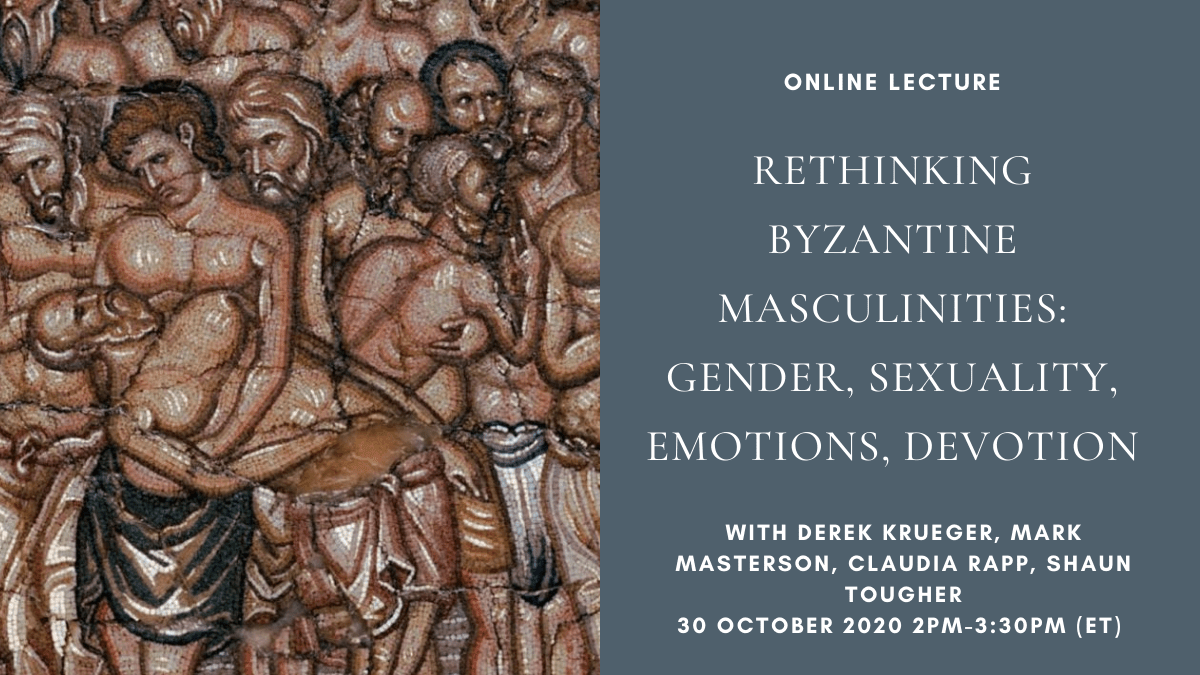
For the past five decades, Byzantinists have explored gender and sexuality. More recent work has turned to gendered emotions and religious devotion. While much of this research has its origin in women’s history, there has been an increasing interest in men, including monks and eunuchs, and in the articulations and performances of masculinity.
This conversation brings together scholars across the globe who have actively promoted this research to reflect on their work and its evolving academic and nonacademic contexts.
Organizers: Claudia Rapp (University of Vienna and Austrian Academy of Sciences) and Derek Krueger (University of North Carolina at Greensboro)
Participants
Derek Krueger is the Joe Rosenthal Excellence Professor of Religious Studies and Women’s, Gender, and Sexuality Studies at the University of North Carolina at Greensboro. He serves as chair of the United States National Committee for Byzantine Studies (2016–2021) and as a senior fellow at Dumbarton Oaks (2015–2021). His current project is entitled “Monastic Desires: Homoeroticism in Byzantine Ascetic Literature.”
Mark Masterson is senior lecturer of classics at Victoria University of Wellington, New Zealand. His major research interest is same-sex desire between men in classical antiquity and medieval Byzantium. His Between Byzantine Men: Desire, Brotherhood, and Male Culture in the Medieval Empire is forthcoming from Routledge.
Claudia Rapp is professor of Byzantine studies at the University of Vienna, director of the Division of Byzantine Research at the Austrian Academy of Sciences, and scholarly director of the Sinai Palimpsests Project. She serves as president of the Austrian Association for Byzantine Studies and as a senior fellow at Dumbarton Oaks (2019–2021). Her research and publications (including Brother-Making in Late Antiquity and Byzantium: Monks, Laymen, and Christian Ritual) focus on social and cultural history, often from the angle of religious history and manuscript studies.
Shaun Tougher is professor of Late Roman and Byzantine history in the School of History, Archaeology and Religion at Cardiff University. He works especially on Constantinian and Macedonian dynastic history and on eunuchs. His Roman Castrati: Eunuchs in the Roman Empire is forthcoming this autumn.
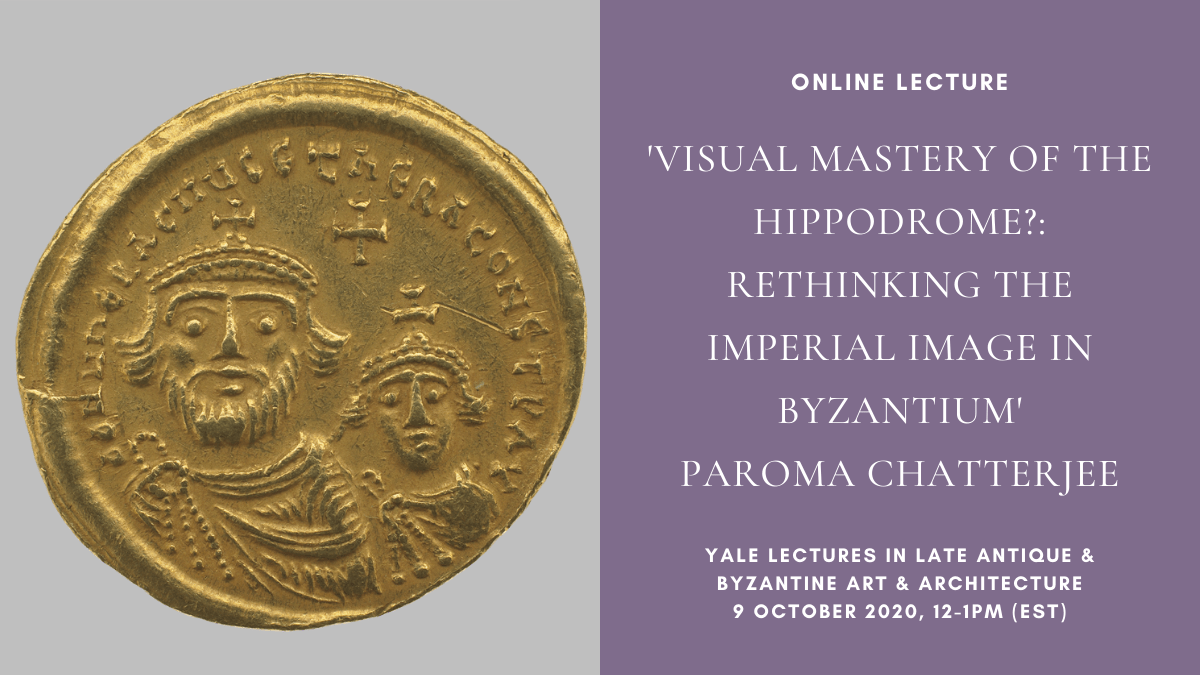
This is the second in a series of Yale Lectures in Late Antique and Byzantine Art and Architecture. The lecture series is organized by Robert S. Nelson, Robert Lehman Professor in the History of Art, and Vasileios Marinis, Associate Professor of Christian Art and Architecture at the ISM and YDS. Support is provided by the Department of Classics and the Department of the History of Art.
Zoom lectures begin at 12 noon Eastern Time; registration is required. You can register at any time to join a lecture. Your registration is valid for the whole series; attend as many as you like.
Paroma Chatterjee is Associate Professor of Art History at the University of Michigan, Ann Arbor. Her research focuses on artistic encounters in the medieval Mediterranean, medieval image theories, ekphrasis, relics and icons, and Byzantine sculpture, among other subjects.
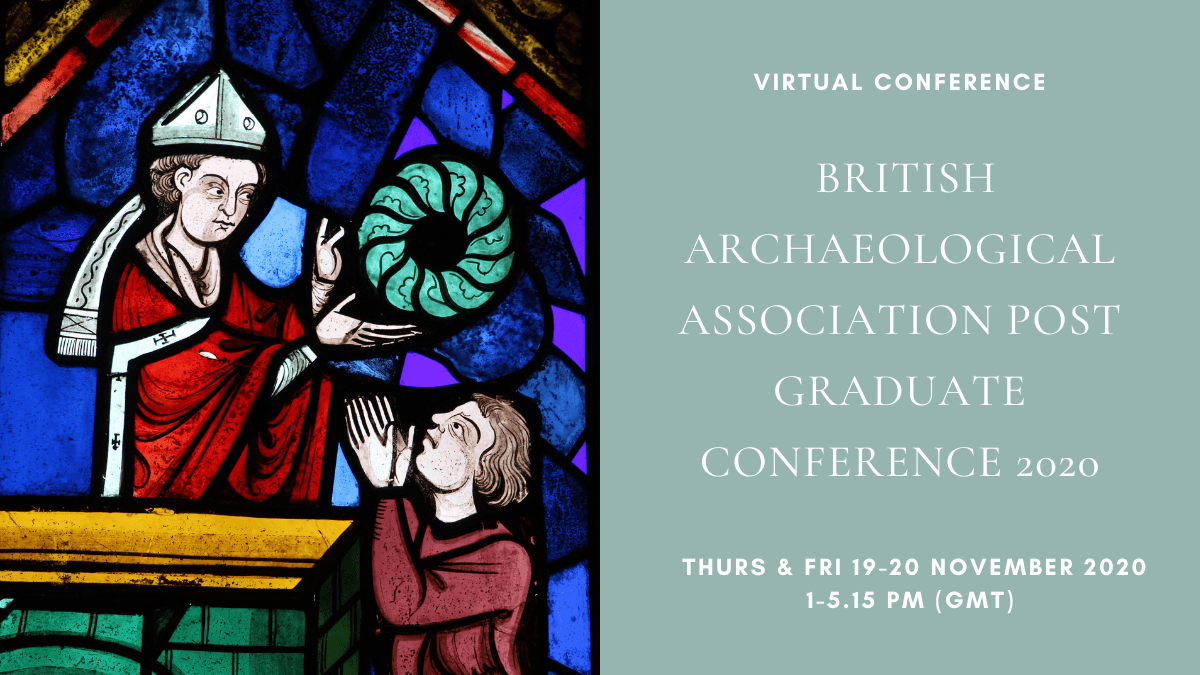
We are excited to present a diverse conference which includes postgraduates and early career researchers in the fields of medieval history of art, architecture, and archaeology. The British Archaeological Association postgraduate conference offers an opportunity for research students at all levels from universities across the UK and abroad to present their research and exchange ideas.
This year the conference will take place online over two days: Thursday & Friday, 19-20 November 2020, beginning from 1pm (GMT)
Elena Lichmanova (School of History, National Research University Higher School of Economics, Moscow), An Alternative to the Cross Pattern in Early Christian and Early Medieval Art
Nadezhda Tochilova (Saint Petersburg Stieglitz State Academy of Art and Design), New perspectives on studying art of the Baltic region in the 10th -12th centuries: The issue of artistic interaction between Scandinavia and Ancient Rus´
Millie Horton Insch (UCL), Skeuomorphic Exchange Between Embroideries and Wall Paintings in Eleventh and Twelfth-Century England
2:30 – 2:55 pm – Break
3:00 – 4pm – Panel 2: Making and Meaning of Medieval Tombs
Chair: Dr Tom Nickson (Courtauld Institute of Art)
Jack Wilcox (University of Kent), The Mystery of the Tree of Jesse Tomb Slab in Lincoln Cathedral
Richard Asquith (Royal Holloway, University of London), Epigraphy, Executors, and Encounters: contextualising the trope of the ‘bad executor’ on pre-Reformation English tombs
4:00 – 4:15 pm – Break
4:15 – 5:15 pm – Panel 3: Visual Culture in English Religious Spaces
Chair: Dr Richard Plant (BAA. Publicity Officer)
Lydia McCutcheon (University of Oxford), Children and Families in the ‘Miracle Windows’ of Canterbury Cathedral
Crystal Hollis (University of Exeter), Graffiti as a Historical Resource: Parish History on Church Walls
5:15 pm – End
Friday 20 November 2020, 1 – 4.50pm (GMT)
1:00 – 1:10 pm – Welcome Back
1:10 – 3:00 pm – Panel 4: Encountering Architecture and the Urban Space
Chair: John McNeill (BAA. Honorary Secretary)
Giulia Bison (University of Leicester), Metalworking and the transformation of Late Antique Rome
Marta Vizzini (Università degli Studi di Firenze), A miniature Rome, away from Rome: Montefiascone and its medieval San Flaviano church
Thomas Pouyet (Université de Tours-CNRS), The Romanesque tower of the monastery of Cormery in the Loire valley: some architectural and liturgical aspects
Virginia Grossi (Scuola Normale Superiore – Università di Pisa) and Giuseppe Tumbiolo (University of Pisa), When colour matters: materials and historical significance of stone polychromy in medieval Pisa
3:00 – 3:20 pm – Break
3:20 – 4:40 pm – Panel 5: Art & Patronage of Royalty & Nobility
Chair: Dr. Jana Gajdošová (Sam Fogg, London)
Cécile Lagane (Centre Michel de Bouärd – CRAHAM / UMR 6273 Caen), The “throne of Dagobert”: real royal artefact or tool of propaganda by Suger?
Laura Castro Royo (University of St Andrews), Royal Symbols from Above: Sīmurgh and the representation of Kings in medieval Persian manuscripts
Dr Katherine A. Rush (University of California, Riverside), Ivories and Inventories: Tracing Production and Patronage in Late Medieval French Household Records
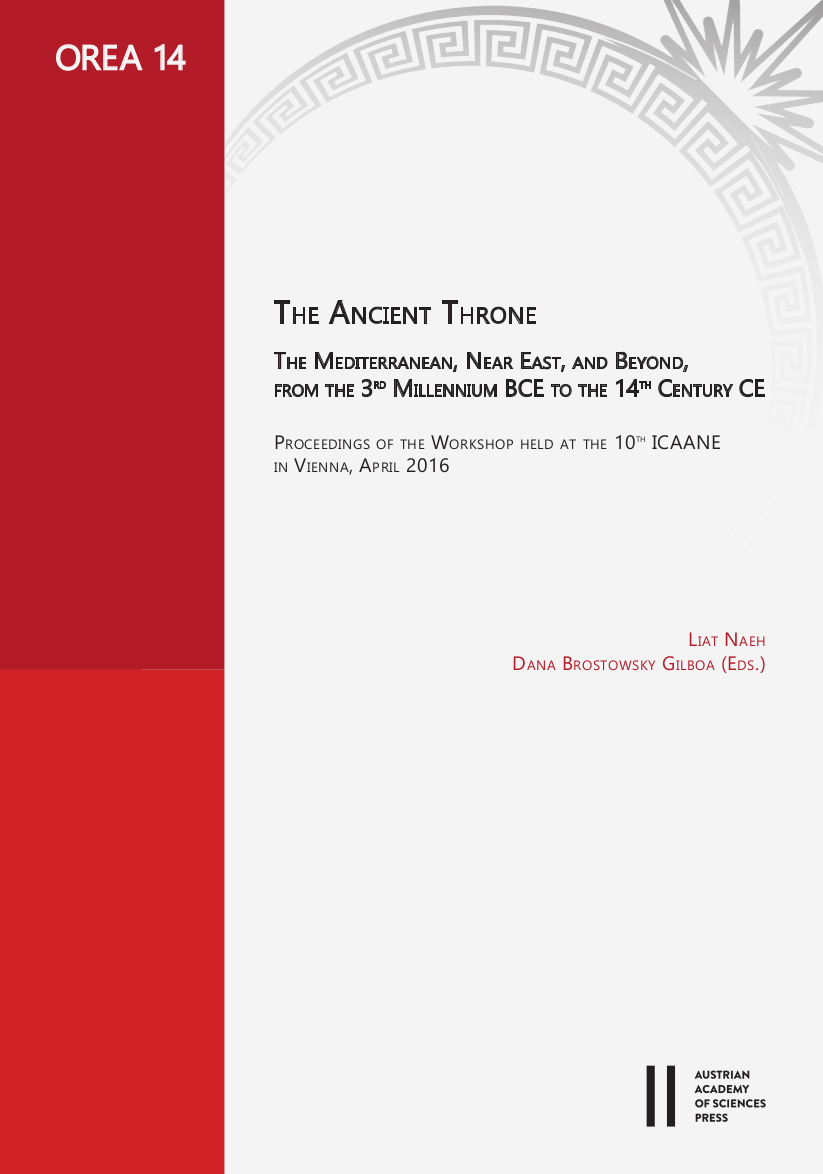
Proceedings of the Workshop held at the 10th ICAANE in Vienna, April 2016 International Series OREA 14. Vienna: Austrian Academy of Sciences Press
The volume features studies focusing on specific thrones known from historical texts, artistic depictions, or excavations, or that offer an overview of the role of thrones from as early as ancient Mesopotamia in the 3rd millennium BCE to as late as Iran and China in the 14th century CE. Its diverse articles all present thrones as a meaningful category of material culture, one that may inspire both inter-cultural and intra-cultural insights on how types of chairs may embody or induce notions of kingship and a range of concepts pertaining to the religious, ideological, and social spheres.
Table of Contents
Preface by the Series Editor
Liat Naeh – Dana Brostowsky Gilboa: Preface
Liat Naeh: In the Presence of the Ancient Throne: An Introduction
Claudia E. Suter: The Play with Throne Designs in Third Millennium BCE Mesopotamia
Caroline J. Tully – Sam Crooks: Enthroned Upon Mountains: Constructions of Power in the Aegean Bronze Age
Christina Ruth Johnson: To Sit in Splendour: The Ivory Throne as an Agent of Identity in Tomb 79 from Salamis, Cyprus
Yael Young: Throne Among the Gods: A Short Study of the Throne in Archaic Greek Iconography
Aaron Koller: Thrones and Crowns: On the Regalia of the West Semitic Monarchy
Elizabeth Simpson: The Throne of King Midas
Niccolò Manassero: The Ivory Thrones from Parthian Nisa: Furniture Design between Philhellenism and Iranian Revival
Sheila Blair: Women Enthroned: From Mongol to Muslim
Allegra Iafrate: Solomon as Kosmokratōr and the Fashioning of his Mechanical Throne from a Comparative Perspective
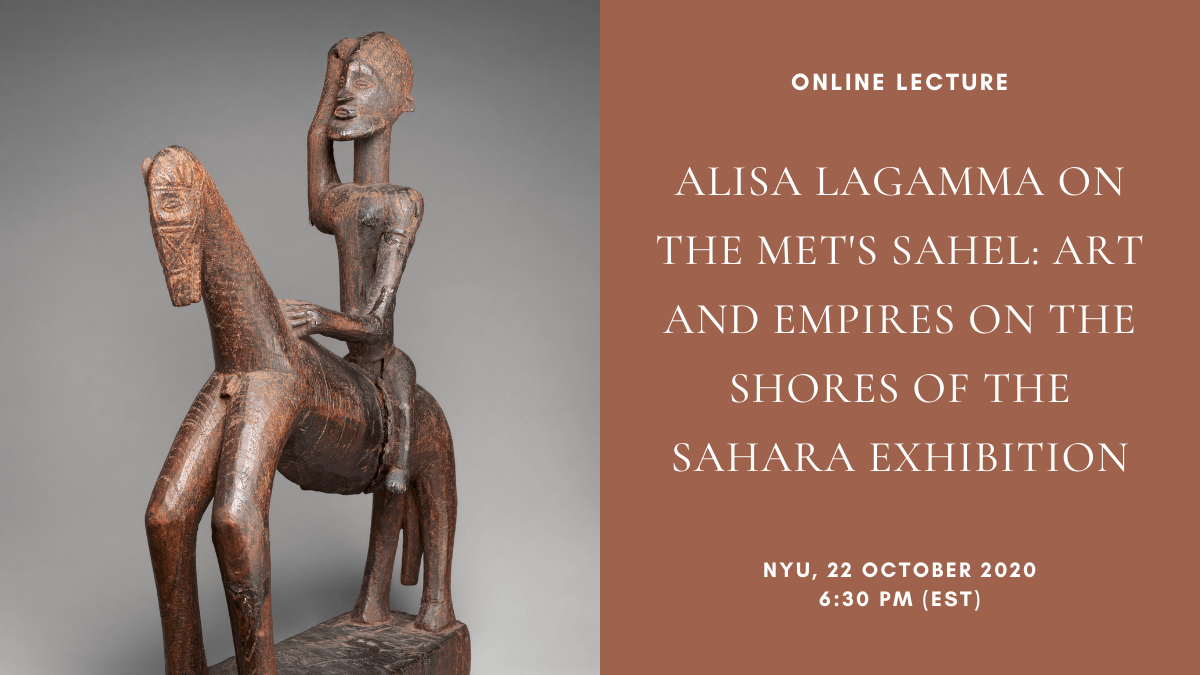
Alisa LaGamma (Ceil and Michael E. Pulitzer Curator in Charge of the Department of the Arts of Africa, Oceania, and the Americas), will be speaking on her Sahel: Art and Empires on the Shores of the Sahara exhibition, now reopened at the Metropolitan Museum of Art.
This NYU lecture will take place on zoom at 6:30pm (EST).
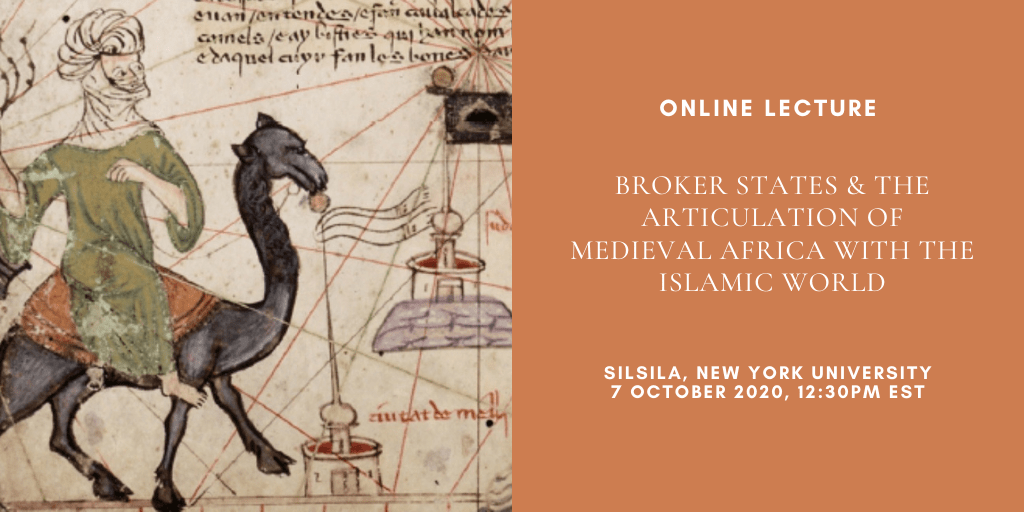
Presented by Silsila at New York University, tune in Wednesday, October 7th for a lecture by François-Xavier Fauvelle (Collège de France). “Broker States & the Articulation of Medieval Africa with the Islamic World” will be the second lecture in Silsila’s Fall 2020 lectures series, Islam in Africa: Material Histories. Registration is required. Please click here to register.
The interconnection between several regions of Sub-Saharan Africa with the rest of the medieval oecumene is now a well-established fact. However, the multiple forms of these interconnections remain to be carefully studied. Based on his own experience of discovering several Ethiopian Muslim cities from the Middle Ages, including the capital of the sultanate of Ifât, as well as comparisons with medieval Northwest and East Africa, Fauvelle observes that many African polities of the time had their capital on ecological thresholds. Hence it is suggested that such counter-intuitive environments may explain both how these “broker states” functioned as commercial interfaces with the Islamicate world and why many once-famous sites still remain elusive to the researchers.
François-Xavier Fauvelle, is an Africanist historian and archaeologist, and Professor at the Collège de France. He was the coordinator of several historical and archaeological research programs in Ethiopia, and for the last ten years has been leading the French-Moroccan program of excavations at Sijilmâsa, an Islamic medieval city in Morocco. He is the author of around 150 academic articles, and the author or editor of around 20 books, including The Golden Rhinoceros: Histories of the African Middle Ages (Princeton University Press, 2018).
Silsila: Center for Material Histories is an NYU center dedicated to material histories of the Islamicate world. Each semester we hold a thematic series of lectures and workshops, which are open to the public.
Online conversation via Zoom (link to be sent out 1 day prior)
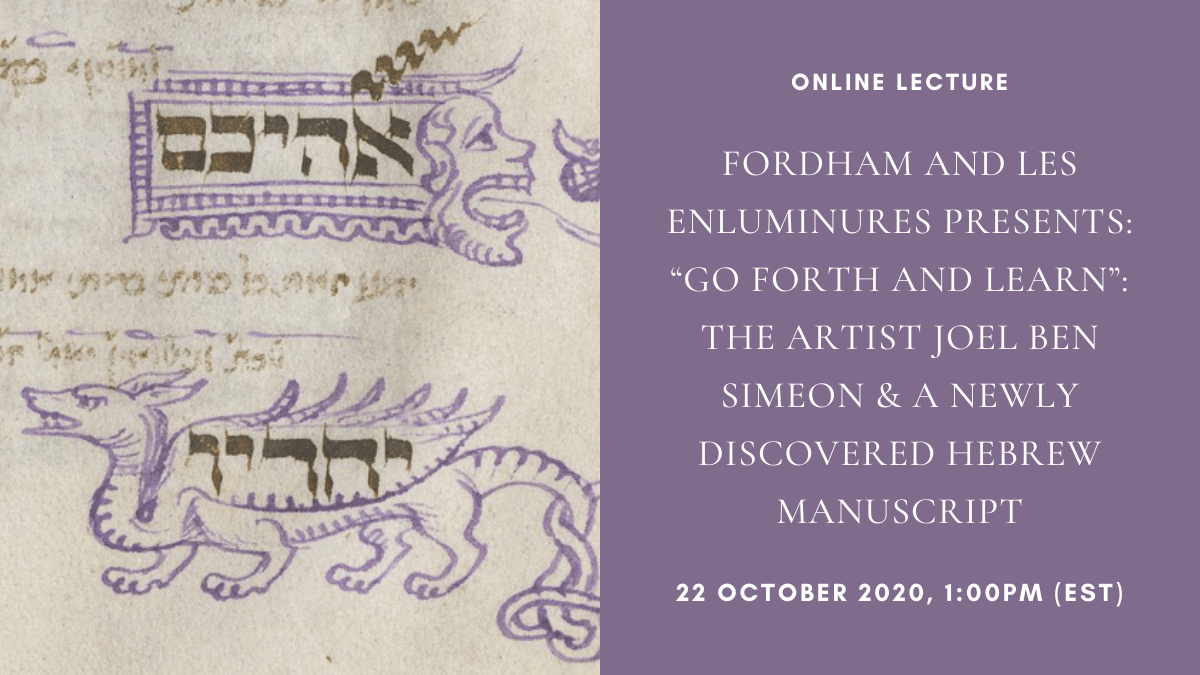
The discovery of a new manuscript with more than 300 drawings by the hand of Joel ben Simeon, a fifteenth-century Jewish scribe and illuminator, prompts a reassessment of his career at a time of great religious uncertainty, economic opportunity, and cultural exchange. Born in Germany, where he trained as an artist and scribe and from where he was probably expelled, Joel ben Simeon spent most of his itinerant career in the book arts in northern Italy. We perhaps know more about him – from his colophons and his signed works – than any other illuminator-scribe, Jewish or Christian, in the fifteenth century. He depicts himself as a traveler in one manuscript next to the words “Go forth and learn,” which we hope to accomplish in this Webinar.
Speakers:
Keynote: Professor Katrin Kogman-Appel, University of Muenster, Institut fur Judische Studien, previously taught at Ben-Gurion University of the Negev (1996-2015). Professor Kogman-Appel has published extensively on medieval Jewish art and book culture and is particularly interested in Hebrew manuscript illumination and its cultural and social contexts.
Professor Lucia Raspe, Goethe Universitaet, Frankfurt am Main. Professor Raspe has published widely on late medieval and early modern Jewish communities, including the migration of German Jews to Italy, on manuscript and print culture.
This event is a joint program between Fordham Jewish Studies and Les Enluminures, organized by Sandra Hindman, Professor Emerita of Art History, Northwestern University, and President and Founder, Les Enluminures and Sharon Liberman Mintz, Curator of Jewish Art, The Library of the Jewish Theological Seminary, and Senior Consultant, Judaica, Sotheby’s.
Raphael’s work in painting, drawing, architecture and design had a profound effect on the arts, influencing not only his own time but also ours. Raphael 500 celebrates the painter’s life and marks the 500th year of his death with a programme that considers elements of his approaches to the invention and production of works of art and looks at the way the study of Raphael widens our understanding of other Italian Renaissance artists.
Focussing on key paintings of the Roman period and the designs for the Sistine tapestries, individual speakers will consider the artist’s understanding of theory, his use of networks, and his development of Renaissance workshop technique. A final roundtable discussion will consider the fruits of the intense attention given to Raphael in the last few years to highlight what we have learned and to explore how new understandings of Raphael affect our comprehension of wider issues in the study of fifteenth- and sixteenth-century Italian art.
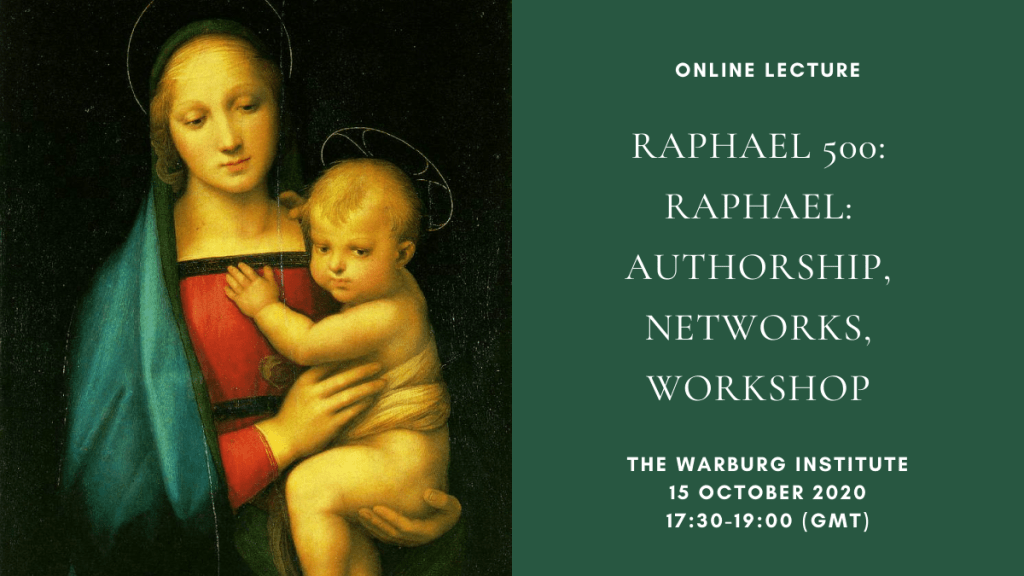
Raphael: Authorship, Networks, Workshop
15 October 2020, 5.30-7.00pm (GMT) | Presented by Professor Ulrich Pfisterer (Director, Zentralinstitut)
Professor Pfisterer will focus on two related works by Raphael to address key questions concerning the relevance of authorship for the painter and his workshop, his approach to theoretical thinking, and the composition and interaction of his social network. This event is also part of the Director’s Seminar series, which brings leading scholars and writers to the Institute to share new work and fresh perspectives on key issues in their fields.
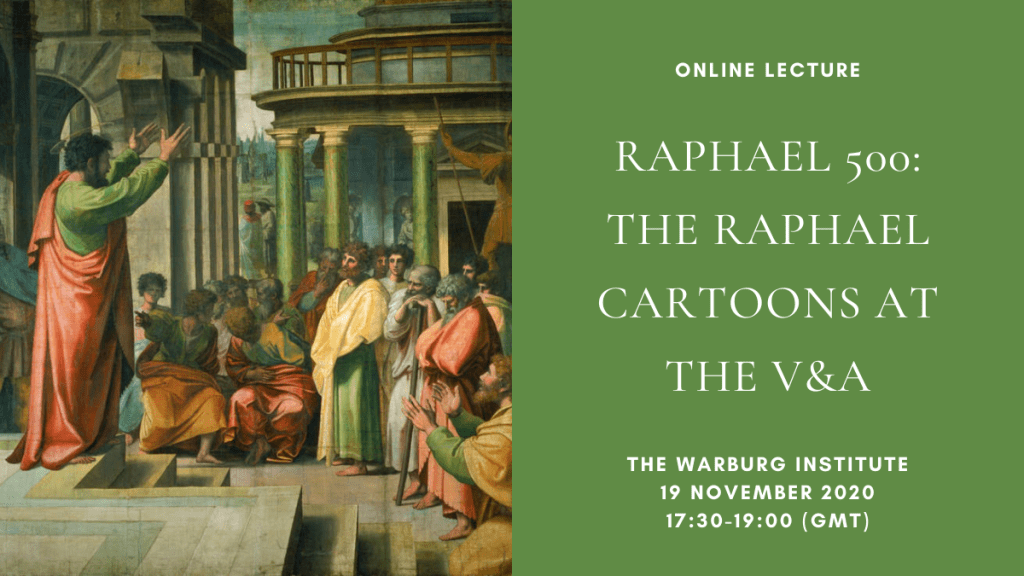
19 November 2020, 5.30-7.00pm | Presented by Dr Ana Debenedetti (Victoria and Albert Museum)
Ana Debenedetti talks to Warburg Deputy Director Michelle O’Malley about the V&A’s new installation of the celebrated Raphael Cartoons in the Museum’s Raphael Court. This event is also part of the Curatorial Conversations series, which brings to the Warburg curators of world-leading museums and galleries to discuss their work.
8 December 2020, 5.30-7.00pm | Panel: Tom Henry (University of Kent), Claudia La Malfa (Loyola University, Chicago and University of Kent in Rome), Adam Lowe (Factum Arte), Arnold Nesselrath (Humboldt University, Berlin), Catherine Whistler (Ashmolean Museum, Oxford).
In the last few years, a plethora of international events, books, articles and exhibitions have focused on Raphael to shed new light on his processes of production, his operation of networks, his engagement with the environment, and much more. Please join us and our panel of distinguished Raphael specialists to explore the new perspectives on Raphael that arise from the long year marking his death and celebrating his life.
The annual Oxford Art Journal Essay Prize for Early Career Researchers 2020 is now open for submissions.
The Essay Prize for Early Career Researchers aims to encourage submissions from British and international doctoral students, as well as early career researchers who are within five years of gaining their PhD.
The essay will be on any topic relevant to art history and should be between 6,000 and 10,000 words (normally including footnotes) in length. The editors will review all submissions to select the Prize winner and will work with the successful candidate to advise on revision of the manuscript for publication.
The winner will receive:
– Publication of the winning essay in Oxford Art Journal – £500 worth of Oxford University Press books – A year’s free subscription to Oxford Art Journal
Other entries of sufficient quality may be invited to publish their submission in Oxford Art Journal.
How to enter:
Entries should be submitted via our online submission system. New authors should create their own account when they first log on. Authors who already have an account should log in using their previous account ID and password to submit a new manuscript.
Competition rules:
Essays will be 6,000-10,000 words (normally including footnotes) in length.
Papers can be submitted at any point before the closing date, which will be 1st December 2020.
The winner of the Prize will be required to verify their status as a current doctoral student or as an early career researcher who gained their PhD no more than five years previously. The journal will make due allowance for entrants who have had career breaks.
Entries submitted to the Oxford Art Journal Early Career Essay Prize must not be under consideration for publication elsewhere.
The decision of the judges will be final, and no correspondence will be entered into by the editors.
In the unlikely event that, in the editors’ opinion, the material submitted is not of a suitable standard, no Prize will be awarded.




 Medieval Art Research