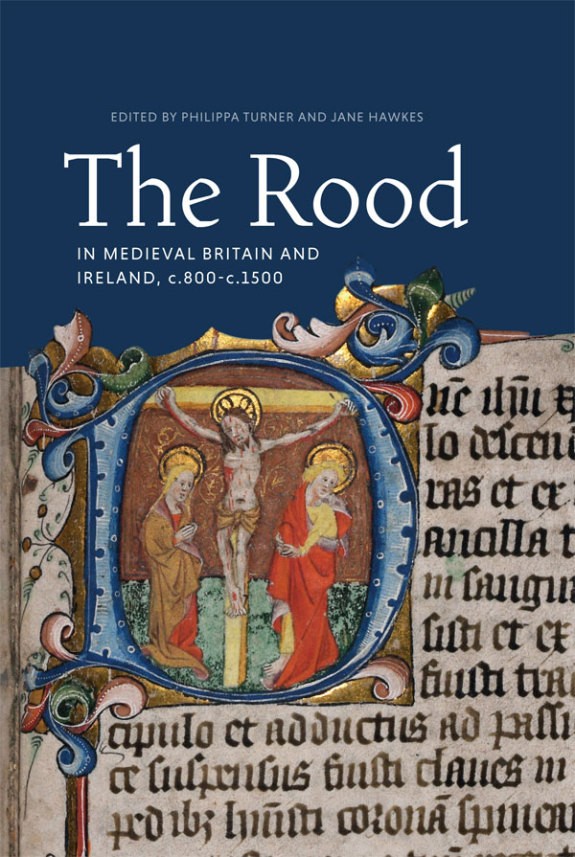
New Publication: ‘The Rood in Medieval Britain & Ireland, c.800-c.1500’, Edited by Philippa Turner & Jane Hawkes

New readings demonstrate the centrality of the rood to the visual, material and devotional cultures of the Middle Ages, its richness and complexity.

The rood was central to medieval Christianity and its visual culture: Christ’s death on the cross was understood as the means by which humankind was able to gain salvation, and depictions of the cross, and Christ’s death upon it, were ubiquitous.

This volume brings together contributions offering a new perspective on the medieval rood – understood in its widest sense, as any kind of cross – within the context of Britain and Ireland, over a wide period of time which saw significant political and cultural change. In doing so, it crosses geographical, chronological, material, and functional boundaries which have traditionally characterised many previous discussions of the medieval rood. Acknowledging and exploring the capacity of the rood to be both universal and specific to particular locations and audiences, these contributions also tease out the ways in which roods related to one another, as well as how they related to their physical and cultural surroundings, often functioning in dialogue with other images and the wider devotional topography – both material and mental – in which they were set.

The chapters consider roods in a variety of media and contexts: the monumental stone crosses of early medieval England, twelfth-century Ireland, and, spreading further afield, late medieval Galicia; the three-dimensional monumental wooden roods in English monasteries, Irish friaries, and East Anglian parish churches; roods that fit in the palm of a hand, encased in precious metals, those that were painted on walls, drawn on the pages of manuscripts, and those that appeared in visions, dreams, and gesture.

Editors:

PHILIPPA TURNER gained her PhD in History of Art at the University of York; JANE HAWKES is Professor of Art History at the University of York.

Contributors: Sarah Cassell, Sara Carreño, Jane Hawkes, Malgorzata Krasnodebska-D’Aughton, John Munns, Kate Thomas, Philippa Turner, Maggie Williams, Lucy J. Wrapson.

Table of Contents:

  • Introduction: Rethinking the Rood – Philippa Turner
  • Approaching the Cross: The Sculpted High Crosses of Anglo-Saxon England – Jane Hawkes
  • The Mark of Christ in Wood, Grass and Field: Open-Air Roods in Old English Medical Remedies – Kate Thomas
  • Twelfth-Century English Rood Visions: Some Iconographic Notes – John Munns
  • Crosses, Croziers, and the Crucifixion: Twelfth-Century Crosses in Ireland – Maggie Williams
  • From Religious Artefacts to Symbols of Identity: The Role of Stone Crosses in Galician National Discourse – Sara Carreño
  • The Rood in the Late Medieval English Cathedral: The Black Rood of Scotland Reassessed – Philippa Turner
  • The Cross of Death and the Tree of Life: Franciscan Ideologies in Late Medieval Ireland – Malgorzata Krasnodebska-D’Aughton
  • Heralding the Rood: Colour Convention and Material Hierarchies on Late Medieval English – Lucy Wrapson
  • Reframing the Rood: Fifteenth-Century Angel Roofs and the Rood in East Anglia – Sarah Cassell

Order your copy here.

  • November 2020
  • 14 colour, 48 black and white illustrations
  • 247 pages
  • 24×17 cm

Online Workshop: ‘Meet the Manuscripts: The Psalms in the Middle Ages’ with the Bodleian Library, 3 December 2020, 5.30–6.15pm (GMT)

Registration closes on 1 December – book your tickets now.

This workshop showcases medieval manuscripts of the Book of Psalms.

Join Matthew Holford, Tolkien Curator of Medieval Manuscripts at the Bodleian Library, and Lesley Smith, Professor of Intellectual History at the University of Oxford, to learn how manuscripts can help us understand the central place of the Psalms in medieval culture.

Find out more here.

Call for Papers: Cistercian Worlds, Centre for for Medieval Studies, University of York (July 1-2 2021), deadline 31 January 2021

Scholars have explained the success of the Cistercians materially through the perspectives of archaeology, architecture and art, and historians, theologians and literary scholars have analysed the achievements of Cistercian thought and spiritual practices. More recently, investigations have broadened the range of sources used (e.g. works of medicine and natural science, exempla collections), in addition to analysing this evidence using novel, paradigm-shifting approaches (history of emotions, neuroscience, queer theory).

‘CISTERCIAN WORLDS’, a two-day conference scheduled for early July 2021, aims to offer a forum for researchers to build upon existing modes of scholarship and bring together discussions currently occurring across disciplines. How did an initial shared world-view create many different Cistercian ‘worlds’? What were the boundaries – real or imagined – of these spheres? Who composed them? In which ways did they extend, shrink, overlap and evolve? What approaches can be used to study them?

As such, we are seeking proposals for papers that distil the latest interdisciplinary research on the medieval Cistercians (writ large) and place the study of the Order into conversation with currents and themes outside the cloister walls. Graduate students and early-career researchers are particularly encouraged to apply. Papers should look to showcase the evolving nature of Cistercian scholarship and the new directions that are now being taken.

The organisers are looking to publish the conference proceedings as a special edition. While this is not a guarantee of publication, successful participants should be aware that their research, pending the usual process of peer review, may be accepted.

The organisers are excited to announce our two keynote speakers: Professors Emilia Jamroziak and Constance Mews. The conference will also conclude with a roundtable discussion, with participants including Professors Emilia Jamroziak, Janet Burton, and Martha Newman.

How to Apply

Please send an abstract (no longer than 250 words) to Emmie Rose Price-Goodfellow (erpg500@york.ac.uk) with details of your institutional affiliation (if any) and career stage. Deadline 31st January 2021.

Workshop: Virtual/Material: Color/Pigment, Penn State University (9–13 August 2021), Deadline 14 December 2020

The Department of Art History at Penn State University is seeking applications from doctoral students in art history and related disciplines for the week-long workshop, Virtual/Material: Color/Pigment.

Funded by the Samuel H. Kress Foundation, this workshop will offer an integrated curriculum of Technical and Digital Art History via the special case history of color. Through a combination of seminars, demonstrations, and hands-on labs led by a distinguished faculty of scientists and historians, participants can expect to leave the workshop better equipped to understand historical colorants and their production as well as the ways in which digital cultures can distort or ameliorate historians’ approach to such colorants.

The current requirement that art historians rely more or less exclusively on virtual platforms and digital resources for their research and teaching during the COVID-19 pandemic has made plainer the need for scholars to understand the relationship between works of art as material objects and as data. The evidentiary status of digital representations of works of art is a question that has become as pressing for students and scholars of art history as it has long been for conservators and conservation scientists, imaging professionals, data scientists, and information specialists. Processes of translation from the material into data and vice-versa are poorly understood by most art historians, potentially jeopardizing the validity of research questions and findings. This predicament is especially conspicuous in the realm of color —a property of artworks that is often misunderstood or marginalized.

Led by Sarah K. Rich, the workshop’s distinguished faculty includes Susan Farnand (Rochester Institute of Technology), Carolyn L. Kane (Ryerson University), Hannelore Roemich (Institute of Fine Arts), Michael Hickner (Penn State), John Russell (Penn State), Pamela H. Smith (Columbia University), and Tracy Stuber (Getty Research Institute).

The workshop will take place August 9 – 13, 2021.

Plans are to conduct the workshop in person; however, should conditions related to the COVID-19 pandemic necessitate the shift to a virtual format, all sessions will be live-streamed and necessary instructional materials will be shipped in advance to participants. The decision about whether the workshop will be held in-person at Penn State or conducted virtually via Zoom or another digital platform will be made at the time applicants are notified of admission.

DEADLINE and SUBMISSION
Applications for Virtual/Material : Color/Pigment are due via email to color@psu.edu by 11:59
pm EST on Monday, December 14, 2020. Award notifications will be sent in late February.

ELIGIBILITY
• Applicants should be PhD students in art history or a related discipline (e.g. archaeology,
architectural history, visual studies).
• International students and students pursuing their PhD at institutions outside the U.S.
are eligible and encouraged to apply.

Interested students who do not anticipate being able to travel to Penn State to
participate are encouraged to apply given the possibility that the workshop will be
conducted virtually.

EXPENSES INCLUDED
Roundtrip travel, shared lodging, shared meals, books, and all lab materials.

APPLICATION MATERIALS

  1. Letter of Interest (2-3 pages), which should include an explanation of the value of this
    workshop for your current research
  2. Dissertation prospectus or other relevant writing sample (20 pages maximum)
  3. CV
  4. One recommendation letter

Find out more here.

Online Lecture: ‘Searching for Identity: Byzantine Southern Italy’ with Paul Arthur, British School at Rome, 2 December 2020, 6:00–7:30 pm (CET)

This event will take place via Zoom and requires advance registration. Please click here to reserve your place.

There is abundant literature on the Byzantine reconquest of Italy in the 6th century and on the transition from late antiquity to the Middle Ages. Paradoxically, despite various historical contributions on the long period of Byzantine domination in the South, from the 6th to the 11th century, there is a lack of archaeological studies that propose an integrated overview. This is unfortunate, as the centuries were formative in the definition of southern Italy, helping to make it what it is today. This can be seen in many aspects of the country, including settlement patterns and communication, food and language, culture and traditions and, apparently, genetic makeup and mentality.

With these problems in mind, I applied for a major funding to the Italian Ministry of Education, which was awarded for the project entitled “Byzantine Heritage of Southern Italy: settlement, economy and resilience in changing territorial landscape contexts”.

The aim of the project is therefore to provide a panorama of the Byzantine heritage and its role in the formation of society across southern Italy, proposing to make different sources (archaeological, documentary, climatic and environmental, anthropological, genetic) interact in a systemic way through a database linked to a GIS platform. Even if we may speak of this large territory as a political significant entity in Byzantine times, it was constantly changing in size and boundaries, and in social composition through politics and mobility. Thus, it was also somewhat of a palimpsest. The examination of the ‘Byzantine Heritage of Southern Italy’ is thus an examination of differences and contrasts, in which we will explore and characterize unity in disunity.

The ultimate aim of the project is thus to rewrite part of the history of Italy from a new point of view, enhancing the vision of the South in its role as a geographical centre of the Mediterranean and key territory to the survival of the Byzantine Empire through a global analysis of interconnecting data.

Furthermore, the project intends to play an active role in the communication and dissemination of research results to the general public in line with modern trends of ‘public archaeology’. Therefore, the processing of information, in addition to normal scientific outlets, involves public presentation and the involvement of schools, in order for it to play an active role in disseminating knowledge so as to impact on local understanding and international tourism, thus reinforcing unity and identity.

Paul Arthur holds the Chair of Medieval Archaeology at University of Lecce (now Salento). 

Register here.

Online Lecture: ‘”The face of one making for Jerusalem”: The Angel Choir of Lincoln Cathedral & Joy’ with Katherine Turley, BAA Lecture, 2 December 2020, 5:00 PM (GMT)

The British Archaeological Association’s December Lecture will be by Katherine Turley (Birkbeck College) who will be presenting ‘”The face of one making for Jerusalem”: The Angel Choir of Lincoln Cathedral & Joy’.

The lecture will take place on Zoom on 2 December 2020 at 5pm (GMT).

Register here.

Medieval Views Virtual Arts Festival Crowdfund Campaign

In these trying times Medieval Studies needs more opportunities to come together to positively build and reinforce our community. Before the COVID-19 pandemic this was largely handled by universities, research groups and smaller location based gatherings. It wasn’t a perfect system as many were left out, their voices diminished or unable to contribute to any of the important conversations that results in modern research advances. More and more medieval focused graduate students enter a job market that holds no work or hope for them.

Medieval Views: A Virtual Arts Festival seeks to address that need while simultaneously being more inclusive to the public. Let us try a creative solution. Let us, as scholars and researchers, take it upon ourselves to hold a virtual gathering. In short let’s be inclusive, show some kindness and have an art party for all to enjoy if they so choose.

This Virtual Festival is designed to provide creative public engagement for all ages as the event provides a common positive memory with which to build and maintain relationships. There will be virtual events such as coloring, group art creation and an online historical fashion show. The Festival will also consist of virtual gallery displays of medieval themed art created and submitted by people of all ages. I would like to include the products of classroom projects as well, with permission from the creators.

Also on display will be the products of medievalists as artistic creators. Many have taught themselves skills of the medieval past and the digital present with great beauty as a result. Sharing that with one another forms another means of reinforcing our community and allowing it to grow. Since it so far has not been a need addressed let’s change that. There are few enough positive topics in the world. Together let’s create more.

Find out more information here.

How

In order to achieve the outlined description I want to create a dedicated website to host all of the art submissions and gallery displays, the links for videos, podcasts and talks for those who are okay with them being posted. If I’m able to arrange keynote speakers for the Festival period itself their contribution will also be hosted there. A full list of all Backers will be posted to this website. This would have member-only areas so that participants can be safer in this process.

To make this work a social media platform dedicated to the Festival itself will be set up. This will include Instagram, Facebook, Twitter, and Youtube. This will better support live question and answer sessions. A direct email for the festival will be set up for general inquiries and questions for the live question and answer sessions. This will help to involve the public from the beginning of the project.

If this Kickstarter campaign is successful I would like to give all of those who present a paper, including the keynotes, token compensation for their time. I’d also like to do the same for the winners of the popular vote for the art submissions themselves. Any volunteers would also be eligible for this. The best way to do that in this case is to give gift certificates to the recipients for use at a local indie art supply or bookstore to help these venues better survive the economic effects of COVID. If the campaign is more successful than this need I’d like to be able to offer small carer subsidies to help cover the cost of the time necessary for people to take part in Medieval Views as well.

New North of Byzantium Digital Project: Mapping Eastern Europe

North of Byzantium has launched a new open access digital project – Mapping Eastern Europe intended to promote study, research, and teaching about the history, art, and culture of Eastern Europe between the thirteenth and seventeenth centuries among students, teachers, scholars, and the wider public.

https://mappingeasterneurope.princeton.edu/

Mapping Eastern Europe gathers a multitude of specialists – early career and senior scholars who have either already published or are currently researching new topics – to supply original online content in English in the form of historical overview, art historical case studies, short notices about ongoing projects, and reviews of recent books and exhibitions. 

This platform aims to stimulate new research and outreach focused on the networked regions of the Balkan Peninsula, the Carpathian Mountains, and further north into early modern Russia, which developed at the crossroads of the Latin, Greek, Slavic, and Islamic traditions during the late Middle Ages and early modern periods. 

Mapping Eastern Europe is made possible through generous support from the “Rapid Response Magic Project of the Princeton University Humanities Council”.

If you have suggestions for future contributions you or other colleagues might be interested in submitting, please get in touch here: https://mappingeasterneurope.princeton.edu/help.html

Call for Papers: Saint Angelus, Carmelite: between history, hagiography & iconography on the Eighth Centenary of his martyrdom, deadline mid-December 2020

Licata (Sicily, Italy), 15th May 2021

The Eighth Centenary of the martyrdom of Saint Angelus (1220-2020) who is, together with Saint Albert of Trapani (†1307), one of the earliest saints of the Carmelite Order represents an important occasion to rediscover and revalue this figure. For this reason, the Postulator General and the General Archive of the Carmelite Order are organising an academic conference, for the purpose of reflecting on and deepening the study of Saint Angelus from historical, hagiographic and iconographic angles. 

Saint Angelus is counted as pater Ordinis of the Carmelite Order and his role was symbolically and iconographically central in the late medieval period, where he is represented in hagiographical and spiritual works. The conference will bring attention to a figure of great relevance who has not been the subject of focussed or systematic academic study.

Proposals for contributions are invited on topics including, but not limited to the following: 

• The history and reception of Saint Angelus in the Carmelite Order over the centuries. 

• Aspects of iconography and artistic history. 

• Liturgical aspects. 

• Hagiographical texts, literary traditions and references, including in non-Carmelite texts. 

• The late-medieval history of the Carmelite Order in Sicily, with particular reference to the historical context of Saint Angelus. 

• Connections between Saint Angelus, and Saints Francis and Dominic, founders of the other mendicant orders. 

Proposals of up to 300 words are invited, which should be sent, together with your biography and academic bibliography to archivio@ocarm.org before mid-December 2020. Presentations of up to 25 minutes may be given in Italian, English, Spanish or French, and will be subsequently collected in a volume published by Edizioni Carmelitane. 

Academic advisors: 

Fr. Mario Alfarano O.Carm. (General Archivist), 

Dr. Marco Papasidero

Online Lecture: Raphael 500: New Perspectives on Raphael, The Warburg Institute, 8 December, 17:30 – 19:00 (GMT)

Panel: Tom Henry (University of Kent), Claudia La Malfa (Loyola University, Chicago and University of Kent in Rome), Adam Lowe (Factum Arte), Arnold Nesselrath (Humboldt University, Berlin), Catherine Whistler (Ashmolean Museum, Oxford)

In the last few years, a plethora of international events, books, articles and exhibitions have focused on Raphael to shed new light on his processes of production, his operation of networks, his engagement with the environment, and much more. What are the most significant things we have learned from such intense looking at the work of this artist? Have Raphael studies also enlightened our understanding of his peers and their practices? Do we appreciate Raphael’s period in a new way? Please join us and our panel of distinguished Raphael specialists to explore the new perspectives on Raphael that arise from the long year marking his death and celebrating his life.

Raphael’s work in painting, drawing, architecture and design had a profound effect on the arts, influencing not only his own time but also ours. Raphael 500 celebrates the painter’s life and marks the year of his death with a programme that considers elements of his approaches to the invention and production of works of art and looks at the way the study of Raphael widens our understanding of other Italian Renaissance artists. 

Supported by the Italian Cultural Institute in London 

FREE VIA ZOOM. PLEASE BOOK IN ADVANCE – BOOK HERE.

More information can be found here.