Online Conference: Travelling Objects, Travelling People: Art & Artists of Late-Medieval & Renaissance Iberia & Beyond, c. 1400–1550, 10-11 December 2020

This is a live online event. Please register for more details. The platform and log in details will be sent to attendees at least 48 hours before the event. Please note that registration closes 30 minutes before the event start time.  If you have not received the log in details or have any further queries, please contact researchforum@courtauld.ac.uk

Travelling Objects, Travelling People: Art and Artists of Late-Medieval and Renaissance Iberia and Beyond, c. 1400–1550

Travelling Objects, Travelling People aims to nuance our understanding of the exchanges and influences that shaped the artistic landscape of Medieval and Renaissance Iberia. Traditional narratives hold that late fifteenth-century Iberian art and architecture were transformed by the arrival of artists, objects and ideas from France, the Low Countries, and eventually Renaissance Italy, while 1492 marked a chronological rupture and the beginning of global encounters. Challenging these perceptions, this conference revisits the dynamics of artistic communication in late medieval Iberia, placing the peninsula in a global network, from Flanders to Florence, from Madeira to Santo Domingo. Bringing together contributions from international scholars working on Spain, Portugal and a range of related geographies, this event seeks to address the impact of ‘itinerant’ artworks, artists and ideas, and to investigate moments of encounter, conflict, and non-linear transfers of materials, techniques and iconographies.  

Conference Programme:  

Day 1 – Thursday 10th December, 1pm (GMT)

Opening remarks  

Panel 1: Nexus Objects 

  • Bart Fransen (KIK/IRPA), Two Fragments from the Predella of Juan de Flandes’ Altarpiece for the University Chapel in Salamanca
  • Alexander Röstel (Bibliotheca Hertziana, Rome) and Caterina Fioravanti (Independent Scholar), Lorenzo Ghiberti, Rodrigo Borgia and the Cradle of the Iberian Renaissance: The Retrochoir and Chancel of Valencia Cathedral in the Fifteenth Century  
  • Francisco Montes (Universidad de Sevilla), The Jamuga of Cortés. An Islamic Throne Chair for the Conquest of Mexico

Break  


Panel 2: Transmission and Image Chains 

  • Vanessa Antunes (Universidade de Lisboa), Travelling from Flanders to Portugal Via Techniques and Materials: the Portuguese Copy of the Painter Jorge Afonso to Quentin Metsys’s Painting The Angel Appearing to Saints Clara, Colette and Agnes  
  • Maria Sanz Julian (Universidad de Zaragoza), Original, Copies and Iconographic Traces in Illustrated Books at the End of the Middle Ages 
    Nelleke de Vries (Ludwig-Maximilians-Universität München), Portable Passion. The Dissemination of Martin Schongauer’s Artistic Inventions in Spain 

Break  

Keynote: Fernando António Baptista Pereira (Universidade de Lisboa), Importing Painting, Sculpture and other artistic objects from the Low Countries to Madeira during the Cycle of the ‘White Gold’ 

Day 2 – Friday 11th December, 1pm (GMT)

Welcome  

Panel 3: Not All Those Who Wander Are Lost 

  • Piers Baker-Bates (The Open University), ‘In the Spanish Fashion’: Iberian Artists Travelling in Italy 1450–1550 
  • Eduardo Lamas Delgado (KIK/IRPA), Looking for Italy in Castile: the Iberian Career of Willem van Santvoort, a Netherlandish Assistant of Alonso Berruguete 
  • Marco Silvestri (Universität Paderborn), Family Ties and Diffusion of Architectural Knowledge: Migration, Networks and the Establishment of Two Sixteenth-Century Spanish Stonemasons in Latin America  

Break 

Panel 4: Stones Don’t Move  

  • Joana Balsa (Universidade de Lisboa), Ricardo Nunes (Universidade de Lisboa), All Saints’ Hospital in Lisbon: Artistic Exchanges in the Context of Hospital Architecture in the Renaissance 
  • Elena Paulino (Universidad Complutense de Madrid), Negotiating the American space: Travelling Artists and Local Elites in the Architectural Configuration of Santo Domingo at the End of the Fifteenth Century 
  • Kelley Helmstutler di Dio (University of Vermont), Labor, Transportation and Technological Systems of Sculpture Exchange in Early Modern Europe 

Break 

Panel 5: Reconsidering Influence  

  • Encarna Montero (Universitat de València):  Recomposing and Reframing the Northern Influence in Aragonese Painting ca. 1400: the Hazardous Case of Marçal de Sas
  • Eva March (Universitat Pompeu Fabra), The Itinerancy of Jan van Eyck’s Models: (Re) Creating Images of Power in Late Medieval Catalonia 
  • Maria Vittoria Spissu (Università di Bologna), A Missing Ring in the Iberian Marian Atlas: Transferring the Cult of the Seven Sorrows from the Habsburg Netherlands to Mediterranean Kingdoms in the Early Modern Age 

Closing remarks 

This event is supported by the Society for Renaissance Studies.

Find out more here.

Organised by: Costanza Beltrami (University of Oxford) and Sylvia Alvares-Correa (University of Oxford)

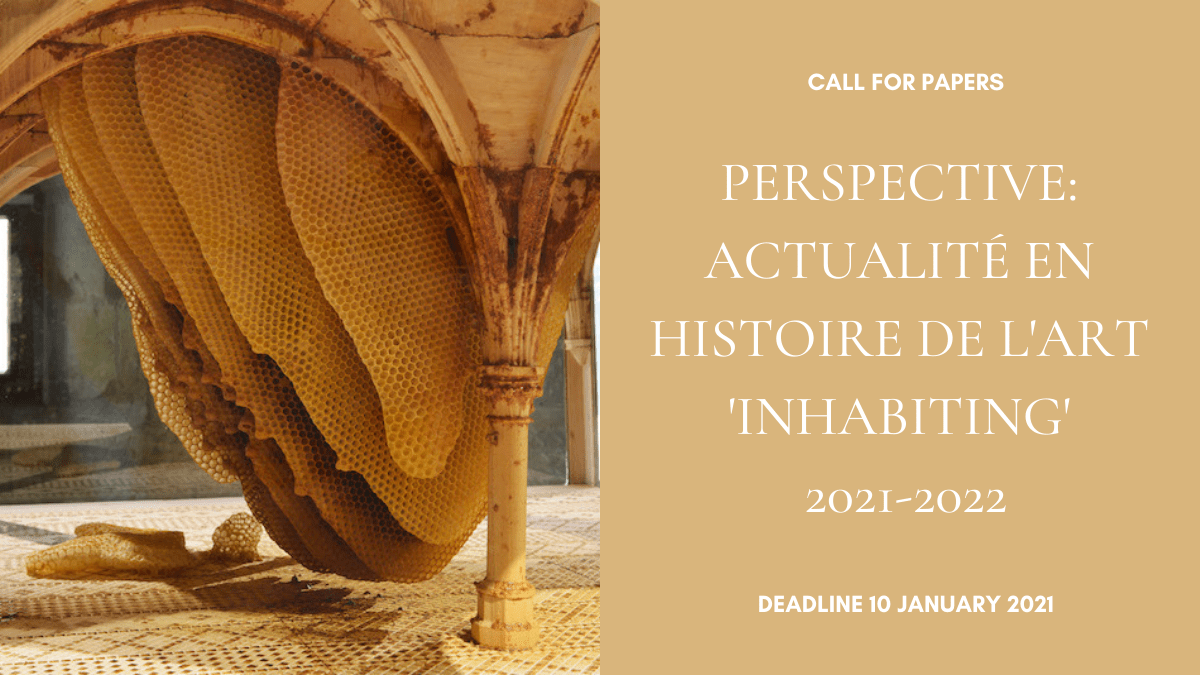
CFP: Perspective: actualité en histoire de l’art, ‘Inhabiting’ 2021-2022 (deadline 10 January 2021)

For its coming issue, the INHA journal Perspective asks the question of what it means to inhabit: to inhabit a space, a territory, one’s home or one’s body, whether we are dealing with far away frontiers, or the outlines of intimacy; to inhabit one’s life, one’s society/ies, one’s epoch, in what inhabiting means in terms of being present in one’s world, for and with one another, to face circumstances as they stand. In a time when, across the globe, entire populations are confined to their homes, Perspective issues an invitation to revisit the visual and imaginary plasticity of inhabiting: “to occupy a place of settled residence or habitat,” so states the dictionary, suggesting habit, repetition, regularity; but also occupying persons, inhabiting them, animating them, moving them.

In this manner, Perspective endeavours to dedicate its coming issue to the ways in which artists, art historians, and their colleagues from various neighbouring disciplines, take on these interrogations and bring forth the multiple ways in which one can inhabit or be inhabited. This subject calls for a wide variety of approaches, both in terms of thematic and fields of study. All geographical areas, periods, and mediums are welcome.

Please send your submissions (an abstract of 2,000 to 3,000 characters, a provisional title, a short bibliography on the subject, and a biography of a few lines) to the editorial office (revue_perspective@inha.fr) before January 10, 2021.

As Perspective will manage translations, projects will be examined by the issue’s editorial board regardless of language. The authors of selected proposals will be informed of the committee’s decision in February 2021, and articles must be submitted by June 15, 2021. Submitted articles, with a final length of 25,000 or 45,000 characters depending on the project, will be definitively accepted after the anonymous peer-review process.

Recorded Conference: British Archaeological Association Postgraduate Conference 2020

We are excited to present a diverse conference which includes postgraduates and early career researchers in the fields of medieval history of art, architecture, and archaeology. The British Archaeological Association postgraduate conference offers an opportunity for research students at all levels from universities across the UK and abroad to present their research and exchange ideas.

This year the conference took place online via Zoom across two days. Whilst we would have loved to have hosted the conference in-person, the silver lining is that we were able to have scholars and academics across the world attend and present their work. So fear not if you missed out – as we recorded the conference and you can view the panels here.


Panel 1: Iconography: Transmission, Adaptation and Interpretation

Chair: Dr Emily Guerry (University of Kent)

Elena Lichmanova (School of History, National Research University Higher School of Economics, Moscow), An Alternative to the Cross Pattern in Early Christian and Early Medieval Art

Nadezhda Tochilova (Saint Petersburg Stieglitz State Academy of Art and Design), New perspectives on studying art of the Baltic region in the 10th -12th centuries: The issue of artistic interaction between Scandinavia and Ancient Rus ́

Millie Horton Insch (UCL), Skeuomorphic Exchange Between Embroideries and Wall Paintings in Eleventh and Twelfth-Century England


Panel 2: Making and Meaning of Medieval Tombs

Chair: Dr Tom Nickson (Courtauld Institute of Art)

Jack Wilcox (University of Kent), The Mystery of the Tree of Jesse Tomb Slab in Lincoln Cathedral

Richard Asquith (Royal Holloway, University of London), Epigraphy, Executors, and Encounters: contextualising the trope of the ‘bad executor’ on pre-Reformation English tombs


Panel 3: Visual Culture in English Religious Spaces

Chair: Dr Richard Plant (BAA. Hon. Publicity Officer)

Lydia McCutcheon (University of Oxford), Children and Families in the ‘Miracle Windows’ of Canterbury Cathedral

Crystal Hollis (University of Exeter), Graffiti as a Historical Resource: Parish History on Church Walls


Panel 4: Encountering Architecture and the Urban Space

Chair: John McNeill (BAA. Hon. Secretary)

Giulia Bison (University of Leicester), Metalworking and the transformation of Late Antique Rome

Marta Vizzini (Università degli Studi di Firenze), A miniature Rome, away from Rome: Montefiascone and its medieval San Flaviano church

Thomas Pouyet (Université de Tours-CNRS), The Romanesque tower of the monastery of Cormery in the Loire valley: some architectural and liturgical aspects

Virginia Grossi (Scuola Normale Superiore – Università di Pisa) and Giuseppe Tumbiolo (University of Pisa), When colour matters: materials and historical significance of stone polychromy in medieval Pisa


Panel 5: Art & Patronage of Royalty & Nobility

Chair: Dr. Jana Gajdošová (Sam Fogg, London)

Cécile Lagane (Centre Michel de Bouärd – CRAHAM / UMR 6273 Caen), The “throne of Dagobert”: real royal artefact or tool of propaganda by Suger?

Laura Castro Royo (University of St Andrews), Royal Symbols from Above: Sīmurgh and the representation of Kings in medieval Persian manuscripts

Dr Katherine A. Rush (University of California, Riverside), Ivories and Inventories: Tracing Production and Patronage in Late Medieval French Household Records

Online Lecture: ‘Thomas Becket’s Greatest Miracle: The Blinding and Castration of a Thief in Bedford’ with Professor Rachel Koopmans, IHR European History 1150-1550, 10 December 2020, 5:30-7:30pm (GMT)

Professor Rachel Koopmans will address the seminar on the topic of the cult of Thomas Becket, and the miracle windows at Canterbury Cathedral.

All welcome- but booking is required. Register here.

Call for Papers: ‘Alabaster as a Material for Medieval & Renaissance sculpture’, 8th Annual Ards Conference, Deadline 15 December 2020

The 8th ARDS annual colloquium, which celebrates new research in the field of renaissance and medieval sculpture will focus on alabaster as a material for European sculpture from the 14th until the 17th century.

Much research has been carried out on this subject over the past few decades in several European countries, both in universities and in laboratories, and in particular on the occasion of restorations carried out in museums and historic monuments. New analysis methods have improved our knowledge of the origin of alabaster and the quarries exploited during this period, supply and trade circuits – often long distance – have been brought to light, restorations have enabled to specify the implementation of the material. The results have been the subject of seminars, study days and major publications.

In order to present the general public with a summary of the current state of our knowledge, M Leuven and the Musée du Louvre have decided to jointly organize an international exhibition on this theme in 2022, showing how and why alabaster was used for sculpture in Western Europe during the late Middle Ages, Renaissance and Baroque period. This exhibition will bring together high-quality sculptures, small-format objects with monumental achievements, from the Louvre and M’s collections, as well as from numerous public and private collections. About a year before the exhibition, the Paris colloquium aims to bring together specialists in this material, whether they are geologists, restorers, historians or art historians. The scientific committee of the conference invites researchers to submit papers on:

  • Identifying the provenance of alabaster, quarries, quarrying and trade in alabaster
  • Recent restorations implementing new analysis methods and providing information on the use of alabaster (cutting and polishing, polychromy and surface treatments, framing, association with other materials, etc.)
  • Significant achievements in alabaster
  • The meaning of alabaster from the 14th to the 17th century

The conference committee consists of Sophie Jugie (Musée du Louvre), Peter Carpreau (M Leuven/Ards), Marjan Debaene (M Leuven/Ards), Pierre Yves le Pogam (Musée du Louvre)

Would you like to submit a paper for this conference?

Your proposal can be of an art-historical, historical as well as historiographical, technical or scientific in nature. Multidisciplinarity is encouraged. Case studies as well as papers providing a broader view and/or of a more reflective nature are welcomed. Priority will be given to speakers presenting new research findings and contributions relevant to the specific conference theme. Submissions that are not selected for presentation in plenum, can still be taken into consideration for a (digital) poster presentation. The organisation will publish acta colloquia in postprint after the conference.

How to submit your proposal?

  • Write an abstract in English in word or pdf; max. 500 words (excl. authors name(s) and contact details).
  • Include a short CV.
  • E-mail to Marjan Debaene via info(a)ards.be

Practical info

  • Call for papers Deadline: 15.12.20
  • Successful applicants will receive a notification by 31.01.21
  • The languages used during these days are French and English.
  • The lectures, illustrated by PowerPoint presentation, will last 20 minutes.
  • Discussion moments will be provided at the end of each session of 3 or 4 presentations.
  • Transport and / or accommodation costs are the responsibility of the selected communicators.

Organising committee : Sophie Jugie (Paris, Louvre Museum, Sculptures Department), Isabelle Haquet (Louvre Museum, Auditorium), Peter Carpreau (M Leuven / ARDS), Marjan Debaene (M Leuven / ARDS), Anne Liefsoens (M Leuven / ARDS)

Scientific committee: Peter Carpreau (M Leuven / ARDS), Marjan Debaene (M Leuven / ARDS), Sophie Jugie (Paris, Louvre Museum), Pierre-Yves Le Pogam (Paris, Louvre Museum), Lise Leroux (Paris, Historical Monuments Research Laboratory), Aleksandra Lipinska (Munich, Ludwig-Maximilians- University, Wolfram Klopmann (Orleans, Bureau of Geological and Mining Research), Carmen Morte Garcia (Zaragoza, University of Zaragoza), Kim Woods (London, Open University UK).

Questions or more information? Please contact Marjan Debaene via info@ards.be

Disclaimer: Should there arise problems or new restrictions regarding travel to Paris due to a possible new wave of COVID-19, the conference will be held online via webinar presentations (and if so unfortunately without the in situ visits).
Therefore the final program will only be compiled and communicated in the spring of 2021.

CFP: The (After)Lives of Objects: Transposition in the Material World, deadline 15 December 2020

The (After)Lives of Objects: Transposition in the Material World, University of Virginia Art & Architectural History Graduate Online Symposium, March 18–19, 2021

Transposition involves the movement of people, objects, and ideas from one context to another. The reverberating impacts of such regional and transregional exchanges have shaped artistic expressions, systems of knowledge, and relationships among polities. Recently, scholarship has turned to the object as a material manifestation of cross-cultural, transregional, and imperial encounters. [After]Lives is an interdisciplinary symposium that explores how transposition has materialized throughout history. How are objects changed when they are activated as mediums of encounter? In what ways do makers and users negotiate their positionality between and within societies through objects? How have artists and other creators problematized binary ideas of encounter and exchange in their works? When should adaptations be considered cultural appropriation instead of cross-cultural connectors? Can they be both? What is at stake when materials, artistic techniques, and/or technologies originating from one region are duplicated outside of that region?

Possible topics include, but are not limited to:

  • Mediation of transcultural encounters through visual and material objects
  • Processes of adaptation and assimilation in visual and material culture
  • History of looting, collecting, and the art market
  • Role of institutions in the (re)contextualization of objects
  • Studies that problematize notions of influence, exchange, and reception across social, cultural, and artistic hierarchies
  • Imperial and colonial networks of collection, trade, and exchange

We welcome submissions from graduate students at all stages and areas of study. 

  • Papers should be 20 minutes in length and will be followed by a Q&A plenary session.
  • Papers must be original and previously unpublished. Graduate students are invited to submit a CV and an abstract (250 words) in a single PDF file by December 15, 2020 to the symposium committee at uvaartandarch@gmail.com.
  • Applicants will be notified of decisions by January 15, 2021. Limited funds will be available to cover expenses associated with presenting at the symposium.

Keynote Speaker: Kristel Smentek, Associate Professor of Art History, Department of Architecture, MIT | Author of Mariette and the Science of the Connoisseur in Eighteenth-Century Europe (2014) and Objects of Encounter: China in Eighteenth-Century France (forthcoming)

New Publication: The Monuments Man: Essays in Honour of Jerome Bertram, ed. Christian Steer

This Festschrift honours the late Jerome Bertram of the Oxford Oratory and former Vice-President of the Monumental Brass Society, who admired, researched, lectured and wrote about monumental brasses and incised slabs for over fifty years. The essays in this volume represent the latest research from scholars who shed new light on all types of monument – cross-slabs, effigies, incised slabs and brasses, canopied tombs – as individual case studies and regional studies.

They also consider the production process, workshops, antiquarian studies and the evidence for lost monuments not only in England and Wales but across mainland Europe. They range chronologically from as early as Christ’s tomb in ancient Jerusalem through the Roman, medieval and early modern periods and conclude with a study of a brass in nineteenth-century Oxford. These essays are a worthy tribute to an antiquary who did so much to promote the study of medieval funerary monuments. The contents are:

  • Martin Stuchfield Foreword
  • Christian Steer Introduction: Jerome Bertram and the Study of Monuments
    Julian Luxford The Greatest Tomb of All
  • Martin Henig Dining in Paradise: The Totenmahl in Roman Britain
  • Aleksandra McClain Symbols on Medieval Cross-Slabs: What have we learned?
  • Brian and Moira Gittos Middleton on-the-Wolds: The Anatomy and Genesis of a Thirteenth Century Effigy
  • Madeleine Gray ‘Jesu mercy, Lady help’: Medieval Tomb Carvings at Tintern Abbey
  • Sally Badham The Iconography and Meaning of Semi-Effigial and Related Monuments in Lincolnshire c. 1275–c. 1400
  • Nigel Saul Why are there so few Pre-Reformation Monuments in Cornwall?
  • Robert Hutchinson Piety in Peril: Sixteenth Century ‘Chichester School’ Monuments and a Case Study in Iconoclasm
  • Philip J. Lankester and John Blair The Medieval Purbeck Marble Industry at Corfe and London
  • Jon Bayliss New Thoughts on A Sixteenth-Century Workshop
    Paul Cockerham Contrasting Commemorative Patterns in Late-Medieval Lübeck
  • Sophie Oosterwijk “All that glitters is not gold …”. New Evidence on Precious-Metal Effigial Tombs in Medieval Europe
  • Ann Adams Place and Space: The Epitaphs of Jean de Melun and Philippe Pot, Fifteenth-Century Knights of the Order of the Golden Fleece
  • Reinhard Lamp Enigmatic Anna: On the Slab of Anna von Mecklenburg in Doberan Minster
  • David Lepine Mount Carmel on the Marches: The Commemoration of Carmelite Bishop, John Stanbury, at Hereford Cathedral
  • John S. Lee Commemoration in Context: The Stapleton, Hathelsay and Fitzwilliam Chantries at St John the Baptist’s Haddlesey, Yorkshire
  • Jean Wilson Sit! The Brydges Monument at Ludgershall, Wiltshire
  • Adam White Richard Hayward and the Henley Family
  • Robin Emmerson Lost Monuments? A Couple of Wedgwood Near Misses
  • David Meara The Brass to John Billingsley Seymour (d. 1843), Balliol College, Oxford
  • Christian Steer ‘A tombe to be made over my grave’: The Parishioners of St Nicholas Shambles, London, and their Monuments, c. 1350–c. 1550
  • Nicholas Rogers Why St Jerome? A Note on the Iconography of the Great Berkhamsted Palimpsest
  • Richard Busby Alexander Nesbitt (1817–86): A Pioneer in the Study of Continental Brasses and Incised Slabs
  • Charlotte A. Stanford By Land or Sea: The Fifteenth-Century English Pilgrim’s Choice of Route to Santiago de Compostela

The retail price is £49.50 plus P&P but a special offer is available of £40 (post-free in the U.K., check with pub- lisher the price for overseas). To order a copy please send a cheque for £40 made payable to Shaun Tyas and this order form to Shaun Tyas Publishing, 1 High Street, Donington, Lincolnshire, PE11 4TA (e): shaun@shauntyas.myzen.co.uk and (t): 01775 821542.

CFP: ‘Power, Patronage & Production: Book Arts from Central Europe (ca. 800–1500) in American Collections’, (Princeton/New York, 13-15 Jan 2022), Deadline 1 February 2021

On January 13–15, 2022, the Index of Medieval Art (Princeton University), the Pierpont Morgan Library & Museum (New York), and the Department of Art and Archaeology at Princeton University will host a conference to accompany the exhibition, “Imperial Splendor: The Art of the Book in the Holy Roman Empire, 800–1500,” presented at the Morgan Library from October 15, 2021 to January 23, 2022. The conference will include two days of papers as well as a study day at the Morgan Library. For each paper, 30 minutes of speaking time, followed by 15 minutes of discussion, will be allotted. In addition to a viewing of the exhibition, the study day will include an opportunity to view other, unexhibited materials in the Morgan’s collections.

Despite its scope, the exhibition cannot comprehend all the relevant material in American collections. Nor can the accompanying book treat all the exhibited items in depth. With this in mind, we solicit proposals for papers. Pending the usual peer-review process, the contributions will be published.

Paper proposals, no more than one page in length, should fall into one of the following categories or address one of the following topics:

– in-depth monographic discussion of a single manuscript in an American collection, whether or not it is included in the exhibition. Please contact Joshua O’Driscoll (jodriscoll@themorgan.org) for a list of objects that will be discussed in the book accompanying the exhibition (many but not all of which will be exhibited) and a list of all relevant materials in the Morgan Library’s collections. More information on many of these manuscripts, also those in other American collections, can be found at Digital Scriptorium: https://digital-scriptorium.org/.

– thematic treatment of one of a number of broader issues relevant to the exhibition’s concerns; these include but are by no means limited to the following:

  • Art & the politics of empire
  • Art & reform/Reformation
  • Borders of empire
  • Cosmopolitan contacts and exchanges
  • Geographic foci (e.g., Helmarshausen, Prague, Salzburg, Weingarten)
  • Humanism in Central Europe
  • Imperial patronage
  • Monastic networks
  • Manuscript illumination and the other arts
  • Paper, parchment & pen-drawing/production techniques
  • Patrician patronage in imperial cities
  • Panel painting
  • Psalters
  • Reception/collecting of German medieval art in the United States
  • Urbanism & the art of the book
  • Visualization & the vernacular

Proposals should be submitted to Prof. Jeffrey F. Hamburger, Harvard University (jhamburg@fas.harvard.edu) by February 1, 2021. A response indicating whether or not any given proposal has been accepted will be forthcoming by April 1, 2021. Finalized abstracts, which will be circulated to all participants, would then be due by August 1, 2021. The organizers will do their best to accommodate all relevant proposals within the confines of the program, the scope and format of which will be determined by the funding available and the current public health situation. In the event that an in-person meeting is feasible, speakers’ costs for travel and accommodation in Princeton and New York will be covered. Colleagues submitting proposals are asked to indicate their interest in presenting a paper by video call, should travel not be possible.

Job: Director of the Excavations of the Athenian Agora, deadline 31 January 2021

The American School of Classical Studies at Athens seeks an active scholar and experienced field archaeologist to direct its excavations of the Athenian Agora. Familiarity with the School’s program of excavation and research at the Agora is highly desirable. The Director administers the School’s plant and facilities at the Agora. The Director works with the excavation staff in developing and conducting fieldwork and documenting results. The Director supervises the management of collections and the publication of all finds. The Director identifies projects for funding and helps to identify possible sources of funds for the excavations. The Director participates in the School’s activities, including its academic program and the instruction of students through the summer volunteer program. Candidates must demonstrate strong qualities of leadership and articulate clearly their vision for the future of the Athenian Agora excavations. Command of Modern Greek is essential.

The term of residency in Athens is flexible in order to accommodate applicants who teach on semester and quarter terms or have other university teaching requirements. The initial appointment is for three to five years, with five years being the preferred norm. It begins on July 1, 2022, and is renewable. Salary and benefits commensurate with rank and experience; certain travel costs are provided.

The Director of the Excavations of the Athenian Agora reports to the Director of the School and through the Director to the Managing Committee. The current Director of the Agora Excavations is not seeking a new term.

The deadline for applications and all supporting materials is January 31, 2021.

Candidates apply online, uploading a cover letter or statement explaining their interest in the position and their vision for it (max. 750 words) and curriculum vitae, at:
ascsa.submittable.com/submit/178254/director-of-the-agora-excavations-application-form.

Candidates should ask three people familiar with their work to send a letter of support as a PDF to application@ascsa.org.

ASCSA is an EO/AA employer.

The American School of Classical Studies at Athens does not discriminate on the basis of race, age, sex, sexual orientation, color, religion, ethnic origin, or disability when considering admission to any form of membership or application for employment.

Online Lecture: ‘Wild (Wo)men, Commodified Forests: Matter & Myth in German Sculpture’ with Dr Ruth Ezra, 2 December 2020, 18:00-18:40 (GMT)

Join this virtual discussion of Paloma Varga Weisz: Bumped Body, an exhibition of contemporary sculpture now on view at the Henry Moore Institute, Leeds. (Galleries currently closed.)

Dr. Ruth Ezra will be speaking on the matter, myth, and morphology of Varga Weisz’s sculpture and fielding questions from the public at a Q&A on Wednesday, December 2 at 6 p.m. GMT / 1 p.m. EST / 10 a.m. PST. Her pre-recorded remarks will also be available to watch on the website from November 25.

The event is free and open to all; please register online.


Early in her career, the contemporary sculptor Paloma Varga Weisz spent three years training as a limewood carver in Bavaria. Learning this traditional craft opened up new possibilities in her sculptural practice. It also connected her to the celebrated history of limewood carving in southern German art.

This talk begins by looking back half a millennium at limewood sculpture produced north of the Alps, c.1500. As we journey into the forested hinterlands of Franconia in search of trunks to carve, we will encounter other traditional materials that feature in Weisz’s art, such as clay.

But the forests of southern Germany provided sculptors with more than just matter. They were the stuff of myth: in their shadows lurked hairy wild men. It is against this background of a natural world at once commodified and mythologised that we will consider the formation and deformation of sculpted bodies such as Weisz’s Woman of the Forest (2001), Wild Bunch (1998), Bumpman (2002), and Deer, Standing (1993), among others.

Dr Ruth Ezra is currently a Postdoctoral Fellow at University of Southern California. She has received research grants from The British Museum, Villa I Tatti, Gerda Henkel Stiftung and Zentralinstitut für Kunstgeschichte, among others. In 2017, she held a Visiting Research Fellowship at the Henry Moore Institute.

Find out ‘Moore’ here (sorry, I had to include the pun…).