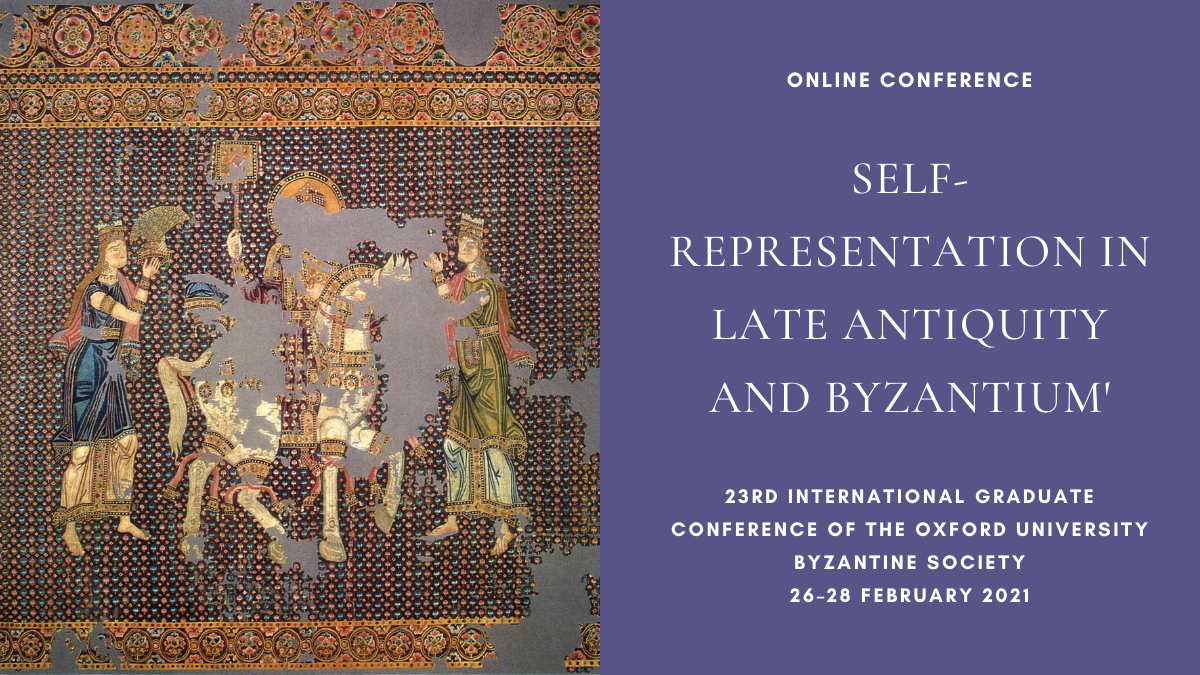
Online Conference: ‘Self-Representation in Late Antiquity and Byzantium’, 23rd International Graduate Conference of the Oxford University Byzantine Society, 26–28 February 2021

Self-representation is a process by which historical actors – individuals, communities and institutions – fashioned and presented a complex image of themselves through various media.

Referring to Byzantine portraits, Spatharakis claimed that this “form of representation cannot be divorced from its purpose and the requirements of the society in which the given visual language gains currency”. Equally, self-representation provides an original way to interpret the past, because this artificial and reflected image cannot be divorced from the cultural, social, economic, religious and political context of its time. As a methodological tool, it has received increasing attention in the field of Late Antique and Byzantine Studies, following the interest it has created in neighbouring fields such as Western Medieval or Early Modern studies.

The present conference  aims to explore the cultural outputs of the Late Antique and Byzantine world – e.g. architecture, material culture, literary works – which conventionally or unconventionally can be understood as acts of self-representation. The Late Antique and Byzantine world was filled with voices and images trying to present and represent an idea of self. Some of the most famous examples of this are the lavish mosaics sponsored by imperial and aristocratic patrons, whose splendour still dazzles their observers and gives an idea of the kind of self-fashioning that they embody. Urban elites, such as churchmen, bureaucrats and intellectuals, constructed idealised personae through their literary works and the careful compilation of letter collections, while those of the provinces displayed their power through images on seals and inscriptions. In monastic typika, the founders presented themselves as pious benefactors, while donor epigraphy in rural churches secured the local influence of wealthier peasants. However, self-representation is not only a matter of introspection but also of dialogue with the “other”: such is the case of spolia, used to reincorporate a supposed classical past in one’s self-portrayal, or to create an image of continuity by conquerors. It is the conscious use of Byzantine motifs in Islamicate architecture, the fiction of Digenes Akritas, or the religious polemics of late Byzantium, pitting Muslim, Jews and Christians against one other. Through depicting what they were not, historical actors were (consciously or unconsciously) shaping their own identity.

This conference seeks to join the ongoing dialogue on self-representation in Late Antique and Byzantine Studies by providing a forum for postgraduate and early-career scholars to reflect on this theme in a variety of cultural media. In doing so, we hope to facilitate the interaction and engagement of historians, philologists, archaeologists, art historians, theologians and specialists in material culture.

This conference was conceived and organised by the OUBS Committee: Lorenzo Saccon (President); Alberto Ravani (Secretary); James Cogbill (Treasurer)

With the support of the: Oxford Centre for Byzantine Research; Oxford Centre for Late Antiquity; Society for the Promotion of Byzantine Studies; Arts and Humanities Research Council; Oxford Medieval Studies; The Oxford Research Centre for Humanities; History Faculty, University of Oxford.

Advance registration required – register here.

Find out more here.

Conference Programme

Day 1: Friday 26 February 2021

9:30am – Opening Remarks

Speaker: Lorenzo Saccon (OUBS President)

10:00am – Session 1: Self-Representation in Early and Middle Byzantine Religious Writings.

Chair: Callan Meynell

  • Speaker 1.1: Paul Ulishney (Christ Church, Oxford), References to Islam in Anastasius of Sinai’s Hexameron
  • Speaker 2.1: Blake Lorenz (KU Leuven)Psalm 78 and the Self in Pseudo-Methodius; Speaker 3.1: Arie Neuhauser (St Cross College, Oxford), Negotiating Legitimacy Between a Rebel and Lazaros of Mount Galesion
  • Speaker 4.1: Cristina Cocola (Ghent University-KU Leuven), A Repentant Sinner: Representing the Self in Nikephoros Ouranos’ Katanyktic Alphabet

11:40am – Break until 12:00pm

12:00pm – Session 2: Representing Power and Legitimacy from Late Antiquity to Middle Byzantium.

Chair: Raymond Ngoh

  • Speaker 2.1: Matt Hassall (University of Cambridge), Devolved Networks of Self-Representation and Propaganda during the Reign of Justinian the 1st
  • Speaker 2.2: Silvio Roggo (University of Cambridge), The Self-Portrayal of Eutychios of Constantinople as Legitimate Patriarch, 577-582
  • Speaker 2.3: Zhang Kaiyue (St Stephen’s House, Oxford), The Lawgivers and the Idol-Breakers: Self-Representation of the Isaurian Emperors as Old Testament Kings
  • Speaker 2.4: Tom Alexander (St John’s College, Oxford), A Prince of Armenia between Byzantium and the Caliphate: Tʿēodoros Ṙshtuni as Depicted in Seventh- and Eighth-Century Armenian Historiography.

13:40pm – Break until 15:00pm

15:00pm – Session 3: Ut Pictura Poesis: Representing Art, Literature and Self

Chair: Kelly McClinton

  • Speaker 3.1: Julian Wood (University College, Oxford), ‘For this does not define Peter only, but also Paul and John’: Theodore of Stoudios on Representing the Unique Self
  • Speaker 3.2: Ana C. Núñez (Stanford University), Lost Mosaics and Religious Chant: Fashioning Royal Power in the Kingdom of Jerusalem
  • Speaker 3.3: Joshua Hitt (St Hilda’s College, Oxford), ‘I Scrape off the Old Age of the Painting’s Colours’: The Rhetoric of Restoration in Twelfth-Century Byzantium
  • Speaker 3.4: Dorota Zaprzalska (The Jagiellonian University), Composite Icons as a Means of Presenting and Interpreting the Past

16:40pm – Break until 17:00pm

17:00pm – Keynote Lecture

Professor Cecily Hilsdale (McGill University), Genres of Imperial Self-Representation in Later Byzantium


Day 2: Saturday 27 February 2021

11:00am – Session 4: Self-representation in Late Antique literature

Chair: Arie Neuhauser

  • Speaker 4.1: Filomena Giannotti (University of Siena), Self-Representation and Fictional Portraits of a Key Figure in Late Antiquity: Sidonius Apollinaris
  • Speaker 4.2: Ben Kybett (University of Cambridge), Religious Self-Representation in Fourth-Century Panegyric
  • Speaker 4.3: Elia Otranto (University of Granada), Let’s Talk About Me: Dialogue and Self-Representation in Emperor Julian’s Writings
  • Speaker 4.4: Frederick Bird (Regent’s Park College, Oxford), The ‘Dead Self’ in Byzantine Sepulchral Epigrams

12:40pm – Break until 14:00pm

14:00pm – Session 5: Negotiating Identity within and outside Late Byzantium

Chair: Lorenzo Saccon

  • Speaker 5.1: Christina Nicole Conti (Independent Researcher), Heir to An Ancient Empire and the Illusion of Power: The Examination of Imperial Propaganda Under Alexios III of Trebizond in the Greek Alexander Romance Codex gr. 5
  • Speaker 5.2: Francesca Samorì (University of Padua), Shaping History for an Autobiographical Outline: the Historia Dogmatica of George Metochites
  • Speaker 5.3: Benjamin Sharkey (Magdalen College, Oxford), Forming a Christian identity: Syriac funerary inscriptions in Kyrgyzstan (1201-1345)
  • Speaker 5.4: Bella Radenović (Courtauld Institute of Art), Artistic Self-Representation in Medieval Georgian Metalwork

15:40pm – Break until 17:00pm

17:00pm – Session 6: Buildings, Images and patrons

Chair: Katerina Vavaliou

  • Speaker 6.1: Kelly E. McClinton (Merton College, Oxford), Elite Identity and Self-Representation in Domestic Spaces in Rome: Redecoration in Late Antique Houses
  • Speaker 6.2: Veronika Poláková (National Autonomous University of Mexico), Self-Representation as a Marian Devotee: A Comparison of Donor Portraits in Byzantine and New Spanish Paintings
  • Speaker 6.3: Maria Elisavet Samoili (Independent Researcher), The Modified Portrayals of the Founders Th. Limniotis and A. Radini in Frescoes at Agioi Anargyroi in Kastoria, Greece: From Aristocracy to Monasticism?
  • Speaker 6.4: Alevtina Tanu (Independent Researcher), Two Examples of Comparison of Royal Women to the Theotokos in the Eastern Orthodox World.

Day 3: Sunday 28 February 2021

9:30am – Session 7: Society and its Representation in Middle and Late Byzantium

Chair: Joshua Hitt

  • Speaker 7.1: Emma Huig  (Christ Church, Oxford) Title: Dynamics of the Identification of Female Characters in the Slavic and Greek Digenis Akritis
  • Speaker 7.2: Zuzana Mitrengová (Masaryk University), Self-Representation of the Female Protagonist in Late Byzantine Romances
  • Speaker 7.3: Michael Kiefer (University of Heidelberg), What to Wear in Byzantium? – On the Portrait Habitus of Middle and Late Byzantine Elites
  • Speaker 7.4: Anna Adashinskaya (New Europe College), Pious Offerings to Meteora Monasteries (1348-1420s): Between Political Representation, Family Belonging, and Personal Agency

11:10am – Break until 12:00pm

12:00 – Session 8: Beyond the Border and across the Sea: Constructing Identities around Byzantium

Chair: Benjamin Sharkey

  • Speaker 8.1: William Neubauer (Balliol College, Oxford), The Fourteenth Sibylline Oracle: Eschatology and Identity among the Jews of Seventh-Century Alexandria
  • Speaker 8.: Valentina A. Grasso (University of Cambridge), Kingship, Self-Representation and Cross-Cultural Assimilation: A Reading of Late Antique pre-Islamic Arabian Epigraphic Testimonies
  • Speaker 8.3: Fermude Gülsevinç (Bilkent University), ‘We Are Pilgrims in an Unholy Land’: Christianizing the Seascape of Naxos and Chios in the Late Antiquity (Fourth to Sixth Centuries)
  • Speaker 8.4: Prolet Decheva (University College, Dublin), An Abstract Way of Self-Representation: Personified Virtues in Late Antique Mosaics and Beyond.

13:40pm – Break until 14:30pm

14:30pm – Session 9: Self-Representation in the Socio-Economic Sphere

Chair: Thomas Laver

  • Speaker 9.1: William Bunce (Wadham College, Oxford), Roman Law as Roman Self-Representation: A Case Study in Holiday Law
  • Speaker 9.2: Gemma Storti (The Ohio State University), Mismatched Eyes, Penny-Pinchers, and Eaters: Byzantine Nicknames and Self-Representation
  • Speaker 9.3: Carlo Berardi (University of Michigan, Ann Arbor), A Lion, not an Angel: Heraldic Devices and Dynastic Identity in the Frescoes of Saint Panteleimon, Nerezi
  • Speaker 9.4: Yunus Doğan (Bilkent University), ‘S(igillum) Felicis (Fran)Corum Exercitus in Rom(a)nie F(..)Bus(?) Comorantis’: Seal of the Catalan Company.

16:10pm – Break until 17:15pm

17:15pm Keynote Lecture 2

Professor Stratis Papaioannou (University of Crete), The Literature of the Self in Byzantium; Closing Remarks

New Publication: ‘Typical Venice? The Art of Commodities, 13th-16th Centuries’, edited by Ella Beaucamp and Philippe Cordez

What is the art of commodities, and how does it contribute to shaping a city? The case of Venice, which perhaps more than any other late medieval or early modern city depended on trade, offers some widely applicable considerations in response to these questions.

Commodities exist as such only when they can be bought and sold. Select materials, techniques and tools, motifs, and working processes are entailed in the conception and realization of commodities, with the aim of producing and selling in numbers. The art of commodities is an art of anticipation and organization, as complex as the material, social, and symbolic situations it results from, deals with, and contributes to shaping. In turn, an analysis of commodities allows for profound insights in these situations. The art of commodities ultimately presents specific challenges, solutions, and styles; it is an art of objects, as well as an art of cities and societies.

In Venice, commodities did much more than circulate throughout the Lagoon: the city was made of them. The studies in this book consider the Serenissima’s diverse commodities, merchants, and routes from multiple perspectives.

Ella Beaucamp is a doctoral candidate at Ludwig-Maximilians-Universität München, where she developed her dissertation topic within the research group ‘Premodern Objects. An Archaeology of Experience’, led by Philippe Cordez. She studies the high medieval stone reliefs of Venetian house facades, relating them to the larger context of Mediterranean trade and artistic production. The Centro Tedesco di Studi Veneziani, the Gerda Henkel Stiftung, and the Max Weber Foundation – German Humanities Institutes Abroad have supported her work. For her master’s thesis she was the recipient of the Heinrich Wölfflin Prize from Ludwig-Maximilians-Universität München.

Philippe Cordez is Deputy Director of the German Center for Art History in Paris. His research and teaching deal with medieval art history and more generally with object studies in art history. This work has been supported by the École des Hautes Études en Sciences Sociales in Paris, the Universität Hamburg, the Kunsthistorisches Institut in Florenz – Max-Planck-Institut, Ludwig-Maximilians-Universität München, the Université de Montréal, and the Sterling and Francine Clark Art Institute, Williamstown. His book ‘Treasure, Memory, Nature: Church Objects in the Middle Ages’, translated from French and awarded the Prize of the German Medievalists’ Society (Mediävistenverband e.V.), is available at Harvey Miller Publishers.

Find out more information here.

Table of Contents

ELLA BEAUCAMP AND PHILIPPE CORDEZ
Glass Vessels, Camel Imagery, House Façades: The Venetian Art of Commodities (13th–14th Centuries)

MANLIO LEO MEZZACASA
Sacred Objects by Venetian Goldsmiths (Late 13th–15th Centuries): Economics, Seriality, Identity

NATHANIEL SILVER
‘magna ars de talibus tabulis et figuris’: Reframing Panel Painting as Venetian Commodity (14th–15th Centuries)

BENEDETTA CHIESI
Ivories of the 14th–15th Centuries: The Pride and Ill-Fortune of a ‘Venetian Commodity’

ELIZABETH RODINI
Imitation as a Mercantile Strategy: The Case of Damascene Ware

SUSANNE THÜRIGEN
The Commodification of Ornament: Jacob Marquart’s Table Clocks

DARIO MICHELE ZORZA
Crafting Venetian Quality: Printing Legislation and the Case of Gabriele Giolito’s ‘Orlando Furioso’ (1542)

MEGAN K. WILLIAMS
Paper in the Piazza: The Late Medieval and Early Modern Trade in Venetian Paper

CRISTIAN LUCA
The Export of Venetian Commodities to the Romanian Principalities in the 16th Century

LEAH R. CLARK
The Politics of Acquisition: Venetian Objects in Italian Courtly Collections, c. 1475–1525

ROMEDIO SCHMITZ-ESSER
An Untypical Case? Late Medieval and Early Modern Venetian Commodities and their Re-Evaluation

CFP: Islamic Legacy: Narratives East, West, South, North of the Mediterranean (1350-1750), deadline 1 April 2021

IS-LE and COST (European Cooperation in Science and Technology) invite papers for the workshop Islamic Legacy: Narratives East, West, South, North of the Mediterranean (1350-1750): a thesaurus under discussion. Studying the relations between Christianity and Islam in late medieval and early modern Europe and the Mediterranean means covering a vast geographical region, which is diverse in its languages and cultures. Against this background it is necessary to find a common ground that makes it possible to understand the exchange between these two cultures as one border-crossing phenomenon. To achieve this comprehensive understanding, it is necessary to identify overarching ideas and common terms that are widely used in this field of research. Some of these terms are used analogically or even equivalent in different languages, which emphasizes the fact that there were similar images circulating throughout Europe and the Mediterranean. Therefore, the aim of this project is to discuss each of the 5 below terms in the context of their historiographies and how they were shaped by then prevailing notions.

Topics (terms) to be addressed:

  1. Orient-Occident, Morgenland-Abendland, Doğu-Batı
  2. Coexistence, Convivencia
  3. Hybridity
  4. Border-Frontier, Center-Periphery, Holy Land 5. Reconquista, Rückeroberung, Fetih

The deadline for submissions is 1 April 2021. Each proposal for an article should discuss one term, respectively one set of terms. The variations of the terms are not limited to the languages used above and can be complemented by translations into other languages. Proposals should not exceed one page (12 pt.), please also submit a short bio (250 words). The selected proposals will be presented during a workshop organized by the COST Action in Bosnia Harzegovina (University of Sarajevo), September 7, 2021. Due to budgetary restrictions, the number of reimbursed participants will be limited. If the Covid-19 situation prevents the in-person celebration of the workshop, it would be conducted online. Following the workshop, the articles will be published in a special issue of a journal to be announced at a later moment. We explicitly encourage submissions of researchers at any stages of their career and any related field of research.

For more information, please visit the IS-LE and COST website.

Image credit: detail of the Catalan Atlas, c. 1375, Bibliothèque nationale de France

Online Lecture: ‘The ‘Tara’ brooch: the making of a medieval masterpiece’ by Dr Niamh Whitfield, 17 February 2021, 7.30pm (GMT)

Join the Cork Historical and Archaeological Society on Wednesday 17 February for Dr Niamh Whitfield’s presentation on: ‘The ‘Tara’ brooch: the making of a medieval masterpiece’.

Register here.

More information can be found here.

Online Event: Interview with Ephraim Shoham-Steiner on “Jews and Crime in Medieval Europe,” Fordham University, 17 February, 2021

Join Fordham University’s Center for Jewish Studies on Wednesday, 17 February at 1:00pm EST for an interview with Ephraim Shoham-Steiner on his recently published book Jews and Crime in Medieval Europe. Hosted by Fordham University and the New York Public Library,  Ephraim will be in conversation with Fordham history professors Nicholas Paul and Magda Teter. 

Shoham-Steiner is a professor of Medieval Jewish History in the Department of Jewish History at Ben-Gurion University of the Negev in Be’er-Shevah Israel (BGU).

Beginning in the Middle Ages, Jews were often portrayed as criminals driven by greed. While these accusations were often unfounded, at times criminal accusations against Jews were not altogether baseless. Drawing on a variety of legal, liturgical, literary, and archival sources, Ephraim examines the reasons for Jewish involvement in crime, the social profile of Jews who performed crimes, and the mechanisms employed by the legal and communal body to deal with Jewish criminals and with crimes committed by Jews. A society’s attitude toward individuals identified as criminals—by others or themselves—can serve as a window into that society’s mores and provide insight into how transgressors understood themselves and society’s attitudes toward them. 

This event is a joint initiative of Fordham University’s Center for Jewish Studies and the New York Public Library and is a part of the Fordham-NYPL Joint Research Fellowship Program in Jewish Studies.

This event is predicted to be very popular, and advantage register is encouraged and required. Please register here.

CFP: Resilience, Resistance, and Renewal in the Medieval and Early Modern World (UCLA, 27 May 2021), deadline 1 March 2021

 The medieval and early modern world (broadly considered, c. 900-1750) underwent myriad profound changes, from devastating famines, plagues, and wars to an increased entanglement of the continents, economic transformations, and technological and scientific developments. These changes were often accompanied by calls for the reshaping of the institutions and structures – political, religious, intellectual, etc. – which undergirded societies’ approach to these challenges, encompassing such responses as resistance, resilience, and renewal. 

The Medieval and Early Modern Student Association (MEMSA) and Center for Medieval and Renaissance Studies (CMRS) at UCLA invite submissions of individual paper presentations (15-20 minutes) for an online conference considering aspects of cultural, environmental, social, economic, and other change in the medieval and early modern world. We particularly encourage those whose work highlights moments of resilience, resistance, and renewal. Presenters from all disciplines are welcome, especially those that take on inter-disciplinary perspectives and methodologies. We hope to provide opportunities for graduate students to present their research on a variety of topics that takes into consideration what many are also thinking about from another perspective, informed by the experience of recent events. 

Please contact the officers of MEMSA (memsa.ucla@gmail.com) to submit an abstract of the proposed presentation (250-300 words) by March 1, 2021

Image credit: The Morgan Library, Book of Hours, France, Paris, ca. 1420-1425, MS M.1004 fol. 143v

Online Lecture: ‘Wound Man: Three Early Modern Afterlives of a Medieval Surgical Image’ with Jack Hartnell, Early Science and Medicine Seminar, University of Cambridge, 23 February 2021 17:00 – 18:30 (GMT)

Early Science and Medicine Seminar, Department of History and Philosophy of Science, University of Cambridge

Dr Jack Hartnell (University of East Anglia) presents: ‘Wound Man: Three Early Modern Afterlives of a Medieval Surgical Image’

More information can be found here.

Please register here to receive the Zoom link for the session. Organised by Lauren Kassell. All welcome. The Zoom will be open for informal discussion from 4:45-5pm and 6:30-7pm.

Online Colloquium: ‘Dante & Medieval Conceptions of Space and Architecture’ part of the In via Dante colloquium series, 24 February 2021, 15:00-17:30pm (GMT)

The In via Dante Network at the University of Leeds are hosting three colloquia aimed at creating a platform for doctoral and early career researchers working on Dante across different institutions to come together to discuss their work. Our 2021 colloquia will focus on Dante’s relationship to three areas of enquiry: Latin literature (and its medieval reception); medieval religious culture; and medieval conceptions of space and architecture. 

The format for each colloquium will be as follows: three PGRS or early-career researchers will present their work to a panel of three established scholars from a range of disciplines who will act as respondents and guide subsequent discussions (20 mins/paper followed by 20 mins of discussion of each paper). 

The first colloquium will focus on ‘Dante & Medieval Conceptions of Space and Architecture’ and will be held online on 24 February from 3:00-5:30 GMT.

In all three realms of the afterlife, Dante describes the architecture and spaces he encounters as meaningful. These representations provide clues to how one moves through and experiences space as an individual and/or community in activities like prayer, processions, meditation, and other religious practices. This colloquium seeks to explore how Dante’s Commedia is shaped and informed by medieval conceptions of space and architecture.

Presenters: Caroline Domor (Oxford), Emma Wall (Durham), and Elisabeth Trischler (Leeds) will each present a 20 minute paper.

Respondents: Christopher Kleinhenz (Wisconsin-Madison) and Theodore J. Cachey Jr. (Notre Dame)

Click here to register.

Job: Assistant Professor in Archaeology, University of Copenhagen (deadline 1 March 2021)

The Saxo Institute, Faculty of Humanities, Copenhagen University (UCPH), Denmark, invites applicants for a tenure-track assistant professorship in Archaeology to be filled by the 1st of September 2021 or as soon as possible thereafter.

We are looking for an outstanding junior researcher with an innovative mind-set and intellectual curiosity to strengthen and complement the research profile of Archaeology at the Saxo Institute. Our research group comprises the fields of Classical, Nordic, and contemporary archaeology, and its research focuses on visual culture, landscape, technology and production, archaeo-metallurgy, textile studies, and archaeological theory and epistemology in the humanities. Methodologically, fieldwork, excavations, surveys, experimental archaeology, and museum studies form an integral part of our research. We aim to attract an international top-talent to our ambitious and collaborative environment.

The Saxo Institute is dedicated to the study of human societies past and present, with degree programs ranging from History to Ethnology, Archeology, Classical Languages and Migration Studies. With some 1400 students and a staff of 100 employees, the Institute offers a variety of research and library facilities, servicing a vibrant community of tenured scholars, graduate students, visiting researchers and externally funded projects. The institute also hosts a range of leading research centres and externally funded research projects.

For more information on this job opening, please visit University of Copenhagen’s website.

Fellowship: Bard Graduate Center Visiting Fellowships, 2021-2022

Bard Graduate Center (BGC) invites scholars from university, museum, and independent backgrounds with a PhD or equivalent professional experience to apply for non-stipendiary visiting fellowships, to be held during the 2021–22 academic year. BGC Visiting Fellowships, which are intended for scholars who have already secured means of funding, provide scholars with workspace in the BGC Research Center and enable them to join our dynamic intellectual and scholarly community in New York City. Visiting Fellowships represent our commitment to conversation and scholarly communication. We are happy to welcome scholars who similarly seek a serious but informal intellectual environment in which to pursue their work in the decorative arts, design history, and material culture. Visiting Fellowships may be awarded for anywhere from one month to the full academic year.

Bard Graduate Center is a graduate research institute in New York City. Devoted to the study of the decorative arts, design history, and material culture, the research at the BGC draws on methodologies and approaches from art history, economic and cultural history, history of technology, philosophy, anthropology, and archaeology.

For more information, please go here. Applications must be submitted online, and are due March 1st. Please direct questions to the Fellowship Committee via email at fellowships@bgc.bard.edu.