Online Conference: ‘Loss’, 14th Annual Schoenberg Symposium on Manuscript Studies in the Digital Age, 17-19 November 2021

The Schoenberg Institute for Manuscript Studies (SIMS) at the University of Pennsylvania Libraries is pleased to announce the 14th Annual Lawrence J. Schoenberg Symposium on Manuscript Studies in the Digital Age.

Engaging with pre-modern books and manuscripts necessarily involves reckoning with the paradox of loss. While a historical document from the distant past is the material survivor of a singular attempt to hedge against the disappearance of an idea, image, or text, the extant specimen always has to be considered alongside missing exemplars, damage and erasure, lost comparanda, and the vanished life-worlds that produced the object in the first place. This symposium will interrogate the notions of loss, survival, and recuperation in manuscript studies, so often in the background but rarely acknowledged as defining features of the field.

Bringing together scholars, librarians, curators, and conservators, we will investigate losses unknowable and quantifiable, ancient and recent, large and small, physical and digital. How have chance survivals shaped literary and linguistic canons? How might the topography of the field appear differently had certain prized unica not survived? What are the ways in which authors, compilers, scribes, and scholars have dealt with lacunary exemplaria? How do longstanding and emergent methodologies and disciplines—analysis of catalogs of dispersed libraries, reverse engineering of ur-texts and lost prototypes, digital reconstructions of codices dispersi, digital humanities, cultural heritage preservation, and trauma studies to name a few—serve to reveal the extent of disappearance? How can ideologically-driven biblioclasm or the destruction wrought by armed conflicts — sometimes occurring within living memory — be assessed objectively yet serve as the basis for protection of cultural heritage in the present? In all cases, losses are not solely material: they can be psychological, social, digital, linguistic, spiritual, professional. Is mournful resignation the only response to these gaps, or can such sentiments be harnessed to further knowledge, understanding, and preservation moving forward?

The online program will take place in morning and afternoon sessions (EST) from Wednesday, November 17, to Friday, November 19. The symposium will end with a keynote address by Professor Elaine Treharne, Stanford University

Other speakers include:

  • Matt Aiello, University of Pennsylvania
  • Olivia Baskerville, Institute for English Studies, University of London
  • Federico Botana, Institute for English Studies, University of London
  • Georgios Boudalis, Museum of Byzantine Culture, Thessaloniki
  • Laura Cleaver, Institute for English Studies, University of London
  • Kate Crosby, King’s College London
  • Eyob Derillo, The British Library
  • Siân Echard, University of British Columbia
  • Susan Einbinder, University of Connecticut
  • Natalia Fantetti, Institute for English Studies, University of London
  • Joanna Fronska, Institute de Recherche et d’histoire des textes (CNRS), Paris-Aubervilliers
  • Kathryn Gerry, Bowdoin College
  • Elina Gertsman, Case Western Reserve University
  • Dot Porter, Schoenberg Institute for Manuscript Studies, Penn Libraries
  • Sana Mirza, Freer Gallery of Art and Arthur M. Sackler Gallery, Smithsonian Institution
  • Hannah Morcos, Institute for English Studies, University of London
  • Pierre-Louis Pinault, Institute for English Studies, University of London
  • Angéline Rais, Institute for English Studies, University of London
  • Heghnar Watenpaugh, University of California, Davis
  • Yunxiao Xiao, Princeton University

Program details are available via the tab above. Registration is open to all but required for the zoom link. To register, click here.

We are also planning an open round of pre-recorded 5-minute Lightning Round Talks treating manuscript loss in or as a consequence of digital projects. Stay tuned for further details and a call!

For more information on the Schoenberg Symposium Series, click here.

Conference Programme

Wednesday, 17 November 2021 (EST): Loss of and in Manuscripts

10:00 -10:15 am

10:15 am -12:15 pm

12:15 – 1:00 pm

1:00 – 2:30 pm

2:45 – 3:30 pm

Welcome & Introduction:

  • Sean Quimby, Director, Kislak Center for Special Collections, Rare Books and Manuscripts, Penn Libraries
  • Lynn Ransom, SIMS, Penn Libraries
  • Joanna Fronska, Institute de Recherche et d’histoire des textes (CNRS), Paris-Aubervilliers: The Loss and Survival of Manuscripts from Chartres. For a History of the Cathedral Chapter Library
  • Eyob Derillo, The British Library: The Lost Library of Maqdala
  • Kate Crosby, King’s College London: TBA

Break

  • Elina Gertsman, Case Western Reserve University: Image and Loss: Sites of Generation
  • Georgios Boudalis, Museum of Byzantine Culture, Thessaloniki: TBA

Dot Porter, Schoenberg Institute for Manuscript Studies, Penn Libraries: Manuscript Loss in Digital Contexts


Thursday, 18 November 2021 (EST): Recovering and Remediating Loss

10:00 am – 12:00 pm 

12:00 – 1:30 pm

1:30 – 3:00 pm

  • Yunxiao Xiao, Princeton University: Reconstructing from the Disappeared: On the Recent Discovered Tsinghua Manuscripts
  • Kathryn Gerry, Bowdoin College: Put It in Writing (and Drawing): Issues of Loss and Preservation in the Work of Matthew Paris
  • Natalia Fantetti, Institute for English Studies, University of London: Forgotten but Not Gone: Writing Women into the History of the Medieval Manuscript Trade

Break

Discussion Panel, with responses by:

  • Susan Einbinder, University of Connecticut: Preaching in Times of Plague:  Solomon Marini in the Paduan Ghetto (1630-31)
  • Sana Mirza, Freer Gallery of Art and Arthur M. Sackler Gallery, Smithsonian Institution: Tracing Transregional Resonances: Harari Qur’anic Manuscripts as Testaments
  • Siân Echard, University of British Columbia: ‘Secure from the Ravages of Time’: Antiquarian Avatars of Medieval Manuscripts

Friday, 19 November 2021 (EST): Workshop Session

10:00 am – 11:30 am 

Laura CleaverOlivia BaskervilleFederico BotanaHannah MorcosPierre-Louis PinaultAngéline Rais, Institute for English Studies, University of London: Lost provenance and What it Reveals about Manuscript Studies: Lessons from the CULTIVATE MSS Project

11:45 am – 1:15 pm 

Reflections on Loss, Trauma, and Conflict

  • Matt Aiello, University of Pennsylvania: Expanding the Scope of Traumatic Testimony in Early England (and Beyond)
  • Heghnar Watenpaugh, University of California-Davis: Survivor Objects: How the Destruction of Art Shapes the History of Art

1:15 – 2:00 pm

2:00 – 3:00 pm  

Break

Keynote Address: Elaine Treharne, Stanford University: The Senses and Seduction of Loss

Lecture: ‘The City as Signifier: Nuremberg in the Nuremberg Chronicle’ with Professor Jeffrey F. Hamburger, The Morgan Library & Museum, New York, 6:30pm (EDT), 15 October 2021

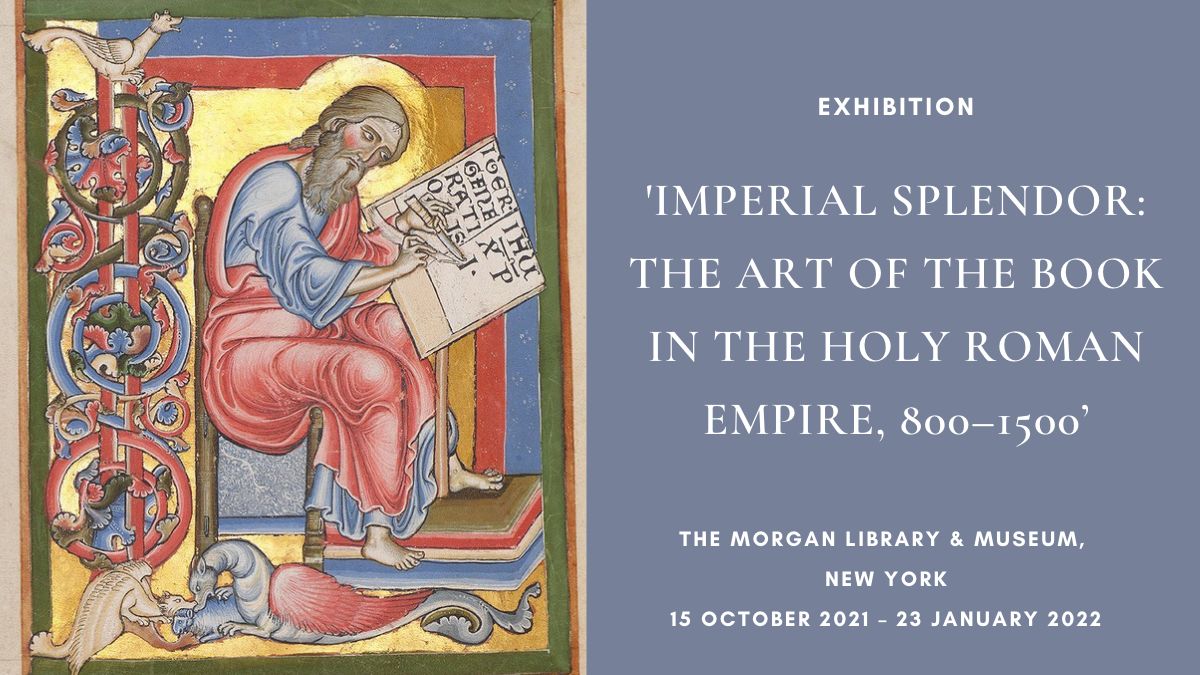
Join Jeffrey F. Hamburger, exhibition co-curator and the Kuno Francke Professor of German Art & Literature in the Department of the History of Art & Architecture at Harvard University, for a lecture to celebrate the opening of Imperial Splendor: The Art of the Book in the Holy Roman Empire, ca. 800–1500. No illustrated book from the fifteenth century is more famous than the so-called Nuremberg Chronicle, published in the same city in 1493, first in Latin, then in German. And of its 1,809 illustrations, none is better known than the two-page spread depicting the imperial city of Nuremberg itself. This lecture will take a close look at this famous view in the context of the artistic, civic, mercantile, religious, and political life of the city at the time it was made and against the backdrop of the earlier tradition of city views and illustrated chronicles.

The lecture will take place in the Morgan’s Gilder Lehrman Hall. In compliance with city guidelines, museum visitors 12 and older must show proof of at least one shot of a Covid-19 vaccine approved for emergency use by the FDA or the World Health Organization. Seating for this event will be at 75% capacity, click here for more information about our visitor guidelines and safety protocols.

The exhibition Imperial Splendor: The Art of the Book in the Holy Roman Empire, ca. 800–1500 will be open at 5:30 pm for program attendees.

Friday, October 15, 2021, 6:30 PM

Tickets: 

$15; $10 for Morgan Members; limited free for students with a valid ID.

Find out more here.

Book your tickets here.

Online Lecture: ‘Representing Architecture in early Islam: The San’a’ Qur’an Frontispieces’ with Professor Marcus Milwright, University of York History of Art department, 17 November 2021, 4.00pm (GMT)

The cache of ancient parchment fragments recovered from the Great Mosque in Sana‘a’ in Yemen included two folios with elaborate architectural designs. While their provenance remains the subject of speculation, there is broad scholarly agreement that these folios were originally frontispieces or finispieces from a luxury Qur’an, probably produced in Syria. There has been general acceptance that the paintings themselves are attempts to depict aspects of the plan, exterior features and interior spaces of a courtyard mosque. Some features suggest comparisons with the decorative components in the Great Mosque of Damascus, commissioned by caliph al-Walid I (r. 705-15). The images are problematic, however, in that they are not composed according to the conventions employed in the ancient world for the representation of standing buildings This paper locates the drawings in the tradition of Late Antique architectural ornamentation in the Mediterranean and Middle East. It is argued that the form of the early Islam courtyard mosque represented a unique challenge for the established modes of architectural representation, and that this problem has implications for our understanding of the goals of the designers of the Sana‘a’ frontispieces. The last part of the paper assesses the importance of these manuscript images in the evolution of early Islamic ornament.

To register your interest for this event please click here.

Location: This is an online event, please register using the link provided.

Email: history-of-art@york.ac.uk

Find out more here.

CFP: ‘The Medieval Diagram as Subject’, School of Advanced Study, London, deadline 15 October 2021

This conference will examine medieval diagrams as autonomous objects, and the visual and material features that allow them to function as independent entities. We understand diagrams as schematic representations designed to communicate ideas. In the Middle Ages, various words were used to define what we now call a ‘diagram’, including imago, figura, pictura, descriptio and tabula. The meaning of these terms could encompass a variety of forms and content and suggest different emphases for these complex works that often combined images and text. The conference will consider diagrams across different media in medieval visual culture, to address their design, function and reception.

An abundance of recent scholarship focuses on diagrams that accompany or illustrate text, and that often work as part of a larger object. Some diagrams, however, appear as self-sufficient images.  While some of these images were deployed with, or may contain or be accompanied by text or multiple texts, the function of that text is to elucidate the diagram and it does not serve as the object’s primary content. These types of diagrams include maps, genealogies, apotropaic or magic images, drawings of instruments, and works designed to communicate complex ideas about theology or function as prompts for religious devotion. They are found as wall paintings, pavements, mosaics, sculpture, manuscript rolls, sets of diagrams on single leaves or bound into codices, and architecture. In the twenty-first century, as in the Middle Ages, they pose particular challenges for those seeking to edit or reproduce their content.

The conference organisers (Laura Cleaver, Sarah Griffin, and Jenny Shurville) invite proposals for 20-minute papers on diagrams  in the Middle Ages, in any relevant discipline. Papers from graduate students and Early Career Researchers are particularly welcome. Potential topics might include, but are not limited to:

  • How the forms of autonomous diagrams shape their function(s) How autonomous diagrams use (or do not use) text
  • Relationships between content and context
  • Evidence for the circulation and reception of autonomous diagrams
  • Approaches to publishing medieval diagrams

Abstracts of 250 words and questions should be sent to medievaldiagrams2022@gmail.com by Friday 15 October 2021. We hope to hold this conference in hybrid format at Senate House, London. When submitting your abstract, please tell us if you would like to attend in person or online.


Lecture series: London Society for Medieval Studies Autumn 2021 Programme, 28 September – 14 December 2021

All lectures will take place on Zoom at 17:30 UK time (unless otherwise stated). Registration is necessary.

September 28 2021 (18:30 BST)

Tracy Adams (Auckland): Agnès Sorel and Antoinette de Maignelais: A star and a footnote

October 26 2021

Michael Staunton (UCD): The Problem with Medieval Biography

November 9 2021

Blake Gutt (University of Michigan): Pregnant Men and Backward Birth, or: What are the Trans Middle Ages, and Why do they Matter?

December 7 2021

Lauren Rozenberg (UCL & Courtauld): Finding the membrane: between skin and image

December 14 2021

Jacopo Gnisci (UCL) & Sophia Dege-Müller (Hamburg): Psalters in Early Solomonic Ethiopia (1270-1527)

Online Conference: ‘Fragments and Frameworks: Illuminated Manuscripts and Illustrated Books in Digital Humanities’, National Gallery of Art, Washington DC, 11am–4pm (EDT), 1 October 2021

The study of art history has long dealt with fragments and processes of fragmentation. Illuminated manuscripts and illustrated books in particular may have their fragments and folia fugitiva—pieces of material—separated from a whole collection or corpus. Many thousands of drawings and miniatures are dispersed around the world, including those donated to the National Gallery of Art by Lessing J. Rosenwald.

The adoption of open-access online collections has enabled new avenues for study. Open digital frameworks promise to bring new data and new attention to these objects and to ask critical questions about their provenance and conservation. 

This conference will discuss fragments and frameworks, actual and conceptual, in art history and related disciplines, and address emerging questions in digital humanities. What kinds of afterlives are incurred by processes of fragmentation and cutting? How does the concept of the frame or framework inform the study of illuminated manuscripts and illustrated books? How does the concept of (digital) remediation inform our approach to these works?  

Find out more here.

Advance registration required.

Conference Programme:

Morning Session: 11:00 a.m.–1:00 p.m. (EDT)

Steven Nelson, The Center, National Gallery of Art: Welcome

Matthew J. Westerby, moderator, The Center, National Gallery of Art

Catherine Yvard, Victoria and Albert Museum: Framing the Gaze: Some Thoughts on Illuminated Manuscripts and Cuttings

Cristina Dondi, Lincoln College, University of Oxford, and Secretary of CERL: Books as Fragments of Libraries—Illustrations as Fragments of Books: A Digital Illustrated Census of Dante’s Comedia (1481)

John Delaney and Michelle Facini, National Gallery of Art: Collaborative Technical Study and a Machine Learning Future for Illuminated Manuscripts

Bryan Keene, Riverside City College: Encompassing the Globe: Digital Scholarship and Virtual Reconstructions of Illuminated Manuscripts

Afternoon Session: 2:00 p.m.–4:00 p.m. (EDT)

Peter M. Lukehart, moderator, The Center, National Gallery of Art: Welcome and introduction

Lisa Fagin Davis, Medieval Academy of America: Medieval Fragments and Modern Fragmentology

LauraLee Brott, University of Wisconsin–Madison: The Materiality of Medieval Maps in the Age of Digital Discovery

Heather Bamford, George Washington University: Out of Practice, Uncertain Cultures

Matthew J. Westerby, The Center, National Gallery of Art: Frameworks for Fragments: The Digital Lives of Miniatures

CFP: ‘Rethinking Royal Manuscripts in a Global Middle Ages’, ICMA sponsored session at AAH conference London 2022, deadline 1 November 2021

This panel sets out to examine and compare the impact of royal patronage on the visual, material, and textual features of manuscripts produced across Africa, Asia, Mesoamerica and Europe during the ‘Global Middle Ages.’ As polysemic and multi-technological objects, royal manuscripts were produced in different forms and sizes, and from a variety of materials that could vary according to the taste, wealth, ideology, religion, and connections of their patrons and makers. Their visual and textual content could conform or deviate from existing traditions to satisfy the needs and ambitions of those involved in their production and consumption. Finally, pre-existing manuscripts could be appropriated, restored, enhanced, gifted, and even worshipped by ruling elites for reasons connected with legitimacy and self-preservation, becoming powerful instruments of hegemony, or symbols of prestige and piety. Because of this semiotic versatility, written artifacts provide ideal vantage points for understanding the agency of material culture in the creation and perpetuation of political power.

To what extent do the materials, texts, and images of royal manuscripts reflect the integration of pre-modern courts in networks of patronage and exchange? In which ways were these features adapted for different audiences and for female, male, or genderqueer patrons? How did they inform local and transregional notions of power and authority? How did communities that opposed royal authority situate themselves in relation to the political agency of written texts and their illustrations? When and how did such artifacts become imperial relics to be displayed, or symbols of a contentious past to be concealed or destroyed? What can manuscripts tell us about the royal patronage of other artistic media, dynastic rivalries, political alliances, and state-endorsed religious phenomena?

In pursuing similar questions, we are particularly interested in multidisciplinary papers that move beyond a Eurocentric reading of material culture by considering royal manuscripts from pre-modern polities traditionally seen as ‘peripheral.’ We welcome proposals that apply innovative methodologies to the study of handwritten material and its circulation, questioning conventional assumptions about politics, culture, and religion, and privileging comparative approaches and transcultural artistic phenomena.

Call for Papers deadline 1 November 2021. Please submit your paper proposal to the convenors.

Umberto Bongianino, University of Oxford, umberto.bongianino@orinst.ox.ac.uk

Fellowship: Thomson Curatorial Fellowship in European Art, Art Gallery of Ontario, deadline 5 November 2021 *updated

The Art Gallery of Ontario welcomes applications for the Thomson Curatorial Fellowship in European Art, a two-year position beginning in 2022.

About the Art Gallery of Ontario:

At the AGO, we are committed to fostering a diverse and inclusive workplace dedicated to hiring individuals who reflect the communities we serve. We welcome and encourage all interested candidates to apply for this new and exciting opportunity, especially those from traditionally underrepresented groups in the museum field, including candidates who are BIPOC, LGBTQ2S+, women, and people with disabilities. If you require accommodations at any point in the hiring process, please let us know and we will be happy to provide them.

As one of North America’s leading art museums, the AGO welcomes close to 1 million visitors annually and is deeply committed to making art and lifelong learning accessible to everyone. Our ambitious vision is to lead global conversations from Toronto through extraordinary collections, exhibitions and programs, and by reflecting the people who live here.

The European Art department believes that historical art can help us to connect with the past and with one another. Through the tools at our disposal—exhibitions, installations, research, and acquisitions—we envision that the European Art collection at the AGO will become a vital resource for studying the past as an essential means of living an informed present. We invite applicants who are inspired by this purpose to join us on our journey.

About the fellowship:

The Thomson Curatorial Fellowship in European Art is a two-year position that trains a doctoral candidate or recent doctorate to become a future curator of European art. Working closely with curators and collaborating with colleagues across the museum, the Fellow’s work will include the following key responsibilities:

  • The Fellow will develop an exhibition drawn from the Thomson Collection of European Art that aligns their interests with the department’s priorities. They will guide this project from conception through installation, which will include selecting objects, developing a narrative, writing interpretive text, exhibition design, and installation.
  • The Fellow will have substantial time dedicated to pursuing independent research on an aspect of the Thomson Collection leading to a conference presentation and/or publication. Support resources include access to the AGO Library & Archives, Toronto’s university libraries, and collaboration with AGO Conservation staff.
  • To promote and share knowledge about the Thomson Collection of European Art, the Fellow will participate in public programming and outreach through in-person and virtual programs, the AGO newsletter, and other programs in collaboration with curators and the Education & Programming department.
  • Through participation in day to day activities of the European Art department and the museum, the Fellow will gain exposure to the broad spectrum of activities involved in curatorial work.

About the Thomson Collection of European Art:

The Thomson Collection of European Art is one of the world’s finest collections of medieval, renaissance, and baroque sculpture, painting, and decorative arts. Numbering over 900 objects, the collection ranges from the late 10th century to the 19th century and across media, with particular strength in ivory, boxwood, and metalwork. To browse the collection, visit https://ago.ca/collection/thomson.

Specific areas of interest may include:

  • Gothic ivories (also includes some Carolingian and Byzantine examples)
  • Limoges and Byzantine enamels
  • Medieval manuscripts
  • German and Flemish Baroque ivory and boxwood carvings
  • Scientific and navigational instruments
  • Portrait miniatures

Historic European frames: In 2022 the AGO will have an expert in Frames Conservation in residence to work with the AGO’s collection of 1,500 historic European frames. If in-depth research on the history of frames and a possible exhibition project related to this collection is of interest, please discuss your interest in your application.

Revelant Skills:

  • PhD or ABD (all requirements toward the completion of a PhD with the exception of dissertation submission) in art history or a related humanities field
  • Expertise in an area directly related to the Thomson Collection of European Art
  • Excellent analytical and writing skills; experience in writing for multiple purposes and broad audiences
  • Demonstrated experience in speaking and writing about art to specialized audiences as well as broader public audiences
  • Minimum 1 year of related art museum experience
  • Well-developed organizational, interpersonal and public relations skills
  • English language proficiency required

Compensation:

  • The Fellow will receive a CAD $50,000 stipend per year for the 2-year placement, along with a CAD $5,000 allowance for research travel and professional development. If applicable, a moving stipend will also be provided.
  • Health insurance benefits including extended health, prescriptions, dental, and vision will be provided.

Application materials:

  • Two-page cover letter: Please describe your interest in a curatorial career in general, this position in particular, and how your experience to date will support you in the role of the Fellow; Please also include a description of a potential research project to pursue during the Fellowship related to a particular area of the Thomson Collection of European art. This may be drawn from the list above or a different area of interest that aligns with the Thomson Collection of European art.
  • Curriculum vitae
  • Copy of a published paper or recent writing sample
  • Two confidential letters of recommendation

Please apply through the online-portal:
http://app.jobvite.com/m?3niY4mwy

Application Deadline: 11/05/2021

This fellowship will take place on-site at the AGO with an expected start date beginning in January 2022.

The Art Gallery of Ontario is located at: 317 Dundas Street West, Toronto, Ontario, Canada M5T 1G4

New Publication: ‘Imperial Splendor: The Art of the Book in the Holy Roman Empire, 800–1500’, by Jeffrey F. Hamburger & Joshua O’Driscoll

This new book by Jeffrey F. Hamburger (Harvard University) and Joshua O’Driscoll (Morgan Library & Museum) accompanies their exhibition of the same title, ‘Imperial Splendor: The Art of the Book in the Holy Roman Empire, 800–1500,’ on view at the Pierpont Morgan Library & Museum in New York from Oct. 15, 2021 to Jan. 23, 2022.

Imperial Splendor offers a sweeping overview of manuscript production in the Holy Roman Empire, one of the most impressive chapters in the history of medieval art. While little known and rarely seen by the general public, these illuminated manuscripts count among the most luxurious works of art from the Middle Ages. Designed to edify, to entertain, and above all to embody the sacred, these manuscripts and their spectacular illuminations retain the ability to dazzle and inspire modern audiences just as they did those of the Middle Ages. Bringing together some seventy manuscripts from collections across the country, the exhibition begins with the reforms initiated by Charlemagne, the first emperor following the fall of Rome. It ends with the flurry of artistic innovation coinciding with the invention of the printing press and the onset of humanism in the fifteenth century. As the first major presentation of this subject in the English-speaking world, Imperial Splendor introduces visitors to fundamental aspects of this history, including how artists developed a visual rhetoric of power, the role of the aristocratic elite in the production and patronage of manuscripts, and the impact of Albrecht Dürer and humanism on the arts of the book.

A highly-illustrated history and survey of centres of book production and use within the Holy Roman Empire over the course of 700 years.

Author biographies

  • Jeffrey Hamburger is Kuno Francke Professor of German Art & Culture at Harvard University.
  • Joshua O’Driscoll is assistant curator in the department of Medieval & Renaissance Manuscripts at The Morgan Library & Museum, New York.

Table of Contents

  1. Director’s Foreword by Colin B. Bailey
  2. Acknowledgments
  3. Abbreviations
  4. I Introduction
  5. II Imperial Networks
  6. III Imperial Monasteries
  7. IV Imperial Cities
  8. The Main Imperial Dynasties
  9. Glossary
  10. Bibliography
  11. Index of Objects
  12. General Index
  13. Credits

More information:

  • Hardcover
  • ISBN: 978-1-911282-86-0
  • 216 Pages
  • 280 x 229 mm (9 x 11 in)
  • 153 colour illustrations
  • In association with the Morgan Library & Museum
  • October 2021

Call for Journal Submissions: Cuadernos de la Alhambra, issue 50, deadline 1 November 2021

For issue 50, which will be published in December 2021, interested researchers are invited to send their proposals through the journal’s page: https://cuadernosdelaalhambra.alhambra-patronato.es/index.php/cdalhambra.

Deadline: 1 November 2021

Cuadernos de la Alhambra is a scientific journal in the field of heritage research and dissemination with free and free access, founded in 1965, which publishes original studies on heritage and its management focused on both the dissemination of research and actions related to the environment. of the Alhambra, as in relation to other national and international enclaves with similar patrimonial interests. The areas of thematic interest are: anthropology, archival, archeology, architecture, fine arts, library science and documentation, biodiversity, botany, artistic creation, conservation and restoration, Arab and Islamic studies, geography and land management, geology, history, history of the art, engineering, gardens, mathematics, museums, landscaping, new technologies for knowledge and dissemination of heritage,

The journal publishes research articles in Spanish, English, Italian, French, Portuguese and German. It is aimed at the scientific and academic community, as well as all professionals, researchers and specialists, both nationally and internationally, interested in the Monumental Complex of the Alhambra and the Generalife and, in general, in historical heritage.

Find out more about the journal here.