History within the Academy: Ask the Experts Friday, 27 June 2014 from 09:15 to 13:30 London, Institute of Historical Research
This half day workshop is organised jointly with the Royal Historical Society & History Lab Plus. The workshop is aimed at early career historians and anyone seeking an academic post in history. Those who have recently completed or are about to submit a PhD are particularly welcome.
The event will be informal, with plenty of time to ask questions and to meet the speakers. The discussion will focus on the academic job market, public engagement, open access and looking ahead to REF2020. There will also be chance to raise any other questions or concerns relating to building an academic career in History.
CFP: Object Fantasies. Forms & Fictions (Munich, 7-9 Oct 15)
Munich, Ludwig-Maximilians-Universität,
7 – 9 October 2015 Deadline: 31 July 2014
Interdisciplinary Conference of the Junior Research Group “Premodern Objects. An Archaeology of Experience“ (Elite Network of Bavaria / Ludwig-Maximilians-Universität Munich)
In modern understanding, the word “object” signifies something material, spatially defined and functionally determined. These notions are accentuated by the word objectivity, which defines an ideal, systematic mode of grasping objects as “subjects” that presumably operate neutrally and scientifically. In contrast, the Latin word “fantasia” has, since antiquity, signified an apparition or the ability to imagine something that can equally be an image, a concept or, also, an object.
The conference takes the latter alternative meaning, that is, the non-objective experience of objects as well as recent positions of thing studies as the basis for inquiry into the creative act in the reception and construction of objects. How, for instance, do the object fantasies let the borders between object categories or objects and creatures blur? What role do they – equally nourished by illusion and experience – play in the perception and handling of material objects? To what degree do perceptions of and references to objects have a lasting effect on the conception and creation of other material objects or fictional objects in images and texts? And finally: What correlation exists between the creative handling of the objectual, the self-perception of subjects and the concrete and imaginary conditions of their social lives?
The conference will pursue these as well as other lines of questioning of different formal as well as fictional possibilities in the creation of objects. Welcome are papers from all fields of human sciences on individual objects, object categories and systems, objects in images and texts, objects with images and script as well as object theories.
The travel and accommodation costs of the speakers will be covered. The conference serves as a preparation for an anthology on the same topic. Working languages are English, German, French and Italian. Please send a one page abstract and a short CV by July 31, 2014 to objektfantasien@kunstgeschichte.uni-muenchen.de.
RSA-Session ‘Artists in Habits’ Berlin, 26-28 March 2015 Deadline: 10 June 2014
This panel seeks papers that explore the dual identities of artists who were members of a religious order. More than fifteen years since seminal studies on the “frate-dipintore” by William Hood and Megan Holmes, on Fra Angelico and Fra Filippo Lippi respectively, we ask how scholarship on monastic-artistic occupations has evolved.
Are we closer to understanding if, and if so how, these artist’s personal piety or theological training informed their painterly approach? Did their allegiance to a specific order give rise to iconographies reflecting the spirituality of that order? Is there evidence that they were sought by patrons specifically because of their spiritual ‘purity’? Did their status allow access to religious spaces that ordinary artists could not enter? How did religious institutions make use of the talents of their artist members? And overall, is this even a valid area of enquiry?
The panel invites proposals from scholars wishing to re-address canonical monastic artists as well as those who hope to shine a light on lesser known monk/friar/nun artists.
RSA-Session ‘Arts in Quattrocento Pisa I-II’ Berlin, 26-28 March 2015 Deadline: 12 June 2014
The Quattrocento was a dramatic century for Pisa. The Tuscan town, formerly a leading “Maritime Republic” and one of the wealthiest and most splendid Mediterranean centers in the Middle Ages, lost its independence in 1406 and fell under the dominion of Florence. The
political, economic and social crisis reached its apex in the first half of the century: thousands of people, both locals and foreigners, migrated elsewhere. Despite this, many of the foremost artists of the period were present in town, personally or through their works, from the International Gothic champs Lorenzo Monaco and Gentile da Fabriano to the founders of the early Renaissance revolution, Masaccio, Donatello (with Michelozzo), Fra Angelico. Their influence can be seen in the locally active painter Borghese di Piero and in the prolific
sculptor Andrea Guardi.
In the second half of the Quattrocento the archbishop Filippo de’ Medici and Lorenzo il Magnifico himself patronised notable architectural and artistic commissions (such as the Archbishop’s and the Sapienza University Palaces). The Opera del Duomo promoted the
completion of the fresco decoration of the Camposanto, which was entrusted to Benozzo Gozzoli who prevailed over such competitors as Andrea Mantegna, Vincenzo Foppa and the Lucchese Michele Ciampanti. Other notable painters, all of them Florentine, active in Pisa in those decades were Paolo Schiavo, Alesso Baldovinetti, Cosimo Rosselli, Domenico Ghirlandaio; not to say of the Flemish presences (e.g. the Master of the Legend of St. Lucy), or of the glazed-terracotta creations of the Della Robbia and Buglioni workshops. The only local talent, emerging in the last years of the century, was Niccolò di Bartolomeo dell’Abbrugia, better known as Niccolò Pisano, who then moved to Ferrara.
The century ended with the descent of French King Charles VIII in 1494: Pisa regained its liberty for fifteen years, rediscovering an ephemeral but intense civic pride in the profoundly changing assets of Italy and Europe.
The two sessions aim to give a proper critical and historical consideration to this still fragmentary and little studied chapter of Italian Quattrocento Art. Please send paper proposals – in English, Italian, or French – of 150 words (with keywords) and a cv of 300 words by June 12, 2014, to < gerardo.desimone@gmail.com > https://accademiadinapoli.academia.edu/GerardodeSimone
A workshop introducing students to the study of medieval documents.
Saturday 14 June 2014, UCL History Department
Diplomatic is the formal term for the study and analysis of documents in medieval
manuscripts. Diplomatic encompasses a broad range of documents from the Middle
Ages (royal charters, papal bulls, diplomas, legal writs, contracts, judicial records,
treaties, etc.) and requires a number of technical skills. But it is more than a merely
antiquarian pastime. The careful use of documents is essential for writing the
political, institutional, religious, social, economic and intellectual history of the Middle
Ages.
Despite its importance, provision for introducing British students to the study of
Medieval Diplomatic remains limited. This one-day workshop at UCL will fill that gap.
Led by Professor David d’Avray the workshop will provide an introduction to some of
the technical skills necessary for analysing different types of British and continental
documents. Equally importantly, it will demonstrate how Diplomatic can help answer
a range of historical questions about secular governance, the papacy, monasteries
and social power, and medieval rationality.
The workshop is open to all students and will be of particular benefit to those
considering graduate work in medieval history.
Attendance is free and no knowledge of Latin is required. Lunch and refreshments
will be provided.
To register or find out more information, please contact the course organiser by
email (z.mistry@ucl.ac.uk) with your name and details. Please note that priority will
be given to undergraduates.
For more information about the UCL Centre for Medieval and Renaissance Studies,
visit http://www.ucl.ac.uk/mars.
Book project, ed. by Dr Antje Bosselmann-Ruickbie and Dr Leo Ruickbie
Magic is a wide field of research comprising what we might call the occult, paranormal events, anomalous experience, spirituality and other phenomena throughout human history. However, research has often been focused more narrowly on the historical analysis of written sources, or the anthropology and occasionally sociology of practitioners and their communities, for example. What is often overlooked are the physical artefacts of magic themselves.
In all areas of research, ‘material culture’ is becoming increasingly important – the ‘material turn’ as it has been labelled. This is particularly the case for disciplines that traditionally have not focused on object studies but on theory such as historical or social sciences. However, it is self-evident that the objects emerging from a culture provide valuable information on societies and their history. This is also and particularly the case for magic and related phenomena. Magic, especially, became divorced from its concrete expressions as academic study focused on problems of rationality and functionalist explanation.
When studying magic it is crucial to look at the objects that have been produced and what purpose they had, who made them and in what period, whether they represent only a certain historical period or are a long-lasting phenomenon, etc. This volume hence aims to ‘re-materialise’ magic, to re-anchor it in the physical things that constitute ‘magic’ and recover the social lives, even biographies, of these things.
The envisaged academic book aims to cover a wide range of subjects, periods, geographical areas, as well as methods: firstly, because an interdisciplinary approach is essential to adequately encompass the subject; secondly, to investigate whether similar objects were used in different cultures in parallel or over a long period; and thirdly, to serve as a starting point for future research. This will be the first book on the material culture of magic and consequently has the potential to become a foundational text.
Therefore, we invite contributors from different disciplines such as anthropology, archaeology, art history, ethnology, folklore, parapsychology, religious studies, sociology and others. Subjects could be, for example, case studies focusing on particular objects, museum collections, or mass market items labelled as magical; analysis of classes of embodied magical functions, such as charms, amulets, talismans, magical jewellery, icons, relics, poppets (Voodoo dolls), etc.; consideration of classes of materials, such as bone, wood, metal, precious and semi-precious stones, etc. In addition, it is important to understand people-object relations, spatial-temporal aspects of magical objects, the dialectics of transference (projection and introjection), the role of narratives and social performance, cultural trajectories, and the processes of commodification and fetishisation (reification). These can be addressed in a variety of contexts from traditional religion to popular culture, and historically situated anywhere from prehistory to the present day.
Any physical representation of magical ideation or anything imbued with supernatural meanings by its creator, such as found objects, animal/human parts, and man-made artefacts, can be considered in this context. What matters is a central focus on the physicality of the magical object; its material existence.
The volume will present an overview of current research in this field. It will comprise approximately 20 of the best and most relevant contributions on this subject. Contributors will be asked to submit a finished chapter of around 6,000 words (inc. references) with publication planned for 2015.
In the first instance, an abstract of no more than 300 words should be sent, together with a brief biography, to the editors before1 August 2014atBosselmann-Ruickbie@uni-mainz.de. We are also happy to answer any questions.
***
Dr Antje Bosselmann-Ruickbie is a lecturer in the Department for Christian Archaeology and Byzantine Art History, Institute for Art History and Musicology, Johannes Gutenberg University, Mainz, Germany.
Dr Leo Ruickbie is the published author of several books, as well as the editor of the Paranormal Review, the magazine of the Society for Psychical Research, and a Committee Member of the Gesellschaft für Anomalistik (Society for Anomalistics).
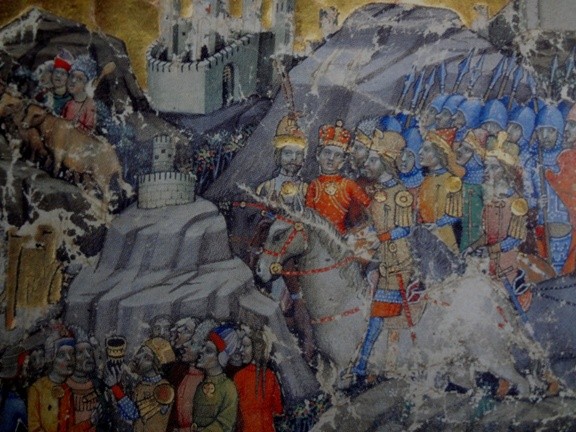
The Hungarians’ First March into Pannonia, Chronicon Pictum
Performing Power through Visual Narrativity in Late Medieval Europe. An Interdisciplinary Approach, 29-31 May 2014
International Research Center for Late Antiquity and the Middle Ages, University of Zagreb.
Organizing and scientific committee
Xavier BARRAL I ALTET
Alain Erlande BRANDENBURG
Jean Pierre CAILLETNikola JAKŠIĆ
Miljenko JURKOVIĆ
Vinni LUCHERINI
ČETVRTAK, 29. svibanj / Thursday, May 29th
15.00
POZDRAVNI GOVORI / GREETING SPEACHES
Miljenko Jurković (University of Zagreb) and Vinni Lucherini (Università degli Studi di Napoli Federico II)
Xavier Barral i Altet (Université de Rennes II, Università Ca’ Foscari di Venezia), Formes de narration médiévale, avec ou sans “histoires”, au service du pouvoir. Introduction au colloque
THE REPRESENTATION OF MONARCHIC POWER
First Session
Chair:X. Barral i Altet
Martin Aurell (Université de Poitiers), L’art comme propagande? Henri II d’Angleterre, Aliénor d’Aquitaine et leurs enfants
Vinni Lucherini (Università degli Studi di Napoli Federico II), Saint-Denis, Luigi IX e le tombe dei re di Francia: nuove ipotesi di lettura attraverso le fonti testuali medievali16.30-17.00 – coffee break
Jean-Pierre Caillet (Université Paris-Ouest), Le Roman des rois de Primat (1274): une première interprétation imagée de l’histoire de France
Alain Dubreucq (Université de Lyon), L’idéologie royale et ses représentations des Carolingiens aux Valois
Imre Takács (Museum of Applied Arts, Budapest), Corona et crux – Heraldry and Crusader symbolism on some 13th century Hungarian royal seals
—Discussion
PETAK, 30. svibanj / Friday, May 30th
Second Session
Chair:Jean-Pierre Caillet
9.30
Giulia Orofino (Università di Cassino), Icone del potere nel Regesto di Pietro Diacono (cod. Casin. Reg. 3)
Maria Alessandra Bilotta(Iem, Faculdade de Ciências Sociais e Humanas da Universidade Nova de Lisboa), Fra regalità e giustizia: la rappresentazione del sovrano in un inedito manoscritto tolosano dell’Infortiatum all’Escorial (prima metà XIV secolo)
Nicolas Reveyron (Université de Lyon), Le côté obscur du pouvoir royal. Prétérition et métonymie dans le discours politique au portail nord de la cathédrale de Lyon
11.00 – 11.15coffee break
THE MONARCHIES OF CENTRAL EUROPE AND THE ADRIATIC
Zsombor Jékely (Museum of Applied Arts, Budapest), Narrative Structure of the Painted Cycle of a Hungarian Holy Ruler: The Legend of St. Ladislas
Mladen Ančić (University of Zadar), The Realm of St. Stephen or Angevin Empire. The 14th Century Kingdom of Dalmatia et Croatia as Case Study of Governing Institutions
Nikola Jakšić (University of Zadar), La committenza reale in Dalmazia angioina. L’arca di San Simeone profeta a Zara
Vesna Pascuttini-Juraga, Ivana Peškan (Conservation Department, Varaždin),A key stone from the parish church of St. Nicholas in Varaždin: a connection with the family of the king Matthias Corvinus
—Discussion
13.30 – 15.00 — lunch break
THE ROYAL POWER AND THE IMAGE OF DEATH
Third Session
Chair:Vinni Lucherini
15.00
Gerardo Boto (Universitat de Girona), La peninsula de los panteones. Espacios funerarios regios en monasterios y catedrales ibericas medievales
Marta Serrano (Universitat Rovira i Virgili, Tarragona), Visualizing the Monarchy Power in the XIVth Century: An Example of Narrativity through Chronicle Texts and Funeral Images in the Iberian Peninsula
Stefano D’Ovidio (Università degli Studi di Napoli Federico II), La tomba di Roberto d’Angiò in Santa Chiara a Napoli: una lettura iconografica
Ivan Gerat (Institute of Art History, Bratislava), The Power of Deceased in Panel Paintings from Central Europe (c. 1474 – 1507)
17.00-17.30– coffee break
—Discussion
18.00.
Presentation of the 20th volume of Hortus artium medievalium
SUBOTA, 31. svibanj / Saturday, May 31st
THE REPRESENTATION OF ECCLESIASTICAL AND LAY POWER
Fourth Session
Chair:Nikola Jakšić
9.30
Milagros Guardia (Universitat de Barcelona, Ircum), La ripresa e i valori semantici della storia di Giuseppe l’ebreo nel primo duecento: i rilievi di Santa Restituta a Napoli e i suoi precedenti monumentali nella tarda antichità
Christian Lauranson (Université de Lyon), “Ad utrumque paratus” ou la crosse et l’épée. Duplicité du pouvoir de l’évêque du Puy au Moyen Âge
Carles Mancho (Universitat de Barcelona, Ircum), Oltre i muri della chiesa: la decorazione di San Pietro a Sorpe (Catalogna) come imposizione sul territorio
11.00 – 11.15coffee break
Imma Lorés (Universitat de Lleida), Hagiographie et mémoire: l’utilisation de l’évêque saint Ramon de Roda au XIIIe siècle
Isabel Escandell Proust (Universitat de les Illes Balears), Reflets de la politique épiscopale. À propos des manuscrits enluminés et bibliothèques de la Couronne d’Aragon (XIII-XIVème siècles)
Gabriele Archetti – Francesca Stroppa (Università Cattolica del Sacro Cuore, Milano-Brescia), Immagine e buon governo nell’ideologia politica e nella memoria visiva del vescovo Berardo Maggi (Brescia, 1275-1308)
13.30 – 15.00 — lunch break
Fifth Session
Chair:Miljenko Jurković
15.00
Roberto Greci (Università degli Studi di Parma), L’associazionismo e i suoi simboli
Rosa Alcoy (Universitat de Barcelona), Ley y potestades eclesiásticas del Trecento: patrimonio visual y contexto jurídico en las Causas del Decretum Gratiani
Stéphanie Diane Daussy (UMR 5138, Archéométrie et Archéologie, Lyon 2), «Quanto cultu auroque Templa fulgerent». La beauté de la vision comme expression des pouvoirs
17.00-17.30 – coffee break
Vinni Lucherini – Conclusions
Sunday,June 1st
9.00-16.00
TERENSKI OBILAZAK LOKALITETA I SPOMENIKA ISTRE
EXCURSION FOR THE PARTICIPANTS Uz stručno vodstvo / Guided by: prof. dr. sc. Miljenko Jurković; prof. dr. sc. Ivan Matejčić
Lunch at one of the monuments (with paid inscription fee)
10.00 Introduction John Lowden and Catherine Yvard, The Courtauld Institute of Art
10.15 KeynotePaul Williamson, Victoria and Albert Museum
‘They Who Only Ivories Know, Know not Ivories’: Polychrome and Other Micro-Carvings around 1400 in their Broader Context.
Session One: The Object and its History
10.45 The Ivory Virgin and Child from the Martin Le Roy Collection
Danielle Gaborit-Chopin, Musée du Louvre, Parisand Juliette Levy-Hinstin, Conservator, Paris
11.05 A Happy End: The Group of the Descent of the Cross Reunited
Élisabeth Antoine-König, Musée du Louvre, Paris and Juliette Levy-Hinstin, Conservator, Paris
11.25 Looking Closely: What a 14th-Century Ivory has been Waiting to Tell Us
Lydia Chávez, University California Berkeley
11.45 Coffee break
Session Two: Ivories in Context: Sources and Uses
12.15 I segni del potere. I Pastorali gotici in avorio per i Vescovi dell’Italia mediana
Ileana Tozzi, Museo Diocesano di Rieti
12.35 Buying, Gifting, Storing: Ivory Madonnas in Documentary Sources from Late Medieval Central Europe
Christian Nikolaus Opitz, University of Vienna
12.55 What’s in a Name: Peigniers, Tabletiers, and Late Flamboyant Parisian Ivory
Katherine Eve Baker, Institut National d’Histoire de l’Art, Paris
13.15 – 14.30 Lunch
Session Three: Ivory Carving in the 16th century
14.30 Reproductions Reproduced. Woodcut, Ivory and Terracotta
Ingmar Reesing, University of Amsterdam
14.50 Biting, Dripping, Screaming? Active Bone on a Medical Knife Handle
Jack Hartnell, The Courtauld Institute of Art, London
15.10 Anatomical Impulses in 16th-Century Memento Mori Ivories
Stephen Perkinson, Bowdoin College, Brunswick (Maine)
15.30 Refreshments
Session Four: Collecting in the 19th Century
16.00 Gothic Ivories in an Unknown Illustrated Catalogue of the Collection of Clément Wenceslas, Comte de Renesse-Breidbach (1776 – 1833)
Franz Kirchweger, Kunsthistorisches Museum, Vienna
16.20 Fictile Ivories: Diffusing the Taste for and Connoisseurship of Gothic Ivories
Benedetta Chiesi, Museo Nazionale del Bargello, Florence
16.40 William Maskell and his Network: a 19th-Century Case Study
Naomi Speakman, The British Museum, London
17.00 – 18.00 Reception
DAY 2
Sunday 6 July: The British Museum, Stevenson Lecture Theatre
9.30 Registration
10.00 Introduction Naomi Speakman, Curator of Late Medieval Collections, The British Museum
10.15 KeynoteMichele Tomasi, Université de Lausanne
Why the Embriachi?
Session One: New Perspectives on Embriachi Carving
10.45 When is a Workshop not a Workshop? Re-considering Embriachi Bone Carving
Glyn Davies, Victoria and Albert Museum, London
11.05 The Embriachi Collection of the Museum of Decorative Arts, Paris
Monique Blanc, Musée des Arts Décoratifs, Paris
11.25 Coffee break
Session Two: Questions of Iconography
11.55 The Son of Man Crowned in Thorns: Gothic Ivories and the Invention of Tradition in 13th-Century Paris
Emily Guerry, University of Oxford
12.15 A Workshop Reconstructed: Construction and Content
Sarah Guérin, Université de Montréal
12.35 Twin Plaques from the State Hermitage Museum and Budapest Museum of Applied Arts: an Iconographical Study
Marta J. Kryzhanovskaia, The State Hermitage Museum, Saint Petersburg
12.55 – 14.00 Lunch
Session Three: Relationships with Other Media
14.00 The Use of Gothic Ivories as a Basis for the Iconography of the Tomb of Lady Inês de Castro (Alcobaça Monastery – ca. 1358 -1362)
Carla Varela Fernandes, Fundação para a Ciência e a Tecnologia, Lisbon
14.20 Christ Crucified Between Two Thieves in the Wallace Collection London
Geoffrey Rampton, Independent Scholar, London
14.40 Ivory, Parchment, Paper: Ivory Sculpture and the Arts of the Book, 14th-16th Century
Catherine Yvard, The Courtauld Institute of Art, London
15.00 Refreshments
Session Four: Collectors and Ivories, 19th– 20th Centuries
15.30 ‘Collected with Love and Care’: Gothic Ivory in the Neutelings Collection of Medieval Sculpture
Lars Hendrikman, Bonnefantenmuseum, Maastricht
15.50 Paul Thoby, MD.: a Constant Collector
Camille Broucke, Musée Dobrée, Nantes
16.10 De Aves Venando in Eburibus: Two 19th– or 20th-century Ivories Acquired by Sir William Burrell
Anisha Birk, The British Museum, London and Robert Gibbs, University of Glasgow
The Plantagenet Empire, 1259-1453
Tuesday 15th – Friday 18th July 2014 Harlaxton Manor, Harlaxton, Lincs
Provisional Programme
Tuesday, 15th July
2:00 Welcome by Christian Steer (Symposium Secretary)
2:15–3:30 Session 1: Introductions: Themes and Approaches
Mark Ormrod, David Green, Peter Crooks
This session will offer some introductory thoughts on approaches to the subject of the Plantagenet Empire, with considerations of methodology, historiography, terminology, and the ‘imperial model’.
3:30 -4:15: Tea
4:15–5:30 Session 2: Ideology and Perceptions of Empire
Jean-Philippe Genet, „Empire and the English identity: reflections on the king of England‟s dominium‟
Len Scales, „The Empire in translation: English perspectives on imperium and emperors, 1220-1420‟
6:00–7:00: Dinner
7:15 Informal visit to Harlaxton church
Wednesday, 16th July
7:00-8.30: Breakfast
9:00–10:15 Session 3: Domination and Conquest
Brendan Smith, „Status and Power in the Plantagenet Empire‟
Craig Taylor, „Imagining the Lancastrian Empire in France‟
10:15-11:00: Coffee
11:00–12:45 Session 4: Resistance and Collaboration
Seán Duffy, „Irish and Welsh responses to empire, 1258-1327‟
Francoise Lainé, „Uncommon seneschals in Aquitaine: three Gascon commoners in Edward II‟s time‟
Rachel Moss, „Substantiating Sovereignty: Regal Imagery in Plantagenet Ireland‟
1:00: Lunch
2:00–3:45 Session 5: Peripheral Perspectives
Jackson Armstrong, „Peripheries, Provinces and the Plantagenet North‟
Peter Fleming, „Bristol and the end of Empire: the consequences of the fall of Gascony‟
Helen Fulton, „Cultural interactions between Wales and Ireland, c. 1300‟
3:45–4:15: Tea
4:15–6:00 Session 6: Imperial Networks 1
Anne Curry, „The baillis of Lancastrian Normandy: English men wearing French hats?‟
Andrea Ruddick, „Clerical careers and networks in the Plantagenet world‟ Joel Rosenthal, „Have Mitre, will travel: Edward III‟s bishops as diplomats‟ 6:00–7:00: Dinner
Thursday, 18th July
7:00-8:30 Breakfast
9:00–10:45 Session 7: Race and Identity
Julian Luxford, „Specimens of race: their representation in Plantagenet documents‟
Godfried Croenen, „Regional identities in France: Froissart and other chroniclers‟
Kim Woods, „Plantagenets in Alabaster‟
10:45-11:15: Coffee
11:15–1:00 Session 8: Imperial Networks 2
Michael Bennett, „The Plantagenet empire as „enterprise zone‟: war and business networks, c. 1415-1450‟
Jessica Lutkin, „Patterns of purchase – the networks of English goldsmiths, alien merchants and Plantagenet patrons‟
Gwilym Dodd, „Minor Diplomatic Incidents: the English Crown and Foreign Litigants‟
1:00: Lunch
2:00: Excursion to Tattershall Castle and Church
7:00: Reception
7:30: Symposium Dinner in the Great Hall
Friday, 18th July
7:00-8:30: Breakfast
9:30–10:45 Session 9: Language and Communication
Serge Lusignan, „Communication in the Later Plantagenet Empire: the Use of Anglo-French in England and in continental domains‟
Steve Boardman, „ “Our mother tongue”: language and the “end of empire” in fourteenth-century Scotland‟
10:45–11:15: Coffee
11:15–12:30 Session 10: Responses: The Empire in Retrospect and Prospect
Michael Brown, „The Plantagenet Empire and the Insular World‟
John Watts, „The Plantagenet Empire and the Continent‟
12:45: Lunch and departure



![_66149494_66149493[1]](https://medievalartresearch.com/wp-content/uploads/2014/05/66149494_661494931.jpg)


 Medieval Art Research