Call for Papers: Law, Custom and Ritual in the Medieval Mediterranean (Lincoln, July 2015)

Call for Papers:
Law, Custom and Ritual in the Medieval Mediterranean
Fourth biennial conference of the Society for the Medieval Mediterranean
University of Lincoln, 13-15 July 2015
Deadline: 18 October 2014

Alfonso X the wise (Spain)We are pleased to announce that the fourth biennial conference of the Society for the Medieval Mediterranean will take place at the University of Lincoln from Monday 13th July to Wednesday 15thJuly 2015. The theme of the conference is “Law, Custom and Ritual in the Medieval Mediterranean” and the keynotes will be delivered by Professor Maribel Fierro (CSIC, Madrid: “Obedience to the ruler in the Medieval Islamic West: legal and historical perspectives”) and Dr Andrew Marsham (University of Edinburgh: “Rituals of accession in early Islam: a comparative perspective”). We welcome both individual papers and panel proposals (please, fill in this form). Those who are interested in presenting at the conference might consider the following sub-themes when putting together their abstracts (but are by no means limited to them):

  • Roman, Canon and municipal law in the medieval Mediterranean
  • Lawyers: their identities, status and practice
  • Disputes, dispute settlement
  • Legal agreements (e.g. charters, treaties)
  • Law codes and codification
  • Manuscripts of law codes, charters, etc.
  • Legal training in the medieval Mediterranean
  • Ritual sites and ritual objects
  • Law, treaties and rituals in visual and material culture
  • Trading and other contractual agreements
  • Oath-making and oath-breaking
  • Outlaws, criminals and rebels
  • Scribal practices and legal record-keeping

We are also interested in papers that propose to take a more openly theoretical look at law, ritual and custom in our period, digital humanities approaches to the topic, and would also consider proposals that discuss the (contemporary) teaching of law, ritual and custom in the medieval Mediterranean.

Abstract: We invite 200-300 word abstracts for individual 20 minute papers relating to the conference theme. Participants are also encouraged to submit proposals for sessions of 3 papers – in this case, the session proposer should collate the three abstracts and submit them together, indicating clearly in a covering letter/ email the rationale behind the planned session. Please, fill in this form.

Deadline: Abstracts for individual papers and proposals for sessions should be emailed to the conference email address smmconference2015@gmail.com by the end of the day on Saturday 18th October 2014.

Postgraduate student bursaries: We will offer up to 10 bursaries for MA and PhD students who are interested in presenting at the Conference. The bursaries, which will cover the Conference fees, will be assigned to those proposals which best fit the theme of the Conference.

Publication: Presenters will be invited to submit their papers for publication in the Society’s journal, Al Masaq: Journal of the Medieval Mediterranean , published by Taylor and Francis. Previous conferences have resulted in the publication of special issues of the journal as well as individual articles.

Queries: Specific questions about the conference can be directed to the conference organisers, Dr Antonella Liuzzo Scorpo and Dr Jamie Wood at the conference email address smmconference2015@gmail.com.

Source: http://www.societymedievalmediterranean.com/conference-2015.php
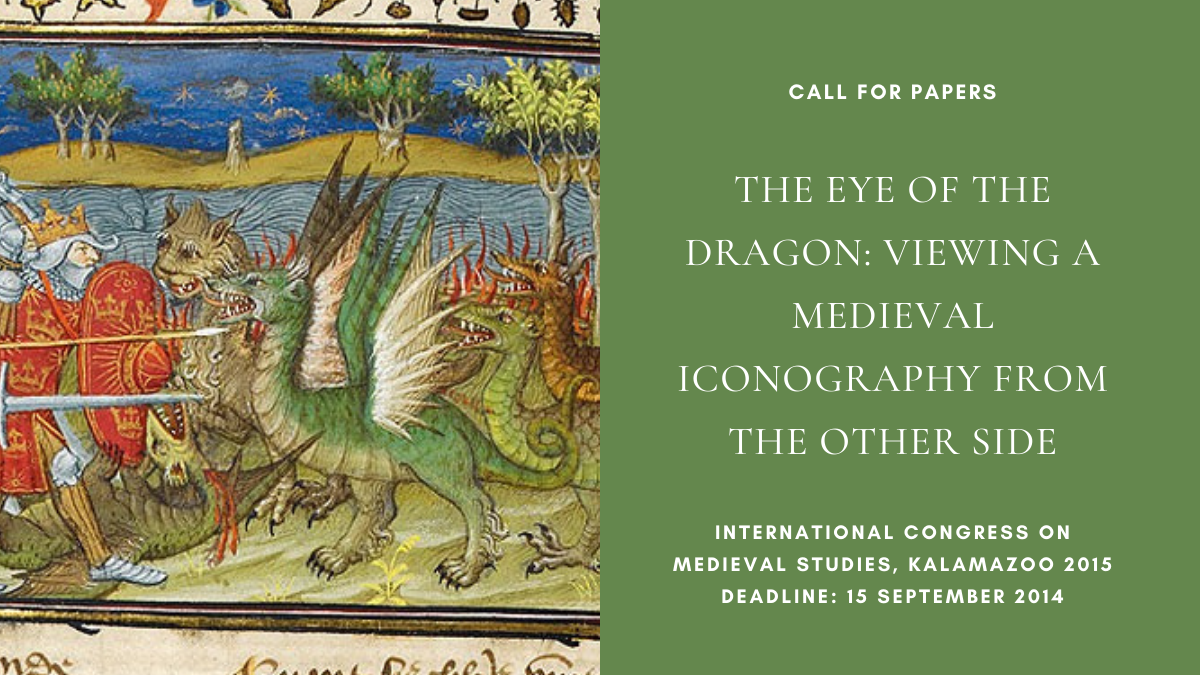
CFP: The Eye of the Dragon: Viewing a Medieval Iconography from the Other Side (Kalamazoo 2015), deadline 15 September 2014

From the iconic heroism of Saint George to the resolute piety of Margaret of Antioch; from the arrow-shooting Bahram Gur to anonymous spear-wielding riders, slayers of dragons have received considerable art historical attention. Individual slayers, as well as the iconography itself have been extensively studied and critically contextualized to reveal multi-layered meanings and changing identities. In his study on the Islamic Rider of the Gerona Beatus, O. K. Werckmeister demonstrated how, in the context of the Reconquista, the identity of the slayer could switch from good to evil, while Oya Pancaroglu argued that in Medieval Anatolia slayer images were both products and facilitators of cross-cultural exchange. Dragons and other monsters have been under the lens of art historians, too. Michael Camille and Debra Strickland have emphasized their roles as surrogates for social types and political adversaries. In that sense, the victims of the slayers, though independent of the iconography, have also been studied. However, it is difficult to say that the perspectives of the victims have received equal attention.

This panel calls for papers that will look at the slayer iconography from the position of the slain rather than the slayer. It seeks papers that will approach the image visually and conceptually from bottom up and explore alternative and innovative interpretations.  What can this switch of gaze reveal about the relationship between the dragon and the slayer? In what novel ways can we interpret the visual asymmetry between them?  Would it correspond to actual social asymmetries, or to their subversion? Does the diagonal of the spear pin down and stabilize differences and antagonisms, or does it cut across and mediate between them?  Especially welcome are papers that move beyond Western European examples and provide comparative perspectives.

Due date for the abstracts (approximately 250 words) is September 15, 2014.

Contact Person: Saygin Salgirli, Sabanci University: salgirli@sabanciuniv.edu

Call For Journal Submissions: Emotion and Affect (Hortulus, Fall 2014 Issue)

Call for Journal Submissions:
Hortulus (Fall 2014 Issue): Emotion and Affect 
Deadline: 15 August 2014 (extension possible)

Hortulus: The Online Graduate Journal of Medieval Studies is a refereed, peer-reviewed, and born-digital journal devoted to the culture, literature, history, and society of the medieval past. Published semi-annually, the journal collects exceptional examples of work by graduate students on a number of themes, disciplines, subjects, and periods of medieval studies. We also welcome book reviews of monographs published or re-released in the past five years that are of interest to medievalists. For the fall issue we are highly interested in reviews of books which fall under the current special topic.
hortulusFor our Fall 2014 themed issue, “Emotion and Affect,” we invite articles that engage with emotion and affect from a variety of disciplinary angles, including the depiction of emotions in medieval literature, history, philosophy, theology, and art. An article might address theoretical approaches to the study of emotion and affect, including history of the emotions, psychoanalysis, and affect theory. We would be happy to receive papers related to gender and feeling, emotion and politics, the rhetoric of affect, the relationship between emotion and memory, affective theology, and the role of emotions in material culture. Submissions examining emotion and affect in any medieval context are welcome. Most importantly, we seek engaging, original work that contributes to our collective understanding of the medieval era.

Contributions should be in English and roughly 6,000–12,000 words, including all documentation and citational apparatus; book reviews are typically between 500-1,000 words but cannot exceed 2,000. All notes must be endnotes, and a bibliography must be included; submission guidelines can be found here. Contributions may be submitted to hortulus@hortulus-journal.com and are due August 15, 2014. If you are interested in submitting a paper but feel you would need additional time, please send a query email and details about an expected time-scale for your submission. Queries about submissions or the journal more generally can also be sent to this address.

See also: http://hortulus-journal.com/2014/08/01/fall-2014-cfp-reminder/

Call for Papers: Biennial London Chaucer Conference: Science, Magic and Technology (London, 10-12 July 2015)

Call for Papers:
Biennial London Chaucer Conference: Science, Magic and Technology
London, Senate House, Institute of English Studies, 10-12 July 2015
Deadline: 1 September 2014

chaucer
© The British Library Board

Papers are sought on all aspects of ‘Science, Magic and Technology’ in late medieval literature and culture and particularly within Chaucer studies. Approaches might include:

  • The presentation of scientific ideas in myth and poetry
  • Observation and naturalism in literature and art
  • Experiment and experience in science and literature
  • The occult sciences (astrology, magic, alchemy) and their relationship to literature
  • Technology as magic, magic as a technology
  • Scientific literatures and the literariness of science
  • Epistemology and taxonomy in late medieval writing
  • Technologies of writing, parchment making and codicology
  • Concepts of the material and immaterial worlds, the environment, astrology, astronomy and cosmology
  • Cartography; deep-sea and space exploration
  • The science of the senses, optics, sound or scent
  • The representation of medicine in literature or the literary modes of medical writing
  • Trade technologies in literature
  • Science, magic and technology in medievalism

Papers are welcomed on the work of Geoffrey Chaucer or, more broadly, on late medieval writing and culture.

Please send 250 word abstracts to Dr Isabel Davis; Birkbeck, University of London. i.davis@bbk.ac.uk by 1st September 2014.

CFP: Renewal in the Cults of Saints, 1050-1300 (Leeds 2015)

Call for Papers:
Renewal in the Cults of Saints, 1050-1300
International Medieval Congress, Leeds, 6-9 July 2015
Deadline: 25 August 2014

We are seeking proposals for papers on the topic of renewal, reinvention and reinterpretation in the cults of saints in the period 1050-1300. Possible topics might include, but are not limited to:

  • The reinvention of saints across cultural, national, or linguistic borders
  • The impact of church reform on the cults of saints
  • Reinterpretation of a saint’s cult within cult practice, hagiography, liturgy and art
  • How a saint’s cult might be renewed or revitalised for a new audience

cuthbert
Papers dealing with renewal in the cults of Anglo-Saxon or British saints in this period will be particularly welcomed.
Proposals for papers of 15-20 minutes should be sent to steffenabhope@gmail.com or eleanor.parker@ell.ox.ac.uk by 25 August.

Source: http://my-albion.blogspot.co.uk

Conference: Le XIe centenaire d’Aght‘amar. Politique, art et spiritualité au royaume du Vaspurakan (Paris, 22-23 September 2014)

Conference:
Le XIe centenaire d’Aght‘amar. Politique, art et spiritualité au royaume du Vaspurakan
Paris, Institut des Études Avancées and Fondation Simone et Cino del Duca (Institut de France), 22-23 September 2014

Programme

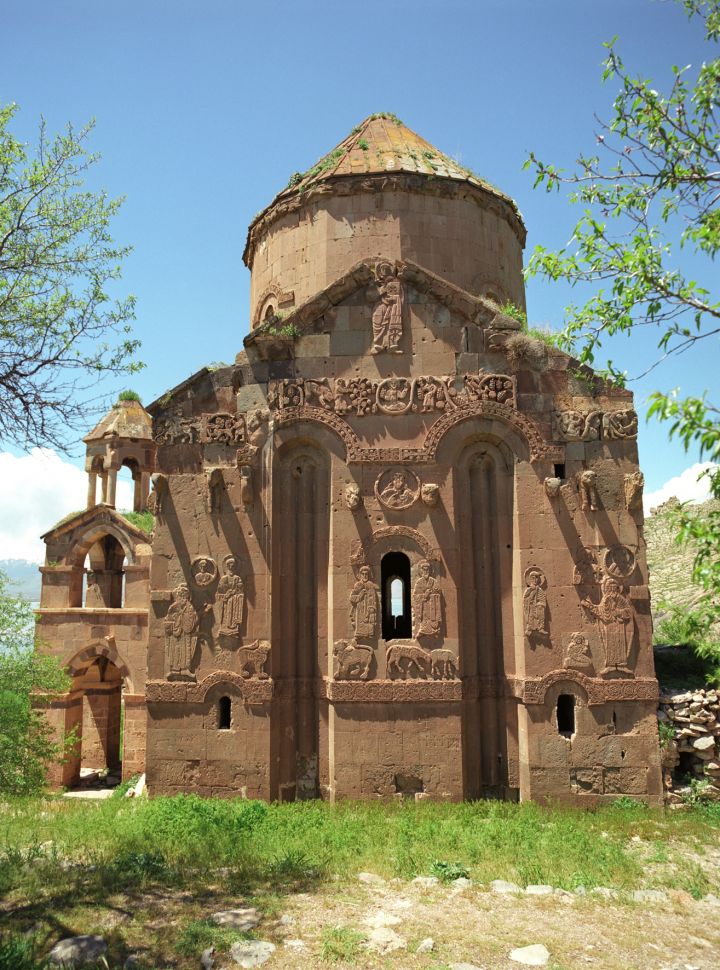
aghtamarColloque international organisé par l’Académie des Inscriptions et Belles-Lettres, l’Institut d’Etudes Avancées de Paris et l’Université John Cabot de Rome. 

En 915, le roi Gagik Artsruni commençait de construire l’église Sainte-Croix d’Aghtamar, qui fut achevée en 921. Ce chef-d’œuvre architectural, unique en Arménie par la richesse de son décor peint et sculpté, a retenu l’intérêt des historiens de l’art bien au-delà de l’horizon proche-oriental. Le développement des études de terrain et l’approfondissement des sources historiques et religieuses permettent aujourd’hui de replacer cette église palatine dans le cadre des programmes architecturaux de son bâtisseur. S’attachant à l’analyse architecturale du monument et au déchiffrement symbolique et biblique de son décor peint et sculpté, le colloque examinera, dans une large perspective comparatiste, le contexte historique et culturel de l’Arménie.

22 septembre 2014, à l’Institut d’Etudes avancées – 17, quai d’Anjou, 75004 Paris

9h15 : Accueil
9h30 : Ouverture : Jean-Pierre Mahé, Zara Pogossian, Edda Vardanyan
9h30 : Jean Richard (Membre de l’AIBL) : Conférence inaugurale

10h : Tim Greenwood (Université de St-Andrews) : «Historical Tradition, Memory and Law in the Era of Gagik Artzruni»
10h30 : Jean-Claude Cheynet (Université de Paris-Sorbonne) : «Le royaume du Vaspourakan et Byzance au Xe siècle»

11h : Discussion puis pause café

11h30 : Alison Vacca (Université du Tennessee, Knoxville) : «Basfurğān and the Artzruni Family in Arabic Sources»
12h : Aram Vardanyan (Académie des sciences d’Armenie, Erevan) : «A Case of a Rough Interaction : What was Money in the Kingdom of Vaspurakan (9th-11th c.) ?»

12h30 : Discussion puis pause déjeuner

14h30 : Robert Thomson (Université d’Oxford) : «Biblical Exegesis in Vaspurakan in the 10th Century»
15h : Igor Dorfmann-Lazarev (Université Boğaziçi, Istanbul) : «La lettre du roi du Vaspourakan Gaguik à l’empereur Romanos concernant la foi»

15h30 : Discussion et pause café

16h30 : Sergio La Porta (Université de Californie, Fresno) : «Beyond Image and Text : Armenian Readings of the Old Testament Scenes on the Church at Aght‘amar»
17h : Krikor Beledian (INALCO, Paris) : «L’émancipation de l’image dans le royaume du Vaspourakan»

17h30 : Discussion

23 septembre 2014, à la Fondation Simone et Cino Del Duca – 10, rue Alfred de Vigny, 75008 Paris

9h30 : Allocution (Académie des Inscriptions et Belles Lettres)

10h : Bernard Flusin (Université de Paris-Sorbonne) : «Le culte de la Croix à Constantinople au Xe siècle : le témoignage du Livre des cérémonies»
10h30 : Zara Pogossian (Université John Cabot, Rome) : «From Héraclius to Gagik : Veneration of the True Cross in Vaspurakan»

11h : Discussion puis pause café

11h30 : Jean-Pierre Mahé (Membre de l’AIBL) : «La Sainte-Mère-de-Dieu d’Aparank‘ : politique, diplomatie et spiritualité»
12h : Patrick Donabédian (Aix-Marseille Université) : «Sainte-Croix d’Aght‘amar. Observations sur le sens symbolique, architectural et iconographique de la dédicace»

12h30 : Discussion puis pause déjeuner

14h : Armen Kazaryan (Académie d’architecture de Moscou) : «The Church of Aght‘amar : a New Image in Medieval Architecture»
14h30 : David Kertmenjian (Académie des Beaux-Arts d’Erevan) : «About the Architecture of the Historical Palace Complex in Aght‘amar Island»

15h : Discussion puis pause café

15h30 : Ioanna Rapti (UMR 8167, Orient et Méditerranée, Paris) : «Calling Holy Patrons : the Hagiographic Component in the Iconography of Aght‘amar»

16h : Edda Vardanyan (Institut d’études avancées de Paris) : «La frise de la vigne de l’église d’Aght‘amar et la Bible»
16h30 : Gohar Grigoryan (Université de Fribourg, Suisse) : «King Gagik Artzruni’s Portrait on the Church of Aght‘amar»

17h : Discussion et conclusion

For further information, see: http://paris-iea.fr/node/1841


Call for Applicants: Resident Researchers 2015 (Madrid, Casa de Velázquez)

Call for Applicants:
Resident Researchers 2015 (Madrid, Casa de Velázquez)
Deadline: 30 September 2014

Casa_de_Velazquez_hoy_en_dia

The Casa de Velázquez in Madrid is taking applications for “Resident Researchers” for 2015. Resident Researchers may be affiliated with French or non-French universities and research institutes, and can propose a stay of between one and ten months. Resident Researchers will receive accommodation, a monthly stipend and a partial reimbursement for travel costs. The deadline for applications is September 30, 2014. For more information, see https://www.casadevelazquez.org

Call for Applicants: Medieval Mediterranean PhD Program (Universidad de Alicante, Spain)

Call for Applicants:
Medieval Mediterranean PhD Program
Universidad de Alicante, Spain
Application period: 1 July – 15 September 2014

The University of Alicante (Spain) is taking applications for their PhD program in Intercultural and Historical Transferences in Medieval Mediterranean Europe.

uni-alicante2This doctoral program is convened under the auspices of ISIC-IVITRA (http://www.ivitra.ua.es) (Ref. ISIC/2012/022), of the Faculty of Philosophy and Letters of the Universidad de Alicante (http://lletres.ua.es/va/postgrau/doctorat.html),and the Seu Universitària de la Nucia (http://web.ua.es/es/seus/lanucia/), and is administered by the Escola de Doctorat de la UA (http://cvnet.cpd.ua.es/webcvnet/planestudio/planestudiond.aspx?plan=E020#). The doctoral program is also affiliated with the following research projects: I+D+i PROMETEO/2014/012 and PROMETEO/2009/022 (Group Projects for Excellence), and  FFI/2012/37103, VIGROB-125, GITE-09009-UA, and USI-UA-45 (Competitive Research Projects).

For more information, see http://www.ivitra.ua.es/doctorado/doctorado.htm
[This program can also be completed via distance learning]

New Journal: Convivium: Exchanges and Interactions in the Arts of Medieval Europe, Byzantium, and Mediterranean

New Journal: Convivium. Exchanges and Interactions in the Arts of Medieval Europe, Byzantium, and Mediterranean (Seminarium Kondakovianum Series Nova)
Deadline for Article Submission: March and November each year

Convivium restarts and continues the glorious Seminarium Kondakovianum, the journal of the institute founded in memory of Nikodim Kondakov in 1927, which represented the desire to maintain and deepen Kondakov’s pioneering scholarly work in Byzantine and medieval studies, celebrated not only in the Russian and Czech worlds but also in western Europe. Convivium covers an extended chronological range, from the Early Christian period until the end of the Middle Ages, which in central Europe lasted well beyond the Renaissance in Italy. Equally vast is the range of subjects it will treat. Whereas its central concern remains art history, that is, whatever pertains to images, monuments, the forms of visual and aesthetic experience, it is also open to many disciplines tied to art history in the deepest sense: anthropology, liturgy, archaeology, historiography and, obviously, history itself. The goal is to ensure that the journal will provide a 360o opening onto the field and the research methods being deployed in it.

Two numbers of the journal will be issued every year; all articles will be approved by a blind peer-review process. The first will focus on a theme, and the second will be a miscellany. Each issue will comprise five to ten articles (in French, English, Italian, or German), between 40,000 and 60,000 strokes long and fifteen illustrations (some in color). Convivium will be published in paper and digital format and distributed by Brepols. To submit an article, contact: convivium@earlymedievalstudies.com.

For further information on editors, editorial board, advisory board and style guidelines, see: http://www.earlymedievalstudies.com/convivium.html

Upcoming thematic issues include:

2014: Circulation as Factor of Cultural Aggregation. Relics, Ideas, and Cities in the Middle Ages
Editors: Klara Benesovska, Ivan Foletti, Serena Romano

2015: The Three Romes (Rome, Constantinople, Moscow). Studies in Honour of Hans Belting.
Editors: Ivan Foletti, Herbert Kessler

2016: Facing and Forming the Tradition. Illustrated Texts on the Way from Late Antiquity until the Romanesque Time.
Editor: Anna Boreczky

2017: Inventing the Past: Medieval Studies as a Virtual Construction.
Editors: Xavier Barral i Altet, Ivan Foletti

2018: Multicultural Spaces in Southern Italy.
Editors: Elisabetta Scirocco, Gerhard Wolf

Call for Papers: Moving Women, Moving Objects 300-1500 (Kalamazoo 2015)

Call for Papers:
Moving Women, Moving Objects 300-1500 
ICMA-sponsored session at the International Congress on Medieval Studies
Kalamazoo, Michigan, 14-17 May 2015
Deadline: 15 September 2014

As we examine medieval works of art like manuscripts, reliquaries, and jewels, today anchored and spotlighted in their museum vitrines, it is easy to imagine these sumptuous objects at rest in the hands of their original owners. But, in truth, they were in constant motion, and women were especially responsible for the movement of these works of art.
Isabeau_de_Baviere3This panel seeks to enrich the discussion of women and their relationships with their objects that, in the area of non-book arts, remains relatively unexplored. Luscious objects were gifts that traveled lesser and greater distances, some imported in brides’ nuptial coffers and many more commissioned and used to unite women separated by their politically advantageous marriages. Sisters and mothers, grandmothers and aunts, daughters and cousins, as well as friends and allies, all exchanged works of art with shared stories and iconographies. These pieces were the tokens that served as tribute, the centerpieces of rituals and ceremonies, the precious keepsakes enjoyed in intimate places, and the markers of architectural spaces often also founded or endowed by these women.

Theories of feminism, anthropology, sociology, and geography, among others, can all aid in the interpretation of the movement of works of art by women. New technologies such as GIS mapping and digital modeling enable us to visualize the international trajectories of works of art, as well as the movement and placement of them within architectural space. Proposals for this panel could include papers concerning women living between 300-1500. While proposals discussing European examples are anticipated, those analyzing any culture are encouraged. Papers might discuss women moving their objects in ritual space; the international, cross-cultural fertilization of the arts resulting from women’s gifts; the mapping of women’s identity through placement of objects; or class and women’s movement of their objects.

Please email the session chairs a one-page abstract of your paper, with images of the works of art you will discuss, and the Participant Information Form (available athttp://www.wmich.edu/medieval/congress/submissions/#PIF)

Contact: Tracy Chapman Hamilton, Sweet Briar College, thamilton@sbc.edu; Mariah Proctor-Tiffany, California State University, Long Beach, mariah.proctor@csulb.edu

Proposals due: September 15, 2014