 On Wednesday 24 January 2018 Lloyd de Beer and Naomi Speakman once again welcomed a group of staff and students from The Courtauld and elsewhere, as well as Sophie Kelly, PhD student from the University of Kent. The focus of our session was objects in the British Museum collection with links to the Trinity.
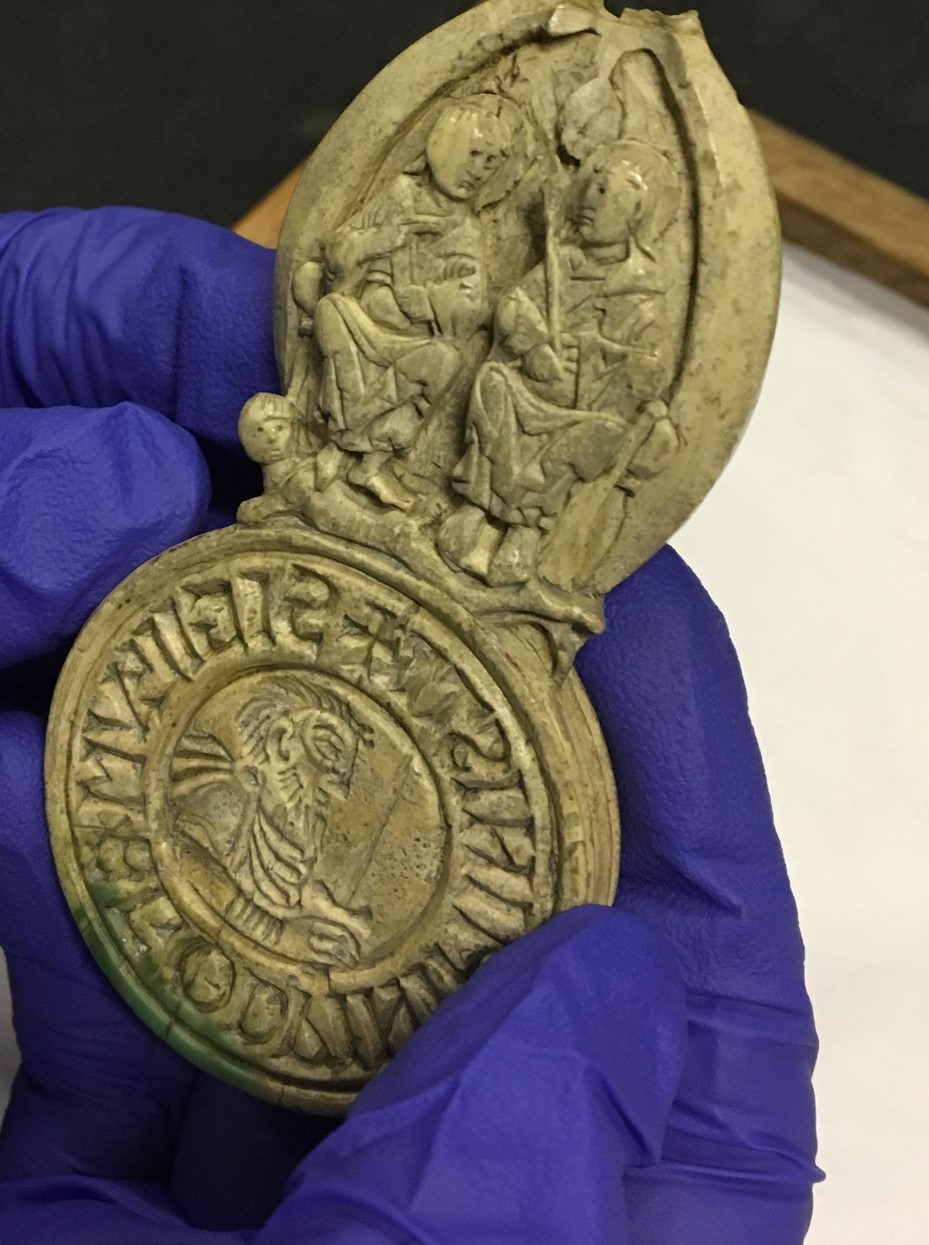
We looked at eleven objects with Trinitarian iconography, the earliest of which was the walrus ivory seal die of Godwin the Thane, dating from the early eleventh century. Beautifully carved with iconography inspired by Psalm 109 (110), ‘The Lord said unto my Lord: Sit thou at my right hand and I will make thine enemies thy footstool’. The decoration on the handle consists of God the Father and Son in relief, enthroned over a prostrate human figure. We were very interested to investigate the evidence of damage above the two figures which, we agreed, was likely to have once included a symbol of the Holy Ghost in the form of a dove.
The Trinity also features on a fourteenth-century circular bronze seal-matrix (with wax impression) with a loop at top. Here the Trinity is depicted as three near-identical figures with an inscription ‘SCA TRINITAS.VHVS.DEVS’. The third seal which we saw was the fifteenth-century circular bronze seal-matrix (with wax impression) of the Friars of the Holy Trinity, Hounslow. Under a Gothic canopy with side-tabernacles the Trinity is depicted in a manner which allowed us to discuss different ways of representing the Trinity in the Middle Ages. Here, the iconography known as the Throne of Grace (Gnadenstuhl), is used. In these depictions of the Trinity, God the Father is seated and holds the cross upon which Jesus Christ is crucified in front of his lap, with the dove of the Holy Spirit alongside. This iconography became popular from the thirteenth century and is seen across a wide range of artistic media, including manuscripts, stained glass and stone carving. The Trinity depicted as the Throne of Grace also appeared on a late Medieval gold finger ring. With the help of a magnifying glass we were able to appreciate the detailed depiction of the Trinity on the oval bezel of the ring, which included the dove which is shown between Christ’s right arm and God the Father.
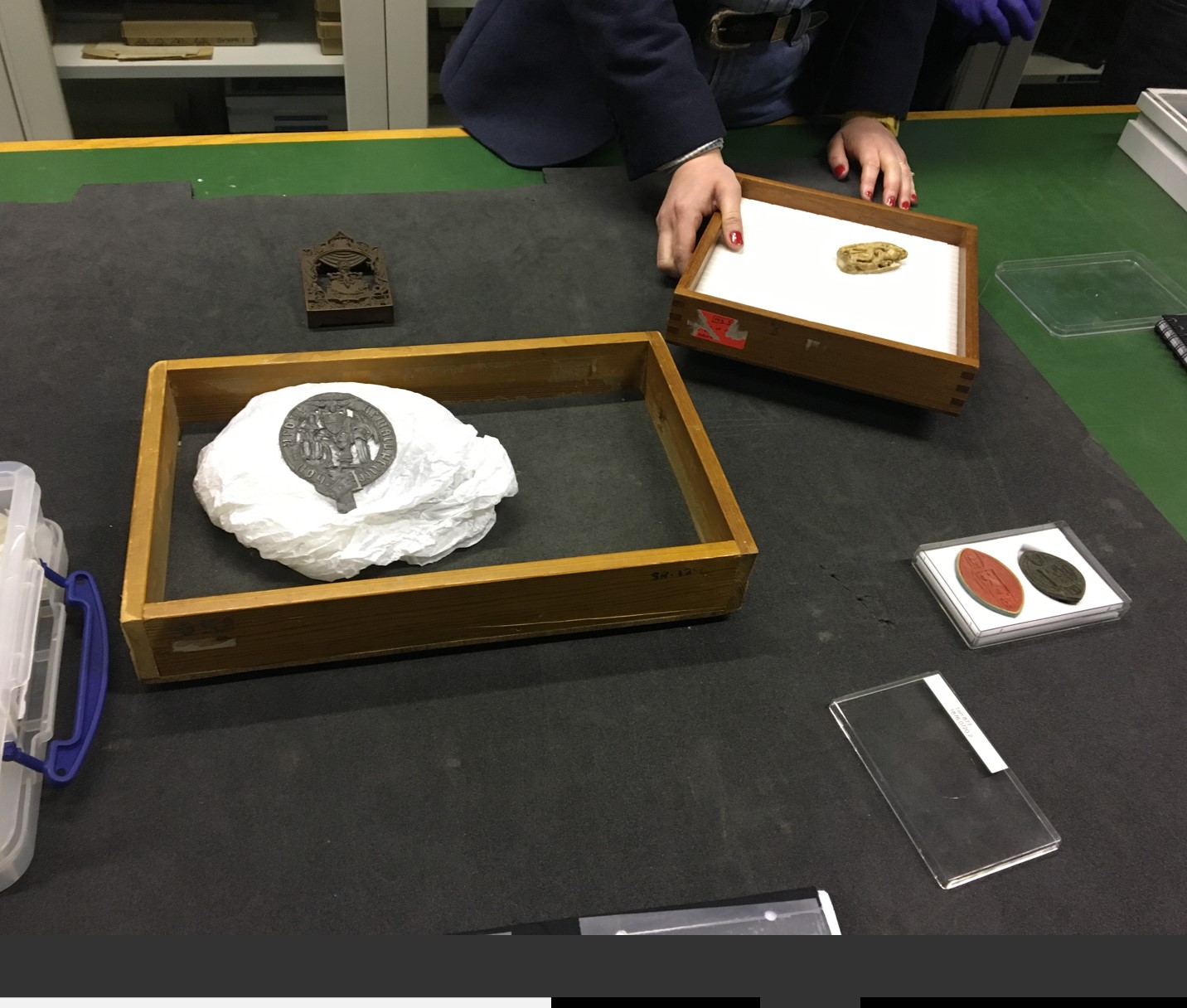 We discussed Plantagenet devotion to the Trinity evidenced through the lead Badge of the Black Prince of c.1376 which shows the Black Prince kneeling before Trinity (although the dove is missing). The Black Prince wears a tabard with Arms of England and has thrown down his gauntlet before him; above him is an angel in clouds holding his shield. We also looked at two Anglo-Saxon ivory plaques depicting the Crucifixion. Above the head of Christ, the Hand of God is depicted, thereby alerting us to the presence of two persons of the Trinity. This led to discussion related to how we might understand images where one of the member of the Trinity is ‘missing’; can the presence of the other person be implied?
An object which we all found challenging was a wood-carved relief representing the Trinity (also in the Throne of Mercy composition) dated 1450-1500 and including depictions of the Annunciation, St Francis of Assisi, St Bernardino and St Sebastian. The largest object encountered was a late Medieval alabaster Coronation of the Virgin which still shows traces of painting and gilding. Here the Virgin is surrounded by the persons of the Trinity represented as three crowned figures.
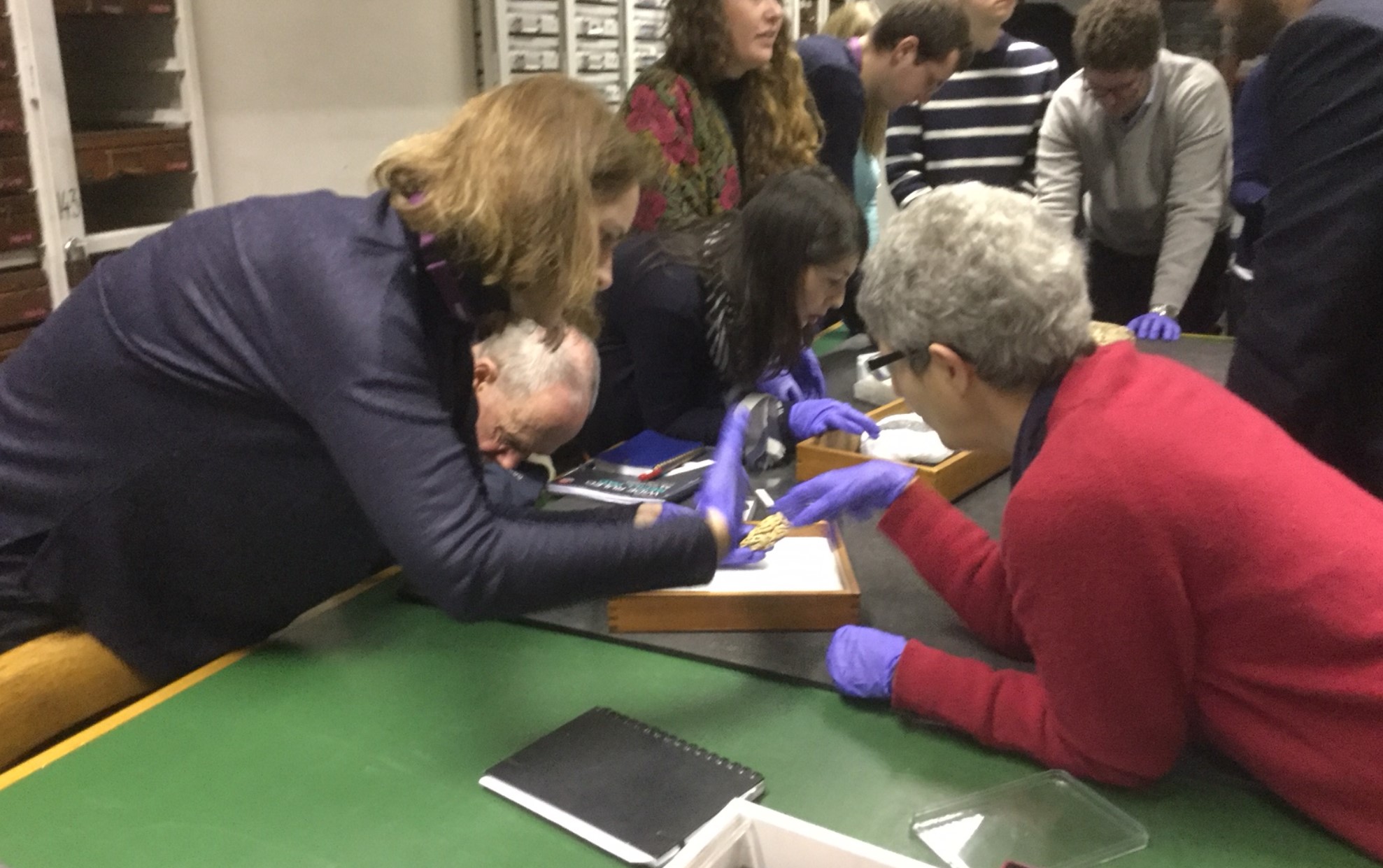
In preparation for the handling session we read the following texts and discussed them at a reading group the night before:
Bernard McGinn, ‘Theologians as Trinitarian Iconographers’, In: Jeffrey Hamburger and Anne-Marie Bouché The Mind’s Eye. Art and Theological Argument in the Middle Ages, Princeton, 2006, 186-207
André Grabar, ‘Dogmas Expressed in a Single Image’, In: Christian Iconography. A Study of its Origins, London, 1969, 112-127
Jacobus De Voragine, ‘The Holy Spirit’, In: The Golden Legend, Princeton, 1993, 299-306
We looked at the definition of the Trinity in The Oxford Dictionary of the Christian Church (Oxford, 1997), and were interested to explore the tension between theology and iconography. In particular, how can dogma such as the Trinity be represented? Grabar and McGinn have contrasting views on what constitutes ‘successful’ iconography; McGinn sees artistic experimentation and lack of iconographic stability as positives, whereas Grabar suggests that the fact an image appears in limited or isolated circumstances makes it a failure. To aid our discussions, we looked at some manuscript images of the Trinity. These included: British Library, MS Cotton Tiberius C vi (Tiberius Psalter); British Library, MS Cotton Titus D. xxvii (Ælfwine’s Prayerbook); British Library, MS Add. 34890 (Grimbald Gospels); British Library MS Cotton B IV (Aelfric’s Hexateuch); British Library, MS Harley 603 (Harley Psalter); MS Lansdowne 383 (the Shaftesbury Psalter); Winchester Bible, Winchester Cathedral; and St John’s College, Cambridge, MS K 26 (St John’s Psalter). We discussed the experimental nature of Trinitarian iconography and how this might help us understand the chancel wall painting of the Throne of Grace at the Church of St Mary, Houghton-on-the-Hill, Norfolk which is unique, and the earliest known appearance of this motif.


 Medieval Art Research