Call for Submissions: Metropolitan Museum Journal

The Editorial Board of the peer-reviewed Metropolitan Museum Journal invites submissions of original research on works of art in the Museum’s collection. There are two sections in the JournalArticles and Research NotesArticles contribute extensive and thoroughly-argued scholarship. Research Notes typically present a concise, neatly bounded aspect of ongoing investigation, such as a new acquisition or attribution, or a specific, resonant finding from technical analysis. All texts must take works of art in the collection as the point of departure. 

The deadline for submissions for Volume 56 (2021) is September 15, 2020

The process of review is double-blind. Manuscripts are reviewed by the Journal Editorial Board, composed of members of the curatorial, conserva­tion, and scientific departments, as well as external reviewers.Articles and Research Notes in the Journal appear both in print and online, and are accessible via MetPublications and the Journal‘s home page on the University of Chicago Press website. For more information, please visit these sites:

Submission guidelines: www.journals.uchicago.edu/journals/met/instruct
Send materials to: journalsubmissions@metmuseum.org
Inspiration from the Collection: www.metmuseum.org/art/collection
View an online sample issue here

Seminar: ‘The Patrons of the Percy Psalter-Hours’, Dr Eleanor Jackson

Tuesday 9 June 2020, 5.30pm

Speaker(s): Dr Eleanor Jackson is Curator of Illuminated Manuscripts at the British Library. She completed her PhD at the History of Art Department at the University of York in 2017.

In March 2019, the British Library acquired a late 13th-century book of hours of the Use of York known as the Percy Hours. This would be exciting enough on its own, but the British Library also holds its long-separated other half, the Percy Psalter, with which it originally formed a single-volume psalter-hours. This acquisition allowed the Library to reunite the two manuscript halves in the same institution for the first time in around 200 years.

The Percy Psalter-Hours is one of a relatively small number of devotional books for the laity surviving from 13th-century England, and probably the only example from York. It provides rare insight into a period of great change in book culture, when devotional books for the laity were growing in popularity and regional workshops for commercial book production were emerging around the country.

Despite its significance, the question of the manuscript’s patronage has never been satisfactorily answered. Scholars have long recognised that the original owners should be identifiable based on the portrait of a knight and lady with coats of arms on the Beatus page. While scholarly opinion has generally settled on Henry de Percy (d. 1314) and his wife Eleanor FitzAlan (d. 1328) as an approximate fit for the heraldry, there are serious problems with this identification. This paper, still a work in progress, presents a new identification of the patrons for your opinions and feedback.

The meeting will be held by Zoom. To join the meeting please sign up on this Google Form. Registration closes at 10am on the day itself. Participants will receive an email containing a link to the meeting once registration has closed. If you have any queries, please email hanna.vorholt@york.ac.uk.

All Welcome! 

Location:  Online via Zoom

Organiser: Centre of Medieval Studies and the History of Art Department’s Medieval Art and Medievalisms Research School at the University of York

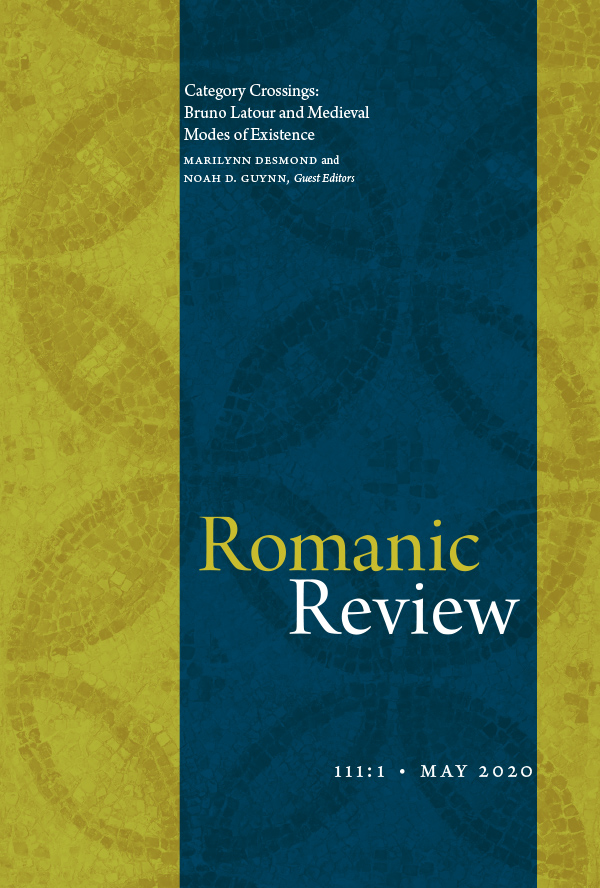
New Publication: ‘Category Crossings: Bruno Latour and Medieval Modes of Existence’, Romanic Review

Duke University Press is please to announce that the latest issue of Romanic Review, “Category Crossings: Bruno Latour and Medieval Modes of Existence,” is free to read online for the next three months (beginning May 6, 2020). Published by Columbia University, Romanic Review is a journal devoted to the study of Romance literatures that has been in publication since 1910.

Continue reading “New Publication: ‘Category Crossings: Bruno Latour and Medieval Modes of Existence’, Romanic Review”

New Publication: Christ on the Cross, edited by Shirin Fozi and Gerhard Lutz

Volume 14 in the series Studies in the Visual Cultures of the Middle Ages, this publication provides a comprehensive view of the first generation of monumental crucifixes to appear in medieval Europe, which balances examinations of the history, theology, styles, and material properties of these evocative objects.

Continue reading “New Publication: Christ on the Cross, edited by Shirin Fozi and Gerhard Lutz”

Exhibition: The Ministry of Works collection: Photographs and images from the Conway Library

The Courtauld has created a new online exhibition of photos from the Conway library, including a set of extraordinary photos taken in the aftermath of WWII. Medievalists will find much of interest here, including this striking photo of Private William Scollie of Chicago examining art works in the Siegen caves near Cologne in April 1945.


Online Resources: Les Enluminures

Les Enluminures, a gallery specializing in medieval illuminated manuscripts with locations in NYC, Chicago, and Paris, provides several digital resources for specialists, collectors, and the public alike to learn about medieval manuscripts. Here is a list of some of their online offerings:

Podcasts
Screen Shot 2020-05-06 at 12.48.44 PM

Begun in 2019, here you can listen to untold stories of medieval and Renaissance artworks, medieval manuscripts and jewelry. Join us for illuminating lectures, gallery talks, recent research, and interviews with collectors and scholars. Les Enluminures podcasts transform the past into the present.

TextManuscripts.com
Screen Shot 2020-05-06 at 12.48.04 PM

This is the oldest digital initiative of Les Enluminures, launched not quite twenty years ago. The online site dedicated to the description and sale of text manuscripts http://www.textmanuscripts.com first appeared in September 2002. It offers the largest and most wide-ranging inventory of text manuscripts currently on the market. Beginning with Text Manuscript 1 (TM1), manuscripts on the site number well over 1,000. The majority belong to college and university libraries worldwide, and many have been the subject of scholarly study – articles, books, colloquia, and so forth. Fulfilling a service to the larger manuscript community, Les Enluminures maintains an Archive in which all sold manuscripts remain online for citation and study. New items are posted bi-annually, in the Fall and in the Spring.

Blog
Screen Shot 2020-05-06 at 12.55.19 PM

Begun in 2015, this occasional blog highlights what makes our text manuscripts particularly interesting and appealing to us. Here we explore what these books disclose about how they were made and used. We also share what we know of their most fascinating and unusual contents, makers, and owners. Some of our discoveries are quite significant, some merely amusing, and some bizarre. Some blogs spill over into other areas of our inventory, like Books of Hours and miniatures. All medieval manuscripts have much to reveal to their attentive modern audiences.

To learn more about Les Enluminure’s resources, as well as to see their available artworks, please visit their website.

CFP: Materiality and Conversion

Materiality and Conversion: The Role of Material and Visual Cultures in the Christianization of the Latin West

November 30 – December 1, 2020

The Center for Early Medieval Studies at Masaryk University invites you to submit to their call for papers on material and visual culture in the early medieval Mediterranean. Please submit your proposals by May 30, 2020.

Materiality&Conversion_WEB-page-001Materiality&Conversion_WEB-page-002


Online Resources: Teaching Art History

In light of our current global crisis, most of us are facing drastic changes to every area of our lives—including how we study art and interact with teachers, students, and colleagues. The International Center of Medieval Art (ICMA) has pulled together a fantastic master list of online resources for art history academics and enthusiasts.

Browse blog posts, Youtube videos, power points, and more. Find content but also tips and tricks on how to learn online. And always remember, learning art history is supposed to be fun!

Conference: Materiality and the Virtual, a virtual symposium, 1 May 2020

The MARGIN (Medieval and Renaissance Graduate Interdisciplinary Network) team at New York University cordially invite you to attend their first-ever virtual symposium! Tune in to this highly relevant symposium, Materiality and the Virtual, this Friday, May 1. RSVP is required to receive the link to the Zoom conference call. Please click here to RSVP.

0002

CFP: Within and Without the Manuscript, deadline 22 May 2020

Within and without the manuscript: interactions between illumination and the other arts

Université de Lausanne

October 22nd-23rd, 2020

Due April 19, 2020 May 22, 2020

Since at least the 1960s, book illumination has been fully recognized as an important sector of the arts and as an integral part of the historical studies of the book. The study of this branch takes place not only in libraries and archives, but also in universities, with dedicated chairs and specific journals, as well as its own research institutes and congresses. However, the increasing specialisation should not make us forget that this field of artistic production has never been isolated from the others.

Throughout the history of this technique the links between the arts of the book and other media have been deep, continuous and fruitful. Painters have often practiced equally on panel, fresco, parchment and glass. The composite and complex nature of the book has often encouraged artists working in its pages and on its binding (whether goldsmiths or ivory carvers) to inspire each other. Patrons of manuscripts and illuminators shared the same background as other patrons and artists; formal ideas, iconographic solutions, and compositions have thus circulated to and from codices. While there is no shortage of studies addressing these issues. Nonetheless, it seems valuable to create a collective discussion and reflection centered entirely on this issue.

Continue reading “CFP: Within and Without the Manuscript, deadline 22 May 2020”