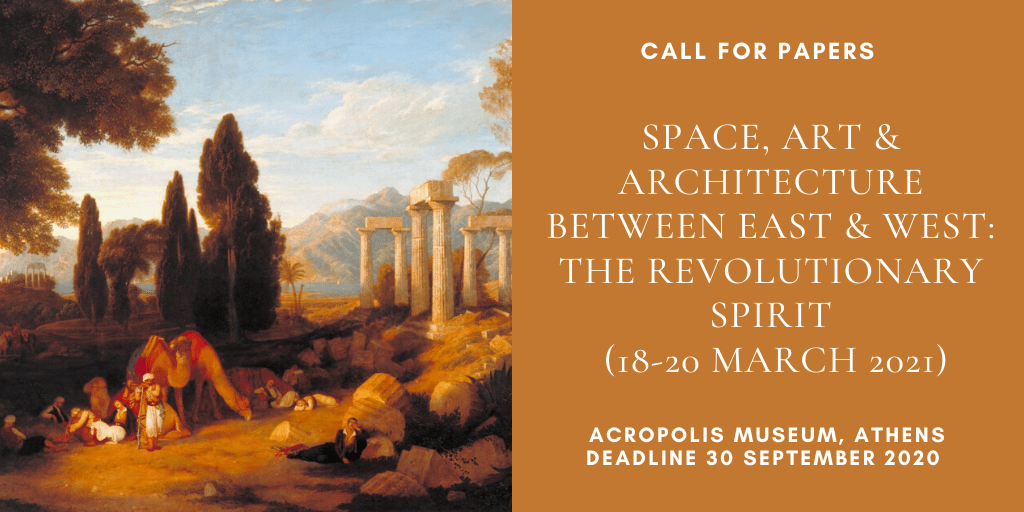
CFP: Space, Art and Architecture between East and West: the Revolutionary Spirit, conference at the Acropolis Museum, Athens, Greece (18-20 March 2021), deadline 30 September 2020

The emergence of modernity coincided with the geographical expansion of Europe and its influence through the discovery of the continents, trade, and colonialism. In the process, the perception of global space in geographical, cultural and artistic terms was radically changed. Exoticism, Chinoiseries, Japonisme, Egyptomania, India and the Americas, among others, influenced deeply the West, shaped modernism as a dominant art and architectural movement, and meant the demotion of the Mediterranean in matters of trade though not of cultural focus. All this can be portrayed, indicatively, in the works of Eugène Delacroix, Charles Rennie Mackintosh, Frank Lloyd Wright, Vincent van Gogh and Paul Klee.

How we define ‘the East’ and ‘the West,’ whereby the East has been regularly identified with backwardness and tradition, while the West with dynamism and modernization, as Edward Said has shown, is subject to historical-geographical changes. This is witnessed in the case of Greece: Cradle of the Western civilization for its classical period, it became an Ottoman province for four centuries after the fall of Constantinople, gravitating between a dystopian East and an ideal West in the geographical imaginations of Europe which participated multifariously in its return to the ‘Western’ sphere. These geographical re-orientations, power relations and antagonisms have often involved all kinds of clashes over resources, predominance, religions and cultures, some of which continue unabated, despite recent cultural movements such as post-modernism and concomitant explorations of otherness, as processes of globalization are fiercely resisted nationally.

The international conference Space, Art and Architecture between East and West: The Revolutionary Spirit, organized by the Module Art-Architecture-Urban Planning, Hellenic Open University, intends to explore the spatial and creative aspects and impacts of the above processes both diachronically and in the present. More particularly, the following relevant dimensions will be pursued globally:

  • Competing cultures: ‘East’-‘West’ dialogues, rationalities, spatialities, perceptions, artistic and architectural creativity, old and new colonialisms, clashes and upheavals.
  • Processes of exchange during the beginning of modernity, starting from the 16th century.
  • What and where was the Renaissance in regard to appropriations and interpretations of Byzantium and the East.
  • Edward Said’s Orientalism and cultures of travel: The present narratives.
  • Eastern art and architecture as Western history of art and architecture.
  • Post-war cultural dynamism of the USA as the new ‘Western’ frontier of art and art history.

In the above context we invite the submission of proposals for papers from art theorists and historians, architects, social anthropologists, archaeologists, architectural historians, urban planners, human geographers, and other relevant theorists until September 30, 2020. Acceptance of papers will be decided until late October 2020.

Languages: English, Greek.

Proposals, including name plus title and abstract of paper of up to 300 words can be sent to: on.revolution.conference@gmail.com by September 30, 2020.

We intent that the conference will take place at the Acropolis Museum, Athens, 18-20 March 2021, following in the footsteps of our two previous conferences, held there in 2017 and 2019. However, please note that, due to the coronavirus pandemic, we are also preparing alternative plans for the materialization of the conference either via physical presence, or as a webinar, or as a combination of the two.

The Organizing Committee:
Professor Argyro Loukaki, Hellenic Open University
Professor Dimitris Plantzos, National and Kapodistrian University of Athens
Dr. Dionysis Mourelatos, Hellenic Open University
Dr. Stavros Alifragkis, Hellenic Open University
Dr. Kostas Soueref, Hellenic Ministry of Culture and Sports
Dr. Jenny Albani, Hellenic Ministry of Culture and Sports
Seminars: Uncovering the Parish Church’s Naughty Bits, talk by Dr Emma J. Wells, The Churches Conservation Trust seminar series, Thursday 23 July at 1pm

Gazing at the inside or outside of an historic church, your eyes are likely to encounter strange beasts, frolicking figures and twisted foliage staring back at you from doorways, windows, friezes, corbel tables, roof bosses and stained glass – although plenty are just hidden enough to fool the eye. What are these strange images? Hidden messages and tongue-in-cheek depictions were actually widespread throughout medieval churches. Was the period simply rife with satire or did these etchings and carvings hold deeper meanings? Here, we will explore some of the most curious examples.

This talk is given by Dr Emma  J. Wells. Dr Emma is an Ecclesiastical and Architectural Historian specialising in the late medieval and reformation parish church/cathedral, the senses, pilgrimage, saints as well as built heritage more generally. She is the Programme Director of the PGDip in Parish Church Studies in partnership with the CCT at the University of York. Her book, Heaven On Earth: The Lives & Legacies of the World’s Greatest Cathedrals, is to be published by Head of Zeus in Autumn 2021.

Find out more here.

New Publication: Visualizing Justice in Burgundian Prose Romance: Text and Image in Manuscripts of the Wavrin Master (1450s-1460s), by Rosalind Brown-Grant

This book explores the textual and visual representation of justice in a corpus of chivalric romances produced in the mid-15th century for noble patrons at the court of Burgundy.

This is the first monograph devoted to manuscripts illuminated by the mid-fifteenth-century artist known as the Wavrin Master, so-called after his chief patron, Jean de Wavrin, chronicler and councillor at the court of Philip the Good of Burgundy. Specializing in the production of pseudo-historical prose romances featuring the putative ancestors of actual Burgundian families, the artist was an attentive interpreter of these texts which were designed to commemorate the chivalric feats of past heroes and to foster their emulation by noble readers of the day. Integral to these heroes’ deeds is the notion of justice, their worth being measured by their ability to remedy criminal acts such as adultery, murder, rape, and usurpation. In a corpus of 10 paper manuscripts containing the texts of 15 romances and over 650 watercolour miniatures, the stylized, expressive images of the Wavrin Master bring out with particular clarity the lessons in justice which these works offered their contemporary audience, many of whom, from the Burgundian dukes downwards, would have been responsible for upholding the law in their territories. Chapters are devoted to issues such as the nature of just war and how it is linked to good rulership; what forms of legal redress the heroines of these tales are able to obtain with or without the help of a male champion; and what responses are available in law to a spouse betrayed by an adulterous partner. The book will be of interest to scholars of medieval art, literature, legal and cultural history, and gender studies.

Rosalind Brown-Grant is Professor of Late Medieval French Literature at the University of Leeds. She has published on Christine de Pizan, French prose romance, Burgundian historiographical writing, and text/image relations. Her work has been funded by the Arts and Humanities Research Council, British Academy, and Leverhulme Trust; she has also held Research Fellowships at Le Studium, Institute for Advanced Studies, Orléans, and the Netherlands Institute for Advanced Study in the Humanities and Social Sciences, Amsterdam.

Table of Contents

List of figures
Foreword and acknowledgements

Introduction
This chapter sets out the rationale for the monograph. First, it situates its approach to study of the works of the Wavrin Master in relation to past and current scholarship in the field of Burgundian manuscript illlumination. Second, it explains and briefly illustrates the methodology it adopts, this being the analysis of the interplay between text and image in manuscripts of these prose romances, from the particular perspective of how this interplay inflects the issues of justice that are raised in the narrative. Third, it outlines in detail the precise research questions that will be addressed in the monograph and explicates the order of the chapters, justifying which texts have been selected from the corpus for detailed treatment.  


Chapter 1: Artist, Corpus, Patrons, Court 
This chapter provides a detailed context for analysis of the manuscripts in the Wavrin Master corpus by outlining who the artist was, what his body of work consisted of, who his chief patrons were, what books they held in their libraries, and how these texts contributed to the wider ideological project of legitimising the Burgundian polity as a personal union between the lord and his subjects, particularly during the reigns of the third and fourth dukes, Philip the Good and Charles the Bold. It thus sees these romances as forming part of a “literature of statecraft” teaching princely virtues, especially on matters of justice, alongside moralising works such as mirrors for princes, military treatises, and the many different types of historiographical texts that found favour at the Burgundian court.


Chapter 2: Justice, Warfare, and Rulership in Florimont, the Seigneurs de Gavre and Saladin 
This chapter focuses on three texts whose presentation of the hero’s military exploits can be read as a demonstration of medieval just war theory in action and of the link between just war and just rulership. It argues that the first two tales, Florimont and the Seigneurs de Gavre, can be seen as paradigmatic of the Wavrin Master’s corpus in depicting an unequivocally exemplary hero as a just warrior and later ruler pitted against a series of antagonists whose illegitimate wars destroy their credibility as governors of their lands. By contrast, the third text, Saladin, is much more ambivalent in its portrayal of a hero whose undoubted status as a model of just conduct in war is fatally undermined by his reasons for going to war in the first place, being chiefly motivated by an insatiable desire for conquest, a lesson which may well have had a particular pertinence for Charles the Bold whose territorial ambitions far outstripped those of all three of his ducal predecessors. Translating these texts’ often abstract ideas about just war and just rulership into the realm of the visual, the Wavrin Master plays with the extent to which the hero as a chivalric leader can be contrasted with his opponents in terms of both his appearance and his physical domination of space as a way of underlining the rightfulness or wrongfulness of the military causes he espouses.  


Chapter 3: Poor Judgements: Righting Wrongs against Women in Gérard de Nevers, the Fille du comte de Pontieu, and Florence de Rome
This chapter examines three romances that deal with the righting of wrongs perpetrated by men against women and the ways in which these female victims of injustice find legal redress. In the first of these texts, Gérard de Nevers, justice for the wronged heroine is obtained by the male figure who had endangered her in the first place, as he fights a series of judicial duels to clear her name. Nevertheless, the heroine herself is not simply a passive receiver of this justice but herself has to use the workings of the law in order to regain her rightful place in society, in particular through her eloquence in pleading in court. The doubly wronged heroine of the second text, the Fille du comte de Pontieu, victim of a gang-rape and of her own father’s punishment of her for having supposedly dishonoured her family, gains legal redress through her own efforts, pardoning the father who had wronged her but also making him swear a solemn oath never to reproach her again for her misfortune. Finally, in Florence de Rome, the heroine is abducted by her brother-in-law and subjected to multiple attempts at rape but eventually attains justice through herself exercising  judgement over her transgressors. In his treatment of these women in relation to justice, the Wavrin Master places particular emphasis on representing scenes of crimes so as to establish the heroine’s innocence and the different forms of judicial process by which she regains her honour and status. Valorising women in relation to justice through their demonstration of eloquence as well as through their capacity to make just judgements, these romances play their part in legitimising the role that high-status women such as the duchesses in particular were playing de facto in the good governance of the Burgundian polity.    


Chapter 4: Domestic Betrayals: Adultery and the Problem of Lawful Response in the Chastellain de Coucy and the Comte d’Artois
This chapter, which deals with two romances that focus on the question of adultery, seeks to correct a scholarly misconception about the prevalence of extramarital relationships in Burgundian chivalric literature being a reflection of the licence that members of the male elite, particularly Philip the Good himself, allowed themselves in their own adulterous relations. It argues that, in fact, rather than celebrating extramarital love, the Chastellain de Coucy and the Comte d’Artois are concerned to teach their noble readers, both male and female, about the dangers of adultery. In particular, the way in which the domestic betrayals within these romances are treated textually and visually rejects the idea of adultery as an ennobling passion (as found in the Tristan legend, for example) and instead examines the lawful or unlawful response on the part of the betrayed spouse to the fact of their betrayal, thus addressing the wider social and legal repercussions of such extramarital passions. In his treatment of these two texts, the Wavrin Master draws on multiple pictorial traditions and runs a gamut of emotions from the courtly to the bathetic and from the erotic to the tragic in order to show that adultery, as an act of private domestic betrayal, can only lead to further forms of injustice.


Conclusion: Text, Image, Ideology, Justice
This chapter summarises the case made for seeing the Wavrin Master as a highly original interpreter of an unusually homogeneous body of works, ones in which the interplay of text and image is integral to the way that its lessons in statecraft, particularly on the issue of justice, would have been received at the court of Burgundy by both a male and a female audience.

Appendix 1: Corpus of manuscripts
Bibliography
Index

CFP: Identity and Status in Byzantine Material Culture, International Congress on Medieval Studies (13-15 May 2021), deadline 15 September 2020

Session organized by Dr Nicole Eddy (Dumbarton Oaks Medieval Library)

In addition to written sources like letters, Byzantine material culture provides evidence for identity and status. Coins and seals, textiles and jewelry, and inscriptions and art objects — these objects provide a window on the ways in which individuals and groups at all levels understood and presented themselves and their place in society. Although focusing on objects from Byzantium this panel welcomes speakers working on materials from a comparative perspective.

Paper proposals and inquiries can be sent to eddyn01@doaks.org by September 15, 2020.

Publication Prizes: The Medieval Academy of America, deadline 15 October 2020

Every year the Medieval Academy of America invites applications for a number of Publication Prizes. Here are the ones for 2020. The deadline for all the prizes is 15 October 2020.

Karen Gould Prize in Art History

Books published in 2018 are eligible for the 2021 Gould Prize

Due to COVID-related warehouse closures and delays, e-galleys of nominated books may be submitted instead of hardcopies this year. Please email e-galleys along with the required PDF reviews to Executive Director Lisa Fagin Davis <LFD@TheMedievalAcademy.org>

The Karen Gould Prize, established by an endowed gift from Lewis Gould in 2016, is awarded annually for a book or monograph (conference proceedings and collected essays are not eligible) in medieval art history judged by the selection committee to be of outstanding quality. To be eligible, the author must be a member in good standing of the Medieval Academy of America.

Karen Gould (1946 – 2012) was an art historian specializing in manuscript illumination and was the author of The Psalter and Hours of Yolande of Soissons (Speculum Anniversary Monographs) (Medieval Academy of America, 1978). The prize established in her name consists of a certificate and a monetary award of $1,000. It is announced at the annual meeting of the academy each spring. The first Prize will be given in 2018.

Current Winner of the Karen Gould Prize

Click here for submission instructions.

PAST WINNERS:

2020 – Benjamin Anderson, Cosmos and Community in Early Medieval Art (New Haven: Yale University Press, 2017)

2019 – Ivan Drpić, Epigram, Art, and Devotion in Later Byzantium (Cambridge University Press, 2016)

2018 – Elina Gertsman, Worlds Within: Opening the Medieval Shrine Madonna (Penn State University Press, 2015)

2018 – Christina Maranci, Vigilant Powers: Three Churches of Early Medieval Armenia (Brepols, 2015)

Find out more information here.


Haskins Medal Prize

Books published between 2015-2019 are eligible for the 2021 Haskins Medal

Due to COVID-related warehouse closures and delays, e-galleys of nominated books may be submitted instead of hardcopies this year. Please email e-galleys along with the required PDF reviews to Executive Director Lisa Fagin Davis <LFD@TheMedievalAcademy.org>

The Haskins Medal is awarded annually by the Medieval Academy of America for a distinguished book in the field of medieval studies. It is the Academy’s most prestigious award and is usually granted to a relatively senior scholar for a work of their maturity. Seniority is not an absolute requirement, but the award seems especially worthy if it recognizes both a distinguished book and a fruitful career.

First presented in 1940, the award honors Charles Homer Haskins, the noted medieval historian, who was a founder of the Medieval Academy and its second President. The award is announced at the annual meeting of the Academy each spring. The medal was designed in 1939 by Graham Carey, and the name of the recipient and the year of the award are engraved on the edge.

Submission Instructions

Winner of the Haskins Medal

List of Recipients


John Nicholas Brown Prize

Books published in 2017 are eligible for the 2021 Brown Prize.

Due to COVID-related warehouse closures and delays, e-galleys of nominated books may be submitted instead of hardcopies this year. Please email e-galleys along with the required PDF reviews to Executive Director Lisa Fagin Davis <LFD@TheMedievalAcademy.org>

The John Nicholas Brown Prize, established by the Medieval Academy of America in 1978, is awarded annually for a first book or monograph on a medieval subject judged by the selection committee to be of outstanding quality.

John Nicholas Brown was one of the founders of the Medieval Academy and for fifty years served as its Treasurer. The prize established in his name consists of a certificate and a monetary award of $1,000. It is announced at the annual meeting of the academy each spring.

Submission Instructions

Current winner of John Nicholas Brown Prize

Recent Recipients


Van Courtlandt Elliott Prize

Articles published in 2019 are eligible for the 2021 Elliott prize.

The Van Courtlandt Elliott Prize, established by the Medieval Academy of America in 1971, is awarded annually for a first article in the field of medieval studies, published in a scholarly journal, judged by the selection committee to be of outstanding quality.

Van Courtlandt Elliott was Executive Secretary of the Academy and Editor of Speculum from 1965 to 1970. The prize that bears his name consists of a certificate and a monetary award of $500. It is announced at the annual meeting of the academy each spring.

Recent Recipients

Submission Instructions:

The eligibility of the article is determined by the publication year that appears in the journal or book where the article was published. Articles shall be submitted in the year following the publication year. For example, articles bearing a publication date of 2005 were submitted in 2006 for the prize given in 2007.

Articles, published in a scholarly journal, must be at least five pages in length and by a single author whose residence is in North America. A PDF of the article should be sent by email to the Executive Director at LFD@TheMedievalAcademy.org, together with a statement by the author that it is his or her first article in the medieval field.

Submissions must reach the Academy’s office no later than 15 October.

Find out more here.

Current Winner: 2020 Van Courtlandt Elliott Prize
The Van Courtlandt Elliott Prize recognizes a first article of outstanding quality in the field of medieval studies. This year, out of many excellent submissions, the committee has selected Randall Todd Pippenger’s gripping article, “Lives on Hold: The Dampierre Family, Captivity and the Crusades in Thirteenth-Century Champagne,” Journal of Medieval History 44 (2018), 507-28.

Many of our surviving sources speak of crusading as a glorious activity. The reality was surely far different, but it remains difficult to imagine what going on crusade might have meant for most participants. In “Lives on Hold,” Pippenger explores what he calls “the worst possible outcome for a crusader and his family”: being captured and imprisoned while on crusade. Pippenger observes that more than one third of crusaders between 1095 and 1270 never returned from the Holy Land. Of these, most died on crusade, some settled in the Crusader States, and some were captured, imprisoned, or enslaved.  A new order was dedicated to ransoming captives, the Trinitarians, but of the captives’ fate, and the impact of their captivity on their families, we know very little.

Into this dark corner of crusading history, Pippenger opens a shaft of light. He examines the case of Renard II of Dampierre, a Champenois baron who spent nearly half his life imprisoned in the Holy Land.  When he departed on crusade in 1202, Renard was thirty years old, had three children, and his wife was already deceased. His oldest son was no more than eleven years old, so the lordship was placed in his brother’s hands. Through a masterful analysis of archival, administrative, and legal documents, Pippenger reveals the difficulties faced by the Dampierre family in Renard’s decades-long absence.  He demonstrates how Renard’s captivity crippled this powerful family, putting them into a legal limbo that, over time, badly eroded the Dampierre lordship.  From the perspective of the family’s interests, Renard’s death would have been preferable to his captivity.

In 1231, after thirty years of legal paralysis and administrative chaos, Renard returned home. Pippenger’s account of this return reads like the catastrophe of a Greek drama: Renard’s brother had been dead for almost twenty years, his eldest son had died the previous year, and his son’s widow had already remarried. And then, just after his return, his eldest grandson and heir, Renard IV, died still a child. Renard had to comprehend thirty years of losses to his lordship.

One of the qualities that makes makes this article stand out is Pippenger’s sensitivity to the human tragedy told by the kind of documents that often resist our efforts to humanize them. Pippenger’s is a different kind of Crusading history, one that focuses not on the fervor of the cross, the clash of cultures, or a geopolitical landscape tilting one way or another, but on a single family, powerless to shape its fortunes in the absence of its head.

Respectfully submitted,
Irina Dumitrescu
Rachel Koopmans
Daniel Hobbins, Chair


New Publication: The Notion of Liminality and the Medieval Sacred Space, edited by Ivan Foletti & Katarína Kravčíková

The thematic frame of this issue is the anthropological notion of liminality, applied both to physical as well as imaginary places of transition in medieval art. The volume is thus dedicated to the phenomenon of the limen, the threshold in medieval culture, understood mainly as a spatial, ritual and temporal category. The structure of the book follows the virtual path of any medieval visitor entering the sacred space. While doing so, the visitor encountered and eventually crossed several “liminal zones” that have been constructed around a series of physical and mental thresholds. In order to truly access the sacred – once again both physically and metaphorically – many transitional (micro)rituals were required and were therefore given particular attention within this volume. The volume was published as proceedings of the Liminality and Medieval Art II conference, which was held in October 2018 at the Masaryk University in Brno. Authors were supposed to conceive their contributions in pairs in order to reflect on the selected topics with an interdisciplinary approach. In the end, the very same pattern was also maintained for the final publication.

Table of Contents

Introduction
Liminality and Medieval Art. From Space to Rituals and to the Imagination – Klára Doležalová & Ivan Foletti

Articles

Closed Doors as Bearers and Constructors of Images. Santa Sabina in Rome and Notre Dame du Puy – Ivan Foletti & Katarína Kravčíková

Constructing Liminal Space? Curtains in Late Antique and Early Medieval Churches – Sible De Blaauw & Klára Doležalová

Liturgical Screens, East and West. Liminality and Spiritual Experience – Vlad Bedros & Elisabetta Scirocco

The Depiction of the Acta Martyrum During the Early Middle Ages. Hints from a Liminal Space, the Transept of Santa Prassede in Rome (817–824) – Chiara Croci

Tabulae cum portis, vela, cortinae and sudaria. Remarks on the Liminal Zonesin the Liturgical and Para-Liturgical Contexts in the Late Middle Ages – Jan Klípa & Eliška Poláčková

“Blessed Are the Eyes Which See Divine Spirit Through the Letter’s Veil.” The Book as Object and Idea John Mitchell & Nicholas Pickwoad

Order the book here.

Conference recording: Secret Spaces: Medieval Sacristies, Vestries, Treasure Rooms and their Contents, Society of Antiquaries of London, 25 February 2019

On the 25th February 2019, the Society of Antiquaries of London hosted a one-day conference on Secret Spaces: Medieval Sacristies, Vestries, Treasure Rooms and their Contents. The aim of this conference is to introduce the subject of ecclesiastical treasure houses to both the academic world and the wider public. You can now watch the entire conference from your very own sofa – scroll down for all the recordings.

Treasure houses take the form of small buildings attached as annexes to the cathedrals and churches which they served. Their function as store houses of the priceless ecclesiastical treasure belonging to the church meant that they were accessible to only a few privileged individuals but many are resplendent pieces of architecture in their own right. Recently Yves Gallet, in discussing an ambitious vault within the thirteenth-century treasure house of Saint-Urbain, Troyes, noted that ‘it is curious that they should have placed such a spectacular and up-to-date ornament in a place where it was never going to be seen’. Notable treasure houses in Britain are attached to the cathedrals of Canterbury, Lincoln, Wells, and Bristol, to name but a few. However, medieval ecclesiastical treasure houses existed everywhere in the medieval West and this will be reflected in the conference, which will bring together scholars from different countries. Ecclesiastical treasure houses also stored money, the presence of which necessitated the activities of depositing, guarding and counting. The ecclesiastical treasure house thus occupied a fault line between two opposing ideologies in medieval Christian thinking, the first condemning the accumulation of worldly treasure and the second promoting its use for God’s service.

Medieval treasure houses conserved, displayed and inventorised precious objects in a way that resembles these processes in our museums today. During the last twenty years academic interest in medieval ecclesiastical treasure has grown and has changed direction. Interest in the objects, which previously focussed on style and craftsmanship, has developed, encompassing the issues of how they were used and what they meant to medieval Christians.

A conference devoted to the medieval museums that housed these precious materials is long over-due and is particularly urgent at the moment. Ironically, the interest in the objects that they conserved has resulted recently in such treasures being removed to new museums, leaving their former places of protection in need of protection themselves. This conference brought these buildings to light but will also be concerned with the sumptuous arts in relation to medieval practices of collection, conservation and display.

Welcome by Prof. Eric Fernie CBE HON VPSA former President of the Society of Antiquaries of London

Dr Lesley Milner, Medieval treasure houses: an overview

Professor Eduardo Carrero Santamaria, From the Holy Chamber of Oviedo to the Gothic Cathedral Treasure House. An Iberian Survey

Dr Jeremy Ashbee, Buildings of the English royal treasury in the 13th and 14th centuries

Dr Zoe Opacic, Places of Greater Safety: Imperial treasuries of the Holy Roman Empire

Dr Alexandra Gajewski, Behind Locked Doors: the ecclesiastical treasures in the Papal Palace in Avignon

Dr John Renner, A treasure-chest for paupers: the sacristy of the Franciscan church of Santa Croce, Florence, and its fourteenth-century decoration

Dr Michael Carter, Monastic Treasures at the Suppression: Destruction, Dispersal and the Circumstances of Survival


Resource: Writing about Art with Art Critic Tabish Khan, Association for Art History

How do you write about art? On Wednesday 24 June we launched a new series of short online talks about writing about art. We started the series finding out how to write about art and exhibitions with art critic, Tabish Khan. Tabish has been visual arts editor at Londonist since 2013 and writes extensively about contemporary and historic art exhibitions for a variety of online publications. Join us for a short, informal conversation with Tabish about his work, his approach, and advice and tips for writing about art. This was a live event that was recorded.

Our ‘Writing About Art’ online events are free and open to all. They are useful for anyone interested in doing more writing about art, and looking to make art accessible through writing. They may be of particular interest to students and professionals engaged in writing about art, art history or visual culture who want to get an insider perspective and some top tips. E-tickets are available via eventbrite. The talks last approx 20 mins with time for questions at the end.

Online Seminar: Medieval French Online Seminar, 22 July 2020 at 5pm BST

We hope you can join us for the next meeting on 22 July 2020 at 5pm BST. We will have two papers: 

  • Bex Courtier (Cambridge): “Towards a Migrant Consciousness: Reading Saladin and Chamoiseau’s Frères migrants
  • Charlotte Spencer (Durham): “The Face in the Fountain: Reading, Reflection, and Representation on French Fourteenth-century Ivory Mirror Cases”

To request a Zoom link, contact luke.sunderland@durham.ac.uk

The following meeting, on 5 August, will feature Jonny Morton (Tulane) on “Love and Understanding in the Bestiaire d’Amour“. 

Luke Sunderland and Miranda Griffin (organizers) 

New Publication: Venetian and Ottoman Heritage in the Aegean: The Bailo House in Chalcis, Greece, edited by Nikos Kontogiannis & Stefania Skartsis

Witness the remarkable history of the East Mediterranean through the evidence of a still standing Venetian palace, built in a Byzantine city, transformed into an Ottoman mansion and a neoclassical house.

This book tells the astonishing story of a secular building and its inhabitants over six centuries and four successive civilizations. The Bailo House was constructed as a public loggia in the 14th century by Venetian officials in their Aegean colony of Negroponte on the Byzantine island of Euripos. Italian designs were followed and copied in the style of the lagoon’s palaces, digging the foundations through the earlier Byzantine layers. It later housed an Ottoman official, along perhaps with his apothecary. Thereafter, it was severely damaged before passing into the hands of a local Ottoman dignitary, who completely transformed it into a typical Middle Eastern mansion. In the late 19th century it was reshaped once more with a neoclassical façade to conform to the European models promoted by the Modern Greek state.

Extensive study, excavations and restorations over a ten-year period revealed remarkable evidence for one of the few remaining examples of secular architecture in the Eastern Mediterranean, as well as abundant and rare information about urban planning, material culture, economic and cultural exchanges, art and aesthetics, etc. It is the tale of a harbor town that was always cosmopolitan, a port of call along the Silk Road, the winter base of the Ottoman fleet, a European enclave in the East.

Nikos Kontogiannis and Stefania Skartsis studied Archaeology at the University of Athens, before pursuing graduate studies at the University of Birmingham. Having worked in various areas of Greece, they fruitfully collaborated in the Ephorate of Byzantine Antiquities for Euboea and Boeotia. Stefania is currently Head of Department at the Hellenic Ministry of Culture; Nikos is Assistant Professor of Byzantine Studies, at Koc University, Istanbul.

Table of Contents

Preface

Part 1. Introduction

A. The Restoration Chronicle — Eugenia Gerousi-Bendermacher

B. Chalcis: A Historical Overview — Nikos D. Kontogiannis

Part 2. Archaeological Investigation and Finds

A. Excavation Report: Architectural Data and Use of the Spaces — Stefania S. Skartsis and Panagiota Taxiarchi

B. Catalogue of Finds — Stefania S. Skartsis and Panagiota Taxiarchi

C. Venetian Mortars and Ottoman Drinking Jugs: Pharmacy and Sociability in the Bailo House — Valentina Pugliano, with Catalogue by Stefania S. Skartsis

Part 3. Architectural Study

Plans A1 – D3 

A. Architectural History of the Bailo House —  Nikos D. Kontogiannis, Yorgos Kourmadas, and Panagiota Taxiarchi

B. Architectural Sculpture and Spolia —  Stefania S. Skartsis

C. The Use of Timber in the Construction of the Bailo House —  Yorgos Kourmadas and Eleftheria Tsakanika

D. Dendrochronological Dating of the Bailo House with a Supplementary Comment on the Church of Ayia Paraskevi — Tomasz Wazny, Peter Kuniholm, and Charlotte Pearson

Part 4. The Relation of the Bailo House to the City and the World

A. The Bailo House as Part of the Urban Fabric of Chalcis —  Nikos D. Kontogiannis and Evrydiki Katsali

B. The Place of the Bailo House in the History of Architecture — Nikos D. Kontogiannis

Part 5. The Restoration Project and the Impact on the Modern City

A. Restoration of the Bailo House: An Overview — Yorgos Kourmadas

B. Reintegrating the Monument in the Modern City — Pari Kalamara

Concluding Remarks — Nikos D. Kontogiannis and Stefania S. Skartsis

Bibliography

Index

Order the book here.