Book Festival: 1st Online Edinburgh Byzantine Book Festival, 5-7 February 2021

The Edinburgh Byzantine Book Festival is the first of its kind as a way to learn about recently published books on any area of Late Antique and Byzantine Studies (AD ca.300–ca.1500), including literature, history, archaeology, and material culture. The Festival is an online event, allowing attendees from all over the world to join in. The aim is to hold it every two years in order to promote a wider understanding and awareness of Byzantine scholarship in a spirit of collegiality. It is also intended to encourage future collaborations and networking among the various presenters and attendees, especially in these strange times of the coronavirus pandemic. Hopefully, it will also inspire similar events in other research fields in the future. 

 The 1st Online Edinburgh Byzantine Book Festival includes volumes published in 2019 and 2020, and forthcoming books with an estimated publication date no later than June 2021. It features monographs published in English, French, Georgian, German, Modern Greek, Italian, and Romanian.  

Find out more information here.

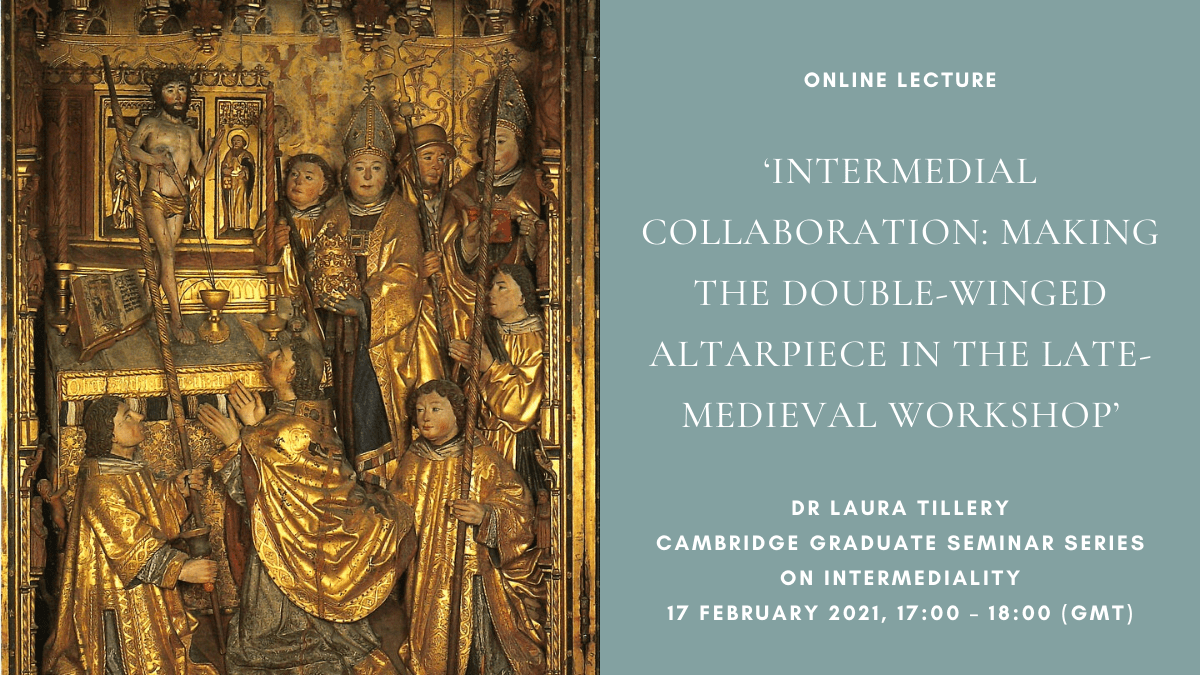
Online Lecture: ‘Painting in Stone: Architecture and the Poetics of Marble from Antiquity to the Enlightenment’ with Dr Fabio Barry, Cambridge Graduate Seminar Series on Intermediality, 3 February 2021, 17:00 – 18:00 (GMT)

For the first ‘Intermediality’ Graduate Research Seminar, organised by the Department of History of Art, University of Cambridge, we are joined by Fabio Barry (Stanford University) who will be discussing his recently published book Painting in Stone: Architecture and the Poetics of Marble from Antiquity to the Enlightenment (Yale University Press, 2020). It tells a new history of premodern architecture through the material of precious stone. Poetry, the lens for understanding costly marbles as an artistic medium, summoned a spectrum of imaginative associations and responses, from princes and patriarchs to the populace. Three salient themes sustained this “lithic imagination”: marbles as images of their own elemental substance according to premodern concepts of matter and geology; the perceived indwelling of astral light in earthly stones; and the enduring belief that coloured marbles exhibited a form of natural—or divine—painting, thanks to their vivacious veining, rainbow palette, and chance images.

Dr Fabio Barry is assistant professor in the Department of Art and Art History at Stanford University. Originally trained as an architect, his research and teaching still gravitates to this art form, although he is deeply interested in painting and sculpture of all periods as well as archaeology. Much of his published research has concentrated on artistic production in Rome, particularly Baroque architecture, treating themes from liturgy to light metaphysics. He is also interested in identifying the evocative qualities of materials (the “Material Imagination”) before the era of mass production and standardization distanced materials from the realm of nature and myth.

The series is convened by Anneke de Bont (ad961@cam.ac.uk), Elisabetta Garletti (esg36@cam.ac.uk) and Stella Wisgrill (sw728@cam.ac.uk).

Register here.

Seminars will take place online via Zoom, hosted by the Department of History of Art, University of Cambridge

As the current pandemic is presenting artists and institutions with the challenge to rethink the ways in which art works can be displayed, mediated and circulated, the question of intermediality has returned with new urgency. In the study of art, the concept of intermediality allows us to consider the longstanding history of the arts’ interaction with each other and other disciplines, while challenging the very notion of media specificity that underlies traditional definitions of art historical and academic specialisms, as well as the organisation of museum collections. This seminar series covers a broad time frame, from antiquity to the present day and offers a fresh opportunity to examine and compare the relevance and productivity of this critical concept to the study of art history across different epochs and geographies.

Online Lecture: ‘Between text and image, between writing and orality’ with Maria Chronopoulou, Centre for Byzantine, Ottoman & Modern Greek Studies, University of Birmingham, 4 February 2021, 17:15 – 18:30 (GMT)

In this talk, Maria Chronopoulou (École Pratique des Hautes Études) discusses the ornate letters in the manuscripts of the XVI homilies of saint Gregory of Nazianzus from 11th to 13th century

Register for tickets here.

Online Lecture: ‘What Did Medieval Slavery Look Like? Colour, Race and Unfreedom in Late Medieval Iberia’ with Dr Pamela Patton, Cambridge Medieval Art Seminars, 1 February 2021, 17:00 (GMT)

Register and find out more here.

Join the upcoming Cambridge Medieval Art Seminar with Dr Pamela Patton (Index of Medieval Art, Princeton University), who will be presenting on: ‘What Did Medieval Slavery Look Like? Colour, Race and Unfreedom in Late Medieval Iberia’. The talk takes place online at 17:00 pm (GMT).

The British Archaeological Association Digital Tour Competition

Inspired by the difficulties in visiting churches and other historic sites during the pandemic, The British Archaeological Association is looking at ways of promoting the use of digital technology to allow them to be seen even during a lockdown, or for those far distant. The Association is therefore holding a competition to produce a short video/photographic presentation of a Roman or medieval site (a building, ruin, even a town) using remote mapping and imaging systems such as Google Earth, or Google Earth Studio. The prize is £300.

An advantage of the new technologies is the capacity to show a building in the context of its surroundings so the tour might also feature topographical context, if appropriate. This might include both extant and lost Roman or medieval buildings and features, though a comprehensive treatment of a single site is also welcome.

The submission should be the virtual equivalent of a 15-minute tour of a site or building. Ideally the tour would take the viewer to all (interesting) parts of a building, and provide information about the views shown, suitable for a (reasonably) scholarly viewer, including some further reading.

Among the criteria for judging will be the quality of information given, which should reflect reliable and up-to-date thinking, the quality of the visuals, and the use of supplementary images – antiquarian views or maps, other photographs, etc. Ease of use is also important, and it should provide users with the opportunity to explore on their own.

HOW TO SUBMIT: please send a link to your project to: web@thebaa.org (i.e. if you have produced a video, please upload to YouTube and send a link)

Samples of the sort of thing we are looking for can be found on the Association’s website: Digital Resources | British Archaeological Association (thebaa.org), and a tutorial videos, exploring the potential of Google Earth and Google Earth Studio can be found here: https://www.youtube.com/watch?v=-XcLcF-huCo&feature=emb_logo (a very simple version 3-minute tutorial from Google) and https://youtu.be/cZ91_arsbdI (a more sophisticated tutorial from James Cameron)

The tour should cover sites within the Association’s areas of interest, which are defined as the study of material culture from the Roman period until the nineteenth century, principally within Europe and the Mediterranean basin, and within that, the core interests of the BAA are Roman to 16th century.

The closing date for competition entries is 1 February 2021 and the result will be announced on 15 February 2021.

Job: Lecturer in Medieval History 1100-1500, University of Lancaster, deadline 22 February 2021

The Department of History at Lancaster University has recently advertised a new post: Lecturer in Medieval History 1100-1500. This is a twenty-four month post, at 0.9 FTE, geared to support the post-holder in developing their research alongside teaching.

The advertisement can be found here: https://www.jobs.ac.uk/job/CDN438/lecturer-in-medieval-history-1100-1500

The deadline for applications is 22 February 2021.

Informal enquiries are welcomed and should be directed to Dr Marco Wyss, at: m.wyss@lancaster.ac.uk.

Online Conference: ‘Remarkable women’: Female patronage of religious institutions, 1300-1550, Courtauld Institute of Art, 29 January 2021, 10:00 – 17:45 (GMT)

Register and find out more here.

Please register for more details. The platform and log in details will be sent to attendees at least 48 hours before the event. Please note that registration closes 30 minutes before the event start time. If you have not received the log in details or have any further queries, please contact researchforum@courtauld.ac.uk

This conference seeks to explore the ways in which women patronised and interacted with monasteries and religious houses during the late Middle Ages, how they commissioned devotional and commemorative art for monastic settings, and the ways in which these donations were received and understood by their intended audiences. The artistic donations of lay patrons to religious institutions has become a fruitful area of study in recent years, but the specific role played by women in these networks of patronage has been subject to less thorough scrutiny. Similarly too, the interests of female patrons have often been considered separately from the contexts of the places to which they made their donations, without a thorough consideration of their very different status from their male counterparts and how this shaped their pursuit for commemoration and memorial after death and their reception as patrons by monastic houses and religious institutions. 

The speakers will consider these issues and to think about the placement of objects and works of art commissioned by women within religious buildings, the devotional practices and beliefs of various religious orders, the physical materials of donations, and the ways in which female patrons situated themselves within monastic spaces. Was there a dialogue between these benefactors and the religious institutions they patronised? What can such donations tell us about the role and position of women in late medieval society and the ways in which they used religious patronage to articulate their own status? By examining a category of patrons that was clearly highly aware of a variety of devotional and commemorative practices, this conference seeks to gain a better understanding of art commissioned for monasteries by female lay donors, and how this more broadly reflects the position of women in late-medieval Europe. 

10:00 Welcome and Opening Remarks – Nicholas Flory (The Courtauld) 

10:05 PANEL 1: Chapels and Devotion – Session chaired by Charlotte Wytema (The Courtauld) 

Dr. Giorgia Mancini (University of Cambridge) – At the heart of devotion in fifteenth century Ferrara: female donors in San Giorgio fuori le Mura 

Maria Lesimple (University of Grenoble-Alpes/LUHCIE) – Margaret of Austria’s ‘Treasure of Brou’: between Arts, Religion and Politics 

Yeidy Rosa (University of Durham) – Hidden and Revealed: Women’s Power, Family Feuds and Jewish-Muslim-Christian Relations through a recently uncovered mural of the Lamentation in the Cathedral of Albarracín 

11:05 Discussion – Chaired by Charlotte Wytema (The Courtauld) 

11:30 BREAK  

11:45 PANEL 2: Patronage choices – Session chaired by Jessica Gasson (The Courtauld) 

Dr. Mija Oter Gorenčič (France Stele Institute of Art History) –Women as Benefactors and Art Patrons in Male Medieval Cistercian and Carthusian Monasteries in Present-Day Slovenia

Dr. Diana Lucía Gómez-Chacón (Universidad Complutense de Madrid) – Beyond the Realms of Castile. Queenship, Devotion and Artistic Patronage in the times of Queen Violante of Aragon (1236-1300/01) 

12:25 Discussion – Chaired by Jessica Gasson (The Courtauld) 

12.55 LUNCH 

14:15 PANEL 3 Dynastic Concerns – Session chaired by Bella Radenovic (The Courtauld) 

Iliana Kandzha (Central European University) – Wives and Widows in aMonastic Space: Kunigunde of Austria (1465-1520) and the Carthusian Monasteru of Prüll 

Isabel Barros Felix (Université Catholique de Louvain) – The funerary monument of prince Afonso of Portugal (1390-1400): A 15th century commission by duchess Isabel of Portugal (1397-1471)? 

Dr. Richard A. Leson (University of Wisconsin-Milwaukee) – “Remembering Enguerrand of Coucy”: Jeanne of Flanders’ Memorial Campaigns at Longpont and Laon 

15:15 Discussion – Led by Bella Radenovic (The Courtauld) 

15:45 BREAK 

16:00 PANEL 4 Objects of Devotion – Session chaired by Susannah Kingwill (The Courtauld) 

Dr. Bryony Coombs(University of Edinburgh) –Devotion in Text and Stone: Female Authority and Agency in Margaret of Scotland’s Foundation of a Royal Chapel at Thouars and her ‘Speciosissimas’ Book of Hours

Dr. Joni M. Hand (Southeast Missouri State University) – Playing by the “Rule”: Monastic Order and Identity in the Psalter of Bonne of Luxembourg 

Amy Neff, Professor Emerita (University of Tennessee) and Anne Derbes, Professor Emerita (Hood College) – Which Remarkable Woman? The Passion Altarpiece for Santa Clara, Palma de Majorca 

17:00 Discussion – Led by Susannah Kingwill (The Courtauld) 

17:30 Closing Remarks 

Register and find out more here.
Online Lecture: Dr Robert Mills’ LGBT History Month Lecture: ‘Recognising Wilgefortis’, Manchester Met, 24 February 2021, 17:30 – 19:00 (GMT)

The point of departure for this talk is a painting by Hieronymus Bosch depicting a crucified saint whose identity, including their gender identity, has sparked controversy.

Current consensus is that the image represents the bearded female martyr, Saint Wilgefortis, also known as Uncumber, Ontcommer, Kümmernis etc. But other identifications have been proposed.

Contextualising the artwork with reference to medieval and early modern understandings of gender diversity and transformation, this paper will stage a dialogue between Bosch’s painting and current debates about the role of identity categories and terminology in histories of gender and sexuality.

What happens when a premodern image is viewed through the prism of modern notions of trans identity and genderqueerness?

What’s in a name?

Dr Robert Mills is Professor of Medieval Studies and Head of the History of Art Department at UCL. Between 2015 and 2018 Mills directed qUCL, UCL’s LGBTQ research network. Previously he was director of the Queer@King’s research centre at King’s College London. Mills’s publications include Suspended Animation: Pain, Pleasure and Punishment in Medieval Culture (2005), Seeing Sodomy in the Middle Ages (2015) and Derek Jarman’s Medieval Modern (2018). He also contributed the medieval section to A Gay History of Britain (2007).

Free online event. Joining instructions will be sent automatically via email nearer the date of the event. Register here.

Queries can be addressed to Heather Shore – H.Shore@mmu.ac.uk, Craig Griffiths – C. Griffiths@mmu.ac.uk or Haseeb Khan – Mohammed.Khan@mmu.ac.uk

Online Lecture: ‘The Great Church which is called Sophia’, with Alessandro Taddei, Centre for Byzantine, Ottoman & Modern Greek Studies University of Birmingham, 28 January 2021, 17:15 – 18:30 (GMT)

Join Alessandro Taddei (La Sapienza) for their talk on ‘The Great Church which is called Sophia’: The History and archaeology of the episcopal church of Constantinople before Justinian.

Register here.

Online Lecture: ‘The stronghold of shields: Two 12th-century kite shields discovered in Poland’ with Keith Dowen, 4 February 2021 14:00 – 15:00 (GMT)

Although the kite shield was a key part of the early medieval warrior’s equipment, only two examples of the type survive. Keith Dowen, Royal Armouries’ Assistant Curator of Arms and Armour, will examine their design and construction as well as the circumstances of their discovery.

Depictions of the early medieval knight, from the Bayeux Tapestry to the silver screen, present the elongated kite shield as an intrinsic and iconic part of a warrior’s equipment. However, while swords, spearheads and armour from the period can be found in various collections including the Royal Armouries, for many years it appeared that no examples of kite shields survived. During archaeological excavations in the Polish city of Szczecin in 2000, however, two extraordinary finds came to light. In different parts of the old stronghold, archaeologists unearthed the partial remains of two kite shields. Possibly connected to the Danish attacks of the late 12th century, these shields are the only known examples of their type to have survived. They are therefore invaluable to our understanding not just of the development of protective technology, but warfare in the early Middle Ages more generally. This lecture will discuss the circumstances of the discovery of these shields, and examine various aspects of their design and construction through detailed analysis and comparison to other shields from England and Scandinavia. This will show that far from being decorative or ceremonial objects, as has previously been suggested, there can be little doubt that the shields from Szczecin were fully functional battlefield pieces.

Register here.