Online Conference: Collecting Orthodoxy in the West: A History and Look Towards the Future, Museum of Russian Icons (11th-12th June 2021)

From the Museum of Russian Icons:

‘In a 1947 article titled “Byzantine Art and Scholarship in America,” Kurt Weitzmann examined the history of collecting Byzantine art in the United States. “…The combination of formal beauty and material splendor, coupled with great technical perfection and an aristocratic spirit which gives to even the smallest object a rare distinction…” renders these works particularly attractive to private collectors, wrote Weitzmann. [This] conference takes this statement as a starting point and focuses on the history of collecting Christian Orthodox objects in the West from the nineteenth century to the present: a topic replete with spectacular objects, profound questions and captivating narratives.

This international conference, organized and sponsored by the Museum of Russian Icons in Clinton, MA (USA), considers why, how, where, and by whom these objects have been and continue to be acquired. Once obtained, how are they classified, conserved, displayed, and described? How and by whom is their value, whether symbolic or monetary, determined? What is the relationship between their original purpose and the newfound one? From Marjorie Merriweather Post and Henry Walters to modern day collectors such as Gordon Lankton, small private museums to major public institutions, there has been a sustained interest in owning architectural remnants, manuscripts, liturgical objects, enkolpia and, of course, icons. Whether to save them from destruction, perpetuate a living tradition, preserve personal or communal memory, demonstrate erudition, wealth or taste, or to tell a story, these pieces are found in nearly every important collection. ‘

The complete programme, list of speakers, and registration link can be found here.

Conference: Fifteenth Century Conference, University of Bristol, 2nd – 4th September 2021

The next Fifteenth Century Conference will be held at the University of Bristol from 2nd to 4th September 2021. This is planned to be an in-person event, subject to government guidelines at the time. A Call for Papers will be circulated in May 2021. All papers accepted for the postponed 2020 conference will automatically be rolled over to this year’s event.

The conference will be convened by Helen Fulton. Please direct all enquiries to Helen: helen.fulton@bristol.ac.uk

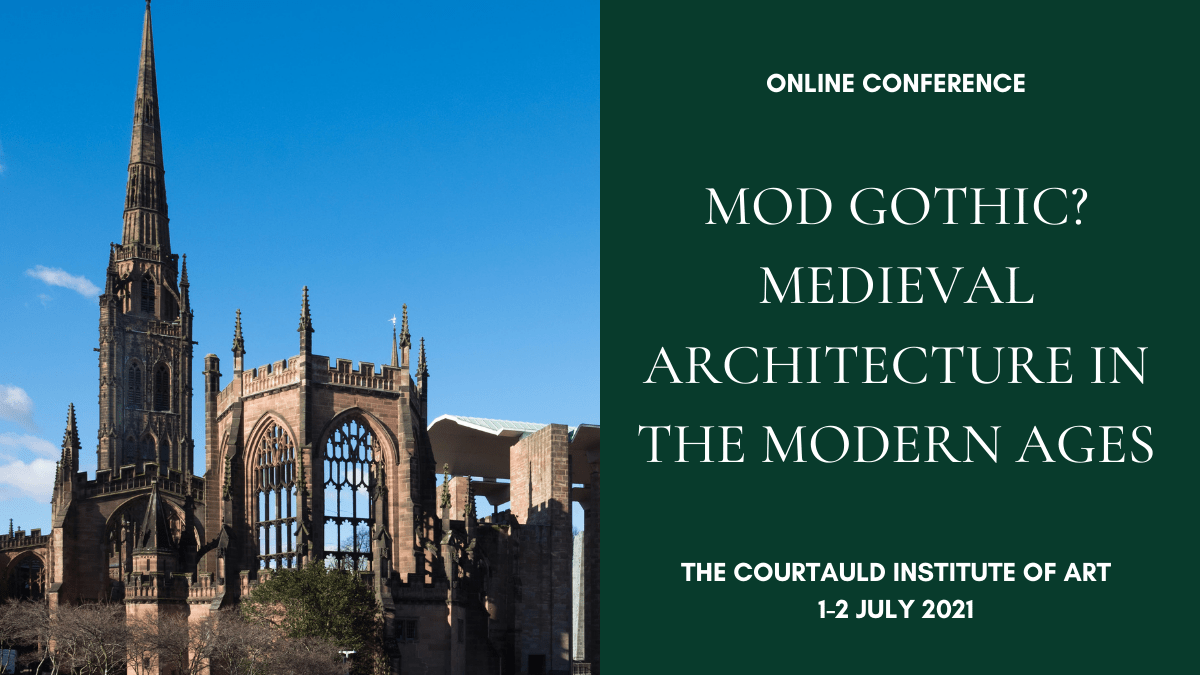
Online Conference: Mod Gothic? Medieval Architecture in the Modern Ages, The Courtauld Institute of Art, 1-2 July 2021

Mod Gothic? Medieval Architecture in the Modern Ages

Online Conference, Courtauld Institute of Art, 1-2 July 2021, 2-6pm each day

Scholars have long recognised the close connections between Gothic revival, restoration and architectural history in the nineteenth century. But how did personal, institutional and political circumstances shape understanding of medieval architecture in the twentieth century? In tribute to the extraordinary scholarship and teaching of Peter Kidson (1925-2019) and Paul Crossley (1945-2019), speakers at this online conference consider the personalities, technologies and geographies that determined how medieval architecture was studied and taught after 1945. ‘Each age builds its own Gothic cathedral’, wrote Paul Crossley: what did the Modern Ages make of the Middle Ages?

Speakers include Elizabeth Sears, Paul Binski, Lindy Grant, Eric Fernie, Zoë Opačić, Klára Benešovská, Tomasz Węcławowicz, Peter Kurmann, Brigitte Kurmann-Schwarz, Alexandra Gajewski and Stephen Murray.

Programme to be announced shortly.

Post-Doctoral Fellowship: ERC Advanced Grant 2020 AGRELITA (Deadline 15th June 2021)

The ERC Advanced grant project AGRELITA “The reception of ancient Greece in pre-modern French literature and illustrations of manuscripts and printed books (1320-1550): how invented memories shaped the identity of European communities”, led by Prof. Catherine Gaullier-Bougassas (Principal Investigator), is now accepting applications for 4 postdoctoral positions, starting on 1st October 2021. AGRELITA is based at the University of Lille and funded for five years by the ERC (2021-2026). Travel in France and abroad is to be expected.

Contract duration: 3 years, with a possible renewal of 2 years. Deadline to apply is 15th June 2021.

Project

Until now the reception history of ancient Greece in pre-modern Western Europe has focussed almost exclusively on the transmission of Greek texts. Yet well before the revival of Greek’s teaching, numerous vernacular works, often illustrated, contained elaborate representations of ancient Greece. AGRELITA will explore a large corpus of French-language literary works (historical, fictional, poetic, didactic) produced from 1320 to the 1550s in France and Europe, before the first direct translations from Greek to French, as well as the images of their manuscripts and printed books. The study of these works and their illustrations (text and image’s dialogue and powers of each) will allow to analyse the representations of ancient Greece from the unexplored perspective of the elaboration of a new memory. They thus will be studied in relation to their political, social and cultural context, as well as in relation to works in related European literature and their illustrations. Situated at the frontiers of literary studies, book and art history, visual studies, cultural and political history and memory studies, AGRELITA proposes a re-evaluation of the role played by ancient Greece in the processes of identity formation in Western Europe. The project also aims to contribute to a general reflection on the formation of memories, legacies and identities.

Tasks

Four post-doctoral fellows will be recruited, two with a predominantly “textual analysis” profile and two with a predominantly “image analysis” profile; all of them will share the study of the links between texts and images. The post-doctoral fellows will work in a team with the Principal Investigator, the project manager, the associate researchers and the visiting researchers.

Main Tasks :

– The analysis of an already identified corpus of texts from the 14th, 15th and 16th centuries and the identification of new texts that contain representations of ancient Greece (texts available in the form of modern editions or from 14th – 16th centuries manuscripts and prints)
– The collection of data and the drafting of notes on the texts, authors, artists, manuscripts, prints, and Greek data present; their entry into a database already begun
– The scientific analysis of textual and visual representations of ancient Greece, of the links between texts and images
– The regular production of original scientific articles, which will appear in the collective volumes of AGRELITA and in specialised journals, in French and in English
– Representing the AGRELITA project at external conferences and workshops in France and abroad, and publishing the papers
– Contributing to an anthology of texts and images (in collaboration with the whole team)

– Participating in all AGRELITA activities: weekly team meeting in Lille, monthly seminar in Lille, bi-annual workshops in Lille, two conferences…
– Contributing to the scientific organisation of these seminars, workshops, conferences; identifying colleagues to be invited, making contacts…
– Contributing to the reception of invited researchers
– Contributing to the editing of the planned collective volumes (rereading, correction, formatting of manuscripts sent to publishers)
– Contributing to the website and the blog
– Contributing to the reflection on the implementation and development of AGRELITA

Qualifications and Required Skills

– PhD in French literature of the Middle Ages and/or the Renaissance, in history of art of the Middle Ages and/or the Renaissance (manuscripts and illuminations, early prints, paintings and engravings), or in cultural and/or political history of the 14th-16th centuries.
– Good analytical skills of texts and images, as well as the relationships between texts and images
– Good knowledge of Middle French and Renaissance French
– Palaeographic skills for reading and transcribing manuscript and printed texts from the 14th-16th centuries
– Knowledge of Latin and Ancient Greek
– Ability to master a large corpus and to conduct comparative studies
– Ability and taste for interdisciplinary studies
– Experience and/or willingness to work in a team
– Sense of initiative
– Proficiency in scientific writing in French and also in English.
– Ability to maintain a website and blog

Working Conditions and Modalities

– Location: University of Lille. The four positions are based at the University of Lille and are attached to the ALITHILA Literary Analysis and history of language, located on the Pont de Bois campus in Villeneuve d’Ascq. Weekly team meeting in Lille, monthly seminar in Lille, as well as bi-annual workshops and two conferences. Some travel is required in France and abroad.

– Employer: University of Lille
– Type of contract: fixed-term contract
– Duration of the contract: 3 years, with a possible renewal of 2 years
– Working time: 100%
– Estimated starting date of the contract : 1st October 2021
– Remuneration: depending on experience

How to Apply

Application file to be sent in digital format (pdf) by 15 June 2021 at the latest to:
catherine.bougassas@univ-lille.fr

The file should include
– A Curriculum Vitae (Education, Experience, Publications)
– A letter of motivation, which explains and presents the interest for the reception of Antiquity
– A pdf of the thesis and a pdf of the thesis report
– The names and contact details of two referees, at the end of the CV file.

The selected candidates will be auditioned at the end of June/beginning of July, in person if possible, if not by video. Response by 15 July 2021 or end of July.

Online Summer School: 2021 Online Byzantine Greek Summer School, Boğaziçi University

The Byzantine Studies Research Center of Boğaziçi University is pleased to announce the organization of its fourth Byzantine Greek Summer School to be held online, from 29 July to 18 August, 2021. Students will have the chance to participate in an intensive program in Medieval Greek with Prof. Niels Gaul and Dr. Foteini Spingou. There is no fee for participation in the program, thanks to a generous grant from the Andrew W. Mellon Foundation.

The deadline to apply is 31st May 2021. To apply, visit http://byzantinestudies.boun.edu.tr/index.php?page=events&id=59.

Format
The program is designed for students who have completed at least two semesters of college-level Classical Greek or its equivalent. Students are expected to have knowledge of basic Greek grammar and to be able to read simple texts from ancient Greek or Byzantine literature. Daily classes are devoted to the reading of Byzantine texts with a focus on Constantinopolitan monuments and/or events that happened in the city; they will be held in two groups, at lower intermediate level and upper intermediate/advanced level, and last three hours Monday to Friday (15 hours per week). Students will be assigned to one of the two groups based on their performance in a prognostic test. The daily classes will be supplemented by shorter tutorial sessions (two to three per week) that offer revisions of grammar or a brief introduction to Greek paleography. The language of instruction is English, and the classes will be held online. The exact schedule will be agreed with those admitted to the course; no activities will be scheduled on weekends. Students will receive a certificate of participation upon successful completion of the program.

Eligibility
Graduate students and advanced undergraduates, as well as individuals with an academic interest in or a career relevant to Byzantine studies can apply, granted that they meet the requirements mentioned above. Priority will be given to graduate students in the field of Byzantine studies.

Niels Gaul is A. G. Leventis Professor of Byzantine Studies at the University of Edinburgh.

Foteini Spingou is currently a Research Fellow in Byzantine Cultural/Intelletual History at the University of Edinburgh; in 2022, she will take up an Associate Professorship in Medieval Greek Philology at the Aristotle University of Thessaloniki.

Online Lecture: Byzantine Ship Design and Its Legacy in the West: Transmission and Application of Shipbuilding Knowledge in Venice and Beyond, 17th May 2021 5:30 pm CST

The Wittgenstein Project Team will host a virtual lecture and discussion with Lilia Campana, featuring her current work on “Byzantine Ship Design and Its Legacy in the West: Transmission and Application of Shipbuilding Knowledge in Venice and Beyond”. After a 45-minute lecture by Dr. Campana, there will be time for discussion, moderated by Prof. Dr. Claudia Rapp.

In the Eastern Mediterranean, the period spanning from the 7th to the 11th century was a time of considerable progress in the technology of ship construction. Archeological data from Byzantine shipwrecks document the transition from shell–first to skeleton–first construction, suggesting the use of whole–moulding methods, a new, revolutionary ship design process devised by Byzantine shipwrights based on Euclidean geometry to produce superior vessels. Fourteenth–century Venetian maritime manuscripts provide the earliest textual and visual evidence for Byzantine whole–moulding methods, implying that, by the Late Middle Ages, they were adopted by the shipyards of European maritime states. Completely revolutionizing ship construction concepts, Byzantine whole–moulding methods created sturdier ships, able to safely cross oceans, eventually launching Europe into the Age of Exploration. 

Dr. Lilia Campana is a maritime and naval historian of the medieval and early modern Mediterranean, specializing in the history of shipbuilding technology, with a focus on the application of ancient mathematics, geometry, and mechanical arts in ship design. Her research on Byzantine shipbuilding and ship design is supported by the Archaeological Institute of America, the Dumbarton Oaks Research Library &  Collections, the American Council of Learned Societies, and the Gladys Krieble Delmas Foundation. She is currently an Affiliated Scholar at the Institute of Nautical Archaeology at Texas A&M University.

Advance registration required.

Call for Papers: History of Illuminated Manuscripts Online (Deadline 15th June 2021)

The International Society of History of Illuminated Manuscripts calls researchers of the discipline to communicate their ongoing investigations in a webinar that will take place on 17th and 18th September 2021. To participate, please send the title and an abstract to <storiadellaminiatura@gmail.com>. The deadline is 15th June 2021. The papers will be published, in synthetic form (max 2500 characters and 1 illustration) in a special section of “Rivista di storia della miniatura”. Presentations must not exceed 15 minutes.


The webinar is open to the members of the Society in compliance with the registration and to researchers of the discipline who meet the necessary registration requirements and wish to join the Society.

Scientific Committee: Susy Marcon, Giordana Mariani Canova, Massimo Medica, Giulia Orofino, Alessandra Perriccioli Saggese, Federica Toniolo, Giusi Zanichelli.

Below is the announcement in Italian:

La Società internazionale di storia della miniatura invita gli studiosi della disciplina a comunicare le ricerche in corso in un webinar che si svolgerà nelle date indicate. Per la partecipazione è necessario inviare, entro il 15 giugno 2021, titolo e abstract (max 300 caratteri) dell’intervento all’indirizzo <storiadellaminiatura@gmail.com>.


Le comunicazioni non dovranno superare i 15 minuti. Esse saranno pubblicate, in forma sintetica (max 2500 caratteri e 1 fotografia), in una apposita sezione della Rivista di Storia della miniatura.
Il Webinar è aperto ai membri della Società internazionale di storia della miniatura in regola con l’iscrizione e a studiosi della disciplina in possesso dei requisiti necessarî all’iscrizione che vorranno entrare a far parte della nostra Società.


Comitato Scientifico: Susy Marcon, Giordana Mariani Canova, Massimo Medica, Giulia Orofino, Alessandra Perriccioli Saggese, Federica Toniolo, Giusi Zanichelli.

Scholarships: Visualizations and Material Cultures of the Heavens in Eurasia and North Africa, Max Planck Institute for the History of Science (Deadline 31st May 2021)

The Max Planck Institute for the History of Science, Berlin, Department III: Artifacts, Action, Knowledge, directed by Prof. Dr. Dagmar Schäfer, offers several Visiting Scholarships (residential, 3–12 months) to take place in the period September 1, 2021 to August 31, 2023. The deadline to apply is 31st May 2021. To submit an application, visit the Max Planck Institute’s career page.

The centre invites scholars to apply for participation in the Working Group “Visualizations and Material Cultures of the Heavens in Eurasia and North Africa (4000 BCE–1700 CE)” of Department III. The Working Group’s research focuses on visual representations and material objects in the creation, change, and movement of astral knowledge across space and time. A growing image database serves as the main tool to collect and research the manifold objects and their imagery, the practices and relations of their production, reproduction and transmission, and their roles in organizing knowledge and creating meaning in different sociocultural contexts like politics, rituals, religion or medicine. We welcome scholars working on the visualization of astral knowledge in any time period before 1700 CE, preferably focused on one of the following geographical regions: East Asia, Southeast Asia, Indian Subcontinent, Central Asia, Asia Minor, Egypt, North Africa, and Europe (with an emphasis on Slavonic, Caucasian, Black Sea, or Celtic cultures).

The Max Planck Institute welcomes applications from scholars in every field within history, history of science and technology, art history, archaeology, philology, cultural history, religious studies, or museum studies, with a focus on visual representations or objects and some preference for research addressing the multilingual and transregional nature of the project. Successful applicants are expected to advance their own research project under the Working Group’s overall research agenda, and to actively contribute to the Working Group activities during their period of affiliation. In particular, they are expected to systematically and comparatively identify and discuss relevant visual materials in the framework of the Working Group’s protected image database. They are also encouraged to actively take part in the scientific life of the Institute with its many academic activities like conferences, workshops, seminars, and colloquia.

Visiting scholars receive a stipend commensurate with rank and experience for their period of residence, and reimbursement for a return ticket to and from their place of residence.
 

ICMA Annual Book Prize Submissions due 31st May 2021 – Notify your publisher!

Single or dual-authored books on any topic in medieval art printed in 2020 are eligible for the ICMA Annual Book Prize. No special issues of journals or anthologies or exhibition catalogues can be considered. The competition is international and open to all ICMA members. Languages of publication: English, French, German, Italian, or Spanish.

Prize: US $1,000 to a single author, or US $500 each to two co-authors. Recipients will be notified in early 2022.

Not a member yet? Go to www.medievalart.org/join to create your account and join!

For more information and to submit, visit https://www.medievalart.org/book-prize. Send questions to icma@medievalart.org.

Online Lecture: The Construction and Destruction of a Saint: Thomas Becket, 25th May 2021, 17:30-18:30 GMT

This discussion explores the meteoric canonisation of Thomas Becket, his subsequent veneration and the destruction of his reputation during the Reformation of the Tudor period.

Join renowned historian of Christianity, Reverend Professor Diarmaid MacCulloch (University of Oxford), for a conversation with distinguished medievalist, Professor Nicholas Vincent (University of East Anglia). Both are Fellows of the British Academy. This lecture is hosted by the British Museum in conjunction with their exhibition ‘Thomas Becket: murder and the making of a saint’, on view from 20th May to 22nd August 2021.

The discussion is chaired by Dr Emily Guerry, Co-Director at the Centre for Medieval and Early Modern Studies at the University of Kent.

Register for free here.

About the Lecturers:

Reverend Professor Diarmaid MacCulloch Kt, FBA is Emeritus Professor of the History of the Church at Oxford University. Well known for his television work, he wrote the acclaimed History of Christianity: the first three thousand years and presented the related BBC TV series in 2009. In 2012, he wrote and presented How God Made the English for BBC Two. MacCulloch has written widely on English statesman Thomas Cromwell and the Reformation.

Professor Nicholas Vincent FBA is Professor of Medieval History at the University of East Anglia. The author of many books, including Brief History of Britain 1066–1485, last year he published a six-volume edition of The Letters and Charters of Henry II, documenting Becket’s former patron and subsequent nemesis. His study of Becket’s Murderers won the 2005 William Urry Prize.

Dr Emily Guerry is Senior Lecturer in Medieval European History and Co-Director of the Centre for Medieval and Early Modern Studies at the University of Kent at Canterbury.

This event is presented in partnership with the British Academy.