Lecture: ‘Monastic Space and the Use of Books in Anglo-Norman England’, Tessa Webber, London Society for Medieval Studies, IHR London

The London Society for Medieval Studies is hosting a lecture at 7.00 in the Torrington Room (104), First Floor, Senate House (located on Malet Street, London WC1E 7HU) by:

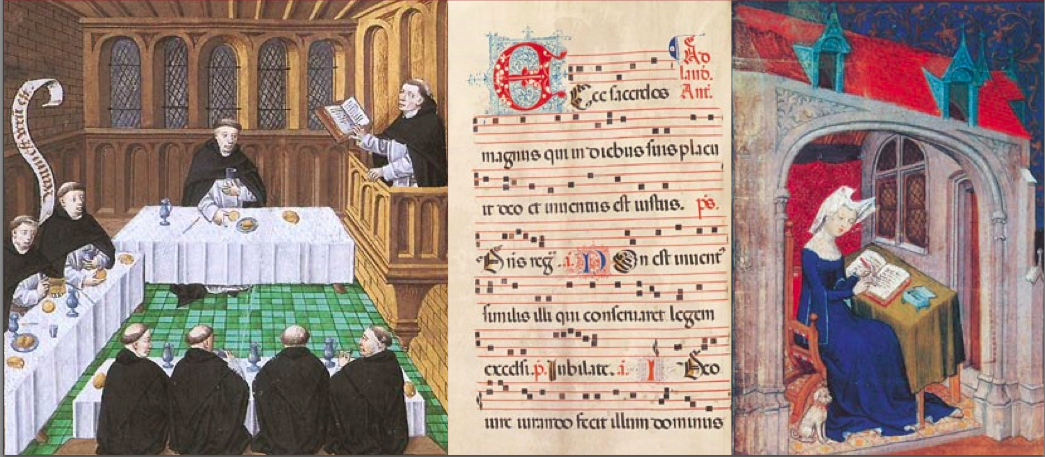
Dr Tessa Webber (Trinity College, Cambridge) who will be speaking on ‘Monastic Space and the Use of Books in Anglo-Norman England’.

All those who are interested in Medieval Studies are very welcome to attend.

The Society is entirely funded by its members and support from the Institute for Historical Research. We suggest a small donation of £6.00 per year if you would like to become a member or, alternatively, £2.00 per lecture. Please contact Sarah (sw544@cam.ac.uk) if you would like more information.

http://www.history.ac.uk/events/browse/15161

Talk: TORCH Book at Lunchtime Byzantine Matters, Professor Averil Cameron (Oxford)

image002TORCH Book at Lunchtime | Byzantine Matters, Professor Averil Cameron

Wednesday 21st May, 13:00 – 13:45, with lunch from 12:45 | Seminar Room, Radcliffe Humanities Building, Woodstock Road, Oxford

The themes raised by Professor Cameron’s book will be discussed by:

– Dr Jas Elsner (Humfrey Payne Senior Research Fellow in Classical Archaeology and Art)
– Dr Peter Frankopan (Director of the Oxford Centre for Byzantine Research)
– Dame Jinty Nelson (Emeritus Professor, King’s College London)

About the book:

For many of us, Byzantium remains “byzantine”–obscure, marginal, difficult. Despite the efforts of some recent historians, prejudices still deform popular and scholarly understanding of the Byzantine civilization, often reducing it to a poor relation of Rome and the rest of the classical world. In this book, renowned historian Averil Cameron presents an original and personal view of the challenges and questions facing historians of Byzantium today.

The book explores five major themes, all subjects of controversy. “Absence” asks why Byzantium is routinely passed over, ignored, or relegated to a sphere of its own. “Empire” reinserts Byzantium into modern debates about empire, and discusses the nature of its system and its remarkable longevity. “Hellenism” confronts the question of the “Greekness” of Byzantium, and of the place of Byzantium in modern Greek consciousness. “The Realms of Gold” asks what lessons can be drawn from Byzantine visual art, and “The Very Model of Orthodoxy” challenges existing views of Byzantine Christianity.

Throughout, the book addresses misconceptions about Byzantium, suggests why it is so important to integrate the civilization into wider histories, and lays out why Byzantium should be central to ongoing debates about the relationships between West and East, Christianity and Islam, Catholicism and Eastern Orthodoxy, and the ancient and medieval periods. The result is a forthright and compelling call to reconsider the place of Byzantium in Western history and imagination.

Averil Cameron is professor emeritus of late antique and Byzantine history at the University of Oxford and former warden of Keble College, Oxford. Her books include The Mediterranean World in Late AntiquityThe Byzantines, and The Later Roman Empire.
Part of the TORCH Book at Lunchtime series
Free and open to all. For more information please visit www.torch.ox.ac.uk or find us on Facebook and Twitter.


Substitute paper wanted for Leeds session

Tunstead, rood screen

Session 1135, Wednesday 9 July 2014: 11.15-12.45

Local Heroes: New Approaches to the Study of Minor Saints and Their Cults

Organizer: Anne E. Bailey, Harris Manchester College, University of Oxford

Chair: Rodney M. Thomson, School of History & Classics, University of Tasmania

One of the Hagiography Society sessions at Leeds this year has had a speaker pull out and is in need of a replacement.  The session topic is on minor saints’ cults, and the session is intended to be interdisciplinary, so there is plenty of room for art-historical work.  Although Leeds is a medieval conference, the Hagiography Society is expanding its reach to include a broader historical and geographical range, so papers outside of the strictly interpreted realm of medieval studies would also be welcome.  If you are interested in contributing a paper, please email Anne Bailey (anne.bailey@history.ox.ac.uk); or, if you know someone who might be interested, please forward this information.

5th International annual conference “Actual Problems of Art Theory and History” 2014

Winter_Palace_facade_large-620x312The Departments of Russian Art and West-European Art of the Faculty of History of St. Petersburg State University, the Department of Art Theory and History of the Faculty of History of Lomonosov Moscow State University and The State Hermitage Museum invite you to participate in the 5th International annual conference “Actual Problems of Art Theory and History”. The conference is to be held on October 28 – November 1, 2014 at the Faculty of History of St. Petersburg State University and The State Hermitage Museum.

The topical problems of art history and theory of art are to be discussed at the conference. The general theme of the conference 2014 is “Images of Classical Antiquity. Ancient Art and its Heritage in the World Culture”. Special attention of the plenary and the sessions will be paid to the phenomenon of art and culture of Classical antiquity, transformation of its legacy in the development of European art system and values, and its significance for the formation of entire European culture and various national cultures.

Working languages of the conference: Russian and English.

Applicants are welcome to suggest papers on all the themes on art from early Middle Ages up to modernity provided they are concerned with the above mentioned problems. It is proposed to hold a plenary session and thematic sessions. Posters are to be admitted to the corresponding sessions. The applications and abstracts of papers should be sent before the 30th of June, 2014 to the following e-mails: conference@actual-art.org (with the subject line “For the conference”).

The application should include the following information:
– Full name
– Date, country and place of birth
– Title of the paper
– University / Place of work, its address and postal code
– Position
– Supervising professor
– Home address and postal code, telephone, fax, e-mail

Please, indicate whether whether you need the University’s assistance in issuing the Russian visa. The applications of students, postgraduate students and young specialists without an academic degree should be accompanied by the recommendation of one`s supervisor sent from the personal e-mail of the latter or a scanned version of the recommendation signed by the supervisor.

The Committee will organize the sightseeing tours to Pavlovsk and Tsarskoye Selo. Also it is possible to arrange seminars in Novgorod and Pskov (1–2 days, at the wish of the participants of the conference). The accommodation of the participants during the conference will be free of charge.

The abstracts of papers should be presented in electronic form, as a Microsoft Word document in Russian or English with 1,5 space, text size 12, Times New Roman Cyr, field size 25 mm. The character limit is 2,000.The name of the file should coincide with the name of the applicant.
The participants will be selected by the Organizing Committee according to the following criteria:
– relevance and the innovative character of the presented research
– quality of the abstracts
– possibility to group the papers into several sessions by their subjects
The materials not selected for participation in the conference are not reviewed and not sent back. The applicants will be noticed upon the selection results by the 10th of September 2014.

The abstracts of papers will be published in 2014. The most prominent papers will be included in the volume of the conference to be issued in 2015.

For the provisional programme and proposed sessions please see programme-of-the-conference-actual-problems-of-art-theory-and-history-2014

Romanesque Virgin found inside walls of Spanish church

romanesque virginA carving of the Virgin Mary, dating to the late twelfth or early thirteeth century, has been found during works on the tower of Utande church, Guadalajara, in central Spain. The work contains much original polychrome, especially in the face. It is most likely it was originally a sedes sapientiae figure, with Christ sitting in her lap.

The statue is currently in a private house in the village, and will probably be sent to the diocesan museum for restoration, where it will ultimately be displayed. The parish priest hopes it may return to the church for feasts, and perhaps that a replica could be made.

It seems possible it was hidden when it became unfashionable, but was kept out of respect for the image. What do fellow medievalists think of this find? Have any similar Romanesque Spanish Madonnas been found in this way? How does she rank among other survivors? Let us know: comment below or email medievalartresearch@gmail.com!

http://www.europapress.es/castilla-lamancha/noticia-albaniles-descubren-emparedada-talla-romanica-virgen-iglesia-utande-guadalajara-20140507190745.html


The Abbot’s Table, Glastonbury Abbey, Friday 13th June 2014

3466856343[1]The Abbot’s Table on Friday 13th June 2014

Chaired by Professor Roberta Gilchrist

(University of Reading and Glastonbury Abbey Trustee)

09:30 – 10.30 Registration and coffee

10.30 – 10.35 Welcome

10.35 – 10.45 Introduction

10.45 – 11.15 Professor James Clark (University of Exeter): ‘Eating and the monastic life in late medieval England’

11.15 – 11.45 Stewart Brown: `Recent archaeological work’

11.45 – 12.15 Coffee break

12.15 – 12.45 PhD student paper

12.45 – 13.15 Peter Brears: ‘The Form and Function of the Medieval Kitchen’

13.15 – 14.15 Lunch

14.15 – 14.45 Professor Chris Woolgar (University of Southampton): How far can we talk about cuisine in the Benedictine monasteries of late medieval England?

14.45 – 15.15 Coffee break

15.15 – 15.45 Marc Meltonville (Hampton Court Palace): ‘Cooking in the King’s Kitchen. The reconstruction and experimental use of the kitchens of Henry VIII at Hampton Court.’

15.45 – 16.30 Discussion & Questions to the panel from delegates

16.30 – 16.45 Summary

16.45 – 17.00 Closing address


Speaker Biography and Synopsis

Professor James Clark (University of Exeter)

‘Eating and the monastic life in late medieval England’

Biography
James Clark is Professor of History at the University of Exeter and Director of the Centre for Medieval Studies. He has published widely on monastic life in medieval England and makes regular contributions to radio and tv documentaries, most recently as series consultant on BBC2’s Tudor Monastery Farm.

Synopsis
‘Monastic glory’s known to one and all: their treats are reading, tears and dinners small!’(anonymous couplet in a medieval English manuscript). Monastic life was expected to be
hard on the mind, the spirit and the body. This was not lost on the monks of late medieval England but unlike the pioneers of early times from whom they had inherited these precepts, they were the residents of well-appointed – even modish – communities which had the benefit of many of the small comforts, and at least some of the great luxuries, available in the outside world. Their investment in food for themselves and their honoured guests was considerable, and, if the bickering chit-chat of the visitation records is to be believed, their preoccupation with it was constant. Yet it would be wrong to represent the last generations of monastic England as wholly given over to high living, whatever the savage portraits of Chaucer – or the sheer scale of their kitchens – might suggest. In reality, these men and women still sought to reconcile the customs of the secular table with the ascetic ideals of the cloister.

Stewart Brown
Biography
Stewart Brown is a field archaeologist (MIFA). He has been an independent archaeological contractor since 1988. He began his career with the Exeter Museums’ Archaeological Field Unit (1972-9), then won a scholarship to attend the Oxford `In Service Training Scheme’ run jointly by Oxford University and the Archaeological branch of the DoE (now English Heritage). From 1982-8 he was Archaeologist and Interpretation/Education Officer at Buckfast Abbey

Synopsis
Excavation of the present 14th dating from the first stone kitchen on the site, as well as one wall footing from an earlier timber structure. Building recording revealed evidence for lost features of the kitchen, as `Recent archaeological work’ -century kitchen’s interior uncovered floors and hearthswell as a hitherto unknown phase of makeshift structures having been erected against
he kitchen’s north and south walls, probably in the early post-medieval period.

PhD Student
This part of the day will offer the opportunity for PhD student/s to deliver a paper.

Peter Brears

‘The Form and Function of the Medieval Kitchen’

Biography
Peter Brears is one of Britain’s leading food historians and a winner of the prestigious international Andre Simon Food Book of the Year 2009 for his book ‘Cooking and Dining in Medieval England’. After a distinguished career in museums, including the directorship
of the York and Leeds City Museums, he became a freelance museum and historic
house consultant and food history writer in 1994. Since then he has undertaken a wide range of research and development projects for Historic Royal Palaces, the National trust, English heritage and others. In 1986 he was a founding member of the Leeds Symposium on Food History and Traditions, in addition to producing separate books both on this subject, and on museum collections of domestic artefacts. In all of these he has demonstrated his skills as an illustrator, his drawings greatly adding to the reader’s understanding and appreciation of our culinary heritage.

Synopsis
Medieval kitchens were carefully planned so as to be as safe and efficient as possible. Using comparisons with other great English kitchens, their buildings and fixtures, this lecture will use their evidence to demonstrate how the Abbot’s kitchen was intended to be used and explain some of its lesser-known but revealing features.

Professor Chris Woolgar (University of Southampton)

How far can we talk about cuisine in the Benedictine monasteries of late medieval England?
Biography
Chris Woolgar is Professor of History and Archival Studies at the University of Southampton, where he is Director of the Centre for Medieval and Renaissance Culture. His books include The Great Household in Late Medieval England (Yale University Press, 1999), The Senses in Late Medieval England (Yale University Press, 2006) and a volume, edited with Dale Serjeantson and Tony Waldron, on Food in Medieval England: Diet and Nutrition (Oxford University Press, 2006). He is currently writing a book on the culture of food in the later Middle Ages.

Synopsis
If, at first glance, it may seem an unpromising line of enquiry to focus on cuisine in monasteries, there is good evidence to show that the scale of the investment in foodstuffs, in cooking and in the kitchens and bakehouses of the great Benedictine abbeys of England was impressive. The Abbot’s Kitchen at Glastonbury is indicative of monastic interest not only in food, but in cuisine. Cooks of distinction prepared the piquant sauces that formed an important component of elite dining, bakers produced a bewildering variety of loaves, of different size and fineness, from a range of grains; and the quality of ingredients was carefully judged. High-class cookery came with a style of dining that would not have been out of place in the households of the upper ranks in late medieval England. In this pattern of consumption, the monastic world was at its most receptive to secular ideas.

Marc Meltonville (Hampton Court Palace)
The reconstruction and experimental use of the kitchens of Henry VIII at Hampton

Biography
Marc has worked in museums for over 20 years in education, exhibition design and more lately interpretation. A chance meeting with a noted food historian led him to be involved with the first experiment with live historic cookery at Hampton Court in 1991. Supposedly a one off project; Marc has worked with the Historic Royal Palaces ever since.

Since 2006 he has been based at Hampton Court working first on the research and representation of the Tudor kitchens and then as similar project to open the long lost Royal Kitchens at Kew Palace. Lately he has been involved in the research and reconstruction of the King George I’s Chocolate Kitchen at Hampton Court.

These projects have seen him involved with numerous TV and radio programmes along
with lecturing across the UK and North America.
In March this year Marc went to Virginia to lecture on his current work and have a go at making whiskey in an 18th Century distillery at Mount Vernon.

Book a place:

http://www.glastonburyabbeyshop.com/rw_shop/ShopViewCat.php?&cat=21061&dx=1&ob=3&rpn=shopviewcat21061&new_cat=21078&sid=355d86891c5eec964ea2089964b9cd80


Conference: Architectures of Knowledge: Objects and Inventories in the Pre-modern World, Courtauld Institute, 15th May

Detail of the tympanum of the Duomo of San Giovanni, Monza, fourteenth century.  © Stefania Gerevini
Detail of the tympanum of the Duomo of San Giovanni, Monza, fourteenth century. © Stefania Gerevini

Speaker(s): Charles Burnett (Warburg Institute), Joanna Cannon (The Courtauld Institute of Art), Donal Cooper (University of Cambridge), Philippe Cordez (Ludwig-Maximilians-Universität, Munich), Stefania Gerevini (The Courtauld Institute of Art), Valentina Izmirlieva (Columbia University), Tom Nickson (The Courtauld Institute of Art), Judith Pfeiffer (University of Oxford), Giacomo Todeschini (University of Trieste)

Ticket/entry details: £10 (£5 students, Courtauld staff/students, concessions). BOOK ONLINE: or send a cheque made payable to ‘The Courtauld Institute of Art’ to: Research Forum Events Co-ordinator, Research Forum, The Courtauld Institute of Art, Somerset House, Strand, London WC2R 0RN, stating your full name and ‘Architectures of Knowledge’. 

Organised by: Drs Stefania Gerevini and Tom Nickson (The Courtauld Institute of Art). Funded by The Courtauld’s Research Forum and the Economic History Society

The technological transformations brought about by the Internet have given unprecedented political, social and economic relevance to questions of management, transmission and organisation of knowledge. They have focused public attention on the importance of the correct and secure preservation of information, and on the imperative for efficient measures against misuse. These have become matters of great concern for public bodies and for the civic and political community at large. But are these concerns entirely new?

This interdisciplinary workshop examines a particular (and particularly widespread) form of organisation and preservation of knowledge in the pre-modern Mediterranean: inventories. Looking beyond the function of medieval inventories as lists of objects, our workshop will explore their historical, legal and epistemological complexity in the Christian and Islamic Mediterranean. Our speakers will reflect upon the different textual and visual formats of medieval inventories, their physical appearance and organisation, and the different ways in which they referred to and provided information about objects and collections. What were the legal, economic and social functions of inventories, and what connections can be traced between practices of inventory-making and broader epistemological developments in the later Middle Ages? Ultimately, this workshop aims to explore the ways in which inventories contributed to produce, organise and transmit knowledge, and the ways in which they operated (together with the objects that they recorded) to maintain or undermine social, religious and political order.

10.45 – 11.15: Registration
11.15 – 11.30: Introduction
Stefania Gerevini (Courtauld Institute) and Tom Nickson (Courtauld Institute)
11.30 – 12.00: Charlemagne and the Saints: Hierarchy in Latin Relic Inventories
Philippe Cordez (Ludwig-Maximilians-Universität, Munich)
12.00 – 12.30: The New Sciences and their Books in the Twelfth and Thirteenth Centuries
Charles Burnett (Warburg Institute)
12.30 – 12.45: Discussion
12.45 – 14.00: Lunch (provided for speakers only)
14.00 – 14.30: Abundance, scarcity, poverty, wealth: the notarial inventories as a textual mirror of economic and theological discourses on the common good (Italy, 13th-14th
centuries)
Giacomo Todeschini (University of Trieste)
14.30 – 15.00: ‘Fiat unum librum inventarium de omnibus notabilibus loci…’: Sacristy inventories as sources for Franciscan art and architecture
Donal Cooper (University of Cambridge)
15.00 – 15.15: Discussion
15.15 – 15.45: Tea for all
15.45 – 16.00: Order in the Sacristy: The Dominicans of Lucca in 1264
Joanna Cannon (Courtauld Institute)
16.00 – 16.15: Inventorying medieval Venice
Stefania Gerevini (Courtauld Institute)
16.15 – 16.30: Memory and Invention: the medieval inventories of Toledo cathedral
Tom Nickson (Courtauld Institute)
16.30 – 17.00: The inventory of Rashid al-Din
Judith Pfeiffer (University of Oxford)
17.00 – 17.30: Discussion
18.00 – 19.00: Keynote lecture: The Inventory Trope
Valentina Izmirlieva (Columbia University)
19.00 – 19.30: Drinks reception

http://www.courtauld.ac.uk/researchforum/events/2014/summer/may15_ArchitecturesofKnowledge.shtml

The Medieval Bible, A Round-table Discussion (23rd May 2014)

 BibleThe Medieval Bible 
 A Round-table Discussion Occasioned by Two Recent Publications

with: 
David d’Avray (UCL)
Julia Boffey (QMUL)
Sara Lipton (SUNY)
Eyal Poleg (QMUL)

   Celebrating the publication of Approaching the Bible in Medieval England, Eyal Poleg (MUP 2013)  and Form and Function in the Late Medieval Bible, ed. Eyal Poleg and Laura Light (Brepols 2013) 

   16:00, Friday 23 May 2014, room 2.17 Arts2 Building, Mile End Campus

    Please RSVP on goo.gl/T6GXFe 
    Travel information:  goo.gl/ZpyWd6 

Resources: Society of Antiquaries London Youtube lectures

Missed a lecture at the Society of Antiquaries? Many of the society’s events, including conferences, public lectures and ordinary meetings of fellows are available on their Youtube channel!

https://www.youtube.com/user/SocAntiquaries/videos

Some talks include:

The recent Church Treasures conference on the 2nd May, featuring John Goodall, Loyd Grossman (https://www.youtube.com/watch?v=w1gmV2I6Mgw)

Sophie Oosterwijk on medieval child monuments (https://www.youtube.com/watch?v=E2ZdKOhp8V8)

Sally Badham on ‘Seeking Salvation: Commemoration of the Dead in the Late Medieval English Parish’ (https://www.youtube.com/watch?v=kOWJLnmeH5Q)

Michael Carter on Cistercian art and architecture in the late Middle Ages (https://www.youtube.com/watch?v=g2CM15ZMoIw)

All medievalists are bound to find something to occupy themselves on a quiet evening, so have a look!

https://www.youtube.com/user/SocAntiquaries/videos

Conference: The Art of Ritual: Object, Image and Space in Medieval and Early Modern Europe (17th May 2014)

Senate Room, Senate House, London, United Kingdom, May 17, 2014
Registration deadline: May 6, 2014

This conference is organized by three Junior Fellows of the Institute
of Historical Research from diverse scholarly backgrounds: Dhwani Patel
(KCL), Wendy Sepponen (University of Michigan) and Jo Edge (RHUL). It
will bring together two fields of research – the material and the
ceremonial – that are intimately connected but rarely explored together
in a conference setting.

The Art of Ritual aims to bring focus to how material culture and art
(broadly defined) fits into and shapes ritual, and will be organized
into three principal thematic strands. The first is art that influenced
ritual, for example space and site specificity, or the importance and
history of a particular place, site or space in connection with ritual.
The second is art that reflected ritual, for example representations of
processions. The final strand concerns objects and images that
functioned as an integral part of ritual, for example relics and
magical diagrams.

PROGRAMME

9.00-9.30
Registration and coffee

9.30-10.45
Urban Architecture and Religious Ritual
Chair: Dhwani Patel

Zoë Opacic (Birkbeck)
‘The Architecture of Ritual in Central Europe’

Tom Nickson (The Courtauld Institute)
‘New Rituals? Art in the Age of Reconquest’

10.45-11.15 Morning coffee

11.15-12.30
Art and Communal Devotion
Chair: Wendy Sepponen

Achim Timmermann (University of Michigan)
‘Golgotha, Now and Then: Image and Sacrificial Topography in Late
Medieval and Early Modern Europe’

Marianne Gilly-Argoud (Université Pierre-Mendès-France)
‘Living Incarnation within depictions of the sacraments: art and ritual
in late medieval alpine iconography’

12.30-1.30 Lunch

1.30-2.45
Ritual and the Unorthodox Imagination
Chair: Jo Edge

Natalia Petrovskaia (University of Cambridge)
‘Literary Fiction or Anthropology: Mapping Imaginary Ritual’

Sophie Page (University College London)
‘Art and ritual in medieval learned magic’

2.45-3.15 Afternoon coffee

3.15-4.30
Place, image and everyday ritual
Chair: Wendy Sepponen

Andrew Murray (University College London)
‘Everlasting and Transitional Rituals Amongst the Mourners of Philip the
Bold’

Adriana de Miranda (University of Bologna)
‘Ancient custom between Art and Rituality’

4.30-5.00
Round table discussion

5.00-7.00 Wine reception

Registration costs £10 (£5 students/retired/unwaged) which includes
refreshments, lunch and wine reception on the day. Registration deadline
is Tuesday 6 May 2014.

To reserve your place please email artofritualconference@gmail.com as
soon as possible.