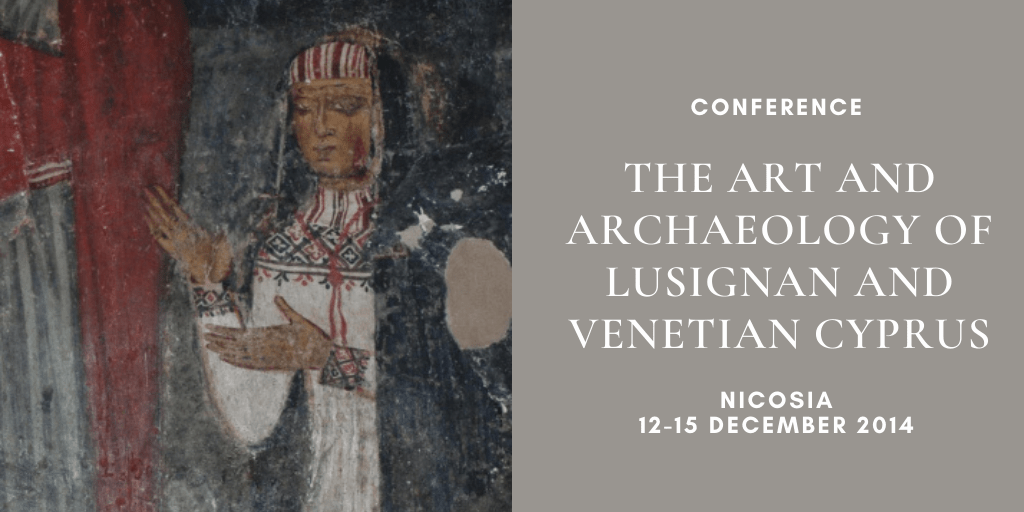
The Art and Archaeology of Lusignan and Venetian Cyprus (1192-1571):Recent Research and New Discoveries
Archaeological Research Unit, University of Cyprus, 12 Gladstonos Str, Nicosia, 12-14 December 2014
Friday, 12 December
9:00 – 9:30 Registration
9:30 – 9:50 Welcome Addresses
SESSION I: VISUAL CULTURE IN THE LUSIGNAN PERIOD
Chair: Michalis Olympios
10:00 – 10:20 Justine Andrews (University of New Mexico), Cyprus in the Medieval Mediterranean: Visual Culture in the Lusignan Period
10:20 – 10:40 Anthi A. Andronikou (University of St Andrews), Academic Myth or Historical Reality? Southern Italy and Cyprus in the Duecento
10:40 – 11:00 Georgios Philotheou (Department of Antiquities, Cyprus) and Maria Parani (University of Cyprus), The Church of the Transfiguration at Sotera and Its Murals: Some Preliminary Remarks
11:00 – 11:20 Discussion
11:20 – 11:50 Coffee Break
SESSION II: CYPRUS AND THE LATIN KINGDOM OF JERUSALEM IN THE THIRTEENTH CENTURY
Chair: Nasso Chrysochou
11:50 – 12:10 Edna J. Stern (Israel Antiquities Authority), A New Perspective on Lusignan Paphos and Its Harbor: Using the Ceramic Record
12:10 – 12:30 Robert Kool (Israel Antiquities Authority), Lusignan Money and the Mainland Economy of Outremer in the Thirteenth Century: A Reappraisal
12:30 – 12:50 Vardit Shotten-Hallel (Israel Antiquities Authority / The Hebrew University of Jerusalem), The Lusignans and the City of Acre
12:50 – 13:10 Discussion
13:10 – 14:45 Lunch Break
SESSION III: DIGGING FOR NUNS: THE EXCAVATIONS AT THE CISTERCIAN NUNNERY OF ST THEODORE, NICOSIA
Chair: Eftychia Zachariou
14:45 – 15:05 Michalis Olympios (University of Cyprus), Housing the Nuns: The Architectural History of St Theodore Abbey
15:05 – 15:25 Smadar Gabrieli (University of Sydney / University of Western Australia), At Home with the Nuns: The Ceramics Assemblages of St Theodore, Nicosia
15:25 – 15:45 Xenia-Paula Kyriakou (Cranfield University / University of Edinburgh / CAARI), Osteological Findings and Bioarchaeological Implications in Cypriot Monasticism: Evidence from the St Theodore Nunnery in Nicosia
15:45 – 16:05 Discussion
16:05 – 16:35 Coffee Break
KEYNOTE SESSION: CONFRONTING THE HISTORIOGRAPHY: CYPRUS BETWEEN EAST AND WEST
Chair: Panagiotis Agapitos
16:35 – 17:05 Margit Mersch (Universität Kassel), Late Medieval Cyprus and the ‘Mediterranean Koine’: The Architectural Evidence
17:05 – 17:35 Michele Bacci (University of Fribourg), The Art of Latin-Ruled Cyprus and the Christian East: Some Thoughts on Historiography and Methodology
17:35 – 17:55 Discussion
Saturday, 13 December
SESSION IV: CROSS-CREEDAL ARTISTIC ENCOUNTERS IN FAMAGUSTA AND ITS REGION
Chair: Tassos Papacostas
9:00 – 9:20 Maria Paschali (Courtauld Institute of Art), Byzantine Monumental Painting in Fourteenth-Century Famagusta: New Frameworks and New Interpretations
9:20 – 9:40 Max Ritter (Johannes Gutenberg-Universität Mainz), The Transformation of a Frankish Fortification Site into a Venetian Monastery – The Case of Ayia Napa
9:40 – 10:00 Guido Petras (Freie Universität Berlin), A Lithic Iconostasis in a Multi-Confessional Sanctuary in Lusignan and Venetian Cyprus? An Art-Historical Approach to the Cave Church in Ayia Napa
10:00 – 10:20 Discussion
10 :20 – 10:50 Coffee Break
SESSION V: CYPRIOT ARISTOCRATIC PATRONAGE AT HOME AND ABROAD
Chair: Michele Bacci
10:50 – 11:10 Aspasia Louvi (Byzantinist), Une princesse, un monastère et la rencontre de deux mondes chrétiens à Mistra
11:10 – 11:30 Dimitris Minasidis (Aristotle University of Thessaloniki), Νέα στοιχεία για το βασιλικό παρεκκλήσι στα Πυργά [New Evidence for the Royal Chapel at Pyrga]
11:30 – 11:50 Thomas Kaffenberger (King’s College London / Johannes Gutenberg-Universität Mainz), A Domed Basilica of the Sixteenth Century: Thoughts on the Architectural Concept and Historical Context of the Unfinished Church in Agios Sozomenos
11:50 – 12:10 Discussion
12:10 – 14:00 Lunch Break
SESSION VI: SELF-REPRESENTATION AND IDENTITY IN VENETIAN CYPRUS
Chair: Margit Mersch
14:00 – 14:20 Barbara McNulty (Lebanon Valley College), Fresco at Kaminaria: Landscape as Allegory
14:20 – 14:40 Tassos Papacostas (King’s College London), Renaissance Portrait Medals for Eminent Cypriots: An Untold yet Telling Tale
14:40 – 15:00 Discussion
15:00 – 15:30 Coffee Break
SESSION VII: THE TOPOGRAPHY AND URBAN FABRIC OF CYPRIOT SETTLEMENTS
Chair: Athanasios Vionis
15:30 – 15:50 Nikolas Bakirtzis (The Cyprus Institute), Byzantine Monastic Patterns in Crusader Cyprus
15:50 – 16:10 Hesperia Iliadou (University of Cyprus), The Pictorial Representation of a Lost Architecture: Cyprus Settlements in the Eve of the Venetian Period as Illustrated in a Fifteenth-Century Manuscript
16:10 – 16:30 Andria Pelekanou, Stephani Georgiou and Marina Andreou (Frederick University), The exploration and understanding of a Venetian-period building in the walled city of Nicosia. An addition to the enigma that is Venetian Nicosia
16:30 – 16:50 Discussion
16:50 – 17:20 Coffee Break
SESSION VIII: ART AND PIETY, PRIVATE AND PUBLIC
Chair: Fryni Hadjichristofi
17:20 – 17:40 Stella Frigerio-Zeniou (art historian), Templa du XVIe siècle à Chypre: une nouvelle approche
17:40 – 18:00 Christodoulos A. Hadjichristodoulou (Bank of Cyprus Cultural Foundation), Φορητή εικόνα με σκηνές από τα μαρτύρια και τα θαύματα των Αγίων Γεωργίου και Μάμαντος [Portable Icon with Scenes from the Martyrdom and Miracles of Saints George and Mamas]
18:00 – 18:20 Discussion
Sunday, 14 December
SESSION IX: URBAN AND RURAL LANDSCAPES
Chair: Nikolas Bakirtzis
9:30 – 9:50 Nasa Patapiou (Cyprus Research Centre), Νέα στοιχεία για ορθόδοξες γυναικείες μονές της Λευκωσίας βάσει αρχειακών μαρτυριών (16ος αι.) [New Evidence for Nicosia’s Orthodox Nunneries on the Basis of Archival Testimony (Sixteenth Century)]
9:50 – 10:10 Fryni Hadjichristofi (Department of Antiquities, Cyprus), New Light on the Topography of Nicosia: The ‘Archbishopric’ Excavation
10:10 – 10:30 Stylianos Perdikis (Museum of Kykkos Monastery), Αυλή Τηλλυρίας: Άγνωστη μεσαιωνική εγκατάσταση [Avli Tillyrias: An Unknown Medieval Site]
10:30 – 10:50 Discussion
10:50 – 11:20 Coffee Break
SESSION X: VESSELS UTILITARIAN AND OSTENTATIOUS: TWO CASE-STUDIES IN THE PRODUCTION AND EVERYDAY USES OF CERAMIC AND GLASS OBJECTS
Chair: Smadar Gabrieli
11:20 – 11:40 Athanasios K. Vionis (University of Cyprus), Maria Dikomitou-Eliadou (University of Cyprus), Maria Roumbou (Harokopeio University) and Vassilis Kilikoglou (N.C.S.R. ‘Demokritos’), Stirring Pots on Fire: Medieval Technology, Diet and Daily Life in Cyprus
11:40 – 12:00 Bernadette McCall (University of Sydney), A Medieval Glass Assemblage from Pafos, Cyprus
12:00 – 12:20 Discussion
12:20 – 14:00 Lunch Break
SESSION XI: STATUS DISPLAYED: THE USES OF LUXURY METALWORK
Chair: Maria Parani
14:00-14:20 Georgios Markou (University of Cambridge), Luxury Items of Minor Arts: The Household Silver of the Gentilhuomini in Venetian Cyprus
14:20 – 14:40 Elena Poyiadji-Richter (Leventis Municipal Museum, Nicosia), Metalwork products destined for Cyprus? – The 15th- / 16th-century dishes in the Leventis Municipal Museum of Nicosia
14:40 – 15:00 Discussion
15:00-15:40 Concluding Remarks – Final Discussion
Monday, 15 December
EXCURSION TO PYLA, SOTERA AND AYIA NAPA
For further information, please contact Michalis Olympios (olympios.michalis@ucy.ac.cy) and Maria Parani (mparani@ucy.ac.cy).





 ures by Christopher de Hamel, Donnelley Fellow Librarian of Corpus Christi College, Cambridge.

