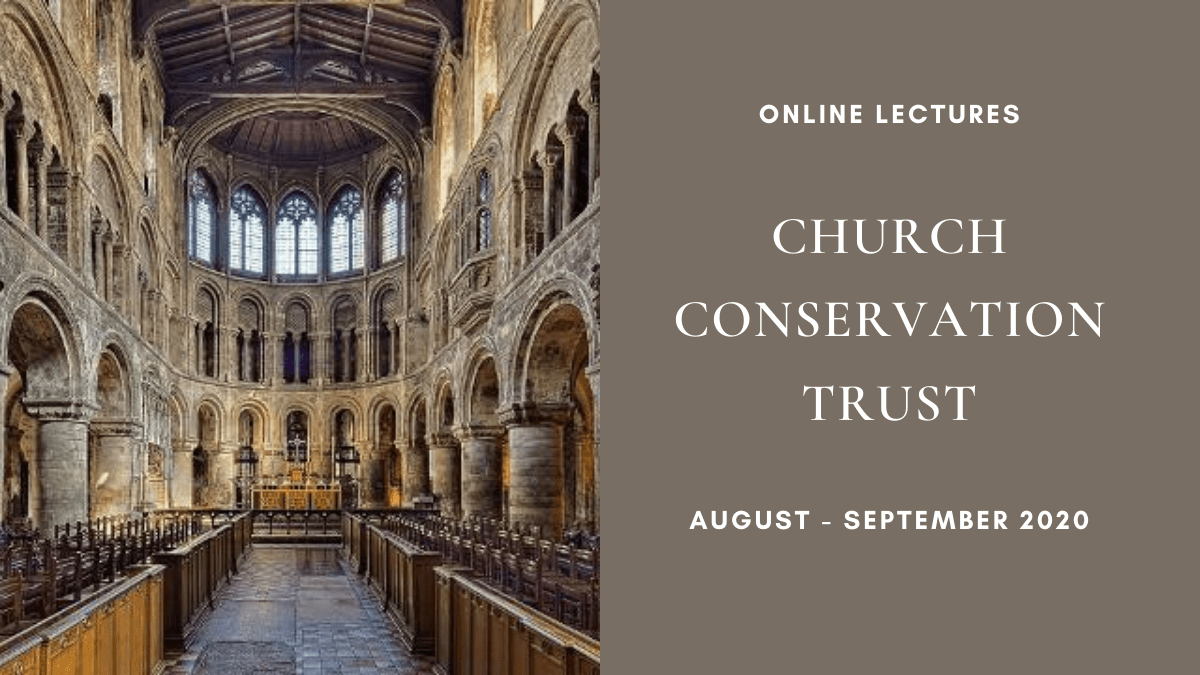
Online Lectures: Church Conservation Trust, August-September 2020

All of the Church Conservation Trust lectures are all free to get involved with and are Livestreamed them via their Facebook page, this allows you to really engage with the talk and to submit your questions live. These lectures are recorded and will be available to watch afterward.

Upcoming Lectures

Thursday 27th August at 1pm – Matilda of Canossa: the life of a woman who changed the course of history

Many of you who watched the lecture, Matilda of Canossa (1046-1115) and the Conservation of Ancient Churches, given by Michèle Spike on July 30, 2020 as part of The Churches Conservation Trust Lunchtime Lecture Series expressed an interest in learning more about the life of the Countess Matilda and about the “scandals in her life” which were discussed in the question and answer section.

On August 27, 2020, Prof. Spike will offer a second lecture to examine the rich details of Countess Matilda’s life and times entitled, Matilda of Canossa: the life of a woman who changed the course of history.

In Part I, Prof. Spike illustrated how Matilda’s construction of over one hundred churches throughout her ancestral domains — much of Italy north of Rome — fulfilled her promise made in the Fall of 1077 to donate of all of her ancestral territory to Pope Gregory VII and his successors as popes in Rome.

In Part II, Prof. Spike will discuss how Matilda and her mother, Beatrice, two women born into a feudal male hierarchy, managed to accomplish that transfer in the face of strong, at times overwhelming, male resistance. As in all human stories their road to victory involved sex, violence, war, and many rumors and innuendos which Prof. Spike will piece together to provide more details of Matilda’s extraordinary life.

The title of the lecture is based upon the exhibition curated by Prof. Spike at the Casa Buonarroti in Florence in 2016 and catalogue of the same name.

Sign up and get a reminder for the lecture here.


Thursday 3rd September at 1pm – Harey Coppar, bell ringer and the historical graffiti in Winchester Cathedral

Winchester Cathedral has a large amount of historical graffiti across all areas of this building, now nearly 1,000 years old. A survey and photographic record of this graffiti can be analysed to help an understanding of how this building has been used and viewed across the centuries by people who were not etherise commemorated here. This talk will consider this graffiti as evidence for an alternative view of its history and will also allow a discussion on how it may be viewed, conserved or even discouraged in the future.

This talk is given by Dr Cindy Wood. Dr Wood is a Senior Lecturer in Medieval History, at The University of Winchester, teaching both subject specific and generic historical themes. These include, the Crusades; material culture; monasticism; local history; medieval death and the late medieval period in general.

Her research areas are religion in the late medieval period, intercession, churches and the late medieval royal family. She is also involved in a local project collecting and collating graffiti in Winchester Cathedral, which is the subject of this talk, with students with the Winchester Research Apprenceship Project (WRAP) and has links with the Hampshire Field Club Graffiti Group. She is also on the editorial board of the Southern History Society, as Hon. Membership Secretary and also Secretary of the Friends of Clarendon Royal Palace.

Sign up and get a reminder for the lecture here.


Thursday 10th September at 1pm – Unlocking the Church: the lost secrets of Victorian sacred space

The Victorians completely transformed our churches: not only building thousands, but restoring – which often meant rebuilding – thousands more. Still more importantly, they transformed how the British understood and experienced their churches. No longer mere receptacles for worship, churches became active agents in their own right, capable of conveying theological ideas and designed to shape people’s emotions.

In this talk, Professor William Whyte explores this forgotten revolution – and its effects on us today. These church buildings are now a challenge: their maintenance, repair or repurposing are pressing problems for parishes in age of declining attendance and dwindling funds. By understanding their past, by unlocking the secrets of their space, there might be answers in how to deal with the legacy of the Victorians now and into the future.

William Whyte is Professor of Social and Architectural History in the University of Oxford. A fellow of St John’s College, the Royal Historical Society, and the Society of Antiquaries, he is Chairman of the Oxford Preservation Trust and the Oxford Historical Society. His most recent book is Unlocking the Church: the lost secrets of Victorian sacred space.

Sign up and get a reminder for the lecture here.
Call for Submissions: Eikon Imago, vol. 10 (2021). Miscellany and Monographic Issue, deadline 15 October 2020

The scientific journal Eikón / Imago, edited by the CAPIRE research team at the Complutense University of Madrid, is already working on the next issue. It is an annual academic publication whose research interest focuses on iconography and visual culture, from a thematic scope that encompasses the forms and meanings of the images of any era, culture or country, as well as any thematic, typological or disciplinary variant: religious, mythological, political, musical, fantastic, animalistic and other.


Each issue of Eikón / Imago Magazine consists of three sections:
– Miscellany: related to any aspect of the general thematic coverage of the Journal (free peer review articles).
– Monographic: the topic changes every year. This year 2021 it is: Eternal Sadness: Representations of Death in Visual Culture from Antiquity to the Present Time (ed. by Luis Vives-Ferrándiz Sánchez)
– Reviews and Chronicles of new books, exhibitions, and conferences.

We are accepting article proposals for the monographic and miscellaneous sections before October 15th, 2020.

You can know more about us in http://www.capire.es/eikonimago/index.php/eikonimago
or writing to our email eikonimago@ucm.es

Online Lecture: ‘Cluny and Vézelay: The Paradox of the Romanesque Capital in Burgundy’, Professor Neil Stratford, CRSBI Annual Lecture 2020

The Corpus of Romanesque Sculpture in Britain and Ireland (CRSBI)’s Annual Lecture 2020, given by Professor Neil Stratford, is now available to watch online. This an opportunity to hear his analysis of Romanesque capitals, using well-known Romanesque buildings as examples, developed over decades of careful study of the subject.

Online Conference: CARMEN Virtual Annual Meeting, 1-2 September 2020

The annual CARMEN open meeting – Program – brings together scholars and professionals from across the world

Every CARMEN meeting since our beginnings in 2007 has spotlighted the host city and its medieval heritage, and part of the meeting has focused on the local / national community of researchers. So this year we invite you to join us virtually in Dublin, with, among several choices, a virtual city walk and an opportunity to meet Irish medievalists and their projects and work.

Program

(all times are IST – Irish Summer Time)

Virtual walking tour of medieval Dublin

coordinated by Caoimhe Whelan. The tour will consist of a series of pre-recorded videos, provided by colleagues in the heritage and research group the Friends of Medieval Dublin. The tour will be running continuously through both days via Twitter, #CARMEN_2020, starting with Tuesday, Sept. 1, 9:00 IST

FORUM/ Medieval research in Ireland

The two well-known formats of the CARMEN meetings will, in the virtual version, be present on Twitter both day and ongoing, #CARMEN_2020.

Tuesday, Sept. 1

13 – 14

Welcome TCD (Gail McElroy, the Dean of the Faculty of Arts, Humanities, and Social Sciences at Trinity College Dublin)

Welcome CARMEN (Catherine Clarke, academic director of CARMEN)

Round Table “Environment”

Convenor: James L. Smith, UCC

As the practices of the Environmental Humanities and medieval studies intertwine–and Leeds IMC takes on the 2021 theme of Climate–collaboration in Irish environmental humanities projects across a trans- inter- and multi-disciplinary spectrum continues to grow. Many of our Irish attendees will be dealing with this material in their own work, and the Trinity Centre for Environmental Humanities has embedded robust collaboration across time period, discipline and subject matter. In this roundtable, we discuss the current environment in Irish and European research, emerging societal challenges and sustainable development goals, and the role of pre-modern source materials in this debate.

14.15 – 15

Workshop: Digital Medieval Studies in Ireland

The proliferation of interdisciplinary studies availing of digital methodologies has offered medieval studies new opportunities and approaches for research. In particular, Irish institutions boast a number of ongoing digital medieval studies projects that exemplify this marriage of disciplines. As such, this workshop focuses on three exciting digital humanities projects currently being undertaken by medievalists across Ireland. Presenters include Pádraig Ó Macháin (UCC) who will discuss the DIAS-led online repository of MSS, Irish Script on Screen (ISOS) [https://www.isos.dias.ie/]; Greg Toner (QUB) who will address his recent IRC-funded project (co-led with David Stifter (MU)) exploring the impact of digitisation on how manuscripts are accessed and research on medieval Ireland and Scotland is conducted; and Lynn Kilgallon (TCD) who will talk about Beyond 2022’s Medieval Exchequer Gold Seam project, which aims to reconstruct entire series of medieval Irish financial and administrative records.

15.15 – 16

Workshop: Edited Volume on Medieval Minds and Matter (Merel E. Veldhuizen, Southampton) Zoom

In this workshop we will discuss the development of an edited volume on the theme ‘Minds and Matter’, containing papers originally presented at the International Medieval Congress in Leeds 2019. I act both as contributor and co-editor (with James Smith) for this volume, the proposal for which is currently under revision at request of the journal Medieval Worlds (Proposed format: 2-3 x thematic clusters of 4-6 essays, 3 x editorials, 3 x response essays). The papers already gathered investigate intersections between medie¬val minds and materialities, bringing together new theoretical approaches to mental landscapes, medieval and medievalist. Medieval Worlds now offers the flexible publication format to create an ongoing conver¬sation through clusters with editorials and response essays as well as a forum to explore and enlarge the definition of the medieval mind, medieval materiality and the notion of the ‘medieval’ itself in a global context, as well as the paradoxical, ambiguous, and slippery relationships between the material and im¬material.

In this workshop we would like to open the discussion on these themes with some of our authors –namely Catherine Clarke (IHR) and James Smith (UCC)- and anybody who shares our interest in these topics or who would be interested in answering our call for papers. The workshop will begin by briefly highlighting some of the themes by having a few collaborators share a bit about their contribution, then extend the discussion by raising some prominent questions with participants, opening up themes and ideas they feel need to be included in a comprehensive and modern take on Minds and Matter in the Middle Ages.

Wednesday, Sept. 2

13.15 – 14

Workshop: Bishops and religious leadership(s) (Andrea Vanina Neyra/ Mariel Pérez/ Victoria Casamiquela Gerhold, Buenos Aires) Google Meet

This project aims to comprehensively research the role of bishops as religious leaders in Medieval Christia-nity, in relation both to local societies and secular authorities. This is a part of an ongoing line of research on different aspects of the episcopal figure that has already led to the organization of two workshops (Buenos Aires, 2018 and 2019) and the recent publication of a collective book on bishops and monaste¬ries (2020). Our proposal seeks to discuss the possible developments of this subject and to organize, upon this basis, a new research project integrating new potential members interested in this line of work. — Suggested topics of discussion are: the role of the bishop as a spiritual leader within his diocese, both in relation with local priests and their parishioners/ links between religious leadership and political power/ the role of tradition and innovation in spiritual leadership/ the place given by bishops to spiritual tasks among the different responsibilities connected to the episcopal role/ representations of spiritual leader¬ship/ Relationship between religious leadership and other kinds of leadership/ Strategies and tensions of religious leadership. — If you are interested in participating in the workshop or integrating our project, please contact our group at grupodeestudiosobispos@gmail.com to express interest, with a short outline of your research area and how it connects to the project theme.

14.15 – 15

Workshop: New Perspectives; New Approaches in Medieval Studies in Ireland

This final session showcasing medieval studies projects currently being undertaken in Irish institutions, ex-plores some new perspectives on the medieval period as well as some new approaches to its study. Pre-senters include Catherine Emerson (NUIG) who will discuss her ongoing research on networks of manus-cripts and manuscript owners in fifteenth-century Paris; Carrie Griffin (UL) topic: TBC; and staff from UCD’s School of Archaeology who will talk about their innovative and unique Centre for Experimen-tal Archaeology and Material Culture.

15.15 – 16

Workshop: Online events and conferences: what works? (Catherine Clarke, Institute of Historical Research, School of Advanced Study, University of London) Zoom

In this workshop, we’ll reflect on the move to online events and conferences necessitated by the COVID-19 pandemic – and likely here to stay, either in the form of fully ‘virtual’ events or blended formats. With the summer’s online conference season – and the CARMEN virtual meeting – to look back on, we’ll share experiences, insights and tips. We’ll discuss academic conferences and meetings, as well as public-facing events. How do we build participation into our online content? How do we facilitate discussion and interaction? What are the barriers to engagement, and how have colleagues dealt with ‘screen fatigue’? What might a ‘blended’ future look like for conferences and events? This will be a participatory session – not an instructional lecture – so please come with experiences and ideas to share.


You will find all events of the folloqing program in the online event site of this Eventbrite announcementThe CARMEN annual meeting always has a thematic strand: this year’s is Environment. A Plenary Round Table will take place during the meeting and will be accompanied on Twitter. We now invite proposals for the workshops which will take place on both days between 2 and 4 pm GMT +1 in webinar format. The organiser of the workshop will be responsible for online hosting, and will provide a link together with a short description; registration will be necessary. The one-hour workshops will have a break to start or boost twitter exchanges.

Workshops are interactive sessions which facilitate development of new projects and partnerships. Workshop sessions should take about 60 minutes and can present a project, or project idea, at any stage of development. Workshops are most successful when the convenor has a clear aim for the session and a plan for fostering discussion, and when the theme has cross-disciplinary reach. They are a valuable way to make links and find new collaborators, and can be on any topic (not limited to the thematic strand).

Proposals for workshops in 2020 including a theme and an abstract of about half a page as well as information on the video conference tool of choice should be sent to felicitas.schmieder@fernuni-hagen.de by July 31st the latest. Workshops will be scheduled in the CARMEN meeting programme and publicised as part of the event. The links to the fixed-time (synchronous) meetings (plenary, workshops) and if applicable the registration tool will be provided on Eventbrite.

We will also host the annual Forum, in virtual format — an opportunity for any medievalist to facilitate outreach, connection and communication between individuals, organisations and projects by presenting their new or planned books, projects, centers. The Forum will take place on Twitter throughout the meeting and will run asynchronously. We will list all projects that are sent to cristina_pimenta@sapo.pt by July 31 st the latest; ideally you will already have a twitter presentation.

Please spread the word and join us via Eventbrite and Twitter. CARMEN relies on your worldwide participation! You can follow our hashtag at #CARMEN_20.

Get a ticket now for further information and communication as the timetable takes shape.

Register here.

Online Exhibitions: The Schoenberg Institute for Manuscript Studies, University of Pennsylvania

The Schoenberg Institute for Manuscript Studies at the University of Pennsylvania have a number of online exhibitions for you to enjoy.

SIMS, LJS 49

A Legacy Inscribed: The Lawrence J. Schoenberg Collection of Manuscripts

Originally exhibited March 1-August 16, 2013, this exhibit showcases the Schoenberg Collection of manuscripts held at the University of Pennsylvania. Each section of the exhibition – Arts and Sciences, Communication, Design, Education, Engineering, Law, the Medical Arts, and Social Policy and Practice – showcases texts, textbooks, documents, and letters that embody the history and mission of the schools that form the University. Often illustrated with complex diagrams and stunning imagery, the manuscripts bring to the present the intellectual legacy of the distant past.

Reactions: Medieval/Modern

Originally exhibited August 25-December 16, 2016, this exhibition explores the many and varied ways that people have reacted to, and acted upon, manuscripts from the Middle Ages up to today.

Intertwined Worlds

Originally exhibited August 23-December 22, 2017, this exhibition explores pre-modern religious traditions of South and Southeast Asia including Jainism, Buddhism, and Hinduism.

A Liberal Arts Education for the (Middle) Ages: Texts, Translations, and Study

This online exhibition explores the study of the liberal arts, the texts of Boethius, and the intellectual life of early medieval monasteries through a selection of manuscripts from the collections of the University of Pennsylvania Libraries. Curated by Christine E. Bachman.

Making the Renaissance Manuscript: Discoveries from Philadelphia Libraries

Originally exhibited March 16-July 25, 2020, this exhibit draws on local collections. It attempts to encompass the broadest possible scope of ideas and material manifestations associated with the European Renaissance. It explores the numerous ways in which the production of hand-written and hand-decorated documents flourished during this period, even as the age of the printing press dawned. The 100 items in the exhibit, drawn from ten local collections, encompass a broad array of ideas and material manifestations associated with the European Renaissance. Curated by Nicholas Herman.

New Publication: Fra Angelico: Painter, Friar, Mystic, by Timothy Verdon

A lavishly illustrated exploration of the art and theology of Fra Angelico.

Beato Angelico offers a unique encounter with the celebrated painter, Fra Angelico, seen through the eyes of Monsignor Timothy Verdon.  As an art historian and (like Angelico) a Catholic priest, Monsignor Verdon approaches the work of the only artist ever beatified through the theological lens it deserves, bringing together Fra Angelico’s art and his faith.

Praised by his contemporaries, by later art historians, and by generations of viewers, Fra Angelico’s art is known for its exceptional combination of piety and painterly skill.  In this book, Monsignor Verdon explores the spiritual and mystical foundations of the friar-painter’s work, and traces his artistic evolution from his early work, to the frescoes for the covent of San Marco in Florence, his Annunciations, and the chapel for Pope Niccolò V.

Lavishly illustrated with over 200 high-quality images, Beato Angelico illuminates Fra Angelico’s art and his faith.

Monsignor Timothy Verdon was born in the U.S. and educated at Yale University (Ph.D. 1975) and has lived in Italy for over 50 years. He is the Director of the Diocesan Office of Sacred Art and Church Cultural Heritage and the Museo dell’Operal del Duomo and a Canon of the Cathedral in Florence. He is also a Fellow of the Harvard University Center for Italian Renaissance Studies, and currently teaches in the Florence Program of Stanford University.

Order the book here.

CFP: ‘Behold a Pale Horse’: Eschatology of the Medieval East and West, ICMS 2021, deadline 15 September 2020

Session Hosts: Sarah Mathiesen (Florida State University) and Britt Boler Hunter (Florida State University)

The COVID-19 pandemic has provoked a revival of Apocalyptic fears. Widespread anxiety in response to the pandemic leads us to ponder how medieval people conflated fears of disease with fears of the End Times. What is the dynamic between medieval diseases and the End? What did individual religious, political, or social communities see as signs of the Apocalypse?


Our aim is to cultivate a conversation about eschatology in the medieval East and West. This is an interdisciplinary, global, and cross-chronological panel that welcomes papers addressing the interaction of disease and eschatological belief in the medieval world. We define the topic of “disease” broadly, from physical illness and mental health to social, religious, or political maladies.
We encourage papers from scholars of all disciplines, particularly PhD students and ECRs.
Suggested topics include but are not limited to:

  • Medieval eschatological theology and traditions
  • Plague, illness, and disease as indication of End Times
  • Social or cultural ailments as Signs of the Times
  • Religious eschatological sects or heresies
  • Practical or how-to material relating to personal or religious eschatology
  • Art and imagery of death, disease, and the Apocalypse
  • Anxiety and mental health in the Middle Ages
  • Psychology of medieval illness and/or eschatology
  • Medieval culture surrounding death

Submissions: Please submit through the ICMS portal (wmich.edu/medievalcongresss/submissions), session ID: 1344S

Deadline: September 15, 2020

New Publication: The Conservation of Medieval Polychrome Wood Sculpture

Conservators Michele Marincola and Lucretia Kargère have published a new volume on the history, theory, and practice of the conservation of medieval sculpture.

Medieval polychrome wood sculptures are highly complex objects, bearers of histories that begin with their original carving and adornment and continue through long centuries of repainting, deterioration, restoration, and conservation. Abundantly illustrated, this book is the first in English to offer a comprehensive overview of the conservation of medieval painted wood sculptures for conservators, curators, and others charged with their care.

Beginning with an illuminating discussion of the history, techniques, and meanings of these works, it continues with their examination and documentation, including chapters on the identification of both the wooden support and the polychromy itself–the paint layers, metal leaf, and other materials used for these sculptures.

Published by The Getty Conservation Institute, this volume also covers the many aspects of treatment: the process of determining the best approach; consolidation and adhesion of paint, ground, and support; overpaint removal and surface cleaning; and compensation. Four case studies on artworks in the collection of The Cloisters in New York, a comprehensive bibliography, and a checklist to aid in documentation complement the text.

Purchase a copy today on the GCI’s website.

Michele D. Marincola is Chair of the Conservation Center at the Institute of Fine Arts, NYU. Lucretia Kargère is the principal conservator at The Met Cloisters.

CFP: British Archaeological Association sponsored panels at International Medieval Congress (Leeds 2021), deadline 21 September 2020

The British Archaeological Association are now welcoming paper proposals for BAA organised sessions at the 2021 International Medieval Congress at the University of Leeds (5 -8 July 2021).

The IMC’s research theme for 2021 is “Climates”, a topic which can be interpreted in numerous ways:

  • Medieval concepts of ‘climes’ and ‘climate’
  • Cosmologies, world views, natural or supernatural causation
  • Ecocriticism, critical race theory, indigenous knowledge, ecofeminism, queer ecology
  • Weather and weathering
  • Medieval enquiry into weather, seasons, monsoon patterns
  • Astronomical and astrological observations and predictions
  • Agriculture, pastoralism, modification of landscapes, exploitation of resources, inequality, colonialism
  • Environmental determinism, medieval histories of modern inequalities
  • Societal organisation, hierarchy, law- making, governance
  • Applying paradigms of adaption, resilience, and collapse
  • Ecosystems, entanglements, human and non-human agency
  • ‘Climates’ of opinion, thought, feeling
  • Disease, pathogens, and microbes
  • Relationships between climate change and human history
  • Interdisciplinarity and integration of historical climate and environmental data
  • ‘Provincialising Europe’: Writing history on the ‘planetary’ or biospheric scale
  • ’Climates’ and interregional connectivities, interdependencies and disconnections
  • Fluctuations in migration, mobility, trade, exchange, and transmission
  • Seas, oceans, rivers, monsoon, floods as dynamic spaces
  • Medievalists, politics, climate justice, pedagogy, and activism
  • Preservation of material remains amid growing climate and societal instability

A full list of suggested topics and more details can be found here: https://www.imc.leeds.ac.uk/2021-climates/

It is hoped that we can organise several sessions once again, with similar papers grouped together (either methodologically or by subject).

Proposals should consist of a paper title, your affiliation, and a short abstract (50-100 words).

Please send paper proposals to Harriet Mahood (hpmahood@gmail.com) by Monday 21st September 2020.

Online Exhibition: Caravans of Gold, Fragments in Time: Art, Culture, & Exchange Across Medieval Saharan Africa

Journey to a medieval world with Africa at its center.

Travel along routes crossing the Sahara Desert to a time when West African gold fueled expansive trade and drove the movement of people, culture, and religious beliefs. Caravans of Gold is the first major exhibition addressing the scope of Saharan trade and the shared history of West Africa, the Middle East, North Africa, and Europe from the eighth to sixteenth centuries. Weaving stories about interconnected histories, the exhibition showcases the objects and ideas that connected at the crossroads of the medieval Sahara and celebrates West Africa’s historic and underrecognized global significance.

Journey across the various sections of the online exhibition here.

The exhibition Caravans of Gold has been developed in consultation with an international group of advisors, each experts in a specialized area that contributes to the big picture that the exhibition conveys. It has also emerged in partnership with institutions and individuals in Mali, Morocco, and Nigeria. In the exhibition and the interviews below we hear directly from the individuals whose work and perspective shaped the exhibition – you can watch some of these interviews here.