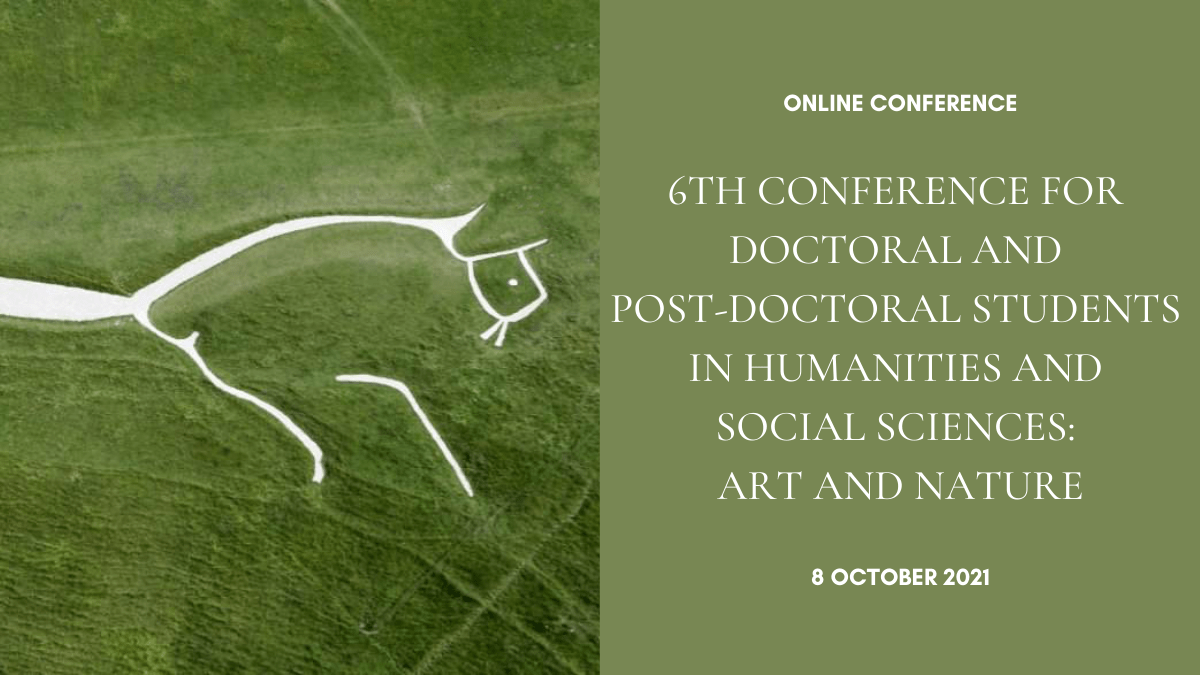
CFP: 6th Conference for Doctoral and Post-Doctoral Students in Humanities and Social Sciences – Art and Nature (8 October 2021), deadline 15 May 2021

The conference will look at how the natural world has been presented, reflected or interacted by visual artists through centuries. The papers will debate on various topics from the pragmatic view of the natural world, existed simply to serve society, through the idea of natural phenomena, animals, plants etc. as allegories and symbols utilized to draw morality tales or aesthetic principles, which were viewed with as much importance as scientific information, to nature as a source of inspiration for new ideas and movements reflected in the fields of arts. Specific focus is put on the modern technologies and media, as well as the artists’ addressing social and political issues relating to the natural environment.


Topics of the conference include, but are not limited to:

• Art as mirror of nature: interpretation of nature in various historical periods, artistic contexts and individual artistic opuses;
• Art and nature: allegoric and symbolic representations, illustrations in the books of nature (botanical and zoological studies), flora and fauna in emblems, design and applied arts;
• Art and natural context: landscape painting, Animalists, Wanderers Art Movement, Land Art, Earth Art, Environmental Art
• Art and new technologies: biotechnological arts (BioArt), Genetic art, Evolutionary art, ethical problems considering using modern technologies and bio materials in art etc.;
• Art and contemporary aspects and dilemmas: climate changes, environmental problems, ecological awareness represented through visual arts (EcoArt, Crop art, Sustainable art).

The conference will be held online.

Proposals should be sent to phd.conference2020.lj@gmail.com by May 15, 2021 and should include an abstract of maximum 400 words and a short CV.

Conference website: https://phdconference2014.wixsite.com/dmr-ljubljana

Online Conference: ‘‘Our Aelred’: Man, Monk & Saint’, English Heritage & the British Archaeological Association, 11-12 January 2021

Join English Heritage and the British Archaeological Association for this major online conference focused on Aelred, abbot of Rievaulx between 1147 and 1167.

Called ‘our Aelred’ by his monks, the abbot was one of the most important monastic leaders of the Middle Ages and remains an inspirational figure to this day.

Bringing together leading scholars and heritage professionals, this conference provides a unique opportunity to examine Aelred’s impact on the architectural development of Rievaulx, his role in the Cistercian settlement of northern England and his activities as an author.

Speakers will address the abbot’s impact in the wider monastic world and Aelred’s legacy, including his veneration as a saint and how his extraordinary life and achievements can be interpreted for 21st-century visitors to Rievaulx.

The event also features a round-table discussion focused on debates about Aelred’s sexuality.

The conference has been scheduled to coincide with Aelred’s feast day on 12 January.

Download the programme and register here.

Conference Programme (GMT)

Day 1: Monday 11 January 2021, Vigil of the Feast of St Aelred, Abbot & Confessor

12:00 – 12:10 pm: Welcome and Introduction: Anna Eavis

Beginnings

  • 12:10 – 12:30: Janet Burton, ‘The Cistercian Settlement of Northern England’
  • 12:30 – 12:50: Stuart Harrison, ‘Aelred’s Inheritance: the monastic buildings of Abbot William’
  • 12:50 – 13:00: Questions

Theology & Patronage

  • 13:00-13:20: Marsha Dutton, ‘Finding God in the Memory According to Aelred of Rievaulx’
  • 13:20-13:50: Peter Fergusson, ‘The Context of Aelred’s Rievaulx Buildings and Precinct Development in the 1150s’
  • 13:50 – 14:00: Questions

DAY 2: Tuesday 12 January 2021, Feast Feast of St Aelred, Abbot & Confessor

12:00 – 12:10pm: Welcome and Introduction

History & Sainthood

  • 12:10 – 12:30: Elizabeth Freeman, ‘Aelred of Rievaulx: the future-looking historian’
  • 12:30 – 12:50: Emilia Jamroziak, ‘Aelred of Rievaulx and other Cistercian Saints in the Late Middle Ages’
  • 12:50 – 13:00: Questions

The Wider Context

  • 13:00 – 13:20: Brian Golding, ‘The abbot, the bishop, and the earl: Aelred and the early years of Revesby abbey’
  • 13:20 – 13:50: Alexandra Gajewski, ‘Aelred, Rievaulx and the French Connections’
  • 13:50 – 14:00: Questions

Break: 14:00 – 14:45

Aelred in the 21st Century

  • 14:45 – 15:00: Michael Carter, ‘Our Aelred’: a Rievaulx interpretation for 2021’
  • 15:00 – 16:00: Dominique Bouchard, Marsha Dutton and Katherine Harvey: ‘Aelred and Monastic Sexuality: a round table discussion’

New Publication: The Lives and Afterlives of Medieval Iconography, Edited by Pamela A. Patton and Henry D. Schilb

What does the study of iconography entail for scholars active today? How does it intersect with the broad array of methodological and theoretical approaches now at the disposal of art historians? Should we still dare to use the term “iconography” to describe such work?

The seven essays collected here argue that we should. Their authors set out to evaluate the continuing relevance of iconographic studies to current art-historical scholarship by exploring the fluidity of iconography itself over broad spans of time, place, and culture. These wide-ranging case studies take a diversity of approaches as they track the transformation of medieval images and their meanings along their respective paths, exploring how medieval iconographies remained stable or changed; how images were reconceived in response to new contexts, ideas, or viewerships; and how modern thinking about medieval images—including the application or rejection of traditional methodologies—has shaped our understanding of what they signify. These essays demonstrate that iconographic work still holds a critical place within the rapidly evolving discipline of art history as well as within the many other disciplines that increasingly prioritize the study of images.

This inaugural volume in the series Signa: Papers of the Index of Medieval Art at Princeton University demonstrates the importance of keeping matters of image and meaning—regardless of whether we use the word “iconography”—at the center of modern inquiry into medieval visual literature.

In addition to the editors, the contributors to this volume are Kirk Ambrose, Charles Barber, Catherine Fernandez, Elina Gertsman, Jacqueline E. Jung, Dale Kinney, and D. Fairchild Ruggles.

Table of contents:

1. Introduction: Plus ça change…? The Lives and Afterlives of Medieval Iconography – Pamela A. Patton and Henry D. Schilb, Index of Medieval Art, Princeton University

2. Afterlife and Improvisation at Santa Maria in Trastevere – Dale Kinney, Bryn Mawr College

3. The Archaeology of Carolingian Memory at Saint-Sernin of Toulouse – Catherine Fernandez, Index of Medieval Art, Princeton University

4. Representation, Signature and Trace in Islamic Art – D. Fairchild Ruggles, University of Illinois, Urbana-Champaign

5. A Matter of Perception: An Hesychastic Understanding of the Work of Art – Charles Barber, Princeton University

6. Spectacles and Prosthetic Visions in Fourteenth- and Fifteenth-Century Art – Kirk Ambrose, University of Colorado Boulder

7. Iconography and the Loss of Representation – Elina Gertsman, The Case Western Reserve University

8. The Work of Gothic Sculpture in the Age of Photographic Reproduction – Jacqueline E. Jung, Yale University

Pamela A. Patton is Director of the Index of Medieval Art at Princeton University. She is the author of several books, including Art of Estrangement: Redefining Jews in Reconquest Spain, also published by Penn State University Press.

Henry D. Schilb is Art History Specialist in Byzantine Art at Princeton’s Index of Medieval Art.

Pre-order the book here.

Online Lecture: ‘Grieving in Trecento Representations of the Lamentation’ with Judith Steinhoff, 16 December 2020, 16:50 – 18:30 (GMT)

Two fourteenth-century Italian representations of the Lamentation over Christ, a large panel by Giottino and a component of a large altarpiece made by Ambrogio Lorenzetti, serve as case studies to argue for a more widespread gendering of grief in Trecento Tuscany. Examining the paintings in relation to several other cultural instruments, including the devotional text, Meditations on the Life of Christ, and the Sienese statutes governing funerals, the paper will argue that, although created primarily for purposes of prayer and spiritual edification, images of grieving over Christ also participated in an intertextual process that encoded and promoted acceptable grieving behaviors in the face of personal loss. Professor Judith Steinhoff considers the gendering of grief in fourteenth-century Italy, as seen in works by Giottino and Ambrogio Lorenzetti.

Register for the event here.

Scholarship: MAA Inclusivity and Diversity Research Grant (Deadline 31 December 2020)

The Inclusivity and Diversity Research Grant of up to $3,000 will be granted annually to a scholar, at any stage in their career, who seeks to pursue innovative research that will broaden the scope of medieval studies. Projects that focus on non-European regions or topics under the Inclusivity and Diversity Committee’s purview such as race, class, disability, gender, religion, or sexuality are particularly welcomed. The grant prioritizes applicants who are students, ECRs, or non-tenured. For the current round of applications, we encourage proposals that address the challenges of conducting research during the Covid-19 era. 

Applicants must be members in good standing of the Medieval Academy of America.

Deadline: 31st December 2020

Online Lecture: ‘What do Mosaics Want? Or, Wall Mosaics & the Space between Viewer & Viewed’ with Dr Liz James, 11 December 2020, 12pm (EST)

Join Yale for their up-coming Lectures in Late Antique and Byzantine Art and Architecture series. In this online lecture, Dr Liz James (University of Sussex) presents: ”What do Mosaics Want? Or, Wall Mosaics and the Space between Viewer and Viewed’.

Respondent: Robert S. Nelson, Yale

This event is free, but you must register in advance – Register for this lecture here.

Online Conference: Travelling Objects, Travelling People: Art & Artists of Late-Medieval & Renaissance Iberia & Beyond, c. 1400–1550, 10-11 December 2020

This is a live online event. Please register for more details. The platform and log in details will be sent to attendees at least 48 hours before the event. Please note that registration closes 30 minutes before the event start time.  If you have not received the log in details or have any further queries, please contact researchforum@courtauld.ac.uk

Travelling Objects, Travelling People: Art and Artists of Late-Medieval and Renaissance Iberia and Beyond, c. 1400–1550

Travelling Objects, Travelling People aims to nuance our understanding of the exchanges and influences that shaped the artistic landscape of Medieval and Renaissance Iberia. Traditional narratives hold that late fifteenth-century Iberian art and architecture were transformed by the arrival of artists, objects and ideas from France, the Low Countries, and eventually Renaissance Italy, while 1492 marked a chronological rupture and the beginning of global encounters. Challenging these perceptions, this conference revisits the dynamics of artistic communication in late medieval Iberia, placing the peninsula in a global network, from Flanders to Florence, from Madeira to Santo Domingo. Bringing together contributions from international scholars working on Spain, Portugal and a range of related geographies, this event seeks to address the impact of ‘itinerant’ artworks, artists and ideas, and to investigate moments of encounter, conflict, and non-linear transfers of materials, techniques and iconographies.  

Conference Programme:  

Day 1 – Thursday 10th December, 1pm (GMT)

Opening remarks  

Panel 1: Nexus Objects 

  • Bart Fransen (KIK/IRPA), Two Fragments from the Predella of Juan de Flandes’ Altarpiece for the University Chapel in Salamanca
  • Alexander Röstel (Bibliotheca Hertziana, Rome) and Caterina Fioravanti (Independent Scholar), Lorenzo Ghiberti, Rodrigo Borgia and the Cradle of the Iberian Renaissance: The Retrochoir and Chancel of Valencia Cathedral in the Fifteenth Century  
  • Francisco Montes (Universidad de Sevilla), The Jamuga of Cortés. An Islamic Throne Chair for the Conquest of Mexico

Break  


Panel 2: Transmission and Image Chains 

  • Vanessa Antunes (Universidade de Lisboa), Travelling from Flanders to Portugal Via Techniques and Materials: the Portuguese Copy of the Painter Jorge Afonso to Quentin Metsys’s Painting The Angel Appearing to Saints Clara, Colette and Agnes  
  • Maria Sanz Julian (Universidad de Zaragoza), Original, Copies and Iconographic Traces in Illustrated Books at the End of the Middle Ages 
    Nelleke de Vries (Ludwig-Maximilians-Universität München), Portable Passion. The Dissemination of Martin Schongauer’s Artistic Inventions in Spain 

Break  

Keynote: Fernando António Baptista Pereira (Universidade de Lisboa), Importing Painting, Sculpture and other artistic objects from the Low Countries to Madeira during the Cycle of the ‘White Gold’ 

Day 2 – Friday 11th December, 1pm (GMT)

Welcome  

Panel 3: Not All Those Who Wander Are Lost 

  • Piers Baker-Bates (The Open University), ‘In the Spanish Fashion’: Iberian Artists Travelling in Italy 1450–1550 
  • Eduardo Lamas Delgado (KIK/IRPA), Looking for Italy in Castile: the Iberian Career of Willem van Santvoort, a Netherlandish Assistant of Alonso Berruguete 
  • Marco Silvestri (Universität Paderborn), Family Ties and Diffusion of Architectural Knowledge: Migration, Networks and the Establishment of Two Sixteenth-Century Spanish Stonemasons in Latin America  

Break 

Panel 4: Stones Don’t Move  

  • Joana Balsa (Universidade de Lisboa), Ricardo Nunes (Universidade de Lisboa), All Saints’ Hospital in Lisbon: Artistic Exchanges in the Context of Hospital Architecture in the Renaissance 
  • Elena Paulino (Universidad Complutense de Madrid), Negotiating the American space: Travelling Artists and Local Elites in the Architectural Configuration of Santo Domingo at the End of the Fifteenth Century 
  • Kelley Helmstutler di Dio (University of Vermont), Labor, Transportation and Technological Systems of Sculpture Exchange in Early Modern Europe 

Break 

Panel 5: Reconsidering Influence  

  • Encarna Montero (Universitat de València):  Recomposing and Reframing the Northern Influence in Aragonese Painting ca. 1400: the Hazardous Case of Marçal de Sas
  • Eva March (Universitat Pompeu Fabra), The Itinerancy of Jan van Eyck’s Models: (Re) Creating Images of Power in Late Medieval Catalonia 
  • Maria Vittoria Spissu (Università di Bologna), A Missing Ring in the Iberian Marian Atlas: Transferring the Cult of the Seven Sorrows from the Habsburg Netherlands to Mediterranean Kingdoms in the Early Modern Age 

Closing remarks 

This event is supported by the Society for Renaissance Studies.

Find out more here.

Organised by: Costanza Beltrami (University of Oxford) and Sylvia Alvares-Correa (University of Oxford)

CFP: Perspective: actualité en histoire de l’art, ‘Inhabiting’ 2021-2022 (deadline 10 January 2021)

For its coming issue, the INHA journal Perspective asks the question of what it means to inhabit: to inhabit a space, a territory, one’s home or one’s body, whether we are dealing with far away frontiers, or the outlines of intimacy; to inhabit one’s life, one’s society/ies, one’s epoch, in what inhabiting means in terms of being present in one’s world, for and with one another, to face circumstances as they stand. In a time when, across the globe, entire populations are confined to their homes, Perspective issues an invitation to revisit the visual and imaginary plasticity of inhabiting: “to occupy a place of settled residence or habitat,” so states the dictionary, suggesting habit, repetition, regularity; but also occupying persons, inhabiting them, animating them, moving them.

In this manner, Perspective endeavours to dedicate its coming issue to the ways in which artists, art historians, and their colleagues from various neighbouring disciplines, take on these interrogations and bring forth the multiple ways in which one can inhabit or be inhabited. This subject calls for a wide variety of approaches, both in terms of thematic and fields of study. All geographical areas, periods, and mediums are welcome.

Please send your submissions (an abstract of 2,000 to 3,000 characters, a provisional title, a short bibliography on the subject, and a biography of a few lines) to the editorial office (revue_perspective@inha.fr) before January 10, 2021.

As Perspective will manage translations, projects will be examined by the issue’s editorial board regardless of language. The authors of selected proposals will be informed of the committee’s decision in February 2021, and articles must be submitted by June 15, 2021. Submitted articles, with a final length of 25,000 or 45,000 characters depending on the project, will be definitively accepted after the anonymous peer-review process.

Recorded Conference: British Archaeological Association Postgraduate Conference 2020

We are excited to present a diverse conference which includes postgraduates and early career researchers in the fields of medieval history of art, architecture, and archaeology. The British Archaeological Association postgraduate conference offers an opportunity for research students at all levels from universities across the UK and abroad to present their research and exchange ideas.

This year the conference took place online via Zoom across two days. Whilst we would have loved to have hosted the conference in-person, the silver lining is that we were able to have scholars and academics across the world attend and present their work. So fear not if you missed out – as we recorded the conference and you can view the panels here.


Panel 1: Iconography: Transmission, Adaptation and Interpretation

Chair: Dr Emily Guerry (University of Kent)

Elena Lichmanova (School of History, National Research University Higher School of Economics, Moscow), An Alternative to the Cross Pattern in Early Christian and Early Medieval Art

Nadezhda Tochilova (Saint Petersburg Stieglitz State Academy of Art and Design), New perspectives on studying art of the Baltic region in the 10th -12th centuries: The issue of artistic interaction between Scandinavia and Ancient Rus ́

Millie Horton Insch (UCL), Skeuomorphic Exchange Between Embroideries and Wall Paintings in Eleventh and Twelfth-Century England


Panel 2: Making and Meaning of Medieval Tombs

Chair: Dr Tom Nickson (Courtauld Institute of Art)

Jack Wilcox (University of Kent), The Mystery of the Tree of Jesse Tomb Slab in Lincoln Cathedral

Richard Asquith (Royal Holloway, University of London), Epigraphy, Executors, and Encounters: contextualising the trope of the ‘bad executor’ on pre-Reformation English tombs


Panel 3: Visual Culture in English Religious Spaces

Chair: Dr Richard Plant (BAA. Hon. Publicity Officer)

Lydia McCutcheon (University of Oxford), Children and Families in the ‘Miracle Windows’ of Canterbury Cathedral

Crystal Hollis (University of Exeter), Graffiti as a Historical Resource: Parish History on Church Walls


Panel 4: Encountering Architecture and the Urban Space

Chair: John McNeill (BAA. Hon. Secretary)

Giulia Bison (University of Leicester), Metalworking and the transformation of Late Antique Rome

Marta Vizzini (Università degli Studi di Firenze), A miniature Rome, away from Rome: Montefiascone and its medieval San Flaviano church

Thomas Pouyet (Université de Tours-CNRS), The Romanesque tower of the monastery of Cormery in the Loire valley: some architectural and liturgical aspects

Virginia Grossi (Scuola Normale Superiore – Università di Pisa) and Giuseppe Tumbiolo (University of Pisa), When colour matters: materials and historical significance of stone polychromy in medieval Pisa


Panel 5: Art & Patronage of Royalty & Nobility

Chair: Dr. Jana Gajdošová (Sam Fogg, London)

Cécile Lagane (Centre Michel de Bouärd – CRAHAM / UMR 6273 Caen), The “throne of Dagobert”: real royal artefact or tool of propaganda by Suger?

Laura Castro Royo (University of St Andrews), Royal Symbols from Above: Sīmurgh and the representation of Kings in medieval Persian manuscripts

Dr Katherine A. Rush (University of California, Riverside), Ivories and Inventories: Tracing Production and Patronage in Late Medieval French Household Records

Online Lecture: ‘Thomas Becket’s Greatest Miracle: The Blinding and Castration of a Thief in Bedford’ with Professor Rachel Koopmans, IHR European History 1150-1550, 10 December 2020, 5:30-7:30pm (GMT)

Professor Rachel Koopmans will address the seminar on the topic of the cult of Thomas Becket, and the miracle windows at Canterbury Cathedral.

All welcome- but booking is required. Register here.