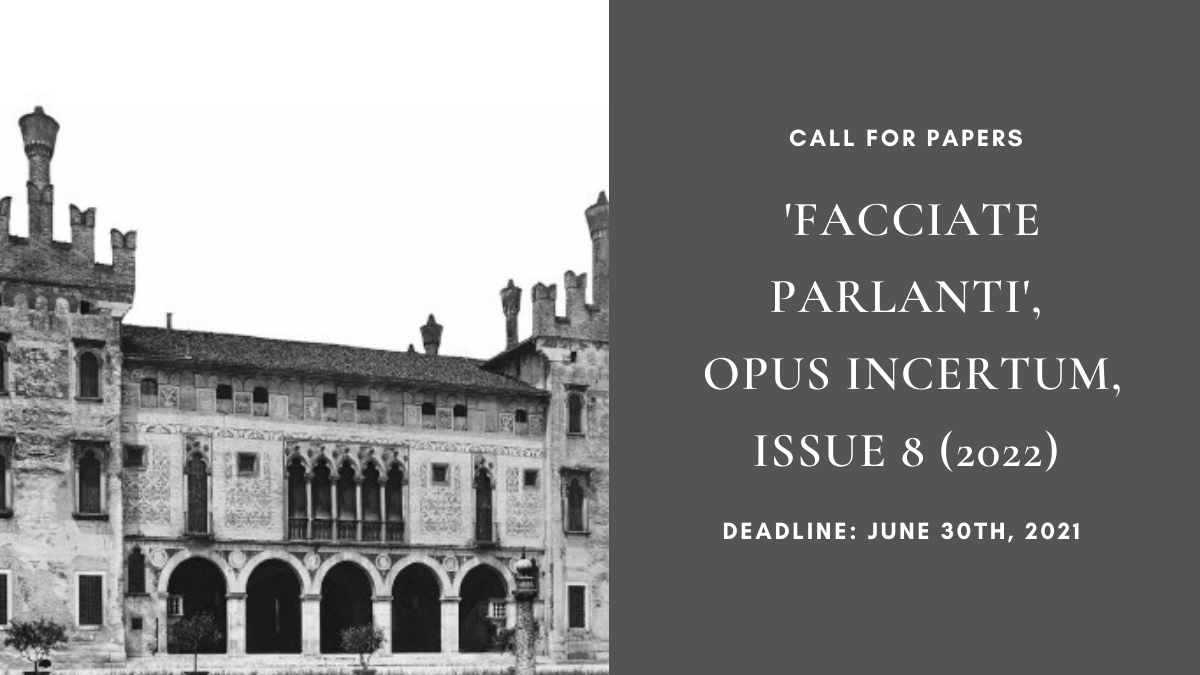
Call for Papers: ‘Facciate Parlanti’, Opus Incertum, Issue 8 (2022), Deadline: June 30th, 2021

Since antiquity buildings have carried inscriptions on their surface. In particular, the habit of decorating façades with epigraphs spread in early modern Europe in keeping with the all’antica revival. The 2022 issue of the journal Opvs Incertvm (Department of Architecture, University of Florence) aims to investigate the role of new and ancient inscriptions (i.e. spolia) in secular and religious architecture (ca. 15th-18th centuries) from an aesthetic, political, literary and artistic point of view. Whether they were realized, or only projected in drawings, the “facciate parlanti” engaged in a close dialogue with public spaces and their audience. While the inscriptions could be in different languages and media (carved on stone, graffite or painted), they always retained a particular relationship with the building itself. 
Possible topics include, but are not limited to, the relationship between inscriptions and the patron’s ambitions and culture, the role of literati, iconographical advisers and antiquari and the social and urban context of the building.

Edited by Alessandro Brodini and Maddalena Spagnolo.

We welcome papers in Italian, English, French, German and Spanish.

An abstract of 500 words ca., and a brief cv, preferably in English or Italian, can be sent to alessandro.brodini@unifi.it and maddalena.spagnolo@unina.it.

Deadline for proposals: 30 June 2021
Notification of acceptance: 30 July 2021
Deadline for the definitive text: 30 April 2022
Publication: before the end of 2022
Opus Incertum has a double-blind peer review
https://oajournals.fupress.net/index.php/oi

Online Seminar: The Global Middle Ages Seminar, Valerie Hansen and Morris Rossabi, 5th May 2021

Valerie Hansen and Morris Rossabi will present at the Global Middle Ages Seminar. They will each give a short paper followed by a moderated conversation and Q&A session.

“The World’s Most Active Sea Route Before 1492: From the Chinese ports of Quanzhou and Guangzhou to Basra (in Modern Iraq) and Sofala (in Modern Mozambique)” (Valerie Hansen)

Starting around the year 1000, Chinese ships began to voyage to the Persian Gulf and sometimes even farther to the East African coast, a journey three times as long as Columbus’s voyage to the Americas. The Chinese imported huge quantities of what they called aromatics (the blanket term xiang covered fragrant woods, incense, spices, and tree resins such as frankincense and myrrh) from Southeast, South, and West Asia, and they exported textiles, metal goods, and ceramics to these regions as well as East Africa. These contacts had multiple effects, some of which we can study on the basis of archeological finds, particularly of ceramics. Hansen will explore why this route isn’t better known. Although traditional treatments of the medieval period do not cover this topic, it certainly falls within the purview of the Global Middle Ages.

“The Golden Horde: Recent Discoveries in Russia” (Morris Rossabi)

Until the late twentieth century, many Russians and foreigners portrayed Mongol rule in Russia as totally disastrous and despotic and leading to autocracy in the country’s later history. In the 1980s, specialists on the period of the Golden Horde, while not ignoring the death and destruction caused by the Mongols, asserted that the Mongols contributed to Russia’s first unification, fostered trade and religion, built new cities, and patronized and supported the arts. Historians and archeologists have recently confirmed some positive aspects of Golden Horde rule. This slide-illustrated lecture provides the historical background and shows samples of the latest archeological and artistic discoveries in ceramics, textiles, and metal work.


Valerie Hansen teaches Chinese and world history at Yale, where she is the Stanley B. Woodward Professor of History. Her current book is The World in the Year 1000: When Globalization Began. Earlier monographs include The Silk Road: A New History with Documents (2012) and The Open Empire: A History of China to 1800 (2015). Hansen is a frequent visitor to Asia teaching at Yale’s undergraduate program at Peking University, Yale-NUS College in Singapore, and as an invited scholar at Xiamen University in Fujian province, China.

Morris Rossabi (PhD Columbia University) was born in Alexandria, Egypt, and teaches Chinese and Mongolian history at the City University of New York and Columbia. Author and editor of numerous books, including Khubilai Khan, Modern Mongolia, Voyager from Xanadu, From Yuan to Modern China and Mongolia: The Writings of Morris Rossabi, and A History of China, as well as dozens of articles, he has collaborated on catalogues for art exhibitions at the Metropolitan Museum of Art, the Cleveland Museum of Art, and the Los Angeles County Museum of Art. He has traveled extensively and lectured in the Middle East, China, Japan, Korea, Central Asia, and Mongolia and speaks several European, Middle Eastern, and East Asian languages. The National Mongolian University awarded him an honorary doctorate in 2009.

Register for this event here.


This event will be held via Zoom. A link will be circulated to registrants by 10 am on the day of the event. This event will be live with automatic captions.

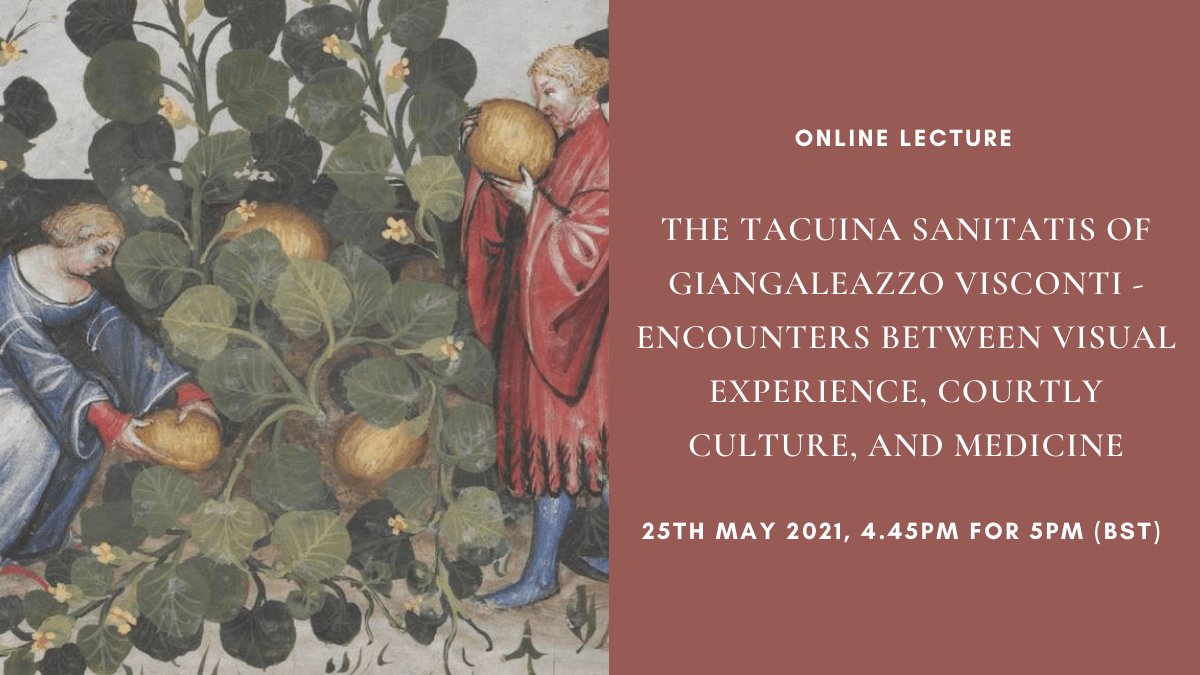
Online Lecture: The Tacuina Sanitatis of Giangaleazzo Visconti – encounters between visual experience, courtly culture, and medicine, Dominic Olariu, Murray Seminars at Birkbeck, 25th May, 4.45pm for 5pm (BST)

Four illustrated Tacuinum sanitatis (Tables of Health) manuscripts commissioned in the late fourteenth century by Giangaleazzo Visconti, Count of Milan and Pavia, pioneered a genre of books based on empirical experience. The manuscripts assimilated the eleventh-century Arabic medical and dietary knowledge of the tract Taqwīm al-ṣiḥḥa (Restoration of Health), itself a ground-breaking work, combining this with new formats and illustrations based on empirically gained experience. In northern Italian court culture the promotion of medical progress was an important aspect of the pursuit of a refined lifestyle in which the experience and practice of a sophisticated garden culture, the cultivation of a learned book culture, and the creation of avant-garde art all played their part. The experiences recorded in these images, combined with short texts, opened up new avenues of scientific practice and allowed Giangaleazzo a courtly self-dramatization as a promoter of medicine, the arts, and a healthy lifestyle, so strengthening his fragile position as ruler.

Dominic Olariu teaches at Philipps University in Marburg and holds a research position at the University of Erfurt. He is the author of Das Herbarium Blackwellianum (2020) and La genèse de la représentation ressemblante de l’homme (2014), and has edited two anthologies on portraiture. His numerous articles reflect his interdisciplinary research interests in conceptions of imitation, indexicality and similitude, particularly as seen in portraiture and illustrations of the natural sciences in the medieval to early modern periods.

Book your place here!

Online Lecture: Land, Memory and Power – Royal Privileges and the Representation of Kingship in Castile (c.1158 – 1350), Fernando Arias Guillén, 5th May 2020 1-2pm (BST)

Medieval encounters is an interdisciplinary medieval seminar series organised by Cambridge University, supported by the Trevelyan Fund and the History Faculty. Seminars normally take place in St Catharine’s College twice a term, including lectures and  events such as meetings with international graduate students and debates. Until further notice seminars are held on Zoom. The link will be circulated to Medieval Research mailing list members

For more information about the seminar series, click here.

Zoom Details:

https://cam-ac-uk.zoom.us/j/92327529817?pwd=RXcrYnprS3p5UGkyTzMzM1U1ditiUT09

Meeting ID: 923 2752 9817

Passcode: 473388

If you have questions or would like to be added to the mailing list please contact Dr N Berend nb213@cam.ac.uk

Online Lecture: Anachronic Empire: The Heraldic Columns of Diogo Cão as Colonial Monuments, Medieval and Modern, Dr Jessica Barker, 28th April 2021, 2.30-4.00pm (BST)

UEA World Art Research Seminar 2021

A black and white photograph shows four men standing around a column on a rocky outcrop, one in clerical dress, one in military uniform, and two more dressed in suits. The monument comprises a pitted stone column surmounted by a metal shield with the coat of arms of the king of Portugal and a metal cross inscribed with the name “Dom João” and the date “1485”. This column, known in Portuguese as a padrão, is a nineteenth-century replica of a fifteenth-century monument, shipped from the port of Belém in Lisbon in 1485 and erected on the Cabo Negro on the coast of modern-day Angola, only to be sent back from Angola to Lisbon in 1892. The original was (and still is) displayed in the ethnographic museum of the Sociedade de Geografia de Lisboa alongside the remains or reconstructions of four other early padrões. The replica shown in this photograph was destroyed in 1975 by the independence movement in Angola, an episode of iconoclasm that is testament to the enduring association of this monument with colonial oppression. This paper explores the forelives and afterlives of the padrões, with particular attention on the shifting significance of their inscriptions and heraldic insignia.

Chaired by Simon Dell

Organised by Dr. Ed Krčma

To attend this lecture, please click here for the Teams link.

Online Lecture: Salvation and the Apocalypse in Santa Caterina, Galatina – eschatological narratives and Greek identity in the Salento, Maria Harvey, 26th April, 18.00–19.30 (CET)

This event will take place via Zoom and requires advance registration. Please click here to reserve your place.

As she returned to the Salento in 1415/6, dowager queen of Naples and Countess of Lecce Maria d’Enghien commissioned an extensive fresco cycle in the Franciscan church of Santa Caterina, founded by her first husband three decades earlier in Galatina (Lecce). A translation of Angevin iconography, the murals include a remarkable cycle of the Book of Revelation closely drawn from Neapolitan apocalypses found on panels, murals and manuscripts. These images will be the focus of the talk, which aims to re-centre the experience of the local Greek community in the reception of Santa Caterina’s frescoes. 

In the Quattrocento, the Salento (the heel of the Italian boot) was characterised by the presence of both Greek and Latin communities, and Galatina was included in a list of bilingual towns where mass was celebrated in both rites as late as 1577/80. However, these Greek individuals are virtually absent from the secondary literature on Santa Caterina, which has predominantly focused on the aristocratic patrons and the friars. An overly militant interpretation of the foundation bull – it speaks of providing mass in Latin for those who did not speak Greek, not of latinisation -, has also contributed to this omission. My work readdresses this imbalance and argues that, although the Greeks were not involved in the creation of the images, their interpretation of the frescoes is worthy of study as a creative, productive process. To do this, I will place the Apocalypse in communication with the rest of the cycle, and foreground Greek ideas about salvation and eschatology, morality and ritual in my analysis of Santa Caterina’s remarkable frescoes. 

Maria Harvey is Rome Fellow 2020-21 at the British School at Rome. After reading History of Art at the University of Cambridge, she completed an MA at the Courtauld Institute of Art on the arts of the medieval Mediterranean, where she became fascinated with southern Italy. Her thesis, at the University of Cambridge, was a monographic study of the church of Santa Caterina at Galatina, in the Salento, with a focus on the relationship between the Greek and the Latin communities. Maria was an Affiliated Lecturer at Cambridge in 2019-20, after having spent a year at the Metropolitan Museum of Art in New York as an Andrew W. Mellon Fellow. In New York, she worked on the museum’s Byzantine micromosaic icon of the Virgin Eleousa, and developed a second project on Simone Martini and Filippo Sangineto, lord of Altomonte in Calabria. Maria is interested in questions about the relationship between art and identity, broadly understood, including the ‘Questione Meridionale’, the meaning of visual languages and how engagement with art is central to the articulation and production of (personal, communal, confessional, etc) identity.

Exhibition: Thomas Becket – Murder and the Making of a Saint, British Museum, 20th May 2021 – 22nd Aug 2021

  • First ever major UK exhibition on Thomas Becket to open at the British Museum
  • Centrepiece will be an extraordinary first time loan of a complete stained-glass window from Canterbury Cathedral, one of the Cathedral’s greatest treasures
  • New research means window will be shown at British Museum in its original arrangement for the first time in 350 years 
  • Exhibition tells the story of the most shocking act of sacrilege in English history

In May 2021, the British Museum will host the first ever major UK exhibition on the life, death and legacy of Thomas Becket, whose brutal murder inside Canterbury Cathedral in 1170 shook the Middle Ages.

Thomas Becket: murder and the making of a saint (20 May – 22 August 2021) will chart over 500 years of history, from Thomas Becket’s remarkable rise from ordinary beginnings to one of the most powerful figures in England, through to his enduring but divisive legacy in the centuries after his death. The story will be told through an array of over 100 stunning objects brought together for the first time, including rare loans from across the UK and Europe.

Originally due to open in October 2020 but delayed by the coronavirus pandemic, the exhibition marks 850 years since the former Archbishop of Canterbury was killed on 29 December 1170 in his own cathedral. The murder was possibly on the orders of his bitter rival and former friend King Henry II. News of Becket’s gruesome death sent shockwaves across Europe and is considered one of the most scandalous acts of sacrilege in English history. Within days, miracles were being attributed to Becket, many connected to the healing power of his spilt blood, which lead to his canonisation as a saint by the Pope. His martyrdom had a profound impact on the power dynamics between Church and State for hundreds of years, culminating in King Henry VIII ordering the obliteration of Becket’s legacy in 1538, calling him a traitor to the crown. Becket’s role as a key figure in major moments of European history will be traced throughout the show.

The exhibition’s centrepiece will be the extraordinary loan of an entire medieval stained-glass window from Canterbury Cathedral. It is one of the surviving famed Miracle Windows which were made in the early 1200s to surround Becket’s now-lost shrine in the Cathedral’s Trinity Chapel. This is the first time one of these windows has ever been lent, and the first time the glass has ever left the Cathedral, since their creation 800 years ago

The Miracle Windows, of which 7 survive from an original series of 12, tell several of the evocative stories of miracles attributed to Becket in the three years following his death. They demonstrate his remarkable transformation from a London-born merchant’s son into the renowned miracle worker known as St Thomas of Canterbury, who is still revered by Christians today. The windows are the only known depictions of Becket’s miracle stories in any media.

The window coming to the British Museum, the fifth in the 12-part series, is a masterclass in medieval artistry and measures over six meters in height. The miracle stories it depicts include the healing of eyesight and the replacement of lost genitals, with the latter being the earliest known depiction of castration in medieval art. New research, recently carried out due to its removal for study prior to the exhibition, has revealed that some of the panels have been in the wrong order for centuries. They were probably mixed up during a hasty rearrangement in the 1660s and the errors were discovered after close inspection of individual pieces under a microscope. When the window is shown at the British Museum, it will be rearranged in the correct narrative order, and this will be the first time in over 350 years that visitors will be able to view these panels as they were made to be seen. It will also be the very first time the window can be seen up-close at eye-level. 

Leonie Seliger, Director of Stained Glass Conservation at Canterbury Cathedral, said: “The Miracle Windows are medieval versions of graphic novels illustrating the experiences of ordinary people. They greeted the pilgrims at the culmination of their journey to Becket’s shrine with images that would be reassuring and uplifting. The window that will be shown at the British Museum is only one of seven that remain, and they are one of Canterbury Cathedral’s greatest treasures.”

Becket’s story will also be brought to life through an array of objects including precious reliquaries, jewellery, pilgrims’ badges and sculpture from the British Museum collection. Spectacular loans (which make up almost half of the objects on display) include objects which may have been owned by Becket himself, such as manuscripts from Trinity College and Corpus Christi College, Cambridge that he is thought to have commissioned or was given. There will also be a single surviving wax impression made from Becket’s personal seal matrix – lent by the National Archives – providing a tantalising glimpse of his personality. An illustrated manuscript containing John of Salisbury’s Life of St Thomas Becket from the British Library, will show visitors one of the earliest known representations of the murder.

Hartwig Fischer, Director of the British Museum, said: “Thomas Becket is one of Europe’s most enduring and controversial figures even today, yet his story has never been told on this scale in a UK exhibition before. The British Museum holds some of the world’s greatest medieval objects and so we’re uniquely placed to tell this shocking chapter in history. We are grateful to those who are contributing loans, including Canterbury Cathedral whose loan of a Miracle Window will be the stunning centrepiece. The exhibition would not be possible without the generosity of the Museum’s long-term supporters the Hintze Family Charitable Foundation, the Ruddock Foundation for the Arts and Jack Ryan and Zemen Paulos.” 

Lloyd de Beer, co-curator of Thomas Becket: murder and the making of a saintsaid “The violent death of Thomas Becket is the ultimate true crime story. It’s a real-life tale as dramatic as Game of Thrones and we’re going to lead visitors through every twist and turn of this remarkable plot. There’s drama, fame, royalty, power, envy, retribution, and ultimately a brutal murder that shocked Europe.”

Tickets will go on sale soon. Check the exhibition’s webpage and sign up to the British Museum newsletter for updates. Check the show’s website for updates.

Thomas Becket: murder and the making of a saint is co-curated by Lloyd de Beer, Curator: Medieval Britain and Europe and Naomi Speakman, Curator: Late Medieval Europe, alongside Sophie Kelly, Project Curator. 

For the British Museum’s exhibition blog, please click here.

Follow this link to book your tickets!

Publication

To coincide with the exhibition, a richly illustrated catalogue, Thomas Becket: murder and the making of a saint,written by Lloyd de Beer and Naomi Speakman, is published by the British Museum Press in April 2021. Hardback, £35, ISBN 9780714128382.

To get your copy of the exhibition catalogue, you can shop online here.

Access:

A hearing loop accompanies the installation ‘Murder in the Cathedral’. The hearing loop symbol will highlight where this is available. A link to this film will be sent in an email after your visit.

There are a few benches where you can sit down in the exhibition. A limited number of folding stools are available at the Main entrance on Great Russell Street. Please drop these off as you exit the Museum on Montague Place.

Supported by :
The Hintze Family Charitable Foundation

The Ruddock Foundation for the Arts

Jack Ryan and Zemen Paulos

Credit: Alabaster panel showing the murder of Thomas Becket. England,
around 1425-50. © The Trustees of the British Museum.
Info: This sculpture was made for an altarpiece in a church. It would probably have
formed part of a sequence of sculptures showing scenes from Becket’s life and death.

Online Lecture: The Ship in the Shop – A Brief Art History of Late Medieval Ships in Miniature, Achim Timmerman, Murray Seminars at Birkbeck, 6th May 2021, 4.45pm for 5pm (BST)

This paper newly outlines an art history of late medieval ship models and their contexts of use. Focusing on the mid-thirteenth through early sixteenth centuries in Europe, an age of rapid maritime expansion, it investigates the design and role of miniature vessels at the intersection between devotional practices, courtly culture, modes of patronage, and technological change. It explores three categories of ship models in particular: ex-voto ships that were presented to a specific shrine after a miraculous rescue at sea or naval victory; nefs, which served as princely table decorations and containers of commodities such as salt and spices; and nefs that, subsequent to their use as banqueting props, were repurposed as devotional vessels that either contained relics or possibly functioned as ex-votos.

Achim Timmermann is Professor of the History of Art and Professor of Architecture at the University of Michigan, Ann Arbor. A specialist in the art and architecture of the late Middle Ages, he is author of Real Presence: Sacrament Houses and the Body of Christ, c. 1270-1600 (2009) and Memory and Redemption: Public Monuments and the Making of Late Medieval Landscape (2017), as well as over fifty journal articles.

Book your place here.

Online Lecture: St David’s Cathedral: Teiliau Tyddewi – The Tiles of St Davids, Martin Crampin, 10th June 2021, 7pm (BST)

The patterns found on the late medieval ceramic tiles at St David’s Cathedral were the starting point for a series of new works by artist Martin Crampin. Sections of an initial piece of work was exhibited in local churches as part of the annual ‘Art on the Faith Trail’ event and subsequently brought together in an exhibition at the cathedral with additional images based on the tiles.

This talk will examine the pattern and imagery of the tiles, which were made in around 1500, and consider their rearrangement in the nineteenth century and the copies made for the restored interior. Just as the Gothic Revival was caught between an authenticity to medieval form and its reinvention, this new work also occupies a creative tension between reproduction and abstraction, while drawing attention to aspects of late medieval decorative arts that have often been overlooked.

Martin Crampin has worked on a series of research projects researching different aspects of the visual culture of Wales while based at the University of Wales Centre for Advanced Welsh and Celtic Studies in Aberystwyth. His primary interests have been aspects of ecclesiastical art and medievalism, and this also forms the primary focus of his artistic practice, which is inspired by the patterns and images found in medieval decorative arts. He also works as a designer and photographer, specialising in the production of books and guides to stained glass.

To book your tickets for this exciting events, please click here.

CFP: Aural Architectures of the Divine – Sacred Spaces, Sound and Rites in Transcultural Perspectives (Florence, 24-26 Feb 22), Deadline: June 30th 2021

An interdisciplinary conference to be held in Florence in February 2022 will focus on the complex interrelation of sacred space, sound and rites in transcultural perspectives from ancient to premodern times. The research project “CANTORIA – Music and Sacred Architecture” (University of Mainz) and the “Dipartimento di Storia, Archeologia, Geografia, Arte e Spettacolo” (University of Florence) invite all interested researchers to submit proposals.

Since ancient times, religious practices and the perception of the divine have been determined by the intersection of rite, sound and sacred space. Temples, churches and other sacred buildings not only define a holy place as a physical and symbolic expression of a specific faith, but establish the setting for performative and multisensorial religious ceremonies in which music and other sonic manifestations play an important role. The structure, decoration and furnishing of sacred buildings create specific acoustics which influence the soundscape of sacred spaces, consisting of chants, music of rites or art music, prayers, recitations and religious sonic utterances. Performative rites such as services, processions, sacred plays or other liturgical ceremonies use the potentials of these environments in specific ways. Vice versa, architecture reacts to ritual and musical developments by modifying venerable sanctuaries or in designing and constructing new buildings. In addition to established architectural-, music- and religious-historical methods and new trends of anthropology and sound studies, digital technologies contribute to the understanding of the architecture-sound nexus in producing virtual and aural spaces. Through acoustic measurements and digital reconstructions of ancient monuments archaeoacoustics help to explore aural architectures of times past.

In this decidedly interdisciplinary conference we focus on the complex interrelation of sacred space, sound and rites in transcultural perspectives from ancient to premodern times. The sacred space is understood as a historical product, which was determined by a religion’s theological, aesthetic and socio-cultural context and which – conversely – shaped the performative, sonic and aesthetic dimensions of the ritual activities. Guiding questions could be: Were sacred architectures intentionally designed to create specific spiritual soundscapes? Did architecture theory discuss acoustics considering spoken and sung word or instrumental music in sanctuaries? What are religious concepts of sound and space as manifestations of the metaphysical? To what extent did composers and performers react to the architectural and acoustic situation in sacred spaces? Were artistic decorations conceived to interact with the ritual, musical and sonic elements? How were the multisensorial performances experienced and perceived by the faithful? In what ways do aural architectures of different religions, historical or geographical settings differ or coincide? And finally: To what extent can digital technologies provide new insights into the spatial-sonic experiences of divine ceremonies of the past?

The interdisciplinary conference is aimed at scholars of architectural and art history, musicology, (archaeo-)acoustic and sound studies, religious studies, archaeology, anthropology and sensual culture studies. With its wide methodological ambitus and the broad historical and geo-cultural and religious outlook the conference seeks to provide a multifaceted investigation of the interconnection of rite, sound and sacred architecture in a transcultural perspective. The conference is organised by the research project “CANTORIA – Music and Sacred Architecture” (Johannes Gutenberg University Mainz) in cooperation with the Università degli Studi di Firenze, Dipartimento SAGAS.

Papers of 30 minutes will be accepted in English and Italian. Interested speakers are invited to submit an abstract of their proposed paper (max. 500 words) and a short CV (max. 300 words) by 30 June 2021 to: anmeldung-musikwissenschaft@uni-mainz.de

Contributions by junior researchers will receive special attention. Travel and accommodation expenses will be reimbursed subject to successful financing.

Further information: https://en.cantoria-mainz.de

Università degli Studi di Firenze, Dipartimento di Storia, Archeologia, Geografia, Arte e Spettacolo (SAGAS)

Concept: Prof. Dr. Klaus Pietschmann and Dr. Tobias C. Weißmann

Conference Committee: Prof. Dr. Mila De Santis, Prof. Dr. Antonella D’Ovidio, Prof. Dr. Klaus Pietschmann and Dr. Tobias C. Weißmann