Online Lecture: BALH Digital Skills Workshop – Uncovering your Medieval Local History, Saturday 10th April 2021 10:00am (BST)

One of a series of digital skills workshops and webinars hosted by BALH in 2021.

Click here to book your tickets.

Participants will be provided with an overview of the structures and institutions which produced records in the medieval period and where these records can be found today. Throughout the workshop case studies will be used from across the UK and there will be plenty of opportunities for questions and a chance to try your hand at some medieval local history research!

No prior knowledge of the medieval period is required for this workshop, if you have any questions please get in touch with Claire directly at digital@balh.org.uk

Practical guidance will be offered and there will be plenty of time for Q+A.

Ticket price: £8.00 (BALH Members £5.00)

Special offer: Is your local history society a BALH member? Enter your society’s discount code for the reduced rate of £6.00.

Venue/Online Details:

A webinar hosted via Zoom – you will be emailed details prior to the event.

Fellowship: Postdoctoral Fellowship, Society of Renaissance Studies, Deadline: 30th April 2021

The Society for Renaissance Studies invites applications for its Postdoctoral Fellowships, which support research in all aspects of Renaissance studies. There will be two Postdoctoral Fellowships awarded in the academic year 2021-22, each worth £15,000.

Our understanding of ‘Renaissance’ is broad: we welcome applications from all disciplinary backgrounds, and across a wide chronological and geographical spectrum; we also prize innovative approaches to undertaking research. SRS supports the principle that academia cannot reach its full potential unless it can benefit from the talents of all, and so is committed to equality, diversity and inclusion.

Eligibility:

  • Applicants must be graduates of British or Irish universities, and currently engaged in full-time research, part-time teaching or independent scholarship.
  • Applicants must either already have been awarded their PhD (from a British or Irish university) no more than five years before 1 October 2021, or have been provisionally awarded their PhD by 31 May 2021, subject to no more than minor corrections. These corrections must be due to be completed and accepted by the awarding university no later than 1 October 2021. It is expected that the applicant’s referees will be able to confirm the status of the PhD.
  • The SRS Fellowships are not to be held alongside other postdoctoral awards or fellowships or jobs that constitute more than 0.5 of a full-time post.

Conditions:

  • The period of tenure is twelve months from 1 October 2021.
  • Fellows are required to become members of the SRS and will be invited to attend meetings of the Society’s Council.
  • Fellows will be asked to present their findings at the end of the period of award, and to submit a written report for publication in the Society’s Bulletin
  • Fellows must name the Society for Renaissance Studies in their affiliation in any publications and conference papers presenting the research.
  • There are no specific residence requirements for successful applicants taking up a Fellowship.

Applicants should complete the online application form below by 30 April 2021.

Experiences of, and advice on, applying for an SRS Postdoctoral Fellowships.

Queries should be addressed to the SRS Fellowships Officer:

Dr David Rundle – e-mail: d.g.rundle@kent.ac.uk

Click here for more information from the Society for Renaissance Studies website.

New Journal Issue: Speculum: A Journal of Medieval Studies, Volume 96 Number 2, April 2021

Find the new issue of Speculum here!

EDITOR Katherine L. Jansen

ASSOCIATE EDITOR Taylor McCall

ASSISTANT EDITOR Carol Anderson

EDITORIAL ASSISTANT Austin Powell

COPYEDITOR Anne Cherry

PROOFREADER Aaron Gies

EDITORIAL INTERNS Maia Driggers Paul Smith

ASSISTANT TO THE EDITOR Christopher Cole

Articles

287 Magical Charaktêres in the Carolingian World: A Ninth-Century Charm in MS Vat. lat. 5359 and Its Broader Cultural Context ▪ Ildar Garipzanov

309 Inventing Apostolic Impression Relics in Medieval Rome ▪ Erik Inglis

367 Tales of the Living Dead: Dealing with Doubt in Medieval English Law ▪ Elizabeth Papp Kamali

418 Eve, Mary, and Martha: Paintings for the Humiliati Nuns at Viboldone ▪ Julia I. Miller

Reviews

466  Abram, Christopher, Evergreen Ash: Ecology and Catastrophe in Old Norse Myth and Literature (Michael Bintley)

467  ‘Alı ̄ al-Tanu ̄khı ̄, Al-Muhassin ibn, Stories of Piety and Prayer: Deliverance Follows .Adversity, ed. and trans. Julia Bray (Nuha Alshaar)

469  Antonsson, Haki, Damnation and Salvation in Old Norse Literature (SvanhildurÓskarsdóttir)

470  Ashdowne, Richard and Carolinne White, eds., Latin in Medieval Britain (PádraicMoran)

472 Bailey, Matthew and Ryan D. Giles, eds., Charlemagne and his Legend in Early Spanish Literature and Historiography (Francisco Bautista)

474  Barr, Jessica, Intimate Reading: Textual Encounters in Medieval Women’s Visionsand Vitae (Barbara Newman)

475  Bayless, Martha, ed., Fifteen Medieval Latin Parodies (Katell Lavéant)

477  Blackmore, Lyn, Ian Blair, Sue Hirst, and Christopher Scull, The Prittlewell PrincelyBurial: Excavations at Priory Crescent, Southend-on-Sea, Essex, 2003 (Janet Kay)

478  Boulton, Maureen B. M., ed., Literary Echoes of the Fourth Lateran Council inEngland and France, 1215–1405 (Charles F. Briggs)

480 Bowersock, G. W., The Crucible of Islam (Suleyman Dost)


482 Butterfield, Ardis, Henry Hope, and Pauline Souleau, eds., Performing Medieval Texts (Anne Stone)

484  Chrissis, Nikolaos, Athina Kolia-Dermitzaki, and Angeliki Papageorgiou, eds.,Byzantium and the West: Perception and Reality (11th–15th c.) (Jonathan Harris)

485  Collins, David J., ed., The Sacred and the Sinister: Studies in Medieval Religion andMagic (Tabitha Stanmore)

487  DeGregorio, Scott and Rosalind Love, trans., Bede: On First Samuel (James T. Palmer)

488  Denissen, Diana, Middle English Devotional Compilations: Composing Imaginative Variations in Late Medieval England; Marleen, Cré, Diana Denissen, and Denis Renevey, eds., Late Medieval Devotional Compilations in England (Alastair Minnis)

491 Edgington, Susan B., Baldwin I of Jerusalem, 1100–1118 (Jay Rubenstein)

492 Emmerson, Richard K., Apocalypse Illuminated: The Visual Exegesis of Revelation in Medieval Illustrated Manuscripts (Jacqueline E. Jung)

494 Fear, Andrew and Jamie Wood, eds., A Companion to Isidore of Seville (Molly Lester)

496 Feller, Laurent and Ana Rodríguez, eds., Expertise et valeur des choses au Moyen Âge (Marta Madero)

498  Font, Márta and Gábor Barabás, ColomanKing of Galicia and Duke of Slavonia(1208–1241): Medieval Central Europe and Hungarian Power (Cameron Sutt)

499  Forrest, Ian, Trustworthy Men: How Inequality and Faith Made the Medieval Church(Fiona Somerset)

501  Fraenkel, Avraham and Abraham Gross, eds., Hebräische liturgische Poesien zu denJuderverfolgungen während des Ersten Kreuzzugs, with Peter Sh. Lehnardt (RainerJosef Barzen)

502  Franses, Rico, Donor Portraits in Byzantine Art: The Vicissitudes of Contact betweenHuman and Divine (Rossitza Schroeder)

504  Geisthardt, Constanze, Monster als Medien literarischer Selbstreflexion: Untersuchungenzu Hartmanns von Aue “Iwein,” Heinrichs von dem Türlin “Crône” und Johannsvon Würzburg “Wilhelm von Österreich” (Ruth Seifert)

505  Griffiths, Fiona and Kathryn Starkey, eds., Sensory Reflections: Traces of Experiencein Medieval Artifacts (Margaret Graves)

507 Hahn, Cynthia, Passion Relics and the Medieval Imagination: Art, Architecture, and Society (Anne E. Lester)

509  Hartley, Julia Caterina, Reading Dante and Proust by Analogy (Ilaria Serra)

510  Hill, Derek, Inquisition in the Fourteenth Century: The Manuals of Bernard Gui andNicholas Eymerich (Justine Trombley)

511  Hodapp, William F., The Figure of Minerva in Medieval Literature (Theresa Tinkle)

513 Hurlock, Kathryn, Medieval Welsh Pilgrimage, c. 1100–1500 (Jane Cartwright) 515 Jager, Katharine, ed., Vernacular Aesthetics in the Later Middle Ages: Politics, Performativity, and Reception from Literature to Music (Taylor Cowdery)

517  Jaynes, Jeffrey, Christianity beyond Christendom: The Global Christian Experienceon Medieval Mappaemundi and Early Modern World Maps (Alfred Hiatt)

518  Johannes de Hauvilla, Architrenius, trans. Winthrop Wetherbee (Greti Dinkova-Bruun)

519  Johnson, Tom, Law in Common: Legal Cultures in Late-Medieval England (Paul Brand)

521  Kesling, Emily, Medical Texts in Anglo-Saxon Literary Culture (Richard Scott Nokes)

522  Kuuliala, Jenni, and Jussi Rantala, eds., Travel, Pilgrimage and Social Interactionfrom Antiquity to the Middle Ages (Richard J. A. Talbert)

524  Leader, Anne, ed., Memorializing the Middle Classes in Medieval and RenaissanceEurope (Eleanor Hubbard)

525  Leidholm, Nathan, Elite Byzantine Kinship, ca. 950–1204: Blood, Reputation, andthe Genos (Shaun Tougher)

527 Lloyd-Morgan, Ceridwen, and Erich Poppe, eds., Arthur in the Celtic Languages: The Arthurian Legend in Celtic Literatures and Traditions (Daniel Helbert)


529 Maimonides, Moses, “On the Regimen of Health”: A New Parallel Arabic-English Translation, ed. and trans. Gerrit Bos, with critical editions of medieval Hebrew translations by Gerrit Bos and Latin translations by Michael R. McVaugh; Maimonides, Moses, “On the Elucidation of Some Symptoms and the Response to Them” (Formerly Known as “On the Causes of Symptoms”): A New Parallel Arabic-English Edition and Translation, with Critical Editions of the Medieval Hebrew Translations, ed. and trans. Gerrit Bos (Maud Kozodoy)


531 Makowski, Elizabeth, Apostate Nuns in the Later Middle Ages ( Tanya Stabler Miller)

533 Mancia, Lauren, Emotional Monasticism: Affective Piety in the Eleventh-Century Monastery of John of Fécamp (John Van Engen)

535  McGrady, Deborah, The Writer’s Gift or the Patron’s Pleasure?: The Literary Economy in Late Medieval France (Sarah Wilma Watson)

536  Meyer-Lee, Robert J., Literary Value and Social Identity in the Canterbury Tales (Roger A. Ladd)

538  Mulligan, Amy C., A Landscape of Words: Ireland, Britain and the Poetics of Space, 700–1250 (Aisling Byrne)

539  Niles, John D., God’s Exiles and English Verse: On the Exeter Anthology of Old English Poetry (Patrick W. Conner)

541 Odorico da Pordenone, Relatio de mirabilibus orientalium Tatarorum, ed. Annalia Marchisio (Peter Jackson)

543  Oftestad, Eivor Andersen, The Lateran Church in Rome and the Ark of the Covenant: Housing the Holy Relics of Jerusalem; with an Edition and Translation of the “Descriptio Lateranensis Ecclesiae” (BAV Reg. Lat. 712) (Lezlie Knox)

544  Palmer, James A., The Virtues of Economy: Governance, Power, and Piety in Late Medieval Rome (Steven A. Epstein)

545  Pettit, Edward, The Waning Sword: Conversion Imagery and Celestial Myth in “Beowulf” (Craig R. Davis)

547  Pluskowski, Aleksander, ed., Ecologies of Crusading, Colonization, and Religious Conversion in the Medieval Baltic: Terra Sacra II (Alan V. Murray)

548  Porck, Thijs, Old Age in Early Medieval England: A Cultural History (Alice Jorgensen)

550 Raffensperger, Christian, Conflict, Bargaining, and Kinship Networks in Medieval Eastern Europe; Raffensperger, Christian, Ties of Kinship: Genealogy and Dynastic Marriage in Kyivan Rus’ (Aleksandr Musin)

553 Rigby, Stephen H., ed., Historians on John Gower, with Siân Echard (Brian Gastle)

555  Russakoff, Anna, Imagining the Miraculous: Miraculous Images of the Virgin Maryin French Illuminated Manuscripts, ca. 1250–ca. 1450 (Tracy Chapman Hamilton)

556  Sabaté, Flocel, The Death Penalty in Late-Medieval Catalonia: Evidence and Significations(Adam J. Kosto)

558  Sadler, Donna L., Touching the Passion—Seeing Late Medieval Altarpieces throughthe Eyes of Faith (Gregory C. Bryda)

559  Schlotheuber, Eva and Anne Liewert, eds., Musik aus Paradiese: Die mittelalterlichenHandschriften der Dominikanerinnen aus Paradiese bei Soest (Cynthia J. Cyrus)

561  Schmidt, Ondrˇej, John of Moravia between the Czech Lands and the Patriarchate ofAquileia (ca. 1345–1394), trans. Graeme and Suzanne Dibble (Tomáš Velicˇka)

562  Staunton, Michael, ed., Herbert of Bosham: A Medieval Polymath ( Julian Haseldine)

564  Stern, David, Jewish Literary Cultures. Vol. 2, The Medieval and Early ModernPeriods (Katrin Kogman-Appel)

565  Stern, Sacha, The Jewish Calendar Controversy of 921/2 CE, with the collaborationof Marina Rustow, Nadia Vidro, and Ronny Vollandt (Elisheva Carlebach)

567  Thomson, R. M., The Fox and the Bees: The Early Library of Corpus ChristiCollege, Oxford. The Lowe Lectures 2017 (Micha Lazarus)

568  Timbert, Arnaud, ed., Qu’est-ce que l’architecture gothique?: Essais (Michael T. Davis)

570 Tolan, John V., Faces of Muhammad: Western Perceptions of the Prophet of Islam from the Middle Ages to Today (Nabil Matar)

572  Toner, Gregory and Xiwu Han, Language and Chronology: Text Dating by MachineLearning (Mike Kestemont)

573  Velasco, Jesús R., Dead Voice: Law, Philosophy, and Fiction in the Iberian MiddleAges (Teofilo F. Ruiz)

575  Vettori, Alessandro, Dante’s Prayerful Pilgrimage: Typologies of Prayer in the “Comedy”(George Corbett)

576  Wallenwein, Kirsten, Corpus subscriptionum: Verzeichnis der Beglaubigungen vonspätantiken und frühmittelalterlichen Textabschriften (saec. IV–VIII) (Markus Schiegg)

578 Wirth, Jean, La sculpture de la Cathédrale de Reims et sa place dans l’art du XIIIe siècle (Christoph Brachmann)

580  Wüsthof, Lucas, Schwabenspiegel und Augsburger Stadtrecht (Stephan Dusil)

581  Zeldenrust, Lydia, The Mélusine Romance in Medieval Europe: Translation, Circulation,and Material Contexts (S. C. Kaplan)

582  Zingesser, Eliza, Stolen Song: How the Troubadours Became French (Wendy Pfeffer)

New Publication: Byzantine Religious Law in Medieval Italy by James Morton

This new work from Oxford University Press is the first ever historical study of manuscripts of Byzantine religious law from medieval Italy. It offers a legal and institutional framework for reassessing relations between medieval Greek and Latin Christians. It includes identifications and descriptions of Italo-Greek canon law manuscripts, which will serve as the basis for future research.

Description:

Southern Italy was conquered by the Norman Hauteville dynasty in the late eleventh century after over five hundred years of continuous Byzantine rule. At a stroke, the region’s Greek Christian inhabitants were cut off from their Orthodox compatriots in Byzantium and became subject to the spiritual and legal jurisdiction of the Roman Catholic popes. Nonetheless, they continued to follow the religious laws of the Byzantine church; out of thirty-six surviving manuscripts of Byzantine canon law produced between the tenth and fourteenth centuries, the majority date to the centuries after the Norman conquest.

Byzantine Religious Law in Medieval Italy is a historical study of these manuscripts, exploring how and why the Greek Christians of medieval southern Italy persisted in using them so long after the end of Byzantine rule. The first part of the book provides an overview of the source material and the history of Italo-Greek Christianity. The second part examines the development of Italo-Greek canon law manuscripts from the last century of Byzantine rule to the late twelfth century, arguing that the Normans’ opposition to papal authority created a laissez faire atmosphere in which Greek Christians could continue to follow Byzantine religious law unchallenged. Finally, the third part analyses the papacy’s successful efforts to assert its jurisdiction over southern Italy in the later Middle Ages. While this brought about the end of Byzantine canon law as an effective legal system in the region, the Italo-Greeks still drew on their legal heritage to explain and justify their distinctive religious rites to their Latin neighbours.

Table of Contents:

List of Figures
List of Tables
Abbreviations
Note on Translation and Transliteration
Chronology
Maps
Introduction
Part I. Sources and Context
1:Introducing the Byzantine Nomocanon
2:Greek Christianity in Medieval Italy
3:Patterns of Source Survival
Part II. Byzantine Canon Law in the Norman Kingdom
4:The Byzantine Background
5:Monastic Nomocanons I: The Monastic Archipelago
6:Monastic Nomocanons II: Style, Content, and Influences
7:The Secular Church and the Laity
Part III. From Legal to Cultural Authority
8:The Papacy Takes Charge
9:The Salentine Group
10: They Do It Like This in Romania
Conclusion
Appendix 1. Manuscript Descriptions
Appendix 2. Statistical Overview
Appendix 3. Uncertain and Disputed Manuscripts
Bibliography
Index of Manuscripts Cited
General Index

James Morton, Assistant Professor, Department of History, The Chinese University of Hong Kong

James Morton is Assistant Professor in the Department of History at The Chinese University of Hong Kong, where he teaches courses on ancient and medieval Europe. He studied Classics at St John’s College, Oxford, before obtaining an MA in Byzantine History at Queen’s University in Canada in 2011, and a PhD in Byzantine and Medieval History at the University of California, Berkeley, in 2018. His research focuses on the relationship between law, religion, and cultural identity in the pre-modern Mediterranean world.

Online Lecture: 2021 Anselm Lecture – Practices of Writing in England, 1050–1250, Professor Elaine Treharne, Thursday 8th April, 6pm (BST)

This talk will follow one line of research attempting to date a bilingual manuscript from the second half of the twelfth century. From exploring the aspect, duct, and shapes of individual letters, the study moves outward to consider the grade and formality of later twelfth and earlier thirteenth-century manuscripts and charters, before focusing on twelfth-century commentary hands. As the thread of research unravels, the issues of scribal training and professional writing become significant, involving discussion of Leofric of Exeter, Saints Anselm, Thomas Becket and Hugh of Lincoln, the Tremulous Hand of Worcester, and a host of other writers and scholars both past and present. In the final analysis, she asks: what uses does palaeography serve? What do we really know about writing practices in England in the central Middle Ages? And while access to digitised handwritten materials is a boon, what else can digital tools and methods now do to advance scholarship in medieval manuscript studies?

To join the seminar, please DM @MEMS_UKC on Twitter for the Zoom link and password. Please email E.Guerry@Kent.ac.uk with any further questions.

Job: Junior Professor ‘Economic History of the Middle Ages’, University of Mannheim – Deadline: 30th April 2021

The School of Humanities at the University of Mannheim offers a position as Junior Professor (W1) “Economic History of the Middle Ages”

The future holder of the position is expected to cover Economic History of the Pre-Modern Period at the University of Mannheim in both research and teaching.

The duties of the professorship will include:

* conducting courses (4 / 6 teaching hours (LVS); as German and English are both languages of instruction, proficiency in both languages is required) and examinations and supervising bachelor’s and master’s theses as well as doctoral dissertations.

* raising funds for and managing a research and/or collaborative project in Economic History of the Middle Ages.

The School of Humanities offers:

*international cooperation opportunities in the context of existing networks, a working group on Economic History of the Pre-Modern Period, interdisciplinary university-wide co- operation in research and teaching as well as collaboration with regional and international archives. The currently running DFG project “Microfinance and market participation” is to be continued in the next phase with a focus on historical sustainability research (in social, eco- logical, and economic terms).

*a well-functioning team, digital infrastructures for economic and social data, support from the research department as well as assistance in the promotion of early-stage researchers at the University of Mannheim.We are looking for a dynamic personality exhibiting the qualifications and potential for a research-oriented career in academia. A qualified doctoral dissertation in the field of medie- val history or economic history is required. Experience in teaching and/or raising third-party funds (collaboration in relevant research projects or proposal writing) and/or in the organi- zation of conferences, workshops, summer schools etc. is highly desired.

The eligibility criteria are stipulated in section 51 (2) and (3) of the act on the higher educa- tion institutions in the Land of Baden-Württemberg (Landeshochschulgesetz, LHG). In addi- tion to a completed higher education degree and proof of an outstanding doctorate, peda- gogical aptitude as well as the qualification for assuming the position of junior professor, which is to be proven by additional scientific achievements, are expected. Provided that the general professional requirements are met, the successful applicant will be appointed as junior professor with civil servant status for a fixed term of three years. Following a positive interim evaluation in accordance with the statutory provisions (see section 51 (7) and (8) LHG), the appointment can be extended to a total of six years.

The University of Mannheim places great importance on comprehensive guidance of its stu- dents and therefore expects professors to be present at the university for their students. Moreover, the University of Mannheim expects the successful applicant to relocate to Mannheim or the greater area in order to become an active member of the university com- munity. The University of Mannheim is committed to increasing the quota of women in re- search and teaching and thus encourages women with adequate qualifications to apply. Ap- plications of disabled applicants are given preferential consideration in the event of equal qualification.

Please submit your application online at sekretariat@phil.uni-mannheim.de (reference “Bewerbung W1-Wirtschaftsgeschichte Mittelalter”) as one pdf file (file size: max. 2 MB). Your application should include the following documents: cover letter, CV, list of publica- tions, certificates and records, teaching evaluation, brief description of your future research project.

If you cannot submit your application online, please send the above-mentioned documents to:

University of Mannheim
Dean of the School of Humanities Prof. Dr. Philipp Gassert
, 68131 Mannheim
E-mail address: sekretariat@phil.uni-mannheim.de
.

For more information, please contact annette.kehnel@uni-mannheim.de.
All applications received before 30 April 2021 will be given full consideration.

Data protection: If you apply by e-mail, please note that protection of confidential data can- not be guaranteed as unauthorized third parties could gain access to unencrypted e-mails during transmission.
Please find detailed information on your rights regarding the collection of personal data according to article 13 of the General Data Protection Regulation (DSGVO) on the University of Mannheim website. (https://www.uni-mannheim.de/universitaet/stellenanzeigen/datenschutz-bei-bewerbungen/)

Conference: London Medieval Society – Medieval Life Cycles, Zoom, Saturday 22nd May 2021, 10:20-14:30 BST

A belated celebration of the London Medieval Society at 75 years, LMS is proud to announce their third online colloquium, where they will be discussing the human life cycle from embryo to the grave, and beyond.

The programme of the day is as follows:

10.20 Welcome and Introduction 

10.30 Isabel Davis (Birkbeck, University of London) – Like a Hare in its Form: Embryology in Medieval Saints’ Lives

11.00 Ben Parsons (University of Leicester) – All Boys Once: Medieval Londoners at School in William Fitzstephen’s ‘Descriptio Nobilissimi Civitatis Londoniae’ (c. 1174)

11.30 Break 

11.45 Jeremy Goldberg (University of York) – The Time of their Lives? Adolescence to Adulthood in Late Medieval England

12.15 Lunch

1.00 Jo Edge (University of Manchester) – Walking the Tightrope: Learned Physicians and the Prediction of Death in the Later Middle Ages

1.30 Marianne Wilson (University of York) – Peacock Feathers and Pater Nosters: The Post-Mortem Commemorative Identity of Sir Thomas Burgh (c. 1430–1496) 

2.00 Round Table (all speakers)

2.30 End of Event

Tickets are free of charge. A link to the Zoom meeting will be sent via email.

Register for your tickets here.

Online Lecture: ‘Hybrid’, ‘transcultural’, ‘eclectic’? Some thoughts on conceptualising the art of the Latin East, Dr Michalis Olympios, April 5th 2021,19:30 (EET)

55th Public Lecture Series | Spring Semester 2021 | ARU 1991-2021: Celebrating 30 Years of Archaeological Research

The Archaeological Research Unit of the University of Cyprus invites you to an online ZOOM public lecture on Monday, April 5th 2021, at 19:30 (EET) by Dr Michalis Olympios Associate Professor, History of Western Art

Summary:

Modern historiography on the art of the late medieval and early modern Eastern Mediterranean has repeatedly bemoaned the nationalist and colonialist bias with which nineteenth- and early-twentieth-century scholarship approached the visual culture of the multicultural and multiconfessional societies of the Levantine Crusader states, Lusignan and Venetian Cyprus, Frankish Greece, Venetian Crete and other polities of the Latin East. Beginning in the latter half of the previous century, critical theorists and social scientists have provided art historians with a series of novel conceptual models, which have allowed the field to move beyond its erstwhile preoccupation with ‘purity’ of style and form – and, by extension, of race and ethnicity – towards a more fragmented, pluralistic and comprehensive view of artistic production in this culturally diverse region. Though the dust has far from settled on these developments, the present talk will attempt to take stock of recent advances and offer some thoughts on the ongoing quest to develop an apposite analytical framework for the study of the art of the Latin East.

All Monday lectures are free and open to the public, but registration is required for access to the Zoom lecture.

For registration, please, click here: https://ucy.zoom.us/meeting/register/tJUvd-GopjoiHtG0fdJHxFc18F5hm_-CXcf8

New Publication: Right and Left in Early Christian and Medieval Art by Robert Couzin

Robert Couzin’s Right and Left in Early Christian and Medieval Art is the first in-depth study of handedness, position, and direction in the visual culture of Europe and Byzantium from the fourth to the fourteenth century. Heretofore largely unnoticed or ignored, the pre-eminence of the right and lapses or intentional departures from that norm in medieval imagery are relevant to such major themes as iconography, visuality, reception, narrative, form, gender, production, and patronage. The author’s investigation of right and left in visual culture is informed by modern experimental research on laterality and contextualized within prevailing theological doctrines and socio-cultural practices.

Illustrations in the text are complemented by hundreds more made available on Brill’s Arkyves platform here.

See inside the book.

Readership

Scholars and students of early Christian and medieval art, as well as historians of other periods or of medieval culture generally, and researchers in laterality interested in its artistic manifestations.

Online Lecture: Art in Cathedrals: Norwich Cathedral – New Perspectives in Medieval Sculpture, Rob Hawkins (Zoom, 15th April 2021 7pm)

This is the first in a new series of online lectures, Art in Cathedrals, organised by Art+Christianity. Please follow this link to book your tickets.

All talks are fully illustrated and begin at 7pm fortnightly on Thursday evenings, beginning on April 15th. A full programme of events is listed below.

Rob Hawkin’s will discuss the 15th-century bosses from Norwich Cathedral cloister, posing big questions concerning pictorial space, point of view, and the assumptions we make when we approach pre-modern sculpture.

The elaborately sculpted vault bosses of Norwich Cathedral Cloister (built 1297-1430) are one of the glories of English medieval sculpture. The later bosses (1410-1430) are particularly virtuosic in their distortion of pictorial space: straight lines are rendered as curves; cuboids are radically warped; figures twist through crazy angles, each boss forming a bulbous hemisphere of intricate narrative. Visiting the cloister it becomes obvious that no single viewing position will suffice to make any one boss comprehensible: their curved surfaces demand that the viewer move in iterative orbits, gradually compiling an image of the whole scene in the mind’s eye.  

Most of our art-historical language for discussing ‘perspective’ and ‘pictorial space’ comes from our study of the Italian Renaissance, and is bound up with the supposed norm of rigid, geometric perspective. This paradigm assumes an ideal static observer. We are much less well equipped to discuss sculptural style, which tends to assume an embodied viewer moving in real space. Medieval theologians who discussed point of view and perspective, however, may offer some cognate concepts as we try to engage with these sculptures in less anachronistic ways. 

This talk presents some findings from new research into these fascinating pieces of sculpture. It makes use of photogrammetric modelling undertaken in the cloisters, which offers a way of reproducing the bosses in all their three-dimensionality in order to better communicate the complexity of their forms. We will also consider some theological connections both medieval and modern, using the bosses as a prompt to think about perspective theologically, asking what it might mean to have a notion of perspective fit for discussing our lived experience of the world.  

Rob Hawkins is an ordinand at Westcott House, reading the theology Tripos. Before training for ordination he studied and wrote about art history, completing an MPhil and PhD at King’s College, Cambridge under the supervision of Paul Binski, on questions of sculptural space and style in medieval craftsmanship. He enjoys making things, gardening, and thinking and writing about the place where theology, art, and matter meet.

For information about other events in this cycle, click here.

Programme:

Norwich Cathedral: New perspectives in medieval sculpture
by Rob Hawkins, art historian and ordinand, 15 April, 7pm 
A discussion of the 15th-century bosses from Norwich Cathedral cloister looking closely at sculptural space, point of view and style in medieval craftsmanship.

Coventry Cathedral: Icon and Inspiration 
by Alexandra Epps, art guide and lecturer, 29 April, 7pm 
The extraordinary story of the rebuilding of the Cathedral as a symbol of peace and reconciliation and its inspiring commitment to the modern.

Salford RC Cathedral: A Hidden Identity
by James Crowley, architectural historian, 13 May, 7pm 
How modern conservation and a traditional approach to re-ordering might re-establish the splendour of this highly significant building and the identity of the Catholic community.

Liverpool Metropolitan Cathedral: conceived in the round 
by Dominic Wilkinson, Principal Lecturer in Architect at Liverpool John Moores University, 27 May, 7pm 
Exploring the integrated conception of art and architecture envisaged by Sir Frederick Gibberd and the artists he worked with.

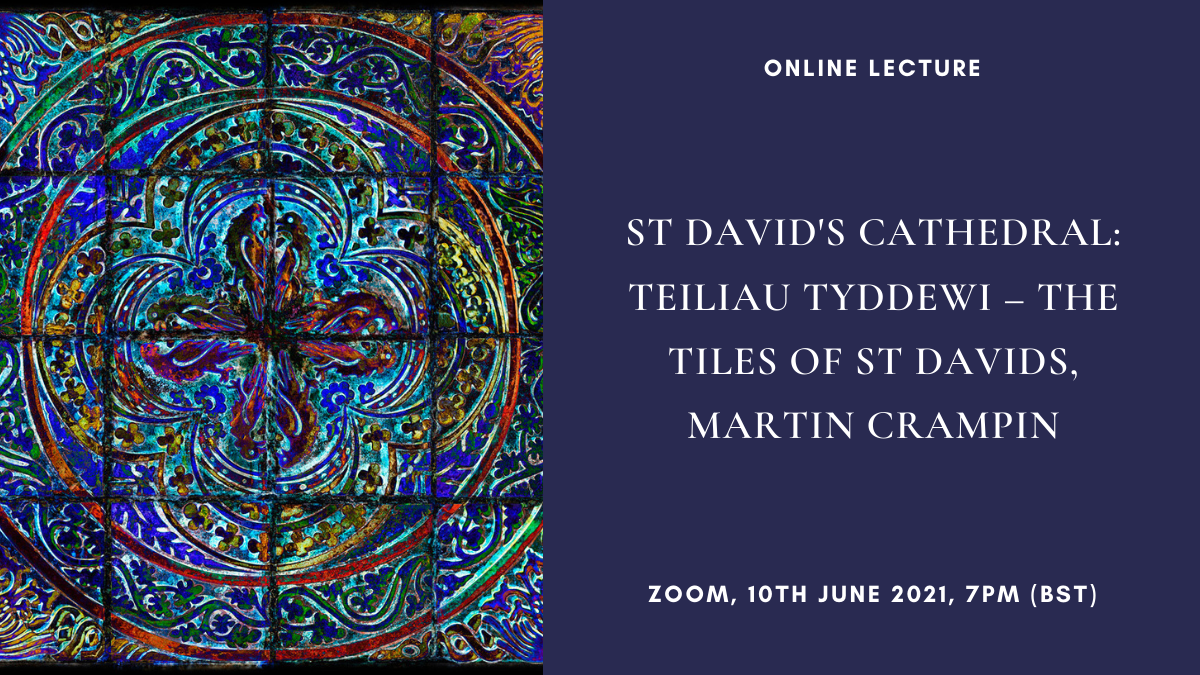
St David’s Cathedral: Teiliau Tyddewi – The Tiles of St Davids
by Martin Crampin, artist and art historian, 10 June, 7pm
A journey from the pattern and imagery of the late medieval ceramic tiles at St Davids Cathedral into Gothic Revival reproduction, interpretation and abstraction.