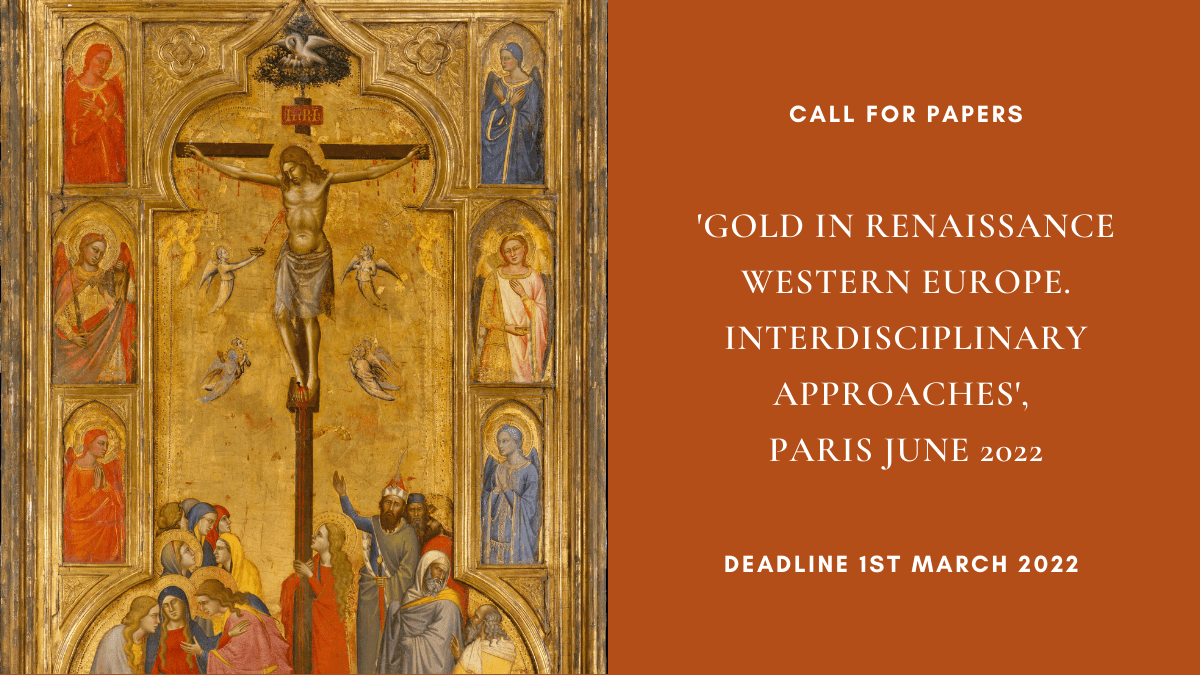
Paris, Jun 9–10, 2022
Deadline: Mar 1, 2022
International Symposium:
“Gold in Renaissance Western Europe. Interdisciplinary Approaches”
In his influential book on painting and visual culture in fifteenth-century Italy (Painting and Experience in Fifteenth-Century Italy, 1972), Michael Baxandall described the abandonment of gold in painting practices as a sensitive phenomenon both in contracts between painters and patrons, and in the writings of some authoritative art theorists. He linked this attitude to a more general movement on a European scale, consisting of the decline of some practices of display, for example the fashion for clothes embellished with precious materials such as gold. He also suggested a correlation between with the shortage of gold in fifteenth-century Europe or the growing interest in the painter’s maestria at the expense of the preciousness of the materials. Although gold backgrounds gradually disappeared from Western European painting – mainly during the fifteenth century – and art theorists condemned the use of this material, gold was not completely abandoned in practice, as shown by certain artworks produced by painters as innovative as Rembrandt and Vermeer in the middle of the seventeenth century. Nevertheless, the question of the subsequent use of gold has not been a major focus of early modern art historians, who have instead sought to refine Baxandall’s vision by examining the disappearance of gold backgrounds in the fifteenth century in the two main artistic areas of the time : the Low Countries and the Italian Peninsula.
Fifty years after Baxandall’s work, this symposium aims to investigate, in an interdisciplinary way, the place of gold in Western European societies during the Renaissance. As a material, gold has played an important role in the cultural and economic history of Europe and the world, in the history of science, and also in the historiography of the ‘material turn’ in art, as shown by several transchronological syntheses published in recent years [Venable 2011; Zorach & Phillips 2016]. Museums have not been left out of this renewed interest in the various uses and meanings of gold: one need only think of the exhibition that the Mucem organised in 2018 [Bouiller 2018], or the numerous physico-chemical analyses carried out on ancient artworks in research laboratories in France (e.g. C2RMF) and abroad, particularly in London (at the National Gallery).
On the basis of these recent achievements, we will focus on a limited area (Western Europe), albeit one connected to the rest of the world, and a given time (especially the period from 1450 to 1520).
The aim of the conference is therefore to explore:
-The economic history of gold and what the heritage science can say about it. Which deposits of the metal were exploited at that time? What is the current state of knowledge of monetary history in Western Europe at the end of the fifteenth century ? How can we characterise the origin of the gold in a work of art?
-The social history of gold. Can we speak of a symbolism linked to this material at that time? What are the myths associated with it (the alchemical quest, Eldorado, etc.)? What place does gold have in sumptuary legislation?
-The taste for gold (e.g. in treasures, domestic interiors, sacred spaces, etc.) and the position of civic and ecclesiastical authorities with regard to this precious metal.
-Learned and practical knowledge : metallurgy, alchemical practices, humanist thinking.
-The craftsmen who worked with gold (e.g. goldsmiths, gold beaters, gilders) and their regulations.
-Its artistic uses (goldsmithing, sculpture, illumination, engraving, tapestry, painting, etc.).
-The techniques for using this material as they can be reconstituted today by the physical and chemical sciences, as well as the techniques for restoring the gilding of a few artworks from this period, including the Isenheim Altarpiece (around 1515), which is currently undergoing restoration in Colmar (Musée Unterlinden).
We are inviting papers in all relevant disciplines.
Abstract submission and deadlines
Please submit your abstract of 300 words with a short biography to Romain Thomas (rthomas@parisnanterre.fr), Valentina Hristova (valqhristova@yahoo.fr), Christine Andraud (christine.andraud@mnhn.fr), Anne-Solenn Le Hô (anne-solenn.leho@culture.gouv.fr) by 1 March 2022. Notification of acceptance will be given around 15 March 2022.
Organising Committee
– Prof. Christine ANDRAUD (Professor of Physics (Optics), CRC/CNRS/MNHN)
– Dr. Valentina HRISTOVA (Post-doctoral Fellow in Early Modern Art History, Fondation des Sciences du Patrimoine and HAR, University Paris Nanterre)
– Dr. Anne-Solenn LE HO (Research Engineer in Physical Chemistry, C2RMF/CNRS)
– Dr. Romain THOMAS (Lecturer in Early Modern Art History, HAR, University Paris Nanterre)
Scientific Committee
-Prof. Erma HERMENS (Professor, Director of the Hamilton Kerr Institute and Deputy Director for Conservation and Heritage Research of the Fitzwilliam Museum, Cambridge University)
-Dr Julien LUGAND (Lecturer in Early Modern Art History, CRESEM, Université de Perpignan Via Domitia)
-Prof. Philippe SENECHAL (Professor in Early Modern Art History, Université de Picardie Jules Verne)
-Dr Laurent-Henri VIGNAUD (Lecturer in Early Modern History, LIR3S, Université de Bourgogne)
-Prof. Alison WRIGHT (Professor in Italian Art c. 1300-1550, University College London)
-Prof. Rebecca ZORACH (Mary Jane Crowe Professor in Art and Art History, Northwestern University)
Summary bibliography
Aix-en-Provence 1983 – L’Or au Moyen Age : monnaie, métal, objet, symbole (proceedings from the international conference in Aix-en-Provence, February 1982), Aix-en-Provence, 1983
Berzock 2019 – Caravans of gold, fragments in time. Art, culture, and exchange across medieval Saharan Africa, exh. catalogue ed. by Kathleen Bickford Berzock, Princeton, 2019
Bouiller et al. 2018 – Or , exh. catalogue ed. by Jean-Roch Bouiller, Philippe Jockey, Myriame Morel-Deledalle & Marcel Tavé (Marseille, Mucem, 24 april-10 september 2018), Vanves, 2018.
Duits 2008 – Rembrandt Duits, Gold brocade and Renaissance painting, London, 2008
Eveno et al. 2014 – Myriam Eveno et al., ”The Louvre Crucifix by Giotto – Unveiling the original decoration by 2D-XRF, X-ray radiography, Emissiography and SEM-EDX analysis”, Heritage Science 2014 2:17 [online]
Eveno-Ravaud 2021 – Myriam Eveno, Elisabeth Ravaud, ”Early occurrences of the use of smalt and shell gold in the Madonna of humility by Jacopo Bellini at the beginning of the fifteen century”, EPJ-P 136, 685 (2021)
Kroustallis et al. 2016 – Stefanos Kroustallis et al., ”Gilding in Spanish panel painting from the fifteenth and early sixteenth centuries”, Journal of Medieval Iberian Studies, 2016.
Le Hô et al. 2021 – Anne-Solenn Le Hô et al., ”A l’origine des couleurs et éléments matériels d’œuvres peintes des XIVe-XVIe siècles – un aperçu des “brocarts appliqués” et d’autres décors d’imitation et d’enrichissement des vêtements”, CeROArt (2021)
Linden 2007 – Mystical metal of gold essays on alchemy and Renaissance culture, ed. by Stanton J. Linden, NYC, 2007
MacLennan et al. 2019 – Douglas MacLennan et al., ”Visualizing and measuring gold leaf in fourteenth- and fifteenth-century Italian gold ground paintings”, Heritage Science, 2019, 7, 25 [online]
Minvielle Larousse et al. 2019 – Les métaux précieux en Méditerranée médiévale. Exploitations, transformations, circulations (proceedings from the international conference in Aix-en-Provence, 6-8 October 2016), ed. by Nicolas Minvielle Larousse, Marie-Christine Bailly-Maître, Giovanna Bianchi, Aix-en-Provence, 2019
Nuechterlein 2013 – Jeanne Nuechterlein, ”From Medieval to Modern : Gold and the Value of Representation in Early Netherlandish Painting” [online]
Schmitt 2018 – Lothar Schmitt, « Farbe, Gold und Teig : druckgraphische Experimente im 15. und 16. Jahrhundert », in Chiaroscuro als ästhetisches Prinzip, ed. by Claudia Lehmann, Norberto Gramaccini, Johannes Rößler & Thomas Dittelbach, Berlin, 2018, p. 241-262
Shelton 1987 – Lois Shelton, Gold in Altarpieces of the Early Italian Renaissance. A Theological and Art Historical Analysis of its Meaning and of the Reason of its Disappearance, Ann Arbor, 1987
Turner 2018 – Nancy K. Turner, ”Reflecting a heavingly light. Gold and other metals in medieval and Renaissance manuscript illumination”, in Manuscripts in the Making : Art and Science, ed. by Stella Panayotova & Paola Ricciardi, II, London, 2018, p. 81-96
Venable 2011 – Shannon L. Venable, Gold. A cultural encyclopedia, Santa Barbara, 2011
Wright 2015 – Alison Wright, ”Crivelli’s divine materials”, in Ornament and Illusion: Carlo Crivelli of Venice, ed. by Stephen J. Campbell, London, 2015, p. 57-77
Wright 2020 – Alison Wright, ”The politics of the gilded body in early Florentine statuary”, The Sculpture Journal, 29, 2, 2020, p. 131-158
Zorach-Phillips 2016 – Rebecca Zorach & Michael W. Phillips, Gold. Nature and Culture, London, 2016
The AORUM project
This symposium is organised in the wake of the AORUM project (Analyse de l’OR et des ses Usages comme Matériau pictural / Analysis of Gold and its Uses as a Painting Material in Western Europe in the 16th and 17th centuries), directed by Romain Thomas (HAR, University Paris Nanterre), Christine Andraud (CRC/CNRS/MNHN), Anne-Solenn Le Hô (C2RMF) and Dan Vodislav (ETIS, CYU Cergy Paris Université). AORUM, which started on 1st October 2021, is an interdisciplinary project (art history, physical chemistry of painting techniques, optics), whose aim is to study gold as a painting material in artistic practices in Western Europe in the sixteenth and seventeeth centuries. Its objective is thus to explore a new historiographical field by gathering a corpus of artworks and analysing them from a triple perspective (historical, technical and optical). Indeed, contrary to the prescriptions suggested by fifteenth- and sixteenth-century painting theorists (e.g. Alberti and Vasari), gold continued to be used well beyond the Renaissance. This is evidenced by the paintings of such famous artists as Rembrandt and Vermeer. Many other examples exist, and yet, among the painter’s materials, gold is the great absentee from the literature on European painting of the early modern period.
The objectives of the AORUM project are precisely to bring this largely ignored corpus out of the shadows: to exploit it according the fundamental questions of art history (iconography, social history, history of taste, etc.); to investigate, with an interdisciplinary approach (material history of art, technical art history – physical chemistry of heritage materials), the history of techniques for using gold; and to analyse the optical properties of gilding, the historical display of works of art, and the effects it generates through the interplay of luminous surfaces, again using an interdisciplinary approach involving art history and physics (optics). Finally, the aim is to manage all of the data in such a way as to contribute to the EquipEx+ ESPADON, thus enhancing its value for art historians, curators, restorers and the general public.
The institutional partners of the project are: the HAR research unit (University Paris Nanterre), the Centre de Recherche et de Restauration des Musées de France, the Centre de Recherche sur les Collections (CNRS, MNHN), the ETIS research unit (information sciences, CY Cergy Paris université). Other collaborators include curators (Louvre Museum, Unterlinden Museum of Colmar), restorers, a historian of science (University of Burgundy), physicists (University Lyon 1, University of Poitiers), and a specialist in digital humanities (École Nationale des Chartes). AORUM has already received financial support from the Fondation des Sciences du Patrimoine, the Université Paris Lumière, the Musée du Louvre, the HAR research unit (Université Paris Nanterre), and the IPERION-HS network (European Union).





 Medieval Art Research