
The antisocial character of witches has always been perceived as a danger to the established order. While the conventional stereotypes associated with witches have now been questioned and—to some extent—recalibrated, a constant factor that persists is the degree to which the “fama di strega” has played a fundamental role in prosecutorial processes. The aim of this conference is to reassess the broad assumption that social and cultural categories associated with individuals accused of witchcraft in early modern Europe are subject to conflicting perspectives. A crucial point of departure is to address, in light of new archival documentation, the ongoing debate between common perceptions (and misconceptions) and extant historical evidence. The organizers—Domizia Weber, Daniele Santarelli and Luca Al Sabbagh—invite proposals for twenty-minute unpublished papers in English or Italian. Ideal papers will interpret in a new and critical way the phenomenon of witch hunts, with particular emphasis on issues related to infamy, scapegoating, ignominy, violence, sexual behavior, sabbaths, legal proceedings, beliefs, folklore, hallucinations, therapeutic magic, medicine, and gender discrimination. The conference will take place at Palazzo Alberti in Florence on 16 September 2022. To apply, please send an abstract (max 250 words) and a short bio (max 200 words) by 1 July 2022 to education@medici.org.
Lecture: ‘The Black Death and the Justinianic Plague – Useful Frameworks for Historical Comparison? Insights from Big Data Paleoecology’, with Dr. Adam Izdebski and Dr. Kevin Bloomfield, 29th March 2022, 12:00 EST
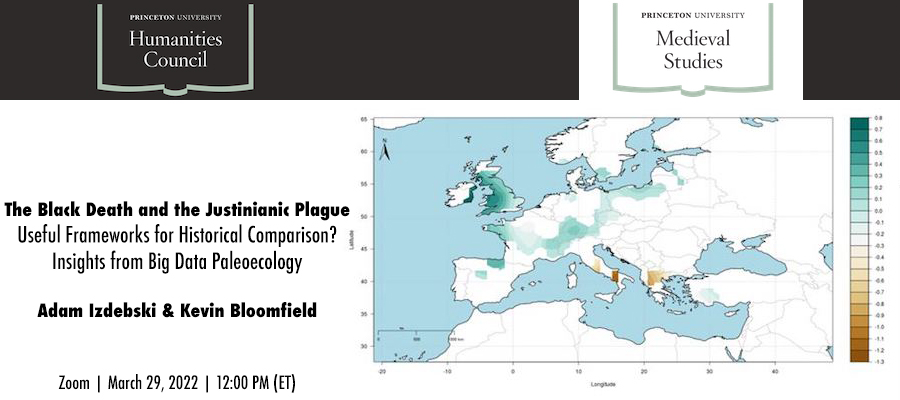
The Environmental History Lab of the Program in Medieval Studies at Princeton University invites you to join the seminar “The Black Death and the Justinianic Plague – Useful Frameworks for Historical Comparison? Insights from Big Data Paleoecology” with Dr. Adam Izdebski, Max Planck Institute for the Science of Human History, and Dr. Kevin Bloomfield, Cornell University.
The lecture will take place on Zoom on 29th March at 12:00 EST.
Call for Proposals: IAS-Sponsored Sessions at CAA 2023 (Deadline 15th April 2022)
The Italian Art Society (IAS) invites proposals for one sponsored conference session (1.5 hours) at CAA, to be held in New York City 15–18 February 2023.
IAS members interested in organizing a panel on any topic of Italian art and architecture and their study should send a brief abstract (250 words max.), session title, a short list of potential or desired speakers (they need not be confirmed), the name of the chair(s) with email addresses and affiliation, and a one-page CV.
Please also include the five CAA Fields of Study that best represent your proposal, per CAA proposal instructions. The first five selected will be used by CAA to filter submissions during the review process and are later searchable in the conference schedule. See an example from CAA 2022 and a PDF list on the original post, at the link included.
We will consider both completed panels and those soliciting contributors, which will be completed during CAA’s annual “Call for Participation” in the summer.
In preparing your application, please consult IAS Submission Guidelines and CAA’s 2023 Submission Portal, to ensure you have gathered the correct materials for the panel format you are submitting for consideration by IAS at this time.
Deadline: Please submit all materials via the online submission form by 15 April 2022.
Please contact Janis Elliot, the IAS Program Committee Chair (programs@italianartsociety.org), with any questions.
Please also note the following rules for participation in the CAA conference:
If an individual’s proposal is accepted and they are not currently a member of CAA, they must join CAA within 90 days of acceptance. All session participants (chair, presenter, discussant) must be current Individual CAA members, and register for the conference.
Your session, presentation, or paper content may not have been published previously or presented at another scholarly conference.
Internship: The Medici Archive Project Summer Internships, 6th June – 15th July 2022 (Deadline 30th April 2022)
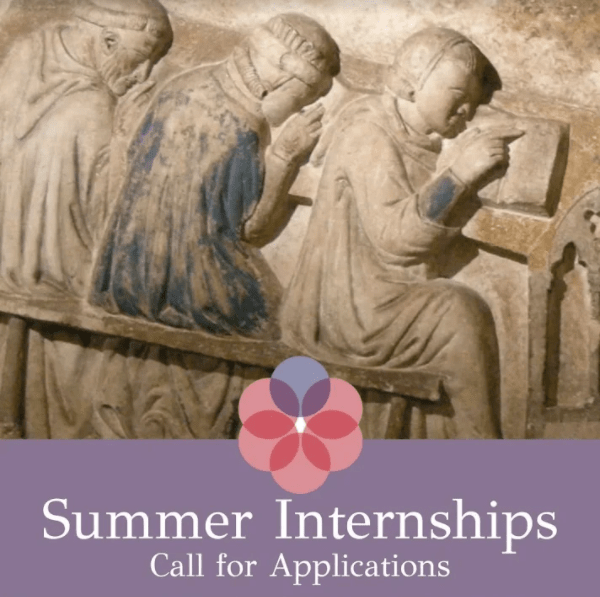
The Medici Archive Project offers internships for undergraduates and graduate students. This year they will run from the start of June to mid-July at MAP’s headquarters in Palazzo Alberti in Florence.
Interns learn the ropes of archival research by shadowing a MAP scholar and helping their mentor with active investigations. Typical responsibilities include digitizing and indexing volumes, transcribing documents, assisting with social media and organizational tasks, public relations correspondence, copy editing, and conducting secondary research online and in local libraries and archives.
How to apply
Please send the following (in PDF format):
– A CV that outlines your academic background and relevant coursework.
– A personal statement (for details, see the Application Procedure to the left).
– One recommendation letter written by someone from your academic institution who knows you well. Recommendation letters can either be sent by you with your application packet, or by the recommender directly to us, using the following email address: education@medici.org.
In their personal statements, prospective interns should:
1) outline their academic interests and motivations for undertaking the internship;
2) indicate current Fellows and Staff Members with whom they would especially hope to collaborate;
3) indicate their level of proficiency in languages other than English, especially Italian, Spanish, German, or Hebrew;
4) note any relevant previous experience (archival experience is not required).
Completed applications and recommendation letters should be submitted to education@medici.org.
Online Conference: ‘(Re)Conceptualizing Communities’, First Annual Symposium Hosted by the Consortium Medievalists, 2nd April 2022, 10:00 – 18:00 EST

The First Annual Symposium Hosted by the Consortium Medievalists: (Re)Conceptualizing Communities will take place on Saturday, April 2nd, 2022 via Zoom. The link to register can be found after the full programme listed below:
10:00-10:15 AM (EST): Virtual Coffee and Welcome
Introduction by Dr. Hal Momma with The Consortium Medievalists
10:15-11:15 AM (EST): (Re)Conceptualizing Medieval Studies
Moderator: Katie Clark (NYU)
Dr. Afrodesia McCannon (NYU): Everyone in the Pool: Thinking about Race and Medieval Studies
Dr. Sierra Lomuto (Rowan University): Forthcoming
12:00-1:30 PM (EST): (Re)Conceptualizing Disability in the Middle Ages
Moderator: Margaret McCurry (NYU)
Dr. Tory Pearman (Miami University): Disability and the Chivalric Community in Malory’s Morte Darthur
Dr. Kisha Tracy (Fitchburg State University): Saint Dymphna of Geel and Communities of Mental Health
Dr. Edward Wheatley (Emeritus, Loyola University, Chicago): Communities of People with Disabilities
2:00-3:00 PM (EST): (Re)Conceptualizing Professionalization
Community Discussion Open to All
Moderators: Alice Grissom (Fordham) and E.G. Asher (NYU)
How might the pandemic transform the trajectory of graduate student research and teaching, as well as undergraduate education? What is the assumed role of individuals and of communities in professionalization? Please join us as we consider these questions among others in a lively discussion open to all.
3:30-4:30 PM (EST): (Re)Thinking Medieval Community: A Perspective from Early Career Academics
Moderator: Alina Shubina (Columbia)
Dr. Ali Gibran Siddiqui (Princeton): Epistolary Spaces and Sacred Networks: A Reappraisal of the Ahrari Naqshbandi Tariqa
Dr. Tamar Rotman (Columbia): Envisioning Identities and Communities in Early Medieval Hagiographies
Dr. Hiba Abid (NYU): Forthcoming
5:00-6:00 PM (EST): Keynote Lecture
Moderator: Ariela Algaze (NYU)
Dr. Asa Mittman (CSU Chico): “Cast Them Out”: Building English Identity through Jewish Exclusion
The Consortium Medievalists are a group of graduate scholars from Columbia, CUNY, Fordham, NYU, Princeton, Rutgers, Stony Brook, and Yale. We would like to kindly thank our sponsors: NYU Critical Theory and Medievalisms Forum, NYU Center for Disability Studies, Columbia Medieval Literature Colloquium, Fordham GSA and Medieval Studies, and an anonymous donor from NYU.
To R.S.V.P., click here.
Online conference: British Archaeological Association’s Romanesque conference: ‘Image & Narrative in Romanesque Art’, 28–30 March 2022

The seventh in the British Archaeological Association’s Romanesque conference series, Image and Narrative, is taking place at the British School at Rome. It will be available on Zoom. Times for the conference are in Italian (not UK) time
Please click the link to join the webinar which is for each of the days. (Passcode: 886218)
Conference programme
Monday 28 March 2022
Session 1: Chair: Grazia Fachechi
9.30 am Welcome and Introduction
9.45am Serena Romano, Image and Narrative in Rome during the ‘Romanesque’ period: A focus on San Crisogono
10.30am Questions
10.45am Break
11.15am Claudia Quattrocchi, Before Narrative: A multifocal method for mapping mural decoration in Central Italy
11.45am Marcello Angheben, Polysemy and multifunctionality in the apse mosaic at San Clemente: Gregorian reform, liturgy and devotion
12.15pm Questions
13.00pm Break
Session 2: Chair: Alison Perchuk
14.30pm Armin Bergmeier, Linear Time and Narrative in the Anagni Crypt Frescoes
15.00pm Andrea Worm, Narrative and Argument: The Emergence of Typological Cycles in the Twelfth Century
15.30pm Questions
15.45pm Break
Session 3: Chair: Béla Zsolt Szakács
16.15pm Kristin B. Aavitsland, Microarchitecture and Storytelling in Twelfth-Century Scandinavia
16.45pm Bella Arcidiacono, Stories from Genesis at the Palatine Chapel in Palermo and the Cathedral of Monreale: Relations, Interactions, Strategies
17.15pm Questions
Tuesday 29 March 2022
Session 4: Chair: Lindy Grant
9.30am Arturo Carlo Quintavalle, The Commissioning and Politics of Images in Twelfth-Century Northern Italy: From the Investiture Controversy to the Fight against Heresy
10.00am Deborah Kahn, Promoting Conformity: The Role of the Church in the Revival of Sculpture
10.30pm Questions
10.45pm Break
Session 5: Chair: Richard Plant
11.15am Jessica Berenbeim, Letter Forms and Literary Meaning: Script and Inscriptions c.1100
11.45am Robert Maxwell, The Narrative Time of Dreams
12.15pm Manuel Castiñeiras, Narrative Strategies, the Senses and ‘Iter’ at Pilgrimage Sites: Conques, Compostela and Bethlehem
12.45pm Questions
13.15pm Break
Session 6: Chair: Rose Walker
14.30pm Irene Caracciolo, A Comparative Analysis of the ‘tecnica mista’ panel portraits inserted into certain wall paintings in Romanesque Italy
15.00pm Mina Miyamoto, A Problem of Identification in Folio 1v. of the Salzburg Pericopes
15.30pm Questions
15.45pm Break
Session 7: Chair: Barbara Franzé
16.15pm Gaetano Curzi, Nature, Landscape and Hagiography on the façade of San Clemente a Casauria
16.45pm Claude Andrault-Schmit, An Unusual Scenography in the Service of Popular Devotion. The Deathbed Scene at Saint-Hilaire-de-la-Celle in Poitiers
17.15pm Questions
Wednesday 30 March 2022
Session 8: Chair: Manuel Castiñeiras
9.30am Wilfried Keil, The Narrative Frieze of Saint Domninus on the Façade of Fidenza Cathedral
10.00am Carles Sanchez, A Roman Saint in Catalonia: Sant Llorenc Dosmunts and the Shaping of Devotional Images through Romanesque Altar Frontals
10.30am Questions
10.45am Break
11.30am John McNeill, A Narrative of Intercession in the Cloister of Saint-Aubin at Angers
12.00pm Barbara Franzé, Image and Narrative in the Cloister at Moissac in the light of the Consecration Ritual
12.30pm Questions
12.45pm Break
Session 9: Chair: John McNeill
14.30pm Béla Zsolt Szakács, From Rome to Somogyvár: Transforming the Spinario
15.00pm Yael Barash, From Sin to Redemption: Narratives, Abstract Conclusions, and Composition in Hildegard of Bingen’s Illustrations
15.30pm Questions
15.45pm Break
16.15pm Alison Perchuk, Narrative Sequences of the Apocalypse in Romanesque Italy: Location, Function, Structure, Meaning
16.45pm Rose Walker, Old Testament Images in Navarre and Aragon in the Middle of the Twelfth Century: Sites of Theological and Social Tension
17.15pm Questions
Funding and Scholarships: ARTES Juan Facundo Riaño Essay Prize and CEEH Scholarships (Deadline 31st March 2022)
Juan Facundo Riaño Essay Prize
ARTES invites submissions for the Juan Facundo Riaño Essay Prize for the best art-historical essay on a Spanish theme. The deadline is 31st March 2022 and full details are available at https://artes-uk.org/2014/01/02/the-juan-facundo-riano-essay-medal/
Scholarships
Thanks to the generous support of CEEH (Centro de Estudios Europa Hispánica), ARTES also awards a number of scholarships to students working on any aspect of Spanish visual culture before 1900. The deadline for all scholarship applications is also 31st March 2022 and there are further guidelines below.
Final year undergraduates and postgraduate students registered for a full or part-time degree course at a UK university may apply for up to £1000 towards the costs of travel to Spain for research purposes (which may include field work, attendance at a conference, or other recognised forms of research).
Doctoral students or those who received their doctorate less than four years before the application deadline may apply for this scholarship provided that they were or are registered for doctoral study at a university in Spain.
£3000 scholarship for PhD students at a UK university
ARTES offers one scholarship each year to a student registered for a full- or part-time doctoral degree at a UK university. The scholarship is intended to contribute towards the costs of tuition, living and/or research, and therefore students with full funding are not eligible.
Seminar: Round Table, ‘Political Culture in the Latin West, Byzantium and the Islamic World’, IHR Seminar Europe 1150-1550, 24th March 2022, 17:30 GMT

The IHR Europe 1150-1550 seminar returns this Thursday 24th March 5.30 pm. Catherine Holmes (Oxford), Jonathan Shepard (Oxford), Jo Van Steenbergen (Ghent) and Björn Weiler (Aberystwyth) will present their book Political Culture in the Latin West, Byzantium and the Islamic World, c.700-c.1500: A Framework for Comparing Three Spheres. (Cambridge: Cambridge University Press, 2021).
This seminar will take place online only. Please register online here.
Please send any enquiries to Andrew.Jotischky@rhul.ac.uk or emily.corran@ucl.ac.uk
Conference: ‘God is in the Details: The Art of Detail in the Middle Ages’, 27th Annual Medieval Postgraduate Colloquium, The Courtauld Institute of Art, 29th April 2022

The Courtauld’s 27th Annual Medieval Postgraduate Colloquium considers the significance of details. For Aby Warburg, God was in the details, while for others they could conceal the devil. From manuscript miniatures to carved altarpieces or richly decorated muqarnas, detail was highly valued in the Middle Ages. The deployment of detail displays, disguises and depends upon the materiality of objects, and our programme reflects the material diversity of detail, from architectural sculpture to multi-media textiles, from manuscript paintings to stained glass. The production of detail was also demanding, often requiring fine materials, masterful skill, hours of time and technical innovation. The intensive requirements of detail enabled them to speak of power and dignity, yet they could also half-conceal subversive subtexts and present subtle suggestions, which only the most perceptive viewers would appreciate.
Close observation of apparently insignificant details lay at the heart of the connoisseurial, attribution-focused art history of the nineteenth century. More recently scholars have examined the cultural significance of detail, from Necipoğlu’s explication of the ‘scrutinizing gaze’ in Islamic art to Geertz’s notion of ‘cognitive stickiness’. Others have closely engaged with detail in relation to craft, such as Margaret Graves’ theory of the ‘intellect of the hand’ and Paul Binski’s explorations of the ‘human “poetics” of materials’. Our varied programme will challenge the marginality of detail, proposing art historical approaches to material which seems fragmentary, incidental, or merely ornamental. As such, this colloquium foregrounds potential meanings which arise from the deployment of details, whether as devices of persuasion, indicators of temporality or pointers to religious dimensions beyond the everyday. Do join us in person, or via Livestream, for this opportunity to delve into detail, in all its complex material, cultural and academic dimensions.
Programme: ‘God is in the Details’ – The Art of Detail in the Middle Ages
10:00 – Registration – Front Hall
10:30 – Welcome – Rachel Alban and Jamie Haskell (The Courtauld)
10:40 – SESSION 1: Marginal, Fragmentary, Isolated: Giving Minutiae Centre Stage
Aidan Valente (University of Cambridge) – Marginalia in Stone: The Evolution of Allegory and Classicism on the Fonte Gaia
Lydia Fisher (University of Exeter) – A Window into Faith: The Value of Studying Stained Glass Fragments
Jessica Gasson (The Courtauld Institute of Art) – Woven Complexities: Untangling the Uses of Silk, Gold and Wool in the V&A Passion Tapestry
Questions and Discussion
12:00 – Comfort Break
12:20 – SESSION 2: Miniscule Details: Motives and Meanings
Danielle Omesi Moisa (Tel Aviv University) – Romanesque Horror Vacui: Ornamental Density in Architectural Sculpture as an Expression of Fear of the Absence of Creation and Creator
Jordan Booker (University of York) – It’s All in the Details: Tracing Temporality in Early Netherlandish Painted Settings
Rachel Alban (The Courtauld) – Framing in Detail: Small-scale Illumination Design as Cognitive Framing in late Timurid and early Safavid Literary Manuscripts
Questions and Discussion
13:40 – Lunch Break (Lunch provided for speakers only)
13.50 – Handling Session (TBC)
14:30 – SESSION 3: Rhetorical Flourishes: The Persuasive Power of Details
Sommer Halquist (University of Cambridge) – Authority is in the Details: Illuminating Apocrypha in the Late Middle Ages
Chloe Kellow (The Courtauld) – From Contemplation to Self-Aggrandisement: Detail as Narrative Device in Plaques from the Lives of Christ and Saint James, The Altar of Saint James in Pistoia (1316-1371)
Michela Young (University of Cambridge) – Saint John Gualbert and the Cross: details of a conversion story in creating the cult of a saint
Questions and Discussion
15:50 – Afternoon break Tea and Coffee Break
16:30 – SESSION 4: Transcendental/ Transformational Power of Detail
Dagmar Thielen (Catholic University of Leuven) – Multum in Parvo: The Intermedial Gothic Detail within the Symbolic Networks of the Ghent Altarpiece (1432)
Adela Foo (Yale University) – Reflections of an Intermediary World: Considering the Mirror as a Threshold into Another World
Juliette Brack (Université Paris 1 Panthéon-Sorbonne) – God is in Textile Patterns: Meditation on the Virgin’s Cloth of Honour in Italian Devotional Panels
Questions and Discussion
17:50 – Closing Remarks – Tom Nickson (The Courtauld)
18:00 – Reception
Job Opportunity: Director, Institute for Medieval Studies, Austrian Academy of Sciences (Deadline 18th April 2022)

The Austrian Academy of Sciences (OeAW), Austria’s central non-university research and science
institution, seeks to appoint a new Director (F*M) with tenure at the Institute for Medieval Research.
The Institute for Medieval Research in Vienna is a vibrant and productive hub for medieval research. IMAFO pursues innovative and cutting-edge approaches to medieval history through cultural and social studies as well as through the interpretation of the medieval heritage of Europe and Byzantium. Further research foci are on Digital Humanities, Historical Auxiliary Sciences, and source studies.
The new Director will complement and further enhance the institute’s outstanding research profile by
supporting interdisciplinarity. The successful candidate will be open to new ideas and be abreast of the latest international developments and new directions in medieval research, thereby fostering conditions that will allow excellent medieval research to flourish. The IMAFO is part of the vibrant local research environment comprising the numerous historical, archaeological and humanities institutes of OeAW and other research institutions in Vienna.
The OeAW is looking for a strong and ambitious person with innovative research ideas and an outstanding academic track record, including success in winning major research grants. The ideal candidate will be a creative scholar with strong leadership and management skills who is well connected within the international scholarly community. The OeAW seeks to appoint a Director who is enthusiastic about pursuing his or her own research within IMAFO while also enhancing and encouraging the research of existing IMAFO staff. Recruiting outstanding talent to fill new appointments will be among the Director’s key responsibilities.
Qualified candidates are invited to apply and submit a detailed application to President Anton Zeilinger and Vice President Arnold Suppan at IMAFO.search.director@oeaw.ac.at, containing the following:
− Research concept and proposal for the strategic development of the IMAFO (maximum 4 pages)
− Curriculum vitae including an overview of recent research activities and funding (maximum 5 pages)
− A list of publications, with pdf files of the four most important publications
See full brief here.

