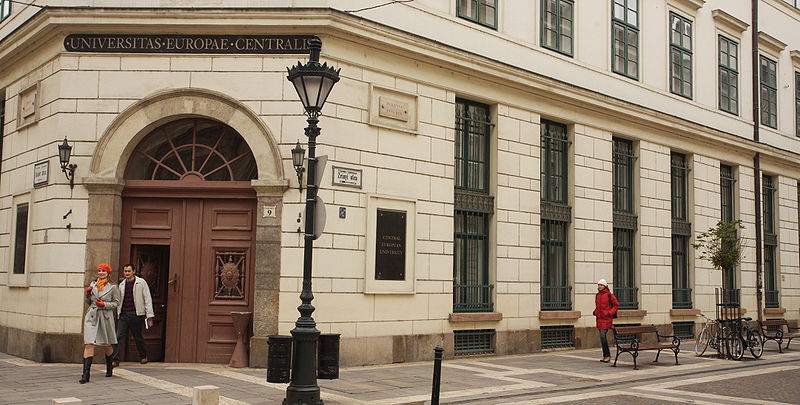
Call for Participants: Summer Intensive Course – Luminosus Limes: Geographical, Ethnic, Social and Cultural Frontiers in Late Antiquity
Central European University, Budapest, 7-12 July, 2014
Deadline: 14 February, 2014
What is a frontier? Does it serve to separate or to link countries, peoples, classes, ideas? Frontiers have become increasingly significant in the study of Late Antiquity, the fastest growing historical discipline, as scholars recognized the fundamental importance of shifting barriers in the process of transformation that led from the classical to the post-classical world. People living in the Roman world between the second and the sixth century tore down many walls demarcating cultures, religions, ethnicities. Frontiers once firmly separating empires, ethnic groups, religions, friends and even the sexes have been intensely crossed in late antiquity – a phenomenon comparable only to the recent transition from modernity to post-modernity — a comparison that we intend to exploit in our methodology.
The “Bright Frontier” summer course explores the dynamic transformation of classical frontiers between the second and the sixth century from a multidisciplinary perspective: archaeology, medieval studies, social and cultural history, art, theology, and literature. Offering a groundbreaking approach to the field of border studies including social, gender, ethnic and religious categories with the participation of outstanding scholars in the field, this course will provide students with a solid knowledge of up-to-date international scholarship on frontiers: a strong theoretical background as well as hands-on acquaintance with physical borders and material artefacts excavated along the Danube River (the ripa Pannonica) as well as in the late antique cemetery of Pécs in Hungary.
Call for Papers: German Wood: Material and Metaphor from Forest to Fireside and Beyond
German Studies Association Thirty-Eighth Annual Conference
Kansas City, Missouri, 18-21 September 2014
Deadline: February 7, 2014
“The German Forest has moved into the German living room,” wrote
liberal politician Friedrich Naumann in response to a 1906 exhibition of modern wooden furniture designed by the progressive Munich architect
Richard Riemerschmid and fabricated with the help of machines. What
might sound at first like a humorous (or even ironic) comment on the
overabundance of natural wood visible in Riemerschmid’s modern “machine furniture,” was actually freighted with economic, social, and cultural weight. For the material product of the “German Forest” – wood – was not only an important resource and major export of the lately established German nation, it had also constituted the utilitarian backbone of German domestic life for centuries; and its cultural resonance was rooted in the legendary Battle of the Teutoborg Forest, when Germanic tribes, emerging from the trees (as the story goes), had vanquished the Roman legions of Ceasar Augustus. But like the account of the Teuton victory – part history, part myth – the notion of a “German Forest,” as historian Jeffrey K. Wilson has recently shown, was a cultural construct: an abstract (though powerful) idea – not a concrete thing. The German lands enclosed a variety of wooded territories, each distinct in its topography and biology. But there was, in actuality, no single “German Forest”; the concept had been cobbled together – like the German nation itself – from various regional examples and traditions to form an ideal or myth of unity, ripe for public figures (like Naumann) to exploit.
This interdisciplinary, diachronic panel will probe the paradox of abstract and concrete embodied by the entry of the “German Forest” into the “German living room.” Its aim is to reveal and untangle the interlaced complexities inherent in wood as indigenous material,
utilitarian product, and cultural symbol. Proposals are welcome that consider the significance of “German wood” from any period and in any manifestation, in its dual role as object and concept. Topics might examine the role that German wood has played in confrontations between: past and future; the domestic and the wild; authenticity and artificiality; the living and the inert or “wooden”; naturalism and folklore; history and myth; the utilitarian and the symbolic; the prosaic and the poetic; the everyday and the marvelous; the vernacular
and the cosmopolitan; science and spirituality. Historiographical and theoretical investigations, as well as specific case studies, will be considered. Proposals are encouraged that move beyond the reductive nationalist rhetoric of “the German Forest” to problematize images of Germans and their trees from the Teutons to today.
Please email a C.V. and proposal of no more than 400 words by Friday,
February 7, 2014 to:
Freyja Hartzell
Post-Doctoral Fellow in Material and Visual Culture, Parsons The New
School for Design hartzelf@newschool.edu
Journal of the Warburg and Courtauld Institutes – Volume LXXVI (2013)
This volume was issued online in two parts: Part I (October) and Part II (November), to be followed by the print edition as a complete volume (expected publication date 18 December 2013). For further information, see the journal’s website.
Part I
Xenophon and the Barberini: Pietro da Cortona’s Sacrifice to Diana Timothy Rood
Philosophy for Princes: Aristotle’s Politics and its Readers during the French Wars of Religion Ingrid De Smet
John Spencer’s De Legibus Hebraeorum (1683-85) and ‘Enlightened’ Sacred History: A New Interpretation Dmitri Levitin
The Qur’an Translations of Marracci and Sale Alexander Bevilacqua
Abigail going to David: The Iconography of a Marble Capital from the Destroyed Romanesque Cloister at Notre-Dame-des-Doms, Avignon Andrew Chen
Part II
Of Stars and Men: Matthew Paris and the Illustrations of MS Ashmole 304 Allegra Iafrate
Additional Thoughts about the Construction of Francesco di Giorgio’s Drawing of Atlas Kristen Lippincott
Martin Meurisse’s Garden of Logic Susanna Berger
A New Renaissance Source on Colour: Uberto Decembrio’s De candore Stuart M. McManus
A Note of the Afterlife of Virgil’s Euryalus: The Classical Ideal of Male Beauty in Renaissance Italy Hugh Hudson
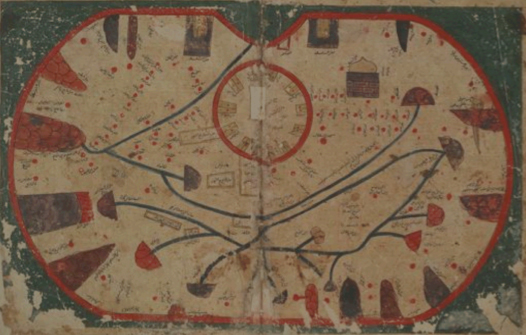
Call for Papers Cartography between Europe and the Islamic World 1100 – 1600
London, Queen Mary, University of London, September 8-9, 2014
Deadline: 21 February 2014
The Leverhulme Network ‘Cartography between Europe and the Islamic World’ aims to promote comparative, cross-disciplinary scholarship on Islamic and European cartography by bringing together experts in these two fields for a two-day symposium to be held at Queen Mary, University of London, on September 8-9, 2014. Participants are invited to explore moments of contact between traditions (e.g. twelfth-century Spain; the court of Roger II of Sicily; fourteenth- and fifteenth-century Italian cartography; Piri Reis and post-Columban cartography of the early sixteenth century) as well as differences and divergences. Reflections on the methodology of the comparative study of maps are also welcome.
Papers may wish to address some of the following topics, but need not be restricted to them:
the contexts – material, political, spiritual, artistic – of mapmaking in Europe and the Islamic world
audiences for maps; ‘cartographic literacy’
interactions between European and Islamic mapmaking: exchange, influence, borrowing
reception of classical texts, e.g. Ptolemy’s Geographia/Jugrafiya
patronage
the cartography of al-Idrisi
nautical mapmaking in the Mediterranean
cartography in the Ottoman empire (up to c. 1600)
comparative histories of cartography
Please send proposals consisting of an abstract of c. 300-500 words for 20-minute papers to Matthew Champion (m.s.champion@qmul.ac.uk) by February 21, 2014. Proposals are encouraged from doctoral students, early-career and established scholars, and travel and accommodation for speakers will be funded.
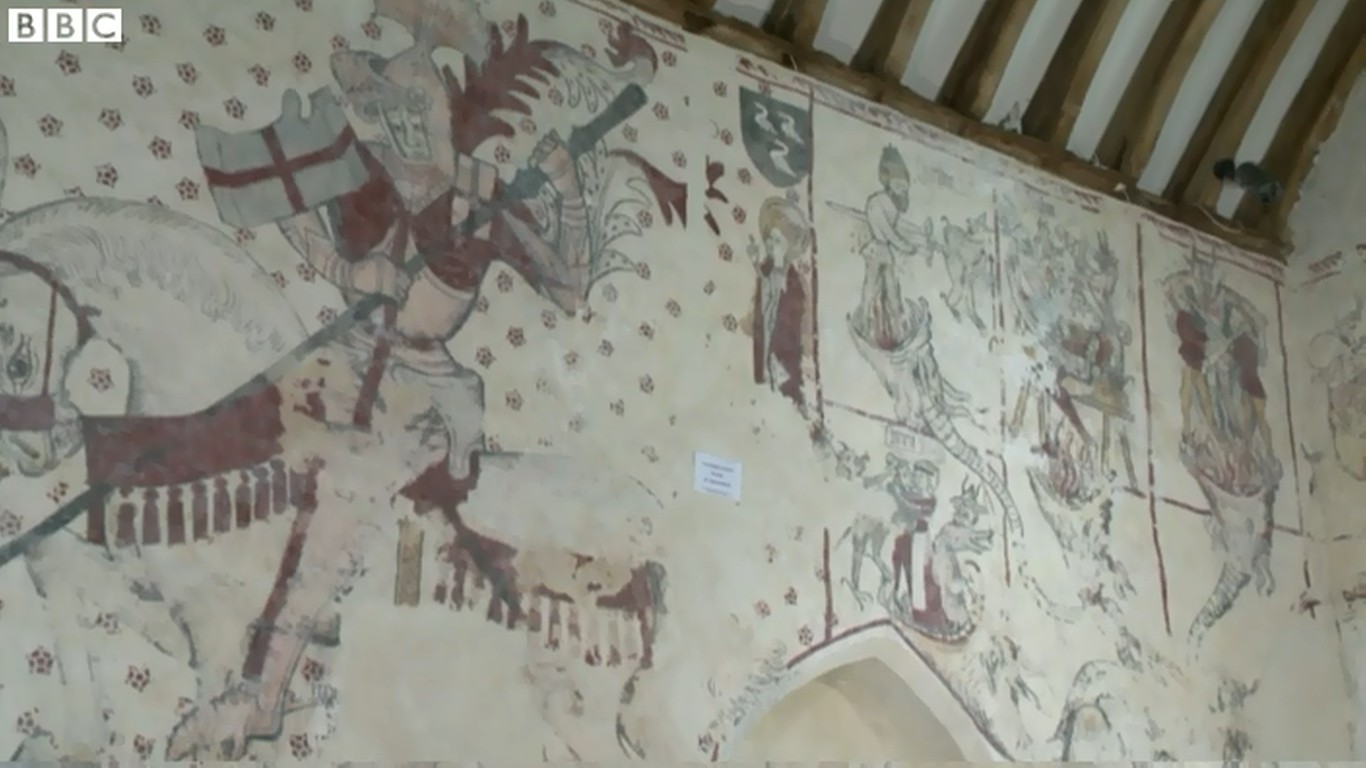
The first stage of revealing the magnificent wall paintings at Llancarfan church in the Vale of Glamorgan is complete, and for the first time these important discoveries are available for viewing by the general public. A video showing these discoveries is available from the BBC.
Discovered only in 2007, these paintings have been painstakingly uncovered by the gradual removal of the limewash coating. They show a dynamic St. George saving the princess from the dragon, a full tableaux of the Seven Deadly Sins, and a youth being led by Death. They show the surprising vivacity and subtlety in late medieval British wall painting.
This is one of the most important finds in British wall paintings in many years, and present a challenge to show how our contemporary conservation attitudes can preserve them, after the disasters of both the repaintings of the nineteenth-century and the occasionally even more destructive techniques of the 1950s and 60s.
This PALATIUM conference draws attention to small buildings in residential complexes – small in size but not in importance – which were meant only for temporary, seasonal use, unlike the permanent use
of the main palace. The role of the palazotto (‘small palace’) was to be a place of rest, leisure and repose, but sometimes it also took on a representative role similar to the main palace. As these ‘satellites’
were usually new buildings rather than rebuilt older structures, they offer a much clearer view of the incentives, intentions and concepts of the clients and can be regarded as ideal models, or miniatures, of the main palace.
This colloquium will study the relationship of the satellite to the palace and examine its function as pendant but also as counterpart or even opposite to large palatial buildings. The small palace usually made it possible to develop certain ideological and spiritual programmes that would have been difficult to achieve within the large palace. Only residential complexes that contained not just the main palace but also the palazotto, aspired to create symbolic images of the universe, the earthly paradise. There was a ‘dialectic unity’ between the main palace as the permanent residence and the smaller, temporary and occasional house; the existence of a palazotto constituted an ‘added value’ to the actual residence, the palatium.
Papers may address one or more of the following themes:
1. From Solitude and Buen Retiro to Mon-plaisir and Sans-souci:Exploring the theory of the architecture of leisure within the palace
2. Tradition and modernity: Defining the palazotto as a spatial and functional type from the late middle ages to the early modern period
3. Decorating the architecture of leisure: Interpreting the satellite’s decor between politics and nature
4. The palazotto in context: Exploring the role of the satellite in the grand design of the residence and its gardens
This colloquium is organized by the European Science Foundation Research Networking Programme “PALATIUM. Court Residences as Places of Exchange in Late Medieval and Early Modern Europe (1400-1700)”, in collaboration with the Institute of Art History (IAH) of the Academy of Sciences of the Czech Republic and with Masaryk University Brno.
Detailed application modalities can be found here.
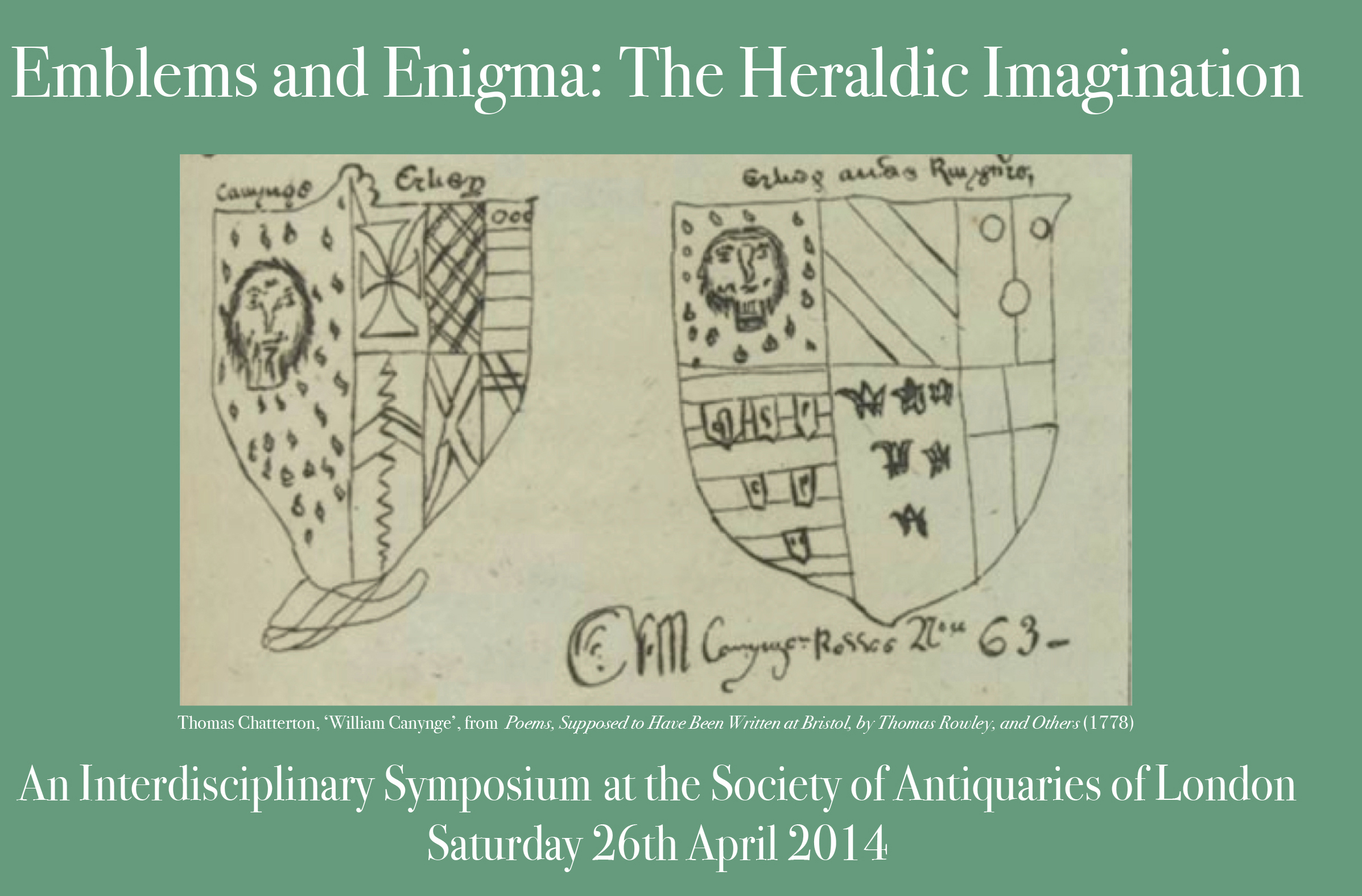
Call for Papers: Emblems and Enigma: the Heraldic Imagination
An Interdisciplinary Symposium at the Society of Antiquaries of London London, Burlington House, April 26, 2014
Deadline: Jan 10, 2014
Conference website: http://heraldics2014.wordpress.com
‘Time has transfigured them into / Untruth’ (Philip Larkin)
In his 1844 short story ‘Earth’s Holocaust’, Nathaniel Hawthorne sees heraldic signs reaching ‘like lines of light’ into the past, but also as encrypted and obsolete. Proliferating and arcane, unique, ubiquitous, and inscrutable, the heraldic has been a major presence across the arts since medieval times; yet it remains, culturally and
critically, enigmatic. The organisers of this interdisciplinary symposium, Professor Fiona Robertson (St Mary’s University College) and Dr Peter Lindfield (University of St Andrews) invite proposals for twenty-minute papers on any aspect of the employment and perception of the heraldic in literature, history, art, architecture, design, fashion, and contemporary and historical practice. The programme will include a keynote address by Professor Vaughan Hart (University of Bath); a special session on the heraldry of Horace Walpole’s Strawberry Hill and William Beckford’s Fonthill Abbey; and papers on eighteenth-century antiquaries’ exploration of the heraldic, and on heraldry in nineteenth-century British and American literature.
Topics may include, but are not restricted to:
– the languages and grammar of heraldry
– armoiries parlantes, allusions and puns
– imaginary and fantastical heraldry
– decoration and display
– blazonry and identity: nations, groups, individuals
– mock- and sham-heraldics; parody and subversion
– practices of memory and memorialisation
– history, development, and modern practice
– blazon and the body
– heraldic revivalism; medievalism; romance
– enigma, error, and absence: the bar sinister and the blank shield
– individual designers, writers, and collectors
– gendered identity
– hierarchies of signs
– international and interdisciplinary perspectives
Currently airing on BBC Two is Tudor Monastery Farm, a rather gentle, post-reality-era bit of television, continuing the popular franchise of Victorian, Edwardian and Wartime Farm. Although a little guilty of choosing the National Curriculum-friendly “Tudor” label over “Medieval” (admittedly however, Late Middle Ages Farm or Circa Fifteen-Hundred Farm lack a certain marketability), it remains a rather interesting little programme for a Medievalist Art Historian to have a look at on the iPlayer.
Unlike the modern-era Farms, authentic-looking locations are tougher to find. Mostly it is filmed at the Weald and Downland Open Air Museum in Sussex, a collection of relocated historic vernacular buildings that has a hyperreal theme-park fantasy feel of a Tudor Westworld. The Monastery itself is Downside Abbey in Somerset, a post-Reformation foundation of a Catholic Benedictine community with a spectacular (although unfinished) Gothic Revival church of 1882-1925. Perhaps as a concession to its post-Harry Potter magic, there is much filming of mysterious monkish goings-on in the cloisters of a former medieval abbey, Gloucester Cathedral.
St Teilo’s church, Welsh National History Museum. (picture by Jacqueline Sheldon)
Finally, there is the reconstructed church of St. Teilo at St Fagans National History Museum near Cardiff, which after being moved had a full cycle of wall paintings reinstated, which while helpful in conveying both the gaudiness and crowded imagery of a late medieval church, it is ultimately a rather strangely sanitised facsimile.
Peter Ginn makes a wattle fence with a “Tudor fence expert” (inset, detail from Robert Campin’s Seilern Triptych)
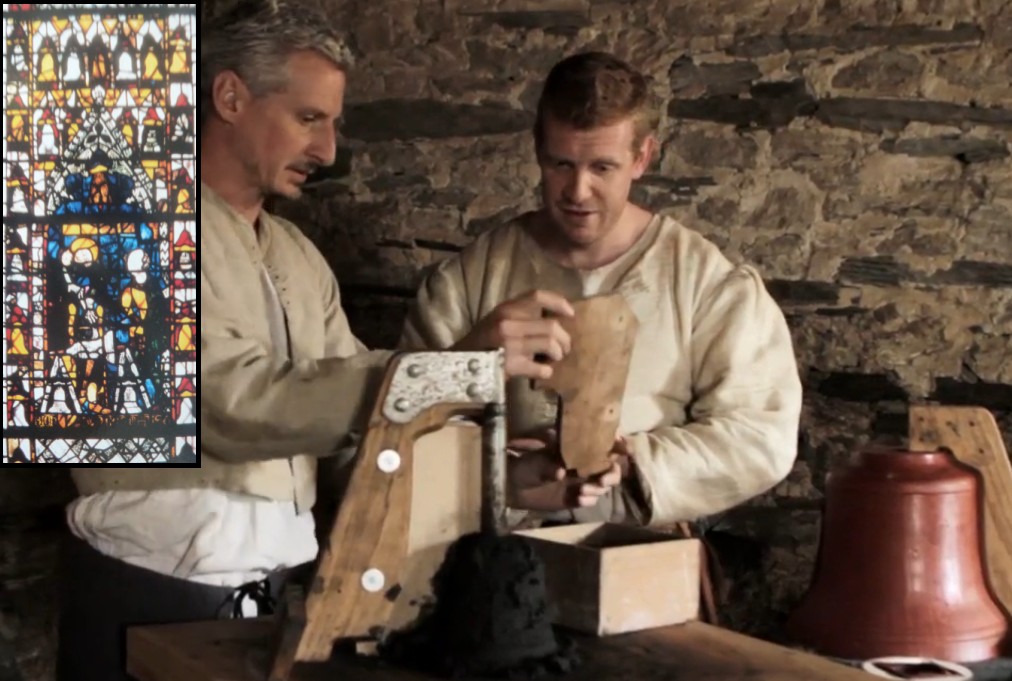
Joining the established presenter Ruth Goodman and stalwart from Victorian Farm Peter Ginn is the excellently-named Tom Pinfold, and together they demonstrate farming, cooking and craft processes, as well as taking part in the ritual of the late medieval Catholic church. In some ways, the programme is more interesting for an art historian to watch than the many medieval art programmes aired on BBC Four in the past decade (increasingly predictably hosted by Dr Janina Ramirez). For instance, making a wattle fence immediately reminds one of its depiction in medieval art, such as in the Seilern Triptych by Robert Campin in the Courtauld gallery, and the process of bell-founding of the stained glass window donated by that profession’s guild to the Cathedral of York Minster in the fourteenth century. The re-enactment of Christian rituals such as holy loaf and lay-led Palm Sunday processions, partway between Church and folk tradition, are also a lot of fun to see. All is done in good Blue Peter-fun with pristine make-up throughout: no diary-room style “I can’t stand another day on the Monastery Farm!” angst here, thankfully.
Tom Pinfold tries his hand at bell-making. Inset, the fourteenth-century Bell Founders’ window at York Minster.
It is somewhat surprising to see such a jolly evocation of a pre-Reformation Merrie England on the BBC at the moment. Recently, with Diarmaid MacCulloch’s documentary on Thomas Cromwell and Melyvn Bragg on William Tyndale, the BBC seems to have been rather consistently painting the sixteenth century as the point when the intellectual glory of the English Renaissance swept away broken old Catholic England and its greedy monasteries. After seeing Diarmaid stand in the ruins of Hailes Abbey trying to convince us that its destruction was “a good thing” it is welcoming to see Tudor Monastery Farm as showing life under a monastery in late Medieval England as a happily functioning society rather than rotten and awaiting Dissolution. But then, we still have three episodes to go…
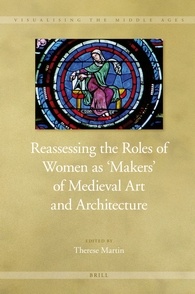
Number 9 of the Journal of Art Historiography is online! Of particular interest to the medieval art researcher is this issue’s focus on Travelling Artists in Medieval and Renaissance Europe, as well as a review of the 2012 publication Reassessing the Roles of Women as ‘Makers’ of Medieval Art and Architecture, edited by Therese Martin. See below for links to these contributions. In order to access all content of the journal’s new issue, please click here.
Travelling Artists in Medieval and Renaissance Europe: Sandra Cardarelli, ‘Travelling Artists in Medieval and Renaissance Europe: An Introduction’ (PDF)
Sandra Cardarelli, ‘Antonio Ghini and Andrea di Francesco Guardi: Two 15th-century Tuscan Artists in the Service of Local Governments’ (PDF)
Katja Fält, ‘Locality, nation and the ‘primitive’ – notions about the identities of late medieval non-professional wall painters in Finnish historiography from 1880 to 1940’ (PDF)
Michelle Moseley-Christian, ‘Confluence of Costume, Cartography and Early Modern European Chorography’ (PDF)
Cinzia Maria Sicca, ‘Vasari’s Vite and Italian artists in sixteenth-century England’ (PDF)
Review:
Kathryn A. Smith, ‘Medieval women are “good to think’ with”. Review of: Therese Martin, ed., Reassessing the Roles of Women as ‘Makers’ of Medieval Art and Architecture, Visualising the Middle Ages, volume 7, 2 vols, Leiden and Boston: Brill, 2012, 1, 280 pp., 287 b&w illustrations, 32 colour plates, ISBN: 978-90-04-18555-5 (hardback), E-ISBN: 978-90-04-22832-0, Euro 215.00 / US$ 299.00. (PDF)
Forthcoming Exhibition: Charlemagne. Power, Art and Treasure
Aachen, 20 June – 21 September 2014
Charlemagne died in Aachen on 28 January 814. 1200 years later, the City of Aachen will be putting on three special exhibitions on the life and works of this legendary Emperor of the Francs. Under the title “Charlemagne. Power, Art and Treasure”, the three exhibitions will run from 20 June to 21 September 2014 as part of the “Year of Charlemagne” celebrations. At three different locations within the boundaries of the former imperial palace, they will offer visitors the chance to see artistic masterpieces from Charlemagne’s court workshops, medieval church treasure, and a cultural history presentation on Charlemagne’s seats of power.
In the former King’s Hall, today’s Town Hall, the focus will be on Charlemagne’s palaces. Visitors will learn about courtly life in Carolingian times. The exhibition will portray how the king and military leader Charlemagne travelled from palace to palace and will display archaeological and cultural-historical evidence to outline the basis of his reign. It will illustrate what power meant in those days, and will trace the boundaries between historical fact and the myth of Charlemagne, a myth to which Aachen owes its status as the birthplace of modern Europe.
In the Centre Charlemagne, a new museum located at the heart of his original palace and due to open its doors in early 2014, visitors will be able to marvel at works of art from Charlemagne’s “Palatine School of Aachen”. Here, choice exhibits will offer an insight into the golden age of Carolingian culture. After centuries of being scattered all over Europe, priceless manuscripts, ivory carvings and goldsmith’s works originating from Charlemagne’s workshops in Aachen will once more be reunited in the Centre Charlemagne.
The Cathedral Treasury will not only be exhibiting the most important pieces from its own church treasure. For the exhibition, curator Georg Minkenberg will be bringing back to Aachen precious objects from the church treasures of Carolingian and medieval times, objects which originally belonged to the Aachen Cathedral Treasury but which fell into other hands in the course of history. The selection of sacred works of art will even feature objects said to be from Charlemagne’s grave.


![_71535705_devilpromoteslust[1]](https://medievalartresearch.com/wp-content/uploads/2013/12/71535705_devilpromoteslust1.jpg)




 Medieval Art Research