
I Tatti – The Harvard University Center for Italian Renaissance Studies and the German Historical Institute in Rome (Deutsches Historisches Institut in Rom) offer a joint residential fellowship for the 2021-2022 academic year. The fellowship offers post-doctoral scholars working on African studies (or topics that closely consider Africa) a ten-month position to conduct historical research in Italy supported by two institutes with dynamic academic communities. Fellows will spend five months (September 1, 2021 – January 30, 2022) in Rome at the DHI and five months (February 1 – June 30, 2022) in Florence at I Tatti.
The fellowship is designed for scholars in fields related to the study of African history c. 1250-1750, including art history, the history of expressive cultures, musicology, economic history, intellectual, political, and religious history, as well as literature and languages. Preference will be given to advanced research projects that address the relationship between the African continent and the Mediterranean world during the early modern period, broadly understood historically to include the period from the 14th through the 17th centuries.
We welcome applications from scholars of all nationalities. Special consideration will be given to scholars from the African continent.
Applications must be written in English and must be submitted electronically by midnight (Cambridge, MA time) on November 16, 2020.
For more information on this fellowship, please visit: http://itatti.harvard.edu/i-tatti-dhi-rom-joint-fellowship-african-studies
CFP: Weather Saints (International Medieval Congress 2021), deadline 10 September 2020

Call for Papers for Session Proposal at the International Medieval Congress (IMC 2021), July 5 – 8, 2021, University of Leeds. Thematic focus: Climates
This session seeks to explore the interaction between human beings and the meteorological manifestations of the weather. It focuses on the intervention of saints who either function as divine intercessors or whose meteorological powers control and influence the weather in order to reassure and reestablish the prosperity/security/protection of a given community.
Suggested topics, on any geographic area, may include, but are not limited to:
- use and reuse of Biblical patterns in the constructions of saintly lives: miracles, control, and influence over the weather;
- miraculous interventions of saints: growths of crops, fruits, and vegetation; engaging with the weather; miraculous protection;
- invocations (of a given saint) against/for: bad weather, cold weather, harvests, crops, disasters, drought, fire, floods, freezing, good weather, hail, rain, storms, tempests, water;
- feasts/celebrations/relics/shrines/cures of weather saints;
- intercession(s) and divine control over the weather by sending: rain, snow, hail, frost, wind, sunshine;
- manifestations of meteorological powers: calming the sea, calming the wind;
- disasters: crop disruption, periods of drought, floods;
- punishment for transgressions: storms, floods, thunder, and fire;
- intersection of weather and geography or agriculture and the protection of saints;
Submissions from a variety of disciplines are accepted including but not limited to: history, art history, visual culture, social history, cultural history, hagiography, religious studies, textual studies in a transdisciplinary perspective.
Please submit a 250-word proposal for a 15-20 minute paper. Proposals should have an abstract format and be accompanied by a short CV, of no more than 800 words, including e-mail, current affiliation, and position. Please submit all relevant documents, as PDF or Word.doc, by 10 September, 2020, to the e-mail address: andrea.znorovszky@unive.it
Contact information:
Andrea-Bianka Znorovszky, Ca’ Foscari University, Venice, Italy (andrea.znorovszky@unive.it)
New Resource: Census of Italian Renaissance Woodcuts
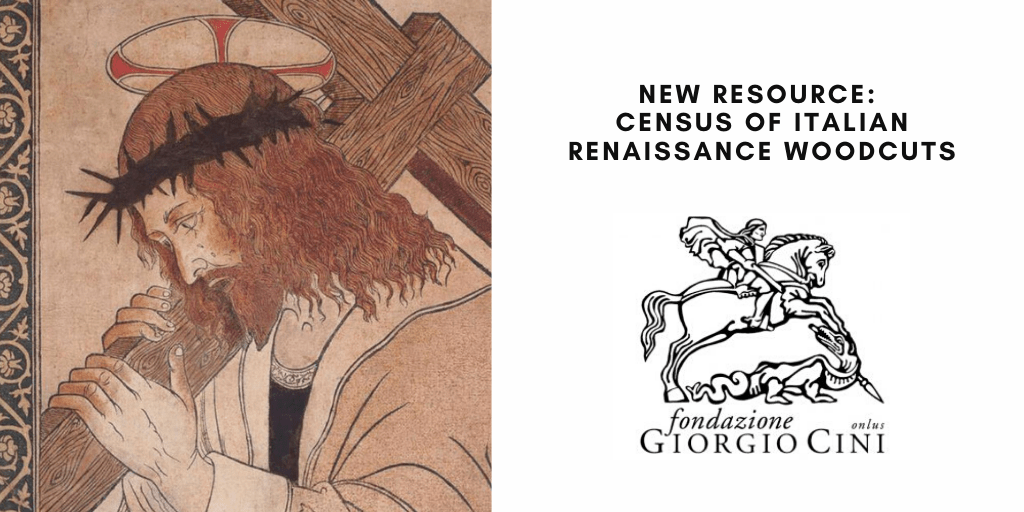
Please note the existence of a new resource, which has just gone live: The online Census of Italian Renaissance Woodcuts. The Census team have traced, studied and catalogued all single-leaf woodcuts and woodblocks made in Italy from the earliest known use of this medium to about 1550.
The project is part of the research activities of the Institute of Art History of the Fondazione Giorgio Cini. It can be consulted from the Fondazione’s website or http://italianrenaissancewoodcuts.com/.
The works belong to museums and public collections, libraries, archives, art dealers and private collectors, in Italy and worldwide. The Census will continue to be enriched with new information.
Essay Prize: XXI Medievalism Prize, Sociedad Española Estudios Medievales, deadline 31 December 2020
The XXI Medievalism Prize welcomes applications according to the following bases:
- Participants may not be older than 30 years and must be members of the Spanish Society for Medieval Studies in active service, that is, up to date with their annual quota.
- The work presented will deal with topics related to any manifestation of the Middle Ages, with special value being given to those contributions that are more interpretive than monographic research.
- The length of the presented work will not be, in any case, superior to the 25 folios (DIN A-4) to double space in Times 12 font size or similar for each one of them (the footnotes may go to single space and in size 10 of the aforementioned typography), and four copies must be presented, presented as follows: in the originals, no identifying element of the author should appear, enclosing the name and surname, complete postal address, telephone number in a sealed envelope and email address. The submission of the work will be through an email to info@medievalistas.es, in PDF format or files compatible with M-WORD, without identification of authorship.
- The prize will consist of 600 euros (300 in case the jury deems it to be shared).
- The prize may be declared void in the event that none of the originals presented reach a minimum quality requirement. The jury’s decision will be final.
- The jury will be made up of the vice-presidents, the secretary and two members of the board of directors elected for that purpose by it. The commission will be obliged to safeguard the anonymity of the originals submitted to the award, and the selection task will be carried out with the highest scientific quality rigor.
- The works must be sent, before December 31, 2020 , to the secretary of the Society:
Prof. Germán Navarro Espinach
More information: info@medievalistas.es
Original Spanish Version
Queda convocado el XXI premio Medievalismo con arreglo a las siguientes bases:
- Los participantes no podrán tener edad superior a 30 años y deberán ser socios de la Sociedad Española de Estudios Medievales en activo, es decir, al corriente de su cuota anual.
- El trabajo presentado versará sobre temática relativa a cualquier manifestación del Medievo, valorándose de manera especial aquellas aportaciones que tengan más carácter de ensayo interpretativo que de investigación monográfica.
- La extensión del trabajo presentado no será, en ningún caso, superior a los 25 folios (DIN A-4) a doble espacio en tamaño de letra Times 12 o similar por cada una de ellas (las notas al pie podrán ir a espacio sencillo y en tamaño 10 de la citada tipografía), y habrán de presentarse cuatro ejemplares presentados de la siguiente forma: en los originales no deberá aparecer ningún elemento identificativo del autor, adjuntando éste en sobre cerrado su nombre y apellidos, dirección postal completa, número de teléfono y dirección electrónica. El envío del trabajo será a través de un correo electrónico a info@medievalistas.es, en formato PDF o ficheros compatibles con M-WORD, sin identificación de autoría.
- El premio consistirá en 600 euros (300 en caso de que el jurado estime otorgarlo de modo compartido).
- Podrá declararse el premio desierto en el caso de que ninguno de los originales presentados alcance un mínimo de calidad exigible. El fallo del jurado será inapelable.
- El jurado estará compuesto por los vicepresidentes, el secretario y dos vocales de la junta directiva elegidos a tal efecto por la misma. Será obligación de la comisión la salvaguarda del anonimato de los originales presentados al premio, realizándose la tarea de selección con el mayor rigor de calidad científica.
- Los trabajos deberán ser remitidos, antes del próximo 31 de diciembre de 2020, al secretario de la Sociedad:
Prof. Germán Navarro Espinach
Más información:
info@medievalistas.es
New Journal Issue: Speculum: A Journal of Medieval Studies, July 2020

Speculum: A Journal of Medieval Studies, Volume 95, Number 3 | July 2020
The latest issue of Speculum is now available on the University of Chicago Press Journals website.
Articles:
Bishop Guðmundr’s Roman Redemption: Imagining and Suspending Papal Government in Medieval Iceland, Joel Anderson
The Social Constituency of the Jacquerie Revolt of 1358, Justine Firnhaber-Baker
Petrarch’s Queer History, Anna Wilson
Copying and Reading The Prick of Conscience in Late Medieval England, Michael Johnston
Book Reviews:
This issue of Speculum features more than 80 book reviews, including:
Kay Davenport, The Bar Books: Manuscripts Illuminated for Renaud de Bar, Bishop of Metz (1303–1316) Reviewed by Anna Russakof
William J. Courtenay, Rituals for the Dead: Religion and Community in the Medieval University of Paris. Reviewed by Sean L. Field
Elisa A. Foster, Julia Perratore, and Steven Rozenski, eds., Devotional Interaction in Medieval England and Its Afterlives. Reviewed by Beth Williamson
Laura Slater, Art and Political Thought in Medieval England, c. 1150–1350. Reviewed by Sonja Drimmer
Miriamne Ara Krummel and Tison Pugh, eds., Jews in Medieval England: Teaching Representations of the Other. Reviewed by Samantha Katz Seal
New Journal Issue: Al Masaq: Islam and the Medieval Mediterranean

Volume 32, Number 2, 3 May 2020. ISSN 0950-3110 (Print); ISSN 1473-348X (Online)
Philippa Byrne, “Reddimus urbem”: Civic Order and Public Politics at the End of Norman Sicily, pp. 125-139
Hana Taragan, Textiles in Cross-Cultural Encounters: The Case of the Umayyad Palace at Khirbat al-Mafjar, pp. 140-155
Antonios Vratimos, Joseph Tarchaneiotes and the Battle of Mantzikert (AD 1071), pp. 156-168
Amar S. Baadj, Evidence for the Ayyūbid Iqā in Ifrīqiyya and a Reconsideration of the Almohad Iqā, pp. 169-184
Hadi Taghavi, Ehsan Roohi and Navid Karimi, An Ignored Arabic Account of a Byzantine Royal Woman, pp. 185-201
Book reviews:
Nicholas Morton Morton, Author, Warriors, Martyrs, Dervishes: Moving Frontiers, Shifting Identities in the land of Rome (13th-15th Centuries) : Buket Kitapçı Bayrı, The Medieval Mediterranean CXIX (Leiden, 2020), xii + 259 pp., pp. 202-203
Valerie Gonzalez, The Fatimids and Egypt : Michael Brett, London and New York: Routledge, 2019. 241 pages. ISBN: 978-1138354821. £120. pp. 203-206
Christopher Heath, The Lands of Saint Ambrose: Monks and Society in Early Medieval Milan : Ross Balzaretti, [Turnhout: Brepols, 2019], [Xvii + 640 pp.] [£110.50] [17 figures, 13 maps, 28 Tables], ISBN: 978-2503-50977-8. pp. 206-209
Nicholas Morton, Recalcitrant Crusaders? The Relationship between Southern Italy and Sicily, Crusading and the Crusader States, c.1060-1198 : P. Z. Hailstone, Advances in Crusades Research (Routledge: Abingdon, 2020), xiv + 235 pp. pp. 209-210
New Resource: Islamic Manuscript Basics

Access the website here.
This site holds basic information and resources relating to the study of Islamic manuscripts. If you are new to thinking about the material aspects of Islamic manuscripts or are simply curious and want to know more, then this site is for you!
Islamic Manuscript Basics is a part of the Schoenberg Institute for Manuscript Studies, was created to go along with the Manuscripts of the Muslim World (MMW) project. It is meant to introduce novices to the basics of looking at Islamic manuscripts.
Organization
There are 7 content pages: Basics, Binding, Substrate, Layout, Scripts, Decoration, Notes.
At the bottom of each page (except Notes) is a link to a short exercise that will let you test your knowledge. You can also access any of the exercises from the Exercises page.
Finally, the Glossary page has photos of additional aspects of manuscripts that may be of use to you, the References page has a short bibliography which will help you get started on further research, and the SIMS Resources page has explanations of tools and resources at The Schoenberg Institute of Manuscript Studies which may be of use to you.
Things to Know
As you work through these pages, keep in mind that manuscript making was a team effort and included papermakers, scribes, and binders at the very least. Fancy, or deluxe, manuscript production would also include (teams of) illustrators and illuminators.
You can find digital collections of Islamic manuscripts used on this website in OPenn, which hosts over 500 open-access, high-resolution digitized Islamic manuscripts from Philadelphia area collections and Columbia University. All images on this site are open access under Creative Commons licenses and have been taken from OPenn, unless otherwise stated.
Where to Start
If you are unfamiliar with Perso-Arabic script, please start with the Basics page, if you are familiar with it, then choose any other page to begin. We recommend beginning with Binding and working your way through the pages in order.
Happy learning!
New Publications: The Religious Figural Imagery of Byzantine Lead Seals I and II, by John A. Cotsonis

The Religious Figural Imagery of Byzantine Lead Seals I: Studies on the Image of Christ, the Virgin and Narrative Scenes, by John A. Cotsonis
The articles republished in this volume are ground-breaking studies that employ a large body of religious figural imagery of Byzantine lead seals ranging from the 6th to the 15th century. A number of the studies present tables, charts and graphs in their analysis of iconographic trends and changing popularity of saintly figures over time. And since many of the seals bear inscriptions that include the names, titles or offices of their owners, information often not given for the patrons of sacred images in other media, these diminutive objects permit an investigation into the social use of sacred imagery through the various sectors of Byzantine culture: the civil, ecclesiastical and military administrations. The religious figural imagery of the lead seals, accompanied by their owners’ identifying inscriptions, offers a means of investigating both the broader visual piety of the Byzantine world and the intimate realm of their owners’ personal devotions. Other studies in this volume are devoted to rare or previously unknown sacred images that demonstrate the value of the iconography of Byzantine lead seals for Byzantine studies in general.
This volume includes studies dedicated to the image of Christ, primarily found on imperial seals, various images of the Virgin, and narrative or Christological scenes. A companion volume presents various articles focusing on sphragistic images of saints and on the religious imagery of Byzantine seals as a means of investigating the personal piety of seal owners, as well as the wider realm of the visual piety and religious devotions of Byzantine culture at all levels.
John A. Cotsonis is Director of the Archbishop Iakovos Library at Holy Cross Greek Orthodox School of Theology, Brookline, MA, a Bishop of the Greek Orthodox Archdiocese of America and a Byzantine art historian specializing in the iconography of Byzantine lead seals. He is the author of Byzantine Figural Processional Crosses which is regarded as the standard work on the subject.
Table of Contents
Introduction
I: IMPERIAL & PATRIARCHAL SEALS
- 1. To Invoke or Not to Invoke the Image of Christ on Byzantine Lead Seals. That is the Question
- 2. The Imagery of Patriarch Methodios I’s Lead Seals and the New World Order of Ninth-Century Byzantium
- 3. The Imagery of Patriarch Ignatios’ Lead Seals and the Rota Fortunae of Ninth-Century Byzantine Ecclesio-Political Policies
- 4. A Seal of Patriarch Nicholas II
II: VARIOUS RARE IMAGES OF THE VIRGIN ON SEALS
- 5. The Virgin with the ‘Tongues of Fire’ on Byzantine Lead Seals
- 6. The Virgin & Justinian on Seals of the Ekklesiekdikoi of Hagia Sophia
- 7. The Virgin Aigyptia (the Egyptian) on a Byzantine Lead Seal of Attaleia
- 8. The Image of the Virgin Nursing (Galaktotrophousa) and a Unique Inscription on the Seals of Romanos
- 9. The Virgin Lysiponos (“The Deliverer from Pain”) on a Byzantine Lead Seal and the Transformation of a Marian Epithet
III: NARRATIVE SCENES ON SEALS
- 10. Narrative Scenes on Byzantine Lead Seals (Sixth-Twelfth Centuries): Frequency, Iconography, and Clientele
- 11. An Early Byzantine Lead Seal with the Image of the Incredulity of Thomas
The Religious Figural Imagery of Byzantine Lead Seals II: Studies on Images of the Saints and on Personal Piety, by John A. Cotsonis
The articles republished in this volume are ground-breaking studies that employ a large body of religious figural imagery of Byzantine lead seals ranging from the 6th to the 15th century. A number of the studies present tables, charts and graphs in their analysis of iconographic trends and changing popularity of saintly figures over time. And since many of the seals bear inscriptions that include the names, titles or offices of their owners, information often not given for the patrons of sacred images in other media, these diminutive objects permit an investigation into the social use of sacred imagery through the various sectors of Byzantine culture: the civil, ecclesiastical and military administrations. The religious figural imagery of the lead seals, accompanied by their owners’ identifying inscriptions, offers a means of investigating both the broader visual piety of the Byzantine world and the intimate realm of their owners’ personal devotions. Other studies in the volume are devoted to rare or previously unknown sacred images that demonstrate the value of the iconography of Byzantine lead seals for Byzantine studies in general.
This volume includes various articles focusing on sphragistic images of saints and on the religious imagery of Byzantine seals as a means of investigating the personal piety of seal owners, as well as the wider realm of the visual piety and religious devotions of Byzantine culture at all levels. A companion volume includes studies dedicated to the image of Christ, primarily found on imperial seals, various images of the Virgin, and narrative or Christological scenes.
John A. Cotsonis is the Director of the Archbishop Iakovos Library at Holy Cross Greek Orthodox School of Theology, Brookline, MA, a Bishop of the Greek Orthodox Archdiocese of America, and a Byzantine art historian specializing in the iconography of Byzantine lead seals. He is the author of Byzantine Figural Processional Crosses which is regarded as the standard work on the subject.
Table of Contents
Introduction
I: SAINTS’ IMAGES ON SEALS
- 1. Saints & Cult Centers: A Geographic & Administrative Perspective in Light of Byzantine Lead Seals
- 2. An Eleventh-Century Seal with a Representation of Patriarch Antony II Kauleas
- 3. The Contribution of Byzantine Lead Seals to the Study of the Cult of the Saints (Sixth-Twelfth Century)
- 4. ’What Shall We Call You, O Holy Ones?’ (Martyrikon Automelon, Plagal 4th): Images of Saints and Their Invocations on Byzantine Lead Seals as Means of Investigating Personal Piety (6th-12th Centuries)
- 5. Choired Saints on Byzantine Lead Seals & Their Significance (Sixth-Twelfth Centuries): A Preliminary Report
- 6. An Image of Saint Nicholas with the ‘Tongues of Fire’ on a Byzantine Lead Seal
II: SPHRAGISTIC IMAGERY AND PERSONAL PIETY
- 7. Onomastics, Gender, Office and Images on Byzantine Lead Seals: A Means of Investigating Personal Piety
- 8. Religious Figural Images on Byzantine Lead Seals as a Reflection of Visual Piety during the Iconoclastic Controversy
Fellowships: Harvard University Society of Fellows Junior Fellowships 2021, deadline 7 August 2020

The purpose of the Harvard University Society of Fellows is to give men and women at an early stage of their scholarly careers an opportunity to pursue their studies in any department of the University, free from formal requirements. They must be persons of exceptional ability, originality, and resourcefulness, and should be of the highest calibre of intellectual achievement, comparable to successful candidates for junior faculty positions at leading universities. These Junior Fellows are selected by the Senior Fellows, who with the President and Provost of the University, and the Dean of the Faculty of Arts and Sciences, ex officio, administer the Society. Those elected receive three year fellowships.
To be eligible for a Junior Fellowship, a candidate must be at an early stage of his or her scholarly career. Men and women interested in any field of study are accepted. Most Junior Fellows receive the Ph.D. just prior to the start of the fellowship. If still pursuing the Ph.D., Junior Fellows should be at the dissertation stage of their theses and be prepared to finish their degrees within a year of becoming fellows. If already a recipient of the degree, they should not be much more than a year past the Ph.D. at the time the fellowship commences.
The number of Junior Fellows at any one time normally is limited to thirty-six, and usually twelve are chosen each year. The term of appointment is three years, and no extensions are granted. During the academic year, Junior Fellows are required to reside in Cambridge or close-by neighboring communities and to regularly attend all of the weekly lunches and dinners. Junior Fellows are expected to work full-time in the office or lab space provided to them by the University during term time. Junior Fellows are not subject to examination, are not required to make reports, receive no credit for courses, and may not be candidates for any degree other than the Ph.D. Those who are still pursuing the Ph.D. should have completed their routine training for advanced work and should be well along in the writing of their theses before becoming Fellows. They may complete the writing of their theses and proceed to such final or special examinations as the universities of their candidacies may require, and may be granted the degree of Ph.D.
Candidates are nominated for Junior Fellowships, generally by those under whom they have studied. Applications are not accepted from candidates themselves.
The deadline for receiving nominations for Junior Fellowships which begin July 1, 2021, is Friday, August 7, 2020.
More information can be found here: https://socfell.fas.harvard.edu/about
Call for Workshop Submissions: The annual CARMEN online meeting (1-2 September 2020), deadline 31 July 2020

The annual CARMEN open meeting brings together scholars and professionals from across the world in participatory and interactive formats: project development workshops; training and networking; the ‘Forum’ showcase for projects, institutions and research centres; and, just as importantly, opportunities for socializing.
This year’s annual meeting, originally planned to take place in Dublin at Trinity College on 1-2 September 2020, will do all of these things; due to the Covid-19 pandemic, however, it will do them online! We are introducing a series of virtual-friendly modifications to the CARMEN formats you are familiar with (or want to familiarize yourself with), and will be welcoming your input on how we can improve this format for a possible hybrid future, enabling people to participate in CARMEN’s international networks in new ways.
The CARMEN annual meeting always has a thematic strand: this year’s is Environment. A Plenary Round Table will take place during the meeting and will be accompanied on Twitter. We now invite proposals for the workshops which will take place on both days between 2 and 4 pm GMT +1 in webinar format. The organiser of the workshop will be responsible for online hosting, and will provide a link together with a short description; registration will be necessary. The one-hour workshops will have a break to start or boost twitter exchanges.
Workshops are interactive sessions which facilitate development of new projects and partnerships. Workshop sessions should take about 60 minutes and can present a project, or project idea, at any stage of development. Workshops are most successful when the convenor has a clear aim for the session and a plan for fostering discussion, and when the theme has cross-disciplinary reach. They are a valuable way to make links and find new collaborators, and can be on any topic (not limited to the thematic strand).
Proposals for workshops in 2020 including a theme and an abstract of about half a page as well as information on the video conference tool of choice should be sent to felicitas.schmieder@fernuni-hagen.de by July 31st the latest. Workshops will be scheduled in the CARMEN meeting programme and publicised as part of the event. The links to the fixed-time (synchronous) meetings (plenary, workshops) and if applicable the registration tool will be provided on Eventbrite.
We will also host the annual Forum, in virtual format — an opportunity for any medievalist to facilitate outreach, connection and communication between individuals, organisations and projects by presenting their new or planned books, projects, centers. The Forum will take place on Twitter throughout the meeting and will run asynchronously. We will list all projects that are sent to cristina_pimenta@sapo.pt by July 31 st the latest; ideally you will already have a twitter presentation.
Please spread the word and join us via Eventbrite and Twitter. CARMEN relies on your worldwide participation! You can follow our hashtag at #CARMEN_20.
Buy a ticket now for further information and communication as the timetable takes shape.
 Medieval Art Research