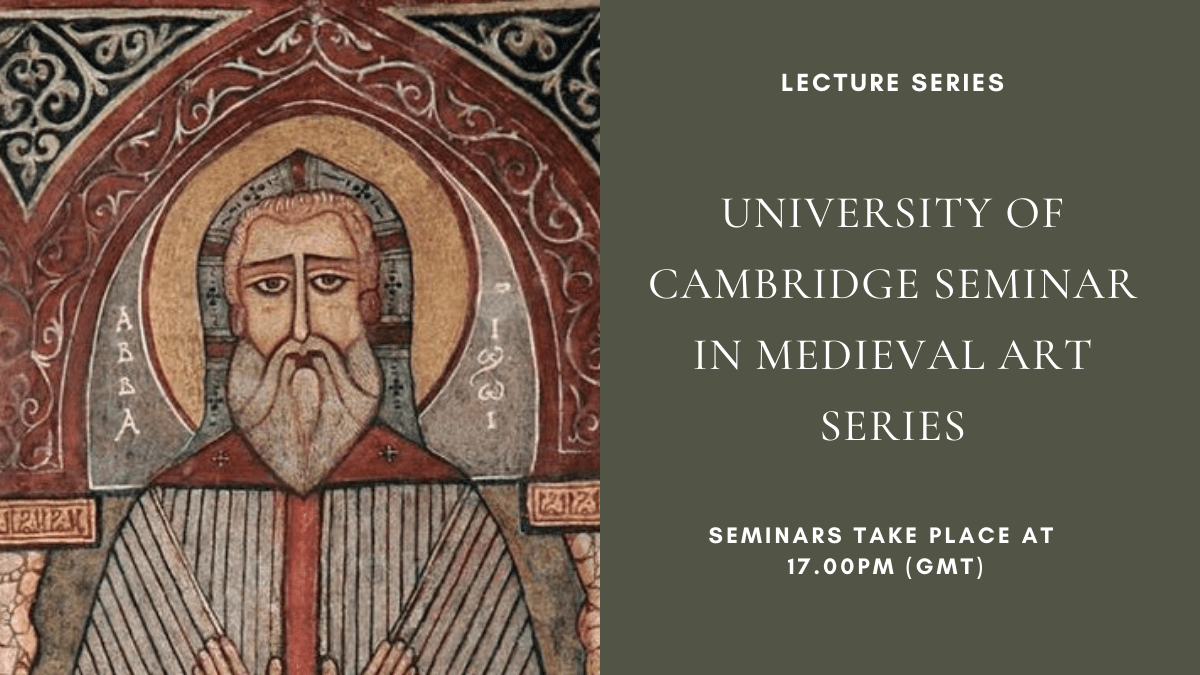
Cambridge Medieval Art Seminar Series, 2020-2021

The University of Cambridge Seminar in Medieval Art meets every other week during full term, attracting an impressive range of speakers from home and abroad. All seminars will take place online. Further details, including registration, to follow. 

Seminars take place at 5pm (17.00) UK time. 

Michaelmas:


Monday 16th November (Wk 6): Dr Heather Badamo (University of California Santa Barbara), ‘Beyond Iconoclasm: Sacred Images and Christian-Muslim Exchange in Medieval Egypt’ (Register here)

Monday 30th November (Wk 8): Professor Jeremy Johns (University of Oxford) and Dr Elise Morero (University of Oxford), ‘Industry not Dynasty: A Different Approach to Medieval Islamic Rock Crystal Objects’ (Register here)


Lent

Monday 1st February (Wk 2): Dr Pamela Patton (Index of Medieval Art, Princeton University) ‘What Did Medieval Slavery Look Like? Colour, Race, and Unfreedom in Late Medieval Iberia’


Monday 1st March (Wk 6): Dr Maria Lidova (Kunsthistorisches Institut, Florence): ‘Christ, Fire, Gospels: Images of Theophany in the Chapel of Galla Placidia in Ravenna’

Organisers: Dr Laura Slater and Dr Donal Cooper. Please email Dr Laura Slater at lss33@cam.ac.uk with any queries.
 

Online Lecture: ‘The Red Monastery Church (Upper Egypt): Its Significance and Conservation’ with Elizabeth S. Bolman, 10 November 2020, 7:00 pm (Greece)

The Red Monastery Church (Upper Egypt): Its Significance and Conservation, webinar with Elizabeth S. Bolman (Case Western Reserve University), American School of Classical Studies at Athens via Zoom, November 10, 2020, 7:00 pm (Greece)/12:00 pm (EDT)

The remarkable Red Monastery Church, located in the Egyptian desert, surprises us. It is not in a city, or even near one. What is it doing, in its isolated environment? The church is a monumental basilica with an elaborate tri-lobed sanctuary, which belongs to a tradition of elite urban architecture. The interior of the eastern end includes the best preserved example of architectural polychromy in paint – tempera and encaustic on architectural elements – that survives on a large scale from the Greek, Roman and early Byzantine periods. This talk will elucidate the significance of the monument and its location, and use it as a means of exploring how we think about the creation of culture in the early Byzantine world. The remarkable conservation project that took well over a decade will also be discussed.

Elizabeth S. Bolman engages with the visual culture of the eastern Mediterranean in the late antique and Byzantine periods. Best known for her work in Egypt, she has demonstrated the vitality of Christian Egyptian art and presented new understandings of the nature of artistic production in the early Byzantine and Medieval periods. She edited and was the principal contributor to the award-winning Monastic Visions: Wall Paintings in the Monastery of St. Antony at the Red Sea (Yale University Press and the American Research Center in Egypt, 2002) and to The Red Monastery Church: Beauty and Asceticism in Upper Egypt (2016). She was appointed Elsie B. Smith Professor in the Liberal Arts and Chair of the Department of Art History and Art at Case Western Reserve University in August 2017. She is the recipient of fellowships and grants from the Guggenheim Foundation, Fulbright program, National Endowment for the Humanities, Dumbarton Oaks, the American Research Center in Egypt, and the United States Agency for International Development, among others.

Presented by the Byzantine Dialogues from the Gennadius Library

Advance registration required.

Find out more information here.

Post Doc: Universitat Hamburg, deadline 30 November 2020

The Center for Advanced Study “RomanIslam Center for Comparative Empire and Transcultural Studies” funded by the German Research Foundation (DFG), invites applications for Resident fellowships (Post Doc) (starting 2021, duration between 1 and 12 months)

The Center for Advanced Study brings together scholars from a wide range of disciplines
working on Romanization and Islamication in Late Antiquity with a focus but not exclusively on
the Iberian Peninsula and North Africa during the first millennium CE. The overall aim of the
Center is to explore new approaches to Romanization and Islamication in this period and to set
the scholarly debate in the field on a new footing. The second year theme is ‘Imperial Religions
and Local Beliefs’, i.e. the relationship between state authority and religion. Which forms of
local religious practice remained in place, despite the dominance of eastern salvation religions,
and which forms changed as a result thereof?


Fellowships are available for scholars at all stages of their academic career who have
completed their doctoral degree and established an independent research profile. Applicants
should be engaged in a research project in any relevant discipline that is related to the Center’s
interests in Romanization and Islamication in the period and area in question. The Center also
welcomes applications from scholars working on comparative empire and transcultural studies
in a broader historical (or contemporary) perspective whose research has a strong focus on
theoretical and methodological issues.


Fellows are required to reside in Hamburg, where they pursue their own research project while
also participating in the colloquia held at the Center. For the duration of their stay fellows
receive a remuneration covering accommodation, travel, and living expenses in accordance
with their needs and the pertinent regulations of Hamburg University and the DFG.


Applications should be in English, including a CV, a research proposal for the project pursued at
Hamburg, including the project’s relation to the topic (2000 words), and an indication of the
months the applicant wants to spend at the Center and the kind of financial support they
require. All materials should be sent in a single pdf document to Dr. Rocco Selvaggi
romanislam@uni-hamburg.de by November 30, 2020.


Should you have any questions pertaining to the details of the fellowship program or the
application, please contact the organizers: Sabine Panzram (sabine.panzram@unihamburg.de) and Stefan Heidemann (stefan.heidemann@uni-hamburg.de).


Find out more here.

Virtual Conference: Medieval Heraldry, London Medieval Society, 21 November 2020

Join London Medieval Society for a one-day colloquium exploring heraldry in the medieval period. 21 November 2020 via Zoom.

The London Medieval Society is proud to announce our first online colloquium, where we will be discussing all things heraldic.

Programme (GMT)

10.15: Alfred Hiatt – Welcome and Introduction

10.30: Alan V. Murray (University of Leeds) – The Origins of Heraldry: Where, When, and Above All, Why?

11.30: Break

11.45: James Lloyd (College of Arms) – The Mercian Saltire

12.30pm: Sheri Chriqui (Royal Holloway) – Lionized Fields in Medieval Heraldry

1.15pm: Lunch Break (provided by your fridge)

2.00pm: Marcus Meer (German Historical Institute): A Herald’s Worst Nightmare: Merchants’ Marks, Heraldry, and Urban Identity in Sixteenth-Century Germany

2.45pm: Round Table (all speakers)

3.30pm: End of Event

Tickets are free of charge.

A link to the Zoom meeting will be sent via email. Get your tickets here.

Job: Assistant Director for Archaeology at British School at Rome, deadline 23 November 2020

We are seeking to appoint an Assistant Director for Archaeology to join us in Rome, to play a vital role in the delivery of the BSR’s Research Strategy and Strategic Plan. Applicants must hold a doctorate, and must have an excellent knowledge and understanding of the UK’s Higher Education and research environment and/or museums sector.


This is a residential position, based at the BSR in Rome, for a fixed term (1 January 2021 [or as soon as possible thereafter] to 31 December 2022 in the first instance). Further information, including the key responsibilities of the role, the person specifications, the terms and conditions, and the application procedure can be found here.


Closing date for applications: noon on Monday 23 November 2020

Find out more here.

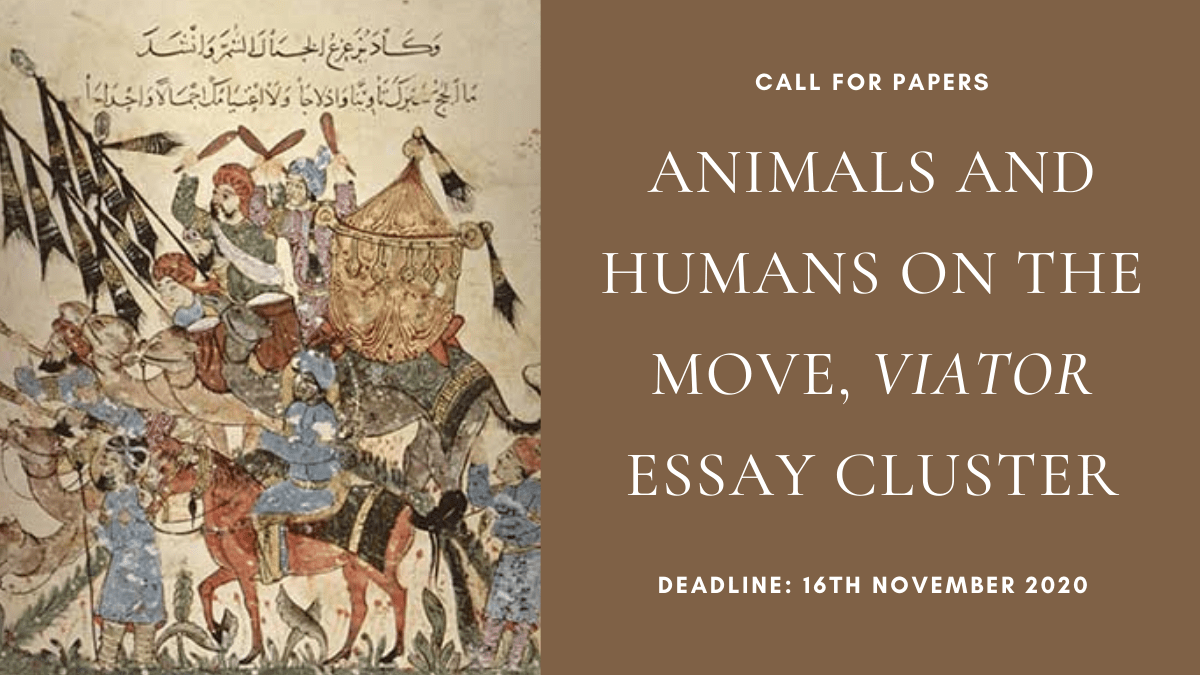
CFP: Animals and Humans on the Move, Viator Essay Cluster, Deadline: 16th November 2020

The relationship between humans and their nonhuman traveling companions changed over time, and over the distances they traveled. Who would Don Quixote be without Rocinante, or Alexander without Bucephalus? This cluster of short essays proposes to look at moving/traveling animals and animals as the companions of traveling/moving humans in the Middle Ages and early modernity. To move or travel might encompass physical travel in its various forms, such as pilgrimage, military campaigns, or travel for commercial or diplomatic reasons, or more conceptual travel across cultures and periods. Contributions might also consider texts that describe animals on the move, including ekphrastic works (such as Byzantine hunting ekphrases), an outsider’s (or traveler’s) perspective on autochthonic animals as recorded in travel accounts, or more abstract texts describing travels and adventures of animals.

This cluster aims to offer cross-cultural perspective; papers exploring Byzantine, Arabic, Turkish, Jewish, Persian and other non-Western cultures are particularly welcome.

  • Animals as “companion species” in travel, war, pilgrimage, commerce, or politics
  • Traveling menageries, circuses, and animals shows
  • Journeys in search of real or imaginary animals
  • Ekphrastic texts depicting traveling animals
  • The dissemination and reception of texts about animals across languages, cultures, and time periods

Essays should be short, focused interventions (2000–3500 words). Contributions from early-stage scholars are especially welcome, including graduate students, postdocs, independent scholars, and members of the precariat.

Short abstracts of around 200 words should be emailed to przemyslaw.marciniak@us.edu.pl by November 16, 2020, with essays to be submitted by January 15, 2021.

CFP: ‘Remarkable women’: Female patronage of religious institutions, 1300-1550, Courtauld Institute of Art, deadline 27 November 2020

This conference seeks to explore the ways in which women patronised and interacted with monasteries and religious houses during the late Middle Ages, how they commissioned devotional and commemorative art for monastic settings, and the ways in which these donations were received and understood by their intended audiences. The artistic donations of lay patrons to religious institutions has become a fruitful area of study in recent years, but the specific role played by women in these networks of patronage has been subject to less thorough scrutiny. Similarly too, the interests of female patrons have often been considered separately from the contexts of the places to which they made their donations, without a thorough consideration of their very different status from their male counterparts and how this shaped their pursuit for commemoration and memorial after death and their reception as patrons by monastic houses and religious institutions.

Applicants are encouraged to consider these issues and to think about the placement of objects and works of art commissioned by women within religious buildings, the devotional practices and beliefs of various religious orders, the physical materials of donations, and the ways in which female patrons situated themselves within monastic spaces. Was there a dialogue between these benefactors and the religious institutions they patronised? What can such donations tell us about the role and position of women in late medieval society and the ways in which they used religious patronage to articulate their own status? By examining a category of patrons that was clearly highly aware of a variety of devotional and commemorative practices, this conference seeks to gain a better understanding of art commissioned for monasteries by female lay donors, and how this more broadly reflects the position of women in late-medieval Europe.

Proposals are encouraged to address these issues throughout Europe between circa 1300 to 1550. Topics might include, but are not limited to considerations of:

  • Issues of access and entry for women into religious spaces
  • The agency of women in donating to monastic orders
  • The significance of widowhood
  • How women made themselves present, either in images or burial, in spaces often unavailable to them in life.
  • The relationships between a female patron and a male religious institution.
  • The role of materials in articulating identity or expressing specific aims, ideas or associations
  • The differences in donations, and their reception, between male and female patrons
  • The positioning of chapels, memorials or objects within monastic spaces
  • How concepts of death and the afterlife may have been expressed in visual terms, and the ways in which this may have been gendered.
  • The political nature of female patronage, and the ways in which women contributed to dynastic or familial ambitions through their donations
  • How different monastic orders may have received and understood female patronage
  • The types of object given by female donors to monastic audiences
  • The types of object owned by women which reflect their interaction with monastic influences

Proposals are welcome from postgraduate, early-career and established researchers working in all relevant disciplines. The conference will be held online on 29 January 2021. Please send a title and an abstract of no more than 300 words for a 20-minute paper, together with a short CV and 100-word biography, to Nicholas.Flory@courtauld.ac.uk by 27 November 2020.

Find out more here.

Online Conference: E-Quadrivium: Researching remotely– Libraries, archives, & digital resourcing, Friday 27 – Saturday 28 November 2020

E-Quadrivium is an online webinar for postgraduate researchers exploring means of accessing and analysing pre-modern primary materials.

Quadrivium is an annual research, careers, and skills training event for postgraduates and early career researchers of medieval and early modern textual studies. The initiative was founded in 2004 where it was supported by AHRC funding. It is run by leading academics who form a network known as the Medieval Manuscripts Research Consortium (MMRC), from the Universities of Glasgow, York, Birmingham, St Andrews, Leicester, De Montfort, Queen’s University Belfast, Sheffield, Kent, Cambridge, and Newcastle.

Conference Programme


Friday 27th November

3.00-3.15pm – Welcome and Introductory Comments

3.15-4.00pm – Visualising manuscripts remotely- University of Glasgow, Special Collections Library – with Dr Johanna Green and Dr Diane Scott (facilitator, Professor Jeremy Smith)

4.00-4.15pm – Break

4.15-5.30pm – Using Libraries and Archives in a time of pandemic: Discussion and Q&A with Dr Paul Dryburgh (The National Archives), Dr Alison Ray (Canterbury Cathedral Archives) and a member of the British Library’s Reader Services team (facilitator, Professor Andrew Prescott)

5.30-5.45pm – Break

5.45-6.30pm – Introducing MEMSLib – A postgraduate-led response to the pandemic in the Centre for Medieval and Early Modern Studies at the University of Kent (facilitator, Dr David Rundle)

6.30-6.45pm – Friday’s concluding comments

Saturday 28th November

3.00-3.15pm – Welcome to day 2

3.30-4.45pm – Working with Manuscripts – Professors Linne Mooney and Wendy Scase (facilitator, Dr Orietta Da Rold)

4.45-5.15pm – Break

5.15pm-6.45pm – Digital Futures in Manuscript Studies: Big Data, Open Access and Computational Analysis– Professors Elaine Treharne, Jukka Tyrkkö, and Mike Kestemont (facilitator, Dr Ryan Perry)

6.45-7.00pm – Break

7.00-7.30pm – Concluding comments and discussion

Register here.

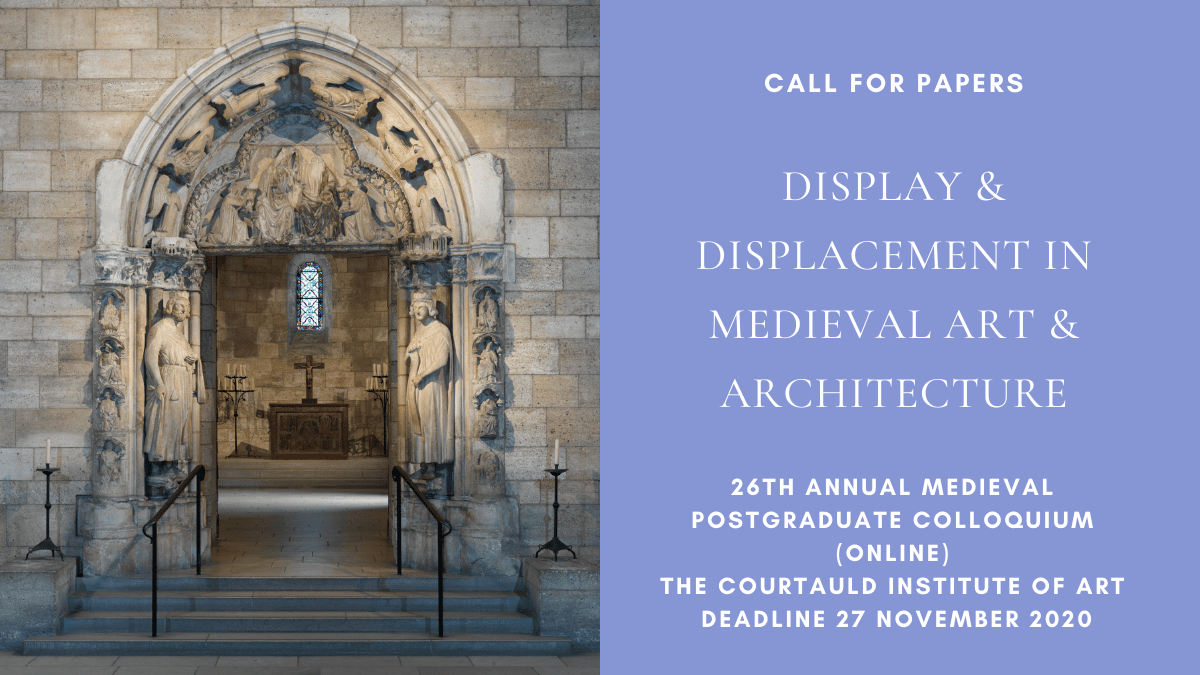
CFP: ‘Display and Displacement in Medieval Art and Architecture’, 26th Annual Medieval Postgraduate Colloquium (online), The Courtauld Institute of Art, deadline 27 November 2020

From the chalices that glisten behind glass museum cases to the ritual staging of powerful relics, from the architectural fragments of once towering cathedrals to fresco schemes designed to envelope the senses of the viewer, the display and location of medieval art and architecture matter. Though often meticulously designed and executed for specific temporal and physical loci, objects frequently moved – whether purposefully, forcefully or even only imaginatively – into new contexts and topographies. Natural disasters, wars and religious conflicts – the 1202 Syria earthquake, the 1204 Sack of Constantinople, St Lucia’s Flood in 1297, or the 1492 expulsion of Jews from Spain, amongst many others – contributed to the displacement of people, objects and buildings.

Surviving sources – whether written or visual – affirm that the reciprocal relationships between objects and their sites were integral to medieval viewers’ experience of art and architecture. At a time when access to artworks and cultural sites has been largely disrupted by the current pandemic, addressing the question of how medieval art was uprooted and its display reconfigured is especially pertinent. The Courtauld Institute of Art’s 26th Annual Medieval Postgraduate Colloquium invites speakers from various academic fields (including, but not limited to, art history, archeology, material culture and conservation studies) to consider various forms of displacement and their visual and experiential implications for medieval art and architecture. Speakers are encouraged to address the following and related questions, understood in the broadest geographical and chronological terms:

Considering original contexts
• What happens when the link between objects, their original sites and geographies is disrupted, and objects are re-imagined and re-configured in new contexts?
• How can primary sources help us to understand the relationships between medieval objects, their settings and viewers?
• How did medieval and later audiences and patrons recontextualise objects, within new sites, that had travelled thousands of miles?

Displaced communities and beholders
• How do medieval artworks testify to the displacement of religious communities and their beliefs?
• What challenges faced displaced craftspeople and how were they forced to innovate? How did displaced craftspeople act as engines of change?
• How did artworks and spatial settings produce a sense of displacement in the beholder?

Visualising Displacement
• How did artists visually articulate stories of travel, migration and displacement?
• How was displacement used to mitigate distance? How was this conceptualised (vis-à-vis creation of mental pilgrimage itineraries, architectural recreations of the Holy Sepulcher, etc.)?
• How did public or private rituals such as processions and religious ceremonies recontextualise objects or concepts of displacement?

Reconstruction and Preservation
• How can digital technologies aid us in the study of displaced art and architecture?
• How do, or could, treasuries, museums and other art repositories draw on the localism of the sites with which their objects are intimately associated in order to reconcile the displacement that is inherent in their collections?
• Is the displacement of objects, wall paintings and whole architectural structures a form of preservation and conservation?

The Medieval Postgraduate Colloquium encourages participation from postgraduate students and independent researchers from across the globe. To apply, please send a proposal of up to 250 words for a twenty-minute paper, together with a CV, to medievalcolloquium@courtauld.ac.uk no later than 27 November 2020.

Organised by Giosuè Fabiano, Chloe Kellow, Susannah Kingwill, Laura Melin and Bella Radenović.

Find out more here.
Online Lecture: Thomas Becket: His Portrayal Through Time, Dr Danica Summerlin, 16 December 2020, 7.30-9pm (GMT)

Join St Albans Cathedral to mark the 850th anniversary of the death of St Thomas Becket, Archbishop of Canterbury from 1162 until his murder at the hands of King Henry II’s men in Canterbury Cathedral in 1170.

His image is emblazoned on the walls of St Albans Cathedral – painted during the medieval period onto a pillar of the nave, and re-illuminated as part of the ‘Alban, Britain’s First Saint’ project. This talk explores how he has been portrayed in the centuries since his death. More information to follow.

Speaker: Dr Danica Summerlin, University of Sheffield

Date & Time: Wednesday 16 December, 7.30-9pm. Participants can join from 7pm. 

Price: £10 (£6 students)

Venue: Online via Zoom

As this talk will be hosted over Zoom, participants will need access to a computer/laptop/tablet/phone which has audio in order to be able to hear. You can also join by dialling in using a telephone, but won’t be able to see the speaker or any visual aids. 

Instructions for signing up and joining the talk will be sent via email between 5-5.30pm on the day of the event. If you have not received these details by 5.30pm, please call 01727 890205. Please ensure that you provide a current email address when you book. 

You can book online here, or call the Box Office on 01727 890290. Tickets will be on sale until 5pm on the day of the event.

Found out more here.