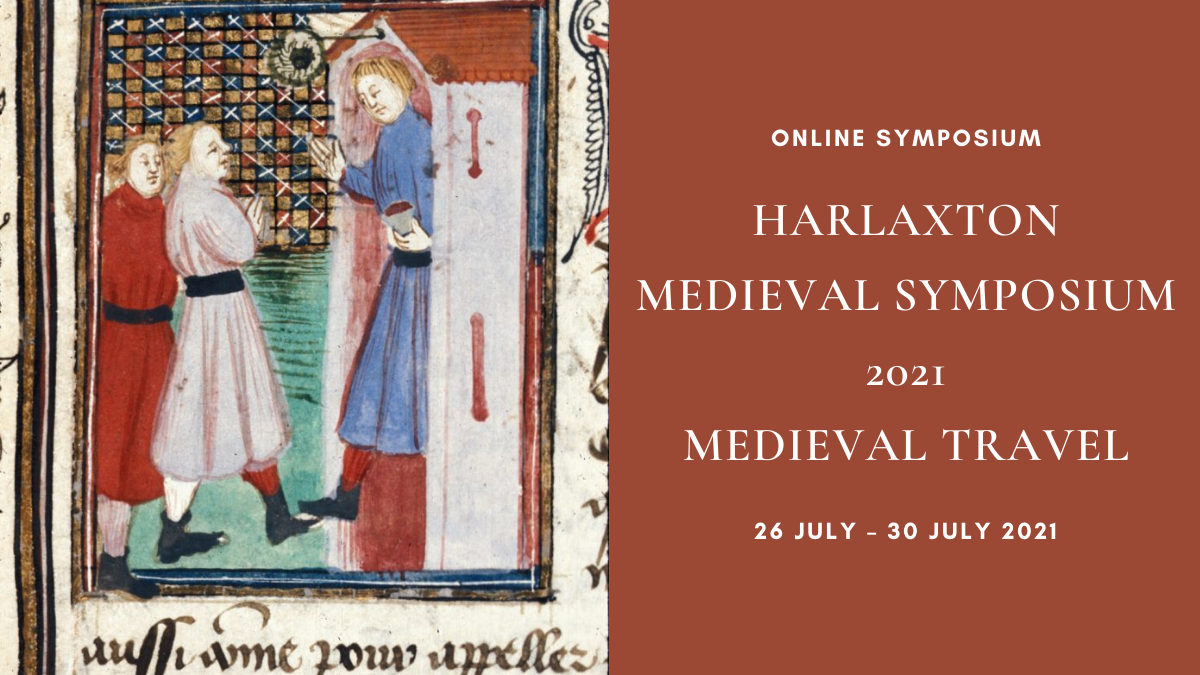
Online Symposium: Medieval Travel – Harlaxton Medieval Symposium 2021

Convenors: CAROLINE BARRON (c.barron@rhul.ac.uk) and MARTHA CARLIN (carlin@uwm.edu)

Register on Eventbrite here.

For a timetable of sessions, speakers, and papers, click here

Registration fee: £15 (students £10) for the five full days.

For registrants with a password from Eventbrite: click here for full conference information and materials.

For registrants with a password (which can be found in your confirmation email from Eventbrite), click here for full conference information and materials:  Medieval Travel registrants’ area

Provisional timetable:

Monday, 26 July:

2.30 – 4.00 PM            Session 1A      Travel Writing 

Welcome:  Martha Carlin

Martha Driver:  Mandeville in the Twenty-First Century

Nicholas Orme: William Worcester: Traveller and Collector

5.00 – 6.30 PM            Session 1B       Images and Travel

Lynda Dennison: Travelling Artists and Travelling Books         

Nicholas Rogers: Visual Souvenirs of the Emperor Sigismund’s Visit to England in 1416

8.00 – 9.30 PM            Session 1C       Pamela Tudor-Craig Memorial Lecture

Julia Boffey: Richard Arnold’s Book

Tuesday, 27 July:

2.30 – 4.00 PM            Session 2A      Maps

Alfred Hiatt: Maps and Travel

David Harrison: A Road Map of Medieval England

5.00 – 6.30 PM            Session 2B       Sources for Travel (panel)

Robert Swanson: Visitation and Church Court Records

Joel Rosenthal: Proofs of Age

Joanna Mattingly: Churchwardens’ Accounts

David Harrap: Travel Coffers 

Anthony Gross: Three Travel Objects

8.00 – 9.30 PM            Session 2C       Student posters I

Wednesday, 28 July:

2.30 – 4.00 PM            Session 3A      Inns

Martha Carlin: Inns, Horses, and Stabling

Laura Wright: Inn Clusters in London in the Fifteenth Century

5.00 – 6.30 PM            Session 3B       Entertainment and Travel

Simon Polson: Travelling Minstrels 

Alexandra Johnston: Travelling Entertainers and Their Patrons: York, 1446-9

8.00 – 9.30 PM            Session 3C       Student posters II

Thursday, 29 July:

2.30 – 4.00 PM            Session 4A      Travel and the Body

Carole Rawcliffe: ‘Do not stop at Famagusta’: Travel and Health in the Later Middle Ages

Kelcey Wilson-Lee: Travel and Childbirth

5.00 – 6.30 PM            Session 4B       Women Travellers

Anthony Bale: Margery Kempe and the Female Traveller in the Later Middle Ages

Bart Lambert and Josh Ravenhill: Travelled Women in the Capital: Opportunities for Immigrant Women in London during the Later Middle Ages

8.00 – 9.30 PM            Session 4C       Poster Judging & Book Launch            

Judging of student posters 

Launch of Harlaxton Medieval Symposia volume(s) 

Friday, 30 July:

2:30 – 4:00 PM            Session 5A      Travel Wonders

Alan Thacker: Travels of St Wulfram

Shayne Legassie: Botanical Wonder and Medieval Travel

5:00 – 6:30 PM            Session 5B       Travel and the Exotic

Melanie Taylor: In Search of the Exotic: Visual Evidence of Knowledge and Trade in Simians, Birds, and Wingless Dragons

Kate Franklin: From Marvels to Motels: Imagined and Infrastructural Worlds of the Silk Road Travel

Final words: Caroline Barron

New Publication: The Gems of Dante’s Divine Comedy by Ann C. Pizzorusso

In honor of the 700th anniversary of the death of Dante, geologist Ann C. Pizzorusso has published a new book, available in English and Italian on the gems Dante used as metaphors in the Divine Comedy.

From a gemological point of view, the Divine Comedy is a veritable treasure trove: containing rubies, topazes, emeralds, sapphires, pearls and diamonds, as well as crystal, amber and glass. Most of the references to gems can be found in the Paradiso, the Canticle of Light, in which Dante makes abundant use of illumination on objects in the form of reflection, refraction and shadow to convey a variety of metaphors and concepts – pearls, the intellectual luster of the wise; rubies, souls of Christian warriors; diamonds, fortitude and steadfastness; and the sapphire, emblematic of the Virgin Mary, Queen of Heaven.


It is evident that Dante was well aware of the intrinsic physical characteristics of each gemstone and its astrological association as well as the spiritual, metaphysical, and medicinal attributes each was purported to possess. His working knowledge of light’s reflection, refraction and dispersion on specific gems is extraordinary as he combines the knowledge of a physicist with the words of a bard. All of this in an era in which many rare, faceted precious stones were entering Europe and the principles of gemology, as we know them, lay centuries in the future.


Using gemological passages from the Divine Comedy, the author will show how Dante used the physical characteristics of each gem to describe the intrinsic characteristics of humanity, starting with man and proceeding upward toward the souls, angels, saints and finally to the divine – as characterized by a brilliant, spotless diamond.

Available on Amazon worldwide in English and Italian in ebook and paperback form.

https://www.prurgent.com/2021-03-04/pressrelease472053.htm

New Publication: Ficino and Fantasy – Imagination in Renaissance Art and Theory from Botticelli to Michelangelo by Marieke J.E. van den Doel

Did the Florentine philosopher Marsilio Ficino (1433-99) influence the art of his time? Art historians have been fiercely debating this question for decades. This book starts with Ficino’s views on the imagination as a faculty of the soul, and shows how these ideas were part of a long philosophical tradition and inspired fresh insights. This approach, combined with little known historical material, offers a new understanding of whether, how and why Ficino’s Platonic conceptions of the imagination may have been received in the art of the Italian Renaissance. The discussion explores Ficino’s possible influence on the work of Botticelli and Michelangelo, and examines the appropriation of Ficino’s ideas by early modern art theorists.

Marieke J.E. van den Doel is Assistant Professor of History of Humanism at the University of Humanistic Studies in Utrecht. Previously, she was Director of Studies in Art History at the Royal Netherlands Institute in Rome (KNIR) and Curator of Exhibitions at Allard Pierson Museum, Amsterdam.

Readership – All interested in History of Art, especially Italian Renaissance Art (Botticelli, Michelangelo) as well as its historiography and Renaissance humanism and Platonism, both students and specialists alike

Call for Papers: Session at International Congress on Medieval Studies (Western Michigan University, Kalamazoo, 9th -14th May 2022), Deadline: 10th May 2021

IAS Sponsored Sessions at ICMS 2022

Call for IAS-Organized Session Proposals (https://:www.italianartsociety.org)
57th International Congress on Medieval Studies 2022
Western Michigan University, Kalamazoo, 9-14 May 2022 
https://wmich.edu/medievalcongress

The IAS sponsors up to three linked sessions at the annual meeting of the International Congress on Medieval Studies (ICMS). The Congress is an annual gathering of more than 3,000 scholars interested in Medieval Studies, broadly defined. It features more than 550 sessions of papers, panel discussions, roundtables, workshops, and performances.

The IAS is seeking session proposals that cover Italian art from the fourth through the fifteenth centuries. Members interested in putting together a panel or linked panels should send a brief abstract (250 words max), session title, a short list of potential or desired speakers (they need not be confirmed), the name of the chair(s) with email addresses and affiliation, and a one-page CV.

IAS online application:
https://www.italianartsociety.org/conferences-lectures/icms/

Questions to programs@italianartsociety.org.

More information about ICMS submissions:
https://wmich.edu/medievalcongress/submissions

Submit to IAS by: 10 May 2021 
Submit to ICMS by: 1 June 2021

Online Lecture: Curators’ Introduction – Thomas Becket: Murder and the Making of a Saint, 7th May 2021, 17.30–18.30 (BST)

To mark last year’s 850th anniversary of his brutal murder, the exhibition explored Becket’s remarkable life, death and legacy. It presents his journey from a merchant’s son to Archbishop of Canterbury, and the attempts to obliterate his cult under the Tudor dynasty.

Introduced and chaired by the Director of the British Museum, Hartwig Fischer, the exhibition curators, Lloyd de Beer and Naomi Speakman, discuss the themes, context and highlight objects of this remarkable show.

To book this online event:

Book now to secure your place. We’re hosting the event on Zoom – a free video conferencing system that requires users to register in advance. If you do not already use Zoom, you can sign up using this registration link.

If the event is fully booked, or you do not wish to use Zoom, you can also watch the event streamed live – as well as other events in the series – on the Museum’s live events YouTube channel.

This event includes live captioning delivered by Stagetext and delivered by MyClearText.

Credit: Reliquary pendant showing Becket as archbishop. England, 15th
century. © The Trustees of the British Museum.
Info: This pendant may once have contained Becket’s relics. The reverse shows an
image of St John the Baptist.

New Journal Article: ‘A portrait of central Italy’s geology through Giotto’s paintings and its possible cultural implications’, Ann Pizzorusso, Geoscience Communication, Volume 3, Number 2, December 2020

Central Italy has some of the most complex geology in the world. In the midst of this inscrutable territory, two people emerged – St. Francis and Giotto – and they would ultimately change the history of ecology, religion and art by extolling the landscapes and geology of this region.

From antiquity to the Middle Ages, humans had a conflicting relationship with nature, seeing it as representing either divine or satanic forces. On the vanguard of a change in perspective toward the natural world was St. Francis of Assisi (ca. 1181–1226) who is now, thanks to his pioneering work, a patron of ecology. He set forth the revolutionary philosophy that the Earth and all living creatures should be respected as creations of the Almighty.

St. Francis’ affinity for the environment influenced the artist Giotto (ca. 1270–1337), who revolutionized art history by including natural elements in his religious works. By taking sacred images away from heaven and placing them in an earthly landscape, he separated them definitively from their abstract, unapproachable representation in Byzantine art. Giotto’s works are distinctive because they portray daily life as blessed, thus demonstrating that the difference between the sacred and profane is minimal.

Disseminating the new ideas of St. Francis visually was very effective, as the general populace was illiterate. Seeing frescoes reflecting their everyday lives in landscapes that were familiar changed their way of thinking. The trees, plants, animals and rocky landscapes were suddenly perceived as gifts from the Creator to be used, enjoyed and respected. Furthermore, Giotto recognized that the variety of dramatic landscapes would provide spectacular visual interest in the works. By including the striking landforms of central Italy, and portraying them accurately, Giotto allows us the opportunity to identify the types of rock in his frescoes and possibly even the exact locations he depicted. In fact, it would be discoveries in the pink Scaglia Rossa limestone – depicted in Giotto’s frescoes as pink buildings and used to construct the Basilica of St. Francis at Assisi – which would revolutionize the history of geology.

How to cite. Pizzorusso, A. C.: A portrait of central Italy’s geology through Giotto’s paintings and its possible cultural implications, Geosci. Commun., 3, 427–442, https://doi.org/10.5194/gc-3-427-2020, 2020.

To read the full article, click here.

Call for Papers: ‘Facciate Parlanti’, Opus Incertum, Issue 8 (2022), Deadline: June 30th, 2021

Since antiquity buildings have carried inscriptions on their surface. In particular, the habit of decorating façades with epigraphs spread in early modern Europe in keeping with the all’antica revival. The 2022 issue of the journal Opvs Incertvm (Department of Architecture, University of Florence) aims to investigate the role of new and ancient inscriptions (i.e. spolia) in secular and religious architecture (ca. 15th-18th centuries) from an aesthetic, political, literary and artistic point of view. Whether they were realized, or only projected in drawings, the “facciate parlanti” engaged in a close dialogue with public spaces and their audience. While the inscriptions could be in different languages and media (carved on stone, graffite or painted), they always retained a particular relationship with the building itself. 
Possible topics include, but are not limited to, the relationship between inscriptions and the patron’s ambitions and culture, the role of literati, iconographical advisers and antiquari and the social and urban context of the building.

Edited by Alessandro Brodini and Maddalena Spagnolo.

We welcome papers in Italian, English, French, German and Spanish.

An abstract of 500 words ca., and a brief cv, preferably in English or Italian, can be sent to alessandro.brodini@unifi.it and maddalena.spagnolo@unina.it.

Deadline for proposals: 30 June 2021
Notification of acceptance: 30 July 2021
Deadline for the definitive text: 30 April 2022
Publication: before the end of 2022
Opus Incertum has a double-blind peer review
https://oajournals.fupress.net/index.php/oi

Online Seminar: The Global Middle Ages Seminar, Valerie Hansen and Morris Rossabi, 5th May 2021

Valerie Hansen and Morris Rossabi will present at the Global Middle Ages Seminar. They will each give a short paper followed by a moderated conversation and Q&A session.

“The World’s Most Active Sea Route Before 1492: From the Chinese ports of Quanzhou and Guangzhou to Basra (in Modern Iraq) and Sofala (in Modern Mozambique)” (Valerie Hansen)

Starting around the year 1000, Chinese ships began to voyage to the Persian Gulf and sometimes even farther to the East African coast, a journey three times as long as Columbus’s voyage to the Americas. The Chinese imported huge quantities of what they called aromatics (the blanket term xiang covered fragrant woods, incense, spices, and tree resins such as frankincense and myrrh) from Southeast, South, and West Asia, and they exported textiles, metal goods, and ceramics to these regions as well as East Africa. These contacts had multiple effects, some of which we can study on the basis of archeological finds, particularly of ceramics. Hansen will explore why this route isn’t better known. Although traditional treatments of the medieval period do not cover this topic, it certainly falls within the purview of the Global Middle Ages.

“The Golden Horde: Recent Discoveries in Russia” (Morris Rossabi)

Until the late twentieth century, many Russians and foreigners portrayed Mongol rule in Russia as totally disastrous and despotic and leading to autocracy in the country’s later history. In the 1980s, specialists on the period of the Golden Horde, while not ignoring the death and destruction caused by the Mongols, asserted that the Mongols contributed to Russia’s first unification, fostered trade and religion, built new cities, and patronized and supported the arts. Historians and archeologists have recently confirmed some positive aspects of Golden Horde rule. This slide-illustrated lecture provides the historical background and shows samples of the latest archeological and artistic discoveries in ceramics, textiles, and metal work.


Valerie Hansen teaches Chinese and world history at Yale, where she is the Stanley B. Woodward Professor of History. Her current book is The World in the Year 1000: When Globalization Began. Earlier monographs include The Silk Road: A New History with Documents (2012) and The Open Empire: A History of China to 1800 (2015). Hansen is a frequent visitor to Asia teaching at Yale’s undergraduate program at Peking University, Yale-NUS College in Singapore, and as an invited scholar at Xiamen University in Fujian province, China.

Morris Rossabi (PhD Columbia University) was born in Alexandria, Egypt, and teaches Chinese and Mongolian history at the City University of New York and Columbia. Author and editor of numerous books, including Khubilai Khan, Modern Mongolia, Voyager from Xanadu, From Yuan to Modern China and Mongolia: The Writings of Morris Rossabi, and A History of China, as well as dozens of articles, he has collaborated on catalogues for art exhibitions at the Metropolitan Museum of Art, the Cleveland Museum of Art, and the Los Angeles County Museum of Art. He has traveled extensively and lectured in the Middle East, China, Japan, Korea, Central Asia, and Mongolia and speaks several European, Middle Eastern, and East Asian languages. The National Mongolian University awarded him an honorary doctorate in 2009.

Register for this event here.


This event will be held via Zoom. A link will be circulated to registrants by 10 am on the day of the event. This event will be live with automatic captions.

Online Lecture: The Tacuina Sanitatis of Giangaleazzo Visconti – encounters between visual experience, courtly culture, and medicine, Dominic Olariu, Murray Seminars at Birkbeck, 25th May, 4.45pm for 5pm (BST)

Four illustrated Tacuinum sanitatis (Tables of Health) manuscripts commissioned in the late fourteenth century by Giangaleazzo Visconti, Count of Milan and Pavia, pioneered a genre of books based on empirical experience. The manuscripts assimilated the eleventh-century Arabic medical and dietary knowledge of the tract Taqwīm al-ṣiḥḥa (Restoration of Health), itself a ground-breaking work, combining this with new formats and illustrations based on empirically gained experience. In northern Italian court culture the promotion of medical progress was an important aspect of the pursuit of a refined lifestyle in which the experience and practice of a sophisticated garden culture, the cultivation of a learned book culture, and the creation of avant-garde art all played their part. The experiences recorded in these images, combined with short texts, opened up new avenues of scientific practice and allowed Giangaleazzo a courtly self-dramatization as a promoter of medicine, the arts, and a healthy lifestyle, so strengthening his fragile position as ruler.

Dominic Olariu teaches at Philipps University in Marburg and holds a research position at the University of Erfurt. He is the author of Das Herbarium Blackwellianum (2020) and La genèse de la représentation ressemblante de l’homme (2014), and has edited two anthologies on portraiture. His numerous articles reflect his interdisciplinary research interests in conceptions of imitation, indexicality and similitude, particularly as seen in portraiture and illustrations of the natural sciences in the medieval to early modern periods.

Book your place here!

Online Lecture: Land, Memory and Power – Royal Privileges and the Representation of Kingship in Castile (c.1158 – 1350), Fernando Arias Guillén, 5th May 2020 1-2pm (BST)

Medieval encounters is an interdisciplinary medieval seminar series organised by Cambridge University, supported by the Trevelyan Fund and the History Faculty. Seminars normally take place in St Catharine’s College twice a term, including lectures and  events such as meetings with international graduate students and debates. Until further notice seminars are held on Zoom. The link will be circulated to Medieval Research mailing list members

For more information about the seminar series, click here.

Zoom Details:

https://cam-ac-uk.zoom.us/j/92327529817?pwd=RXcrYnprS3p5UGkyTzMzM1U1ditiUT09

Meeting ID: 923 2752 9817

Passcode: 473388

If you have questions or would like to be added to the mailing list please contact Dr N Berend nb213@cam.ac.uk