CFP: “Landscapes of Sanctity,” Leeds International Medieval Congress 2024, Deadline 31 July 2023

The AHRC-funded project “Liturgical and Literary Landscapes” welcomes applications from Early Career Researchers to participate in panels on ‘Landscapes of Sanctity’ to be put forward for the Leeds International Medieval Congress 2024. The four successful applicants will each be given a bursary of £450 towards the costs of attending the conference.

‘Liturgical and Literary Landscapes’, led by Johanna Dale (UCL) and Sarah Bowden (King’s College
London) brings together historical approaches with those from literary studies to reassess the
transmission of the cult of St Oswald, and, more broadly, uses multi-disciplinary approaches to place,
space and landscapes to explore new ways of thinking about the transnational cults of saints. The organizers plan to propose two or three interlinked panels to the Leeds IMC 2024, with contributions from the project leads, a couple of established experts, and new ECR voices. In these panels, which will be brought together under the framework ‘Landscapes of Sanctity’, the organizers would like to explore the ways in which the cults of saints are connected to the landscape, both as physical reality and as experienced and constructed in the cultural memory and imagination. Papers might consider the ways in which cults change as they move, and how these movements can be traced through texts or material artefacts; or how cults leaves traces on landscapes through time (e.g. buildings or settlements) and how these traces and connections are manifest today, both physically and in the cultural imagination. They might explore the role and construction of landscape in lives of saints, or offer ecocritical readings; alternatively they might think about ways in which saintly cults are anchored across time in place, i.e. through liturgy.

Paper proposals are welcome from ECR researchers from a range of disciplines, including (but not
limited to): History, Literatures, Art History, Archaeology, Musicology, Theology. Those interested in
offering a paper and applying for a bursary should send an abstract and a short CV (one side) to Sarah
Bowden (sarah.bowden@kcl.ac.uk)
by 31 July 2023. The organizers will prioritize applicants with no (or limited) access to funding for conference attendance, so please indicate whether or not other sources may be available to you.
Resource Update: Index of Medieval Art Open Access

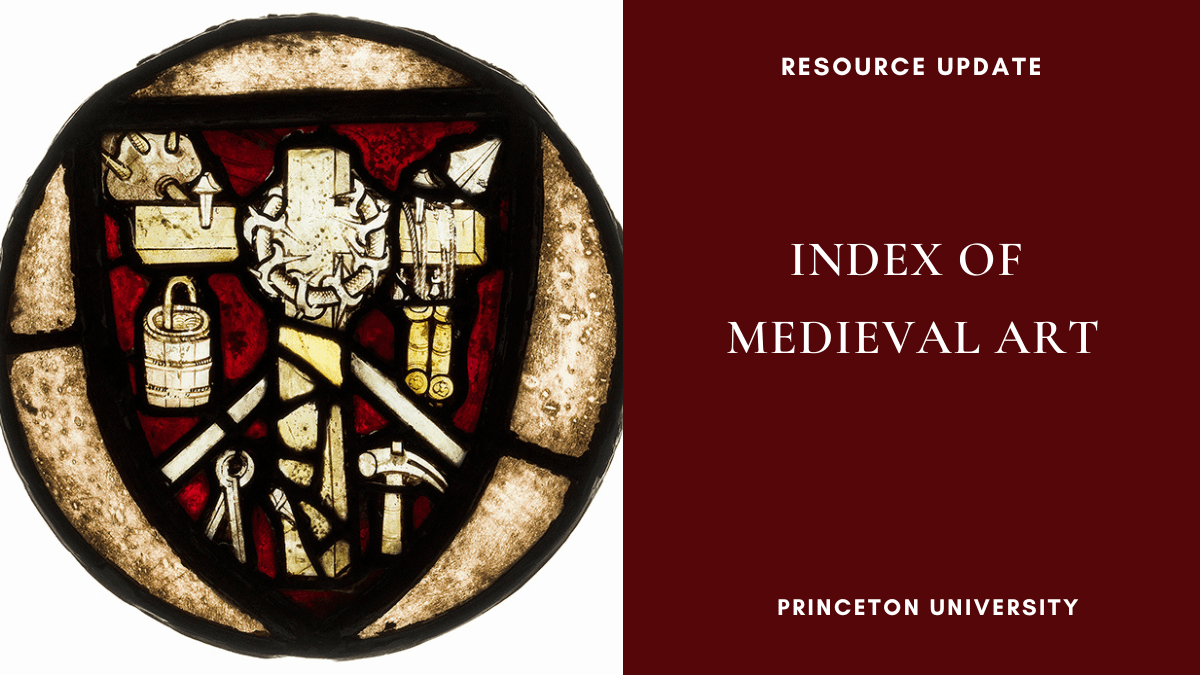
The Index of Medieval Art at Princeton University is delighted to announce that as of July 1, 2023, its online database is free to all users. This change has been made possible by a generous bridge grant from the Samuel H. Kress Foundation and the ongoing support of Princeton’s Department of Art & Archaeology. The database can be consulted at https://theindex.princeton.edu/.  

The Index of Medieval Art looks forward to sharing resources with students and scholars at all levels and with public learners seeking reliable information about medieval art and culture. In the coming months several online training sessions will introduce the database to those who may be unfamiliar with it, the schedule and signups for which will be publicized on the Index of Medieval Art blog (https://ima.princeton.edu/) and through the Index social media accounts. The first session will be held on August 3, 2023 from 10:00 to 11:00am EDT; further information and registration can be found at this link: https://ima.princeton.edu/index_online_workshop_august_2023/. Index staff also remain available for researcher questions via our online form at https://ima.princeton.edu/research-inquiries/.

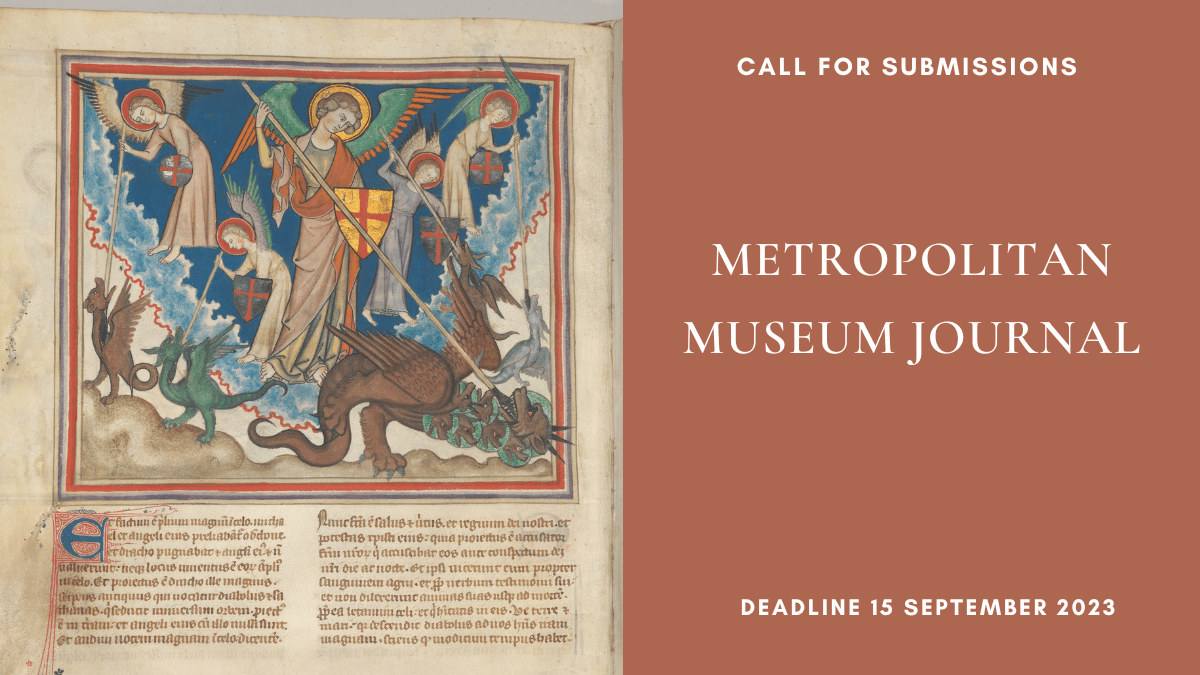
Call for Submissions: Metropolitan Museum Journal, Deadline 15 September 2023

The Editorial Board of the peer-reviewed Metropolitan Museum Journal invites submissions of original research on works of art in the Museum’s collection.

The Journal publishes Articles and Research Notes. All texts must take works of art in the collection as the point of departure. Articles contribute extensive and thoroughly argued scholarship, whereas research notes are often smaller in scope, focusing on a specific aspect of new research or presenting a significant finding from technical analysis. The maximum length for articles is 8,000 words (including endnotes) and 10–12 images, and for research notes 4,000 words with 4–6 images.

The process of peer review is double-anonymous. Manuscripts are reviewed by the Journal Editorial Board, composed of members of the curatorial, conservation, and scientific departments, as well as scholars from the broader academic community.

Articles and Research Notes in the Journal appear in print and online, and are accessible in JStor on the University of Chicago Press website.

The deadline for submissions for Volume 59 (2024) is September 15, 2023.

Submission guidelines: www.journals.uchicago.edu/journals/met/instruct
Please send materials to: journalsubmissions@metmuseum.org
Questions? Write to Elizabeth.Block@metmuseum.org

Inspiration from the Collection: www.metmuseum.org/art/collection
View the Journal: http://www.journals.uchicago.edu/loi/met

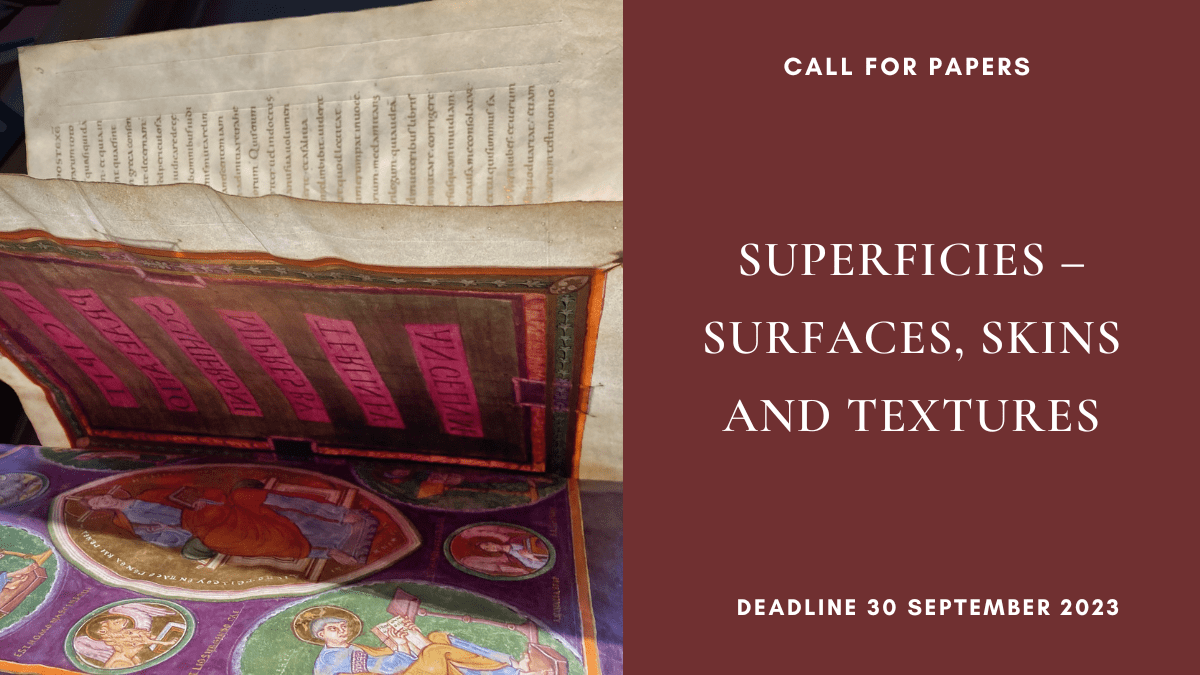
CFP: “Superficies – Surfaces, Skins and Textures,” deadline 30 September 2023

The research group “Textures of Sacred Scripture. Materials and Semantics of Sacred Book Ornament” (https://textures-of-scripture.ch) and the Chair of Medieval Art History at the University of Zurich invite paper proposals for an international conference on “Superficies – Surfaces, Skins, and Textures. Sensory encounters with books and related multi-layered objects”. The conference, funded by the Swiss National Science Foundation, is scheduled to take place at the Institute of Art History of the University of Zurich on 18-20 January 2024.

Surfaces are boundaries that mediate our sensory interactions with objects. Surfaces reveal, but they also conceal. In traditional aesthetic discourse, their multiple tactile and visual qualities are often contrasted with depth, and in a pejorative sense, superficiality is opposed to inner virtue and an intellectual understanding of things. This stark opposition between outer surface and inner core is put to the test by multi-layered objects such as books. Here, surfaces abound. Once opened, books in codex format display a multitude of layered skins and textures that are essential for the visual and haptic experience of the object in space and time. Perhaps more than other objects, books tangibly embody the complex relationship between surface and depth, through their composition and spatial structure as multi-layered objects. While the surfaces of sculpture and architecture have recently come to the attention of art historians, the surfacescapes – to use an expression coined by the art historian Jonathan Hay – of books and other multi-layered objects have been far less examined.

The conference aims to take a fresh look at the diversity of surface landscapes in books and other multi-layered objects. From the highly valuable vestments that clothe the exteriors of precious books to the parchment skins of their interiors, all layers are the product of diverse surface treatments. Techniques such as coating, polishing, tooling, and engraving determine the visual and haptic qualities of bindings and pages, and are reflected in their textures and sensory qualities.

We welcome proposals that consider the various surfaces of books and related multi-layered objects, such as handheld foldable objects, albums of prints and papers, multi-layered clothing, accoutrements, and containers. Paper topics may range from antiquity through the Middle Ages and beyond, in all cultures; transcultural studies as well as broader theoretical approaches are also welcome. Discussions across disciplinary boundaries are encouraged. Topics of particular interest are:

– Surfaces and the multi-layered spatiality and temporality of books and related objects.
– Ornament as surface and surface as ornament.
– Surface and ground.
– The textures, multi-materiality, and sensory qualities of surfaces.
– The preparation of surfaces to receive writing or painting, and the production processes concerning surfaces.
– The material traces of use, damage, and reworking that become inscribed into the surfaces of objects.
– Surfaces and transparency.
– The rough and the smooth: tactile dimensions of surfaces.
– Surfaces in relationship to the human body and its skin.
– Surfaces and the critique of superficiality.

Speaking time for each paper should not exceed 30 minutes and will be followed by a discussion. The conference languages are English, German, French, and Italian. Submissions should include the title and an abstract (max. 300 words), as well as the name, contact information, and a short CV of the speaker. Proposals should be submitted to the organizers Simon Breitenmoser, David Ganz, and Thomas Rainer by 30 September 2023. Please use the email address thomas.rainer@uzh.ch. The conference is planned as an in-person event. Travel expenses and on-site accommodation of all speakers will be covered.

Scholarship: Society of Architectural Historians of Great Britain MA Scholarship, deadline 5 July 2023

The Master’s Bursary scheme, supported by the generous bequest of the Arnold Hayward Stevenson Educational Trust Fund, is now open for applications.

There are significant, often structural, barriers to postgraduate study, in particular in disciplines like architectural history. We are working to diversify our discipline and those who practise it. As part of the Society’s commitment to Equality, Diversity and Inclusion, we very strongly encourage underrepresented communities to imagine their futures in architectural history and to apply for this bursary. Recognising that partial support often excludes those from non-traditional backgrounds for postgraduate study in the humanities, we are offering a £20,000 bursary to one candidate. 

Our intention is that this bursary will be transformational for the successful candidate, opening up the possibility of further study and career development in architectural history in higher education, heritage practice and/or museums and collections.

Further Particulars:

  • The bursary is for a sum of £20,000, to include fees and maintenance (1 year full-time or 2 years’ part-time study)
  • Candidates, who have already been accepted to a post-graduate taught or 1 year post-graduate research Master’s in Architectural History or related disciplines which will commence in Autumn 2023 are eligible to apply.
  • Candidates should be intending to study a course at a U.K. university.
  • The Society will not support candidates on MArch courses
  • Funds will be issued to the candidate directly, not via their university
  • Funds will be paid in two instalments over the academic year, subject to successful progress through the course
  • The recipient of the award will work closely with our Equality, Diversity and Inclusion, and Early Career Research networks, and take part in organising the SAHGB’s PhD / ECR Symposium.
  • All applications are welcome, though priority will be given to applicants who have SAHGB membership, as well as demonstrating eligibility through their responses to the areas we ask about.
  • The recipient will receive a year’s free membership of the SAHGB
  • Eligible candidates may self-nominate for this Scholarship by filling in the fields at the base of this page. Please complete all fields at the same time – we recommend that you plan your application offline and paste into the text boxes before making a submission.
  • Please send evidence of your place offer as directed, to arrive by the deadline below.

We are grateful to the trustees of the Arnold Stevenson estate for the generous bequest which has made this award possible.

The deadline for applications, including receipt of a copy of the offer letter to complete an entry, will be 5th July 2023. Please note the word count guidelines on each section of the online form.

Find out more information here: https://www.sahgb.org.uk/funding/sahgb-ma-scholarship

Lecture: ‘Analysis of Pigments on Painted Byzantine & Japanese Manuscripts’, Kate Fulcher, Bodleian Libraries Oxford, 26 June 2023, 1:00–2:00 pm (BST)

This lecture is an introduction to the analysis of painted Byzantine and Japanese manuscripts by the Bodleian Libraries’ new Heritage Scientist.

The post of Heritage Scientist at the Bodleian Libraries was re-instated at the beginning of 2023, enabling the analysis of manuscripts in the library’s collection. The focus so far has been on Byzantine manuscripts from the 10th to 13th centuries, and Japanese scrolls from the 17th century which contain painted pictures.

Kate Fulcher, Heritage Scientist at the Bodleian Libraries.

Registration is essential for attending this lecture, which takes place in person in the Sir Victor Blank Lecture Theatre. When you have booked your place the ticketing system will send you an automated confirmation.

Sir Victor Blank Lecture Theatre, Weston Library, Broad Street, Oxford, OX1 3BG

Find out more information here.

Study day: ‘The Invention of Greek origins in the textual and visual cultures of pre-modern Europe (1100-1600)’, University of Lille, 30th June 2023

Maison de la Recherche, Université de Lille, France, 30th June 2023
Organised by Catherine Gaullier-Bougassas

The ERC AGRELITA organises the workshops “The Invention of Greek origins in the textual and visual cultures of pre-modern Europe (1100-1600)”. The AGRELITA project was launched on October 1st, 2021. It is a 5-year project (2021-2026), which has received funding from the European Research Council (ERC) under the European Union’s Horizon 2020 research and innovation programme (grant agreement No 101018777).

ERC AGRELITA: The Reception of Ancient Greece in Premodern French Literature and Illustrations of Manuscripts and Printed Books (1320-1550) : how invented memories shaped the identity of European communities.

Programme:

-10h30 Welcome

-10h40 Introduction, Catherine Gaullier-Bougassas (Université de Lille, ERC AGRELITA)

-10h50-11h15 Elena Koroleva (Université du Littoral Côte d’Opale), « Les héros grecs à l’origine de l’humanité : Prométhée et Deucalion (re)peuplant la terre »

-11h15-11h40 Iolanda Ventura (Université de Bologne), « L’‛histoire de la pharmacologie et ses origines gréco-arabes dans les préfaces des imprimés du XVIe siècle »

-11h40-12h05 Discussion

Plenary conference:

-13h45-14h25 Lorena Lopes da Costa (Université Fédérale de Rio de Janeiro, chercheuse invitée en résidence ERC AGRELITA), « Chanter un Ulysse portugais : l’héroïsme maritime pour présenter le nouveau monde »

-2:25-2:40 p.m. Discussion
-2:40-2:55 p.m. Break

-14h55-15h20 Soizic Escurignan (Université de Poitiers), « Les origines grecques de l’Espagne dans la Estoria de España, un étrange paradoxe »

-15h20-15h45 Clarisse Evrard (Université de Lille, ERC AGRELITA), « La Grèce aux origines de la figure de l’artiste »

–3:45 p.m.-4:15 p.m. Discussion and closing


Find out more information here: https://agrelita.hypotheses.org/3462#more-3462

Invite to join the ‘Medieval Wall Paintings’ Research Group

Two PhD students (Florence Eccleston, Courtauld Institute of Art; and Katharine Waldron, University of Oxford and Hamilton Kerr Institute) are setting up a working group entitled the ‘Medieval Wall Painting’ Group to facilitate discussion, networking, and learning about wall paintings, and to promote research. They hope to be able to bring together both conservation and art historical approaches to encourage cross-disciplinary conversation and understanding. 

Please get in touch with them if you would like to be on the mailing list, and let others who might be interested know about this working group.

They are in the midst of organising future events on a biannual/ triannual basis with dates to follow soon, including a yearly workshop following on from Florence’s workshop ‘Researching Medieval Wall Paintings’ held at The Courtauld Institute of Art in May. 

In the meantime, please let them know if you have any ideas for future events or would like to be involved in planning in any way. They would love your help! 

Lecture: ‘The Conway Library: historiography, colour, and bibliography’, Anthony Hamber, Thursday 6th July, 17:30-18:30 (BST), Courtauld Vernon Square Campus

The Conway Library contains almost one million photographs of world architecture, architectural drawings, sculpture, decorative arts and manuscripts.  It has been constructed over a period of almost a century, though some of the photographs held are considerably older. This paper provides a focused evaluation of the historiography of the library’s origins, and how and why it was built upon Conway’s original donation.  A wide spectrum of issues and considerations are examined; the scale and scope of the market for, and availability of, architectural photographs from the time of Conway’s undergraduate career; Conway’s philosophy and approach; channels of distribution and acquisition; the physical constraints of the solander boxes and the range of photographic formats available; of colour photography; of image classification systems; and photographic print processes. There are also cultural and anti-semitic dimensions linked to the Warburg Institute and the role of pre-WW2 German emigrees to London. Cross-references between photographers and their photographs represented in the Conway help link this matrix together and provide further insights into the library’s significance and influence.

Anthony Hamber is an independent photographic historian, specialising in the 19th century.  He was the photographer and head of visual resources at the History of Art Department, Birkbeck College.  His PhD was published as A Higher Branch of the Art / Photographing the Fine Arts in England 1839-1880 (1996) and his recent book is Photography and the 1851 Great Exhibition (2018). He has published and lectured widely. His current research projects include an annotated bibliography of photographically illustrated publications 1839-1880. Anthony researches the historiography of art and architecture photographic collections, photographic print processes, and colour reprographics processes.

Organised by Dr Tom Nickson (The Courtauld) 

This is an in person event at our Vernon Square campus. Booking will close 30 minutes before the event begins.

Find out more information here.

CFP: British Archaeological Association post-grad conference 2023, deadline 31 July 2023

The BAA invites proposals by postgraduates and early career researchers in the field of medieval history of art, architecture, and archaeology. Papers can be on any aspect of the medieval period, from antiquity to the Later Middle Ages, across all geographical regions.

Proposals of around 250 words for a 20-minute paper, along with a CV, should be sent by 31st July 2023 to postgradconf@thebaa.org

The conference will take place online 29-30th November 2023