Online Lecture: ‘Emblems of the Past: saints, stained glass and early medieval antiquities’, Dr Martin Crampin, 12 October 2023, 5.00pm (BST)

Focussing mainly on the nineteenth- and twentieth-century imagery of saints in Wales, the talk will look at ways in which artists and designers, mainly working in stained glass, attempted to provide the early saints of Wales and Ireland with an authentically Celtic appearance. These images sometimes included specific references to early medieval metalwork and other kinds of historical artefacts.

Follow the link to join through Zoom:
https://uwtsd-ac-uk.zoom.us/j/91815254511

Martin Crampin is an artist, photographer and designer based at the University of Wales Centre for Advanced Welsh and Celtic Studies in Aberystwyth. He has been researching ecclesiastical art, the visual culture of Medievalism and the Celtic Revival in Wales for around twenty years, and has contributed to a series of research projects including ‘The Visual Culture of Wales’, ‘Imaging the Bible in Wales’, ‘The Cult of Saints in Wales’ and ‘Ports, Past and Present’. Publications include Stained Glass from Welsh Churches (2014), Depicting St David (2020) and Welsh Saints from Welsh Churches (2023).

Lecture: ‘Medieval and Medical: Developing The Wellcome Historical Medical Museum in the 1940s’, Lauren Rozenberg, University of East Anglia, 11 October, 5pm (BST)

It is our immense pleasure to invite you to the first of this year’s World Art Research Seminars, coming up on Wednesday 11th October at 5pm in the SCVA Lecture Theatre (01.10).

In this opening session, we’ll be welcoming Dr Lauren Rozenberg, currently a Leverhulme Fellow in the Department, who will be sharing her fascinating research on the unusual formation of Henry Wellcome’s Medical Museum in the 1940s, a project that draws together her expertise on medical curating, medieval healing, and both modern and premodern visual culture.

As ever, WARS sessions are free and followed by a glass of wine – all are welcome, so please do pass on the details to interested friends, colleagues, and students!

For more information on the series please contact j.hartnell@uea.ac.uk.

Location: Department of Art History & World Art Studies, UEA (SCVA Lecture Theatre (01.10))

Online Lecture: ‘Reconstructing Bury St Edmunds Abbey’, with Steven Brindle, British Archaeological Association, Wednesday 4 October 2023, 5pm (BST)

This month’s British Archaeological Association Lecture will take place via Zoom (sign up link here). Tune in to hear Dr Steven Brindle from English Heritage present on ‘Reconstructing Bury St Edmunds Abbey’.

Grants: American Philosophical Society’s Franklin Research Grants, deadline 1 December 2023

The American Philosophical Society’s Franklin Research Grants support the cost of research leading to publication in all areas of knowledge. The Franklin program is particularly designed to help meet the costs of travel to libraries and archives for research purposes; the purchase of microfilm, photocopies, or equivalent research materials; the costs associated with fieldwork; or laboratory research expenses. The Society is particularly interested in supporting the work of young scholars who have recently received the Ph.D.

Award: up to $6,000

Web: https://www.amphilsoc.org/grants/franklin-research-grants (for information and access to application portal)

Lecture series: Medieval Work-in-Progress Seminars at The Courtauld 2023-2024

All seminars are held on Wednesdays at The Courtauld’s Vernon Square campus, and begin at 5.30pm. Talks usually last approx. 45-60 minutes, followed by questions and drinks. Events are free and open to all, but please book your place via https://myaccount.courtauld.ac.uk/overview/11300

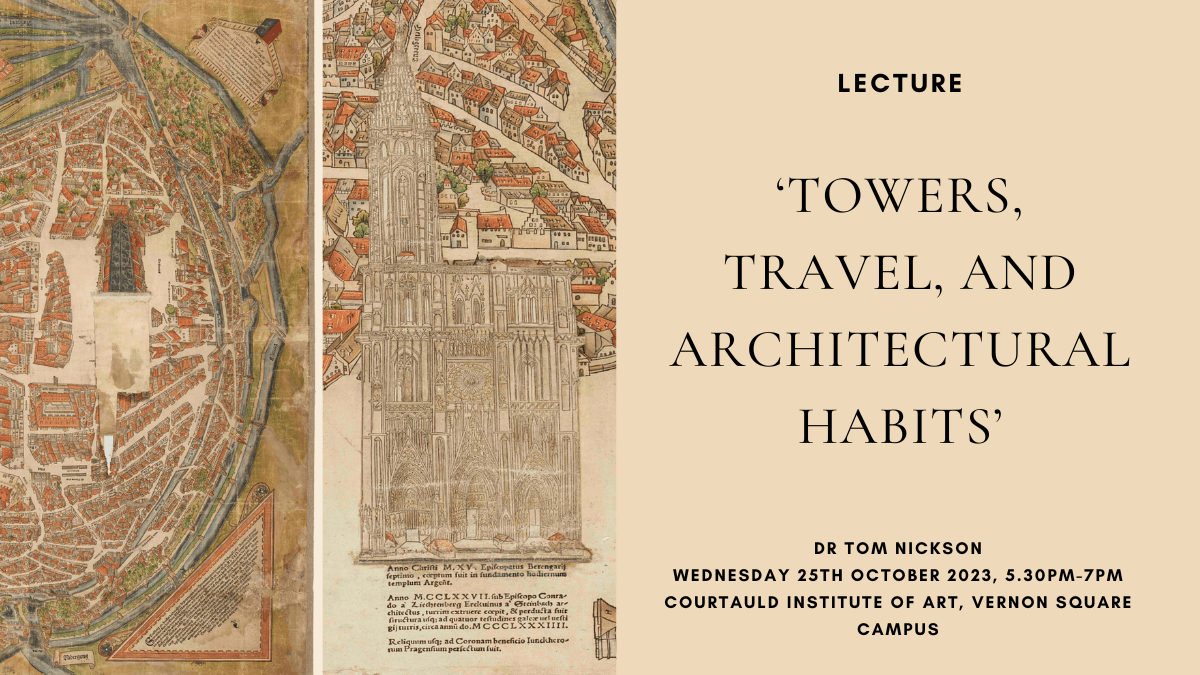
25 October: Tom Nickson (The Courtauld): Towers, Travel, and Architectural Habits

15 November: Niamh Bhalla (Northeastern University): Birth, Death and Protective Imagery in a Rock-hewn Church from Tenth-Century Cappadocia [moved from 4 October to avoid train & tube strikes]

6 December: Assaf Pinkus (Tel Aviv University): Experiencing the Gigantic in Late Medieval Art: Schloss Runkelstein

17 January 2024: Katrin Kogman-Appel (Muenster University): Entanglement in Shared Cultural Spaces: Hebrew Book Art in Iberia, c. 1300

7 February, ICMA lecture: Nina Rowe (Fordham): Dancing in the Streets (and the Courts and the Choirs) of Fifteenth-Century Austria

6 March: Elena Paulino Montero (UNED, Madrid): Architecture in Fourteenth-Century Castile (TBC)

1 May: Margaret Crosland (Washington University & St Louis Art Museum): (TBC)

15 May, Paul Crossley Memorial Lecture: Merlijn Hurx (KU Leuven): Keldermans on Horseback. Five Star Architects in the Medieval Low Countries

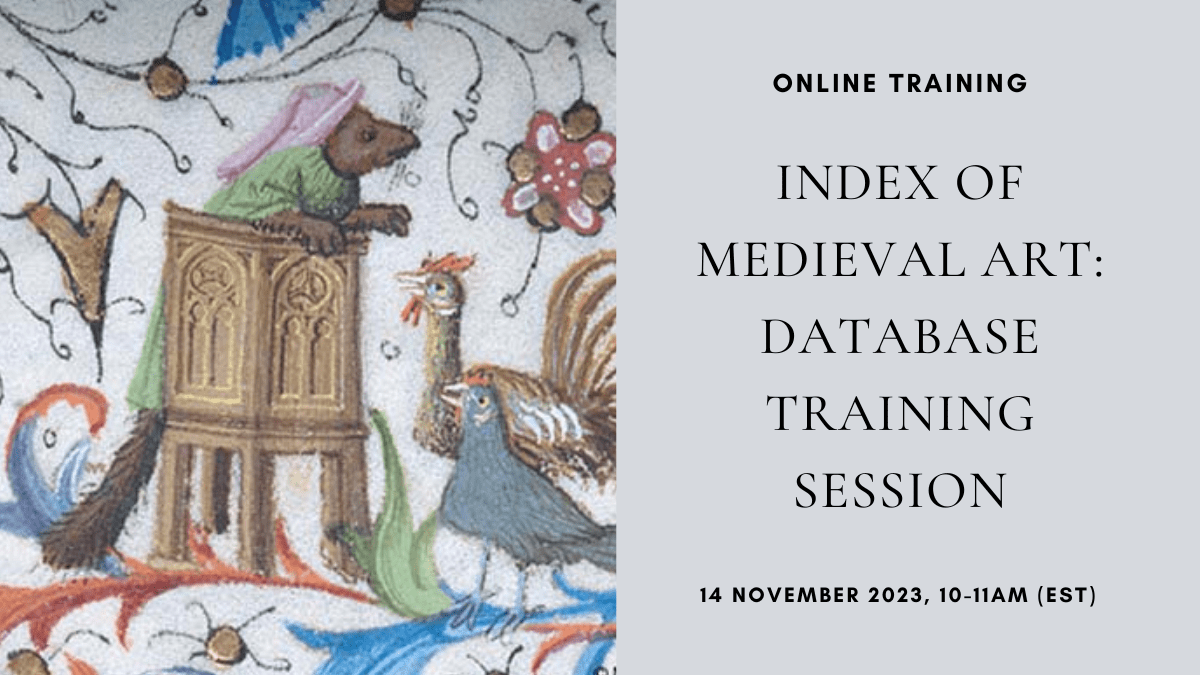
Scholarship: Index of Medieval Art Student Travel Grant, deadline 1 October 2023

For the second year, the Index of Medieval Art is pleased to offer a student travel grant to attend this year’s Index conference, Whose East? Defining, Challenging, and Exploring Eastern Christian Art, on November 11, 2023.

The grant will support attendance by one non-Princeton student who wishes to attend the conference but lacks the financial resources to do so. Up to $500 will be offered in reimbursement for travel and accommodations. Preference will be given to students whose institutions do not offer travel funding, who are not currently supported by a research fellowship, and who would be traveling from outside a 120-mile radius of Princeton. The grantee will be invited to participate in all aspects of the conference, including the speaker lunch, and to pursue research at the Index if their visit schedule permits.

Find out more information here.

Call for editors: Co-editors-in-chief for postmedieval journal, deadline 1 October 2023

We seek to recruit up to FOUR new Editors-in-Chief (EiCs) –two EiCs to begin three-year terms in January 2024; two to start in January 2025. (Staggered start dates will allow current editors to move out of their roles in rolling sequence. The total number of co-editors-in-chief will rise from three to four.)

Responsibilities of Editors-in-Chief are as follows:

  • -Helping to lead the journal into the future, guided by intellectual vision and ethical/political principles, in collaboration with co-editors and the editorial board
  • -Soliciting content for the journal (open-topic articles, essay clusters, and special issues), with the goal of publishing four issues annually
  • -Managing the peer-review process
  • -Editing (developmental editing, line editing, and copy editing – probably the largest single time commitment)
  • -Collaborating with the journal’s editorial board to maintain and strengthen the journal’s self-governance and profile
  • -Developing initiatives to make postmedieval more accessible, visible, and active.

Note that the publisher, Palgrave Springer, does not substantially remunerate the position of EiC; payment is limited to a small annual stipend. The hours of work per week vary with publication-schedule but regularly range between 5 and 10 hours/week. Editors-in-Chief are aided by a part-time, salaried Managing Editor, responsible for many of the day-to-day operations of the journal. We ask that new editors plan to occupy the role for at least three years from their start date.

postmedieval: a journal of medieval cultural studies is a quarterly academic journal that publishes theoretically driven scholarship on premodernity and its ongoing reverberations. Contributions are characterized by conceptual adventure, stylistic experiment, political urgency, or surprising encounter. Our aim is to facilitate collaborative, ethical, and experimental engagements with the medieval – with its archives and art, its thought and practices, its traces and its enduring possibilities. The current editors and editorial board are committed to expanding the fields of knowledge and geography represented in the journal, by showcasing scholarship that reaches across disciplines, language traditions, locales, modes of inquiry, and levels of access.

A full catalogue of postmedieval’s issues to date is available here. This content is largely paywalled. If you lack access, please write to postmedievalED@gmail.com to request a representative sample of articles.

The journal is seeking diverse editorial leadership, to help define what a theoretically minded premodern studies can be – across disciplines, language traditions, identity positions, locales, modes of inquiry, and levels of access.

Applications are warmly invited from scholars in all fields of premodern studies, including but not limited to the disciplines of Art History, History, Languages and Literatures, Musicology, Philosophy, Religious Studies, and Theater and Performance Studies, and/or in subfields like Gender and Sexuality, Ecocriticism, Global Medieval Studies, and Medievalism. Early Modernists who are medievally inclined would be very welcome.

Selection of new editors will be made by a committee consisting of current EiCs (Shazia Jagot, Julie Orlemanski, and Sara Ritchey) and members of postmedieval’s editorial board. The plan is to conduct online interviews after an initial review of applications.

To apply, please send a CV (short-format is fine) as well as a brief cover letter (2-page max) addressing the following three prompts. Note: CVs are requested to establish details of career history and intellectual and publishing experience, rather than prestige; many different academic trajectories would be welcomed and valued.

Prompts (to be addressed in the cover-letter):
-Your vision for the future of postmedieval
-Prior experience that has prepared you for this editorial role (whether in editing, academic organizing and leadership, collaborative scholarship, and/or involvement in the publishing process)
-Your sense of how an editorial position at postmedieval fits into the logistics of your life over a three year term (January 2024–December 2026 or January 2025–December 2027) as well as longer-term professional and intellectual goals. Please specify whether you would prefer to start in 2024 or 2025 and how strong this preference is.

Completed applications should be sent to postmedievalED@gmail.com. Also, feel free to reach out with any questions!

APPLICATION DEADLINE: OCTOBER 1

CFP: ‘The Medieval in Museums’, IMC Leeds 2024, deadline 18 September 2023

Proposals are invited for 15-minute papers examining presentations of the medieval in museum and heritage contexts. We invite interrogation of the social, political, historical, and cultural effects of museum and heritage work, including: 

  • practices of acquisition, curation, display, and interpretation
  • archives, record-keeping, and databases
  • education and community projects
  • digital presences
  • outreach or knowledge exchange activities run by field archaeologists or academics
  • performances or reenactments
  • artworks or events commissioned as part of museum or heritage programming

Catherine Karkov (2020), Alexandra Sterling-Hellenbrand (2021), and Karen Jolly (2022) have argued that museums reflect and construct national and local identities, which, intentionally or unintentionally, may prop up myths of ethnogenesis or ethnonationalism. Joshua Davies (2018), Clare Lees and Gillian Overing (2019), and Beth Whalley (2023) have directed attention to the workings of creative medieval heritage broadly conceived. We invite a similarly expansive approach to the medieval and to museums.

We encourage reflection on the stakes of representing the medieval at a time of increased public awareness of how museums and heritage are entangled with histories of European imperialism, calls for decolonisation, and matters of social justice. 

We also encourage attention to written medieval sources (histories, poems, or other texts): how manuscripts are displayed or interpreted in conjunction with other visual or material culture, places, or landscapes.

To apply: please send an abstract of no more than 150 words explaining your approach to the medieval and museums and/or heritage to Fran Allfrey and Maia Blumberg, fran.allfrey@york.ac.ukm.blumberg@qmul.ac.uk 

Deadline: 18 September 2023. The session organisers will submit the complete session by 29 September 2023. 

Please include the following: 

  • details of your academic affiliation (if appropriate), email, and postal address. 
  • a short abstract for the paper of no more than 150 words, in the language in which you want to present your paper. 

CFP: ‘Commemoration and the Senses in Late Medieval Europe’, IMC Leeds 2024, deadline 24 September 2023

In the lesser-known treatise De cura pro mortuis gerenda, Augustine of Hippo argued that tombs, when located in beautiful surroundings, are particularly powerful tools to incite genuine experiences of prayer in the mourner. Though writing in late antiquity, Augustine’s words would be echoed in several late medieval texts concerning commemoration, as a myriad of sensorial experiences was thought to be an integral component of the commemoration of deceased individuals. The ensemble of funerary art was charged with meaning through the careful orchestration of rituals and their sensorial input. Material remains, such as the tombs of the deceased, are only one of the sensory aspects once associated with the commemoration, while ephemeral displays of emotion by individuals through gesture, music, or clothing and other meaningful sensory signifiers are often hard to trace. Access to these ephemeral details is in the direct or indirect accounts of funerary rituals that tried to capture a sensory experience in text. These descriptions charged a monument or other funerary object with meaning, and allowed it to leave its material form and to start circulating throughout Europe in textual and visual copies.

While Augustine’s thought on the importance of senses in experiencing tombs was agreed upon and taken over by many authors in Late Medieval Europe, modern-day scholarship on funerary monuments and other commemorative practices has taken a long time to catch up with the intricate intellectual legacy on that matter. Particularly in the last two decades, scholarly attention has shifted to how commemoration goes beyond what remains visible today. Sharon Strocchia’s seminal 1992 book on burial rituals in 15th -century Florence was one such trailblazer, showing that key parts of the cityscape could be appropriated and activated to commemorate significant deceased individuals. While this and other publications have prompted more scholarly attention for the rituals surrounding commemoration in many parts of the European continent and beyond, much still remains to be said on how actively the senses were targeted in these rituals and what the link is between commemoration and the senses in the period after the ritual. This session, therefore proposes to look at funerary practices and their associated objects in Late Medieval Europe through the lens of sensory experiences. In our section, we tend to explore this intersection between ritual and object in which an object gets charged, activated or loaded with a certain meaning through a sensory effect at its initiation.

As such we would be very interested in posing questions such as (but certainly not limited to); In what way was existing liturgy embedded in the sensory “experience” of mourning? How was the sensory experience of funerary monuments and rituals captured in words? How could funerals temporarily “take over” public spaces by their ephemeral sensory presence? How could mourning, sermons, and commemorative literature be used to comment or reflect on a material object and its artistic qualities or another sensory performance. How did the spatial arrangements of the funerary monument relate to a specific funerary ritual and its sensory expressions? How did views of gender impact commemorative practices? How was music used to commemorate or commiserate? To what extent did certain rituals guide the gaze of the audience through the spatial arrangement? How were ephemeral rituals remembered and did the interpretation of them leave a lasting impression in the material culture?

This session encourages scholars to present new types of sources and approaches that give us new insights on the relation between the senses and mourning rituals. The session furthermore shows the importance and interconnectedness of sensory experience and commemoration, as it allows us to research the mechanisms and strategies of consolidating memory into existing rituals and spaces in Late Medieval Europe.

Submissions from a variety of disciplines are accepted, including but not limited to: archaeology, hagiography, religious studies, cultural and textual studies, humanist studies, musicology, history, history of art etc.

Please submit a 200-300 words proposal (in English) for a 15-20 minute paper. Proposals should include an abstract and be accompanied by a CV (including contact details, institution and academic or other affiliation).

This session is planned to take place in-person.

Please submit all relevant documents by 24 September 2023 to the following email addresses:

Mats Dijkdrent: mats.dijkdrent@uclouvain.be
Philip Muijtjens: ptm36@cam.ac.uk

New Publication: ‘Welsh Saints from Welsh Churches’ by Martin Crampin

The imagery of saints was once commonplace in churches in Wales, and by the fifteenth and sixteenth centuries painted and carved images of local and international saints would have been found on altars, screens, on the walls and in glazed windows of churches. Larger standing figures would have also been a feature of medieval churches, and these were probably the first images to have been removed and destroyed at the time of the Reformation.

Although images of saints in Wales survive from the later medieval period, very few can certainly be identified as Welsh saints, and the imagery of Welsh saints that can be seen in churches today mostly dates from the end of the nineteenth century and the twentieth century. These images are mainly in the form of stained glass and sculpture, charting the changing tastes of the Gothic Revival, the Arts and Crafts Movement and the changes in the way that medieval saints were understood in the popular imagination. Standing figures of saints sometimes make references to hagiographic texts, and additional scenes sometimes portray episodes from these stories.

Hardly any of this imagery has been studied or published before, and around 580 colour illustrations are provided by the author.

Dr. Martin Crampin is a Research Fellow at the University of Wales Centre for Advanced Welsh and Celtic Studies in Aberystwyth, with a particular expertise in the study of ecclesiastical art. He is also an acclaimed artist and photographer, and the author of Stained Glass from Welsh Churches (Y Lolfa, 2014) as well as a series of studies on individual churches.