Call for Papers: Twelfth Annual Material Culture Symposium

Winterthur Museum and Garden, Wilmington, Delaware, April 12, 2014
Deadline: Dec 2, 2013

ImageThe Center for Material Culture Studies at the University of Delaware invites submissions for papers to be given at the Twelfth Annual Material Culture Symposium for Emerging Scholars.

Focus: “Consuming” is a multivalent word, fraught with provocative denotations and connotations. Whether we buy them, sell them, use them, or eat them, we all consume objects through a variety of channels. We seek papers that highlight the intersection between people and their things within this broad framework of consumption. This conference will consider how material culture can act as an extension of ourselves, provide repositories for memory, help stabilize identity, interrupt our sense of scale and space, give permanence to relationships, function as a semiotic marker, and enable human activities. Papers may also address how objects mediate human sensory experience and create aesthetic meaning. We encourage papers that reflect upon and promote an interdisciplinary discussion on the state of material culture studies
today.

This conference is not bound by any temporal or geographical limits. Disciplines represented at past symposia include American studies, anthropology, archaeology, consumer studies, English, gender studies, history, museum studies, and the histories of art, architecture, design, and technology. We welcome proposals from graduate students, postdoctoral scholars, and those beginning their teaching or professional careers.

Format: The symposium will consist of nine presentations divided into three panels. Each presentation is limited to eighteen minutes, and each panel is followed by comments from established scholars in the field. There will be two morning sessions and one afternoon session, with breaks for discussion following each session and during lunch. Participants will also have the opportunity to tour Winterthur’s unparalleled collection of early American decorative arts and to engage in a roundtable discussion on Friday, April 11, 2014. Travel grants will be available for presenters.

Submissions: Proposals should be no more than 300 words. Please indicate the focus of your object­based research, the critical approach that you take toward that research, and the significance of your research beyond the academy. We encourage the inclusion of relevant images with your abstracts.

While the audience for the symposium consists mainly of university faculty and graduate students, we encourage broader participation. In evaluating proposals, we will give preference to those papers that keep a more diverse audience in mind. Programs and paper abstracts from past symposia are posted here:
http://www.materialculture.udel.edu/emerging_scholars.html.

Send your proposal, with a current c.v. of no more than two pages, to:
emerging.scholars@gmail.com

Deadline: Proposals must be received by 5 p.m. EST on Monday, December 2, 2013. Speakers will be notified of the vetting committee’s decision in January 2014. Confirmed speakers will be asked to provide symposium organizers with digital images for use in publicity and are required to submit a final draft of their papers by March 11, 2014.

2014 Emerging Scholars Co-­Chairs:
Anastasia Day (Hagley Program in the History of Industrialization) and Philippe Halbert (Winterthur Program in American Material Culture), University of Delaware

Call for Papers: Vagantes 2014

Call for Papers:

vagantesheader

Vagantes 2014
March 20-22, 2014 at the University of Texas at Austin
www.vagantesconference.org

Vagantes is thelargest conference in North America for graduate students studying the Middle Ages. Vagantes aims to provide an open dialogue among junior scholars from all fields of Medieval Studies. The conference features two faculty keynote speakers and professional development workshops, but its main focus is the presentation of original research by junior scholars. We are pleased to have Dr. Glenn Peers from The University of Texas at Austin and Dr. Bonnie Effros of the University of Florida as our keynote speakers this year.

Vagantes emphasizes interdisciplinary scholarship; each year, presenters from backgrounds as varied as Anthropology, Archaeology, Art History, Classics, Languages and Literatures, Manuscript Studies, Musicology, Philosophy, and Religious Studies come together to exchange ideas. In this manner, Vagantes fosters a sense of community for young medievalists of diverse backgrounds, and because the conference does not have a registration fee, this community can flourish within the margins of a graduate student budget.

Abstracts for twenty-minute papers are welcome from graduate students on all topics considering the Middle Ages. Please email a brief vita, along with an abstract of no more than 300 words by Monday, November 18, 2013 to:

Raúl Ariza-Barile
arizab.raul@utexas.edu
Sarah Celentano
scelentano@utexas.edu

Call for Papers – From eald to new: translating early medieval poetry for the 21st century.

6-7 June 2014, School of English, University College Cork.

getting medievl

In recent years, the shelves of commercial bookshops have been graced with accessible translations of medieval poetry from the Old English, Old Irish and Old Norse traditions, including Heaney’s award-winning rendition of Beowulf. Many of these reworkings give a contemporary flavour and immediacy to medieval texts, and they are increasingly being adopted for introductory courses on medieval literature. But what place do literary translations have in the academy, and should they be taught as creative works in their own right? How are the latest translations adapting to the needs of students and teachers? What exactly do we lose, and gain, in the translation of medieval texts?

This conference will explore the ideology of translation, the subtleties of the translation process, and the teaching of translation in modern university settings in relation to memory, adaptation and remediation. It will examine the cultural and historical inflection of individual translations, the ways in which the student’s experience of medieval literature is affected by the translation adopted for study, and the particular challenges related to the translation and reception of early medieval vernacular poetry.

We invite abstracts for 20 minute papers from both individuals and panels. Abstracts of approx. 250 words should be emailed to Dr Tom Birkett or Dr Kirsty March at ealdtonew2014@ucc.ie. The closing date is 15 December 2013.

Topics may include:

  •  Audience, cultural specificity and local idiom
  •     The meeting place of literary and academic translations
  •  Past translations, constraints of precedence, and suppression of difference
  •  Ideas of ownership, authorship and canonicity
  •  Teaching the translation of medieval languages in the academy
  •  Problematic poetry: translating verse forms, metrics, poetic language
  •  The potential of new media to change our relationship to the translated text
  •  Translation theory applied to medieval texts

For more information, see the website.

Call for Session Proposals – Conquest: 1016, 1066

‘Conquest: 1016, 1066’ – an interdisciplinary anniversary conference.

St Anne’s College, Oxford, and TORCH, 20-23 July 2016.

Call for Session Proposals (CFP to follow in May/June 2014)

baba

Sessions will run in parallel for 90 minutes each. Session proposals of any suitable form are invited (3x20min papers, 2x30min papers, round tables, debates); session organisers are welcome to have speakers already in mind, but need not do so: a call for papers will follow. Session organisers are asked to nominate one or more of the thematic strands in which their session would fit:

1.    The Church; monasticism, clerical reform, theology, religious experience
2.    Literature, authors, and patronage
3.    Language and multilingualism, language contact
4.    Institutions and governance; lordship; kingship
5.    Warfare, battles, conduct in war, fighting men
6.    Art and material culture; music; court life
7.    Society and peoples
8.    Trade and commerce
9.    Space, movement, contact, networks; England and Europe, England and Scandinavia
10.  Historiography

Email laura.ashe@ell.ox.ac.uk by 1 May 2014.

Dürer and Warburg: Interpreting Antiquity

Orpheus16.30 – 17.45, Friday 22 November 2013 (with registration from 16.00)

Lecture Room, The Warburg Institute, Woburn Square London WC1H 0AB

10.00 – 17.30, Saturday 23 November 2013 (with registration from 09.30) Kenneth Clark Lecture Theatre, The Courtauld Institute of Art, Somerset House, Strand, London WC2R 0RN

Organised by Stephanie Buck (The Courtauld Institute of Art) and Claudia Wedepohl (The Warburg Institute)

On 5 October 1905 the art and cultural historian Aby Warburg (1866-1929) delivered the lecture ‘Dürer und die italienische Antike’ (Dürer and Italian Antiquity) for the Congress of German Philologists and Teachers in Hamburg. Focussing on Albrecht Dürer’s drawing The Death of Orpheus (Hamburger Kunsthalle) Warburg discussed the role classical antiquity continued to play in the Renaissance and introduced the seminal term ‘Pathosformel’ (Pathos formula) for a formalized, transferable artistic expression of extreme passion. Our conference addresses the wider context of Warburg’s lecture and coincides with two exhibitions on view at The Courtauld Gallery from 17 October 2013 – 12 January 2014 – The Young Dürer: Drawing the Figure, and Antiquity Unleashed: Aby Warburg, Dürer and Mantegna.

Ticket/entry details: £20 (£12 students, Courtauld staff/students and concessions). BOOK ONLINE here:

http://ci.tesseras.com/internet/shop

Dürer and Warburg: Interpreting Antiquity (Programme)

Call for Papers – Robert Grosseteste and the Pursuit of Religious and Scientific Learning in the Middle-Ages

18-20 July 2014, Lincoln

robbie

It is intended that this conference will explore the relationship between the pursuit of scientific and religious knowledge in the middle-ages, with a particular focus on the British scholar, theologian, scientist, astronomer and philosopher, Robert Grosseteste (c. 1175-1253). It will discuss Grosseteste’s theological and scientific understanding, particularly of the new Greek and Arab learning, and how this influenced his theological/philosophical investigations. Whilst it is anticipated that the main focus will be on Grosseteste, it will also be an important part of the conference’s rationale to discuss contemporaries as well as later writers who drew on his learning in order to advance the study of science and religion. In addition to this rationale it will be an over-riding aim of the conference to discuss in general the relationship between science and religion and to discuss whether our present era has anything to learn from the middle-ages in this respect. Key note speakers will include Prof. Tom McLeish and Dr Giles Gasper from Durham University’s Order Universe Project and Dr Amanda Power from Sheffield University. It is expected that the proceedings of this conference will be published.

Proposals for 40 minutes papers or enquiries should be directed by 1st  December to Dr Jack Cunningham,j.p.cunningham@bishopg.ac.uk, Bishop Grosseteste University, Lincoln, LN1 3DY, UK. Proposal should be 300-400 words in length and should include your telephone number or e-mail address, as well as your academic affiliation (if any).

Call for Papers – Old and Middle English Studies: Texts and Sources

University of London, 03-05 September 2014.

Deadline for abstracts: 1st December 2013.

G336_0026rwf

The study of Old and Middle English is a prominent and important field of academic enquiry. With a lively community of scholars, nationally and internationally, this conference aims to open up and explore new possibilities for intellectual exchange and fruitful collaboration between scholars working in any aspect of medieval English, in London and Japan especially. Conference organizers, Keio University (Tokyo) and Institute of English Studies (London), invite scholars to submit abstracts of up to 250 words, for papers on topics related to the main themes of texts and sources transmitted from England during the Middle Ages, to ieskeio.conference@gmail.com.

Some suggested topics might include (papers with special emphasis on Japanese and/or British research will be encouraged):

  • Digital Humanities and Virtual Libraries
  • Manuscript Studies
  • Medievalism
  • Old and Middle English Literature and Literary Culture
  • Old and Middle English Philology: Texts and Contexts.

For further details, visit the conference webpage.

Recent Speculum reviews of books on medieval art

RoweNew reviews in Speculum include those of:

Christine Sciacca , ed., Florence at the Dawn of the Renaissance: Painting and Illumination, 1300–1350. Los Angeles: J. Paul Getty Museum, 2012.

Sherry C. M. Lindquist , ed., The Meanings of Nudity in Medieval Art. Farnham, UK: Ashgate, 2012.

Warwick Rodwell , The Archaeology of Churches. Stroud, UK: Amberley Publishing, 2012.

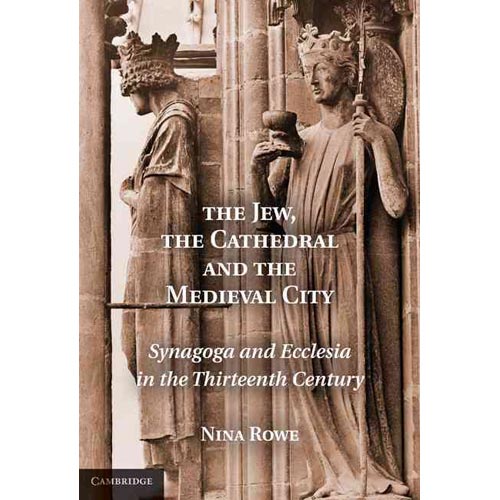
Nina Rowe , The Jew, the Cathedral, and the Medieval City: Synagoga and Ecclesia in the Thirteenth Century. Cambridge: Cambridge University Press, 2011.

Eléonore Fournié , L’iconographie de la “Bible historiale.” (Répertoire Iconographique de la Littérature du Moyen Âge 2.) Turnhout: Brepols, 2012

CFP deadline: The Visual Arts and Music in Renaissance Europe c.1400-1650

image003-crop[1]Deadline 4 November 2013, for conference on Saturday 18 January 2014 at The Courtauld Institute of Art

The study (and experience) of music and art has occurred largely separately, however. Hence, the wariness of students of Renaissance art and music to explore the relationship between their own discipline and their close yet unfamiliar counterpart has resulted more in the appropriation rather than synthesis of diverse research skills. This symposium hopes to break down these historiographic boundaries and explore the numerous instances of interdisciplinarity that exist in Renaissance scholarship. We invite postgraduate and early career scholars of all disciplines to present instances of this relationship in their research, and to use this symposium as an opportunity for exploratory and open-minded discussion of aural and visual experience in Renaissance culture and historiography. We are particularly keen to encourage participants to consider ways of presenting interdisciplinary research in engaging and inventive ways.

Topics could include, but are not limited to:

  • joint musical and commissions
  • patronage
  • devotional function
  • the relationship of art and music to physical space
  • audiences / congregations
  • relationships between the senses and the arts
  • -commemorative art and music
  • historiography (of interdisciplinary study)
  • mnemonics
  • curatorial, performative, and museological approaches to Renaissance culture
  • contemporary or modern relationships in hermeneutic interpretation

The Renaissance Symposium offers the opportunity for research students at all levels from universities in the UK and abroad to present their research and receive feedback in a friendly and constructive environment. We cannot offer travel subsidies for speakers, and therefore students from outside London are encouraged to apply to their institutions for funding to attend the symposium.

Please send proposals of no more than 250 words and your academic CV by 4 November 2013 to renaissanceartandmusic@gmail.com


http://www.courtauld.ac.uk/researchforum/events/2013/autumn/jan18_RenaissanceArtsMusicSymposium.shtml