Conference: The Augustinian Canons in Britain – Architecture, Archaeology, Art and Liturgy (Nov 7-9, 2014)

O14P101ARR_1_Abstract[1]The Augustinian Canons in Britain – Architecture, Archaeology, Art, and Liturgy 1100-1540

Rewley House, 1 Wellington Square, Oxford

Fri 7 to Sun 9 Nov 2014
The Augustinian canons are very much the Cinderellas of medieval monastic history. In Britain, despite their prolific numbers, the not inconsiderable quantity and quality of their archives, and the fame and celebrity of much of their surviving architecture, the canons continue to stand in the shadow of the more familiar and generally better-researched monastic groups, most notably the Benedictines and the Cistercians.

Encouragingly, in recent years, a new generation of monastic historians has been working hard to redress this balance, but much remains to be done. In particular, the buildings of the Augustinian canons, their architecture, art, and the liturgy within, all remain woefully neglected areas of study. This is surprising, given the celebrity of English sites such as Bolton in Wharfedale, St Frideswide’s in Oxford (now the cathedral church), St Bartholomew’s in London, Hexham, Waltham and Walsingham; or Llanthony and Bardsey in Wales; or Jedburgh and St Andrews in Scotland.

This conference presents a major opportunity to consider the buildings at these and many other Augustinian sites across the country – more than 200 in all. It brings together an impressive body of historians, architectural and art historians, and archaeologists, whose principal focus will be the canons in Britain. However, the conference will also provide some contextual Continental background, and will further consider comparative material in Ireland.

It will be the first ever conference to consider the Augustinian canons in Britain from this perspective.

FRIDAY 7 NOVEMBER 2014

6.00pm Registration (for those who have booked meals and or accommodation)

7.00pm Dinner

8.00pm Registration (for those who have booked as non-residential without meals)

8.15pm- What Augustinian architecture?
9.30pm DR DAVID ROBINSON

SATURDAY 8 NOVEMBER 2014

8.00am Breakfast (residents only)

9.15am The Augustinians in England and Wales
PROFESSOR JANET BURTON

10.15am Architecture and Augustinian communities in the Mediterranean c.1080 – c.1200
JOHN MCNEILL

11.15am Coffee / tea

11.45am Aesthetic restraint in a regional frame: Augustinian architecture in France from the eleventh to the fourteenth century
PROFESSOR SHEILA BONDE and PROFESSOR CLARK MAINES

12.45pm Lunch

2.00pm The aisleless cruciform church and the first Augustinian canons in Britain
DR JILL FRANKLIN

3.00pm Greater twelfth-century Augustinian churches in Britain
RICHARD HALSEY

4.00pm Tea / coffee

4.30pm The Augustinians as guardians of pre- and post – Conquest cults
DR DAVID ROBINSON

5.00pm A twelfth-century Augustinian cloister in its liturgical and theological context
THE REVD JEFFREY J WEST

6.00pm Break / bar open

7.00pm Dinner

8.15pm-9.30pm Eastern extensions in the thirteenth and fourteenth centuries
DR NICOLA COLDSTREAM

SUNDAY 9 NOVEMBER 2014

8.00am Breakfast (residents only)

9.15am The architecture of the Augustinian canons in Ireland
PROFESSOR ROGER STALLEY

10.15am The liturgical books of the English Augustinians
PROFESSOR NIGEL MORGAN

11.15am Coffee / tea

11.45am The place of patronage in the study of Augustinian art and architecture
DR JULIAN LUXFORD

12.45pm Lunch

2.15pm Meet at Christ Church for an afternoon visit to the Augustinian priory of St Frideswide

4.00pm Course disperses, or you may wish to stay for Evensong which is at 6.00pm

As of 20th Oct 2014 some non-residential places are still available.

To book: – http://www.conted.ox.ac.uk/O14P101ARR


Call for Papers: “Muslim Subjects and Clients in the Pre-Modern Christian Mediterranean,”

The Mediterranean Seminar is seeking proposal for two proposed panels, on “Muslim Subjects and Clients in the Pre-Modern Christian Mediterranean,” organized by Abigail Balbale [Bard Graduate Center/University of Massachusetts Boston] and Brian Catlos [Religious Studies, CU Boulder/Humanities, UC Santa Cruz] to be submitted for consideration for the annual meeting of the Middle East Studies Association to be held November 22-25 in Washington DC. Prof. Stephen Humphreys (Emeritus, History, UC Santa Barbara) will provide comment.

Islam was conceived as a universal religion and social organization, and a ideology of liberation rooted in the correct expression of divine sovereignty. The first era of Islam was characterized by a wave of conquest that only reinforced the faith’s universal aspirations — in space of less than a century, Arab Muslims and their clients brought the former Persian Empire, much of Byzantium, the Maghrib and the Iberian Peninsula under their rule. Both Revelation and the practica associated with this conquest led Muslims to develop a formal position in which members of monotheistic religions (in principle, Jews, Christians, and Zoroastrians) were incorporated into dar al-Islam as subject peoples or dhimmis. This phase of ebullience coincided with the formulation of Islamic law and the crystallization of Islamic institutions.

Beginning in the mid-eleventh century, however, the political tide in the Mediterranean turned, as Latin Christian powers began to expand at the expense of Muslim princes, and began to conquer and colonize substantial areas in the Islamic Mediterranean. For the first time Islam was confronted with the situation of substantial populations of Muslims living under non-Muslim rule  (“mudéjares”/“mudajjan”) — a state of affairs that flew in the face of fundamental principles. Moreover, Muslim princes who had previously held the upper hand in relationships of clientage with Christian rulers, now found themselves in a subordinate role in the Latin-dominated Mediterranean.

In the last four decades, subject Muslims in Iberia, Italy, Ifriqiya, and the Eastern Mediterranean have been the subject of intense historical study, most of it locally or regionally-based and finely focused in terms of chronology or approach.  In March 2014, Cambridge University Press will publish “Muslims of Medieval Latin Christendom, ca. 1050–1614” the first monographic study of the experience of subject Muslims across the Christian West — an attempt to synthesize the work of scholars of subject Muslims to date.  To mark this occasion, and to showcase the newest and most original research in this field, we are seeking papers for two panels: “Theory,” and “Practice.”

“Theory” will examine how Islam grappled with the problem of Muslim submission to infidels from the point of view of ideology, whether religious or political, and may include studies from disciplines including, for example, history, literature, legal history and philosophy.

“Practice” will look at the dynamics of Muslim clientage and submission “on the ground” and may include economic, political, and social history, the study of art, architecture and material culture, and literature, to name but a few.

We are particularly interested in papers that cross or interrogate categories of analysis (such as “Muslim” and “Christian”), that examine issue of Muslim heterodoxy and diversity, that examine Muslims’ relations with other minority communities (e.g.: Jews), or that engage with relatively neglected areas of mudéjar studies, such as gender, conversion, and slavery.

Please submit a proposals for 20-minute papers to be presented in person to Abigail Balbale (balbale@bgc.bard.edu) and Brian Catlos (bcatlos@ucsc.edu) on or before Tuesday, February 11 for consideration. Include a 150-200 word abstract and a 2-page CV and indicate whether you will need to request AV equipment.

Call for Papers: The Making of the Humanities IV, Rome, 16-18 October 2014

The Making of the Humanities IV, Rome, 16-18 October 2014

http://makingofthehumanities.blogspot.com

The fourth conference on the history of the humanities, “The Making of the Humanities IV”, will take place in Rome from 16 till 18 October 2014.

Goal of the Conference

This is the fourth of a biennially organized conference that brings together scholars and historians interested in the cross-cultural history of the humanities (philology, art history, historiography, linguistics, logic, literary studies, musicology, theatre studies, media studies, a.o.).

Theme of the 2014 Conference: Connecting Disciplines

We welcome papers and panels on the history of the humanities that focus on any period or region. The theme of the 2014 conference will be Connecting Disciplines, with a special interest in comparing methods and patterns across disciplines — both within and between regions (e.g. China and Europe).

Confirmed Invited Speakers

Fenrong Liu (Tsinghua University)

Hans-Jörg Rheinberger (Max Planck Institute for the History of Science)

Helen Small (University of Oxford)

Deadline for abstracts and panel proposals: 1 June 2014

 For more information, see http://makingofthehumanities.blogspot.com


Medieval Romance in Britain

Registration for the fourteenth biennial Medieval Romance in Britain Conference (11-13 April, Clifton Hill House, University of Bristol) is now open.

For details of the programme and to access the on-line registration form, please visit the conference website at http://www.bris.ac.uk/arts/birtha/events/medievalromance/

This is the 14th biennial conference on medieval romance in Britain. The conference is devoted to the study of medieval romance in all the languages of medieval Britain (French, English, Latin, and the Celtic languages).

The conference marks the conclusion of an AHRC-sponsored research project on the Verse Forms of Middle English Romance.

Conference: The Culture of the Upper Rhine Valley in the Late Middle Ages and Early Renaissance

South_Germany

SOUTH GERMANY
The Culture of the Upper Rhine Valley
in the Late Middle Ages and Early Renaissance

21 March 2014
 at the Warburg Institute

Organised by: Cornelia Linde (German Historical Institute), Nigel F. Palmer (Oxford), Stephen Mossman (Liverpool) and Peter Mack (Warburg Institute)

Speakers: Martina Backes (Freiburg), Sigrid Harbodian (Tubingen), Nikolaus Henkel (Hamburg), Stephen Mossman (Liverpool), Balázs J. Nemes (Freiburg) and Annette Volfing (Oxford)

Programme

Thursday, 20 March 2014
German Historical Institute, 17 Bloomsbury Square, London WC1A 2NJ
5:30pm
Nigel F. Palmer (Oxford): The Literary History of the Upper Rhine in the Later Middle Ages: Carthusians, Dominican Nuns and Knights Hospitaller.

Followed by reception

Friday, 21 March
Warburg Institute, Woburn Square, London WC1H 0AB

10.00 Registration and Coffee

10.30
Stephen Mossman (Manchester): Religious Writing in the German South-West in the Age of Ruusbroec

11.20
Martina Backes (Freiburg): Retelling the Bible: The Illustrated Manuscripts of “Der saelden hort”

12.10
Sigrid Hirbodian (Tübingen): Female Proponents and Opponents of Monastic Reform. Strategies and Agency of Religious Women in the Reforms of the 15th Century

1.00-2.00 Lunch

2.00
Annette Volfing 
(Oxford): Johannes Geiler von Kaysersberg and Late Medieval Contemplative Practice

2.50
Balázs J. Nemes (Freiburg): Lost in Transmission? – Heinrich Laufenberg in Song-Books of the 15th Century

3.40 Tea

4.10
Nikolaus Henkel (Hamburg)Sebastian Brant as an Academic Lawyer, Editor, and Poet at the Time of theNarrenschiff (Basel 1494)

5.00 Concluding Discussion

On the evening before the conference, on Thursday, 20 March 2014, there will be a talk by Nigel Palmer at the German Historical Institute on “The Literary History of the Upper Rhine in the later Middle Ages: Carthusians, Dominican Nuns and Knights Hospitaller”.

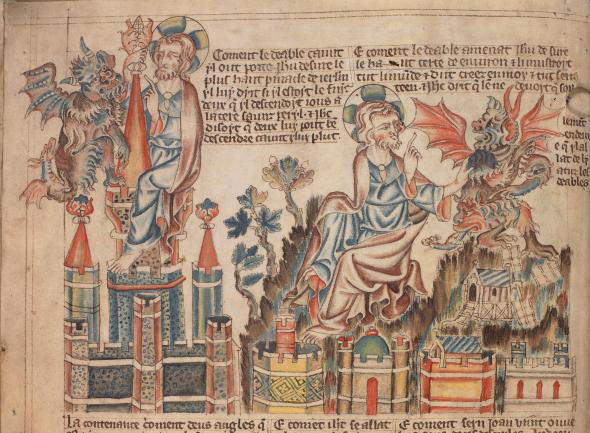
Illustration: Anonymous, German, Upper Rhine, 15th century, Saint Bernard Vanquishing the Devil

Fees and Registration

Conference fees
Unless otherwise stated conferences fees (which include coffee/tea, and a sandwich lunch) are as follows:

· One day conferences: £25 (£12.50 concessionary rate for full-time students/retired)

· Two day conferences: £40 (£25 for concessionary rate for full-time students/retired)

To check the details please visit the individual webpage for the conference you are interested in.

Conference catering: We provide a range of meat/fish and vegetarian rolls/sandwiches for lunch. If you have other dietary requirements please email warburg(at)sas.ac.uk at least ten days before the conference so that we can try to cater for your needs.
Registering and paying for a conference/course

Please note that in order to attend Institute conferences you need to register and pay online in advance (except where otherwise instructed for a limited number of free conferences). Our Lecture Room can only accommodate 90 people and our conferences are often fully booked in advance. If you come to a conference without booking and paying in advance you may be disappointed.

CLICK HERE TO REGISTER ONLINE
http://store.london.ac.uk/browse/department.asp?compid=1&modid=5&deptid=179
NB: online registration closes 24 HOURS BEFORE the start of each conference

If you are registering for a 2 day conference but only wish to attend for one day, please email warburg(at)sas.ac.ukto register. In your email please say which day of the conference you wish to attend and whether you are standard or concessionary rate (as explained above under Conference fees).

If you are unable to pay online, you can pay by cheque or cash in advance of the conference, but only if you are based in the UK. Attendees from outside the UK must pay online in advance.

· To pay by cheque: please send your cheque made out to The University of London with a note of your name, email, phone number, name of your institution if relevant, and the name of the conference you wish to attend to: Warburg Events, The Warburg Institute, Woburn Square, London WC1H 0AB.

· To pay in cash: please visit the Institute to pay on weekdays from 10.00 to 13.00, or 14.00 to 17.00.


Queries

If you have any queries about the registration process please email: warburg(at)sas.ac.uk or see the instructions below.

Tips about registering online:

·Tick the Select Course box(es) for the event(s) you wish to attend

· Click on Book Selected Courses and register if you are a first time visitor, or log in if you have registered before

· Once registered, click Add Attendee for the first event you wish to attend

· Click Use My Customer Details on right of page to automatically fill in your registration form

· Click Continue and select the relevant price depending on your status

· Repeat for another event if relevant, and then follow the instructions to complete your registration.

If you have any queries about the registration process please email: warburg(at)sas.ac.uk


Clothing Sacred Scripture (Zurich 9-11 Oct 14)

Zurich, October 9 – 11, 2014
Deadline: Feb 25, 2014

In a traditional perspective, book religions are seen as agents of
logocentrism, establishing a sharp dichotomy between scripture and
aesthetics, religion and art. This judgment was based primarily on
dogmatic assumptions and posterior idealizations, however. In the light
of their material, performative and artistic practice, religions of the
book show a surprisingly strong tendency to evolve their
own »aesthetics of inlibration«. Especially in pretypographic
cultures, »clothing« sacred texts with precious materials and ornate
forms was a powerful instrument for creating a close relation between
the divine words and their human audience.

The questions this conference aims to address grow from a comparative
and transcultural approach to religious book culture. Whereas
traditional research on book art has focused on single textual
communities within exclusive religious frameworks, we propose to look
beyond these boundaries. Our discussion of various strategies for
clothing sacred scripture shall include objects and practices from all
Abrahamic religions. Judaism, Christianity, and Islam developed
different approaches to the aesthetics of inlibration. By analyzing and
comparing these practices of religious book art, we aim to better
understand their cultural and historical specificity within a broader
spectrum.

To which extent the choice of materials, book formats, and artistic
patterns mark religious difference and shape religious identity is one
of several questions this conference will address. Yet »Clothing« the
book could also produce the contrary effect. Since it was based on
practices of circulation and exchange between different religious
cultures, it could also undermine claims of religious identity and
absolute truth.

Furthermore, addressing questions of materiality and mediality should
not obfuscate the conflicts and tensions that arise at times between
the visual and tactile dimension and the invisible and intangible
dimension of sacred books. In this respect, the activity of adorning
holy scripture appears to be located between two extremes that
characterize the concept of the book. On the one hand, the book is a
visible and tangible container of God’s animate speech, on the other,
the book is a threshold that leads to the invisible and immaterial
realm of God’s holy words.

This conference will explore both sides of the nexus between sacred
scripture and art. How did art shape the religious practice of books,
and how did the central importance of religious books shape the
evolution of artistic practices? The organizers welcome contributions
from a wide range of medievalist research, discussing topics such as:

– the spatial and temporal structure of books. How do books articulate
the process of opening, unfolding, and closing, and how does their
physical or visual structure contrast exterior with interior spaces,
beginnings with endings? How do these elements create different spheres
and times of revelation?

– the performativity of book rituals. Which kind of ritual activities
(in the broadest sense) involve sacred books? How does book art answer
to the dynamics of animating the letter by reading, singing,
displaying, carrying, illuminating and writing or burying books?

– materiality and its transformation. Which materials were chosen for
creating sacred books, which semantic values and transformative forces
were ascribed to them, and in which ways did these materials contribute
to mediate between human and divine spheres?

– ornament and its rejection. Analyzing the art of sacred books can
lead to a more nuanced understanding of ornamental practices. In some
contexts, traditional ornament is rejected in favor of scripture in its
purest form, thus generating a kind of anti-ornamental décor for the
book. So when was ornamentation considered merely a mundane practice?
And which arguments were put forward to propagate ornament as evocation
of divine beauty?

– iconicity and aniconicity of decorated books. Recent scholarship has
underlined analogies between the cult of books and the cult of images.
This approach has opened new avenues of thought for perceiving books as
objects and not just as texts. Some book religions tend to contrast
books with images, however, and treat books as alternative solutions
for worship. How is the clothing of books related to these contrasting
principles of iconicity and aniconicity?

Please send Please send proposals of up to 300 words for 30min papers
and a short CV to:
David Ganz (david.ganz@uzh.ch) and Barbara Schellewald
(Barbara.Schellewald@unibas.ch) by February 25 2014

Reference / Quellennachweis:
CFP: Clothing sacred scripture (Zurich 9-11 Oct 14). In: H-ArtHist, Feb
5, 2014. <http://arthist.net/archive/6927>.

Workshop and Symposium: Minorities in the Mediterranean (7 & 8 March, San Francisco)

The Mediterranean Seminar/University of California Multi-Campus Research Project and the departments of Comparative and World Literature, History, Jewish Studies, and the Spanish Program of the Department of Foreign Languages and Literatures at San Francisco State University invite participants to a two-day, two-part event on Medieval and Early Modern Minorities in the Mediterranean, to be held on 7 & 8 March 2014at San Francisco State University, San Francisco, CA. Participants from the broadest range of relevant disciplines are welcome and encouraged to register.

Mediterranean Minorities – Symposium
Friday, 7 March, 10am—5:30pm
Humanities Bldg, Rm 587
A one-day symposium consisting of three round table discussions:
1)  Opportunity
2)  Assimilation and Exchange
3) Vulnerability
featuring:
Fred Astren (Jewish Studies, San Francisco State)
Jeremy Brown (Hebrew and Judaic Studies, New York University)
Brian Catlos (Religious Studies, CU Boulder/ Humanities, University of California, Santa Cruz)
Tom Dandelet (History, University of California at Berkeley)
John Dagenais (Spanish and Portuguese, UCLA)
Federica Francesconi (Jewish Studies, University of Oregon)
Paolo Girardelli (History, Boğaziçi University)
Mike Hammer (Spanish, San Francisco State)
Joshua Holo (Hebrew Union College-Jewish Institute of Religion)
Slobodan Dan Paich (Artship Foundation, San Francisco CA)
Jonathan Ray (Jewish Studies, Georgetown University)
Jarbel Rodriguez (History, San Francisco State)
Stefan Stantchev (History, Arizona State University)
David Wacks (Romance Languages, University of Oregon)
Valerie Wilhite (Romance Languages, University of Oregon)
Megan Williams (History, San Francisco State)

Mediterranean Minorities – Workshop
Saturday, 8 March, 9:30am—5:15pm
Humanities Bldg, Rm 587
A workshop consisting of three pre-circulated papers and a talk by our featured scholar:
Papers:
• “Do Mediterranean Studies Speak to Latin American Colonial Studies? A Suspected German Lutheran Conquers A Suspected “Morisco”in the Canaries Before Taking On the New World”
Giovanna Montenegro (Comparative Literature, University of California, Davis);
• “Alexandria ad Aegyptum”
Dan Selden (Literature, University of Californi,a Santa Cruz)
• Being Different in the Medieval Middle East? The Poet’s Story”
Jocelyn Sharlet (Comparative Literature, University of California, Davis)

Featured scholar:
Stephen Humphreys (History, University of California Santa Barbara):
“Adapting to the Infidel: the Christian Communities of Syria in the Early Islamic Period”

Full program for conference and workshop available soon at http://mediterraneanseminar.ihr.ucsc.edu/overview/.

All interested graduate students and scholars are welcome. Both events are free but pre-registration is required; attendance is limited so please register soon. UC-and SFSU-affiliated scholars may register immediately, non-UC scholars on or after February 7. Lunch will be provided on both days for attendees who register prior to February 26.

To register for the workshop and/or conference and receive the workshop papers, please contact Courtney Mahaney (cmahaney@ucsc.edu) at the University of California, Santa Cruz. UC-affiliated faculty and graduate students will be eligible for up to $350 for travel expenses; non-UC participants may apply but support will granted as available (contingent on availability and attendance at both events).

The Mediterranean Seminar is an interdisciplinary scholarly forum, the aim of which is to promote collaborative research and the development of the field of Mediterranean Studies. The UC Mediterranean Studies Multi-Campus Research Project is funded by the UC Office of the President and is administered by the Institute for Humanities Research at the University of California, Santa Cruz.

Radio: BBC Radio 3 – The Essay, Islamic Architecture: The Islamic Golden Age

This major essay series continues as leading thinkers and practitioners share their knowledge and passion for the Golden Age of Islam. Dr. Sussan Babaie from the Courtauld Institute is an expert in Islamic architecture. She turns the spotlight on two significant monuments of the early medieval period in the Islamic world: the 10th century royal mausoleaum of the Samanid dynasty in Bukhara, present-day Uzbekistan and the 11th to 12th century developments in the great congregational mosque of Isfahan, in central Iran, built under the patronage of the Seljuq dynasty.

http://www.bbc.co.uk/programmes/b03t0dc0

Byzantine Studies Symposium, Knowing Bodies, Passionate Souls: Sense Perceptions in Byzantium

Smell 3“Knowing Bodies, Passionate Souls: Sense Perceptions in Byzantium”
Byzantine Studies Symposium | April 25-27, 2014
Symposiarchs: Susan Ashbrook Harvey, Brown University and Margaret Mullett, Dumbarton Oaks.
Byzantine culture was notably attuned to a cosmos of multiple domains:  material, immaterial; bodily, intellectual, physical, spiritual; human, divine. Despite a prevailing discourse to the contrary, the Byzantine world found its bridges between domains most often in sensory modes of awareness. These different domains were concretely perceptible; further, they were encountered daily amidst the mundane no less than the exalted. Icons, incense, music, sacred architecture, ritual activity; saints, imperial families, persons at prayer; hymnography, ascetical or mystical literature:  in all of its cultural expressions, the Byzantines excelled in highlighting the intersections between human and divine realms through sensory engagement (whether positive or negative).

Byzantinists have been slow to look at the operations of the senses in Byzantium, especially those of seeing, its relation to the other senses, and phenomenological approaches in general.  More recently work on smell and hearing has followed, and yet the areas of taste and touch—the most universal and the most necessary of the senses—are still largely uncharted. Nor has much been done to explore how Byzantines viewed the senses, or how they envisaged the sensory interactions with their world. A map of the connections between of sense-perceptions and other processes (of perception, memory, visualization) in the Byzantine brain has still to be sketched out. How did the Byzantines describe, narrate or represent the senses at work? It is hoped to further studies of the operations of individual senses in Byzantium in the context of all the senses, and their place in what the Byzantines thought about perception and cognition. Recent work on dreaming, on memory and on the emotions has made advances possible, and collaborative experiments between Byzantinists and neurological scientists open further approaches. The happy coincidence of a Dumbarton Oaks Garden and Landscape symposium on ‘Senses in the landscape: non-visual experiences’ and of a forthcoming exhibition at the Walters Art Museum on the five senses enable some cross-cultural comparisons to be made involving gardens in Islamic Spain, Hebrew hymnography, Syriac wine-poetry, Mediterranean ordure, and Romanesque and Gothic precious objects—that were not just looked at but also touched, smelled, heard. Architects, musicologists, art historians, archaeologists, philologists, all can contribute approaches to the revelation of the Byzantine sensorium.

Publication News: Commentari d’arte 52-53

2776925Commentari d’arte, rivista di critica e storia dell’arte

Anno XVIII, n. 52-53 – maggio-dicembre 2012
Contents:

Carlo Loiacovo, “Commentari d’Arte”: una rivista aperta ai giovani
p. 4

Articles: 
Giacomo Guazzini, Il coro delle monache di San Pier Maggiore a Pistoia: funzione e percezione di un inedito ciclo decorativo di primo Trecento
p. 5

Anna Sgarrella, Per un riesame del corpus di magister Andriolus tajapiera
p. 22

Silvia De Luca, La Madonna della Misericordia della Pieve di Canoscio: una possibile fonte figurativa per Piero della Francesca
p. 37

Giancarlo Gentilini, Ercole e il centauro ed altre Fatiche: una proposta per Giovanni Bandini scultore in argento
p. 50

Lorenzo Principi, La Madonna delle Grazie di Grottaferrata: una proposta per la gioventù di Giovanni di Biasuccio da Fontavignone
p. 60

Francesco Traversi, Un Crocifisso dei Sangallo a Santa Croce sull’Arno
p. 75

Miles Chappell, Postilla per una copia
p. 82

Alessandro Nesi, Sull’Elemosina del Beato Tommaso da Villanova della Propositura di Scarperia (Firenze): da Cavalori a Coccapani?
p. 86

Andrea Cambi, Torello Macchia (1864-1948): un architetto eclettico
p. 94

Adriano Marinazzo, Ipotesi su un disegno michelangiolesco del foglio XIII, 175 v, dell’Archivio Buonarroti
p. 108

Lanfranco Ravelli, Contributo per Nicola van Houbraken (Messina 1660 –
Livorno 1723)
p. 111

Caterina Zappia, Le Alpi frontiera della bohème
p. 113