Book roundup: New art history books from Brepols

Here are some new medieval art history books on manuscripts, architecture and sculpture from publisher Brepols that we have been alerted to, and we think will prove very exciting to a number of our readers.

HMSAH_75_3DKing’s College Chapel 1515-2015: Music, Art and Religion in Cambridge, edited by J. M. Massing, N. Zeeman

This lavishly illustrated, interdisciplinary volume encompasses many aspects of the Chapel’s history from its foundation to the present day. The essays all represent new research, with a particular emphasis on areas that have not been investigated before: Chapel furnishings and art; the architectural engineering of the building and current state of the glass; the history of the Choir and the life of the Chapel, not least in recent centuries. Essays will engage with politics, drama, music, iconoclasm and aesthetics. This will be a serious academic book, but also a visually stimulating and beautiful one. It will contain two hundred and fifty colour reproductions of images of the Chapel – prints, watercolours, oil paintings, photographs, architectural drawings, plans, maps and even postcards, reflecting the many and varied responses that the Chapel has elicited over time.

HMSAH_59 Jean Pucelle: Innovation and Collaboration in Manuscript Painting, edited by K. Pyun, A. Russakoff
This book focuses on the works and legacy of Jean Pucelle, a French 14th-century artist.
Jean Pucelle (fl. ca. 1319-d. 1334) was one of the most prominent artists of the first half of the fourteenth century, an influential illuminator who worked closely with a number of collaborators both known and anonymous. A large number of lavishly-illuminated manuscripts have been attributed to him based on stylistic analysis.

Scholarly essays in this book explore issues crucial to the establishment of his distinctinve style: originality, technique, color palette, influence, levels of resemblance, the relationships between artistic media, and patronage. The contributors to this volume analyze the major works associated with Pucelle or the Pucellian style, and interpret pictorial elements in the tradition of artistic collaboration. This is the first collective work devoted entirely to Jean Pucelle and his legacy.

With contributions by Barbara Drake Boehm, Pascale Charron, Marc Gil, Joan A. Holladay, Marguerite A. Keane, Mie Kuroiwa, Domenic Leo, Kyunghee Pyun, Anna D. Russakoff and Roger S. Wieck.

097728-RogierVanDerWeydenstofwikkel.inddRogier Van der Weyden and Stone Sculpture in Brussels by B. Fransen
The activities of Rogier van der Weyden (1399/1400-1464) were much wider in scope than the well-known painted oeuvre that has been the subject of so many publications. This book, with its focus on stone sculpture in Brussels at the time that Rogier was established there, an area of art history that to date has been little explored, offers a fresh and fascinating look at the context in which Brussels’s famous city painter operated. Bart Fransen leads you through a network of stoneworkers and craftsmen, from the stone quarry to the sculptor’s workshop, to discover a number of remarkable but unknown or misjudged sculptures now in churches, an abbey, a béguinage, a museum’s reserve collection and a castle chapel. With the various case studies in mind he goes on to examine Rogier van der Weyden’s direct involvement in sculptural projects, turning to the evidence revealed by archival documents, drawings and sculpture itself. The result is a highly readable and plentifully illustrated book that re-establishes the close relationship between the various art forms that existed in the fifteenth century.

MEF_07The Making of Hispano-Flemish Style: Art, Commerce, and Politics in Fifteenth-Century Castile by R. Kasl
This book examines the phenomenon of “Hispano-Flemish” style in fifteenth-century Castile, providing an account of its most important monuments and describing the ways in which it is embedded in specific social and cultural settings. Trade, diplomacy, and immigration account for the widespread presence of art and artists from northern Europe in Castile during the period and these mechanisms of international contact and exchange are the starting point for this inquiry. Chapter one details commercial relations between Castile and the art-producing centers of northern Europe, stressing the dominant role of merchants from Burgos and documenting the prevalence of imported luxuries like tapestries, paintings, and sculpture. The presence of imported artworks in Castile was paralleled by a similarly robust number of immigrant artists, some itinerant and others attached to permanent workshops. Their influence is discussed in chapter two, with emphasis on the establishment of multi-generational family workshops under the direction of immigrant masters. Such workshops rooted foreign styles on Castilian soil and decisively influenced the ways in which visual conventions were learned, transformed, and transferred. The receptivity of patrons to the visual qualities of the imported style is analyzed in relation to its capacity to assert emerging social, political, and spiritual values.

The adoption of northern forms in Castile, first detected in the sculptural decoration of funerary chapels of the mid-1430s, was sustained for the rest of the century, culminating in the completion of the monastery of Miraflores under the patronage of Isabel of Castile. Chapter three outlines the religious, commemorative, and political motives that informed the foundation of the monastery by Juan II and those that animated his daughter’s efforts to complete it. It establishes the chronology of works in relation to historical events and details the intervention of Juan and Simón de Colonia, Gil de Siloe, Juan de Flandes, and others. The reelaboration of Siloe’s northern European sculptural idiom at Miraflores was a distinctive process, stimulated by the demands of his royal patron, conditioned by the practices of a heterogeneous workshop, and obliged to visualize a new concept of royal sovereignty.

Follow Brepols on Facebook and Twitter

Exhibition: Communities in Communication: Languages and Cultures in the Low Countries 1450-1530 (John Rylands Library)

P1930063The John Rylands Library is an extraordinary neo-Gothic building to which no tourist visit to Manchester is complete without. The architectural experience is supplemented by many fine exhibitions making use of its special collections, although due to their small, studious nature, they can often be overlooked. Communities in Communication is one such exhibition taking place in its cloistral vaulted corridors. Drawing on the Rylands’ large collection of books from the late medieval Netherlands, this small show forms part of a larger AHRC-funded project to understand the interplay of literary cultures in the late medieval Low Countries.

P1930065Guided by the excellent little exhibition booklet, the cases are grouped by themes that elucidate how the objects represent a window into the intellectual and linguistic cultures of their age. Trilingual phrase books show that individuals from urban burghers to the nobility were keen to improve their vocabularies. The new technology of printing had begun make written culture more accessible to a world burgeoning with literacy and an appetite for the word, and the majority of books here are printed rather than manuscripts written by hand. The books are beautifully displayed in shallow cases that allow you to appreciate the clarity of the printed text by actually reading the words, appreciating them as works of art and craft in themselves rather than simply vehicles for illumination. Perhaps the most significant object on show here is William Caxton’s Recuyell of the historyes of Troye, the first book printed in English.

P1930097I was fortunate enough to visit the exhibition on the occasion of a study day led by the exhibition curator, Adrian Armstrong. Our group was assigned a wonderful copy of Caxton’s English translation of the Golden Legend. First we studied the book as a physical object: assessing how the paper had been folded into bifolios and bound into quires. A copy that appears mint at first belies a fascinating object history: on close inspection showed how pages had been bookmarked by a neat reader. After a short break we looked at the book in a different way: how we might consider transcribing the text for a modern critical edition. Does one insert modern punctuation and expand contractions, or go the whole way and modernise the often archaic spelling? These are no doubt issues Caxton himself faced when sitting down with English, Latin and French versions of the Legenda Aurea back in Westminster in the 1480s.

The prologue from Caxton''s Golden Legend: the largest woodcut he ever produced
The prologue from Caxton”s Golden Legend: the largest woodcut he ever produced

These dual themes of material codicology and the linguistics of the text helped illuminate the texts on display outside, be it historical writing, poetry or phrasebooks. All these texts are material artefacts that can make manifest the essentially ephemeral speech of daily life in the late medieval Northern Europe: be it in diplomacy, trade, or leisure. This is certainly an exhibition to see if you are interested in the future aims of the project to unravel the interplay of literary cultures in this dynamic environment: both the autumn of the Middle Ages and the springtime of the Northern Renaissance.

Communities in the Communication: Languages and Cultures in the Late Medieval Low Countries is on at the John Rylands Library, Deansgate, Manchester until 21 December 2014. Admission is free.

Call for Journal Submissions: Hortulus (Spring Issue 2015)

Call for Journal Submissions
Hortulus: The Online Graduate Journal of Medieval Studies (Spring Issue 2015)
Deadline: 13 February 2015


Hortulus: The Online Graduate Journal of Medieval Studies 
is a refereed, peer-reviewed, and born-digital journal devoted to the culture, literature, history, and society of the medieval past. Published semi-annually, the journal collects exceptional examples of work by graduate students on a number of themes, disciplines, subjects, and periods of medieval studies. We also welcome book reviews of monographs published or re-released in the past five years that are of interest to medievalists. For the spring issue we are highly interested in reviews of books which fall under the current special topic.
hortulus

Our upcoming issue will be published in the spring of 2015, and is an open issue with no theme. We particularly encourage the submission of proposals that take a strongly theoretical and/or interdisciplinary approach, and that examine new and previously unconsidered aspects of these subjects within medieval studies. Articles may be from any discipline: history, art history, archaeology, literature, linguistics, music, theology, etc. Work from every interpretive angle is encouraged. Most importantly, we seek engaging, original work that contributes to our collective understanding of the medieval era.

Contributions should be in English and roughly 6,000 – 12,000 words, including all documentation and citational apparatus; book reviews are typically between 500-1,000 words but cannot exceed 2,000. All notes must be endnotes, and a bibliography must be included; submission guidelines can be found here. Contributions may be submitted to hortulus@hortulus-journal.com and are due February 13, 2015. If you are interested in submitting a paper but feel you would need additional time, please send a query email and details about an expected time-scale for your submission. Queries about submissions or the journal more generally can also be sent to this address.

Source: http://hortulus-journal.com/2014/11/02/call-for-papers-spring-2015-open-issue/

Conference: In centro et oculis urbis nostrae. La chiesa e il monastero di San Zaccaria (Venice, 27-29 November 2014)

Conference:
In centro et oculis urbis nostrae. La chiesa e il monastero di San  Zaccaria
Venice, 27 – 29 November 2014

Curated by  Bernard Aikema, Massimo Mancini, Paola Modesti

Venice_San_ZaccariaThe Studium Generale Marcianum is proud to present the symposium dedicated to the Church and Monastery of San Zaccaria in Venice. This is the fourth of a series of conferences related to the project “Chiese di Venezia. Nuove prospettive di ricerca” (The Churches of Venice. New Research Perspectives) aimed at studying some selected Venetian churches. During these conferences, groups of scholars participate to discussions and activities related to the churches and their history, exchanging comparative researches on different fields. The results of each symposium enhance new direction of research and are yearly published in a new series of volumes edited by Marcianum Press. The Benedictine Monastery of San Zaccaria, founded by the Doge of Venice before the church of St. Mark and close to the political and religious centre of the city, was one of the wealthiest Venetian ecclesiastical institutions. The art and architecture of the two fifteenth century paired churches, many aspects of the history of the monastery and the life and artistic patronage of the nuns have been the subject of several researches in the past. The goal of this conference is to integrate and update those contents with new contributions, to address some specific questions which have not been sufficiently investigated yet and to critically analise the events, issues and critical works from a comparative point of view. The focus of this study will be the life of the monastery during the period between the ninth and the sixteenth century: its wide and central urban “territory”; the construction phases of the ancient church; the architecture of the “new” church and monastery; the magnificent wooden choir of the nuns; the rituals, traditions and transformations of the two churches occurred between the fifteenth and seventeenth century and the seventeenth and eighteenth century decoration of the church with some paintings representing  the splendor of the monastery.

The last session of the conference will be held in the church of San Zaccaria and in the former monastery (now headquarter of the Comando Provinciale dei Carabinieri) which will be open to the public for this special occasion.

Thanks to the presence and contribute of a group of respondent-guests, some key issues and problems regarding the art and architecture will be taken up and discussed in situ. The officer of the Sovrintendenza, together with some restorers, will illustrate the conservation interventions carried out recently or still going on. For a wider audience than that of the “insiders” a side event will be organized: the concert of the Reverendissime Gentildonne, during which music and readings will alternate in the church of San Moise.

The church and the monastery of San Zaccaria will be open to the public thanks to the contribution of the students of the degree course in Cultural Heritage of the Istituto Superiore di Scienze Religiose San Lorenzo Giustiniani, who will do some guided tours for the participants.

For the full conference programme, see:
http://www.marcianum.it/studi-ricerche/chiese-venezia/chiesa-e-monastero-san-zaccaria

Info:
http://www.marcianum.it
chiesedivenezia@marcianum.it

Call for Book Manuscripts: Maps, Spaces, Cultures (Brill)

Call for Book Manuscripts:
Maps, Spaces, Cultures (Brill)

Edited by Surekha Davies (Western Connecticut State University) and Asa Simon Mittman (California 
State University, Chico).

Editorial board: Michiel van Groesen (University of Amsterdam), Ricardo Padrón (University of Virginia), Ayesha Ramachandran (Yale University) and Dan Terkla (Illinois Wesleyan University).

This innovative series seeks monographs and essay collections that investigate how notions of space, 
geography, and mapping shaped medieval and early modern cultures. While the history of cartography has traditionally focused on internal developments in European mapping conventions and technologies,  pre-modern scribes, illuminators, and printers of maps tended to work in multiple genres. Spatial thinking informed and was informed by multiple epistemologies and perceptions of the order of nature. 

Hereford_Mappa_Mundi_1300Maps, Spaces, Cultures  therefore integrates the study of cartography and geography within cultural history. It  puts genres that reflected and constituted spatial thinking into dialogue with the cultures that produced and consumed them, as well as with those they represented. The editors welcome submissions from scholars of the histories of art, material culture, colonialism, exploration, ethnography (including that of peoples described as monsters), encounters, literature,  philosophy, religion, science and knowledge, as well as of the history of cartography and related disciplines. They encourage interdisciplinary submissions that cross traditional historical, geographical, or methodological boundaries, that include works from outside Western Europe and outside the Christian tradition, and that develop new analytical approaches to pre-modern spatial thinking, cartography, and the geographical imagination.

Authors are cordially invited to write to either of the series editors, Surekha Davies (surekha.davies@gmail.com) and Asa Simon Mittman (asmittman@mail.csuchico.edu), or to the  publisher at Brill, Arjan van Dijk (dijk@brill.com), to discuss the submission of proposals and/or full manuscripts.

For Brill’s peer review process see here: http://www.brill.com/author-gateway/publishing-books-brill/propose-your-publication

For Brill’s Open Access options click here: http://www.brill.com/brill-open-0 

CFP: Imaging the Public Square (Florence, 22-24 October 2015), deadline 15 January 2015

Imaging the Public Square. International conference within the framework of the „Piazza and Monumento“ project at the Kunsthistorisches Institut in Florenz – Max-Planck-Institut (Florence, 22 – 24 October 2015)

Recent broadcasts of scenes playing out in Egypt, Turkey and Ukraine have reinforced our awareness of the significance of the public square as a venue of action and assembly. As a consequence of protest movements, but also independently of them, images circulated in various media have participated in the construction of a visual culture of the public square. Each of these images should be historicised and analysed according to its own logic. The conference, organized by the collaborators of the “Piazza e Monumento” project at the Kunsthistorisches Institut in Florenz – Max Planck Institut, will take the image and imagination of the square as a point of departure for a discussion, ideally through comparative analysis, of the following themes:

I THE PUBLIC SQUARE IN ARCHITECTURAL DRAWINGS AND THE PLANNING PROCESS:
The square is often the result of a pictorial concept in the architectural planning process, whether it results in entirely new venues or the partial alteration of older ones. Carl Linfert has provided a methodological model for this kind of research in his investigation of tactile responses to the architectural drawing. Regarding the depiction of the public square in architectural designs, the question likewise arises: how do approaches to representation shape the image of the square, and how do they relate to structural, formal-aesthetic, legal, and urban-spatial conditions and possibilities? The built city and the designed city are mutually dependent entities. The degree to which architectural designs are capable of intervening in the existing structure of a city is thus worthy of consideration. In other words, to what extent do such plans and drawings develop a dynamic of their own, above and beyond the function assigned them, leading in the long term to changes in the existing built environment?

II ARTISTIC REPRESENTATIONS OF THE CITY SQUARE: The square is often the main feature of a picture, situated in a larger spatial context, and it can be regarded as an embodiment of the city – regardless of whether we are looking at prints of the Early Modern era of the Meidan in Isfahan, built by Shah Abbas I, Menzel’s painting of the Piazza della Erbe in Verona, or photos of Tahir Square in Egypt in the 1950s. Since images of squares vary historically and culturally, but also respond to one another and are subject to processes of change, images of piazzas should also be analysed as pictorial solutions. What perspectives on the public square, and thus on the city and the territory, are developed pictorially? What artistic media are employed in the process, and who are the makers and recipients of these pictures?

III SCHOLARLY RESEARCH ON THE SQUARE AND THE CITY: Images of squares find their way into many publications, whether as illustrations, elements in a visual argument, or the focal points of research itself. From Renaissance architectural theory and pre-modern engravings to modern architectural and urban anthologies, images of squares are important players on theoretical and methodological levels. What is the significance of these images in architectural and urban studies – including from a history of science perspective – and what social, political and cultural conceptions of society are linked to them?

IV THE MEDIATISATION OF THE SQUARE: The public square is the subject of popular media in various forms, ranging from film, literature and comics to (often anonymous) newspaper, television, and cell phone images. To discuss the square’s mediatisation is thus also to consider the rapid blending of media reality with social and political reality, and to take the pictorial history of the square into account. How much do pictures tell us about the square when protestors climb onto monuments with fluttering flags, as in Kiev? Does this form part of the visual history of liberty, whose canon includes works such as Delacroix’s ‘Liberty Leading the People’, and which can be examined against the background of studies such as Jutta Held’s ‘Monument und Volk’? What impact does the mediatisation of the square have on the ephemerality of certain elements (platforms, public artworks, protest signs, etc.) that temporarily re-design and semanticise the square? And what is the relationship between the visual focus on the square and the construction and transformation of squares? In other words, what effect do experiences of the square from near and far have on not only its perception, but also on its material-physical constitution?

The conference is intended for art historians as well as representatives of neighbouring disciplines. It welcomes case studies and synthetic reflections on the above-suggested themes, which can be treated individually or together, as well as on other topics. Papers should not exceed 25 minutes. Please send your proposal (max. 300 words) and a short CV in German, English or Italian to Dr Brigitte Sölch (soelch@khi.fi.it) and Dr Stephanie Hanke (hanke@khi.fi.it) by 15 January 2015.

CFP: Monastic Europe, Landscape and Settlement (Ennis, 22-25 August 2015)

Call for Papers:
Monastic Europe: Landscape and Settlement. International Conference
Ennis, Co. Clare, Ireland, 22-25 August 2015 
Deadline: 28 November 2014

The Irish Research Council-funded Monastic Ireland: Landscape and Settlement project is a research partnership between the Department of the History of Art and Architecture, Trinity College Dublin, the Discovery Programme and the Department of History, University College Cork. The project is examining the unusually well preserved remains of late medieval monastic buildings in Ireland within their broader European context, with a particular emphasis on their architecture and impact on the landscape around them.
Kilconnell

The project team is pleased to announce an international conference, to be held 22-25 August in Ennis, Co. Clare, Ireland. Located in an area rich with the medieval buildings of the European monastic orders, the conference will balance sessions of papers with a number of site visits, and will stimulate a focused academic debate on the impact of monasticism in shaping the development of the physical environment across Europe between c. 1100 and c. 1700. Conference themes will include:

– The topography of medieval monastic settlement (1100-1700) in both urban and rural environments
– The impact of Church reforms on the physical structures and landscapes of monastic foundations
– Monastic space (liturgical, social, and architectural aspects)
– Patronage networks
– Architecture and identities
– Written sources for understanding the monastic environment

We welcome proposals for 20-minute papers exploring this theme across the stated time span, throughout Europe. Papers may deal with either case studies or broader methodological questions, and are not limited to delivery in the English language.

Proposals for posters are also welcomed from doctoral students and early career scholars, and the conference organisers hope to have small subsidies available for accommodation costs>

Please send an email containing both your proposed title and an abstract of no more than 300 words to Dr Rachel Moss at rmoss@tcd.ie. If you intend for apply for a conference subsidy please indicate this on your proposal. Deadline for proposals is Friday, 28 November, 2104.

Workshop: The Iconicity of Script in Manuscripts from  Asia, Africa, America and Europe (Hamburg, 31 October – 1 November 2014)

Workshop: 
The Iconicity of Script in Manuscripts from  Asia, Africa, America and Europe
Centre for the Study of Manuscript Cultures, Hamburg
31 October -1 November 2014

carminaOutline
Scripts and writing systems are more than neutral transmitters of the words that are encoded by them. When words that were previously spoken and transmitted orally are written down, they gain a new, visual and material dimension. The iconic component with which the script can be endowed in this process has a hermeneutic, as well as an aesthetic, potential. Recognising and decoding it is as much part of the process of reading as is the deciphering of the written text. In manuscript cultures all over the world, script is adorned with or transformed by ornamental and figurative elements. The aim of this workshop is to explore how the visual and iconic potential of script has been used in manuscript cultures in Asia, Africa, America, and Europe. Its approach is a comparative one, exploring similarities as well as differences and the possible reasons behind them.

Relevant phenomena include:

The semantic potential of particular styles of scripts and of writing systems.
In many manuscript cultures, scribes and illuminators have a range of different writing styles, and sometimes even different writing systems, at their disposal. These can be used, separately or in combination, for various different purposes. As complex visual patterns, they can encourage or control the way in which a text is read and interpreted. Often, sacred or revered texts are written in a particularly elaborate script, hereby both emphasizing and affirming their outstanding dignity and authority. In other cases, calligraphy can be part of an artistic, philosophical or political statement. On a more (but by no means exclusively) pragmatic level, different scripts can be used to indicate hierarchical relationships between different texts (e.g. a treatise and its commentary) or the structure of a text (e.g. by highlighting chapter breaks) within a manuscript. In some cases, which would be of particular interest to our workshop, calligraphic shapes, techniques and practices are subject to intercultural transfers, by means of quotation, adaptation or assimilation.

Script constituting figures and images
Calligrams, carmina figurate, text ‘labyrinths’ and other instances in which script is arranged in figural shapes, or in which such figures are revealed to the reader in the process of reading a text, are found in many manuscript cultures, and in many different variations. Some of these variations may be due to different writing systems that are current in different manuscript cultures; others, to varying notions of the status of script, of writing and reading within a culture. In some, e.g. Islamic and Jewish cultures that restrict the use of images, script can perform some functions that pictures do in others, perhaps taking on some of the aesthetic and even figurative characteristics that are elsewhere attributed mainly to images.

Figures and bodies constituting script
While figurative forms can be constituted by script, script in turn can also be formed by figurative elements. For instance, so-called anthropomorphic and zoomorphic initials in European manuscripts consist of the painted or drawn bodies of humans and animals, and in Arabic calligraphy, script can bloom and sprout leaves. In other cases, script in a manuscript can be written or painted in a way that conjures up a specific material, such as textile or stone.

Diagrams and schemata consisting of or incorporating script
A different kind of iconicity lies at the heart of diagrams and schemata. Here, too, the written and the figural form an inextricable whole. Their overall visual structure, however, serves first and foremost as a matrix which represents not things or concepts themselves, but relationships of concepts and/or things to one another, making diagrams and schemata unique instruments for transmitting and even generating knowledge.

Organizers
Hanna Wimmer, Rostislav Tumanov and Lena Sommer

For the full workshop programme, and to register, see here:
http://www.manuscript-cultures.uni-hamburg.de/register_iconicity.html

CFP: Object Emotions, Revisited (Yale, 20-21 February 2015), deadline 15 November 2014

Keynote speaker: Spyros Papapetros (Princeton U)

Organizing Committee: Padma Maitland (UC Berkeley); Christopher P. Miller (UC Berkeley); Marta Figlerowicz (Yale U); Ksenia Sidorenko (Yale U); Emma Natalya Stein (Yale U)

“Object Emotions” continues a critical dialogue about new directions in humanities research and theory that began at UC Berkeley in 2013. This conference is inspired by the recent heightened attention to objects and emotions as new points of entry into history, literature, art, architecture, area studies, and the social sciences. We aim to foster interdisciplinary reflections about the critical uses of thing theory, affect theory, the histories of emotions, and new materialism. We also want to study how these discourses might benefit from being set in conversation with each other.

Last year, these questions inspired papers on, among many other topics, forms of animism in fourteenth-century England, the role of tiles in Taiwanese architecture, representations of churches in Willa Cather, oral accounts of labor in factories in India, and the songs of Kylie Minogue. This coming conference seeks to be similarly diverse and experimental in the kinds of approaches it brings together. By exploring emotions and objects in conjunction with each other we hope to bring out the shared stakes of these scopes of critical inquiry, as well as the divergences among the ways feelings and things are studied in particular disciplines.

Questions we want to ask include, but are not limited to, the following: How is the task of describing emotions within the context of a poem different from describing them within the context of a painting or a temple? How do the current fields of affect theory, thing theory, and the history of emotions participate in the much longer history of debates about the subjective and the objective? How do emotions and the bodies experiencing them relate to each other? Are there cultural differences in the way objects and emotions are defined and assessed? What does it mean to attribute feelings to an inanimate object, or even to describe this object as the cause or inspiration of a feeling? Do feelings have an animating force? How does the critical framing of scale—the microscopic, the individual, the human, the social, the global—change the way we pursue questions about objects and emotions?

The conference will take place at Yale on February 20th and 21st, 2015. Participants will include both graduate students and faculty members. We welcome papers that address any of the questions described above, or related ones, with reference to the bodies of theory shared across disciplines or to individual works of literature, art, or architecture. Please submit 250-word abstracts to Padma Maitland at padmamaitland@berkeley.edu by November 15, 2014.

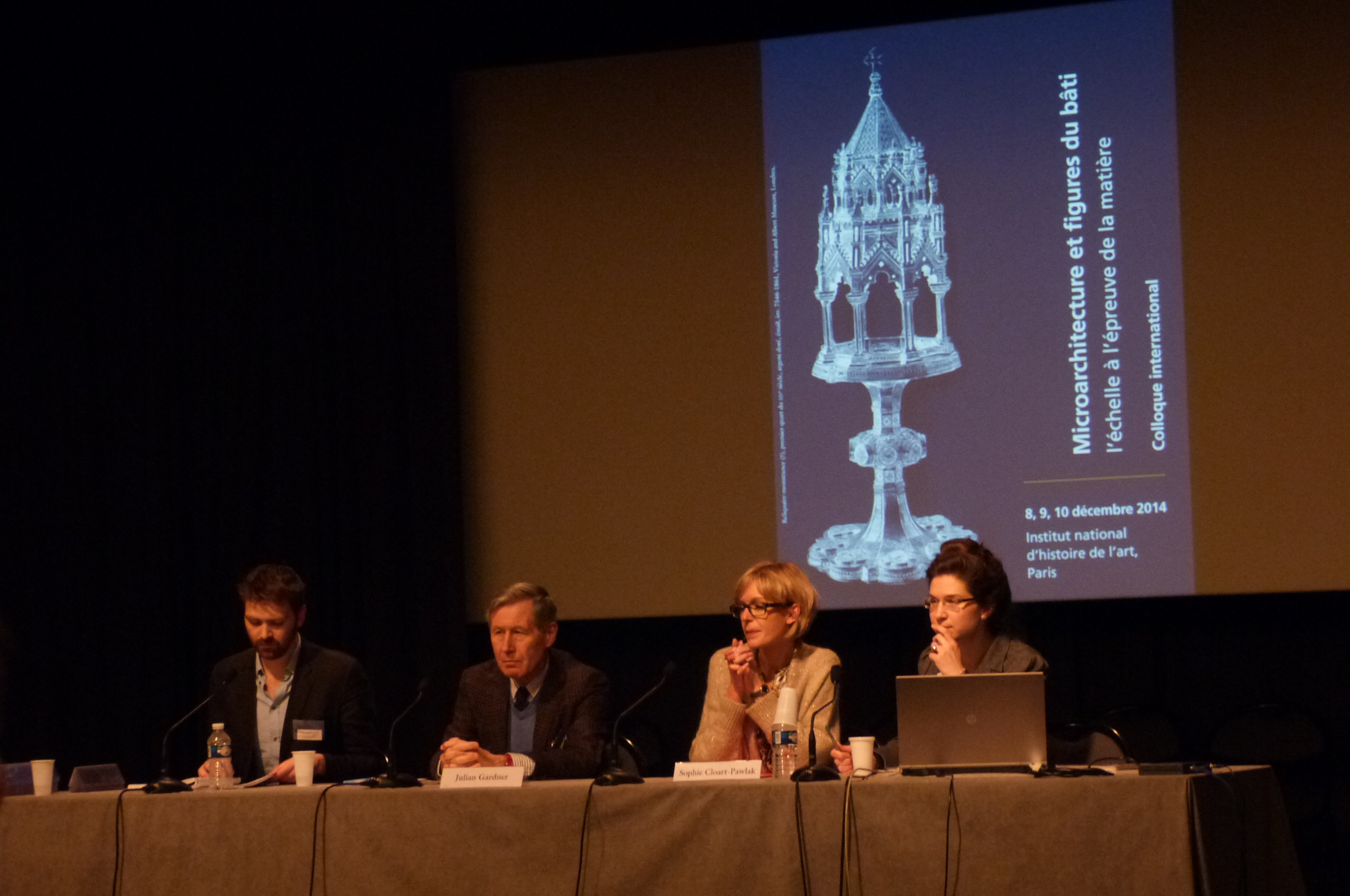
Conference: Microarchitecture and Miniaturized Representation of Buildings (INHA, Paris 8-10 Dec 2014)

The font enclosure c.1330 in Luton (Bedfordshire)

Micro-architecture et figures du bâti au Moyen-Âge : l’échelle à l’épreuve de la matière

Institute national d’historie de l’art

8 – 10 December 2014
Auditorium de la Galerie Colbert
6 rue des Petits-Champs ou 2, rue Vivienne
75002 Paris
Free entry

This conference organized by the National Institute of Art History, University of Nantes and the National Archives has the ambition to address issues related to the miniature representation of the built environment in a different perspective from that which has gone before. The phenomenon of “architecturation in which the proliferation of architectural vocabulary in all forms of art continues to intrigue historians of the Middle Ages. But this can only be truly understood if one takes into account the changes that scaling affects the work of artisans, and the reception of their works.

Programme:

Lundi 8 décembre
13h30     Accueil


14h00 – 15h30

Échelle

Présidence: Paul Binski

Julian Gardner (University of Warwick), Who were the microarchitects?          


Javier Ibàñez Fernandez (Universidad de Zaragozza) et Arturo Zaragozá Catalán (Universidad de Valencia), Entre imaginación y realidad. Microarchitecturas y architecturas en el mundo Ibérico entre los siglos XV y XVI

15h00-15h30          discussion


15h30 – 17h00

James Alexander Cameron (The Courtauld Institute of Art, London), Sedilia in English churches: micro-architectural innovation in function and form


Sabine Berger (Paris-Sorbonne), Edifices minia-turisés et figures de bienfaiteurs à la période médiévale: iconologie de la maquette d’architecture


19h00

au Musée de Moyen Age-Termes de Cluny,

conférence plénière de Paul Binski (sur réservation: microarchitecture@inha.fr)

Mardi 9 décembre


8h30     Accueil


9h00 – 10h30

Modèle(s)

Présidence: Isabelle Marchesin

Giovanni Santucci (Università di Pisa), Archi-tectural paper models in Early Modern Italy


Peter Kurmann (ETH, Zurich), Les modèles miniaturisés et leur rôle de transfert d’idées au XIIIe siècle.

10h-10h30       discussion et café


10h30 – 12h30

Circulations et transferts

Présidence: Julian Gardner

Felipe Serrano Estrella (Universidad de Jaén), Circulation of Classicist Models between Spain and Italy through the “Eucharistic Microarchitecture”


Farah Makki (EHESS, Paris), Figures scripturales de la microarchitecture au palais de l’Alhambra (XIVe siècle): préceptes d’une architecture relationnelle en Islam médiéval

12h-12h30       discussion


12h30-14h00     Déjeuner


14h00-15h30

Orfèvrerie et mobilier

Présidence: Élisabeth Taburet-Delahaye

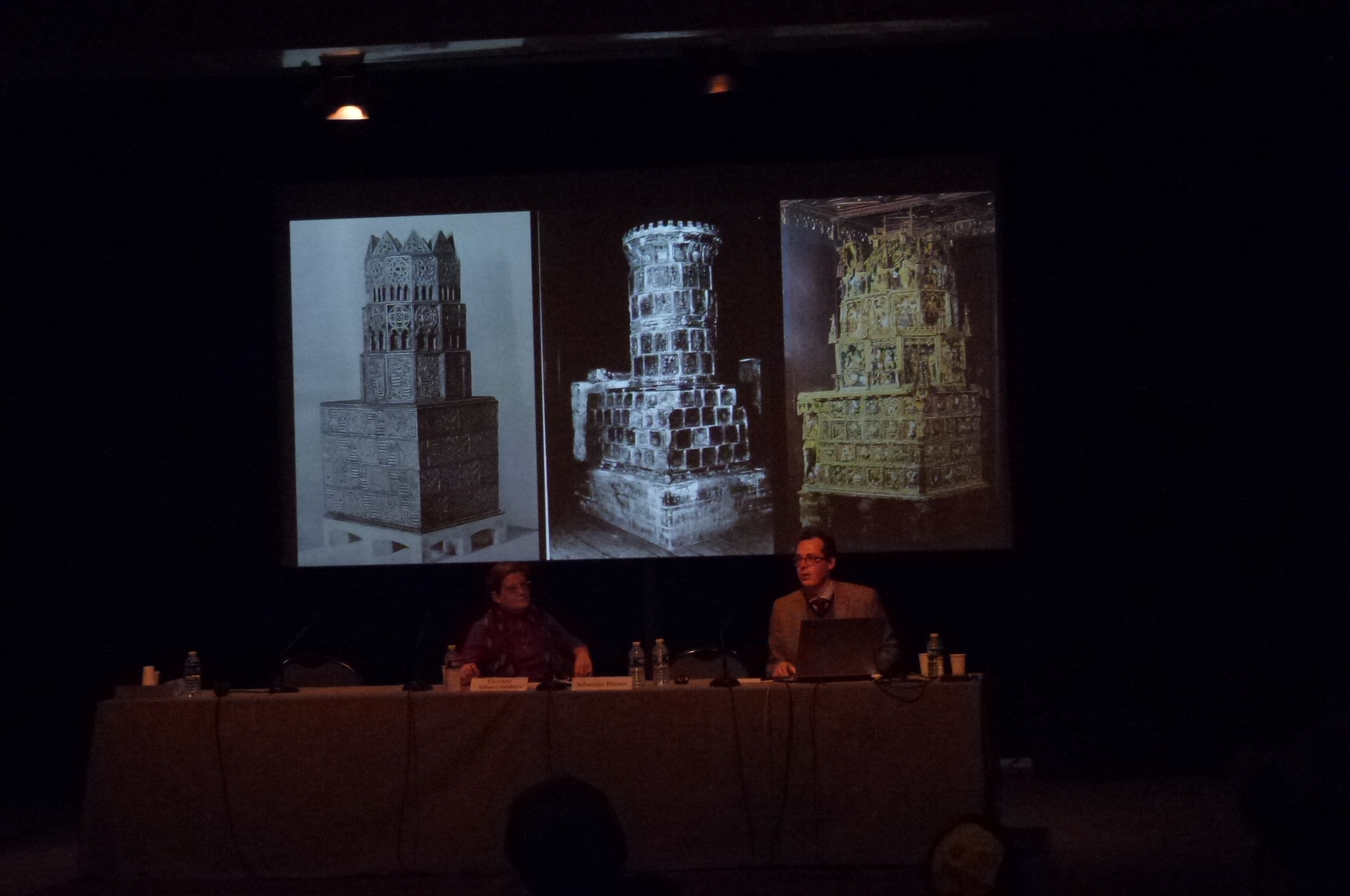
Sebastian Fitzner (Ludwig-Maximilians-Uni-versität München), Tile stoves as buildings and symbolic forms. Remarks on a largerly unexplorated field of microarchitectures in late medieval times


Anita Paolicchi (Università di Pisa), Examples of miniaturized architecture: the chivots at the time of Constantin Brâncoveanu


15h00-15h30          discussion

15h30 – 18h Dany Sandron (Paris-Sorbonne), La châsse de Saint-Marcel et l’architecture de Notre-Dame de Paris: renvoi et emprunts    


Frédéric Tixier (Université de Lorraine), Dextérité de l’orfèvre, symbolisme de la forme: remarques sur quelques crosses “architecturées” médiévales (XIIIe-XVIe siècle)


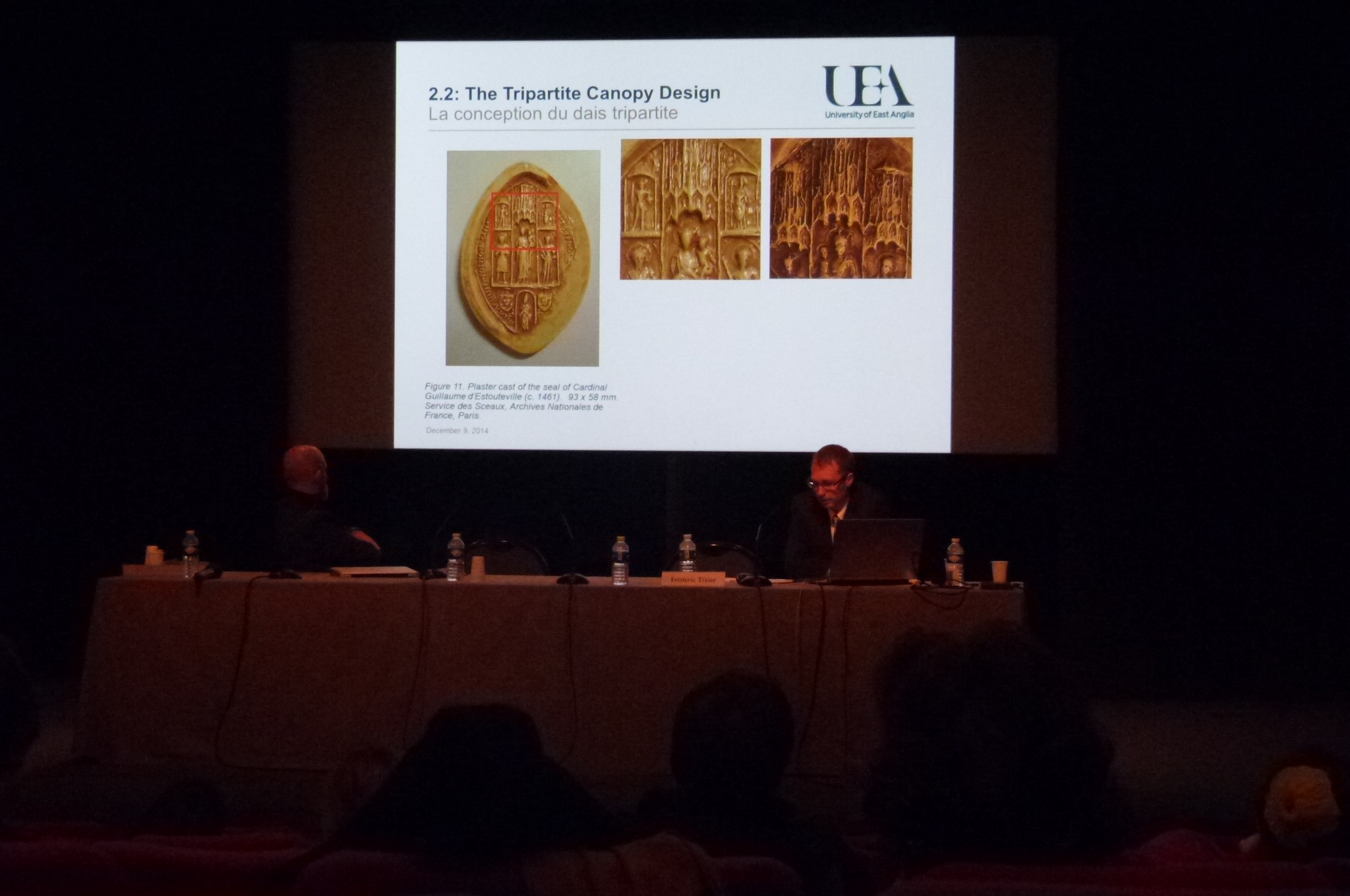
Matthew James Sillence (University of East Anglia, Norwich), Compositions and Associations of Architectural Frameworks on Cardinals’ Seals 1378-1533

17h30-18h00          discussion générale


Mercredi 10 décembre


9h00 – 10h30

Renovatio

Présidence: Peter Kurmann

Anne-Orange Poilpré (Paris I, Panthéon-Sor-bonne), Bâtir et figurer la royauté chrétienne au IXe siècle: les trône architecturés des manuscrits de Charles le Chauve


Matt Ethan Kavaler (University of Toronto), Microarchitecture as the Paradigme of Antique Architecture in the Low Countries: 1515-1540

10h-10h30       discussion et café


10h30 – 12h30

Symbole(s)

Présidence: Roland Recht

Achim Timmermann (University of Michigan, Ann Arbor), City, Cathedral, scopic labyrinth: scalar travels in medieval microarchitecture


Renzo Chiovelli (Università La Sapienza, Roma), Pifferi Sandra (Architecte), Materials, space and time in the microarchitecture of the Holy Sepulchre

12h-12h30       discussion

12h30-14h00     Déjeuner


14h00-17h00

Devotion(s)

Présidence: Danielle Gaborit-Chopin

Sophie Cloart-Pawlak (IRHiS, Lille), Identifica-tion, hiérarchisation et sacralisation des espaces au seuil de l’église. Remarques sur le rôle des décors d’architecture à travers l’exemple de l’ornementation des portails gothique


Alexander Collins (University of Edinburgh), Miniaturising Mary: The Microarchitecture of Embodiment in the Sherborne Missal (British Library, MS. Add. 74236)


Sarah Guérin (University of Montréal), Micro-architecture and memory: a place of devotion

16h30-17h00          discussion générale et conclusions

Official site: http://www.inha.fr/fr/agenda/parcourir-par-annee/en-2014/decembre-2014/micro-architecture-et-figures-du-bati-au-moyen-age.html