 Lire les objets médiévaux
Ce livre prend le « parti-pris des choses », à la confluence de l’histoire, l’histoire de l’art, |’archéologie, l’anthropologie et la philosophie en interrogeant les spécificités de l’objet au Moyen Âge en littérature. Pas encore doté d’une autonomie matérielle propre, l’objet médiéval, carrefour herméneutique, fonctionne comme signe d’une grande plasticité, apte à référer à autre chose qu’à lui-même, à assurer un rôle médiateur et une fonction identitaire ou transactionnelle. Il nécessite donc de prendre en considération son rapport avec le sujet.
Informations pratiques :
Fabienne Pomel (dir.), Lire les objets médiévaux. Quand les choses font signe et sens, Rennes, Presses universitaires de Rennes, 2017 (Interférences). Format : 15,5 x 21 cm. Nombre de pages : 320 p. Illustrations : N & B. ISBN : 978-2-7535-5309-5. Prix : 22,00 €.
 The Century of the Flemish Primitives : Late Medieval Art in the Royal Museum of Fine Arts in Antwerp
Author: Vandenbroeck, Paul
Price: $42.50
ISBN: 9789085867272
Record created on 03/04/2016
Description: Schoten: BAI, 2016. 23cm., hardcover, 144pp. illus. English translation of 2014 edition.
Summary: At 152 paintings, the collection of ‘Flemish Primitives’ held by the Royal Museum of Fine Arts Antwerp is the largest in Flanders. This publication gives an overview from ‘pre-Eyckian’ painting to some of the highpoints of late medieval art from beyond the Low Countries. Works discussed include altarpieces, secular art, pieces by women religious, Flemish artists elsewhere in Europe, as well as sculpture. Besides the religious views that framed thought, the art of painting is contextualized in a wider perspective on art itself.
 MARIA CRISTINA IMPROTA. Il restauro dei portali di San Petronio a Bologna. Studi e approfondimenti, Edifir, 2016, 232 p.
ISBN: 978-8879707442
El presente volumen está dedicado a la presentación del complejo proyecto de conservación y restauración -a nivel de diagnóstico en una fase preliminar- para la caracterización de los materiales constituyentes y para el estudio del estado de conservación de estos materiales en la fachada de la basílica de San Petronio en Bolonia, llevado a cabo por el Opificio delle Pietre Dure.
El O.P.D. ha efectuado la intervención de la restauración de los tres portales de la fachada de San Petronio (la portada central o Porta Magna de Jacopo della Quercia, y las dos portadas laterales, diseñadas por Ercole Seccadenari entre 1524 y 1530) en sólo tres años, afrontando las espinosas problemáticas típicas de las esculturas al aire libre en condiciones severas de conservación.
Se ha aplicado un protocolo de intervención absolutamente innovador que ha permitido obtener resultados ampliamente satisfactorios.
 MARIO D’ONOFRIO, MANUELA GIANANDREA (dir.), Fondi nel Medioevo, Gangemi, 2016, 351 p.
ISBN: 978-8849233384
Este volumen contiene las actas de la conferencia internacional celebrada en Fondi en octubre de 2013, un congreso que tenía como objetivo principal dar a conocer los extraordinarios tesoros histórico-artísticos de la época medieval aparecidos durante los últimos quince años en la ciudad de Fondi y su territorio, gracias a una campaña sostenida de restauraciones y de mejoras.
Entre los monumentos y obras redescubiertas y restauradas figuran el monasterio de San Magno, el complejo de San Domenico, la iglesia de San Tommaso d’Aquino, las pinturas del Palazzo Caetani, el complejo arqueológico medieval de Casale Mosillo y los fragmentos pictóricos de Suio.
Además de la importancia evidente y obvia del propio descubrimiento, la mayor parte de las obras dadas a conocer permiten ilustrar un prolongado período de la historia artística de Fondi -desde la Alta Edad Media hasta inicios del siglo XIV- que hasta ahora se mantenía parcialmente en la sombra en favor de la etapa del Renacimiento tardío.
Los nuevos hallazgos permiten ahora poner de manifiesto también un “otro Fondi”, revelando un panorama rico y articulado, vinculado por su naturaleza a la producción artística de la histórica Terra di Lavoro, así como también abierto a la región Marittima medieval, o incluso a Roma.
Fondi, por lo tanto, se revela en estos siglos como un centro cultural entre la Urbe y el Regnum, pasando a formar parte de la relación problemática entre “centro” y “periferia”, que hasta bien entrado el siglo XIII estrechó Roma y Montecassino a su entorno.


 The International Image Interoperability Framework (
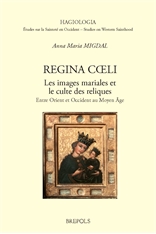 Les images-reliquaires, dont la singularité attire notre attention, se définissent par la complexité de leur composition tant au point de vue artistique qu’au point de vue religieux. Il s’agit ici des peintures sur panneau de bois (plus rarement, sur verre églomisé), ayant fonction de porte-reliques, et décorées dans certains cas de pierres précieuses ou semi-précieuses. Le modèle de tableau-reliquaire : panneau unique, diptyque et triptyque comprenant le portrait de la Vierge à l’Enfant enchâssé dans une large bordure incrustée de reliques, se répandit particulièrement dans la péninsule italienne, et par la suite en Europe centrale. Cependant, les reliquaires polonais, connus sur le territoire de la Petite-Pologne durant le XVe siècle jusqu’au début du siècle suivant, ne sont mentionnés que de manière sporadique dans l’histoire de l’art. Ils sont apparus dans quelques articles, mais sans avoir fait l’objet d’aucune analyse spécifique quant à leur contenu iconographique, leur similarité formelle, ainsi qu’à l’égard de leur usage dévotionnel. C’est pourquoi, nous souhaitons les joindre aux créations semblables répandues dans l’art entre Orient et Occident au Moyen Âge. Dans la même optique, il serait également intéressant de s’interroger sur la continuité de tels objets au-delà de l’époque médiévale.

 London, The Warburg Institute,
  Deadline:
  Medieval Art Research