Job: One-year conservation position at the Arnamagnæan Institute, Copenhaven, deadline 8 August 2020

The Arnamagnæan Institute, Department of Nordic Studies and Linguistics at the University of Copenhagen is looking to recruit a full-time conservator, starting as soon as possible or on the 1st of October 2020. 

The Arnamagnæan Institute conducts research in the areas of philology, manuscript studies, textual scholarship and linguistics, with special focus on the older Scandinavian languages: West Norse (Icelandic, Norwegian and Faroese) and East Norse (Danish and Swedish). The Arnamagnæan Institute houses several collections of primary sources, the most important of which is the Arnamagnæan Manuscript Collection, now divided between Iceland and Denmark. The Collection was inscribed on UNESCO’s Memory of the World register in 2009.

It is the principal task of the Institute’s members of staff to preserve the Collection for posterity in keeping with the Institute’s preservation policy. The Conservation Workshop undertakes preservation and conservation of manuscripts and documents from the middle ages and early modern period.

The Institute’s Preservation section consists of a photographer and two conservators, who work closely with Collection’s Curator and other philologists attached to the collection, as well as visiting researchers from around the world.

Responsibilities

You will work closely with the other members of the preservation team. The work will chiefly involve conservation and restoration of paper and parchment codices, diplomas with wax seals and historical bindings from various periods, as well as documentation in our conservation database. You will also be involved in monitoring the condition of the collections and the manuscript strongbox. Other responsibilities include assisting with displaying manuscripts, teaching activities and accompanying the curator when transporting manuscripts. Furthermore, you will participate in relevant courses and seminars both in Denmark and abroad, including the biennial conference on the Care and Conservation of Manuscripts.

The Arnamagnæan Institute and the Department of Nordic Studies and Linguistics is an open and informal workplace, and we offer a range of facilities such as coffee, tea and fruit for the staff. We are looking for someone dedicated and professional, and who works well as part of a team.

Qualifications

The ideal candidate should be a graduate of a recognised conservation-training program or possess commensurate experience eqiuvalent to the Danish Bachelor of Science (B.Sc.) in Conservation and Restoration. Documented experience in the areas mentioned is preferable, but we also welcome applications from recent graduates. You will have excellent team-working skills, with the ability to develop and maintain good working relationships, as well as planning and organising skills combined with a strong ability to take responsibility for own work, being self-reliant and making appropriate use of initiative. Proficiency in English as well as Danish and/or another Scandinavian language is desirable.

Prior to employment, a public criminal record will be obtained.

Terms and conditions of employment

The appointment is initially for one year, after which there is the possibility of a permanent position. The position is full-time at 37 hours (including a 30-minute lunch break). Wage and employment terms are made in accordance with the joint agreement between the Danish Ministry of Finance and public sector organizations – the OAO-S Joint Agreement and the Circilar for Academics in the State or other relevant agreement.

Applying

For further information on the position contact Natasha Fazlic, chief conservator workshop, tel. +45 35 33 57 26 / fazlic@hum.ku.dk, or head of administration Morten Tang Petersen, tel.+45 21 32 90 42 / mtp@hum.ku.dk.

We look forward to receiving your application, which should include a cover letter, your current CV and any relevant diplomas and certificates no later than the 8th of August 2020. Interviews will be held the following week.

Your online application must be submitted by clicking ‘Apply now’ below.

Further information on the Arnamagnæan Institute can be found here: https://nors.ku.dk/english/research/arnamagnaean/

More information here.

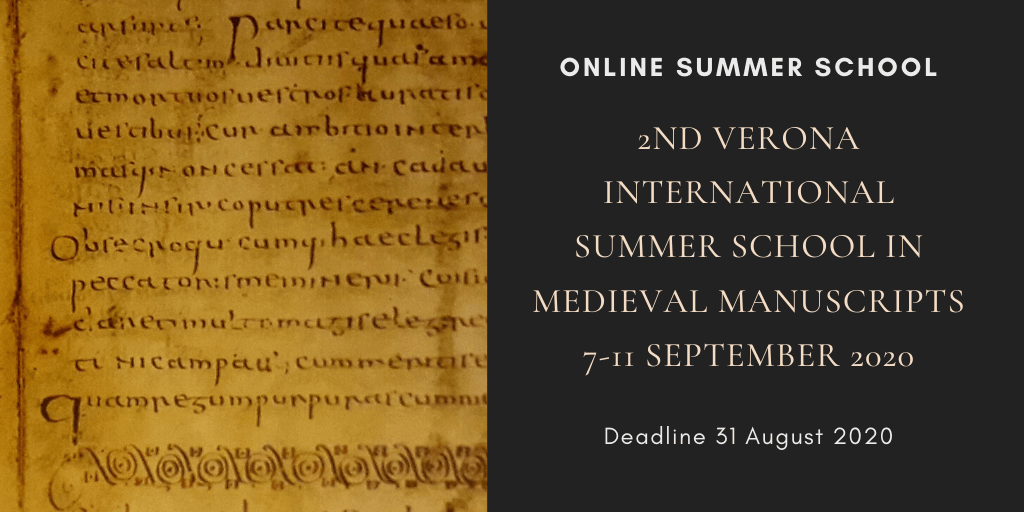
Online Summer School: 2nd Verona International Summer School in Medieval Manuscripts (7-11 September 2020), deadline 31 August 2020

The Verona International Summer School in Medieval Manuscripts offers an intensive course in writing culture from Late Antiquity to the Middle Ages (415-1500).

Due to the effects of the Covid-19 pandemic outbreak, the 2020 edition is offered only via a digital platform (Moodle).

It provides an overview of the main elements of Latin palaeography, showing the evolution of letter forms and most common abbreviation systems; the course consists of practical exercises, reading and transcribing several different types of script. It is also open to students with some experience in Latin and Greek palaeography, who wish to refresh or improve their skills. Participants must have elementary Latin in order to benefit from lectures; when applying, they should indicate whether they had any previous experience in palaeography.

This course will last for five days and lectures will be both recorded and live streamed by experts in their respective fields, working both at Verona University, Culture & Civiltà Department, and at a wide range of other institutions.

Subject areas include Latin, Gothic, Greek and Early Modern Italian palaeography, illuminated manuscripts, codicology, liturgical and devotional manuscripts.

Most of the morning lectures will be offered as pre-recorded talks, exploring the outstanding original Late Antique and Medieval writing materials preserved at the Biblioteca Capitolare, the «Queen of all Late Antique and Medieval Libraries», according to E.A. Lowe.

In the afternoons, recorded lectures will take turns with live Zoom meetings hosted by our lecturers in order to: – offer practical sessions on manuscripts and charters; – get specific insights through topics discussed during the morning sessions; – answer attendees questions.

The course also provides training for historians, archaeologists and textual scholars in the discipline of reading and interpreting medieval graffiti and epigraphic evidence, analysed in their original context. The importance of understanding graffiti and inscriptions within their archaeological and topographical contexts will be explored during virtual site visits to S. Giorgio/S. Elena, S. Zeno and S. Maria in Stelle. These virtual visits will be led by experts in Medieval Archaeology, Art and Architecture History.

Applications

The full program of 2020 Summer School (recorded lectures and live Zoom meetings) is open to a maximum of 20 students. Attendees are asked to submit a short statement of why they wish to take the course together with a CV. Non-selected applicants will still have the chance to enrol for the light program of the Summer School (please, see below).

In order to apply you are kindly asked to write as soon as possible to medievalmanuscripts@ateneo.uni-vr.it with your CV attached. You will receive an application form and the instructions for the bank transfer.

Your completed application form and your bank statement must be sent back via email before August, 31st, 2020.

Fees and Payments

  • Student Five-Day full program Fee (recorded and live streamed sessions): Euro 120,00.
  • Student Five-Day light program Fee (recorded-only sessions, available after September, 11th): Euro 60,00.

Fees include attendance (recorded and live streamed sessions for the full program, recor- ded-only sessions for the light one) and a wide ranging of teaching and bibliographical mate- rial (for both programs), available on ours Moodle.

Payments must follow the indications given by the Scientific Coordinators per email.

  • Summer School Administrator Dipartimento Culture e Civiltà, Room 3.19 Università degli Studi di Verona
    Viale dell’Università, 4
    I-37129 Verona
  • Tel: +39 (0) 45 8028733
  • Email: enrico.cazzaroli@univr.it

More information can be found here.

Journal Publication: The Saint Enshrined: European Tabernacle-Altarpieces, c. 1150–1400, Medievalia, Journal of Medieval Studies (Vol. 23, No. 1, 2020)

The Medievalia, Journal of Medieval Studies is excited to announce a special monographic volume: The Saint Enshrined: European Tabernacle-Altarpieces, C. 1150–1400 edited by Fernando Gutiérrez Baños Justin Kroesen Elisabeth Andersen

It comprises of contributions by 10 international scholars on the mentioned European Tabernacle-Altarpieces. It has been published fully online (with the possibility of printing on demand), and can be downloaded for free. You can find it here: https://revistes.uab.cat/medievalia

Table of Contents

Tabernacle-altarpieces: Variety within Unity, Fernando Gutiérrez Baños, Justin Kroesen, Elisabeth Andersen

Tabernacle Shrines (1180–1400) as a European Phenomenon: Types, Spread, Survival, Justin Kroesen, Peter Tångeberg

Closing the Tabernacle European Madonna Tabernacles c. 1150 – c. 1350, Elisabeth Andersen

Marian Tabernacles on Main Altars. Norwegian Thirteenth-Century Altar Decorations in Their European Context, Stephan Kuhn

(Dis)closed: Tabernacle Altarpieces in the Rhineland, Pavla Ralcheva

Central Italian “Tabernacula”: A Survey, Cristiana Pasqualetti

Minor or Major? Castilian Tabernacle-Altarpieces and Monumental Arts, Fernando Gutiérrez Baños

The Tabernacle of the ‘Virgen de los Reyes’ and the Documentary Memory of Other Gothic Tabernacles of the Cathedral of Seville, Teresa Laguna Paúl

Movement on the Altar: Gothic Tabernacle-altarpieces in the Crown of Aragon (and Their Context), Alberto Velasco Gonzàlez

Images and Altar Structures in Romanesque Catalonia: A Restored Virgin and Child Sculpture in the Museu Nacional d’Art de Catalunya, Jordi Camps Soria

New Journal Publication: British Art Studies, Issue 16 – June 2020

The British Art Studies is pleased to announce the publication of the latest journal issue: Issue 16 – June 2020. Of interest to Medieval Art historians may be their section New Approaches to St Stephen’s Chapel, Palace of Westminster, which includes:

You can access and read the new issue here.

British Art Studies, Paul Mellon Centre for Studies in British Art and Yale Center for British Art

Call for Papers: The Virgin as Auctoritas: The Authority of the Virgin Mary and female moral–doctrinal authority in the Middle Ages (Session sponsored by ICMA), Association for Art History Annual Conference, deadline 19 October 2020

Annual Association for Art History Conference, Birmingham 14 – 17 April 2021
Deadline 19 October 2020

This session aims at exploring a fundamental issue: female authority through the lens of visual/material culture. It involves prominently the Virgin Mary – as well as figures of female authority in the medieval world – because in the late decades of the 20th century, feminist thinkers pointed at the ‘negative model’ offered by the Virgin Mary since for centuries she had been branded by the Catholic Church as a role model for modesty, submission and virginity. However, between late Antiquity and the Middle Ages, the Virgin Mary emerged as Queen of Heaven through preaching and liturgical texts, visual arts and public assemblies – that is, the ‘mass media’ of that time. Mary was pictured as a very strong, authoritative figure, rather than weak and compliant.

Already during late Antiquity, Mary was commonly perceived as the mighty protector and spiritual stronghold of capital cities in the Mediterranean. Between the 8th and the 11th centuries, the role of royal women came to the fore, especially in Byzantium and in Ottonian Germany. Very striking is also the case of a number of major Italian city-states between the 12th and the 15th centuries where the Virgin Mary came to be identified with political and economic supremacy. But how did the preaching and missions of mendicant orders affect her image? How has a prominent role for female authorities been transmitted through visual arts and material culture? And what about the roles that women held in Africa and Asia and in other religious traditions?

In sum, this session can help understand what bearing the figure of the humble Virgin Mary eventually had on female leadership, and also how female leadership evolved or not. Topics may include but are not limited to:

  • The Virgin Mary as a figure of authority and wisdom in texts and images
  • The Virgin Mary in medieval preaching/arts: ‘only’ a model for humility and mercy?
  • Female political authority and the Virgin Mary as a role model in texts and images
  • Female moral, doctrinal, political and religious authority within and without the Christian oecumene in texts and images
  • Women and power: a difficult relationship.

Email abstracts to: Francesca Dell’Acqua, Università degli studi di Salerno, fdellacqua@unisa.it

Online Course: Manuscripts in Arabic Script: Introduction to Codicology, Aga Khan University, 14 -15 Aug 2020

Introductory short course on manuscripts in Arabic script.

This online course (2 days) aims to introduce Arabic manuscripts from a codicological and textual point of view. The first day will provide an overview of the field of codicology and it role in the manuscript field in general and in identifying the key features of the manuscript in particular. The second session will be dedicated to writing supports, the structure of quires, ruling and page layout, bookbinding, ornamentation, tools and materials used in bookmaking, and the palaeography of book hands. The second day will focus on the importance of manuscripts in research. While the first session will cover the Para-textual features in the Arabic manuscripts, the second session will demonstrate the different approaches in editing manuscripts.

This introductory course is intended for students, researchers and librarians who are working in the field of manuscript studies. In the two-days course, a wide range of aspects will be covered for those who are acquiring basic knowledge in this field.

Learning outcomes:

– Basic understanding of the field of manuscript studies in general.

– Identify the role of manuscripts in knowledge production in different areas studies in Muslim cultures.

Length of course: 2 days (4 lectures)

Download course structure.

Course Convenor:

Dr Walid Ghali is the Head of the Aga Khan Library, London, Assistant Professor at the Aga Khan University’s Institute for the Study of Muslim Civilisations and a Chartered Librarian of the Chartered Institute of Library and Information Professionals (CILIP). Also, he is a member of the Islamic Manuscript Association, University of Cambridge.

Dr Ghali received his PhD from Cairo University, Faculty of Arts in 2012. His current research projects focus on the Islamic manuscript traditions, particularly in Arabic script, and the history of books. Dr Ghali teaches Sufism, Arabic literature and manuscript traditions. Before moving to London, Dr Ghali worked in various librarian roles at the American University in Cairo. He has also held several consultancy roles in and outside Egypt, such as the Ministry of Endowment, Qatar University and the Supreme Council for Culture in Kuwait.

Tickets: £50 per day, £80 two days

*The course will be delivered via Zoom and further details will be provided later upon registration. For any questions about the course, please contact walid.ghali@aku.edu

Get your tickets here.

New Publication: The Hidden Life of Textiles in the Medieval and Early Modern Mediterranean: Contexts and Cross-Cultural Encounters in the Islamic, Latinate and Eastern Christian Worlds, edited by Nikolaos Vryzidis

The book contains published papers of the conference ‘Textiles & Identity in the Medieval and Early Modern Mediterranean: Paradigms of Contexts and Cross-Cultural Exchanges’ of the British School at Athens held at the (Benaki) Museum of Islamic Art in 2016, as well as some new contributions.

The focus in this wide-ranging collection of studies by key scholars in the field is on textiles and their functions in various Mediterranean contexts (and beyond) during medieval and post-medieval times (ca. 10th-19th c.). The scope of the contributions encompasses archaeological, anthropological and art historical perspectives on a great variety of subjects, such as textiles from the Byzantine Empire and the Medieval Islamic World (e.g. Spain, Mamluk Egypt, Seljuk Anatolia), as well as the production and use of textiles in Italy, the Ottoman Empire, Armenia and Ethiopia. The volume offers a state-of-the-art of an often still hardly known area of study of textiles as historical and cultural sources of information, which makes it essential reading for scholars and a larger audience alike.

The book includes contributions by Laura Rodríguez Peinado, Ana Cabrera-Lafuente, Avinoam Shalem, Scott Redford, Maria Sardi, Vera-Simone Schulz, Nikolaos Vryzidis, Marielle Martiniani-Reber, Elena Papastavrou, Jacopo Gnisci and Dickran Kouymjian.

Nikolaos Vryzidis received his PhD from SOAS, University of London, with a thesis on Greek clerical costume of the Ottoman period. He has already published on the subject in journals like Byzantine and Modern Greek Studies, Convivium, Iran, JOTSA and Orientalia Christiana Periodica. His research interests are centred on material culture of religion, cross-cultural encounters in the Medieval Mediterranean, and Byzantine-Islamic interchange.

Find out more here.

Table of Contents

  • Laura Rodríguez Peinado (Complutense University of Madrid) & Ana Cabrera-Lafuente (Museo del Traje, Madrid), New approaches in Mediterranean textile studies: Andalusí textiles as case study
  • Avinoam Shalem (Columbia University), Metaphors we dress with: Medieval poetics about textiles
  • Scott Redford (SOAS, University of London), Flags of the Seljuk sultanate of Anatolia: Visual and textual evidence
  • Maria Sardi (Independent scholar), Foreign influences in Mamluk textiles: The formation of a new aesthetic
  • Vera-Simone Schulz (Kunsthistorisches Institut in Florenz), Entangled identities: Textiles and the art and architecture of the Appenine peninsula in a trans-Mediterranean perspective
  • Nikolaos Vryzidis (Independent scholar), Animal motifs on Asian textiles used by the Greek Church: A case study of Christian acculturation. Appendix by Dimitris Loupis: Woven Islamic inscriptions
  • Marielle Martiniani-Reber (Musée d’art et d’histoire, Geneva), Quelques aspects des relations entre productions textiles byzantine et arabe au Xe-XIe siècles
  • Elena Papastavrou (Hellenic Ministry of Culture), Osmosis in Ottoman Constantinople: The iconography of Greek church embroidery
  • Jacopo Gnisci (Oxford University), Ecclesiastic dress in Medieval Ethiopia: Preliminary remarks on the visual evidence
  • Dickran Kouymjian (California State University, Fresno), Armenian altar curtains: Repository of tradition and artistic innovation
  • Nikolaos Vryzidis, Concluding remarks: Textiles as units of transmission

Online Lecture: Tom Nickson, ‘Light and the Cult of St Thomas Becket’, 7 July 2020

Listen to the Lecture here.

7 July 2020 is the 850th anniversary of Thomas Becket’s death and 800th anniversary of his translation.

Light and light imagery is prominent in the cult of St Thomas Becket, as it was and is in many pilgrimage cults across the world. In this short talk I briefly consider the role of light in Becket’s lives, miracles, and liturgy, before turning to explore its place in his cult and its architectural setting. I will focus particularly on two sites associated with St Thomas Becket in Canterbury cathedral, one of the most important pilgrimage destinations in medieval Europe. First the crypt, where Becket’s body was buried following his murder in December 1170, and second his shrine in the Gothic Trinity chapel, to which his body was solemnly translated on 7 July 1220, exactly 800 years ago. I examine the custom of giving votive candles to the tomb and shrine, the social and symbolic significance of Canterbury’s ‘economy of wax’, and the massive coiled taper that was periodically donated to the shrine by the town of Dover. When were these lit, and how did they affect perceptions of Becket’s tomb and shrine? Alongside this consideration of ‘artificial’ lighting, I will explore how natural light was controlled and regulated by Canterbury’s architecture, furnishings and stained glass. Light, I argue, was carefully choreographed at Canterbury, complementing its symbolic role in Becket’s lives, miracles and liturgy, and enhancing the sensory experience of pilgrims to his tomb and shrine.

Tom Nickson is Senior Lecturer at The Courtauld Institute of Art, London. He teaches and researches the art and architecture of medieval England and Iberia, and is editor of a forthcoming collection of essays on the art and cult of St Thomas Becket.

The lecture forms part of Durham University’s On Pilgrimage programme

Suggested Readings

Blick, S. 2011. Votives, Images, Interaction and Pilgrimage to the Tomb and Shrine of St. Thomas Becket, Canterbury Cathedral. In S. Blick & L.D. Gelfand (eds.) Push Me, Pull You: Imaginative, Emotional, Physical, and Spatial Interaction in Late Medieval and Renaissance Art: 21-58. Leiden: Brill.

Turner, D.H. 1976. The Customary of the Shrine of St Thomas Becket. Canterbury Cathedral Chronicle 70: 16-22.

Jenkins, J. 2019. Replication or Rivalry? The ‘Becketization’ of Pilgrimage in English Cathedrals. Religion 49: 24-47.

Duggan, A. 2012. Religious Networks in Action: the European expansion of the cult of St Thomas of Canterbury. In J. Gregory & H. McLeod (eds.) International Religious Networks: 20-43. Woodbridge: Boydell and Brewer.

Job: Lecturer in Medieval History, Aberystwyth University, deadline 28 July 2020

Aberystwyth University – Department of History and Welsh History

Job Description

To promote a flexible workforce, the University will consider applications from individuals seeking full time, part time, job share, or term time only working arrangements.

The Department of History and Welsh History wish to appoint a Lecturer in Medieval History for a fixed-term period. The successful candidate will cover the teaching position of Dr Elizabeth New, recently awarded a Leverhulme Major Research Fellowship, for the duration of her award. Applications are particularly welcome from those with a specialist knowledge of any aspect of later medieval/early modern British History (c. 1350-1550) and with an ability to teach in the area of heritage, although we welcome all applications.

The successful candidate will be expected to teach at both undergraduate and graduate level, to supervise undergraduate and graduate dissertations and to participate in University examining at undergraduate and taught graduate level. They will contribute to student recruitment and administration within the Department. The successful candidate will also have a strong research record, or exhibit evidence of the capacity to develop such a record, in a relevant field of later medieval/early modern history, c. 1350-1550.

The appointment will be subject to the successful completion of a probationary agreement and the successful candidate will be required to complete the Postgraduate Certificate in Teaching in Higher Education, unless they already hold an appropriate equivalent qualification.

To make an informal enquiry, please contact Phillipp Schofield, Head of Department at prs@aber.ac.uk or on 01970 622662.

Ref: HWH.20.3214

Closing date: 28 July 2020

Interview date: w/c 3 August 2020

We welcome applicants from all backgrounds and communities and in particular, those that are currently under represented in our workforce. This includes but is not limited to Black, Asian and Minority Ethnic (BAME) candidates, candidates with disabilities, and female candidates. We specifically encourage female candidates to apply for this post as they are currently under-represented at this level in our organisation.

We are a Bilingual Institution which complies with the Welsh Language Standards and is committed to Equal Opportunities. You are welcome to apply for any vacancy in Welsh or English and any application submitted will be treated equally.

More information here.

Salary: £36,914 to £40,322

Hours: Part-Time

Contract Type: Fixed-Term/Contract

Deadline: 28th July 2020

Podcast Series: British Art Talks, Paul Mellon Centre

The Paul Mellon Centre has now released seven episodes of a new podcast series, British Art Talks, which are permanently available across our websiteSpotify and Apple Podcasts. Each episode features new research and aims to enhance and expand knowledge of British art and architecture. Please see the full list of episodes below.

Medieval related podcasts include:

“What Will Survive Of Us Is Love”: Memory And Emotion In Late-Medieval England, Jessica Barker 

Jessica Barker explores the gesture of joined hands on medieval tomb monuments. Medieval tombs often depict husband and wife lying hand-in-hand, immortalised in elegantly carved stone: what Philip Larkin would later describe in his celebrated poem, An Arundel Tomb, as their ‘stone fidelity’.
These gestural monuments seem to belong to a broader tendency towards ‘expressivity’ in late-medieval sculpture. Whereas the figures on Romanesque portals stare back at the viewer impassively, their Gothic counterparts beam with radiant smiles, wipe away bitter tears or grimace and gurney with uncontrolled rage. The nature and significance of this shift has been much debated in recent years, in particular the extent to which the heightened representation of emotion was designed to provoke an equivalent emotional response.

This talk explores these ideas through the gesture of joined hands on medieval tomb monuments. I first address the issue of why hand-joining tombs are almost entirely restricted to a fifty-year period in England, before going on to place these amorous effigies in dialogue with wedding rings and dresses, changes to matrimonial ritual, and the new economic opportunities offered to widows. What emerges is the careful artifice beneath their seductive emotional surfaces: the artistic, religious, political and legal agendas underlying the medieval rhetoric of married love.  

Listen the podcast to here.

The English Carthusians And The Art Of Abstinence, Julian Luxford 

May 27, 1:00 PMFacebookTwitter Headliner Embed

Julian Luxford discusses the art and architectural dimensions of Carthusian life. The Carthusian order was founded in the late eleventh century in France. It spread rapidly and widely, and experienced great popularity during the later Middle Ages, when dozens of new charterhouses were founded against a background of sharp decline in monastic foundation in general. The main reason for Carthusian popularity was the order’s consistent adherence to the eremitic precepts and form of living established by its founding fathers. Manifest holiness generated a powerful reputation and patronage to match. The Carthusians also proved adaptable, managing to integrate into urban environments from the thirteenth century onwards without seriously compromising their principles.

This talk covers the art and architectural dimensions of Carthusian life with particular reference to the ten foundations of the order’s English Province. While these monasteries are all largely destroyed, enough survives to give a clear picture of the distinctive layout and elevation of their essential buildings and the sorts of embellishment they received. A fairy large number of Carthusian books and documents has also come down to us, some containing illumination, drawings and seals. Examples of this material that illustrate Carthusian ritual, customs and spirituality will be selected for discussion.

Listen to the podcast here.

Speaker Q&A

Over the upcoming weeks questions are invited for the British Art Talks speakers related to the topics of their podcasts. Email or submit a question via social media and answers will be published on the Paul Mellon Centre website on the dates below:

Friday 3 July
Jessica Barker

Friday 17 July
Julian Luxford

Find out more information about all the podcasts here.