Juan Facundo Riaño Essay Prize & ARTES-CEEH Scholarships, deadline 30 April 2025

ARTES and the Centro de Estudios Europa Hispánica (CEEH) are delighted to invite applications for the 2025 Juan Facundo Riaño Essay Prize and ARTES-CEEH Scholarships. These awards are designed to support students and early-career researchers exploring Spanish visual culture and art history.

The deadline for these applications are midnight on 30 April 2025. Winners will be announced on 31 May 2025 and an award ceremony for the winners of the Juan Facundo Riaño Essay Prize and the ARTES Travel Scholarship for Artists will be held on 27 June 2025 at the Spanish Embassy in London. The winners of these last two awards must be able to attend the ceremony on that date in order to be eligible to claim the prizes.

The Juan Facundo Riaño Essay Prize is awarded to students and early career scholars for the best art-historical essay on a Hispanic theme, kindly supported by the Office for Cultural & Scientific Affairs of the Spanish Embassy in London. Full details are available here.

Generous support from the Centro de Estudios Europa Hispánica (CEEH) also allows ARTES to award the following scholarships to students working on any aspect of Spanish visual culture before 1900:

Travel scholarships

Final year undergraduates and postgraduate students registered for a full- or part-time degree course at a UK university may apply for up to £1,000 towards the costs of travel to Spain for research purposes (which may include field work, attendance at a conference, or other recognised forms of research).  

£3,000 scholarship for PhD students at a UK university 

ARTES offers one scholarship each year to a student registered for a full- or part-time doctoral degree at a UK university. The scholarship is intended to contribute towards the costs of tuition, living and/or research, and therefore students with full funding are not eligible. 

£3,000 scholarship for PhD students or post-doctoral scholars who wish to conduct research in the UK 

Doctoral students or those who received their doctorate fewer than four years before the application deadline may apply for this scholarship provided that they were or are registered for doctoral study at a university in Spain. 

ARTES is also proud to offer a new prize to support artists to travel to Spain, Portugal or Hispano/Lusophone regions. Applicants must engage creatively with the rich and distinctive visual cultures of Iberia and Latin America and be based in the UK and may be at any stage of their career.

Call for journal submissions: Venezia Arti 2025, vol. 34, theme: Soglia / Threshold, deadline 31 March 2025 

Ca’ Foscari’s (Venice) art history journal Venezia Arti. Thematic call: Soglia / Threshold and ALIA ITINERA miscellaneous section

In medieval art, the theme of the threshold, as the passage from one dimension to another, is crucial from a symbolic point of view and involves both spatiality and temporality (T. Bawden, Die Schwelle im Mittelalter, 2014). The definition that Christ gives of himself in the Gospel had great resonance in the realm of the sacred: “I am the door; if anyone enters through me, he will be saved” (Jn 10:9). Hence the high significance that Christianity attributes to the boundary between the human and the transcendent, between sin and salvation. Within the domain of representation, this message is conveyed both on a figurative level and in instances where lines of demarcation are drawn between the earthly world and the hereafter (P. Florenskij, Iconostasis, 1996). It is expressed also in architecture, as witnessed by the density of inscriptions and artistic expressions at the entrances to places of worship (M. Pastoureau, Tympans et portails romans, 2014) and, within them, between the space reserved for the faithful and the presbytery. The concept of the threshold is also linked to the temporal structuring of festivities, from the anxious anticipation on the eve to the celebration itself. A prime example of this can be found in the rite of baptism and the significance attributed to the spaces in which it takes place (R.M. Jensen, Living Water, 2011). These spaces are meticulously constructed and embellished with great creative effort, with multisensory mises-en-scène playing a pivotal role in the experience. The monumentalisation of entrances, rites of passage, and liminal zones exerts an influence on the secular world, manifesting in the form of urban infrastructure, such as city walls, as well as in the entrances to princely residences and military fortresses. Nor, on the other hand, would it be fair to separate the secular dimension from the religious one: suffice it to consider the fact that in Byzantium Iconoclasm began in 726 with the order – given by Leo III the Isauric – to remove the effigy of Christ on the Chalke, the gate of the imperial palace in Constantinople.

In the Early modern period until the Enlightenment, the European cultural universe has expanded and transformed beyond the borders of the Pillars of Hercules (F.A. Yates, Astrea. The Imperial Theme in the Sixteenth Century, 1975). The introduction of unprecedented objects, naturalia and mirabilia to the European continent, as evidenced by a prolonged process extending throughout the 17th century, significantly influenced the prevailing mentalities of the era, thereby facilitating new forms of experimentation and figurative elaboration. The dissemination of knowledge from unknown civilisations, as exemplified by renowned Jesuits such as the geographer, mathematician and cartographer Matteo Ricci of Macerata and later Athanasius Kircher, who pioneered a form of Egyptology, resulted in the generation of new ways of contamination and unprecedented cross-fertilisation at the intersection of the ‘imaginary’ and the ‘imagined’ East. The encounter with the ‘other’ thus becomes a crucial interpretative framework, imbued with political and propagandistic connotations, and alternative forms of knowledge that are articulated through diverse media (an example of this is the encounter/clash with the infidels of the faith, in a paradigm where the image of the Turk become a symbol of the evil, following the political instability of the Mediterranean region – see for example, Images in the Borderlands, eds I. Čapeta Rakić, G. Capriotti, 2022). In this sense, the concept of threshold can be considered as a flexible framework that can be applied at will when exploring the ‘history’ of a cultural product in the broadest sense, as the outcome of a process of double-edged correspondence between one civilisation and another. Early modern period is in itself a season in which crossing a threshold becomes crossing a limit, whether geographical or cultural and esthetical as well, towards a “new unexplored worlds”. This development was significantly furthered by the revolution that followed the scientific discoveries of Galileo (1564-1642). Once considered insurmountable and as a limit (be it for political, religious, philosophical or technological reasons), the threshold is transformed, metaphorically speaking, into a springboard towards the globalised world (T. Brook, Vermeer’s Hat. The Seventeenth Century and the Dawn of the Global World, 2006).

In more recent times, the out-of-frame device has prompted a heated debate in the arts, spanning from painting (V. Stoichita, A Short History of the Shadow, 1997) to cinema (A. Bazin, What is Cinema?, 1967; D. Morgan, The Lure of the Image, 2021). In the context of the ongoing development of virtual, immersive and interactive spaces, the distinction between image and reality is increasingly blurring (P. Conte, Unframing Aesthetics, 2020; A. Pinotti, Alla soglia dell’immagine, 2021). At the same time, the vanishing boundary between human contribution and generative development is the object of studies investigating the historical, aesthetical and ethical ramifications of artificial intelligence (R. Pedrazzi, Futuri possibili, 2021; M. Pasquinelli, The Eye of the Master, 2023; L. Manovich, E. Arielli, Artificial Aesthetics, 2024). In the context of the Cultural Cold War Studies, the concept of the threshold comes into play by questioning an alleged impenetrability of the Iron Curtain, whose points of contact are instead probed as generators of cultural, artistic and exhibition practices. Thresholds is the title of the exhibition hosted in the German pavilion at the Venice Art Biennale in 2024 as the debut, in the history of German participation, of a venue outside Giardini, in line with that ‘expanded format’ to multiple possibilities – physical or virtual – that characterises the format of Biennials on a global scale (C. Jones, The Global Work of Art, 2017). Finally, the concept of trespassing, in the sense of insisting on demarcation lines and on their political, social and cultural implications, is the object of artistic and curatorial practices that can be ascribed to the broader interdisciplinary field of the Border Studies

As is now customary, the 2025 issue will also welcome a number of contributions outside the monographic theme, in the specific section Alia itinera.

CALL FOR ABSTRACTS:

  • Abstract of approx. 2000 characters (including spaces), in the language of the article, with a title proposal.
  • Only proposals from scholars holding a Ph.D  may be considered.  

ABSTRACT DEADLINES: 

Abstracts deadline: 31 March 2025 

Notification of accepted abstracts: 14 April 2025

CALL FOR SELECTED PAPERS:

Admissible length: between 30,000 and 40,000 characters, including spaces and footnotes (not included in the final count: abstract, captions, bibliography).

The essay must be written according to the editorial standards of the journal.

The essay must also include:

  • an abstract in English of approx. 1000 characters including spaces;
  • 5 keywords in English;
  • a final, complete bibliography, written in alphabetical order according to Edizioni Ca’ Foscari editorial standards
  • image captions including photo credits.

Illustrations: max 10 images,  in Jpeg format, 300 dpi resolution, with specification of credits already paid or authorised.

Languages allowed: Italian, English, French.

DEADLINES FOR ARTICLES

Deadline for the final version: 31 August 2025

FOR FURTHER INFORMATION

Please contact venezia.arti@unive.it.

CFP: ‘Good Governance and the Built Environment of Late Medieval Cities (ca. 1200–1600)’, deadline 7 April 2025

Brussels, 3-5 September 2025

In the late Middle Ages, cities were governed through constant dialogue. Rulers, nobility, citizens and other social groups all found ways to shape urban governance, each articulating complex views on what “good” governance entailed. In order to meet expectations of justice, protection, economic welfare, and the common good, all the aforementioned individuals would often invest in the city’s built environment, either by initiating new architectural and infrastructural projects, or by securing the maintenance of existing ones.

The city as a built space thus required constant development, and in this upkeep and expansion, rulers and governors were attributed a specific responsibility. Scholarship has already extensively explored various policies initiated by rulers and governors for the construction and maintenance of the city’s built environment; Previous studies have, for example, drawn attention to the governmental structures set up in late medieval cities or have explored the legal measures implemented to control urban environments. Similarly, scholarly attention has also focused on individual architectural and infrastructural projects initiated by rulers and governors as a means to meet expectations regarding their governmental responsibilities. However, a systematic overview of how these tasks and obligations regarding the built environment of the city were linked to ideals of good governance is missing, as well as the scope to set individual cases within an overarching framework.

This conference seeks to address this lacuna by asking specifically how the built environment of late medieval cities was conceptualised and physically shaped in relation to ideals of good governance. The focus will be on urban centers in diverse geographical regions (from North-Western Europe and the Mediterranean to the Middle East), and this in the period of 1200 to 1600.

We invite contributions coming from a variety of disciplines (architectural history, art history, literary history, political history and so on) to explore how—and to what extent—building was integral to governing a late medieval city.

Themes may include, but are not limited to:

  • The relationship between political and architectural thought with regards to good governance and the construction and maintenance of the city’s built environment.
  • The various media (texts, images, etc.) through which political thinking on good governance with regards to the city’s built environment was expressed.
  • The tasks, responsibilities, and expectations towards rulers and governing bodies in the construction and maintenance of a city’s built environment.
  • The means through which rulers and governors hoped to translate policy for the city’s built environment into practice (administrative bodies, legal measures, direct patronage).
  • Specific architectural and infrastructural projects initiated and overviewed by rulers, governors, but also other urban groups, and their relation to political ideals (such as authority, the common good, urban health, justice…).
  • The overlapping jurisdictions and governmental structures within late medieval cities and their impact on the construction and maintenance of the urban built environment.

Applications

Please send an abstract (max 500 words) with a short CV (2 pages max) to governingandbuildingthecity@gmail.com by 7 April 2025.

Contributions should be in English and the result of original research. Contributions should not be previously published or in the process of being published. Notifications of acceptance will be sent out by the end of April.

Conference information

The conference is organised within the research project “Governing and Building the City: Mirrors-for-Magistrates as a lieu for theoretical reflection on architecture (1200-1600)” funded by an Incentive Grant for Scientific Research (FNRS, Belgium).

For more information on the project: http://governingandbuilding.com 

Organisers:

  • Nele De Raedt, professor of history, theory and criticism of architecture, LOCI/LAB, UCLouvain
  • Minne De Boodt, post-doctoral researcher in political history, LOCI/LAB, UCLouvain/ Research Group Medieval History, KU Leuven
  • Philip Muijtjens, post-doctoral researcher in art history, LOCI/LAB, UCLouvain

CPF: ‘Communication – Cooperation – Confrontation: Queens, Noblewomen, and Burgher Women in the Middle Ages’, deadline 20 April 2025

Academic Conference Center, Prague, 16–17 October 2025

Medieval women were not isolated figures in society. As part of a complex system of relations – personal, ideological, or material –, they lived and worked within various networks. The terms “communication, cooperation and confrontation” can served as analytical categories for comprehending how women exerted influence and power, gained support for the realization of their goals, and navigated around their social, economic and other obstacles. With this conference, we seek to apply these lenses to the investigation of the manifold relations between medieval women and material culture in the broadest sense. The conference focuses on three main areas depending on the nature of these relations:

1. Women and their public image

As widely demonstrated in scholarship, women frequently shaped their own public image and used different media to achieve that goal. We are interested in the communication strategies women were choosing to promote their agenda and to overcome diverging interests, and within this scope, we wish to give particular attention to artwork commissions by women: architecture, altarpieces, books, seals and other types of objects. How were these inscribed or imprinted, for example, with tension in such cases as problematic succession or contested authority, either religious or secular, or with the politics of fama when women had to face various accusations?

2. Women and their entourages

To a large extent, women in the Middle Ages exercised agency through a specific engagement with material culture. Within those negotiations in which they could actively take part, women often participated in the exchange of gifts such as jewels, books and artworks, combining cultural and political influence. We wish to investigate with particular attention the instances in which women sought through donations to secure or strengthen cooperation in various social circles with which they were involved: families, households, noble courts, religious houses etc. We also hope for a comparative discussion of such acts in different situations and contexts: Can some be characterized as products of long-term strategy while others, perhaps, as tactical or even ad hoc, reactive measures?

3. Women and their artists

While the scarcity of sources typically precludes an examination of the entire process behind works commissioned by women, its details are often worth inquiring into. We invite discussions of the various modes of interaction and cooperation between the commissioners, the artists (e.g. painters, sculptors, architects, goldsmiths, writers, poets, musicians) and, where relevant, also the go-betweens. On what grounds were decisions and choices made? What factors influenced the choice of a particular artist or workshop? How important were the material and social constraints or the personal networks involved? When faced with obstacles in their pursuits, how did women react, what course of action did they take, and what other agents did they, perhaps, seek to collaborate with?

Within these three areas, we invite contributions from various fields of research: art history, history, literary studies, musicology archeology and others.

The language of the conference proceedings will be English and each paper should be a maximum of twenty-minutes long and include a slide presentation.

We are able to cover accommodation expenses in Prague for the conference speakers.

If you wish to take part, please let us know by 20 April 2025, sending the title of your paper with an abstract (one standard page long at most) and specifying your affiliation.

Please write jointly to all three of the conference organisers:

  • Helena Dáňová (danova@udu.cas.cz);
  • Klára Mezihoráková (mezihorakova@udu.cas.cz)
  • Věra Soukupová (soukupova@ucl.cas.cz)

This international conference will be the third meeting in a row on the topic “Queens, Noblewomen, and Burgher Women in the Middle Ages” organized by the Institute of Art History of the Czech Academy of Sciences and the Institute of Czech Literature of the Czech Academy of Sciences with the support of the Strategy AV 21 Programme – Anatomy of European Society: History, Tradition, Culture, Identity. The aim of the conference continues to be the development of an international platform for research on the topic of women patrons, their social standing and way they presented themselves in medieval Europe. In connection with the conference, a volume on the topic will be published by the Institute of Art History, Prague.

Symposium: ‘From Jean le Bon to Good Duke Humfrey: a new manuscript witness to Anglo-French cultural exchange’, Weston Library, Friday 21 March 2025, 11am–5pm (GMT)

 Free and all welcome, booking required | At the Weston Library and online (book here)

About the event

The Bodleian Libraries have recently acquired a previously unknown manuscript from the library of Humfrey Duke of Gloucester. First written and illuminated in Paris towards the end of the 13th century, the manuscript is an early example of the translation of the New Testament into French. Owned by Jean le Bon, King of France, in the middle of the 14th century, by the early 15th it was in England and came into the hands of a series of Lancastrian royal princes.

This symposium provides a first opportunity to explore this outstanding arrival and to point the way for future research. Coffee and tea will be provided.

This symposium will be followed by a drinks reception in Blackwell Hall.

Programme

10.30–11am: Arrival and coffee

11–11.15am: Welcome from Richard Ovenden; Introduction by Martin Kauffmann

11.15am–12.30pm: Origins (chaired by Daron Burrows)

Clive Sneddon, Translating the Bible into medieval French
Emily Guerry, The Cholet Master and manuscript illumination in Paris at the end of the 13th century

12.30–2pm: Lunch (not provided)

2–3.15pm: From France to England (chaired by Jocelyn Wogan-Browne)

Laure Rioust, Biblical manuscripts in the libraries of Kings John II the Good and Charles V the Wise: heritage and dispersal
Laure Miolo and Jean-Patrice Boudet, The circulation and spoliation of scientific manuscripts between France and England in the Hundred Years’ War

3.15–3.45pm: Tea

3.45–5pm: The manuscript in England (chaired by Daniel Wakelin)

David Rundle, The Lancastrian moment: the manuscript’s English owners
Daniel Wakelin, Conclusion and avenues for further research

Followed by a drinks reception and launch of the digital facsimile of MS. Duke Humfrey c. 1

Speakers

  • Jean-Patrice Boudet, Université d’Orléans
  • Emily Guerry, University of Oxford
  • Laure Rioust, Bibliothèque nationale de France
  • David Rundle
  • Laure Miolo, University of Oxford
  • Clive Sneddon, University of St Andrews
  • Daniel Wakelin, University of Oxford

Booking information

This event is free but booking is required. You can attend this event in person at the Weston Library or online via Zoom.

When you have booked your place, the ticketing system will send you an automated confirmation. If you book to attend this event online, you will receive details for joining the Zoom webinar by email.

Book now – in person

Book now – online

Location

This symposium takes place in person in the Sir Victor Blank Lecture Theatre at the Weston Library.

Weston Library, Broad Street, Oxford, OX1 3BG.

CFP: ‘La sculpture monumentale médiévale à l’épreuve du musée: enjeux, conceptions, réceptions’, deadline 1 March 2025

International Study Days (Paris, Musée du Louvre, Centre Dominique-Vivant Denon, 30 June – 1 July 2025; Toulouse, Université de Toulouse, IUT Paul Sabatier, 2–3 October 2025)

The Musée du Louvre, the Musée des Augustins in Toulouse, the Université de Toulouse, and the research group Patrimoines en partage are organising two events focusing on the challenges of presenting sculptures from mostly vanished religious buildings in the permanent collections of museums. These events aim to address audiences who may be unfamiliar with such works and who require interpretive keys for a more accurate and enjoyable appreciation of medieval monumental sculpture.

This inquiry stems from the experiences of the Musée des Augustins, which has experimented with various presentations of its medieval collections over time. These collections primarily consist of sculptures from three lost Romanesque cloisters. The museum’s reflections have been enriched by discussions with the OCMI (Ontology of Medieval Christianity in Images) research programme at the INHA, led by Isabelle Marchesin and Mathieu Beaud. The museum’s ongoing renovation project presents an opportunity to share these concerns more widely. In an effort to account for different audiences and foster interdisciplinary perspectives, the event will give significant space to contributions from museology and information and communication sciences.

Key Issues

The exhibition of fragments and detached works of medieval monumental sculpture presents several specific challenges.

  1. Presentation Out of Context: One of the main issues, which is not unique to sculpture, is how to present an artwork removed from its original setting, where its visibility is altered (in terms of distance, lighting, and spatial or iconographic order). The loss of sacred, liturgical, and communal markers further complicates its interpretation. This problem is exacerbated when the original buildings no longer exist, have been significantly altered, or when fragments are dispersed, come from older archaeological contexts, or have been sold on the art market without clear provenance.
  2. The Role of Conservation Status and Provenance: Differentiating between preserved, altered, and lost contexts—whether due to vandalism, collecting, art market dynamics, changing tastes, or mere chance—is crucial for understanding these works. When archaeological excavations have taken place, how can a meaningful dialogue be established between archaeology and art history? How can visitors grasp a lost context and the interdisciplinary perspectives required to interpret it? Should the priority be an archaeological or topographical reconstruction, and to what end?
  3. Fragmentation and Meaning: The condition of the sculptures themselves poses another challenge. A significant proportion of preserved works consist of capitals, historiated or decorated pillars, lintel sections, impost blocks, bases, and plaques. Should these fragments be considered as standalone artworks? What level of intelligibility should they be given?
  4. Museums as a Lens of Prestige: Museums confer an aura of importance—some works gain status as masterpieces because they are housed in prestigious institutions, being frequently published, loaned, and analysed, while their counterparts that remain in situ receive far less attention. What factors influence this discrepancy, and are there exceptions worth examining?
  5. Maintaining Links to Original Structures: When multiple pieces come from the same architectural complex, how should their relationship to the original structure be conveyed? Through narratives, plans, drawings, or digital tools? How can a balance be struck between highlighting the individuality of each piece and preserving its connection to a broader whole?
  6. Mediation Tools: What interpretative tools should be employed, ranging from traditional methods to innovative digital solutions, and for which audiences? Museums allow close scrutiny of sculptures in ways that were not possible in their original settings. How can these new conditions best serve the transmission of technical, stylistic, and iconographic knowledge?
  7. Tailoring Interpretation to Visitor Diversity: How can responses to these questions be prioritised within a single exhibition space, given visitors’ diverse expectations based on age, socio-professional background, educational level, and interests?
  8. Medievalism and Popular Perceptions: It is important to consider visitor experiences and desires, incorporating insights from information and communication sciences (ICS) to study the reception of scholarly discourse and mediation strategies. Additionally, how should museums respond to the widespread fascination with a romanticised, fictionalised Middle Ages found in popular culture, from video games to films and television? Can medievalism offer lessons for museum practices?

Translating Academic Discourse for Museum Audiences

How should the scholarly discourse of art history—whether within or outside the museum—be translated into exhibition narratives and mediation strategies? This shift involves moving from the specialised discourse found in academic research (often in theses and niche publications) to more accessible exhibition interpretations and mediation tools.

Information and communication sciences have explored various museological approaches, as outlined by Jean Davallon: object-based museology, idea-based museology, and viewpoint-driven museology. The rise of new museology has placed greater emphasis on audience engagement and community collaboration, encouraging participatory, immersive, and interactive exhibition formats.

Since the 1980s, museums have increasingly embraced communication strategies, leading to an explosion of temporary exhibitions seen as media in their own right (Jean Davallon, Daniel Jacobi). This shift has also spurred the development of numerous mediation tools, some more innovative than others, designed to enhance visitor comprehension (Patrick Fraysse). These changes inevitably influence public expectations for permanent collections.

These current debates have generated significant scholarly discussions, such as the recent call for papers by Géraldine Mallet and Sylvain Demarthe for the online journal exPosition on Displaying Medieval Collections. Our proposal aims to complement this by analysing the specific case of medieval monumental sculpture in museums, with an emphasis on audience inclusion, knowledge democratisation, and the insights provided by information and communication sciences.

Call for Papers

Proposals, which may include theoretical approaches or case studies, should be submitted by 1 March 2025 to sculptures@louvre.fr. Submissions should consist of a 3000-character abstract, accompanied by a biography of the speaker(s) and a short bibliography (maximum five references).

If you are only available for one of the two events (Paris or Toulouse), please indicate this in your submission. Selected papers will be announced in early April, with their allocation to Paris or Toulouse determined based on the proposals and speaker availability.

A publication of the conference proceedings is under consideration.


Organisers

  • Musée du Louvre (Sophie Jugie, Pierre-Yves Le Pogam, Department of Sculptures)
  • Musée des Augustins, Toulouse (Charlotte Riou)
  • Laboratory for Applied Research in Social Sciences, Université de Toulouse (Patrick Fraysse)
  • Patrimoines en partage research group, directed by Sylvie Sagnes, supported by the CNRS Institute for Humanities and Social Sciences
  • In collaboration with Mathieu Beaud, Associate Professor at the Université de Lille

Provisional Programme

Paris, Musée du Louvre: From Monument to Museum Audience

The first session, held at the Centre de recherche Dominique-Vivant Denon, will explore general exhibition issues and case studies, with contributions from art historians, curators, and museum mediators. Topics include:

  • Restitution of original contexts: utility, challenges, and methods
  • The role of chronological and period-based classifications
  • Technical and administrative constraints of exhibition spaces
  • The uniqueness of exhibited works: strength or limitation?
  • Materials and techniques: insights into medieval craftsmanship
  • Creating networks between disparate works: typological and iconographic possibilities
  • The critical apparatus: balancing text and imagery around artworks
  • Limits of contextualisation, explanation, and interpretation
  • Can we reconstruct medieval emotional responses to these works?

A museum visit in Paris will be included.


Toulouse: Scientific Content – Mediation – Evaluation

The second session will focus on the content and audience reception, examined through interdisciplinary perspectives. Topics include:

  • Guiding visitor perception: how to present the whole and the details?
  • Engaging visitors as active participants
  • The role of style and iconography in interpretation
  • Mediation tools and public expectations
  • Structuring exhibitions through chronology and periodisation
  • Balancing scholarly discourse with accessible mediation
  • Evaluating visitor experiences: qualitative data analysis
  • Addressing religious contexts and Christian iconography in museums

A visit to the Musée des Augustins collections (depending on renovations) is planned.


Practical Information

Toulouse, Université de Toulouse, IUT Paul Sabatier: 2–3 October 2025

Paris, Musée du Louvre, Centre Dominique-Vivant Denon: 30 June – 1 July 2025

CFP: ‘Permanence and Continuity in Medieval Art’, deadline 15 April 2025

November 24th, 2025 — Paris, INHA, salle Vasari | November 25th, 2025 — Université de Lille, IRHiS

“Continuity is undeniable; the first Gothic master builders or architects were raised in the Romanesque world. They naturally drew inspiration from it, but this continuity is a living and dynamic one; it is similar to life itself, where heredity, education, and the past weigh on each individual without compromising the emergence of freedom.”
— Jacques Henriet

By questioning continuity and its intentionality in medieval production, Jacques Henriet highlights a widely observed process whose parameters have rarely been examined. Indeed, art history often analyzes its subject through the lens of innovation. This epistemological bias has led to the marginalization of the issues of permanence in the historiography of medieval artistic production, despite their essential role in understanding this period.

The study of this theme has also suffered from an almost exclusive focus on the legacy of antiquity in medieval art. While this question is crucial, it limits our overall perception of conservative forms and practices. An interest that may have seemed novel twenty years ago now appears to be a central concern in medieval studies.

These study days aim to explore the relationship between permanence and continuity in the use of models and forms specific to medieval culture. In particular, his perspective seeks to examine the existence of a genuine aesthetic conservatism, understood as a fertile artistic dynamic. We will address these notions through the lens of innovation, dissemination channels, creative contexts, and the various intellectual processes at work.

Theme 1: Permanence, Continuity, and Innovation

During this period, creation was often developed and justified by clerics according to a principle of continuity—one may recall the expression “dwarfs standing on the shoulders of giants” which John of Salisbury attributed to his master Bernard of Chartres, and which he claimed as the only worthy path to intellectual creation. Therefore, we must question the originality of medieval works through the notion of borrowing from older formulas and the reactivation of past models. This unique relationship with temporality may be explored through the process of creating an artwork, such as an illuminated book or the reinterpretation of monumental works. This approach aims to critically assess the singularity of certain continuities, such as the Franco-Insular style of the Second Bible of Charles the Bald (BnF, Latin 2, c. 871-877), which may invoke notions of archaism and conservatism or even historicism, and reaction, whose relevance to the Middle Ages needs to be interrogated.

Theme 2: Networks and Agents of Dissemination

Understanding the phenomena of continuity requires analyzing the cultural context of these artistic productions. Indeed, continuity may find expression in the long-term realization of artistic programs, as seen in homogeneous projects spanning decades. Another approach involves questioning the notion of tradition; whether it is linked to a specific artistic practice, a defined space, or a particular milieu. Tradition may also exist within a network of actors, particularly institutional ones, that facilitate the dissemination of models, such as repertoires of forms within monastic orders, like the model books circulated in the Cistercian context. Therefore, we will examine the means of transmission and circulation of models and expertise among these various agents, particularly through apprenticeships..

Theme 3: Modalities of Reception

Were these phenomena as prominent to medieval contemporaries as they are to contemporary art historians? This final theme will explore the intentionality behind the use of forms or processes perceived as representative of an earlier period of creation. More specifically, it will examine the role of heritage, understood as the unconscious reproduction of knowledge acquired through education, and that of tradition, considered a deliberate citation of an ancient form, comprehensible only within a given context—such as the memorial project of Saint-Louis de Poissy (c. 1297-1331), for example. This element of intentionality invites us to refine the definition of aesthetic preferences in the medieval era, when the past was considered an aesthetic category in itself.

Submission Guidelines and Timeline

These study days aim to explore these transmission pathways through original case studies. Our intention is to bring together presentations covering all media of the medieval period (5th–15th centuries). Presentations should be 20 to 25 minutes long. A publication is planned.
Proposals for conference contributions may be submitted in French or English. They should take the form of a summary (approximately 300 words) with a title and be accompanied by a short biography.

Submissions should be sent to jepl.medieval@gmail.com by April 15, 2025. Feedback to authors will be provided by June 30, 2025.

Scientific Committee

  • Mathieu Beaud, Associate Professor of Medieval Art History, UMR 8529 IRHiS, University of Lille.
  • Étienne Hamon, Professor of Medieval Art History, UMR 8529 IRHiS, University of Lille.
  • Anne-Orange Poilpré, Professor of Medieval Art History, UR 4100 HiCSA, University Paris 1 Panthéon-Sorbonne.
  • Ambre Vilain, Associate Professor of Medieval Art History, UMR 6566 CReAAH, LARA Laboratory, Nantes University.

Organizing Committee

  • Hugo Dehongher, PhD Candidate in Medieval Art History, UMR 8529 IRHiS, University of Lille.
  • Angèle Desmenez, PhD Candidate in Medieval Art History, UMR 8529 IRHiS, University of Lille.
  • Max Hello, PhD Candidate in Medieval Art History, UR 4100 HiCSA, University Paris 1 Panthéon-Sorbonne.
  • Pierre Moyat, PhD Candidate in Medieval Art History, UR 4100 HiCSA, University Paris 1 Panthéon-Sorbonne.

Call for papers in English revised by Allyson Tadjer, PhD, Georgia State University, Professor of English at the University of Lille.

Online Lecture: ‘Luxury for All? Jewelry and People in the East Roman Empire’, with Georgios Makris, 11 March 2025, 4pm (GMT)

Mary Jaharis Center for Byzantine Art & Culture

Georgios Makris, University of British Columbia, explores issues of taste in the East Roman Empire.

Valued for its beauty, intricate production processes, and often the precious raw materials it contained, jewelry had a ubiquitous presence in the East Roman Empire. As the quintessential accessory, jewelry was an essential element of official (and sometimes non-official) attire throughout the Middle Ages. Though the medium still sits at the margins of the history of medieval art, especially in comparison to other forms of portable material culture, recent specialist scholarship has stepped outside the world’s museum galleries to consider how jewelry items were treated in the global medieval world as objects of sale, trade, and diplomatic exchange. Due to jewellery’s historical affiliation with luxury and elite culture, the question of whether and how jewelry mattered for the people of underprivileged socioeconomic backgrounds across the empire remains open. 

In this talk, Dr Makris intends to examine the reasons behind jewelry’s identification as an elite category of artefact and discuss jewelry made for and used by non-elites far from the metropolis of the empire. In doing this, Dr Makris draws on finds from excavated cemeteries in mainland Greece. Ultimately, the aim is to initiate a discussion about taste and access to trade routes by the ordinary people, who formed the majority of the population.

This lecture will take place live on Zoom, followed by a question and answer period.

Register here.

About the speaker

Georgios Makris is Assistant Professor of Art History at the University of British Columbia. He specializes in Byzantine art and archaeology, placing particular emphasis on monastic landscapes and material culture. An active archaeologist, he has participated in several projects and currently directs the Maroneia Archaeological Project, supported by Canada’s Social Sciences and Humanities Research Council. This project studies the archaeological remains and ceramics from the city of Maroneia in Thrace (Greece) from the ninth to the fifteenth century. Makris has written on Byzantine donor portraits, the relationship between lay and monastic communities, and, lately, on jewelry and body ornaments. He recently co-convened, with Maroula Perisanidi, the fall colloquium on Disability in Middle and Late Byzantium at Dumbarton Oaks Research Library and Collection.

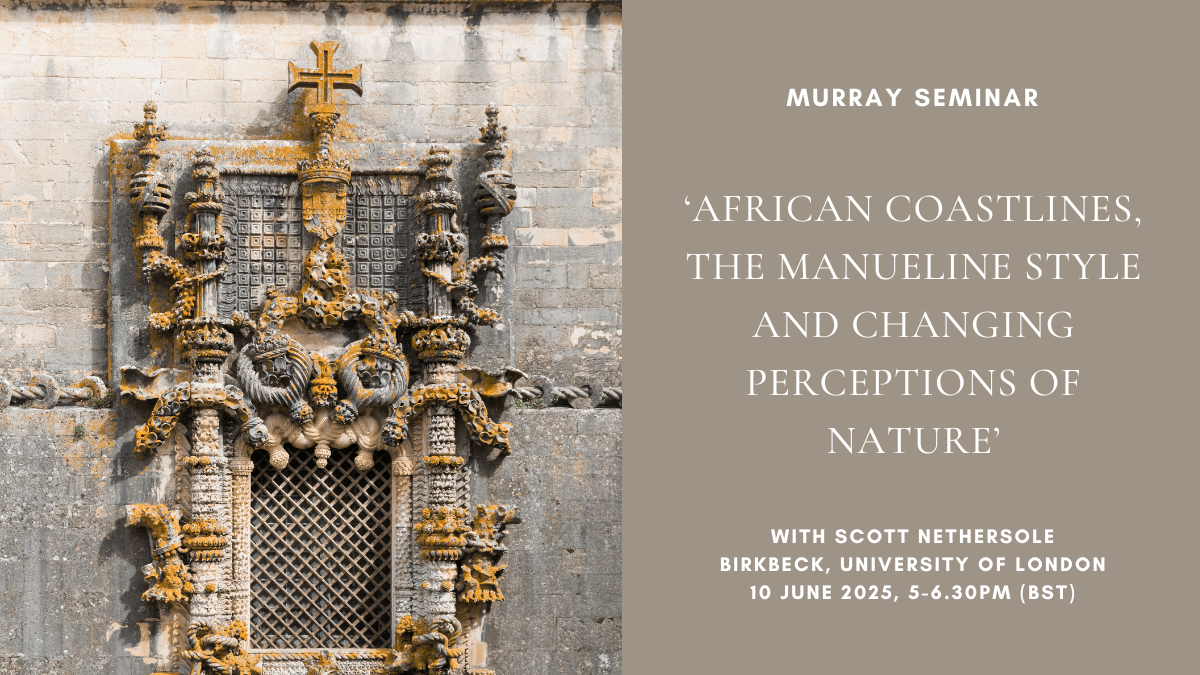
Murray Seminar: ‘Nicola and Giovanni Pisano at the Fontana Maggiore in Perugia’ with Laura Jacobus, 19 March 2025 (5-6.30pm GMT)

In Person at Birkbeck College, Keynes Library, 43 Gordon Square, and Livestreamed.
19 March 2025, 17:00-18:30

At this Murray Seminar, Laura Jacobus will share her research on:

A ‘Most Pleasing Flower among Equally Excellent Sculptors’: Nicola and Giovanni Pisano at the Fontana Maggiore in Perugia

The Fontana Maggiore of Perugia, one of the best-preserved secular monuments of medieval Europe, is decorated by more than fifty sculptures. Its creators, Nicola Pisano and his son Giovanni, were the two star sculptors of thirteenth-century Italy. This seminar paper takes a fresh look at the work, arguing that it has been significantly misunderstood in modern scholarship. Touching on a number of aspects of this radical revision, the paper will concentrate on one: what does the work say about the relationship between Nicola and Giovanni, only one of whom could be the ‘most pleasing flower among equally excellent sculptors’ referred to in the fountain’s remarkable inscription?

Book your place over on Birkbeck’s website.

Online Lecture: Cambridge Medieval Art Seminar, ‘Playing with Fools?’ with Dr Krisztina Ilko, 17 February 2025 (5-6:30pm, GMT)

Join the second Cambridge Medieval Art Seminar of 2025, Krisztina Ilko (Queens’ College, University of Cambridge) will speak on her new research project on medieval chess pieces.

The lecture will be held in ‘The Classroom’ at the History of Art Department in Cambridge (1-5 Scroope Terrace, CB2 1PX) – to attend online, book your free ticket via Eventbrite. No booking is required to attend in person.

Register for the lecture here.