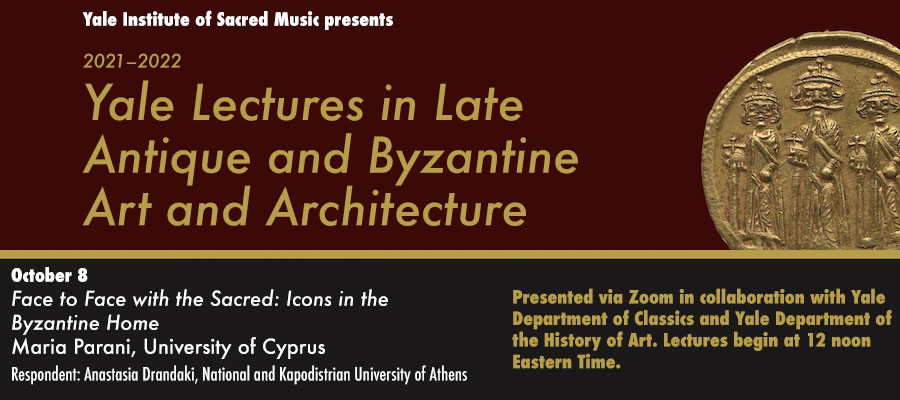
Online Lecture: Face to Face with the Sacred: Icons on the Byzantine Home, Yale Lectures in Late Antique and Byzantine Art and Architecture, 8th October 2021, 12:00 PM EST

Face to Face with the Sacred: Icons in the Byzantine Home, lecture by Maria Parani (University of Cyprus), Yale University via Zoom, October 8, 2021, 12:00 PM

Respondent: Anastasia Drandaki, National and Kapodistrian University of Athens

This is the first lecture in the 2021–2022 series of Yale Lectures in Late Antique and Byzantine Art and Architecture. The lecture series is organized by Robert S. Nelson, Robert Lehman Professor in the History of Art, and Vasileios Marinis, Associate Professor of Christian Art and Architecture at the ISM and YDS. Presented in collaboration with Yale Department of Classics and Yale Department of the History of Art.

Advance regsitration required. You can register at any time to join a lecture. Your registration is valid for the whole series; attend as many as you like. You will automatically receive reminders for the lectures. 

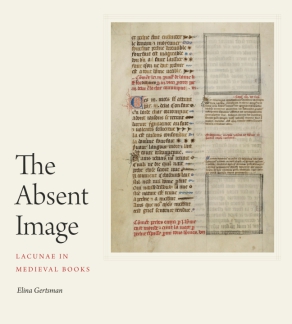
New Publication: ‘The Absent Image: Lacunae in Medieval Books’ by Elina Gertsman

Guided by Aristotelian theories, medieval philosophers believed that nature abhors a vacuum. Medieval art, according to modern scholars, abhors the same. The notion of horror vacui—the fear of empty space—is thus often construed as a definitive feature of Gothic material culture. In The Absent Image, Elina Gertsman argues that Gothic art, in its attempts to grapple with the unrepresentability of the invisible, actively engages emptiness, voids, gaps, holes, and erasures.

Exploring complex conversations among medieval philosophy, physics, mathematics, piety, and image-making, Gertsman considers the concept of nothingness in concert with the imaginary, revealing profoundly inventive approaches to emptiness in late medieval visual culture, from ingenious images of the world’s creation ex nihilo to figurations of absence as a replacement for the invisible forces of conception and death.

Innovative and challenging, this book will find its primary audience with students and scholars of art, religion, physics, philosophy, and mathematics. It will be particularly welcomed by those interested in phenomenological and cross-disciplinary approaches to the visual culture of the later Middle Ages.

For more information and to purchase, please visit PSU Press.

Conference: ‘Pre-former/Performer: Sources et categories pour l’etude de la performance et du rituel’, UC Louvain, 6-7 October 2021

A workshop organised by Sergi Sancho Fibla and Ingrid Falque at the UCLouvain (Louvain-la-Neuve, Belgium) and on Zoom on the categories and sources destined to study performance and ritual in the late Middle Ages and the early modern period. Papers are in French and English.

Le but de cette journée d’études est de s’interroger sur les différentes sources qui nous permettent d’étudier la performance et le rituel, en questionnant les différentes catégories d’analyse : performance dévotionnelle, théâtrale, liturgique, politique, légale, etc. Quels sont les concepts que les historien.nes, les musicologues, les historien.nes de l’art et de du théâtre utilisent et comment les confronter ? Nous entendons donc rassembler des supports variés (manuscrits, images peintes, tapisseries, objets, etc.) qui appellent à une activité performative liée aux espaces et aux actrices et acteurs religieux. Cet événement prendra la forme d’un workshop dans lequel les intervenant.es auront l’occasion de présenter les sources en centrant leurs propos sur les points
suivants :

  • Est-ce que le caractère performatif relié à la source est explicite ou implicite ?
  • Quel est le marqueur ou indice de performance ?
  • Quel rapport établit le support dans l’action performative (est-il un code, un témoignage mémoriel, un objet utilisé, etc.) ?
  • Quelles personnes et quels lieux interagissaient avec la source ?
  • Quelles ressemblances et différences présente-elle par rapport à d’autres sources du même type ?
  • Y-a t-il un rapport entre la source et la culture matérielle ?
  • Y-a t-il une différenciation de genre dans la matérialisation de la performance ? Et dans la production et transmission de la source ?
  • Dans une taxonomie de performances, quelles seraient les catégories susceptibles de l’identifier ?
  • Comment rendre compte de la dimension performative de la source dans une édition papier ? Et dans une édition numérique ?

Click here to register.

Call for Papers: ‘Instruments of Devotion in Medieval Religious Practice’, Quaderni di storia religiosa medievale, for publication in 2023 (Deadline 1st December 2021)

The religious experience of women and men in medieval Europe was stimulated by the works, objects and spaces of worship, understood as fundamental material instruments for mediating the encounter with the divine. The role that works of art had in triggering and orienting the devotional response of their public has recently been the subject of analysis in studies that have favoured socio-anthropological, historical, cognitive and psychological approaches, embracing notions related to the social agency of art, theories of response, and the cognitive dimension of reception.
The monographic issue proposed here is embedded in this line of study, but integrates it with the methods and tools of the art-historical disciplines. It maintains the focus of analysis on the materiality of the objects, regarded as essential historical documents of otherwise elusive practices and customs, which will be examined in their significance as devotional tools. The lens through which the relation between artworks and users will be explored concerns the concepts of interaction and dynamism referred to objects, spaces and modes of experience of Western Medieval art.

The first term, interaction, concerns in particular the relationship between the users, the works and the spaces of devotion. Recent scholarship has pointed out that the works were intended to interact on multiple dimensions with their audience. On the one hand, it was the worshippers who “activated” the signifying potential of the objects with specific interactive practices, for example by coming into physical contact with the artefacts, touching and manipulating them, or even ingesting parts of them; but also, for example, by inscribing written formulas or apotropaic figures on them. On the other hand, the works themselves interacted with the faithful, triggering devotional responses, or empathic reactions, through sensory stimulation and processes that encouraged identification and meditation. The materiality of the objects, the iconography of the chosen episodes and the formal rendering of the figures were in this case fundamental in inducing a precisely oriented spiritual reaction in the faithful.


The second term, dynamism, is in some ways complementary to the first, and yet expands the investigation in other directions. Artworks shall indeed be intented as synamic objects. Not only did they change their form and function, for example by being opened and closed, but they could also be subjected to material metamorphoses, bleeding or oozing oils and essences, and could sometimes even become animated, moving in space or speaking to the faithful. The public, in turn, was involved in devotional practices that implied an active dynamism, participating for instance in processions and paraliturgical dramas, or experimenting with kinetic modes of prayer. The spaces of devotion were also central actors in the ritual dynamism, orchestrating the development of the actions in stages; not only that, but they too changed, on the occasion of certain practices, becoming fulcrums of specific ritual actions, or sets for dramatic performances, or even simulacra of places far away in time and space. Without aiming to provide exhaustive or binding case studies, contributions are invited on:

  • Objects used in specific liturgical and ritual practices, including sacred dramas and processions
  • Miraculous works
  • Reliquaries and openable objects
  • Simulacra spaces, e.g. reproductions of the Holy Sepulchre
  • Rood-screens as settings for dramatic actions
  • Spaces, objects, performances in the religious and secular community
  • Gender interaction: comparing men and women
  • Objects of personal devotion

Contributions are accepted in Italian, English and French. Articles should have a maximum length of 60,000 characters, including spaces. To submit a proposal, please send a title and an abstract to the editors of the monographic issue, Zuleika Murat and Fabio Massaccesi (zuleika.murat@unipd.itfabio.massaccesi3@unibo.it), by 1 December 2021. The final materials (texts and images) must be submitted to the editors no later than 1 October 2022. The volume will be published in 2023. The texts will be subjected to a double-blind peer review process, in line with the journal’s practice.

Autumn lecture series: IHR Seminar Medieval Europe 1150–1550

This year the IHR seminar series will take place in a hybrid form, with some in-person meetings with a live-stream via the usual Zoom room, and some Zoom-only seminars as well. All who wish to attend the seminar in person are very welcome.

The in-person seminars will take place at UCL in Cruciform LT2 (entry via Gower Street), and we still occupy our traditional Thursday evening slot, 5.30pm.

Whether you attend online or in person, it is necessary to register for the event via the IHR Seminars website (the events will go online very shortly).

If you have any questions or enquiries please address them to Andrew Jotischky (Andrew.Jotischky@rhul.ac.uk) or Emily Corran (emily.corran@ucl.ac.uk)

Find out more here.

7 October 2021

  • John Gillingham (LSE), Lindy Grant (Reading) John Sabapathy (UCL) Alice Taylor (KCL): ‘Remembering the work of Michael Clanchy, Susan Reynolds and Donald Matthew.’
  • Zoom and UCL, Cruciform LT2

21 October 2021

  • Philip Slavin (Sterling): ‘The Rise, Persistence and Decline of a Central European Plague Reservoir: c.1350–1500’
  • Zoom and UCL, Cruciform LT2

4 November 2021

  • Sophie Thérèse Ambler (Lancaster): ‘The Battle of Evesham (1265), the relics of Simon de Montfort, and the war of the Welsh march’
  • Zoom and UCL, Cruciform LT2

18 November 2021 – PhD Session

  • Caitlin John (UCL): ‘Cities of the Living and the Dead: Sultanic and Royal Burial in Late Medieval Cairo and Paris Compared.’
  • Eliot Benbow (QMUL): ‘Trade of Devotional Objects in Later Medieval London: Evidence from the City Customs Accounts, c. 1380–1530’
  • Zoom and UCL, Cruciform LT2

2 December 2021 (Online)

  • Christoph Maier (Zurich): ‘Jews, Popes and Crusaders in 1236: A Case Study’
  • Zoom

16 December 2021

  • Emily Guerry (Kent): ‘From four nails to three: Abbot Suger, the reinvention of Crucifixion iconography, and the cult of Passion relics at Saint-Denis’
  • Zoom and UCL, Cruciform LT2

Lecture Series: British Archaeological Association Programme of Meetings 2021-2022

The British Archaeological Association holds regular monthly lectures on the first Wednesday of each month between October and May in the rooms of the Society of Antiquaries of London, Burlington House, Piccadilly, London W1J 0BE.

Please note: However, it may be that precautions against the spread of Covid-19 make this impossible, in which case the lectures will be given online. Details on a lecture-by-lecture basis will be posted on the BAA website.

At the Society of Antiquaries of London: Tea is served from 4.30 p.m. and the Chair is taken at 5.00 p.m. 

The lectures are open to all and provide an opportunity for professionals, students and independent scholars to present research that falls within the BAA’s areas of interest. 

6 October 2021

‘From defacement to revivification: a digital-archaeological approach to illuminating the nave paintings of St Albans Cathedral’

Professor Michael Michael, Hon. Fellow, University of Glasgow

3 November 2021

‘Imagining Jerusalem in Late Medieval Scotland’

Dr Lizzie Swarbrick, Edinburgh University

1 December 2021

‘The Henry of Blois Enamels: A(nother) Reassessment’

Dr John Munns, Magdalene College, Cambridge

5 January 2022

‘Early Irish Sculpture and the Art of the High Crosses’

Professor Roger Stalley, Trinity College, Dublin

The lecture will be followed by the Association’s Twelfth-Night Party

2 February 2022

‘Antiquarian Societies and Scholarly Networks: Collectors, Curators and Conferences’

Dr Naomi Speakman, British Museum

2 March 2022

‘Writing Weaving at Sankt Klara, Nuremburg: A Consideration of Wolfenbüttel, Herzog August Bibliothek, Cod. Guelf. 57 Aug.8’

Dr Megan McNamee, Edinburgh University

6 April 2022

‘Building the Parish Church 1150-1300’

Dr Meg Bernstein, University of York

 4 May 2022

‘Gothic Networks: Juan Guas in Fifteenth-Century Spain’

Dr Costanza Beltrami, University of Oxford

The lecture will be followed by the President’s Reception

Online Study Day: The Digital Medieval Manuscript, University of St Andrews Online, 8 October 2021 15:00-19:00 PM BST

The Digital Medieval Manuscript, University of St Andrews Online via Microsoft Teams, October 8, 2021, 3:00-7:00 PM (BST)

This expert meeting will take place 8 October 2021, from 15:00-19:00 BST. It is hosted by Prof. Kathryn Rudy and Suzette van Haaren, School of Art History, University of St Andrews (Scotland). Panel discussions will centre on pre-recorded and pre-circulated talks. 

In a single click, a tap or swipe, the medieval manuscript appears on our screens: thousands of pixels light up and the ancient book lies open before us, in our office rather than in the reading room. The digital images emulate the book-like object in a two page-spread, or even animate it with graphics that turn its pages. We move through a digital facsimile that is reminiscent of its physical counterpart, and simultaneously is strange and new. What we see is familiar: age-stained parchment, neat script, colourful miniatures and gilded details. But we do not feel the subtle flexibility and soft skin of the parchment between our fingers as we turn the page — instead we feel the hard plastic of our mouse or trackpad, or the glass of our screens. The digital manuscript facsimile is not a medieval manuscript. Yet, the digital is fundamentally connected to parchment pages inscribed, decorated and bound in the Middle Ages.

The digital medieval manuscript has become exceedingly important for how medieval parchment codices are handled, studied and preserved. Libraries, museums and rare book collections are increasingly digitising their material, making objects more accessible to a larger public. Medieval manuscripts are being handled much more in digital environments than they are in reading rooms. Critically examining the effects of digitisation is fundamental to understand how medieval manuscripts move through the world today. The digital environment poses new affordances and constraints, bringing up many practical and ontological questions and ideas surrounding the medieval manuscript and its digital counterpart.

The organisers have invited experts in the field ranging from academics to digitisation specialists (and all overlaps imaginable) to talk about the digitsation of medieval manuscripts. The panel members have sent in videos. These will be available online from 1 October 2021 for everyone to watch.

During the expert meeting itself the panel members will engage in discussions surrounding their specific video topics. Audience members are encouraged to ask questions that contribute to the discussions.

Advance registration required.

Online Lecture: ‘East of Byzantium Lecture: Cosmopolitanism as Hospitality’ with Dr Kate Franklin, East of Byzantium lecture of 2021–2022, 5 October 2021, 12:00 pm (ET)

How was a caravan inn a metaphor for the medieval self?
In this paper I will explore the materiality of charity in high medieval (13th-14th century) Armenia, and in particular the space-times made at the intersection of local politics and expansive worldviews, which worked to contain and produce the mobility and exchange now referred to as the medieval Silk Road. The paper will start from the perspective of the medieval caravan inn– or karavanatun in Armenia– and consider both the broader landscapes of piety and the everyday practices of hospitality which held together complexly interwoven cultures and identities in the medieval period. Bringing together archaeological as well as historical and epigraphic evidence, the paper will examine how nested metaphors of self, space, society, and cosmos linked religious tradition to trade worlds, as well as knitting together the edges of Christian and Muslim identities in the transformative period of the Mongol conquest.

Kate Franklin is an anthropological archaeologist and Lecturer in Medieval History at Birkbeck, University of London. Her work is focused most closely on Armenia in the Mongol period, and specifically engaged with techniques of world-making and Silk Road cosmopolitanism. Dr. Franklin’s dissertation (University of Chicago, 2014) centered on excavations at the Arai-Bazarjul caravanserai in the Kasakh Valley. Her current research explores the layered cultural landscapes of Orbelyan-era Vayots Dzor. Prior to her position at Birkbeck she has taught anthropology, archaeology and history at the University of Chicago as Dumanian Visiting Professor in Armenian Studies, and at the School of the Art Institute of Chicago. She has published on caravan infrastructure, medieval embodied politics, landscape, memory, and everyday life; her book Everyday Cosmopolitanisms: Living the Silk Road in Medieval Armenia will be published (in print and Open Access) in September 2021 from University of California Press.

This lecture will take place live on ZOOM, followed by a question and answer period. Please register to receive the Zoom link. An email with the relevant Zoom information will be sent 1–2 hours ahead of the lecture. Registration closes on October 5, 2021, at 9:00 AM. Time Zone Converter

REGISTER | POSTER

Exhibition: ‘Imperial Splendor: The Art of the Book in the Holy Roman Empire, 800–1500’, The Morgan Library & Museum, New York, 15 October 2021 – 23 January 2022

Imperial Splendor offers a sweeping overview of manuscript production in the Holy Roman Empire, one of the most impressive chapters in the history of medieval art. While little known and rarely seen by the general public, these illuminated manuscripts count among the most luxurious works of art from the Middle Ages. Designed to edify, to entertain, and above all to embody the sacred, these manuscripts and their spectacular illuminations retain the ability to dazzle and inspire modern audiences just as they did those of the Middle Ages. Bringing together some seventy manuscripts from collections across the country, the exhibition begins with the reforms initiated by Charlemagne, the first emperor following the fall of Rome. It ends with the flurry of artistic innovation coinciding with the invention of the printing press and the onset of humanism in the fifteenth century. As the first major presentation of this subject in the English-speaking world, Imperial Splendor introduces visitors to fundamental aspects of this history, including how artists developed a visual rhetoric of power, the role of the aristocratic elite in the production and patronage of manuscripts, and the impact of Albrecht Dürer and humanism on the arts of the book.

Find out more about the exhibition here.

New Publication: ‘The Birth of the Author: Pictorial Prefaces in Glossed Books of the Twelfth Century’ by Jeffrey F. Hamburger

Studies and Texts 225; Text Image Context: Studies in Medieval Manuscript Illumination 9 • xxvi, 302 pp. incl. 150 colour illus. • ISBN 978-0-88844-225-3 • Cloth • $100

This book argues that the images devised to accompany medieval commentaries, whether on the Bible or on classical texts, made claims to authority, even inspiration, that at times were even more forceful than those made by the texts themselves. Paradoxically, it was in the context of commentaries that modern concep­tions of independent authorship first were forged. 

Looking beyond author portraits and the genre known as the accessus ad auctores, usually seen as the sites of such claims, this study examines pic­torial programmes in copies of Horace’s poetic works, the Glossa ordinaria, the dominant biblical commentary of the first half of the twelfth century, anti-heretical polemics, and Rupert of Deutz’s commentary on the Song of Songs. The inventive images fashioned to accompany these works do not merely illustrate or exemplify pre-existing understandings of authorship; rather, they help to shape them at the very moment at which a particular historically situated set of ideas about authorship was itself coming into being.

Pictorial prefaces of the twelfth century represent commentaries of their own that work both in concert with the commentaries to which they are attached but also, at times, in ways that go beyond anything that the commentator himself authored or authorized. In this way, they participate in a broader trend in the High Middle Ages to cham­pion the ability of images to articulate and elabo­rate in the manner of rhetorical persuasion com­plex arguments regarding critical matters of faith.

Find out more here.

About the Author

Jeffrey F. Hamburger is the Kuno Francke Professor of German Art and Culture in the Department of the History of Art and Architecture at Harvard University. His most recent book is Diagramming Devotion: Berthold of Nuremberg’s Transformation of Hrabanus Maurus’s Poems in Praise of the Cross (2020). He is co-author, with Eva Schlotheuber, Margot Fassler, and Susan Marti, of Liturgical Life and Latin Learning at Paradies bei Soest, 1300–1425 (2017), and co-editor, with Robert Suckale and Gude Suckale-Redlefsen, of Painting the Page in the Age of Print: Central European Manuscript Illumination of the Fifteenth Century (2018), also published in Text Image Context.

“This is a brilliant study of illuminated manuscripts of authoritative writers which moves beyond specific author-portraits to explore a wider interpretive context, including representations of the writers of commentaries on auctores and indeed imagery which leaves the human form behind. Monastic illuminators constructed perspectives both narrative and allegorical, which did not merely exemplify or parallel, but did much to shape, ideas of authorship then becoming current in literature. Those artists were prominently present at ‘the birth of the author.’

Jeffrey Hamburger establishes the significance of their genre of the ‘pictorial preface’ and explores the ways in which it shaped readers’ perception of texts, and of those to whom their authorship was attributed, with sensitivity and brio. His methodology throughout is intellectually convincing and aesthetically appealing, and his command of the primary images and texts, along with secondary literature in several European languages, impeccable. Elegantly and enthusiastically written, The Birth of the Author is the very model of what interdisciplinary research should be. It demonstrates superbly well that images which functioned as avatars of authorship and authority could, in their own right, serve as vessels of truth and vehicles of complex, self-conscious argumentation.”

Alastair J. Minnis, Yale University

Ordering

Customers in North America please order through University of Toronto Press Distribution External Link . Please contact UTP Distribution directly by email, phone, or mail (PIMS books are not available through the UTP online catalogue). PIMS books are also available on Amazon External Link .

Customers outside North America please order through Brepols Publishers External Link . PIMS books are available through the Brepols online catalogue External Link .