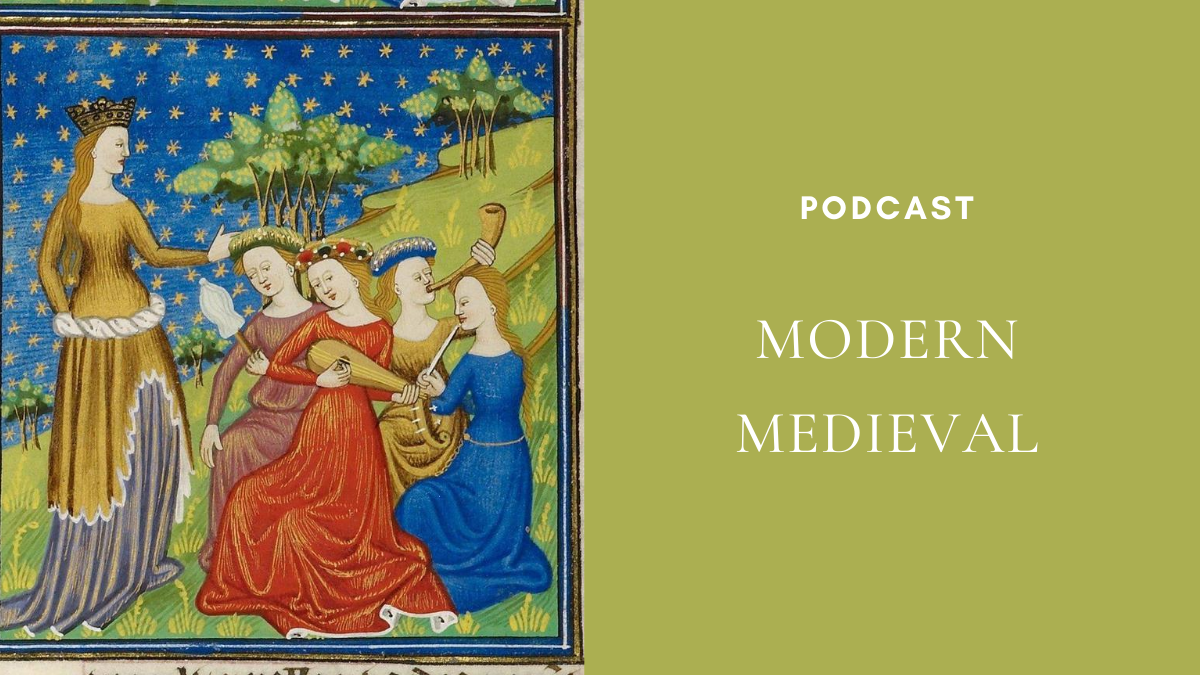
New Podcast: Modern Medieval

Two grad students with little to do but their MA History of Art dissertations finding new ways to procrastinate. Modern Medieval: The Podcast was inspired by a course taken at UCL with Professor Robert Mills titled “Modern Medieval: Revival, Replication, Reception”. Hosted by Meaghan Allen and Eleanora Narbone, the podcast explores various connections between the modern world and the medieval, from pop culture references to marginalia details, Modern Medieval strives to bridge the gap of knowledge in a fun, engaging and accessible way. Lets get Modern Medieval!

You can find us on Apple Podcasts, Spotify and PodBean.

You can also find out more on their Facebook.

New Issue of Peregrinations: Journal of Medieval Art and Architecture

The Autumn 2020 issue of Peregrinations: Journal of Medieval Art and Architecture (Kenyon College) is out now. As always, online access to Peregrinations is free and available to all interested students and scholars.

The current issue features articles highlighting shifts in medieval iconography and its various interpretations. Six book reviews are also included. To access the new issue, please visit Peregrinations’ website.

CFP: ‘Space and the Hospital’ (Lisbon, 26-28 May 2021), deadline: 30 September 2020

The International Network for the History of Hospitals (INHH), the ‘Hospitalis: Hospital Architecture in Portugal at the Dawn of Modernity’, and the ‘Royal Hospital of All Saints: city and public’ health Research Projects are pleased to announce the call for papers for Space and the Hospital. The conference will take place in Lisbon, Portugal from 26-28 May 2021.

Space, in both its physical and conceptual manifestations, has been a part of how hospitals were designed, built, used, and understood within the wider community. By focusing on space, this conference aims to explore this subject through the lens of its architectural, socio-cultural, medical, economic, charitable, ideological, and public conceptualisations.

This thirteenth INHH conference will explore the relationship between space and hospitals throughout history by examining it through the lens of five themes: (1) ritual, space, and architecture; (2) hospitals as ‘model’ spaces; (3) the impact of medical practice and theory on space; (4) hospitality and social space; (5) sponsorship. Below are more details about how the conference themes will address along with related questions. The themes and questions presented are by no means an exhaustive list; however, we encourage the submission of an abstract that examines any aspects of space and the history of hospitals in innovative ways. Please see the attached CfP, or go to our website https://inhh.org/, for a more comprehensive outline of the proposed themes.

We invite proposals for 20-minute papers or posters which address the conference theme. Potential contributors are asked to bear in mind that engagement with the theme of space and the hospital will be a key criterion in determining which papers are accepted onto the programme.

Abstracts should be a maximum of 300 words in length, in English and accompanied by a brief biography of no more than 200 words. Proposals should be sent to space.inhh@gmail.com by 30 September 2020. As with previous INHH conferences, it is intended that an edited volume of the conference papers will be published. Submissions are particularly encouraged from researchers who have not previously given a paper at an INHH conference.

Find out more here.

New Publication: Byzantium in Eastern European Visual Culture in the Late Middle Ages, edited by Maria Alessia Rossi & Alice Isabella Sullivan

Byzantium in Eastern European Visual Culture in the Late Middle Ages, edited by Maria Alessia Rossi and Alice Isabella Sullivan, engages with issues of cultural contact and patronage, as well as the transformation and appropriation of Byzantine artistic, theological, and political models, alongside local traditions, across Eastern Europe. The regions of the Balkan Peninsula, the Carpathian Mountains, and early modern Russia have been treated in scholarship within limited frameworks or excluded altogether from art historical conversations. This volume encourages different readings of the artistic landscapes of Eastern Europe during the late medieval period, highlighting the cultural and artistic productions of individual centers. These ought to be considered individually and as part of larger networks, thus revealing their shared heritage and indebtedness to artistic and cultural models adopted from elsewhere, and especially from Byzantium.

Table of Contents

Introduction, Maria Alessia Rossi and Alice Isabella Sullivan

1. The Allegory of Wisdom in Chrelja’s Tower seen through Philotheos Kokkinos, Justin L. Willson

2. How Byzantine was the Moscow Inauguration of 1498?, Alexandra Vukovich

3. Intellectual Relationships between the Byzantine and Serbian Elites during the Palaiologan Era, Elias Petrou

4. An Unexpected Image of Diplomacy in a Vatican Panel, Marija Mihajlovic-Shipley

5. Byzantine Heritage and Serbian Ruling Ideology in Early Fourteenth-Century Monumental Painting, Maria Alessia Rossi

6. Dečani between the Adriatic Littoral and Byzantium, Ida Sinkević

7. Triconch Churches Sponsored by Serbian and Wallachian Nobility, Jelena Bogdanović

8. Moldavian Art and Architecture between Byzantium and the West, Alice Isabella Sullivan

9. The Byzantine Tradition in Wallachian and Moldavian Embroideries, Henry David Schilb

10. Rethinking the Veglia Altar Frontal from the Victoria and Albert Museum and its Patron, Danijel Ciković and Iva Jazbec Tomaić

Read or order the book here.

New Publication: The Oxford Handbook of Latin Palaeography, Edited by Frank Coulson and Robert Babcock

Latin books are among the most numerous surviving artifacts of the Late Antique, Mediaeval, and Renaissance periods in European history; written in a variety of formats and scripts, they preserve the literary, philosophical, scientific, and religious heritage of the West. The Oxford Handbook of Latin Palaeography surveys these books, with special emphasis on the variety of scripts in which they were written. Palaeography, in the strictest sense, examines how the changing styles of script and the fluctuating shapes of individual letters allow the date and the place of production of books to be determined. More broadly conceived, palaeography examines the totality of early book production, ownership, dissemination, and use. The Oxford Handbook of Latin Palaeography includes essays on major types of script (Uncial, Insular, Beneventan, Visigothic, Gothic, etc.), describing what defines these distinct script types, and outlining when and where they were used. It expands on previous handbooks of the subject by incorporating select essays on less well-studied periods and regions, in particular late mediaeval Eastern Europe. The Oxford Handbook of Latin Palaeography is also distinguished from prior handbooks by its extensive focus on codicology and on the cultural settings and contexts of mediaeval books. Essays treat of various important features, formats, styles, and genres of mediaeval books, and of representative mediaeval libraries as intellectual centers. Additional studies explore questions of orality and the written word, the book trade, glossing and glossaries, and manuscript cataloguing. The extensive plates and figures in the volume will provide readers wtih clear illustrations of the major points, and the succinct bibliographies in each essay will direct them to more detailed works in the field.

Robert G. Babcock teaches Classics at the University of North Carolina at Chapel Hill. He is a Fellow of the Flemish Royal Academy of Belgium, Korrespondierendes Mitglied der Zentraldirektion of Monumenta Germaniae Historica, and has held fellowships from the Alexander von Humboldt-Stiftung and the Belgian Institute for Advanced Studies. His publications focus on Latin manuscripts, Medieval Latin, and the transmission of Classical, Patristic, and Medieval Latin literature. 

Frank T. Coulson is Distinguished Professor of Classics in the Department of Classics at the Ohio State University. He has published widely on the reception of Ovid in the Medieval Ages and is currently finishing a volume for the Catalogus translationum et commentariorum on Ovid’s Metamorphoses. He also serves as the Director of Palaeography for the Center for Epigraphical and Palaeographical Studies.

You can pre-order the book here.

Table of Contents

Forward and Acknowledgements
Introduction: Frank T. Coulson, Department of Classics, The Ohio State University

A. SCRIPT
A.1 Organizing Script
1. Punctuation: Frank T. Coulson, Department of Classics, The Ohio State University
2. Abbreviations: Olaf Pluta, Institut für Philosophie, Ruhr-Universität Bochum
3. Numerals: Charles Burnett, Professor of the History of Islamic Influences on Europe, Warburg Institute
A.2 Greco-Roman Heritage
4. Old Roman Cursive: Teresa De Robertis, Dipartimento di Storia,
Archeologia, Geografia, Arte, Spettacolo – Università di Firenze (Translated from the Italian by Consuelo Dutschke)
5. New Roman Cursive: Teresa De Robertis, Dipartimento di Storia,
Archeologia, Geografia, Arte, Spettacolo – Università di Firenze (Translated from the Italian by Consuelo Dutschke)
6. Square and Rustic Capital: David Wright, The University of California, Berkeley
7. Uncial: Robert G. Babcock, University of North Carolina at Chapel Hill
8. Semi-Uncial: Robert G. Babcock, University of North Carolina at Chapel Hill
9. Greek Scripts in Latin Manuscripts: Walter Berschin, Universität Heidelberg
A.3 Early Medieval Hands
10. Beneventan: Francis Newton, Professor of Latin Emeritus, Duke University
11. Visigothic: Jesus Alturo i Perucho, Universitat Autonoma di Barcelona
12. Luxeuil: Paolo Cherubini, Professore ordinario, Università degli Studi di Milano – Bicocca
13. Merovingian Gaul: David Ganz, Visiting Professor of Palaeography, The Medieval Institute, The University of Notre Dame
14. St. Gall and Alemannic: Anna A. Grotans, Department of Germanic Languages and Literatures, The Ohio State University
15. Insular Script: Peter Stokes, King’s College, University of London
A.4 Carolingian Minuscule
16. Carolingian Minuscule in France and Germany: David Ganz, Visiting Professor of Palaeography, The Medieval Institute, The University of Notre Dame
17. Early Carolingian Minuscule in Italy: Simona Gavinelli, Università Cattolica del S. Cuore, Milano
18. Late Carolingian Minuscule in Italy: Mirella Ferrari, Università Cattolica del S. Cuore, Milano
19. Tironian Notes: David Ganz, Visiting Professor of Palaeography, The Medieval Institute, The University of Notre Dame
A.5 Gothic
20. Nomenclature of Gothic Scripts: Albert Derolez Emeritus Professor at the Free Universities of Brussels
21. French Gothic: Marie-Hélène Tesnière, Conservateur général au département des Manuscrits de La Bibliothèque nationale de France (Translated from the French by Frank T. Coulson)
22. Early English Gothic: Richard Gameson, Durham University
23. Later English Gothic: Pamela Robinson, University of London
24. German Gothic: Karl-Georg Pfaendtner, Bayerische Staatsbibliothek, München
25. Early Italian Gothic: Stefano Zamponi, Università di Firenze (Translated from the Italian by Consuelo Dutschke)
26. Late Italian Gothic: Stefano Zamponi, Università di Firenze (Translated from the Italian by Consuelo Dutschke)
27. Late Dutch Gothic: J.P. Gumbert, Professor Emeritus, Leiden University
28. Czech Republic: Hana Patkova, Charles University, Prague
29. Hungary and Slovakia: Juraj Sedivý, Comenius-University in Bratislava / Faculty of Arts (Translated from the German by Anna A. Grotans and Robert G. Babcock)
30. Interaction of Script and Print: Paul Needham, Scheide Librarian, Princeton University
A.6 Humanist
31. Origins of Humanist Script: Teresa De Robertis, Dipartimento di Storia,
Archeologia, Geografia, Arte, Spettacolo – Università di Firenze (Translated from the Italian by Consuelo Dutschke)
32. Italian Humanist: Teresa De Robertis, Dipartimento di Storia, Archeologia,
Geografia, Arte, Spettacolo – Università di Firenze (Translated from the Italian by Consuelo Dutschke)
33. Byzantium and the West: Marianne Pade, Director, Danish Academy in Rome
A.7
34. The Waning of Manuscript Production: B. Gregory Hays, Department of Classics, University of Virginia

B. MATERIAL EMBODIMENT AND TECHNIQUES
35. Stages of Manuscript Production: Lucien Reynhout, Curator at the Department of Manuscripts Royal Library of Belgium, Brussels, Belgium
36. Stages in Diplomatic Production: Olivier Guyotjeannin, Directeur d’études à l’École nationale des chartes, Paris (Translated from the French by Robert G. Babcock and Frank T. Coulson)
37. Mise-en-page: Marie Hélène Tesnière, Conservateur général au département des Manuscrits de La Bibliothèque nationale de France (Translated from the French by Frank T. Coulson)
38. Format of Books: J.P. Gumbert, Professor Emeritus, Leiden University
39. Format of Documents: Olivier Guyotjeannin, Directeur d’études à l’École nationale des chartes (Paris) (Translated from the French by Robert G. Babcock and Frank T. Coulson)
40. Quantitative Codicology: Ezio Ornato, CNRS, Paris (Translated from the French by Robert G. Babcock and Frank T. Coulson)
41. Comparative Codicology: Malachi Beit-Arié, Professor Emeritus of Codicology and Palaeography, The Hebrew University of Jerusalem
42. Pen Flourishing: Alison Stones, Professor Emeritus, University of Pittsburgh

C. CULTURAL SETTING
43. Orality and Visible Culture: Paul Saenger, Newberry Library, Chicago
44. Who Were the Scribes: Alison Beach, Department of History, The Ohio State University
45. Book Trade: Antiquity and the Early Middle Ages: Guglielmo Cavallo, Accademia Nazionale dei Lincei, Roma
46. Book Trade: Central, High and Late Middle Ages: Kouky Fianu, Université d’Ottawa/University of Ottawa

D. SELECTED SCRIPTORIA AND LIBRARIES
47. An Overview: Donatella Nebbiai, Institut de recherche et d’histoire des textes, Paris (Translated from the French by Frank T. Coulson)
48. Lindisfarne: Michelle P. Brown FSA, Professor Emerita, SAS, University of London
49. Northern Italy in the 7th and 8th Centuries: Paolo Cherubini, Professore ordinario, Università degli Studi di Milano – Bicocca
50. Insular Script in its Cultural Context: Michelle P. Brown, FSA, Professor Emerita, SAS, University of London
51. Montecassino: Francis Newton, Professor of Latin Emeritus, Duke University
52. St. Gall: Anna A. Grotans, Department of Germanic Languages and Literatures, The Ohio State University
53. University of Paris: Richard and Mary Rouse, University of California, Los Angeles
54. Salisbury Cathedral Library: Teresa Webber, Trinity College, Cambridge
55. Florence: Xavier van Binnebeke, Bodleian Library, Oxford

E. VARIETIES OF BOOK USAGE
56. Books of Hours: Rowan Watson. Senior Curator, National Art Library, Word & Image Department, Victoria and Albert Museum
57. Law: Susan L’Engle, Center for Medieval and Renaissance Studies, St. Louis University
58. The Manuscript Miscellany: George Rigg, Professor Emeritus, University of Toronto
59. Florilegia: Jacqueline Hamesse, Professor Emerita, L’Université catholique de Louvain
60. Theological Texts: Lesley Smith, Professor of Medieval Intellectual History, University of Oxford, Fellow in Politics and Senior Tutor, Harris Manchester College
61. Gloss and Text: Greti Dinkova-Bruun, Pontifical Institute of Mediaeval Studies, Toronto
62. Glossaries and Grammars: Patrizia Lendinara, Dipartimento Culture e Società, Università di Palermo
63. The History of Manuscripts since 1500: B. Gregory Hays, Department of Classics, University of Virginia
64. Manuscript Cataloguing: Consuelo Dutschke, Columbia University

The ICMA’s Statement On Executive Orders Regarding Monuments

On July 31, 2020, the International Center of Medieval Art (ICMA) released its official statement regarding current discourses on the creation, history, reception, and destruction of monuments. The Statement also reflects on Executive Orders concerning classical and Federal architecture and its promotion and reception in America.

To read the statement in full, please visit the ICMA’s website here.

CFP: Marco Manuscript Workshop 2021: ‘Immaterial Culture’ (5-6 February 2021), deadline 9 October 2020

Remotely from the Marco Institute for Medieval and Renaissance Studies, the University of Tennessee, Knoxville

Presenters will receive a $500 honorarium for their participation. The sixteenth annual Marco Manuscript Workshop will take place Friday, February 5, and Saturday, February 6, 2021. Sessions will meet virtually via an online platform.

The workshop is led by Professors Maura K. Lafferty (Classics) and Roy M. Liuzza (English), and is hosted by the Marco Institute for Medieval and Renaissance Studies at the University of Tennessee, Knoxville.

This year’s workshop will consider some of the recent challenges that researchers have faced with the suspension of travel, the closing of libraries and universities, and the quarantine restrictions that have kept so many of us in our homes.

How can our field, which has always emphasized the importance of physical place and tactile artifacts, work successfully in isolation and at a distance? What does it mean for us when our work takes place in an incorporeal world of light and numbers rather than ink and flesh, in matrices of data rather than dusty rooms?

We propose to explore the advantages and disadvantages of this “immaterial culture,” and to think about how our work is shaped by access or lack of access to manuscripts, texts, catalogues, and objects. We would like to hear about experiences working remotely, discoveries made using virtual archives or catalogues, or advice on how to study manuscripts without visiting archives or how to teach codicology without a library. We welcome stories of scholars who have been productive in constrained circumstances.

We would also like to learn from the experience of those for whom archives have been inaccessible for other reasons – scholars who are homebound, visually impaired, or otherwise physically challenged, or those whose access to libraries and collections has been restricted or denied. How have these constraints shaped your work? What can these experiences tell us about our discipline? We welcome presentations on any aspect of this topic, broadly imagined.The workshop is open to scholars and graduate students in any field who are engaged in textual editing, manuscript studies, or epigraphy.

This year’s workshop will be virtual, but we hope to retain as much of the format and the flavor of our in-person meetings as possible. Individual 75-minute sessions will be devoted to each project; participants will be asked to introduce their text and its context, discuss their approach to working with their material, and exchange ideas and information with other participants.

We will prepare an online repository where presenters can place abstracts, presentations, or supporting material for access by all attendees. As in previous years, the workshop is intended to be more like a class than a conference; participants are encouraged to share new discoveries and unfinished work, to discuss both their successes and frustrations, to offer practical advice and theoretical insights, and to work together towards developing better professional skills for textual and codicological work.

We particularly invite the presentation of works in progress, unusual problems, practical difficulties, and new or experimental models for studying or representing manuscript texts.The deadline for applications is October 9, 2020.

Applicants are asked to submit a current CV and a two-page abstract of their project to Roy M. Liuzza, preferably via email to rliuzza@utk.edu.

The workshop is also open at no cost to scholars and students who do not wish to present their own work but are interested in sharing a lively weekend of discussion and ideas about manuscript studies. In order to keep the virtual sessions manageable, preregistration will be required and spaces will be limited.

Further details will be available later in the year; please contact the Marco Institute at marco@utk.edu for more information.

Online Exhibition: Celebrating 800 Years of Spirit & Endeavour at Salisbury Cathedral

On the 800th anniversary of the laying of its foundation stones Salisbury Cathedral is launching a virtual version of Celebrating 800 years of Spirit and Endeavour, its largest contemporary art exhibition for nearly two decades. A special service of words and music is programmed to mark this important day in the life of Salisbury Cathedral – click here for details. 

Celebrating 800 years of Spirit and Endeavour brings together work from some of the most important and influential contemporary artists of the 20th and 21st century, including Antony Gormley, Shirazeh Houshiary, Henry Moore, Grayson Perry, Conrad Shawcross, Stanza and Mark Wallinger. Pieces from the Cathedral’s permanent collect have also been incorporated into this exhibition, including sculptures by Dame Elisabeth Frink, Dame Barbara Hepworth and Helaine Blumenfeld.

Please note that this tour is best viewed using a computer or laptop.

View the entire online exhibition here.

Online Workshop: Digital Tools for Teaching Medieval Art

The International Center of Medieval Art (ICMA) is hosting an online workshop on Digital Tools for Teaching on Friday, August 14 at 12:00pm EST. Led by Rheagan Martin, the ICMA’s Coordinator for Digital Engagement, the workshop will focus on a comparison of the capabilities of ArtSteps and Omeka, two virtual exhibition platforms, as well as a demonstration of VoiceThread—a tool for commenting on slideshows and videos with a variety of media including audio, video, and sketching. The demonstration will be followed with discussion, so please bring your questions and insights! No previous experience with these platforms is necessary.

Registration is required. Please sign up here.

New Publication: Christian Maps of the Holy Land: Images and Meanings, by Pnina Arad

An innovative approach to Christian maps of the Holy Land, exploring their devotional imagery.

This book offers a way of reading maps of the Holy Land as visual imagery with religious connotations. Through a corpus of representative examples created between the sixth and the nineteenth centuries, it studies the maps as iconic imagery of an iconic landscape and analyses their strategies to manifest the spiritual quality of the biblical topography, to support religious tenets, and to construct and preserve cultural memory.

Maps of the Holy Land have thus far been studied with methodologies such as cartography and historical geography, while the main question addressed was the reliability of the maps as cartographic documents. Through another perspective and using the methodology of visual studies, this book reveals that maps of the Holy Land constructed religious messages and were significant instruments through which different Christian cultures (Byzantine, Catholic, Protestant, and Greek Orthodox) shaped their religious identities. It does not seek to ascertain how the maps delivered geographical information, but rather how they utilized the geographical information in formulating religious and cultural values.

Through its examination of maps of the Holy Land, this book thus explores both Christian visual culture and Christian spirituality throughout the centuries.

Pnina Arad is a research fellow at the Center for the Study of Conversion and Interreligious Encounters at Ben-Gurion University. Her publications focus on visual representations of the Holy Land and the cultural role they have played for different societies from the Middle Ages to the present.

Order the book here.

Table of Contents

  • List of Illustrations
  • Abbreviations
  • Timeline
  • Introduction

Part I. Iconic Landscape, Iconic Map

Chapter 1. Formation of a Holy Land

Chapter 2. Madaba Map: A Visual Portrait of the Holy Land from the Byzantine Period

  • Composition and Content
  • Religious Message
  • Generator of Cultural Memory
  • Map and Pilgrimage
  • The Holy Land Map and Early Christian Art

Part II. The Map of the Holy Land in the Latin West

Chapter 3. Innovative Western Spiritual Iconographies

  • Twelfth-Century Maps
  • Matthew Paris’s Map in his Chronica majora (mid thirteenth century)
  • Grid Maps from the Fourteenth Century

Chapter 4. Fifteenth-Century Pilgrims’ Maps: Late Medieval Instruments of Devotion

  • Gabriel Capodilista’s Map
  • William Wey’s Map
  • Bernhard von Breydenbach’s Map
  • A Map by an Anonymous Author

Part III. Between Pilgrimage and Scripture, Catholicism and Protestantism

Chapter 5. Friedrich III’s Cartographical Pilgrimage Imagery

  • Lucas Cranach the Elder’s Map: A Transitional Image
  • Gotha Panel

Chapter 6. Map and Scripture

  • Gerard Mercator’s Map of the Holy Land
  • John Speed’s Map, Associated with the King James Bible
  • Maps of the Holy Land in the Dutch States-General Bible
  • Justus and Cornelis Danckerts’ Map of the Holy Land: A Pictorial Epitome

Part IV. Map as Icon: Greek Orthodox proskynetaria from the Ottoman period

Chapter 7. Icon of a Land

Conclusion

Appendices

  • I. Inscriptions on the Madaba Map
  • II. Sites Mentioned in the Pilgrimage Guide of Gesta Francorum Ihrusalem expugnantium (dated to 1101–1104) in Order of Appearance)
  • III. Inscriptions on Three Twelfth-Century Maps of the Holy Land
  • IV. Inscriptions on London, British Library, Add. MS 27376, fols. 188v–189r
  • V. A List of Places in William Wey’s Pilgrimage Account (Oxford, Bodleian Library,MS Bodley 565), said to be synchronized with his map of the Holy Land
  • VI. Sites in and around Jerusalem in Bernhard von Breydenbach’s Map of the Holy Land

Bibliography

Index