Online Lecture: ‘Mining the Collection’ with Joshua O’Driscoll (The Morgan Library and Museum), 19 November 2020, 11:00 am (ET)

The ICMA are delighted to invite you to their third instalment of Mining the Collection.

Joshua O’Driscoll, Assistant Curator of Medieval and Renaissance Manuscripts at The Morgan Library and Museum, will present a fourteenth-century Italian Breviary with intriguing illuminations.

Please join them on Thursday, November 19th at 11:00 am ET for a brief presentation of this fascinating manuscript followed by an informal discussion. Sign up here.

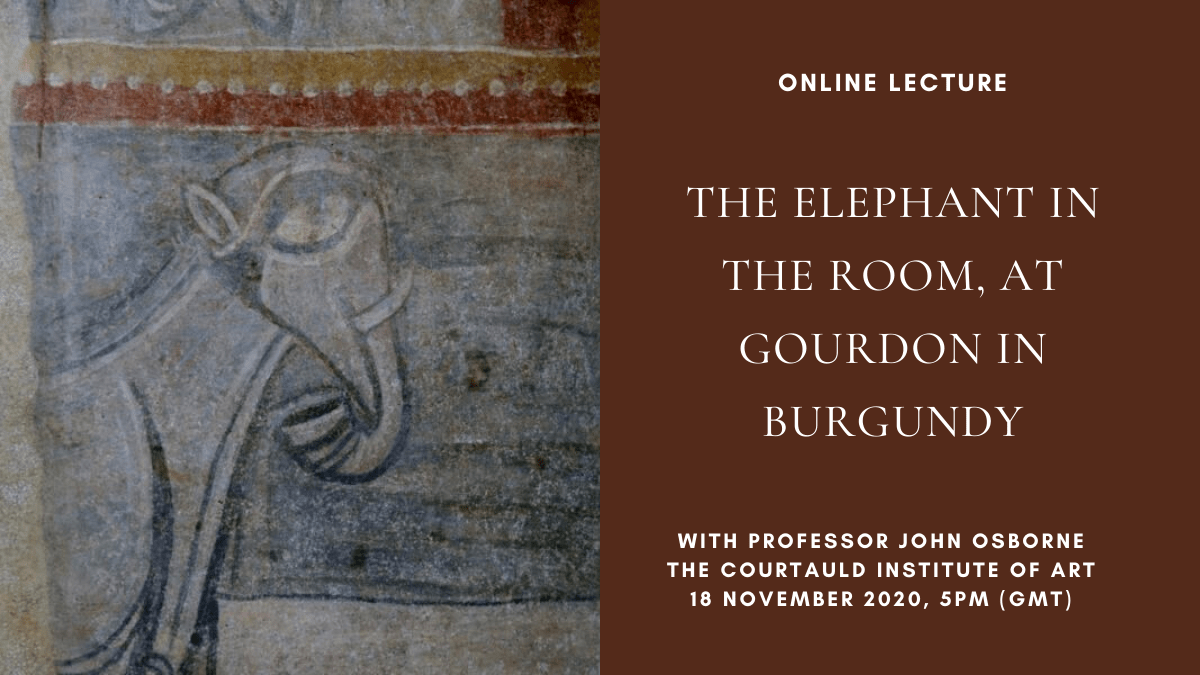
Online Lecture: ‘The Elephant in the Room, at Gourdon in Burgundy’ with Professor John Osborne, 18 November 2020, 5pm (GMT)

This talk explores the fragmentary twelfth-century mural depicting an elephant, situated in the lowermost zone, or dado, of the choir wall in the church of Notre-Dame-de-l’Assomption at Gourdon, a small village in the Charolais district of Burgundy. This painting is unique in France, but its presence has attracted little attention, let alone any further consideration of its meaning and function. Some light can perhaps be shed on these issues by considering the mural in the larger context of dado imagery in western Europe in the central Middle Ages, as well as through an exploration of how medieval audiences knew about and understood elephants. Using texts such as the Bestiary, in which elephants are associated with the virtues of modesty and chastity, it will be proposed that the Gourdon elephant was intended to remind viewers of the theology underlying the selection of Mary, who is depicted receiving the archangel Gabriel’s greeting in a depiction of the Annunciation placed directly above. 


Professor John Osborne is a cultural historian of the early medieval Mediterranean, with a specific interest in the material culture of the cities of Rome and Venice.  He has also written more broadly on the topography of medieval Rome, saints’ cults, cultural transmission between western Europe and Byzantium, the Roman catacombs, and Counter-Reformation interest in Early Christian and medieval antiquities.  Following a “conversion” experience in Venice in the summer of 1970, he pursued a B.A. in art history at Carleton, followed by an interdisciplinary Master’s in Medieval Studies at the University of Toronto.  His doctoral thesis at the University of London (Courtauld Institute of Art) examined the early medieval paintings in the excavated “lower church” of San Clemente, Rome.  Subsequently he has spent part of every year in Rome, based at The British School, which in 2006 appointed him as an Honorary Fellow.  He taught at the University of Victoria (1979-2001), and Queen’s University (2001-2005), before returning to Carleton in 2005 as Dean of the Faculty of Arts and Social Sciences.

This is a live online event.  Please register for more details. The platform and log in details will be sent to attendees at least 48 hours before the event. Please note that registration closes 30 minutes before the event start time. If you have not received the log in details or have any further queries, please contact researchforum@courtauld.ac.uk

Book your place here.

Journal Submissions: Special Issue of Heritage: ‘New Advances in Stained Glass Research: Materials, Production Techniques and Conservation’, deadline 31 August 2021

Heritage, an international peer-reviewed open access journal of cultural and natural heritage science published quarterly by MDPI, has just launched the call for papers for a special issue entitled ‘New advances in stained glass research: materials, production techniques and conservation‘.

Many wrote about stained glass, but one must witness its splendour to understand the meaning of the words, the game of light and shadow, with coloured and colourless glass decorated with painted motifs. However, historic stained glass windows are exposed to the passage of time, facing physical attack and weathering conditions over time. Further changes introduced by restorations, reconstructions and interventions along with the degradation have a strong impact on the stained glass windows that we see today. Fortunately, scientific and technological advancements give, now, new and wider opportunities for preserving, sharing cultural heritage and better interpret its history, both in terms of manufacturing and past restoration actions.  

This issue is dedicated to:
– the technical aspects of the production of historical stained glass windows
– the degradation of stained glass
– stained glass conservation
– the importance of databases in the field of stained glass research

This Special Issue will also be open to contributions dealing with other subjects related to the major research themes mentioned above.

Dr. Marcia Vilarigues
Dr. Sophie Wolf
Dr. Teresa Palomar
Guest Editors

Original research papers and articles providing an up-to-date critical overview of the research in one of the above mentioned fields are invited. Manuscripts may be submitted from now until 31 August 2021 via the journal’s website. Articles will be available online as soon as they are accepted. The official launch of the special issue will be in January 2022 and coincide with the beginning of the International Year of Glass.

Heritage is an open access journal. The Article Processing Charge (APC) for publication is 1000 CHF (Swiss Francs). However, the publisher MDPI has several policies in place to support authors who cannot afford the APC. Please contact the Heritage Editorial Office (ginny.zhang@mdpi.com) for further information and conditions for support.

Online Lecture: ‘Evidence for the Liturgical Use of Thirteenth-century Bibles’ with Laura Light, IHR European History 1150-1550, 16 November 2020, 5:30-7:30pm (GMT)

In this overview, we will begin with twelfth-century Bibles, before turning to the thirteenth century, exploring selected case studies of Bibles used for the Mass and the Divine Office.  The evidence is abundant, but does pose puzzles, including the central one of format.  How were very small Bibles used for the Mass and Office? Historians of the thirteenth-century Bible have always presented it as a new phenomenon, and anyone who has held a very small one-volume Bible from the thirteenth century knows that this is true.  But that is not the end of the story.  These “new” Bibles were also used and understood in very traditional ways, especially within the context of the public liturgy of the medieval church.  Continuity and innovation, I would argue, are both important.

Laura Light it as director and senior specialist at Les Enluminures. She has published widely on the Paris Bible and its precursors, including an exhibition catalogue on the Bible for Harvard University, where she worked as cataloguer of medieval manuscripts at the Houghton Library. She has edited “Form and Function in the Late Medieval Bible” – a collection on the manuscript evidence and the historical significance of late medieval Bibles.

All welcome- but booking is required. Register here.

Online Lecture: ‘Mail-order Mihrabs: Kashan Tiles and Architectural Design in Iran, c. 1200-1330’ with Dr Patricia Blessing, 17 November 2020, 12:00pm (EST)

Medieval Studies at Princeton University is excited for their new upcoming online lecture by Dr Patricia Blessing on: ‘Mail-order Mihrabs: Kashan Tiles and Architectural Design in Iran, c. 1200-1330’, as part of the Medieval Studies Virtual Faculty Colloquium. This talk will take place on Tuesday 17th November 2020 at 12pm (EST).

The city of Kashan in Iran, an oasis located 240 km south of Tehran to the east of the desert of the Dasht-i Kavir, was a major center of ceramic production from the late twelfth to the mid-fourteenth century. One of the hallmarks of this production were luster tiles that were used to clad the dado zones and mihrabs of mosques and mausolea. These tiles were installed locations ranging from major Shi’a holy sites such as the shrine of Imam Reza in Mashhad in eastern Iran to smaller tombs as far as Azerbaijan. Yet despite more than a century of extensive research and publications about the luster industry of Kashan, two simple questions have not been asked: How were the tiles designed to fit the buildings, and how were they transported from Kashan to their destinations? This talk will pursue these questions, attending to issues of design practices, scale, transportation and logistics in medieval Iran.

Patricia Blessing is Assistant Professor of Islamic Art History in the Department of Art & Archaeology, specializing in the art and architecture of the Islamic world, with a focus on the eastern Mediterranean and Iran from the twelfth to the fifteenth centuries.

Registration is required.

Please register here for this colloquium to receive the Zoom instructions, and be sure to add this event to your calendar.

For any questions please contact: Sarah Porter.

Visit the Princeton University Program in Medieval Studies to view all upcoming events.

Dissertation Prize: South Asia Art Initiative at UC Berkeley, deadline 1 December 2020

The South Asia Art Initiative at UC Berkeley invites submissions of doctoral dissertations for the annual UC Berkeley South Asia Art & Architecture Dissertation Prize. The prize will be awarded to an outstanding doctoral dissertation on the art, architecture, or visual cultures of South Asia and its diasporas from any discipline in the arts, humanities, or social sciences. The dissertation may focus on any time period from the prehistoric to the contemporary. The prize comes with a $1,500 award.

Ph.D. dissertations submitted for consideration must have been filed between September 2, 2018 and September 1, 2020 at an accredited university in North America or Europe. The submission package must include the following: a pdf abstract (< 1000 words); a pdf curriculum vitae (please include your contact information); a pdf copy of the dissertation; and a confidential letter from a member of the dissertation committee that speaks to the merits of the dissertation with respect to the current state of the field and the innovation that the work attempts.

The 2020 Prize Committee: Atreyee Gupta (Chair, University of California, Berkeley), Navina Najat Haidar (The Metropolitan Museum of Art), Partha Mitter (Emeritus Professor, University of Sussex), Tamara Sears (Rutgers University)

Deadline: The submission package for the prize must be in English and submitted via email to Puneeta Kala <pkala@berkeley.edu> by December 1, 2020. Late submissions will not be accepted. The result for the 2020 prize recipient will be announced on the South Asia Art Initiative website on February 14, 2021. The winner will give a talk in conjunction with an expenses-paid award conferral ceremony at UC Berkeley in April 2021. If there are continued COVID-19 travel restrictions, the award ceremony in 2021 may be held through a virtual platform. For more details, please see: https://southasia.berkeley.edu/art-awards

The South Asia Art Initiative
Institute for South Asia Studies
University of California, Berkeley
10 Stephens Hall
Berkeley, CA 94720
https://southasia.berkeley.edu/south-asia-art-initiative

The South Asia Art Initiative at the University of California, Berkeley promotes research-based conversations and collaborations around the arts of South Asia + its diasporas from the ancient period to the now.

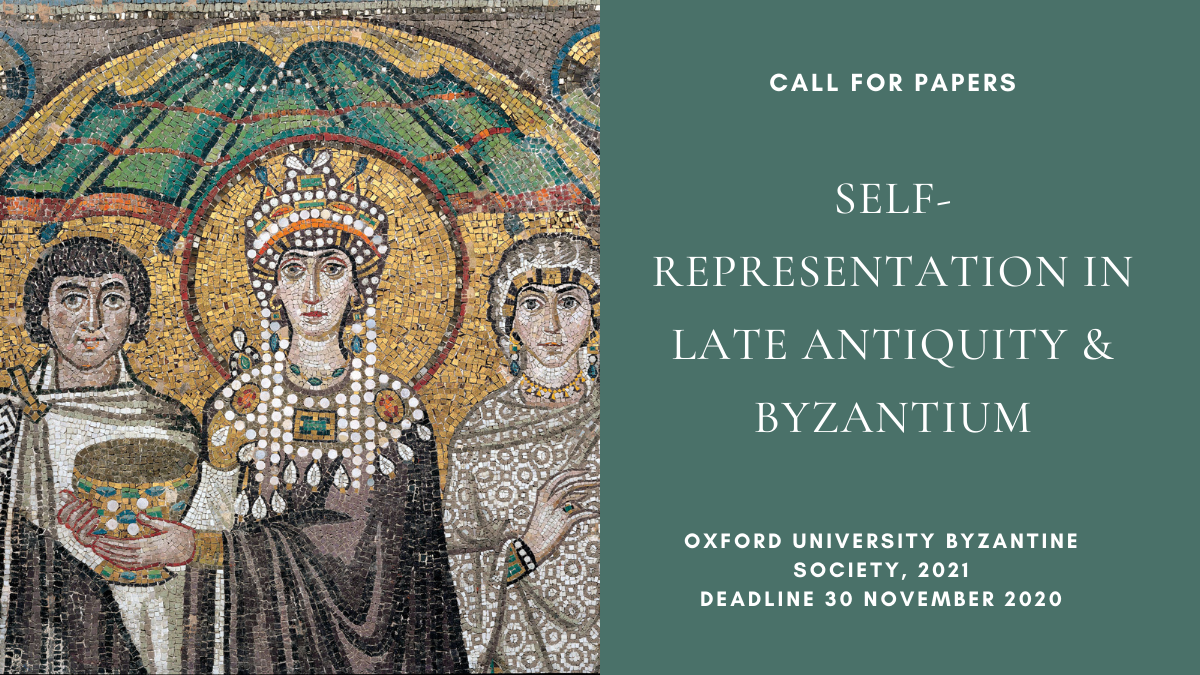
CFP: ‘Self-Representation in Late Antiquity & Byzantium’ Oxford University Byzantine Society Conference 2021, deadline 30 November 2020

23rd International Graduate Conference of the Oxford University Byzantine Society

Self-representation is a process by which historical actors – individuals, communities and institutions – fashioned and presented a complex image of themselves through various media.

Referring to Byzantine portraits, Spatharakis claimed that this “form of representation cannot be divorced from its purpose and the requirements of the society in which the given visual language gains currency”. Equally, self-representation provides an original way to interpret the past, because this artificial and reflected image cannot be divorced from the cultural, social, economic, religious and political context of its time. As a methodological tool, it has received increasing attention in the field of Late Antique and Byzantine Studies, following the interest it has created in neighbouring fields such as Western Medieval or Early Modern studies.

The present call for papers aims to explore the cultural outputs of the Late Antique and Byzantine world – e.g. architecture, material culture, literary works – which conventionally or unconventionally can be understood as acts of self-representation. The Late Antique and Byzantine world was filled with voices and images trying to present and represent an idea of self. Some of the most famous examples of this are the lavish mosaics sponsored by imperial and aristocratic patrons, whose splendour still dazzles their observers and gives an idea of the kind of self-fashioning that they embody. Urban elites, such as churchmen, bureaucrats and intellectuals, constructed idealised personae through their literary works and the careful compilation of letter collections, while provincial elites displayed their power through sigillographic imagery and inscriptions. In monastic typika, the founders presented themselves as pious benefactors, while donor epigraphy in rural churches secured the local influence of wealthier peasants. However, self-representation is not only a matter of introspection but also of dialogue with the “other”: such as in the case of spolia, which was used to reincorporate a supposed classical past in one’s self-portrayal, or to create an image of continuity by conquerors. We see this clearly in the conscious use of Byzantine motifs in Islamicate architecture, in the fiction of Digenes Akritas, and in the anti-Jewish and anti-Islamic religious polemics of Late Byzantium. Through depicting what they were not, historical actors were (consciously or unconsciously) shaping their own identity.

Manuscripts: from the commission of the material object itself, to the self-portraits jotted down in the margins by its owners or readers;

This conference, to be held in late February 2021, seeks to join the ongoing dialogue on self-representation in Late Antique and Byzantine Studies by providing a forum for postgraduate and early-career scholars to reflect on this theme in a variety of cultural media. In doing so, we hope to facilitate the interaction and engagement of historians, philologists, archaeologists, art historians, theologians and specialists in material culture. To that end, we encourage submissions from all graduate students and young researchers, encompassing, but not limited to, the following themes:

  • Literary works: self-portrayal in epistolographical collections; autobiographies; fictional personae in poetical and prose compositions; typika portraying an image of a founder or donor;
  • Portrayal of oneself in terms of gender and sexuality;
  • Epigraphy: material sponsored by both authorities and private citizens; self-representation on funerary artefacts, graffiti, inscriptions;
  • Numismatics: representation of power and authority in the world of Late Antiquity and Byzantium at large;
  • Sigillography: elite self-representation and its importance among the Byzantine upper classes;
  • Artistic production: portrayals in mosaics and icons; private and public forms of representation;
  • Gift-giving: Elite items (e.g. cloths, manuscripts, jewellery) intended for use in diplomatic exchange which were designed to promote a specific image of an emperor and the empire;
  • Political ideology: imperial or ecclesiastical messaging through literary works and monumental architecture;
  • Religion: different theological or philosophical stances, dogmatic truths or polemics as means of self-promotion or self-portrayal;
  • Dialogue with “the other”: Byzantium’s influence in neighbouring cultures as a consequence of its self-representation;
  • Reception: how the field of Late Antique and Byzantine Studies is influenced by the modern-day reception of the self-representation of historical actors;
  • Reception: how the field of Late Antique and Byzantine Studies is influenced by historical Western conceptions of the Late Antique and Byzantine world;
  • Comparative perspectives of the above elsewhere, in opposition or concordance with practices in Byzantium.

Please send an abstract of no more than 250 words, along with a short academic biography written in the third person, to the Oxford University Byzantine Society at byzantine.society@gmail.com by Monday 30th November 2020.

Papers should be 20 minutes in length and may be delivered in English or French. As with previous conferences, there will be a publication of selected papers, chosen and reviewed by specialists from the University of Oxford in Late Antique and Byzantine Studies.

Speakers wishing to have their papers considered for publication should try to be as close to the theme as possible in their abstract and paper. Nevertheless, all submissions are warmly invited.

Find out more information here.

Online Animation: ‘King Oswald’s Raven’

Peterborough Cathedral is delighted to host, via its website, King Oswald’s Raven, an animation and a series of online activities that are part of the 2020 Being Human Festival.

King Oswald’s Raven is a new animation developed by researchers at University College London and King’s College London. The five minute video tells the comic German legend about Peterborough’s most important medieval saint: Oswald of Northumbria.

The animation King Oswald’s Raven uses imagery from the Peterborough Bestiary, a medieval book containing descriptions of animals, to tell the comic German legend of King Oswald of Northumbria’s sassy pet raven.

Oswald was a Christian king of Northumbria who died in battle in 642, slain by the Mercian king Penda, he was soon venerated as a saint.  By the time of the Norman Conquest the most famous relic associated with this saint-king, his incorrupt right arm, was in the possession of the monks of Peterborough.  The arm was kept in a shrine in the chapel dedicated to Oswald in the south transept of the abbey church and was of paramount importance to the religious life of the monastic community.

Soon after his death, Oswald’s fame had spread overseas and through the centuries links between England and German-speaking lands strengthened his cult on the Continent. He became a particularly popular saint in southern Germany where, at some point in the high Middle Ages, his legend underwent a surprising metamorphosis: Oswald was transformed from a pious and austere martyr king into a rather comic figure, overshadowed by his talking raven.

The development of King Oswald’s Raven has been supported by UCL Culture, UCL History, King’s College London German and The Parker Library at Corpus Christi College, Cambridge, which is home to the Peterborough Bestiary. We are really proud to be launching the animation with Peterborough Cathedral as part of the Being Human Festival, the UK’s only national festival for the humanities, taking place 12-22 November. For further information please see beinghumanfestival.org.

King Oswald’s Raven will be available to view on Peterborough Cathedral’s website from 11:30am on Thursday 12th November.

Find out more here and here.

Online Lecture: ‘Picturing West Lake: The Poetics & Representation of an Iconic Place’ with with Dr Hui-shu Lee, East Asian Studies Program, Princeton University, 11 November 2020, 4:30pm (EST)

Picturing West Lake explores how a pictorial tradition in the representation of an iconic place was emplaced, fashioned, refashioned, transmuted and transmitted over time to convey cultural value, historical memory, political ideology, and artistic expression.   

Adjacent to the historically affluent city of Hangzhou in Zhejiang province and long celebrated for its natural beauty, West Lake became iconized for its singular role in the expression of art and culture with the establishment of Lin’an (Hangzhou) as the capital for the latter half of the Song dynasty (1127-1279). By the thirteenth century, a unique visual paradigm had evolved and over time the representation of West Lake in words and images proliferated as it was immortalized as a site of memory and culture. This reached an apogee during the eighteenth century of the Qing dynasty, when the representation of the place witnessed a renaissance in myriad forms and media of artistic production.

In my pursuit of the study of West Lake and its visual representation over time, some essential inquires have arisen. Looking beyond its physical charm, what factors were at play to make West Lake a unique cultural space and a locus in the representation of famous place? How was the representational paradigm in the visual depiction of the place established and how was the place iconized to become a site of memory after the downfall of the Southern Song? What insight can an investigation of the evolution of a single site through history – such as its changing representational status in mapped or painted media – provide? How are the salient features of a Chinese famous place like West Lake revealed, represented, emplaced, and “re-implaced” to become iconic? And lastly, how and why could a sustained mode in the pictorial representation of West Lake so prominently persist in the collective Chinese imagination for over six hundred years and beyond?

Focusing on the two quintessential visual modes in the representation of a Chinese place, linear/planimetric maps, tu圖, and painterly/lyrical paintings, hua畫, this talk is an attempt to address some of these inquires. At the same time, I hope to demonstrate the uniqueness of West Lake as a microcosmic site in a multifaceted cultural discourse involved with the poetics of representing place.

Hui-shu Lee is Professor of the Department of Art History at UCLA and a specialist in Chinese art history.  She received her doctorate degree from Yale University in 1994 after first studying at National Taiwan University and working in the National Palace Museum. Her field of specialization is Chinese painting and visual culture, with a particular focus on gender issues.  These include imperial female agency of the Song dynasty (960-1279) and dimensions of shifting gender persona in late imperial China. Other areas of research are the cultural mapping of Hangzhou and the representation of West Lake since the Southern Song (1127-1279), courtesan culture of Ming-Qing dynastic transition, the seventeenth-century individualist painter Bada Shanren (1626 -1705), and a number of modern and contemporary artists. Among her publications are Exquisite Moments: West Lake & Southern Song Art (New York: China Institute, 2001) and Empresses, Art, and Agency in Song Dynasty China (Seattle: University of Washington Press, 2010). Currently, she is working on two book projects: Shifting Gender Persona in Chinese Art and West Lake & the Representation of An Iconic Place (upcoming with Zhejiang University Press). In addition, extended from her research on Song art and culture she has also taken on “Poetics of Song Gardens” as another book plan, as well as a newly initiated research and exhibition project on the cliff inscriptions along the ancient “Shudao, or Roads to Shu.”  

李慧漱,畢業于台灣大學歷史系、台灣大學歷史研究所藝術史組碩士、美國耶魯大學藝術史博士,曾任職於國立故宮博物院、香港科技大學人文學部與美國史丹福大學,目前任職美國加州大學洛杉磯校區藝術史系教授,專長為中國藝術與視覺文化,尤其以宋畫與南宋藝術領域為其研究特長,並對女性議題深入探討。學術論著與出版涉及宋代書畫與園林、南宋杭州與西湖、女性與中國藝術史的建構、性別發聲與跨越, 以及晚明文化與八大山人; 偶亦涉獵現代與當代藝術。代表著作有:

Exquisite Moments: West Lake & Southern Song Art (New York: China Institute, 2001). Empresses, Art, and Agency in Song Dynasty China (Seattle: University of Washington Press, 2010). 目前除了兩部書稿:性別聲音與藝術 (Shifting Gender Persona in Chinese Art ) ,以及《西湖清趣图》与临安胜景图像的再现 (West Lake and the Representation of An Iconic Place)之外; 同時進行的項目有“宋代園林”(Poetics of Song Gardens), 以及  “蜀道石刻題記與山水”(“ The Roads to Shu: Landscape, Ecology, and Writings in Stone.”)。

Find out more here and register here.

Online Lecture: Picturing Medieval Myths & History: Making ‘Storyland’ & Visualising Becket’s Shrine, with Dr Amy Jeffs & Dr John Jenkins, University of Kent MEMS, 12 November 2020, 6pm (GMT)

Join the Centre of Medieval and Early Modern Studies for this week’s seminar: Picturing Medieval Myths & History: Making ‘Storyland’ & Visualising Becket’s Shrine with Dr Amy Jeffs & Dr John Jenkins.

This seminar will showcase the groundbreaking work of two early career scholars, who are applying their expertise in medieval myths / history to their development of new creative projects and didactic, digital visualisations. 

You can access the seminar using this link.

Dr Amy Jeffs, who has worked as an assistant curator at the British Museum, contributed to the Polonsky Project at the British Library, and helped to shape the Paul Mellon-funded Digital Pilgrim interface, recently completed her PhD from the University of Cambridge, working with Prof Paul Binski. Her doctoral research examined c1330–40s English illustrated manuscripts of histories and romance. She is now finishing her first book, Storylandwhich will retell English medieval myths alongside her own evocative linocut illustrations.

Dr John Jenkins, who obtained his PhD from Oxford, is a post-doctoral researcher at the University of York, based in the Centre for the Study of Christianity and Culture. He is one of the key developers of the Becket 2020 anniversary commemorations, leading the AHRC-funded ‘Becket Story’ activities. He has worked extensively on the history of devotion to Thomas Becket (in Canterbury, London, York and beyond) and his recent article, published on the 800th anniversary of Becket’s ‘translatio’ (on 7 July 2020) includes the first-ever digital reconstruction of the lost shrine in the Trinity Chapel.