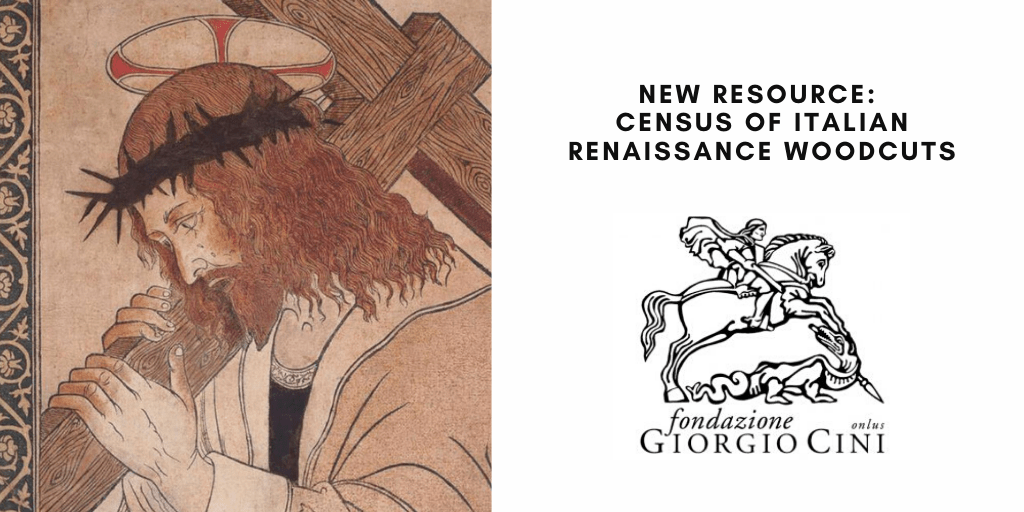
Please note the existence of a new resource, which has just gone live: The online Census of Italian Renaissance Woodcuts. The Census team have traced, studied and catalogued all single-leaf woodcuts and woodblocks made in Italy from the earliest known use of this medium to about 1550.
Author Archives: Roisin Astell
Essay Prize: XXI Medievalism Prize, Sociedad Española Estudios Medievales, deadline 31 December 2020

The XXI Medievalism Prize welcomes applications according to the following bases: Participants may not be older than 30 years and must be members of the Spanish Society for Medieval Studies in active service, that is, up to date with their annual quota. The work presented will deal with topics related to any manifestation of the Middle Ages,Continue reading “Essay Prize: XXI Medievalism Prize, Sociedad Española Estudios Medievales, deadline 31 December 2020”
New Journal Issue: Speculum: A Journal of Medieval Studies, July 2020

The latest issue of Speculum is now available on the University of Chicago Press Journals website: Speculum: A Journal of Medieval Studies, Volume 95, Number 3, July 2020.
New Journal Issue: Al Masaq: Islam and the Medieval Mediterranean

Volume 32, Number 2, 3 May 2020. ISSN 0950-3110 (Print); ISSN 1473-348X (Online) Philippa Byrne, “Reddimus urbem”: Civic Order and Public Politics at the End of Norman Sicily, pp. 125-139 Hana Taragan, Textiles in Cross-Cultural Encounters: The Case of the Umayyad Palace at Khirbat al-Mafjar, pp. 140-155 Antonios Vratimos, Joseph Tarchaneiotes and the Battle of Mantzikert (AD 1071), pp. 156-168Continue reading “New Journal Issue: Al Masaq: Islam and the Medieval Mediterranean”
New Resource: Islamic Manuscript Basics

This site holds basic information and resources relating to the study of Islamic manuscripts. If you are new to thinking about the material aspects of Islamic manuscripts or are simply curious and want to know more, then this site is for you!
New Publications: The Religious Figural Imagery of Byzantine Lead Seals I and II, by John A. Cotsonis

These two volumes are ground-breaking studies that employ a large body of religious figural imagery of Byzantine lead seals ranging from the 6th to the 15th century.
Fellowships: Harvard University Society of Fellows Junior Fellowships 2021, deadline 7 August 2020

The purpose of the Harvard University Society of Fellows is to give men and women at an early stage of their scholarly careers an opportunity to pursue their studies in any department of the University, free from formal requirements. They must be persons of exceptional ability, originality, and resourcefulness, and should be of the highestContinue reading “Fellowships: Harvard University Society of Fellows Junior Fellowships 2021, deadline 7 August 2020”
Call for Workshop Submissions: The annual CARMEN online meeting (1-2 September 2020), deadline 31 July 2020

This year’s annual meeting, originally planned to take place in Dublin at Trinity College on 1-2 September 2020, will do all of these things; due to the Covid-19 pandemic, however, it will do them online! We are introducing a series of virtual-friendly modifications to the CARMEN formats you are familiar with (or want to familiarize yourself with), and will be welcoming your input on how we can improve this format for a possible hybrid future, enabling people to participate in CARMEN’s international networks in new ways.
Resources: British Archaeological Association Online Lectures & More

Due to the pandemic, a number of the British Archaeological Association’s meetings and lectures have had to be cancelled. However, fear not, because the BAA have recorded their lectures and provided a fantastic resource sharing community. Check out what the BAA have digitally available.
New Publication & Call for Manuscripts: Eastern European Visual Culture and Byzantium (13th – 17th C.), edited by Maria Alessia Rossi & Alice Isabella Sullivan
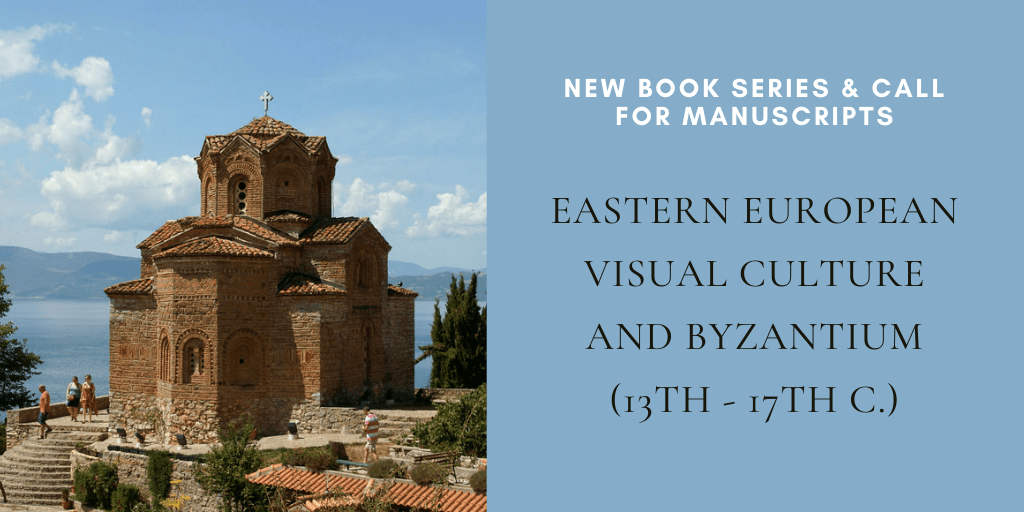
This series explores the art, architecture, and visual culture of regions of the Balkan Peninsula, the Carpathian Mountains, as well as early-modern Russia and Ruthenia between the thirteenth and seventeenth centuries. Through historically grounded examinations of the visual and cultural productions of these Eastern European territories, this series highlights the prismatic relationships between local traditions, the Byzantine heritage, and cultural forms adopted from other models.

