
Proposals for papers are invited for the two day conference ‘The Black Prince and Canterbury Cathedral’ (working title) to be held at Canterbury Cathedral on the 16th and 17th November 2017. The conference is part of a wider project to preserve and research the material culture of the Black Prince held at Canterbury Cathedral andContinue reading “CFP: The Black Prince and Canterbury Cathedral (16-17th November 2017), deadline 30 January 2017”
Tag Archives: CFP
CFP: Medieval Collaborations, The Courtauld Institute of Art’s 22nd Annual Medieval Postgraduate Colloquium (4 February 2017), deadline 25 November 2016

Saturday 4 February 2017. Kenneth Clark Lecture Theatre, The Courtauld Institute of Art, Somerset House, Strand, London WC2R 0RN In the earliest days of the discipline, medieval art historians were preoccupied with attempts to name and locate masters in anonymous works through formal analysis. In recent years, however, new approaches have favoured the proposal andContinue reading “CFP: Medieval Collaborations, The Courtauld Institute of Art’s 22nd Annual Medieval Postgraduate Colloquium (4 February 2017), deadline 25 November 2016”
CFP: Towards an Art History of the Parish Church, 1200-1399, The Courtauld Institute of Art (2-3 June 2017), deadline 15 December 2016

Towards an Art History of the Parish Church, 1200-1399, to be held on 2-3 June, 2017 at The Courtauld Institute of Art, will gather scholars to revisit the question of the parish church and its relationship to medieval visual culture. Participants will contribute to a vibrant discussion of the Gothic parish church, its utility as an object of study, and the insights offered on the subject by diverse methodologies.
CFP: In Search of Crusader Art: Current Approaches and New Perspectives, 4th Forum Medieval Art, Berlin (20-23 September 2017), deadline 31 October 2016
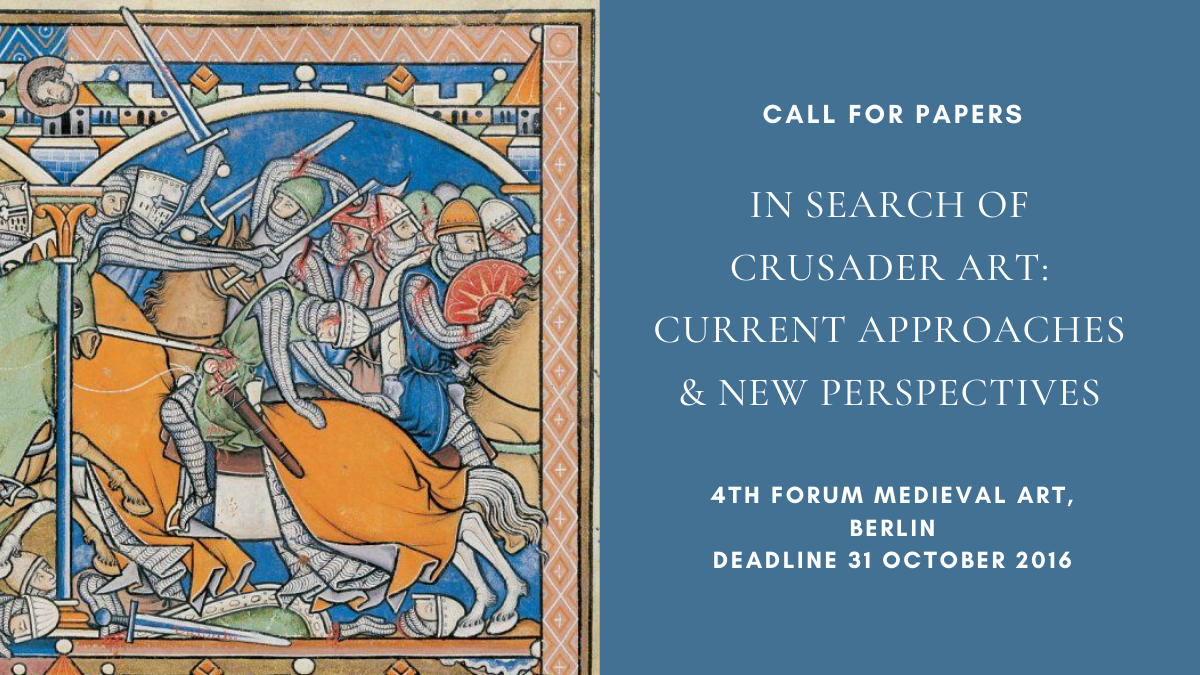
Although the concept of crusader art is effortlessly understood by scholars, its precise definition is notoriously elusive. Crusader art has traditionally been described as the figural art and architecture produced for the Crusaders in the Holy Land.
CFP: The Stones Cry Out: Modes of Citation in Medieval Architecture, International Congress on Medieval Studies, Kalamazoo (11-14 May, 2017), deadline 15 September 2016

This session invites papers that pursue these kinds of questions as they pertain to the diverse building cultures of the Middle Ages, West and East, between c.300 to c.1500. Highly encouraged are contributions that investigate the stimuli for citation, the media that make it possible, and the agents that make it productive.
CFP: The Genesis of a Window: Methods, Preparations and Problems of Stained Glass Manufacture, University of York, King’s Manor (26 – 27 May 2016), deadline 8 May 2016

The University of York’s Stained Glass Research School will be hosting its annual PhD conference on 26th and 27th May 2016. From the early medieval period stained glass design and manufacture has evolved and reacted to changing tastes, styles and technological advances.
CFP: Andrew Ladis Trecento Conference (Tulane University, New Orleans, 10-13 November 2016), deadline 20 February 2016

In the spirit of the tradition forged by the late Andrew Ladis and his colleagues at the University of Georgia, an international congress of Trecento specialists will congregate at Tulane University to share their research formally and informally in New Orleans, LA.
CFP: Time and Temporality in Medieval and Early Modern Art (May 18 – 19, 2016, The Open University of Israel, Raanana), deadline 31 December 2015

IMAGO – The Israeli Association for Visual Culture of the Middle Ages, and the Department of Literature, Language and Arts, The Open University of Israel The subject of time was frequently encountered in medieval and early modern thinking and culture, from the notion of eternity as an abiding “now” outside of time (as defined byContinue reading “CFP: Time and Temporality in Medieval and Early Modern Art (May 18 – 19, 2016, The Open University of Israel, Raanana), deadline 31 December 2015”
CFP: Magic and Magicians in the Middle Ages and the Early Modern Age (The University of Arizona, Tucson, April 28 – 1 May 2016), deadline 31 January 2016
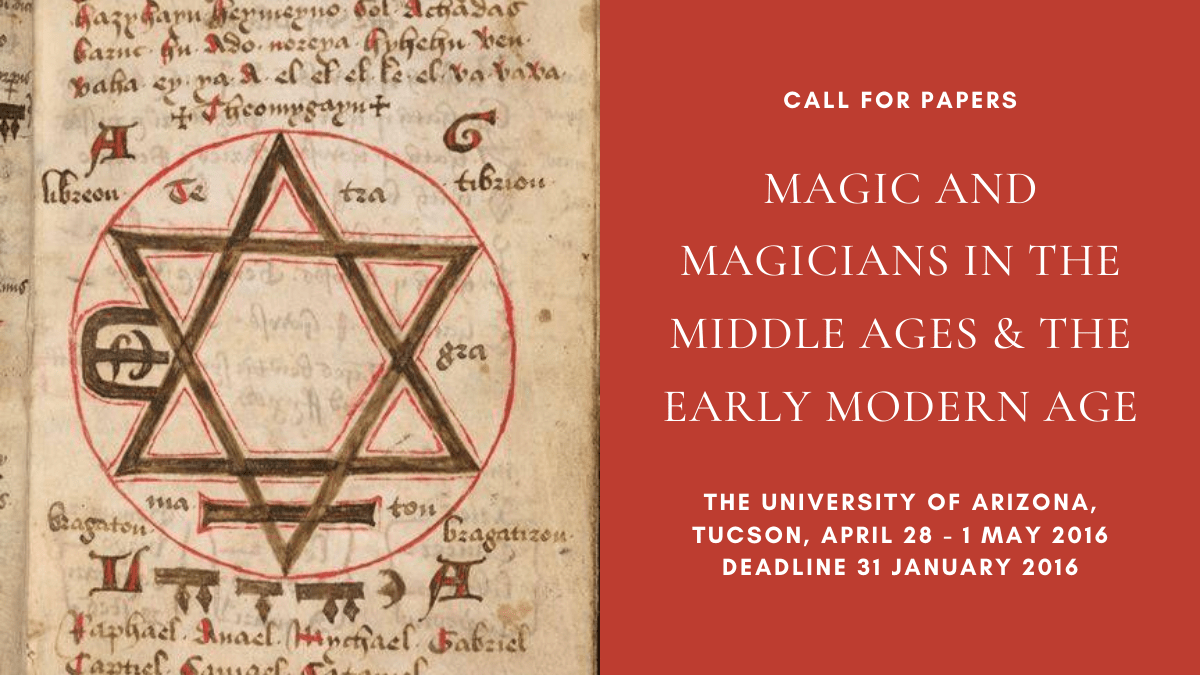
Organizer and Chair: Dr. Albrecht ClassenUniversity Distinguished ProfessorDept. of German Studies, 301 LSB, The University of Arizona520 621-1395; aclassen@u.arizona.edu; aclassen.faculty.arizona.edu Magic and the magician are two critically important aspects of cultural epistemology, challenging and contributing to the world of science, undermining it at the same time. Who was the magician, what did s/he do, how didContinue reading “CFP: Magic and Magicians in the Middle Ages and the Early Modern Age (The University of Arizona, Tucson, April 28 – 1 May 2016), deadline 31 January 2016”
CFP: Reading Architecture Across the Arts and Humanities (University of Stirling, 5 December 2015), deadline 26 September 2015

An AHRC-Funded Interdisciplinary Conference University of Stirling, Saturday 5th December 2015 The organisers of this one-day multidisciplinary conference seek to solicit proposals for 20-minute papers that consider the creation, expression and subject-areas across the Arts and Humanities. Papers should seek to address the creation, understanding, circulation and cultural impact of both real and international contexts. OriginalContinue reading “CFP: Reading Architecture Across the Arts and Humanities (University of Stirling, 5 December 2015), deadline 26 September 2015”
 Medieval Art Research