CFP: ‘“As stiffe twin compasses”: Allegory and Sciences, 1300-1700’, deadline 15 June 2025

Conference date: 24 October 2025, Warburg Institute, University of London

Find out more on the Warburg Institute website.

Organiser: Sergei Zotov (Frances Yates Fellow, Warburg Institute)

Keynote: Sachiko Kusukawa (Cambridge) on how emblematic worldview shaped early modern scientific thought and representation, from Vesalius and Brahe to Gessner, Camerarius Jr, and Boyle.

Zodiac Man as medical microcosm, Christ’s limbs symbolising chapters of the Bible, alchemical androgyne embodying sulphur and mercury, four demons representing cardinal winds, compass legs as lovers, the labyrinth as a path to divine truth — there are many examples illustrating how pre-modern sciences employed allegory to visualise and organise knowledge.

This conference investigates the multifaceted roles of allegory within scientific and intellectual traditions from the Late Middle Ages to the Early Modern period in Europe. Focusing on a wide range of disciplines — including anatomy, astrology, alchemy, botanics, magic, medicine, mathematics, zoology, and theology — we will examine how allegorical modes of representation functioned not only as a tool for conveying abstract ideas and encoding practical knowledge but also as a means of reinforcing the authority of a discipline. 

Allegory helped shaping the conceptual frameworks through which knowledge was produced, transmitted, and legitimised in various sciences. By examining allegorical imagery and textual strategies, we will consider how scholars adapted this rhetorical or iconographical device to communicate across different audiences, from learned circles to broader publics. Through comparative analysis, we aim to uncover common patterns, disciplinary crossovers, and shifts in the use of allegory over time. 

Special attention will be given to the interplay between text and image, the transmission of allegorical motifs, and the role of print and manuscript cultures in shaping allegorical traditions of sciences. Ultimately, the conference seeks to provide new insights into the intellectual history of allegory and its enduring impact on the representation of knowledge. By bringing together scholars from across fields and regions, we seek to advance a deeper understanding of allegory’s place in the intellectual history of premodern Europe.

Suggested topics include, but are not limited to:

  • Epistemic Functions: How did allegory serve to encode and transmit scientific knowledge? What forms of reasoning did it support or obscure?
  • Cross-Disciplinary Currents: How was allegory used to mediate between different branches of knowledge — for instance, theology and natural philosophy, or magic and medicine?
  • Audiences and Authority: How did allegorical modes reinforce the authority of certain disciplines or figures? How were allegories tailored for elite, learned, or popular audiences?
  • Transmission and Variation: How did allegorical forms travel across manuscripts, printed books, and other media? What kinds of variation do we see in their visual or textual expression over time?

We encourage proposals from scholars working in history of science, intellectual history, art history, manuscript and book studies, and adjacent fields. PhD students and ECRs are also welcome to apply.

Please send proposals (max 300 words) and a short biographical note (max 150 words) to sergei.zotov@sas.ac.uk by 15 June 2025.

Conference: ‘Siena: The Rise of Painting 1300-1350’, London, The National Gallery, 20 June 2025, 9am-5.45pm (BST)

Book tickets and find out more on the National Gallery website

On 20th June 2025, the National Gallery will be hosting an international conference to mark the end of its current exhibition, Siena: The Rise of Painting 1300-1350, organised in collaboration with the Metropolitan Museum of Art.

Across four sessions, papers will explore the remarkable achievements and innovations of the city’s leading painters of the 14th century – Duccio di Buoninsegna, Pietro and Ambrogio Lorenzetti, and Simone Martini. Speakers from the USA, Europe and the UK will discuss new insights into the function of paintings made in Siena, their intellectual and devotional contexts, the reconstruction of dispersed altarpieces, and consider the connections between Siena and the wider world.

The conference also provides the opportunity for new technical research on Duccio’s monumental ‘Maestà’ to be presented for the first time, alongside other recent findings from scientific investigations of trecento Sienese objects.

Speakers

  • Professor Anne Derbes (Professor Emerita, Hood College)
  • Dominic Ferrante (Robert Simon Fine Art)
  • Dr Vera-Simone Schulz (Kunsthistorisches Institut in Florenz & Leuphana University Lüneburg)
  • Dr Machtelt Brüggen Israëls (University of Amsterdam)
  • Professor Diana Norman (Professor Emerita, Open University)
  • Dr Carl Strehlke (Emeritus Curator, Philadelphia Museum of Art)
  • Dr Helen Howard (The National Gallery)
  • Dr Jo Dillon (The Fitzwilliam Museum of Art)
  • Dr Lucy Wrapson (Hamilton Kerr Institute)
  • Speakers from the Opificio delle Pietre Dure, Florence
  • Professor Jeffrey Hamburger (Harvard University)
  • Professor Sonia Chiodo (Università di Firenze)
  • Dr Elisa Camporeale (Independent Scholar)

Murray Seminar: ‘African coastlines, the Manueline Style and Changing Perceptions of Nature’ with Scott Nethersole, Birkbeck, 10 June 2025, 5-6.30pm (BST)

10 June 2025, Birkbeck, 43 Gordon Square, Keynes Library and Online, 17:00 — 18:30

Please join Birkbeck for the final Murray Seminar of this academic year with Scott Nethersole, ‘mai non vidi la più bella costa de quel che me parse questa: African coastlines, the Manueline style and changing perceptions of nature’.

Portuguese and Italian explorers, who from the mid-fifteenth century had been edging their way down west Africa and eventually around the Cape of Good Hope, frequently found beauty in the coastline that they surveyed from their boats. In their journals and rutters, they often comment on the ‘bellezza’ of the landscape, especially once they had passed the Sahara and Sahel. Such perceptions are surprising. This open-ended paper will explore what art historical consequences there might be to finding beauty in African coastlines in the late fifteenth century and early sixteenth century. It will locate these comments about beauty in changing perceptions of nature in Europe, especially evident in the development of the Manueline architectural style in Portugal and new approaches to the depiction of landscape.

Scott Nethersole is Hoogleraar Kunstgeschiedenis, 500-1500 at Radboud Universiteit, Nijmegen.

Book your tickets and find out more on Birkbeck’s website.

Scholarship: The Dowley/Retford Studentship in History of Art, Birkbeck University of London, deadline 16 June 2025

Find out more information on Birkbeck’s website.

Award overview

  • Level: Postgraduate research
  • Mode of study: Full-time
  • Tuition fee status: Home
  • Type of award: Full tuition fees plus stipend
  • Number of awards: One
  • Deadline: 16 June 2025

Outstanding candidates for postgraduate research in the History of Art are invited to apply for The Dowley/Retford Studentship. This PhD studentship, based in the School of Historical Studies at Birkbeck and supported by the Dowley Charitable Trust, covers full-time Home fees and an annual stipend. 

Please note: this studentship is not available for part-time, overseas or continuing students.

Background

The Dowley Charitable Trust was set up by Emma and Justin Dowley. Dr Emma Dowley is a History of Art graduate from Birkbeck. The studentship has also been named in honour of Kate Retford, Professor of History of Art at Birkbeck and Emma’s PhD supervisor.

Eligibility

This studentship is for Home students/applicants starting in September 2025 or January 2026. The funding is for three years for students studying full-time. 

Value

Tuition fees are paid in full and an annual stipend for living costs of £20,000 is provided. If you have a disability you may be entitled to a Disabled Students’ Allowance (DSA) on top of your studentship.

Deadline

  • Closing date for applications: Monday 16 June 2025, 5pm
  • Deadline for references/supporting statement: Monday 23 June 2025, 5pm
  • Interview date for shortlisted applicants: Monday 30 June 2025

Only complete and timely applications, received with both references/supporting statement, can be considered. 

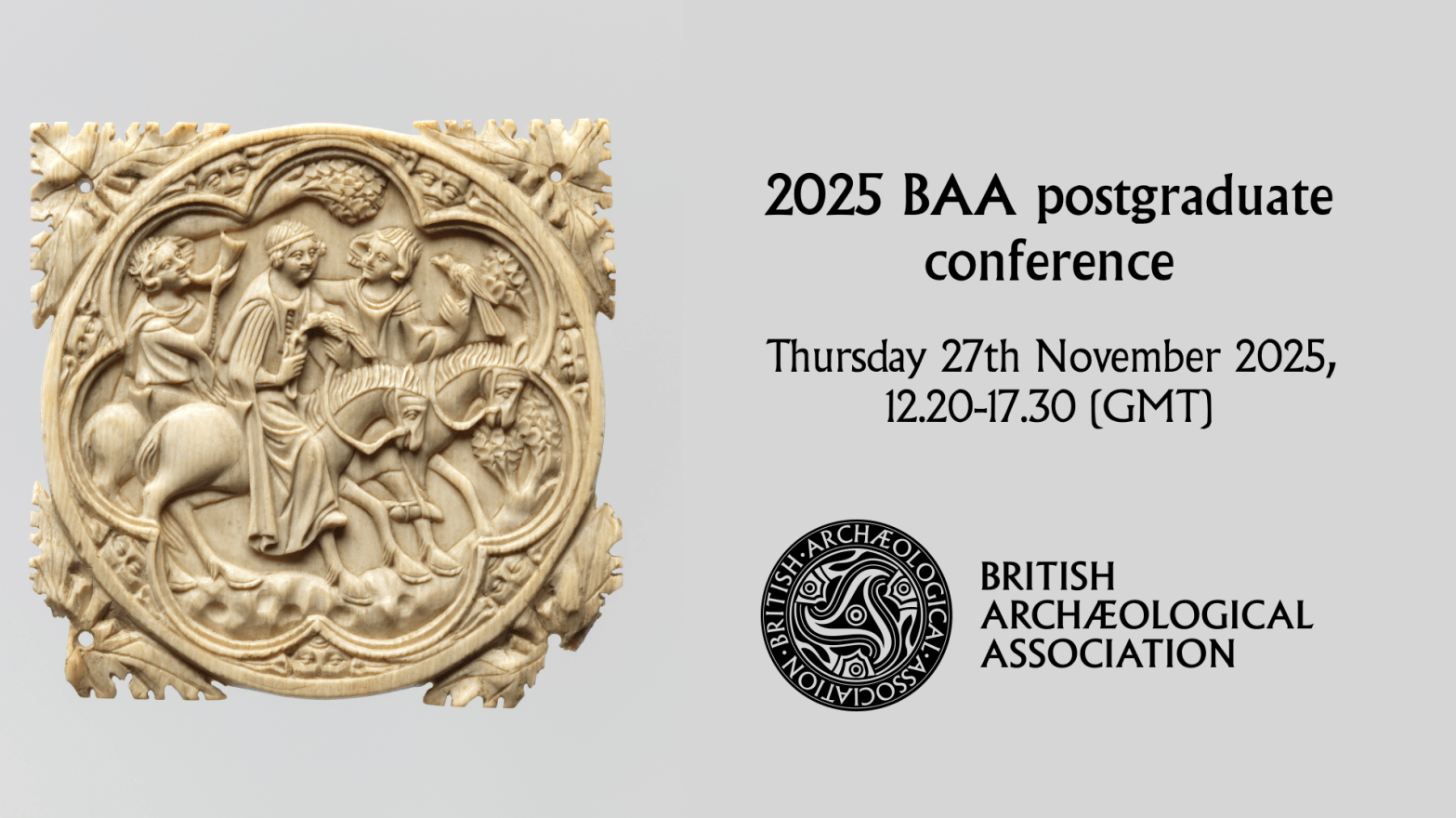
CFP: BAA Post-Graduate Conference, deadline 31st July 2025

The British Archaeological Association is excited to be hosting the 7th BAA postgraduate conference online this year! They’ve found the online format a great way for postgraduate students and early career researchers to come together from across the globe. 

Papers can be on any aspect of the medieval period, from antiquity to the later Middle Ages, across all geographical regions.

The BAA postgraduate conference offers an opportunity for postgraduate students and early career researchers at all levels from universities across the UK and abroad to present and discuss their research, and exchange ideas.

Proposals of around 250 words for a 20-minute paper, along with a CV, should be sent by 31st July 2025 to postgradconf@thebaa.org

The conference will take place online on Thursday 27 November, with potentially a second day on Friday 28 November 2025.

CFP: ‘Cultural Crossroads: Artistic Encounters between the Low Countries and Spain, 15th-17th Centuries’, deadline 6 June 2025

Cultural Crossroads: Artistic Encounters between the Low Countries and Spain, 15th-17th Centuries. III. Echoes of Flemish Sculpture in Spain from Gothic to Baroque (Brussels, 28 November 2025)

Since 2020, the Moll Institute (Madrid) and the Fondation Périer-D’Ieteren (Brussels) have been conducting a research program aimed at identifying and studying the art that developed in the Low Countries between the 15th and 17th centuries and that is preserved in Spanish collections. As part of this collaboration, a series of study days has been organized since 2023 to stimulate and disseminate research conducted in this field. The first and second study days (2023 Brussels; 2024 Madrid) focused on, respectively, painting and tapestry. The third study day will be dedicated to sculpture and will be organized in Brussels, at the Fondation Périer-D’Ieteren.

Cultural context

The period of the 15th-17th centuries witnessed a significant increase in contacts and exchanges between the Southern Netherlands and Spain. These exchanges, facilitated by trade routes and strengthened by close dynastic ties as evidenced, e.g., by the marriage of Philip the Handsome to Joanna of Castile and the installation of the Habsburgs into Spain, had a profound impact on the artistic development of both regions.

The Spanish interest in Flemish art was stimulated particularly by the unique craftsmanship and identity of the Flemish artistic production, making it a symbol of high quality that seduced patrons in search of prestigious works. One of the consequences of this fascination for all things Flemish was the massive importation of sculptures from the southern Netherlands. Brabant altarpieces, for example, were particularly prized for private chapels and churches in Spain, as they demonstrate an exceptional mastery of detail. These monumental works integrated harmoniously into local architectural settings, while sometimes adapting their style to suit local tastes. Alongside these large-scale works, small polychrome statuettes produced among other places in Mechelen responded to a demand for more intimate devotional objects, highly prized by the Spanish elite. Flemish funerary monuments, such as those produced by Egas Cueman for the monastery of Guadalupe, display an innovative combination of Flemish techniques and iconography with local artistic trends.

Many Flemish sculptors settled in the Iberian Peninsula, attracted by prestigious commissions and unprecedented opportunities. Some of them, like Hannequin and Egas Cueman at the end of the 15th century, chose to develop their careers in Castile, forming in the process important Flemish artistic dynasties on Spanish territories and leaving a significant mark on Spanish sculptural production. Others, like Jean Mone in the 16th century, trained as a sculptor in Barcelona before pursuing a career elsewhere. Conversely, some sculptors only came to Spain for specific commissions. These one-off assignments were often in response to prestigious contracts. All these artists helped to forge a hybrid Hispano-Flemish sculptural style.

Finally, cities such as Burgos, Toledo, Seville, and Madrid played a key role in the dissemination and reception of Flemish sculpture. The cities in the region of Castile, in particular, established themselves as vibrant centers for Flemish art thanks to their contacts with the Southern Netherlands. The ports of the Iberian Peninsula facilitated the swift introduction of Flemish art works, while trade fairs such as those in Medina del Campo served as platforms for exchange and negotiation. These networks, reinforced by trade routes and diplomatic interactions, enabled the export of sculptural works, often offered as prestigious gifts.

The 2025 study day will provide a forum to engage in scholarly discussion and exchanges on the topics outlined, some of which have yet to be fully explored, and as such will open new research perspectives in the field of Flemish sculpture and its Spanish reception.

Focus and Scope

Contributions may relate to the following areas:

  • Mobility of artists and local settlement: trajectories of Flemish artists; establishment of artistic hubs in centres such as Seville and Burgos; social and professional integration of sculptors and their workshops; the importance of ports and trade fairs for cultural exchanges.
  • Patrons and commissions: the role of the royal court; commissions from the nobility and the bourgeoisie; the impact of religious institutions.
  • Typologies and specific features of the works: sculpted altarpieces integrated into local architecture; funerary monuments and their iconography; small devotional pieces adapted to the Spanish market etc.
  • Technique and materials: introduction of new techniques; adaptation of local materials by Flemish sculptors.
  • Conservation and restoration issues: exploring conservation challenges and restoration solutions for a distinctive Flemish art form in Spanish collections.

Submission

We welcome all paper proposals (English, French, Spanish) related to the topics outlined above. Duration per paper is maximum 20 minutes. Accepted papers will be considered for publication in a collective volume, to be published in the series Cahiers d’études of the Annales d’Histoire de l’Art et d’Archéologie (Brussels). In addition, the artworks discussed in these papers will be included in the Flemish Art in Spain database: https://www.flemishartinspain.com/en.

Paper proposals can be submitted until and including June 6, 2025, and should include a title and short abstract of approximately 300 words, along with a concise CV (to be submitted to congreso@institutomoll.es and fondation@perier-dieteren.org). 

Notification on the acceptance or rejection of papers will be done before August 31, 2025. Please note that transport and accommodation costs are not borne by the organizing institutions.

Organizing Committee

  • Dr. Sacha Zdanov, Fondation Périer-D’Ieteren / Université Libre de Bruxelles
  • Dr. Wendy Frère, Fondation Périer-D’Ieteren
  • Dr. Ana Diéguez Rodríguez, Instituto Moll / Universidad de Burgos

More information can be found on the conference website.

Oxford Medieval Manuscripts Group, Trinity Term 2025, Fridays 5pm (BST)

Michaelmas Term 2025 | Fridays 5 pm (unless otherwise stated) 

Organisers: Irina Boeru, Fergus Bovill, Ana Dias, Charly Driscoll, Antonia Delle Fratte, Elena Lichmanova, Mathilde Mioche, Celeste Pan, Klara Zhao

For all queries: oxfordmedievalmss@gmail.com

To subscribe to our mailing list, participate in library visits, propose a presentation of your research for work in progress meetings, or submit any queries, please write to: elena.lichmanova@merton.ox.ac.uk 

Week 1, 2 May 2025: Merton College Library Visit

Previous experience of handling medieval manuscripts is desirable. Limited places, write to the email above by 30/04/2025

Week 3, 16 May 2025, 2pm

Sara Charles, School of Advanced Studies, University of LondonGold in Medieval Illumination: Practiced-based Workshop

All materials are provided. £10 fee. In association with Oxford Medieval Studies, sponsored by The Oxford Research Centre in the Humanities (TORCH) and the Faculty of HistoryLimited places, write to the email below by 10/05/2025

Week 4, 23 May 2025, Online

Reading Group: Connoisseurship

  • Sonja Drimmer, Connoisseurship, Art History, and the Paleographical Impasse in Middle English Studies (2022)  
  • Jonathan Alexander, Art History, Literary History, and the Study of Medieval Manuscripts (1997)
  • Sydney Cockerell, The Gorleston Psalter (1907)

Write to the email above to join          

Week 5, 30 May 2025, Merton College, Hawkins Room 

Work-in-Progress Session

  • Irene Van Eldere | Leiden University : Designing Devotion: Characteristics of Early Middle Dutch Books of Hours
  • Elvira Miceli | Wolfson College, Oxford : Kingship and the Question of Iconography in the Liber ad honorem Augusti: Bern, Burgerbiliothek, Cod. 120 II

Week 6, 6 June 2025, 3pm, Venue TBC

Connoisseurship and Medieval Manuscripts: A Roundtable

Michael Michael (University of Glasgow) | Emily Guerry (St Peter’s College, Oxford) | Peter Kidd (Independent Researcher)

Symposium: ‘Concertina-Fold Books across Time, Space and Cultures’, Lambeth Palace Library, Friday 2 May 2025, 10am-5.30pm (GMT)

All are welcome, but those wishing to attend should book a free ticket via Eventbrite or email archives@churchofengland.org no later than Thursday 1 May.

Accordion, screenfold, chain—various terms have been applied to books folded in a zig-zag or ‘concertina’ pattern. Seen now as novelties, concertina-fold books were once found worldwide. They were even the preferred or sole book format in some places, before the imperial spread of the codex. This one-day symposium gathers international experts to talk about the historic uses of the concertina structure in a range of cultural contexts around the world. The discussion showcases some of the many, outstanding examples of these books housed in local London and Oxford collections.

The morning session is an around-the-world tour with short talks on how the concertina-fold format was deployed in different places, across time. The afternoon is devoted to more in-depth discussion of the choice and effects of the concertina format. Lunch will be provided for in-person participants.

The symposium is part of programming for the Unfolding Time exhibition, on medieval ‘pocket’ calendars, which looks at the way the concertina format was deployed in late medieval Europe, with a focus on England. In-person attendees will have the opportunity to visit the exhibition and play with concertina facsimiles. The event is made possible through generous funding from the Centre for the Study of Manuscript Cultures (CSMC), University of Hamburg; Royal Society of Edinburgh; and The National Lottery Heritage Fund.

Find out more on the Lambeth Palace Library website.

Symposium Schedule 

9:30–10:00 Attendee arrival and check-in

10:00 –Symposium Welcome, Pip Willcox and Sarah Griffin

SESSION 1: The Concertina-fold book around the world

10:15 Introduction, Megan McNamee

10:30 Chinese, Costantino Moretti

10:40 Tibetan, Benjamin Nourse

10:50 Japanese, Halle O’Neal

11:00 Batak, Roberta Zollo

11:10 Thai, Peera Panarut

11:20 Ethiopic, Ewa Balicka-Witakowska

11:30 Mesoamerican, Jamie Forde

11:40 Q&A

12:00–1:00 LUNCH (included in ticket) + tours of the Unfolding Time exhibition

SESSION 2: Implications: The Choice and significance of folding

1:00 Introduction, Megan McNamee

1:10 Choosing the concertina: Evidence from Dunhuang, Costantino Moretti

1:30 Tracing the disappearance of folds in Japanese Buddhist manuscript culture, Halle O’Neal

1:50 Straightening the Magic: The Concertina manuscripts produced by the Batak people of North Sumatra, Roberta Zollo

2:10 Q&A

2:30–3:00 COFFEE + comfort break

SESSION 3: Concertina communication

3:00 Introduction, Megan McNamee

3:10 Ethiopic concertina-fold manuscripts, Ewa Balicka-Witakowska

3:30 Pictures and graphic elements in Thai concertina-fold books, Peera Panarut

3:50 Q&A

4:00 Concluding remarks, Marilena Maniaci

4:20 Acknowledgements & Thanks, Sarah Griffin

4:30–5:30 RECEPTION + Unfolding Time exhibition open

Speakers

  • Ewa Balicka-Witakowska, Uppsala University
  • Jamie Forde, University of Edinburgh
  • Megan McNamee, University of Edinburgh
  • Costantino Moretti, École française d’Extrême-Orient (EFEO)
  • Benjamin Nourse, University of Denver
  • Halle O’Neal, University of Edinburgh
  • Peera Panarut, Museum für Asiatische Kunst, Staatlichen Museen, Berlin
  • Roberta Zollo, Museumverband Niedersachsen und Bremen e.V. (mvnb)
  • Marilena Maniaci, Università degli studi di Cassino

Organisers:

  • Megan McNamee, University of Edinburgh
  • Sarah Griffin, Lambeth Palace Library

All are welcome, but those wishing to attend should book a free ticket via Eventbrite or email archives@churchofengland.org no later than Thursday 1 May.

This event is also available to watch online. Please book a separate ticket if you wish to join us online instead of in person.

Please note that tickets must be booked individually for security purposes.

Panel discussion: ‘A Conversation about Concertina-Fold Books across Time, Space and Cultures’, Weston Library, Oxford Bodleian Library, Thursday 1 May 2025, 3-4pm (GMT)

A conversation about the concertina-fold book as a global phenomenon

Accordion, screenfold, chain—various terms have been applied to books folded in a zig-zag or ‘concertina’ pattern. Seen now as novelties, concertina-fold books were once found worldwide. They were even the preferred or sole book format in some places, before the imperial spread of the codex. A group of international experts come together for an afternoon conversation on the historic uses of the format in Buddhist, Mixtec and European contexts as part of The Concertina-Fold Book across Time, Space and Cultures project, supported by the Royal Society of Edinburgh and the Centre for the Study of Manuscript Cultures (CSMC) at the University of Hamburg. Their discussion will be grounded in some of the outstanding examples of these books in Bodleian collections. Attendees will have the opportunity to see a few of the Bodley books in action and play with concertina facsimiles.

Speakers

  • Benjamin Nourse, University of Denver (Buddhist, Chinese + Tibetan)
  • Jamie Forde, University of Edinburgh (Mesoamerican)
  • Sarah Griffin, Lambeth Palace Library (English, European)

Intro + Moderation

  • Megan McNamee, University of Edinburgh (Introduction + Moderation)

Find out more and reserve your spot on the Bodleian Library website.

Book tickets

This event takes place in person in the Sir Victor Blank Lecture Theatre at the Weston Library. Booking is required for this event, and tickets are free. Book now

Location

Weston Library, Broad Street, Oxford, OX1 3BG

International Two-Day Conference: ‘Tracing Jewish Histories: The Long Lives of Medieval Hebrew Manuscripts, Judaica, and Architecture’, Courtauld Institute of Art, 19-20 May 2025

19 May – 20 May 2025, 10:00 – 17:00, Courtauld Institute of Art, Vernon Square campus (WC1X 9EW).

The Courtauld and Case Western Reserve University are delighted to jointly host the two-day symposium Tracing Jewish Histories on 19-20 May 2025. The international symposium brings together museum curators and academics to examine the afterlives of art and architecture made by and for Jewish communities in the Middle Ages. The symposium will feature a round table with curators from The Metropolitan Museum of Art, Museum of Fine Arts in Boston, and Victoria & Albert Museum. The full programme and free registration can be found on the event page, here.

Works of art and architecture made by or for Jewish communities in the medieval period are often examined through the lenses of persecution and expulsion, or are contrasted against Christian or Muslim“styles.” This symposium seeks to expand and nuance these narratives in order to highlight how works of art and architecture can uniquely trace the history of particular Jewish communities by mapping their movements and traditions across generations and geographies. Medieval Jewish objects and spaces can also serve as loci to examine ideas related to collective memory and cultural identity. To that end, the symposium seeks to open new dialogues regarding the “afterlives” of medieval Jewish art more broadly, initiating discussions regarding the ways in which works of art and architecture continued to bear witness to the richness of Jewish life and culture long after they were created. 

The symposium is organised by Laura Feigen, The Courtauld, and Reed O’Mara, Case Western Reserve University. 

The symposium is supported by Sam Fogg and the Mellon Foundation with additional support from The Department of Art History and Art at Case Western Reserve University as well as the Medieval Academy of America Graduate Student Committee Grant for Innovation in Community Building and Professionalization.

Find out more and book your place on the Courtauld website.

Conference Programme

Monday 19 May 2025

10.00 – 10.30: Registration opens
The Courtauld, Vernon Square Campus

10.30 – 11.00: Opening remarks, and introduction to the day
Tom Nickson, The Courtauld; Laura Feigen, The Courtauld, and Reed O’Mara, Case Western Reserve University

11.00 – 12.30: Session I – Manuscripts and movement
Chaired by Claudia Haines, Case Western Reserve University

Judith Olszowy-Schlanger, University of Oxford,
“Palaeography and the Tracing of the Origins and History of a Bilingual Psalter (MS Oxford, Corpus Christi College 10)”
Katrin Kogman-Appel, University of Münster,
“Illustrated Books, their Makers and Owners in an Age of Migration”
Javier del Barco, Universidad Complutense de Madrid,
‘“From Northern Italy to Dublin: The Journey of a Hebrew Bible at the Chester Beatty Library”

12.30 – 13.30: Lunch Break
Provided for speakers and organisers  only

13.30 – 15.00: Session II – Making and remaking
Introduced by Allison Boroff, Case Western Reserve University
Chaired by Sarah Frisbie, Case Western Reserve University

Leor Jacobi, Bar Ilan University,
“Bound in Catalonia: Jewish Bookbindings Produced for Christians as Historical Witnesses”
Hila Manor, Hebrew University of Jerusalem,
“The Long Lives of the Oldest Pair of Torah Finials”
Roni Cohen, Goethe University,
“Manuscripts, Gamblers, and Medieval Hebrew Hits”

15.00 – 15.30: Break

15.30 – 17.00: Session III – New lives of architecture
Introduced by Darren Helton, Case Western Reserve University
Chaired by Natalia Munoz-Rojas, The Courtauld

Ilia Rodov, Bar-Ilan University,
“ ‘A Time to Gather Stones’: Spolia, Sacredness, and Memory in Ashkenazi Synagogues”
Eva Frojmovic, University of Leeds,,
“A Second Life in the Museum: Jewish Tombstones After the Black Death”
Franziska Kleybolte, University of Münster,
“The Synagogue-Church of Santa María la Blanca in Toledo: A Site of Jewish-Christian Memory Between Entanglement and Disentanglement”

17.00 – 18.00: Drinks reception
Open to all

———————————

Tuesday 20 May 2025

10.00 – 11.30: Session IV – Collecting practices at large
Introduced by Olga Morgalyuk, The Courtauld
Chaired by Tess Artis, Case Western Reserve University

William Diebold, Reed College,
“The Darmstadt Haggadah’s Turbulent 1950s”
Abby Kornfeld, City University of New York
“The Róza Gomperz Endowment: Rethinking the Kaufmann Collection of Illuminated Hebrew Manuscripts”
Anna Nizza-Caplan, The Israel Museum,
“”Accessible to All “: The unlimited shelf-life of an illuminated Mishneh Torah

11.30 – 11.45: Refreshment Break
Coffee and Tea provided

11.45 – 13.05: Curatorial Panel – Problems and Priorities: the acquisition and display of Jewish material culture in museums
Introduced by Sam Truman, Kress Fellow at The Courtauld
Response by Elizabeth Morrison, J. Paul Getty Museum

Simona Di Nepi, Museum of Fine Arts Boston
Riva Arnold, The Metropolitan Museum of Art
Alice Minter, Victoria & Albert Museum

13.05 – 13.30: Closing Remarks
Elina Gertsman, Case Western Reserve University