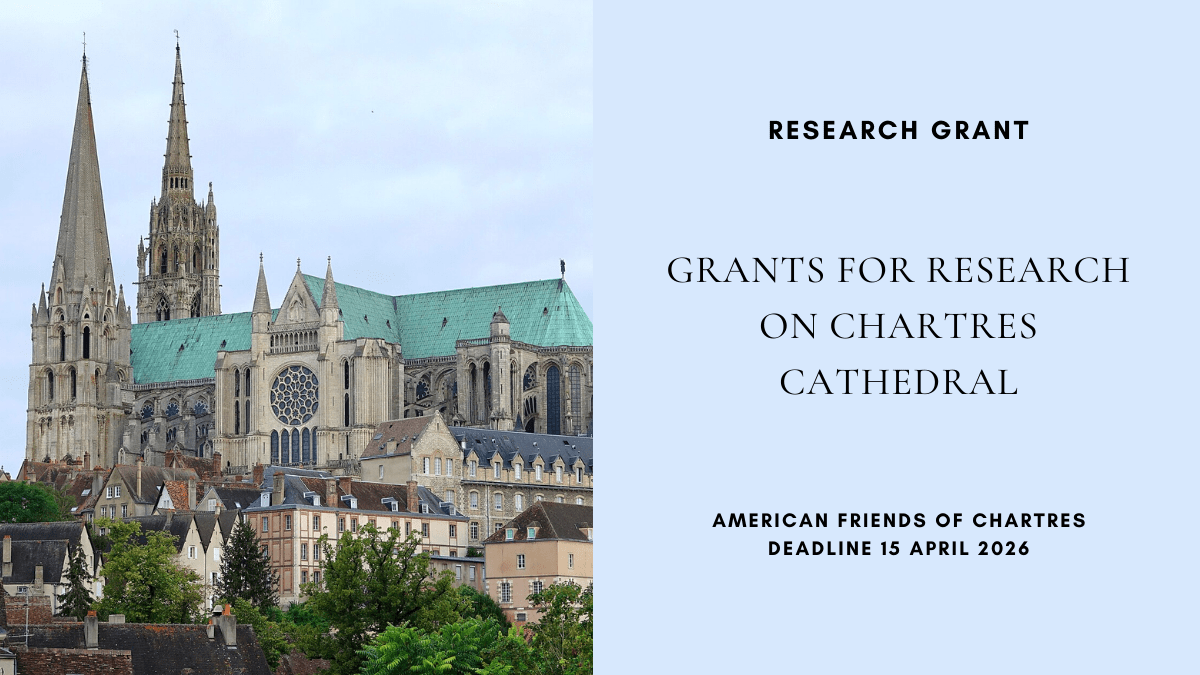
Grants for research on Chartres Cathedral, deadline 15 April 2026

The American Friends of Chartres is accepting proposals for its annual research grant to support a research project requiring on-site research in Chartres that promises to advance knowledge and understanding of the cathedral of Notre-Dame de Chartres or its historical contexts in the medieval to early modern period. The American Friends of Chartres will provide a grant of $2,500.00 and will facilitate access to the cathedral, the Centre International du Vitrail, the municipal library, archival collections and related resources.

Topics in the fields of art history, history, or related disciplines might include architecture, stained glass, sculpture, urban development, economy, religious practices, manuscripts, or the cathedral treasury, among others.

Applicants may be graduate students, recent advanced degree recipients, or established scholars. Joint projects involving faculty and students are also welcome. Following the research project, the grantee is asked to provide a synopsis of the research and conclusions, which will be publicized through the cultural activities and website of the American Friends of Chartres.

Questions about the grant may be addressed to ChartresResearchGrant@gmail.com

Find out more about the grant on the American Friends of Chartres website.

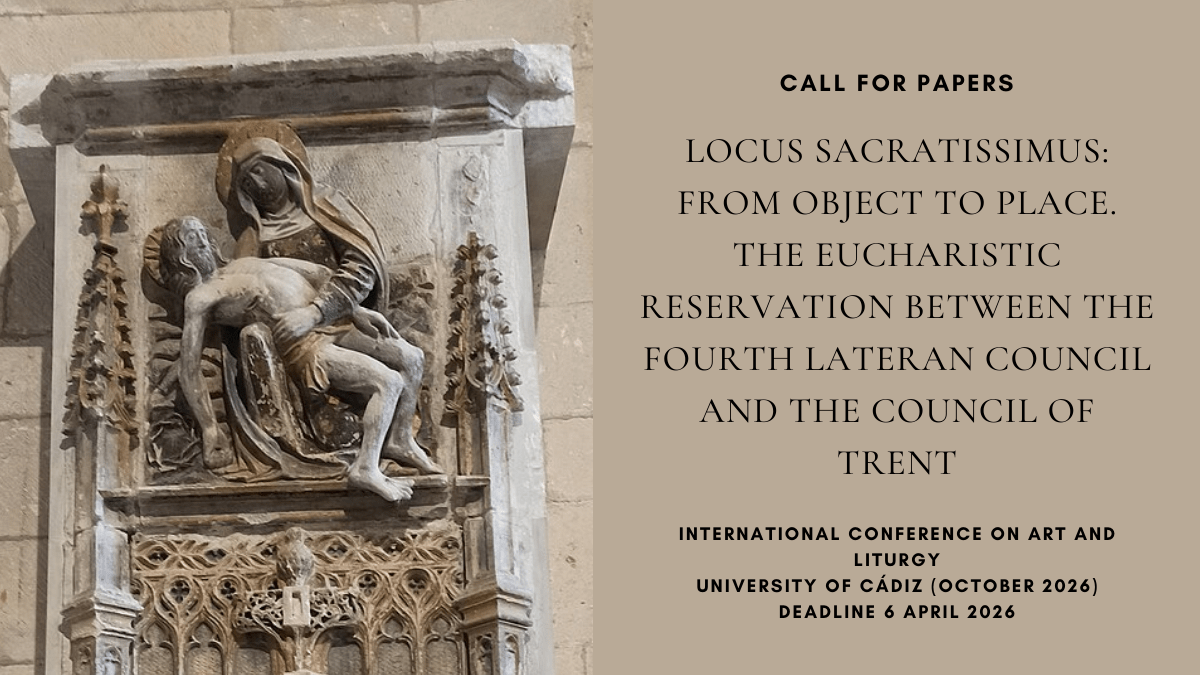
CFP: ‘Locus Sacratissimus: From Object to Place. The Eucharistic Reservation between the Fourth Lateran Council and the Council of Trent’, International Conference on Art and Liturgy, University of Cádiz (October 2026), deadline 6 April 2026

We are pleased to inform you that next October, the III International Conference on Art and Liturgy at the University of Cádiz will take place. This specialised conference, now in its third edition, is entitled “Locus Sacratissimus: From Object to Place. The Eucharistic Reservation between the Fourth Lateran Council and the Council of Trent.”

The conference will be held from 15 to 17 October 2026, and the deadline for submitting proposals is 6 April 2026. We would be most grateful if you could circulate the attached call for papers to colleagues who may be interested in participating.

Further information is available on the following website.

Between the Fourth Lateran Council (1215) and the Council of Trent (1545–1563), Europe witnessed one of the most profound and decisive transformations in the history of the Christian liturgical space: the gradual conversion of the tabernacle from a simple container into an architecturally qualified place, charged with theological, symbolic, and visual significance. This transition was neither immediate nor uniform, but rather the result of a complex process in which doctrinal development, liturgical practice, and devotional growth converged with an unprecedented artistic ambition.

At Lateran IV, the dogmatic definition of the real presence of Christ in the Eucharistic species, as articulated by Scholastic theology, intensified attention toward the reservation of the Sacrament, raising new questions of visibility, custody, decorum, and security. During the Late Middle Ages, the Body of Christ ceased to be solely consumed and became also an object of contemplation, adoration, and vigilant safeguarding. In this context, the tabernacle was transformed into a true “house for the Body of Christ,” whose form was required to express both the sacredness of its content and its centrality in the spiritual life of the Church.

Thus, from the earliest chests and pyxes, there emerged—especially from the late thirteenth century onward—solutions of remarkable formal ambition: sacrament houses, autonomous architectural tabernacles, Eucharistic towers, monumental aedicules, and complex micro-architectures dialoguing with the great Gothic structures. These constructions—situated halfway between reliquary, tomb, tower, and temple—not only addressed functional concerns, but also articulated genuine visual discourses on the mystery of the Eucharist, the Incarnation, the Passion, the Death, and the Resurrection of Christ, integrating themselves actively into the ecclesial topography of the church interior.

Far from being a marginal phenomenon, this development achieved extraordinary diffusion throughout Europe, with particular intensity in the territories of the Holy Roman Empire, France, the Low Countries, and the Iberian Peninsula. In the Spanish case, medieval and transitional tabernacles reveal a remarkable typological diversity and an early sensitivity to the symbolic dimension of the Eucharistic locus, anticipating solutions that would be fully crystallized after Trent. It was then that the tabernacle would be definitively fixed upon the high altar, from which it would hierarchically preside over the entire liturgical space of the church.

This conference seeks to examine this long and fruitful historical itinerary, from the first medieval experiments to the Tridentine consolidation of the tabernacle as the visual, theological, and devotional center of the Christian temple. Through an interdisciplinary perspective—integrating art history, liturgical history, theology, religious anthropology, and visual culture studies—it invites reflection on the tabernacle not merely as an artistic object, but above all as a constructed locus of presence, where architecture, rite, and faith are inseparably intertwined. The conference will feature the participation of renowned specialists such as Aintzane Erkizia, Justin Kroesen, Eduardo Carrero, and Ferruccio Botto, among others. 

The conference will be organized around the following thematic panels: 

  1. Thinking Presence: Concepts, Sources, and Practices of Eucharistic Reservation
  2. Monumentalizing the Eucharist: The Holy Roman Empire, France, England and the Low Countries
  3. The Tabernacle as Center: Models and Meanings in the Hispanic Kingdoms 
  4. Tradition, Form, and Centrality: Italy and the Mediterranean World 

Proposals may be submitted in Spanish, English, Italian, or French and should be approximately 500–700 words in length. Each proposal must clearly indicate the panel to which it is addressed and include a brief curriculum vitae of the presenter, as well as their institutional affiliation, if applicable. Proposals should be sent to arteyliturgia@uca.es no later than 6 April 2026. 

The publication of the contributions is planned (book format with a publishing house of recognized academic prestige). Final versions of accepted papers must therefore be submitted by 30 November 2026.

Registration Fees (Speakers): Regular speakers: 50 €; CEHA members: 25 €. In both cases, the registration fee includes a complimentary copy of the volume containing the conference proceedings.

Once acceptance of the paper has been confirmed, participants will have until 15 June 2026 to complete the registration payment. Payment must be made by deposit or bank transfer to the University of Cádiz bank account: Banco Santander IBAN: ES48 0049 4870 8529 1609 2739 – SWIFT: BSCHESM; IMPORTANT: The bank transfer must include the reference code ARTEYLITURGIA, followed by the speaker’s SURNAME(S) AND FIRST NAME. A copy of the bank transfer receipt must be sent by email to: arteyliturgia@uca.es

Scientific Coordinators: Pablo J. Pomar Rodil. Universidad de Cádiz; Diana Olivares Martínez. Universidad Complutense de Madrid; Elena Escuredo. Universidad de Sevilla

Scientific Secretariat: Francisco de Asís García García Universidad Autónoma de Madrid; Pedro Manuel Martínez Lara. Universidad de Sevilla

Technical Secretariat: Noelia Muñoz Arjona. Universidad de Cádiz
Scientific Committee: Eduardo Carrero Santamaría. Universidad Autónoma de Barcelona; Irma Patricia Díaz Cayeros. Universidad Nacional Autónoma de México; Aintzane Erkizia Martikorena. Universidad del País Vasco; Fernando Gutiérrez Baños. Universidad de Valladolid; Stefan Heid. Pontificio Istituto di Archeologia Cristiana; Justin Kroesen. Universidad de Bergen; Teresa Laguna Paúl. Universidad de Sevilla; Fabio Massaccesi. Universidad de Bolonia; María Rodríguez Velasco. Universidad San Pablo-CEU; María Dolores Teijeira Pablos. Universidad de León; Giovanna Valenzano. Universidad de Padua; Cécile Vincent Cassy. CY Cergy París Université
British Archaeological Association Travel Grants, deadline 15 March and 15 May 2026

The British Archaeological Association invites applications for their travel grants.

Applications for travel grants are invited from students registered on post-graduate degree courses (at M.A., M.Litt., M.St., M.Phil., and Ph.D. level). Grants of up to £500 are available to cover travel for a defined purpose (such as essential site visits, attendance at an exhibition/conference, short research trip, etc). The awards will be made twice yearly, with deadlines for applications on 15 March and 15 May.

Applicants are required to provide one reference, together with a timetable and travel budget, and the objective of the travel must fall within the Association’s fields of interest (as defined below). Applicants should either be registered at a UK University or be undertaking work on material from, in, or related to the art, architecture or archaeology of the British Isles. Applicants are also responsible for asking their nominated referee to forward a reference directly to the Hon. Secretary within one week of the closing date for applications.

An application form is linked on this page. Once complete, this form should be sent as an email attachment to the Awards Officer at awards@thebaa.org. Funds are limited, so the awards are competitive. If successful, the Association expects candidates to write a short account (150-350 words) of the travel facilitated by the award that could be posted on the BAA website.

BAA Statement of Interest

The Association’s interests are defined as the study of archaeology, art and architecture from the Roman period to the present day, principally within Europe and the Mediterranean basin. The core interests of the BAA are Roman to 16th century. We only entertain applications that cover the 17th to 21st centuries if they are of a historiographical, conservationist or antiquarian nature and link back to the BAA’s core interests.

CFP: ‘Queer Sanctity: Contemporary Visions of Medieval and Renaissance Art’, deadline 15 March 2026

Edited by Bryan C. Keene • Riverside City College; formerly Getty Museum

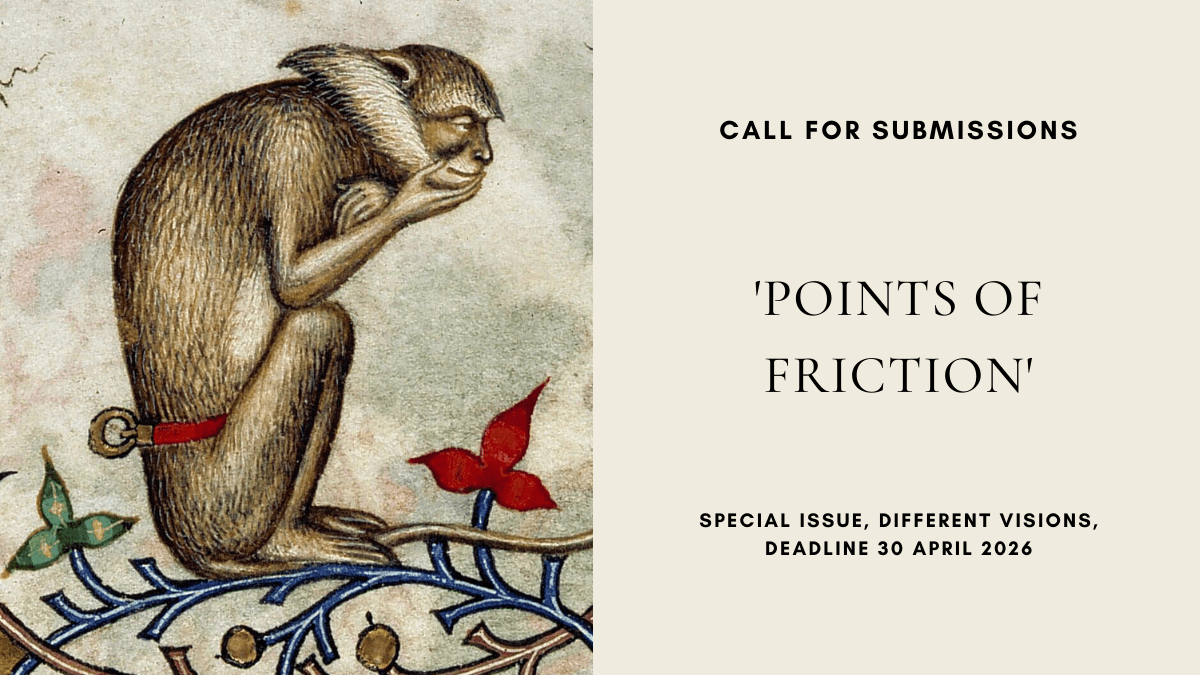
Different Visions invites proposals for contributions to a forthcoming special issue, “Queer Sanctity: Contemporary Visions of Medieval and Renaissance Art.” Find out more about this edition on their website

This volume will take the form of a virtual and imaginary exhibition catalogue examining the ways queer- and trans-identifying contemporary artists working in North America over the last forty years have drawn on medieval and Renaissance visual and material culture (ca. 500–1600 CE) to imagine inclusive futures and advocate for justice in LGBTQIA2+ communities. By juxtaposing historical objects with contemporary works, this issue seeks to interrogate the continuities and ruptures across time in how sanctity, sexuality, and gender identity are represented, perceived, and contested.

The art of the Middle Ages and Renaissance in Europe has inspired creators of the LGBTQIA2+ communities in North America for decades. Themes of religion, the body, disease, and human relationships under the law are as urgent now as they were in the past. This project brings together historical objects made from about 500-1600 with contemporary art from the 1980s to today with the goal of deepening an understanding of gender and sexuality across time and the draw queer- and trans-identifying creators today have with these time periods.

The diversity of queer and trans artists included emphasizes intersectionality, that is, how individuals, especially those who are Black, Indigenous, People of Color (BIPOC) or with multiple intersecting identities of (dis)ability, class, gender, race, religion, and sexuality face marginalization, prejudice, and discrimination. Some of the narratives related to HIV/AIDS and hate crimes are painful and may be triggering. Stories of coming out and pride offer hope for a future of care, inclusion, and justice. All are welcome and invited to reflect, question, admire, and heal.

“Queering” the past has revealed histories that have been erased or censored, while destabilizing cis-heteronormative frameworks that still dominate both medieval studies and museum practice. In pairing premodern art with works by contemporary artists, Queer Sanctity aims to deepen discourse around gender, sexuality, and sacred art.

We envision including works by the following artists (listed alphabetically), with the possibility for revision as the project develops: Ron Athey, Jean-Michel Basquiat, Cassils, Jordan Eagles, Rubén Esparza, Robert Flynt, Gabriel García-Roman, Daniel Goldstein, Félix González-Torres, Keith Haring, Kang Seung Lee, Alma Lopez, Robert Mapplethorpe, Julie Mehretu, Meredith Monk, Kent Monkman, Carlos Motta, Rashaad Newsome, Catherine Opie, Jacolby Satterwhite, Andy Warhol, and Kehinde Wiley.

Submissions

We welcome contributions from art historians, medievalists, curators, artists, and scholars working across disciplines. Submissions may take the form of:

  • Scholarly essays (2,000–8,000 words)
  • Shorter position pieces or artist statements (1,500–3,000 words)
  • Case Study or Museum Exhibition Catalogue-Style Entry (shorter contributions)
  • Interviews, reflections, or multimedia formats – we welcome your creativity!

To express interest in contributing to this project, please fill out this form by March 15, 2026. A zoom meeting will follow to explore possibilities as a group, with this tentative timeline: abstracts for proposed contributions due early fall 2026, full text due winter 2027, publication late 2027.

Find out more about the submission process on their website

For questions or informal discussion of ideas, feel free to reach out to the special issue editor: Bryan C. Keene: bryan.keene@rcc.edu

Lecture: ‘Time, Body and Building: Architecture and Timekeeping in Late Medieval Italy’ with Giosuè Fabiano, 25 Mar 2026, 17:30-19:00 (GMT), Courtauld Institute of Art

Date and time: 25 Mar 2026, 17:30-19:00 (GMT)

Location: Vernon Square Campus, Lecture Theatre 2. This event takes place at our Vernon Square campus (WC1X 9EW).

Register and find out more on the Courtauld Website.

Required to inhabit the same interiors day after day, year after year, medieval monastic and clerical communities developed ingenious ways of measuring the passage of time by tracking how sunlight and stars moved across built surfaces. Sunbeams slid across walls and pavements by day; stars aligned with rooflines and towers by night. Their timekeeping techniques depended on the precise coordination of three things: the moving heavens, the fixed fabric of architecture, and the observing body positioned in the right place at the right moment.

Some of these alignments were discovered empirically, as monks learned through habit where to stand inside a church, which window to watch, or which architectural feature to use as a sighting mark. Others were anticipated in architectural design itself, so that light would fall on specific surfaces or objects at particular hours and seasons. What do surviving buildings reveal of these fleeting visual and temporal experiences? Drawing on evidence from late medieval Italian churches, this talk examines how practices of time measurement shaped architectural and artistic decisions, highlighting shared ways of seeing time across Europe and beyond.

Giosuè Fabiano is Postdoctoral Assistant in Medieval Art at the Institute of Art History, University of Vienna. He received his PhD from the Courtauld Institute of Art, following an MA from the Warburg Institute and a BA from Sapienza University of Rome. His publications explore the intersections of artisanal, scientific, and religious knowledge, including the relationships between optics (perspectiva) and architecture in Florence, as well as the fabrication, destruction, and reuse of gilt metalwork altarpieces in Venice. His current book project, based on his doctoral dissertation, examines how solar time shaped the experience of religious paintings and sculptures across the Italian peninsula.

Dr Fabiano’s research has been supported by fellowships at the Bibliotheca Hertziana – Max Planck Institute for Art History in Rome, the University of Hamburg, the Nederlands Interuniversitair Kunsthistorisch Instituut in Florence, and Bocconi University, Milan.

Organised by Dr Jessica Barker, Senior Lecturer in Medieval Art History, The Courtauld, as part of the Medieval Work-in-Progress Series. This series is generously supported by Sam Fogg.

Fellowship: Wyvern Research Institute-Bilnas Postdoctoral Fellowship, deadline 27 February 2026

The British Institute for Libyan & North African Studies (BILNAS) offers a Wyvern-BILNAS Fellowship of up to £12,000 to support the writing-up of research within the framework of:

Artistic Exchange Along the Silk Roads: How did artistic motifs and materials from North Africa contribute to, or evolve through, interactions along the Silk Roads during the Byzantine and Medieval periods?

The award is explicitly intended to support early career scholars ordinarily resident in the UK (within 8 years of completion of their PhD) who have not yet been appointed to a permanent academic post, and who frequently lack the time and resources they need to publish their work.

By providing funds for scholars to dedicate themselves to writing, BILNAS aims to encourage a new generation of scholars to publish works in the humanities and social sciences that will advance our understanding of artistic exchange.

The research/fieldwork that forms the basis of the writing project is expected to be completed at the time of application. Publication should be in the form of a major journal article or a significant portion of a monograph, or a combination of these.

The awards are non-renewable and provide £12,000 of financial support for 6 months of continuous full-time writing (or longer if held part-time). Awardees must complete their fellowships by 31 March 2027. The Fellowship may also be held part-time over a proportionately longer period by those who hold part-time fellowships, academic posts or other employment (0.6 FTE or less) or those who prefer to hold it part-time due to caring responsibilities, disability or health-related reasons. No research funds in addition to the basic stipend are available. Institutional overheads, FEC, or institutional support are not eligible under this scheme.

Fellows will receive mentorship from the BILNAS Director or a relevant academic on the BILNAS Council or linked to the Wyvern Research Institute throughout the award. This will include meetings to discuss progress of their publication and to advise on preparation of applications for postdoctoral fellowships, research grants, academic and related jobs. BILNAS will also provide a year’s free membership which among other benefits will allow the recipient to have borrowing rights at SOAS where the BILNAS library is housed.

Applicants can apply regardless of institutional affiliation or nationality but must be ordinarily resident in the UK.

For further information regarding eligibility and the format of the application, please consult the BILNAS grants application page and the application form provided there.

CFP: ‘Forma Scientiarum: Image (&) Translation’ (University of East Anglia, 17 March 2026), deadline 2 March 2026

09:00–17:00, 17 March 2026, University of East Anglia

Forma Scientiarum: Image (&) Translation, A Collaborative Study Day

Organised by Benedetta Mariani and Lauren Rozenberg, Leverhulme Early Career Fellows

Translation/Translatio, in all its forms, was inherent to the shaping and practice of medieval sciences. Scholarship has long established that written ideas were constantly shifting from one form to another – from places, languages, and milieux.

But what of images?

Today, associating scientific texts with images is taken for granted. But what of medieval images? How did they complexify the communication of ideas and add new perspectives to written elements which could not be translated otherwise? Beyond the long-studied word/image relationship, how did images translate scientific concepts into a visual language of their own?

Images in scientific texts are usually considered through the lenses of standard and/or pre-existing iconographies. Yet, many were produced when new scientific ideas were translated (both physically and linguistically) into Europe and often there were no such visual traditions to refer to. How then did these images visualise the ‘new’?’ Did they function as a cultural visual translation of sorts?

To tackle these questions, the day will be divided into three collaborative sessions. Firstly, participants will reflect on the ‘forma scientiarum’ of the Middle Ages by responding to a pre-circulated image or word. We conceptualise ‘forma’ as encapsulating different languages – textual, visual, and scholarly – which jointly work(ed) toward shaping medieval sciences.

This will be followed by a second, smaller workshop discussing how scholars mediate(d) the role of visual translations into their own scholarship.

Finally, the day will close with a roundtable. For this session, willing participants will be asked to prepare and pre-circulate a short piece; this can take whatever form they find most useful. We are not expecting ‘conference-style’ papers and welcome more creative ‘formae’.

If you are interested in participating, please send a short expression of interest (no more than 250 words) detailing your research interest and what you’d consider pre-circulating for discussion along with a short biography (no more than 150 words) to the organisers Benedetta Mariani and Lauren Rozenberg at b.mariani@uea.ac.uk and l.rozenberg@uea.ac.uk by 02 March 2026.

Murray Seminar: ‘Debating Sainthood: Didactic Images and the Construction of Colette of Corbie c.1470-75’ with Marisa Michaud, 3 March 2026, Birkbeck and online, 17:00—18:30 (GMT)

3 March 2026 – 17:00 — 18:30 GMT

Birkbeck, 43 Gordon Square, Keynes Library and Online

After Colette of Corbie’s (1381-1447) death, members of her community sought ways to ensure the success of her reformed monastic order and the longevity of her burgeoning saint’s cult. This paper will take a new look at an early illuminated manuscript copy of Colette’s hagiography, la vie de Colette (Ghent, Bisschoppelijk Archief van het Bisdom, Monasterium Bethlehem MS 8), examining the complexities of its rich miniature cycle. Though the creation of these miniatures has often been oversimplified as one in which text informs image, this manuscript contains the most extensive pictorial cycle of Colette’s hagiography and begins to develop an iconography where none had previously existed. This would have been a challenging task for the manuscript’s creators, who had to consider the manuscript’s patron, Valois Burgundian Duchess Margaret of York (1446-1503), as well as the state of Colette’s saint’s cult as it had evolved from the text’s creation around 1449. Therefore, this talk will focus on the function of these images as learning tools which aid the manuscript’s patron in understanding and accessing the complex issues surrounding the creation of a ‘new’ saint in the 1470s. In doing so, it will reveal a focus on early demonological and eschatological debates in Colette’s early saint’s cult, an interest which goes beyond the manuscript and can be further located in Margaret of York’s networks.

Dr Marisa Michaud is a Wellcome Trust IFRC Research Fellow at Birkbeck, University of London, where she previously held a fixed-term lectureship. She holds a PhD in Medieval Studies from the University of York and is currently a Humanities Research Centre Postdoctoral Research Fellow there. 

Please Book Here for the In-Person Seminar

Please Book Here for the Livestream

CFP: ‘The Purple and the Book: Precious Manuscripts from Late Antiquity to Renaissance’ (Turin, 18-20 November 2026), deadline 28 February 2026

Purple manuscripts represent a distinctive genre in Western bookmaking production, holding significant artistic and cultural value. Known since Late Antiquity, the purple colour imparts a high symbolic worth: a mark of imperial authority, it later became, with the advent of Christianity, a symbol of the blood of Christ, of martyrs, and of the authority of the Church. After a revival during the Carolingian era, which influenced Ottonian and Romanesque illumination, these manuscripts experienced renewed prominence during the Humanist and Renaissance periods.

This international conference, as the concluding event of the PURple Parchment LEgacy project (PRIN 2020; https://purpleproject.it), brings together scholars from various fields, time periods, and traditions of book decoration. The aim of the meeting is to offer a comprehensive and multidisciplinary overview of purple manuscripts and the use of purple in manuscript decoration. In addition to invited keynote talks, there will be an open session dedicated to more focused themes and case studies.

Proposals are invited for papers (maximum 15 minutes) addressing, but not limited to, the following research areas, covering periods from Late Antiquity to the Renaissance:

  • case studies on single works or small groups of manuscripts, with a particular focus on their historical-artistic context
  • in-depth studies of techniques and materials (dyes, writing supports, bindings, etc.)
  • research on written sources that contribute to the reconstruction of historical-artistic, documentary, and technical aspects
  • the history of purple manuscripts, with attention to their provenance and collecting histories

Submissions from PhD students, postdoctoral researchers, and early-career scholars are especially encouraged, as well as presentations of ongoing research or projects.

Proposals should be submitted in a single document (Word or PDF format) by 28 February 2026 to: convegno.purple@unito.it. Submissions should include:

  • Full name, email address, and current affiliation
  • Paper title
  • Abstract (maximum 2,000 characters, including spaces)
  • Short CV (maximum 1,000 characters, including spaces)

Proposals may be submitted in Italian, French, English, or German, and will be reviewed by the organizing committee. The outcome of the selection process will be communicated by March 2026.

The conference will take place in person in Turin. Accommodation expenses will be covered by the organization (travel expenses will be the responsibility of the participants). The conference proceedings will be published following a peer-review process

New Publication: ‘Fragments: Medieval Makers, Modern Responses’, eds. Catherine A. Fernandez and Pamela A. Patton

Co-published with The Index of Medieval Art at Princeton University

Fragments are central to the work of medievalists. Whether caused by destruction, decay, or the loss of context, fragmentation shapes how scholars reconstruct and interpret the Middle Ages. In the study of medieval visual culture especially, fragments evoke lost monuments, damaged manuscripts, and vanished rituals—yet their evidentiary role is often overlooked or assumed rather than critically examined.

This volume brings together seven essays that examine the risks and rewards of working with fragments in the study of medieval culture. Developed from a scholarly conference at the Index of Medieval Art, the chapters examine how incomplete material, pictorial, textual, ritual, and conceptual objects have been interpreted, reconstructed, or newly understood over time. Topics include the medieval reframing of earlier fragments, the politically motivated interpretation of fragments to rewrite a lost past or fabricate a new future, market-driven deceptions of the consumer, and the challenges of decoding how fragments of all kinds speak to those who view and study them today.

A valuable resource for scholars of medieval art, history, and material culture, this collection addresses the fundamental methodological challenges of studying the Middle Ages through incomplete evidence. Offering fresh insights into how fragments are perceived and repurposed across time, it encourages critical reflection on the fragment as both obstacle and opportunity in reconstructing medieval worlds.

In addition to the editors, the contributors include Patricia Blessing, William Diebold, Shirin Fozi, Silvia Gianolio, Gregor Kalas, Henry David Schilb, and Susanne Wittekind.

Find out more about the Pennsylvania State University Press website.