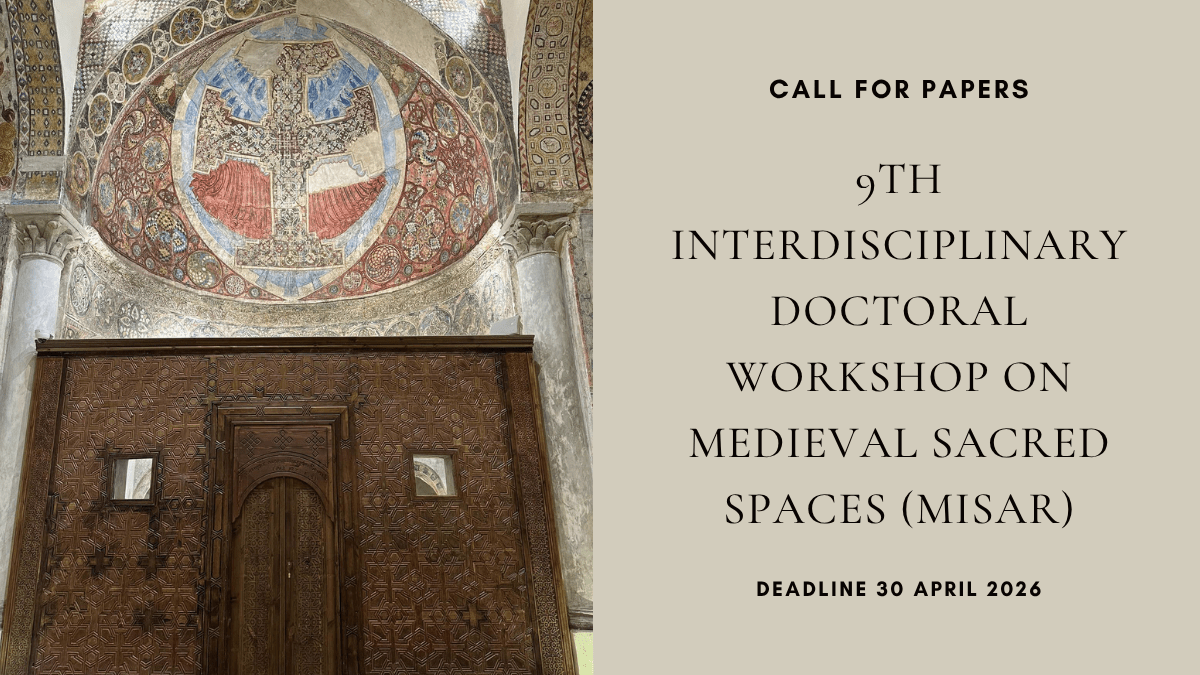
9th Interdisciplinary Doctoral Workshop on Medieval Sacred Spaces (MiSaR)
21–26 September 2026; Schloss Rauischholzhausen, 35085 Ebsdorfergrund, Germany
The European Middle Ages can hardly be imagined without its sacrality. Its most visible expressions remain with us to this day: magnificent churches and monastic complexes, chapels and stations of devotion, and—especially in larger medieval towns—also synagogues and Jewish cemeteries, despite repeated attempts to suppress and destroy Jewish culture. Museums, treasuries, and archives preserve precious reliquaries, invaluable manuscripts, tapestries, liturgical objects, and a wide range of religious art—from ornamented stone choir screens of the Carolingian period to the poignant Pietà sculptures of the late Middle Ages. Often removed from their original contexts, these objects now offer only a glimpse of the considerable efforts undertaken, particularly by social elites, to give visible expression to their piety.
Sacred practices, as expressions of deeply felt devotion, permeated all aspects of medieval society and found their way not least into the political actions of rulers. The spaces dedicated to them were omnipresent and frequently extended into the profane: into urban environments (through stations and processions), along travelled routes (pilgrimage paths, processional ways), and beyond. The sacred was closely intertwined with the rhythm of the seasons, structured by the liturgical year, major feasts, and saints’ days. Members of religious communities devoted their entire daily lives to sacred practice, which in its central function was always oriented toward the afterlife. Just as their days were structured by cycles of prayer, their sacred spaces were constituted through ritual acts, prayer, altars, imagery, and architecture.
Understanding medieval sacred spaces requires a multiperspectival and interdisciplinary approach—and it requires spaces for exchange. The 9th Interdisciplinary Doctoral Workshop aims to provide such a space.
All participants will have the opportunity to present their research project—or aspects thereof—for at least one hour and to discuss it in depth. In addition, the workshop encourages open formats addressing questions of academic practice, informal exchange on the conditions and challenges of doctoral research, constructive feedback in small groups, and opportunities for personal networking.
The workshop is organized by doctoral researchers for doctoral researchers—and has been so successfully for over a decade: operating beyond rigid institutional frameworks while remaining part of a vibrant network that continues to grow with each new generation of scholars, enriched by fresh perspectives.
In order to reflect the wide range of approaches to the study of sacred spaces, we warmly invite early career researchers from architectural and art history, archaeology and building research, liturgical studies and history, digital humanities (especially digital art history or archaeology), and related disciplines to apply with the following documents:
- Abstract of the proposed presentation (max. 500 words; images are welcome)
- CV (including information on the nature and stage of the research project, and—if applicable—supervision)
The current participation fee is €431.35 per person, including accommodation and meals. Once the programme has been finalized, we will seek funding opportunities to help reduce these costs significantly. Nevertheless, we recommend that applicants also explore individual funding options at an early stage.
Applications should be submitted by 30 April 2026 to the following email address:
mittelalterliche-sakralarchitektur@web.de
Organizers:
- Johanna Beutner (Universität Bonn)
- Madlen Gulitsch (Universität Bamberg)
- Nina Kunze (Universität Passau)
- Sophia Wagner (Universität Regensburg)
Discover more from Medieval Art Research
Subscribe to get the latest posts sent to your email.

