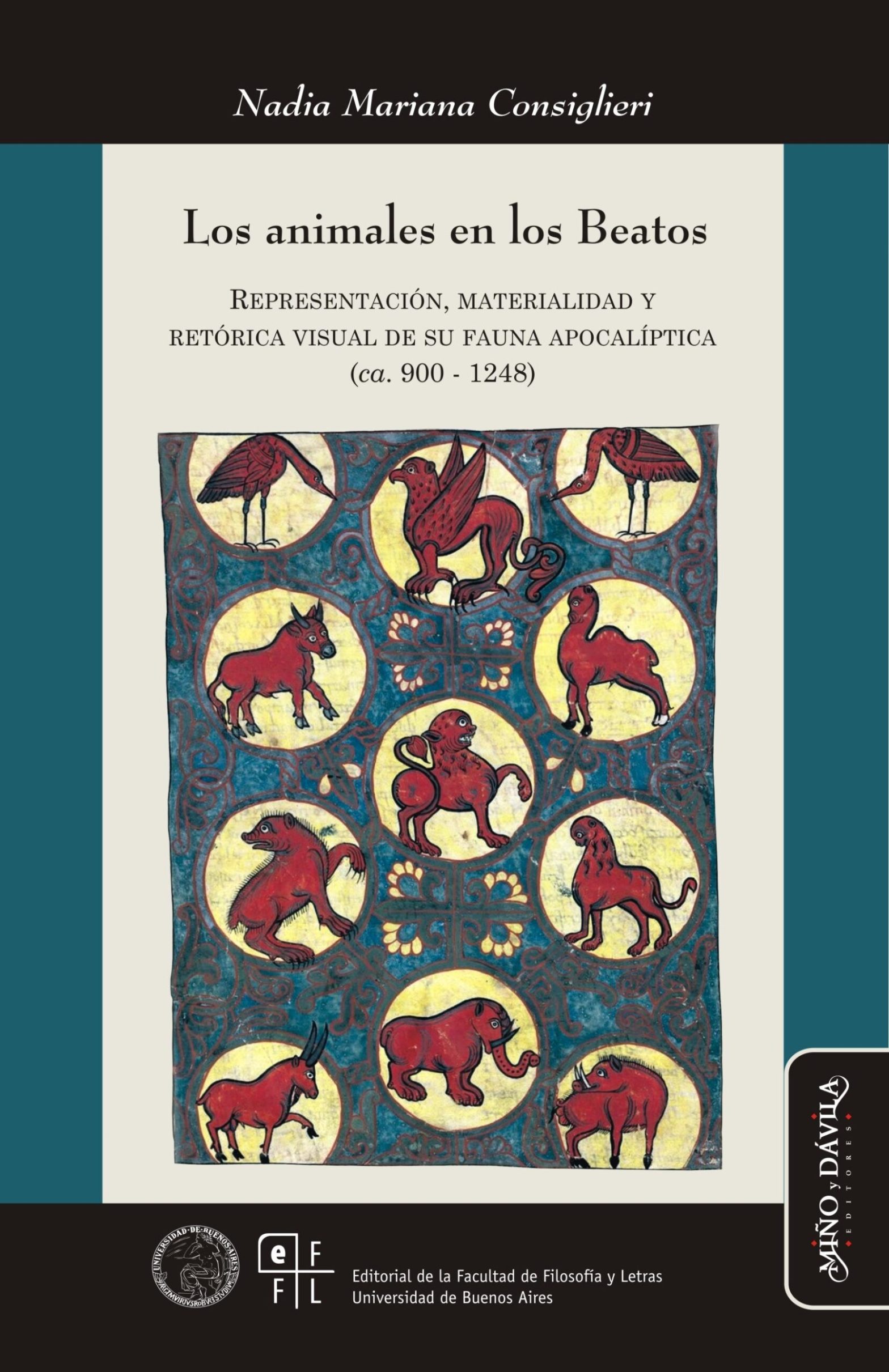
New Publication: ‘Los animales en los Beatos. Representación, materialidad y retórica visual de su fauna apocalíptica (ca. 900-1248)’ by Nadia Mariana Consiglieri

Beatus illuminated manuscripts were mainly produced in the Iberian region but also in French and Italian territories between the 10th and 13th centuries when Beatus of Liébana’s Commentary on the Apocalypse was copied in monastic scriptoria. Depending on their origin and time, the versions of their animals were modified. In this regard, the different animal figures were structured in these manuscripts from the sacred and devil poles in continuity with the Isidorian classification based on the opposite concepts domestication- bestiality, featured in his Etymologiae. These zoomorphic representations in Beatus codex acquired ideological and rhetorical functions by acting as effective support structures for the eschatological contents of the Commentary in the activity of monastic lectio.

To purchase, visit Mino y Davila.

Lecture: ‘”So shall the king greatly desire thy beauty”: on the sculptures of knights and ladies at Santa María la Mayor de Toro (Zamora)’, by Marina Aurora Garzon Fernandez, The Courtauld Research Forum, 23 November 2022, 17:00 GMT

During the second half of the 12th century sculptures of knights and ladies started populating churches across the Iberian North. Particularly interesting is the case of Santa María la Mayor de Toro (Zamora) because it features three capitals carved in successive construction stages that can be linked to different traditions. First, in the apse, a victorious knight facing a lady, similar to scenes found in Lleida, León and Santillana del Mar, could be read as a representation of Psalm 44. Later, a capital with a knight and a lady in a farewell embrace was sculpted at the transept, an iconography that can be traced back to a cycle of the Song of Songs from the portal of San Pedro de Villanueva (Asturias). Finally, decades later, another victorious knight with lady was carved at the tower quoting the earlier sculptures. Traditionally interpreted as images of the fight against evil, a reading of these scenes based on Psalm 44 and the Song of Songs, biblical passages alluding to the marriage between Christ and the Church, offers a new perspective on the sculpture program of Santa María la Mayor de Toro.

Marina Aurora Garzón Fernández studied Art History at the University of Santiago de Compostela (2011) where she earned a Masters in Medieval Studies (2013) and obtained her Phd in Medieval Studies (2019) with the thesis “Santa María la Mayor de Toro (Zamora): Church and City (1157-1312)” focusing on the study of Visual Culture in Leon and Castile during the 12th and 13th century. She is currently pursuing her post-doctoral project about paper-cut calligraphy in the Middle Ages at the CRC 933 “Material Text Cultures” at the University of Heidelberg.

Register here.

Call for Applications: 2023-2024 Predoctoral Research Residencies at the Center for the Art and Architectural History of Port Cities “La Capraia” (Deadline 31 January 2023)

Founded in 2018, the Center for the Art and Architectural History of Port Cities (Centro per la Storia dell’Arte e dell’Architettura delle Città Portuali) is a collaboration between the Museo e Real Bosco di Capodimonte, the Edith O’Donnell Institute of Art History at the University of Texas at Dallas, Franklin University Switzerland, and the Amici di Capodimonte.

Housed in “La Capraia”, a rustic eighteenth-century agricultural building at the heart of the Bosco di Capodimonte, the Center engages the museum and the city of Naples as a laboratory for new research in the cultural histories of port cities and the mobilities of artworks, people, technologies, and ideas. Global in scope, research at the Center is grounded in direct study of objects, sites, collections, and archives in Naples and southern Italy. Through research residencies for advanced graduate students, small field seminars, and larger programs organized with partner institutions, the Center fosters research on Naples and southern Italy as a site of cultural encounter, exchange, and transformation, and cultivates a network of scholars working at the intersection of the global and the local.

The Advisory Committee of the Center for the Art and Architectural History of Port Cities “La Capraia” invites applications for Research Residencies for PhD students in the earlier stages of their dissertations. Projects, which may be interdisciplinary, may focus on art and architectural history, music history, archeology, the digital humanities, or related fields, from antiquity to the present. Projects should address the cultural histories of Naples and southern Italy as a center of exchange, encounter, and transformation, and, most importantly, make meaningful use of local research materials including artworks, sites, archives, and libraries.

This year’s Research Residencies will run for the 2023-2024 academic year, from 11 September 2023 through 3 June 2024. Research Residents will be granted free lodging at La Capraia (private bedroom/study/bath and communal study/living/kitchen spaces) and a modest stipend of 6,500 EUR, administered by the Amici di Capodimonte, to help defray the cost of living. The Center will help Research Residents arrange access to collections, sites, archives, and libraries as needed for their projects; at Capodimonte, we will arrange access to collections and research resources insofar as it is possible during the museum’s upcoming closure for renovation. During their time in Naples, Research Residents are expected to work on their projects full time and in residence, and to participate in the organized activities, scholarly programs, and intellectual life of the Center. In the spring semester, Research Residents will be invited to present their research in an informal seminar, gallery talk, or site visit. In the summer following the residency period, Research Residents will be invited to contribute a short essay to the Center’s annual research report.

Residents will be responsible for obtaining appropriate visas (the Center will provide official letters of support) and for providing proof of health insurance. Residents must arrange their own travel to and from Naples. Because the Center is housed within an Italian institution, all residents are required to follow government COVID-19 regulations in effect during the residency period. We strongly recommend that all residents be fully vaccinated against COVID-19 before arriving in Naples.

We welcome applications from advanced doctoral students of any nationality. Applicants are invited to submit a letter of interest, a CV, and a research proposal of 1,000-1,500 words that frames the central questions, methods, and scholarly contributions of project, and describes the resources that will be used while on site in and around Naples. Materials should be sent in a single PDF file (with last name as the title of the file) to Center Coordinator, Dott.ssa Francesca Santamaria (francesca.santamaria@utdallas.edu). In addition, applicants must invite three recommenders to send letters of support directly to the same email address. All materials, including letters of recommendation, are due by January 31, 2023.

Learn more about the Center for the Art and Architectural History of Port Cities “La Capraia” at https://arthistory.utdallas.edu/port-cities/. Learn about our Research Residencies at https://arthistory.utdallas.edu/port-cities/residencies/. View past and upcoming scholarly programs at https://arthistory.utdallas.edu/port-cities/programs/.

Download an overview of La Capraia at https://arthistory.utdallas.edu/port-cities/La_Capraia_Overview.pdf

Newberry Library Short-Term Residential Fellowships 2023–2024 (Deadline 15 December 2022)

The Newberry Library is currently accepting applications for Short-Term Residential Fellowships for Individual Research. Short-Term Fellowships provide opportunities for individuals who have a specific need for the Newberry’s collection. Short-term fellowships are open to faculty members and postdoctoral scholars; PhD candidates with “All But Dissertation” (ABD) status; and scholars with terminal degrees in areas that do not offer a PhD, such as an MFA, MLIS, MSW, or JD. If you live or work in the Chicago metropolitan area, you may be eligible for a short-term fellowship at the Newberry.

Fellowships are available for one month with a stipend of $3,000. 

Click here for instructions on how to apply.

New Publication: ‘Inventing Late Antique Reliquaries. Reception, Material History, and Dynamics of Interaction (4th-6th Centuries CE)’ by Adrien Palladino

The cult of saints, their relics, and devotion to their shrines is a phenomenon born in Late Antiquity that durably shaped medieval and modern practices across a broad geographical and cultural area spreading first throughout the Roman Empire and beyond. How was the creation of vessels for the holy remains of saints implemented during a culturally heterogenous period? Indeed, how could boxes of various shapes, sizes, and materials become containers to shelter sacred matter? What materials could be used in reliquaries’ making, and what images should adorn them? And how did reliquaries, with their geographical and social portability, contribute to the translocation of site-bound sanctity and the spread of saints’ and shrines’ networks across the Late Antique world?

Tracing the medieval reliquary’s “pre-history”, this volume examines boxes bearing Christian images and patterns made between the fourth to the sixth century CE. It investigates how vessels adorned with images acquired meaning and power, exploring the dynamics of transformation that accompany both the creation of these objects and their long history of reuse, marginalization, and rediscovery.

To purchase, visit Viella.

Call for Papers: ‘Lacunae’, 33rd Annual Medieval Studies Colloquium (MSSC), 11 March 2023 (Deadline 15 December 2022)

The Medieval Studies Program at Cornell is pleased to announce the 33rd Annual Medieval Studies Student Colloquium (MSSC), which takes the idea of “Lacunae” as its theme. The conference will be held virtually over Zoom on Saturday, March 11th, 2023. 

We invite proposals for 20-minute papers investigating the various lacunae present in the Middle Ages or later understandings of or scholarship on the medieval period. Such papers are encouraged to approach this theme from an expansive range of disciplines and perspectives, especially–as the theme suggests–those which have been absent or underrepresented within medieval studies. “Lacunae” can refer to unfilled spaces, gaps, cavities, holes, or absences. For the purposes of this conference, papers may address lacunae in medieval archives or records (i.e., what materials or knowledge about the Middle Ages are we missing or have we lost?) or lacunae in research and other later engagements with the Middle Ages. What strands of theory or scholarship have not been applied to medieval studies? What voices are absent in the field? What medieval works or aspects of medieval culture (material or immaterial) have been overlooked by postmedieval thinkers or reconstructions/re-imaginings of the ‘medieval’? What are the ramifications of medieval lacunae in our current or past understandings of the Middle Ages? Papers may respond to, but are certainly not limited to, these questions.

Papers from underrepresented fields and backgrounds are particularly welcome, and we strongly encourage papers that look beyond Christian, Eurocentric, and Anglocentric contexts. We invite submissions from all fields and disciplines adjacent to Medieval Studies, including but not limited to Asian Studies, Africana Studies, anthropology, archaeology, art history, Asian Studies, classics, Critical Race Studies, gender and sexuality studies, history, Indigenous Studies, literature, Near Eastern Studies, philosophy, and theology. While we will consider all abstracts that are submitted, we will give priority to those aligned with the colloquium’s theme.

Please send abstracts to Lars Johnson at loj6@cornell.edu by December 15th, 2022. 

Lecture: ‘A Beautiful Lie: Medieval Art Forgeries in Catalonia’, Alberto Velasco, Murray Seminar at Birkbeck, 6 December 2022 17:00 GMT

A forgery, regardless of the criteria we may apply when studying it – evaluating its artistry or establishing its significance as an illustrative document of a given period – is a deception. The reasons for the production and commercialization of medieval fakes in Catalonia during the first half of the twentieth century are unique and specific, and they are explained by cultural, political and social conditions that, nevertheless, find points of contact in other parts of Europe. Similarities are found especially in those regions and states where medieval past forms a significant part of national historical roots. Catalan nationalism, the fascination with the Middle Ages and the general interest of the Barcelona bourgeoisie in medieval art has led to the appearance in Catalonia of a market for fakes that attempted to meet the growing demand. These are some of the issues addressed in the lecture, where we will deal with some of the most successful forgers, such as the Junyer brothers, and with fake works which, in their day, were certified as genuine by important scholars. Today some of them are in museums, while others make stellar appearances on the art market.

Register here for in-person attendance.

Register here for online attendance.

Fellowship: Kay Fellow in Premodern Disability Studies, Brandeis University (Deadline 15 December 2022)

Brandeis University invites applications for a two-year, non-renewable Florence Levy Kay Fellowship in Premodern Disability Studies. We seek a Fellow who takes a multicultural and intersectional approach to disability in the global, ancient world. An ideal candidate would examine disability and disabled persons within a premodern context by drawing upon robust theoretical frameworks to embrace an intersectional approach to disability history and redress the discriminatory traditions of scholars of the past. The area and period of specialization is open, but we are specifically seeking a Fellow whose research and teaching interests explore the cross-cultural experiences around disability in a global context. The Fellow would use interdisciplinary methods in their research but may have specialized training in history, linguistics, art, literature, or material culture. We welcome applications from PhDs in ancient Afro-Eurasian history or other related fields in the global premodern world.

Kay Fellowships are interdisciplinary appointments. The Kay Fellow in Premodern Disability Studies will hold a joint appointment as a faculty member at the rank of lecturer in the Departments of Classical Studies and English. The Kay Fellow will teach one course per semester and actively pursue their own research interests. The Fellow will receive a 2023-2024 salary of $62,000, plus benefits, with moving expenses (around $1,500), and a research fund of up to $4,000 per year. PhD should be in hand by the commencement of the fellowship.

Applications, which should be submitted through AcademicJobsOnline at https://academicjobsonline.org/ajo/jobs/23381, should include the following:

● Curriculum Vitae

● Writing sample (under 30 pages)

● Cover letter to include brief statement of research and teaching interests (no longer than two pages)

● Three References (no actual letters, just names and email addresses)

● And anything else requested in the position description.

Letters of recommendation will be solicited for a short list of candidates. First consideration will be given to applications received by December 15, 2022. Questions about the position may be directed to Darlene L. Brooks Hedstrom at brookshedstrom@brandeis.edu.

We plan to conduct the first round of virtual interviews in January 2023 via Zoom.

At Brandeis, we believe that diversity, equity, and inclusion are essential components of academic excellence. Brandeis University is an affirmative action, equal opportunity employer that is committed to creating equitable access and opportunities for applicants to all employment positions. Because diversity, equity, and inclusion are at the core of Brandeis’ history and mission, we value and are seeking candidates with a variety of social identities, including those that have been underrepresented in higher education, who possess skills that spark innovation, and who, through their scholarly pursuits, teaching, and/or service experiences, bring expertise in building, engaging and sustaining a pluralistic, unified, and just campus community.

Study Days: ‘Conques en Rouergue: constructions mémorielles’, 18 and 21 November 2022

Center for Higher Studies in Medieval Civilization, Poitiers
German Center for Art History – DFK Paris

As part of the Conques project in the global world supported by the European Research Council
(Marie Skłodowska-Curie Actions: Research and Innovation Staff Exchange, 2021-2024)

Please find the programme for the two days below:

Friday November 18

Poitiers, Center for Higher Studies in Medieval Civilization
Crozet Room

10am
Word of welcome
Cécile Voyer (CESCM, Poitiers)

Introduction
Ivan Foletti (Masarykova University, Brno)

Moderation: Émilie Kurdziel (CESCM, Poitiers)

10:30 a.m.
The written sources of Conques in their regional environment
Sébastien Fray (Jean-Monnet-Saint-Étienne University)

11:20 a.m. Break

11:40 a.m.
Conques: a stage on the Way of Saint Jacques de Compostela?
Adeline Rucquoi (School of Advanced Studies in Social Sciences, Paris)

12:30 p.m.
Pause

Moderation: Philippe Cordez

2 p.m.
Conques, pilgrimage church. From the historiographical construction to the medieval construction site (19th-11th century)
Eric Sparhubert (University of Limoges)

2:50 p.m.
Amassing gold in Conques: the “new” Sainte Foy and its trousseau
Ivan Foletti (Masarykova University, Brno)

3:40 p.m.
Conches and its enamels: between Silos, Limoges and “Byzantium”
Adrian Palladino (Masarykova University, Brno)

Public lecture

6 p.m.
Inventing France in Conques: from Viollet-le-Duc to Prosper Mérimée and Charlemagne
Ivan Foletti (Masarykova University, Brno)

Monday November 21

Paris, German Center for Art History – DFK Paris
Julius Meier-Graefe Hall
And online: https://dfk-paris-org.zoom.us/j/82187307877

2:30 p.m.
Word of welcome
Philippe Cordez (DFK Paris)

Introduction
Ivan Foletti (Masarykova University, Brno)

Moderation: Cécile Voyer (CESCM, Poitiers)

3:00 p.m.
Conques and the idea of ​​Byzantium
Adrian Palladino (Masarykova University, Brno)

3:45 p.m.
Conques in the 19th century
Ivan Foletti (Masarykova University, Brno)

4:30 p.m.
Modern and postmodern conches
Philippe Cordez (DFK Paris)

5:15 p.m.
Aperitif

Concept and organization
Philippe Cordez (DFK Paris)
Ivan Foletti (Masarykova University, Brno)
Eric Sparhubert (University of Limoges)
Cécile Voyer (CESCM)

For more information please contact: pcordez@dfk-paris.org, cecile.voyer@univ-poitiers.fr

Call for Applications: Mary Jaharis Center Grants 2023–2024 (Deadline 1 February 2023)

The Mary Jaharis Center for Byzantine Art and Culture is pleased to announce its 2023–2024 grant competition. 

Mary Jaharis Center Co-Funding Grants promote Byzantine studies in North America. These grants provide co-funding to organize scholarly gatherings (e.g., workshops, seminars, small conferences) in North America that advance scholarship in Byzantine studies broadly conceived. We are particularly interested in supporting convenings that build diverse professional networks that cross the boundaries of traditional academic disciplines, propose creative approaches to fundamental topics in Byzantine studies, or explore new areas of research or methodologies.

Mary Jaharis Center Dissertation Grants are awarded to advanced graduate students working on Ph.D. dissertations in the field of Byzantine studies broadly conceived. These grants are meant to help defray the costs of research-related expenses, e.g., travel, photography/digital images, microfilm.

Mary Jaharis Center Project Grants support discrete and highly focused professional projects aimed at the conservation, preservation, and documentation of Byzantine archaeological sites and monuments dated from 300 CE to 1500 CE primarily in Greece and Turkey. Projects may be small stand-alone projects or discrete components of larger projects. Eligible projects might include archeological investigation, excavation, or survey; documentation, recovery, and analysis of at risk materials (e.g., architecture, mosaics, paintings in situ); and preservation (i.e., preventive measures, e.g., shelters, fences, walkways, water management) or conservation (i.e., physical hands-on treatments) of sites, buildings, or objects.

Mary Jaharis Center Publication Grants support book-length publications or major articles in the field of Byzantine studies broadly conceived. Grants are aimed at early career academics. Preference will be given to postdocs and assistant professors, though applications from non-tenure track faculty and associate and full professors will be considered. We encourage the submission of first-book projects.

The application deadline for all grants is February 1, 2023. For further information, please visit the Mary Jaharis Center website.

Contact Brandie Ratliff (mjcbac@hchc.edu), Director, Mary Jaharis Center, with any questions.