Call for Papers: Beguiling Structures Architecture in European Painting 1300-1550

Screen Shot 2014-05-04 at 21.33.43Beguiling Structures
Architecture in European Painting 1300-1550
19th September 2014, National Gallery, London

“Is it not true that painting is the mistress of all the arts or their principal ornament? If I am not mistaken, the architect took from the painter architraves, capitals, bases, columns and pediments, and all the other fine features of buildings. The stonemason, the sculptor and all the workshops and crafts of artificers are guided by the rule and art of the painter. So I would venture to assert that whatever beauty there is in things has been derived from painting.”

Leon Battista Alberti – De Pictura, Book II, Chapter XXVI.

So runs Leon Battista Alberti’s famous claim for architectsindebtedness to the creativity of painters. His words draw attention to the close relationship between illusionistic representations of architecture and its actual three-dimensional forms. Indeed, the prominence given to architecture within painting before and after Alberti’s lifetime has long been noted, though its presence is easily overlooked and its precise meaning often elusive. This conference for graduate students and early-career scholars will explore this relationship in all its multifaceted complexity. Conceived to complement The National Gallery’s exhibition Building the Picture: Architecture in Italian Renaissance Painting, this event will look afresh at architecture’s place within European painting and reassess established interpretations. Why were buildings included in pictorial representations? What is their purpose and what do they do for the picture? The answers to these and other questions may well uncover a far more complex interchange between painting and architecture than Alberti’s straightforward assertion would suggest.

Students and scholars working in the visual arts of the late-Mediaeval and Renaissance periods are therefore warmly invited to submit proposals for twenty-minute papers. Interdisciplinary approaches to these subjects and discoveries of current research are particularly welcome. Potential topics for consideration may include:

-The use of architecture to demonstrate perspectival devices and to structure pictorial composition.
-The adoption of elaboration, ornamentation and the ‘fantastic’ in depicted architecture.
-The use of architectural forms to visualise historical time and specific topographies within narratives.
-The theoretical discourse of perspective and its terminology within contemporaneous accounts.
-The creation of dialogues between the architecture of the painting and that of its original location.
-The use and significance of architectural frames both within paintings and surrounding them.

Whilst papers on these themes are encouraged, submissions for proposals on topics across the broader spectrum of artistic media, chronological periods and geographical locations are also welcome. Proposed papers’ titles and abstracts of 250 words, and any additional enquiries, should be forwarded to beguiling.structures@gmail.com by Monday 16TH June 2014. This conference, organised by Alasdair Flint, James Jago and Livia Lupi, forms part of the Galleries & Museums Research Partnerships Programme between The National Gallery, London and the Department of History of Art, The University of York.


Call for papers: Alfonso VIII and Eleanor of England, Artistic Confluences Around 1200 (Madrid, November 12-14, 2014) – Deadline 25th May

Arlanza[1]October 6, 1214. The Castilian monarch, Alfonso VIII, died on his way to Plasencia. Before the month had ended, his wife Eleanor Plantagenet followed him in the monastery of Las Huelgas in Burgos. To celebrate the eight-hundredth anniversary of their passing, the UCM’s Department of History of Art I (Medieval) organises the VIII edition of their International Seminar-Complutense Conference in Medieval Art (12-14 November 2014), under the title “Alfonso VIII and Eleanor of England, Artistic Confluences Around 1200″.

There are four scheduled sessions:


Session I: Alfonso VIII, culture and image of a Kingdom

This first session will explore the memory of the Castilian royal family and its repercussions on cultural and artistic manifestations linked to the regal environment. It will accommodate contributions related to the figure of the monarch and his lineage, his image, or his role as an artistic patron.

Session II: Eleanor of England, women’s artistic patronage

Starting with the figure of Eleanor as queen and patroness of the arts, we suggest a reflection on the role of women in the field of artistic promotion, both in regal and aristocratic spheres.

Session III: Artists, workshops and exchanges

During Alfonso VIII’s time, figurative arts experimented a deep transformation encouraged by workshops and artists’ mobility, sharing knowledge and using the same solutions in often distant territories. The third session will address all figurative artistic expressions during this long reign (1158-1214).

Session IV: Peninsular architecture around 1200, changes and international connections
Alfonso VIII and Eleanor of England’s reign coincided with a time of change in the religious architecture of the Peninsular kingdoms, both Christian and Muslim. New liturgical necessities, together with artistic exchanges within the Hispanic and European territories, had an impact on the renovation of the Spanish monumental landscape.


Invited speakers: Martin Aurell (CESCM-Université de Poitiers), Claude Andrault-Schmitt (CESCM-Université de Poitiers), Isidro Bango Torviso (UAM), Gerardo Boto Varela (Universitat de Girona), Susana Calvo Capilla (UCM), Eduardo Carrero Santamaría (UAB), Therese Martin (CCHS, CSIC), Javier Martínez de Aguirre (UCM), Dulce Ocón Alonso (Universidad del País Vasco), Olga Pérez Monzón (UCM), Marta Poza Yagüe (UCM), Ana María Rodríguez López (CCHS, CSIC), Marta Serrano Coll (Universitat Rovira i Virgili) and Elizabeth Valdez del Alamo (Montclair State University)..


Scientific committee:Marta Poza Yagüe (coordinadora), Diana Olivares Martínez (secretaria), Javier Martínez de Aguirre, Pilar Martínez Taboada and José Luis Senra Gabriel y Galán.


CALL FOR PAPERS

Paper proposals of about 1000 words -including a brief CV- may be submitted in English, Spanish or French. Only those papers presenting new research or critical contributions will be considered. They must fit within the themes of the above sessions. Proposals should be sent to the email address VIII.jornadas@ucm.esby May 25, 2014. After evaluation, the scientific committee will inform the authors of their acceptance on June 20, 2014.

As with previous editions of the Jornadas Complutenses de Arte Medieval, the proceedings of the congress are planned to be published.

For more information, please visit the following website: https://www.ucm.es/artemedieval/8jornadas

Interact with us: follow us on social media and send in your medieval news and events

C14 stained glass of hare riding hound, Great Gonerby church, Lincolnshire

This is only the beginning of the third academic term for this blog, but we are delighted by the postive response it has received. Just remember, it is intended as a totally free resource for all: if you have a medieval event coming up, whether it be an international conference or faculty reading group, please do send it into medievalartresearch@gmail.com and we’ll put it up! The same goes for your own short reviews and opinion pieces: for instance if you are going to Kalamazoo this year, we’d love to hear from you.

Also do follow us on Facebook and Twitter!

And if you want to spread the word, we now have a proper domain: medievalartresearch.com!

Conference: Connecting the Silk Road. Trade, People & Social Networks (c. 400-1300 AD) May 17-18, 2014

silkroadLeiden University (Leiden Global Interactions – Project ‘Guiding Travelers’) has organized in cooperation with the Hermitage Amsterdam the conference Connecting the Silk Road. Trade, People & Social Networks (c. 400-1300 AD) on May 17 and 18, 2014 (see attached programme). The occasion for this symposium is the exhibition Expedition Silk Road. Treasures from the Hermitage, in the Hermitage Amsterdam on view from March 1 until September 5, 2014. Responsible for the conference organization are: Joanita Vroom (Archaeology, Leiden University) & Gabrielle van den Berg (Area Studies, Leiden University), and Birgit Boelens & Vincent Boele (Hermitage Amsterdam).

For thousands of years, land and sea routes served to exchange goods and ideas over thousands of kilometers from the Pacific East to the Atlantic West. Contacts between east and west are often assumed to have developed first in the Roman period, and then re-established again in the post-Marco Polo era. Exchange however continued, evolving along clusters of networks and changing routes and roads, which were commonly known as ‘the Silk Road’. Networks were created with commercial, social, religious, diplomatic incentives and connected geographical regions over any distance.

In this conference, we aim to highlight the complexity and sophistication of interactions through and between such networks by exploring their diversity, connective infrastructure and organization across natural or human-imposed boundaries. In addition, we hope to discuss development over routes and roads under influence of political, religious, economic and social changes.

Poster presentations for the conference are welcome (please contact: Gabrielle van den Berg: g.r.van.den.berg@hum.leidenuniv.nl, or Maria Riep: m.riep@hum.leidenuniv.nl).

Entrance is free, but registration (from April 23 onwards) for the conference is required. Please contact for further information the Hermitage Amsterdam: pressoffice@hermitage.nl

CONFERENCE PROGRAMME: http://media.leidenuniv.nl/legacy/program-17-and-18-may.pdf

OFFICIAL WEBSITE AND REGISTRATION: http://research.leiden.edu/research-profiles/global/guiding-travelers/news/conference-2014.html

Conference: Study of Underdrawing and Technology in Painting XIX and Ghent altarpiece study day, 11-13 September 2014

824334_79f78a52f10d445bac1475e0a543e7cf.gif_srz_2480_466_75_22_0.50_1.20_0.00_gif_srz[1]

The Université catholique de Louvain (UCL, Louvain-la-Neuve), the Laboratoire d’étude des œuvres d’art par les méthodes scientifiques (Musée de Louvain-la-Neuve) and the Flemish research centre for the arts in the Burgundian Netherlands of the Groeningemuseum (Musea Brugge) are honoured to announce the XIXth symposium for the Study of Underdrawing and Technology in Painting which will be held in Bruges on 11-13 September 2014. This series of prestigious conferences, already in their nineteenth edition, was initiated in 1975 by the Université catholique de Louvain in Louvain-la-Neuve (UCL). The colloquium is alternately organized by the UCL, the Katholieke Universiteit Leuven (KULeuven) and the Royal Institute for Cultural Heritage (KIK/IRPA) and its Centre for the Study of the Flemish Primitives, who hosted the XVIIIth symposium dedicated to Jan van Eyck in 2012.

The 2014 colloquium is dedicated to Technical studies of paintings: problems of attribution (15th-17th century). Attributions are central questions in art history. Since the introduction of new examination methods such as radiography, infrared photography and reflectography, conventional art history has undergone major changes. Technical examinations can provide additional arguments for attributing works of art to individual artists or their workshops. However, technical studies often also reveal complex working methods, while new scientific imagery sometimes challenges accepted attributions and instigates reconsiderations of traditional attributions. This symposium focusses on the various ways in which technical studies can provide answers to the often complex issue of attribution and will discuss the challenges that art historians face in proposing conclusive theories.

Scientific Committee

Till-Holger Borchert (Musea Brugge, Flemish research centre for the arts in the Burgundian Netherlands), Jacqueline Couvert (UCL, Laboratoire d’étude des oeuvres d’art par les méthodes scientifiques), Christina Currie (KIK/IRPA), Anne Dubois (UCL, FRS-FNRS), Bart Fransen (KIK/IRPA), Valentine Hendericks (ULB, KIK/IRPA), Vanessa Paumen (Musea Brugge, Flemish research centre for the arts in the Burgundian Netherlands), Cyriel Stroo (KIK/IRPA), Jan Van der Stock (KULeuven), Anne van Oosterwijk (Musea Brugge, Flemish research centre for the arts in the Burgundian Netherlands), Dominique Vanwijnsberghe (KIK/IRPA), Lieve Watteeuw (KULeuven)

Ghent Altarpiece International Study Day

ghent altarpiece restorationThe Royal Institute for Cultural Heritage (KIK/IRPA) and the University of Ghent (UGent) are honoured to announce the Ghent Altarpiece International Study Day that will take place in Ghent on 10 September 2014. This is one day before the renowned Symposium XIX for the Study of Underdrawing and Technology in Painting in Bruges (11-13 September 2014).
The day is intended for art-historians, curators, conservators, scientists and other scholars studying Early Netherlandish painting.
In the morning session, six conferences will present a wide range of aspects of the current research and conservation/restoration treatment on the Ghent Altarpiece. In the afternoon, you will be enabled to witness the progress of the treatment in the Museum of Fine Arts of Ghent, and to informally meet with the members of the treatment and research teams. You are also invited to visit St Bavo’s Cathedral and the two exhibitions on the Ghent Altarpiece in the Caermersklooster.

ORGANIZING COMMITTEE
Till-Holger Borchert (Groeningemuseum), Annick Born (UGent), Christina Ceulemans (KIK/IRPA), Bart Fransen (KIK/IRPA), Maximiliaan Martens (UGent), Ron Spronk (Queen’s University, Canada-Radboud University, Holland), Cyriel Stroo (KIK/IRPA), Anne van Grevenstein (St Bavo Cathedral)

Full Conference Registration (registration before 1 july 2014): 250 €
Full Conference Registration (registration after 1 july 2014): 300 €
One Day Registration: 150 €
Speakers: 190 €
Student: 120 € (please include a copy of your student ID)
Conference dinner: 60 €

OFFICIAL WEBSITE AND REGISTRATION: http://symposiumxix.wix.com/underdrawing

CFP: Gotische Skulptur um 1300 (Berlin, 7-8 May 2015), deadline 8 June 2014

Gotische Skulptur um 1300 in Frankreich und Deutschland Tagung der Staatlichen Museen zu Berlin im Bode-Museum

Die in den Jahrzehnten um 1300 in Frankreich und den angrenzenden Territorien des Deutschen Reichs entstandene, deutlich von wechselseitigen Bezügen geprägte gotische Skulptur wurde lange kontrovers diskutiert. Ziel der meisten Debatten war die Erstellung einer Chronologie der wichtigsten Objekte – ein Bestreben, dem aber allein schon dadurch Grenzen gesetzt waren, dass nur erstaunlich wenige Ensembles oder Einzelwerke datiert bzw. Auftraggebern und Bildhauern sicher zugeschrieben werden können. Daher dominierten stilkritische Zuschreibungen nolens volens das Feld. Sie waren nicht nur Grundlage eines instabilen, gleichwohl allgemein akzeptierten Entwicklungsmodells gotischer Skulptur dies- und jenseits des Rheins, sondern bestimmten auch Überlegungen zu Themen wie Werkstattmigration, Kunst- und Materialtransfer, zur Wahrnehmung der Objekte oder politischen Intention von Kopien prominenter Bildwerke. In jüngster Zeit sind die Diskussionen
wieder lebhafter geworden. Denn neuere bauarchäologische und dendrochronologische Untersuchungen haben überraschende Zeitstellungen gebracht, und Revisionen älterer Datierungsvorschläge lassen das  mühsam aufgerichtete chronologische Gerüst kippen.

Die Frage nach den Folgen für die angerissenen Themenkomplexe ist Anlass der geplanten Tagung. Es sollen keine neuen Chronologiemodelle aufgestellt, sondern in erster Linie aktuelle Forschungsergebnisse von Kunsthistorikern, Bauforschern und Restauratoren gebündelt und somit neue Perspektiven für den gesamten Forschungsbereich gefunden werden. Eine wichtige Rolle sollen auch neuere restauratorische Untersuchungen spielen, die sich vermehrt Steinbildwerken widmen. Die gotische Skulptur, so lauten häufig die Schlussfolgerungen, war viel häufiger und früher monochrom, als bislang angenommen. Die Interpretation dieser Befunde in Hinblick auf Bildwirkung und Rezeption steht oft noch aus.

Einen Schwerpunkt der Tagung wird die Diskussion vor den Objekten der in vielerlei Hinsicht aufschlussreichen Berliner Skulpturensammlung sein, die in einem im Sommer 2014 erscheinenden Bestandskatalog erstmals seit 1930 wieder zusammenfassend gewürdigt wurden.

Erbeten werden Vorschläge zu Vorträgen à 25 Minuten zu den oben genannten Themen, sowohl monographische Präsentationen einzelner Objekte als auch Übersichten zu komplexen Zusammenhängen. Vorträge können in deutscher, französischer und englischer Sprache gehalten werden. Angestrebt wird eine Bezuschussung (Reise- und Übernachtungskosten der Referenten). Eine rasche Publikation (innerhalb eines halben Jahres) ist geplant.

Vorschläge (max. 2000 Zeichen) richten Sie bitte bis zum 8. Juni 2014 an.

Michael Grandmontagne (medrikat-grandmontagne[at]t-online.de) & Tobias Kunz (t-w-kunz[at]web.de)
La sculpture gothique vers 1300, en France et en Allemagne Colloque organisé par les Musées de Berlin, Bode-Museum, 7 et 8 mai 2015
Appel à contribution

Depuis plus d’un siècle, le développement conjoint, autour de 1300, de la sculpture gothique en France et sur les territoires limitrophes de l’Empire allemand a fait l’objet de controverses notoires. L’objectif premier de la plupart des chercheurs aura souvent été d’établir une chronologie des œuvres les plus importantes – effort louable mais qui fut longtemps limité, peu d’œuvres ou même d’ensembles pouvant être datés avec certitude, tandis que force noms d’artistes ou de commanditaires sont tombés dans l’oubli. Bon gré mal gré, le terrain fut donc occupé par les « connaisseurs », qui fondent leurs jugements sur des critères stylistiques, une méthode qui présuppose un développement continu de la sculpture gothique des deux côtés du Rhin, ce qui n’a rien d’évident. De nombreuses recherches ont également été dédiées à des thèmes tels que la migration des ateliers, des œuvres ainsi que des matériaux, jusqu’à la perception des objets ou à la volonté politique de copier certaines sculptures majeures. Ces dernières années, les discussions sont devenues particulièrement animées du fait de nombreuses découvertes, effectuées dans le domaine de l’archéologie du bâti et de la dendrochronologie, et dont les résultats surprenants démentent parfois les certitudes les plus établies. De toute évidence, une révision du cadre chronologique s’impose.

Ce colloque cherche à établir, dans le champ de la sculpture gothique, les conséquences des changements méthodologiques induits par la recherche récente. Il ne s’agira aucunement de proposer un nouveau modèle chronologique, mais avant tout de présenter les recherches actuelles des historiens de l’art et de l’architecture, ainsi que des restaurateurs, ce qui devrait permettre de définir de nouvelles perspectives pour l’ensemble des études dans ce domaine. Une place importante sera consacrée aux problèmes qui ont récemment émergé à l’occasion de certaines restaurations, notamment celles concernant la sculpture sur pierre : la sculpture gothique, nous disent des analyses récentes, était bien plus monochrome qu’on ne le pensait jusqu’à présent. L’interprétation de tels résultats, du point de vue de l’histoire de la réception des œuvres, doit encore être formulée.

La discussion se fondera en grande partie sur les récentes découvertes ayant émaillé l’étude des œuvres de cette période appartenant aux collections de sculptures des Musées de Berlin et conservées au Bode-Museum, anticipant la parution prochaine, à l’été 2014, d’un nouveau catalogue raisonné de ces sculptures, plus de quatre-vingts ans après la dernière édition, publiée en 1930.

Les propositions de communication (de 2 000 signes maximum, espaces compris) devront être envoyées avant le 8 juin 2014 aux adresses ci-dessous. Les conférences seront d’une durée de 25 minutes et pourront être prononcées en allemand, en français ou en anglais. Le déplacement et l’hébergement des intervenants devraient pouvoir être pris en charge, tandis que les actes de ces journées devraient être publiés avant la fin de l’année 2015.

Michael Grandmontagne (medrikat-grandmontagne[at]t-online.de)

Tobias Kunz (t-w-kunz[at]web.de)

Upcoming events: Research Seminars in Islamic Art, SOAS, London

indexThursday 22nd May 2014, 5.30pm in Room B104 (Brunei Building):

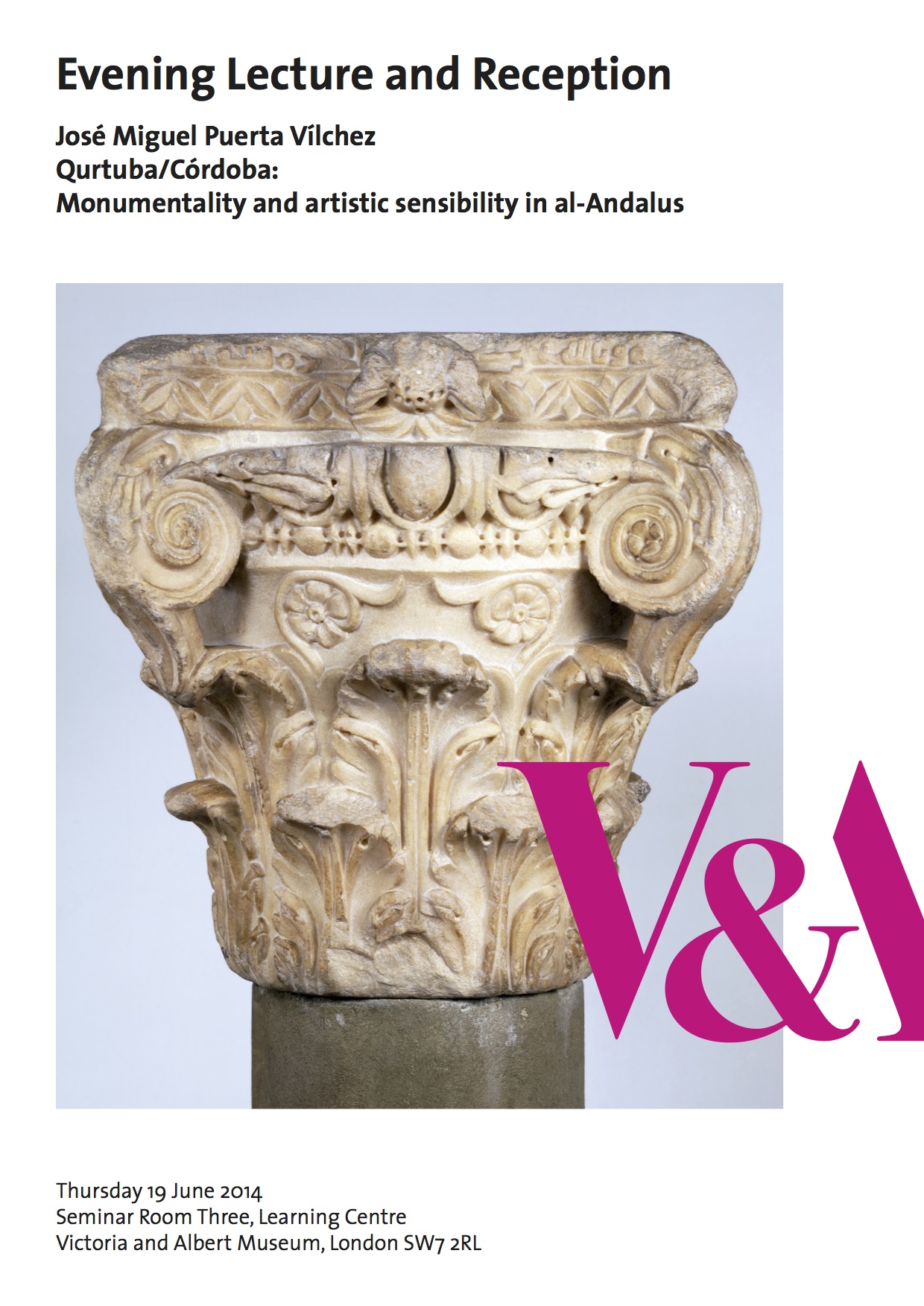
Eduardo Manzano Moreno (CSIC, Madrid) Delivering the Caliphate. The circulation of wealth and valuables in Umayyad ​Cordoba at the 10th/4th century

Broad views of “convivencia” as the main feature that pervades Umayyad Cordoba in the 10th/4th century have usually fostered a number of myths and misconceptions regarding its sudden “magnificence” and “splendor”. This has entailed that the material foundations of the Caliphate have usually been overlooked. The aim of this lecture is to show the role played by wealth and valuables in the social and political articulation of the Umayyad Caliphate, and how a proper assessment of these elements can render new insights for the knowledge of objects and material remains.

Thursday 5th June 2014, 5.30pm in Room B104 (Brunei Building):

Antonio Vallejo Triano (​former director of the Madinat Al-Zahara Architectural Complex, 1985 to 2013) The Cordoba Caliphate through Madinat Al-Zahra: from its proclamation to its consolidation

Madinat al-Zahra was the great urban creation of the Umayyad Caliphate of al-Andalus. It was built in the middle of the tenth century as part of the ideological-structural programme launched by Abd al-Rahman III after his self-proclamation as Amir al-muminin (Prince of Believers) and within the context of his rivalry with other Caliphates, especially the Fatimid Caliphate. Since Madinat al-Zahra was one of the Caliphate’s main means of propaganda and legitimisation, the lecture seeks to explain how city planning and architecture not only reflect the structure of the Caliphate State but also its most pressing concerns and issues. This direct relationship, guaranteed by the sovereign’s involvement in all decision-making processes regarding construction, is one of the aspects that the lecture aims to bring to light. Moreover, the changes in palace architecture also clearly reflect the changes made to the configuration of the State. Madinat al-Zahra was not a static city but underwent very important transformation processes that can be read and interpreted in an historical context as a reflection of the evolution of the Caliphate State from its proclamation to its consolidation. The analysis of the decoratives materials of Madinat al-Zahra in the Victoria and Albert Museum, which were uncovered in the first excavations, will help corroborate these hypotheses.

Conference: FLAWS Medieval Research Conference, UCL

logo[1]The London Medieval Graduate Network is pleased to announce that its annual conference will take place at UCL on 29th May 2014 with the theme of ‘Flaws.’ This inter-disciplinary conference examines how deliberate or mistaken defects, errors, limitations and imperfections have been perceived across the medieval period.

Flaws are something all researchers have to deal with; from flaws in our source material, to flaws in the approaches and theories we use. The late twentieth century witnessed a concerted effort from within the medieval discipline to challenge not only our theoretical approaches but also the validity of our disciplines themselves. These challenges encouraged researchers to be aware of the limitations of their evidence as well as mindful of the choices they make within their own research. As postgraduates and young researchers we are more aware than ever of the flaws which we face. We hope that this theme will give scope for the discussion of newer areas of medieval study, such as considerations of materiality, the built environment and psychological analyses, whilst also allow us to consider new approaches to more traditional discussions of the text, narratives and institutions.

Professor John Arnold (Birbeck) will give a keynote talk entitled, ‘Flaws in Medieval Belief.’

All welcome. Please email londonmedgradnetwork@gmail.com with any enquiries.

Tickets (free!):

http://www.eventbrite.co.uk/e/flaws-conference-tickets-11408159111


Programme:
(
Roberts Building Room 110, UCL)

9.30 – 10:00 Registration and tea

10:00 11:00 Keynote Address
Flaws in Medieval Belief – Professor John Arnold (Birkbeck, University of London)

11.15-11.30 TeaBreak

11.30-1:00 Manuscripts

Chaired by Sheri Chriqui (RHUL)

‘Exquisite Incongruities’: A Historiography of Medieval Marginalia’

Katherine Sedovic (University of Oxford)

Drypoint Corrections in an Old English Manuscript

Christine Wallis (University of Sheffield)

The Restrictions of National Boundaries: Flaws of Early Medieval Historiography and a Comparative Solution

Anthony Mansfield (University of Keele)

1:00 – 2.30 Lunch break

2.30-3.30 Source Analysis

Chaired by Rebecca Hardie (KCL)

Hildegard of Bingen’s epistolary correspondence and the problems of authenticity. Reflections on a flawed approach and proposals towards a new one

Dijana Bugarin (University of Bern)

The Context and Historical Value of the “Sleat History”

Mary MacTavish Crawford (University of Edinburgh)

2.30-3.30 Source Analysis

Chaired by Rebecca Hardie (KCL)

Hildegard of Bingen’s epistolary correspondence and the problems of authenticity. Reflections on a flawed approach and proposals towards a new one

Dijana Bugarin (University of Bern)

The Context and Historical Value of the “Sleat History”

Mary MacTavish Crawford (University of Edinburgh

3.30-3.45 Tea Break

3.45-5:00 Flawed Analysis

Chaired by Louisa Taylor (UCL)

Amiens and Visual Neuropsychology: Questioning Flaws in Gothic Cathedral Architecture

Mathew Jacobs (University of Oxford)

Mixing up lemons with melons: Errors and Confusions in the Depiction of Plants in Aldobrandino of Siena’s Le Régime du corps

Luis Ribeiro (Nova University of Lisbon)

Bums on seats: Between material and documentary evidence in the study of parish church sedilia

James Alexander Cameron (Courtauld Institute)

5:00 5:15 End Notes
5:15
7:00 Drinks Reception
All welcome!

Lectures: Late Antique and Byzantine Archaeology and Art Seminar, Oxford

Trinity Term 2014, Thursdays 11-12:30
St John’s College, New Seminar Room

images1 May   Prof. Wolfgang Hahn (University of Vienna; OCBR Visiting Professor), Some remarks on the Byzantine issues of the Roman mint during the 8th century
8 May   Prof. Andrew Wilson (All Souls), The nymphs and palms of late Roman Aphrodisias
15 May  Dr. Anne McCabe (CSAD), Equestrian sports in and near the Great Palace at Constantinople:  Part 1
22 May  Agnieszka Lic (St Cross),   The mosque at Sobata/Shivta in the Negev in the context of Muslim-Christian relations in Bilad al-Sham in the early Islamic period.
29 May  Dr Simon Davies, From statue to ‘relief icon’: transition in medieval Byzantine sculpture
5 June  Prof. Elizabeta Dimitrova (Skopje), Art and ritual in the sacred images of Macedonia paleocristiana: mosaics, frescoes, relief decoration
12 June Prof. Cyril Mango (Exeter), Equestrian sports in and near the Great Palace at Constantinople:  Part 2
19 June Dr. Jeffrey Featherstone (Corpus) and Dr. Philipp Niewöhner (Brasenose), The topography of  the Great Palace and the iconography of the Walker Trust Mosaics at Constantinople

Conveners:  Dr. Marlia Mango (St John’s) and Philipp Niewöhner (Brasenose)

Call for Session Proposals: Sponsored Panel at Kalamazoo 2015

mjc-logo-lrgTo encourage the integration of Byzantine studies within the scholarly community and medieval studies in particular, the Mary Jaharis Center for Byzantine Art and Culture seeks proposals for a Mary Jaharis Center sponsored session at the 50th International Congress on Medieval Studies, Western Michigan University, Kalamazoo, May 14–17, 2015. We invite session proposals on any topic relevant to Byzantine studies.

Session proposals must be submitted through the Mary Jaharis Center website (http://maryjahariscenter.org/sponsored-sessions/50th-international-congress-on-medieval-studies/). The deadline for submission is May 19, 2014. Proposals should include:

-Title
-Session abstract
-Intellectual justification for the proposed session (about 300 words)
-CV

Successful applicants will be notified by May 28, 2014 if their proposal has been selected for submission to the International Medieval Congress. The Mary Jaharis Center will submit the session proposal to the Congress and will keep the potential organizer informed about the status of the proposal.

If the proposed session is approved, the Mary Jaharis Center will reimburse session participants (presenters and presider) up to $500 maximum for US residents and up to $1000 maximum for those coming abroad. Funding is through reimbursement only; advance funding cannot be provided. Eligible expenses include conference registration, transportation, and food and lodging. Receipts are required for reimbursement.

The session organizer may act as the presider or present a paper. The session organizer will be responsible for writing the Call for Papers. The CFP must be approved by the Mary Jaharis Center. A list of suggested speakers and abstracts may be appended to the session abstract. Session participants will be chosen by the session organizer and the Mary Jaharis Center.

Please contact Brandie Ratliff (mjcbac@hchc.edu), Director, The Mary Jaharis Center for Byzantine Art and Culture with any questions.