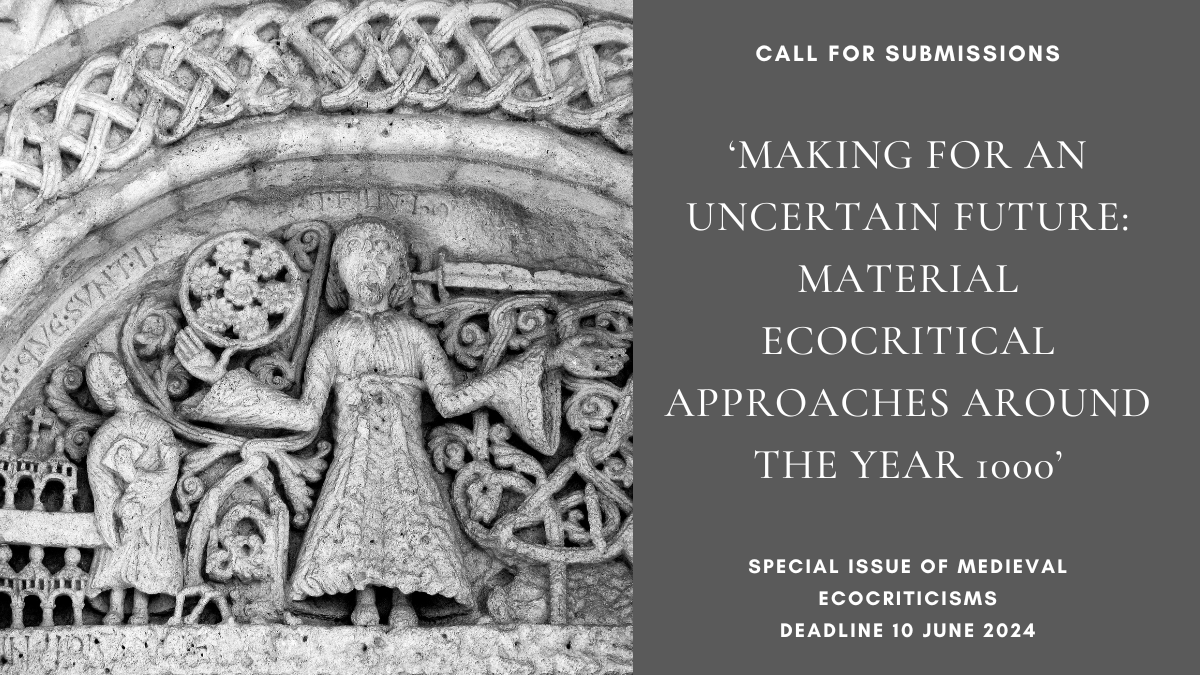
CFP: ‘Marginalia: Frontiers of Connection’, University of São Paulo, deadline 30 April 2024

XIV International Seminar, The Medieval Image: History and Theory
7-9 August 2024, University of São Paulo

Margins are not mere blank spaces: they can bear various marks of the actions of manuscript producers and consumers. In them, for example, the colouration of the parchment becomes more evident, and sometimes holes for ruled lines can be seen. More importantly, annotations and images of various kinds may have been included there. The margins thus could function as spaces of multiple exchanges both within and outside of the book.

However, margins are not exclusive to manuscripts: they can be physical spaces on a geographical scale or in an architectural sense, as well as symbolic spaces. Travelers, the hungry, prostitutes, lepers, and other marginalised individuals inhabit the margins of the city, not only subverting social norms [1] but also reinventing them, becoming vehicles for the circulation of cultural practices between the center and the periphery and among different peripheral regions. They constituted spaces for the production of counter-hegemonic discourses and resistance [2], while simultaneously producing, disputing, and defining the center as a “social field” [3]. As borders of connection, margins were the first territory to be reached by famine, epidemics, outsiders, and commercial exchanges. It was the space where intentional marginalised individuals – such as the pauperes Christi – could build connections with unintentional marginalised individuals – such as the pauperes inviti.

[1] HOOKS, Bell. Choosing the margin as a space of radical openness. Framework: The Journal of Cinema and Media, n. 36, p. 15-23, 1989.
[2] BOURDIEU, Pierre. Razões práticas: sobre a teoria da ação. São Paulo: Papirus, 1996.
[3] SCHMITT, Jean-Claude. A história dos marginais. In: LE GOFF, Jacques. A História Nova. São Paulo: Martins Fontes, 1990. p. 261-290.

Aim of the conference

The Conference “Marginalia, Frontiers of Connection” aims to be, through the study of images and their modes of production in the Middle Ages, a space for discussion about margins and marginality as connected frontiers. The event will welcome papers that analyze strategies of connection between center/periphery and among different peripheral spaces, as well as the center-margin dichotomy. The fundamental question to be addressed is: How did the margins both produce and reveal spaces of connection in the Middle Ages?

Find out more here.

Call for Paper Submission instructions

Paper proposals must be submitted to the email lathimm.usp@gmail.com by April 30th, 2024. Written as expanded abstracts, they are to be published in a specific booklet, having to include a title, a summary of 5,000-7,000 characters (with spaces), 3 keywords, an indication of 4 essential bibliographic references, and the intended axis for the presentation.

Presentations can be delivered in Portuguese, English, or Spanish. The minimum academic level required for paper submissions is to be a Master’s graduate student.

Based on a specific or comparative case study, all presentations should aim to answer the same question: How did the margins produce spaces of connection in the Middle Ages? Presentations will be arranged into three axes, as detailed below:

MARGINAL TERRITORY: the margin as space

  • Marginal regions on maps or georeferencing data in digital maps.
  • Manuscript margins as spaces of creativity or interaction with center-page contents or other works. Studies on illuminations, ornamented margins, glosses, or doodles.
  • Frames, binding, and/or architectural features with supportive functions and their interactions with the image.
  • Images of travelers, modes of transportation, informal trade, and commercial routes in spaces of marginality.

MARGINAL NONCONFORMITY: the margin as strangeness

  • Marginal/dissident iconographies. Survivals of Antiquity in the Middle Ages.
  • Images of marginalized groups: sick or disabled individuals, gender and sexual minorities, prostitutes, drunkards, wanderers, the poor, the famished, charitable institutions, or of voluntary poverty.
  • Tools, practices and evidence regarding fixing material defects in image production (cuts, holes, scars, etc.).

MARGINAL SUBVERSION: the margin as dispute

  • Images of groups in dispute against hegemonic powers: enslaved individuals, minorities, and political oppositions. Heretical movements, religious disputes, criminalities, and the justice system.
  • Images and revisions/notes in manuscripts supplementing/altering the content of the center of the page.
  • Graffiti, iconoclasms, scrapings, erasures subverting the content of the text/image.

Schedule

  • Proposal submission until April 30th, 2024.
  • Announcement of approved submissions and program details by May 10th, 2024.
  • Publication of the abstract booklet by July 31st, 2024.
  • Event to be held from August 7th to 9th, 2024.

PARTICIPATION MODALITIES
The event will take place in person at the Nicolau Sevcenko Auditorium – Department of History – FFLCH, USP, São Paulo. In-person attendance is mandatory for researchers in Brazil. Remote participation will be allowed only for researchers in other countries. Questions, clarifications, and requests for remote participation should be sent to the email lathimm.usp@gmail.com.

ORGANISATION

  • Laboratory of Theory and History of Medieval Media (LATHIMM-USP).
  • Thematic Project “A Connected History of the Middle Ages: Communication and Circulation from the Mediterranean Sea” (FAPESP 21/02912-3).
  • Supplementary aide:
  • Faculty of Philosophy, Letters, and Human Sciences, University of São Paulo

CFP: ‘Carving Collective Practice: Working Against Monolithic Scholarship on Stone’, deadline 5 April 2024

We seek participants for Thinking with Stone, an interdisciplinary, experimental roundtable exploring collaborative methods and conversational approaches to studying stone in the medieval period. We welcome five- to ten-minute presentations on ideas for a work in progress on a stone object or structure, a particular methodological approach to stone, or new pedagogical ideas for engagement with stone. The session provides a forum for collaborative development of these projects in a way that looks outside traditional modes of single-authored expertise.

Thinking with Stone is Session III of a three-part series at IONA 2024 on Carving Collective Practice. Session I: Viewing Stone is a site visit and discursive workshop on early medieval stone sculpture, introducing questions about these multivalent and polyvocal monuments that will be further explored in Sessions II and III. Session II: Handling Stone is an immersive and interactive lab on the haptic qualities of stone. Used as we are to thinking about stone monuments as things not touched or moved, this hands-on lab focuses on the physical, material, and tactile properties of stone as a worked substance that was handled, carved, and subject to changes from weather and use.

Please include in the following Google form

  • Google Form
  • Name, contact details, a short CV, and a 200-word max abstract & title of a project that you would like to share in a five-minute roundtable discussion in Session III.
    • This should focus on your ideas for a work-in-progress, an object of focus, and your methodological approach to the stone object/architecture of your choice.
  • Any questions may be sent to Dr Jill Hamilton Clements at jclements@uab.edu.
  • DEADLINE FOR SUBMISSION: Friday 5 April 2024

We intend to inform participants of their participation by April 15th. We welcome applicants from postgraduates, non-traditional scholars, independent scholars, those holding non-faculty positions, and those underrepresented in the field of medieval studies.

More information can be found here

New Publication: ‘A Spectacle for a Spanish Princess: The Festive Entry of Joanna of Castile into Brussels (1496)’, ed. by Dagmar H. Eichberger

This volume introduces the reader to the festive entry of princess Joanna of Castile into Brussels (1496) that marks the dynastic union between Spain and the Burgundian Netherlands.

Based on the Berlin manuscript 78 D5, the first illustrated report of an entry concentrating on one single lady. This study includes a reproduction of this manuscript in full colour with sixty-three folios.

On the evening of 9 December 1496, Princess Joanna, Infanta of Castile, reaches the outskirts of Brussels where a procession of secular and ecclesiastical dignitaries welcomes her. After having been married to Philip the Fair in Lier, Joanna travelled to Brussels by herself. Equipped with torches and processional crosses, the citizens accompany her all the way to the heart of the city, the large market square with its magnificent town hall. The Berlin manuscript 78 D5 is the first illustrated report of an entry concentrating on one single lady. The manuscript is a treasure to all those interested in urban culture of the Early Modern period. The author of the festival booklet compares the well-lit city with the splendours of Troy and Carthage. Twenty-eight stage sets, or Tableaux Vivants, and an elaborate procession mirror the costly intellectual program presented to the sixteen-year-old princess. The carefully planned theatrical productions underscore themes of marriage, female virtues and the politics of war and peace. The program includes entertainments, soundscapes, and pyrotechnic amusements. The Latin texts are made available in English translation. The entire manuscript, with its sixty-three folios, is reproduced in colour. Eleven leading scholars present their new findings on this spectacular entry from an interdisciplinary approach.

Editor Biography:

  • Dagmar H. Eichberger taught at the Universities of Canberra, Melbourne, Heidelberg, Jena, Konstanz, Paris, Giessen and Vienna. She is the leading expert on Margaret of Austria, Joanna of Castile’s sister-in-law. She has published on Renaissance culture in the Netherlands and Germany and co-edited several volumes on Jan van Eyck, Albrecht Dürer, Religion and Visual Culture, Burgundian Women and Visual Typology. Further research on art objects as material culture and the history of early collections is in progress.

Find out more about the book here.

CFP: ‘Moving Pictures, Living Objects’ , CAA Conference 2025, deadline 22 April 2024 (5pm GMT)

ICMA (International Center for Medieval Art)-sponsored session at CAA (College Art Association)
New York City, 12-15 February 2025
(Travel expenses will be reimbursed)

Organisers: 

  • Prof. Heather Pulliam, University of Edinburgh  
  • Prof. Kathryn Rudy, University of St. Andrews

Many premodern objects require human interaction to animate them and reveal their contents: turning the pages of manuscripts, moving the hinged limbs of figurative sculpture, unrolling scrolls, or opening screens. Others involve the dynamic effects of natural light. Like films or music, many medieval works invite sequential viewing that incorporates repetition and revelation. In art historical research, images do not merely illustrate arguments, they evidence them as much as written text does. Art historians abandoned their slide projectors long ago and have recently embraced e-publishing, but static imagery remains the dominant format for illustrating conference talks and academic publications. However, static images fail to capture aspects of performance essential to the function and meaning of many medieval objects. This session proposes to experiment with a shift in format, one that uses videos or the many tools now available for the analysis of artworks: rotational 3D scans, IIIF, Augmented Reality, Virtual Reality and 3D reconstructions. The session will be the first on premodern art to be exclusively illustrated with moving pictures, testing the boundaries of performativity and reception and questioning how we analyse, discuss, illustrate, and display artworks. This conversation is timely, as we move away from art histories that prioritised European fine art—traditionally static and displayed in galleries—to a more inclusive and diverse definition of art.  We are planning a special-issue journal on this theme, illustrated by moving images.  

The 90-minute session will consist of an introduction by the session organizers; 5 speakers each presenting a 5-minute video and a 7-minute analysis/discussion; and a Q&A. Those who go over the time limit will be publicly shamed and removed from the stage. We have hired a bouncer.

To apply to be one of the speakers, please send a 250-word abstract to Heather Pulliam h.pulliam@ed.ac.uk and Kathryn Rudy kmr7@st-andrews.ac.uk with ‘ICMA-CAA Abstract’ in the subject line. Deadline: 22 April at 17:00 GMT. In your abstract, be sure to tell us why the academic argument you are making can only be illustrated by moving images.

The ICMA through the Kress Foundation is able to offer reimbursements for domestic travel to New York for up to $600; overseas travel for up to $1200. For the full description of qualified travel expenses, please check the full Kress Travel Grant site: https://www.medievalart.org/kress-travel-grant.

Call for Submissions: ‘White and Whiteness in the Medieval Period, 400-1400 AD’, deadline 1 April 2024

The editors for the upcoming book Deep White: Unsettling White in Western Art History and Aesthetics (Brill, 2025) are seeking contributions concerning examination of white and whiteness from the period 400-1400 AD. The notion of Western will be interpreted broadly and contributions that focuses on material or locations that have traditionally been considered peripheral are particularly welcome. This could include histories of material exchange, cultural and religious encounters and the circulation of objects and techniques.

About the book:

The book Deep White: Unsettling White in Western Art History and Aesthetics will delve into an examination of the different entanglements of whiteness in western art. Whiteness is one of today’s key societal and political concerns. Within and beyond academia worldwide, actions of revolt and regret seek to cope with past and present racist mindsets and structures. In the pivotal works in whiteness studies within art and architecture history, whiteness is understood as cultural and visual structures of privilege. This book, however, addresses a distinctively different battleground for politics of whiteness in art and architecture. Deep White critically investigates the cultural, ideological, and aesthetic preconditions of an ambivalent and challenging segment of Western art history, namely the colour white itself. 

While numerous scholars have engaged with the colour white in art history, few systematic research has been carried out to unfold the correlations between materiality and ideology of the colour white in Western art history. Two core premises underpin the book: Whiteness is not only a cultural and societal condition tied to skin color, privileges, and systematic exclusion, but materializes everywhere around us. Second, this materialization is intimately linked to Western arts and aesthetics.  

The aim of this book is to uncover how the myths, materialities, and ideologies of white colour in Western art history has been caught up in different unsettling ambivalences and to map and disentangle these different transhistorical frameworks. The book is written with an experimental methodological approach that merges art history, artistic research, and research-by-design (the chapters are written by art historians, artists, and designers). In addition to conventional academic book chapters, the book also induces shorter artistic essays and photographic essays which explore and contextualize white in art history with and through contemporary art and design practices.

The book is edited by Ingrid Halland, Tonje Haugland Sørensen, and Helene Engnes Birkeli and will be published as part of Brill’s book series Studies in Art & Materiality. It is set to be published in 2025 and funding for the book is secured.

Interested authors are asked to send a max 800 word abstract and biographical details before 1. April 2024 to tonje.sorensen@uib.no

Notification of acceptance will be given within the first week of April. Deadline for full chapter (5000 words) will be 1. October 2024.

Scholarships and Essay Prizes with ARTES, deadline 30 April 2024

ARTES are pleased to invite submissions for the 2024 Juan Facundo Riaño Essay Prize and ARTES-CEEH Scholarships. The deadline is midnight on 30th April 2024. 

The Juan Facundo Riaño Essay Prize is awarded to students and early career scholars for the best art-historical essay on a Hispanic theme, kindly supported by the Office for Cultural & Scientific Affairs of the Spanish Embassy in London. Full details are available here.

ARTES also awards several scholarships to students working on any aspect of Spanish visual culture before 1900. The awards are made possible by the generous support of CEEH (Centro de Estudios Europa Hispánica), and further guidelines are below: 

Travel scholarships

Final year undergraduates and postgraduate students registered for a full or part-time degree course at a UK university may apply for up to £1000 towards the costs of travel to Spain for research purposes (which may include field work, attendance at a conference, or other recognised forms of research). 

£3000 scholarship for PhD students at a UK university 

ARTES offers one scholarship each year to a student registered for a full- or part-time doctoral degree at a UK university. The scholarship is intended to contribute towards the costs of tuition, living and/or research, and therefore students with full funding are not eligible. 

£3000 scholarship for PhD students or post-doctoral scholars who wish to conduct research in the UK 

Doctoral students or those who received their doctorate less than four years before the application deadline may apply for this scholarship provided that they were or are registered for doctoral study at a university in Spain. 

Journal of Historic Buildings and Places, 2024 Stephen Croad Prize (Deadline 2 August 2024)

Do you have a new discovery on historical buildings of England and Wales?

Stephen Croad was an author, researcher, and archivist of architectural history. During his career and in his voluntary roles, he made a profound impact on our knowledge and understanding of the UK’s architectural history.

In Stephen’s memory, Historic Buildings & Places now run an annual competition, with a prize award of £500, to encourage new architectural research and writing.

In the spirit of Stephen’s own research and practice, the essay should be on factually verifiable, documented new discoveries on the historic buildings of England and Wales, whether less examined or part of the established canon.

The award winner will be presented with a certificate at the Historic Buildings & Places’ Annual Lecture, usually held in December. We ask that the winner attend the Annual Lecture to give a brief talk about their essay and to receive the certificate.

The deadline for submission is 2 August 2024.

There is no age limit for contributors, and we welcome all contributions. Submissions should include the author’s full name and contact details, and be sent to: editor@hbap.org.uk with the subject heading Stephen Croad Prize 2024.

More information can be found in the following pdf and on their website.

CFP: ‘Texture in the Medieval World’, deadline 30 March 2024

Interdisciplinary Conference, Centre for Medieval Studies, University of York.
1-2 June 2024

Building on the past success of EMICS events, this, the 21st conference of this research series, considers the possible visual and conceptual approaches to Texture in the Medieval World in its widest possible contexts, through examining written, archaeological, pictorial, architectural, geographical, cartographical and liturgical material in order to shed new light on the uses, understanding, purposes, and transformations of texture in the Middle Ages.

The interdisciplinary, two-day conference focuses on the visual, conceptual and haptic qualities of textual and visual material and their importance and use in the medieval world. In order to explore the relationship between text, texture and materiality papers will explore ideas of; decoration, colour or luxurious materials; manipulation of texture and materiality through skeuomorphism and symbolism or as exegetical devices; the role of texture and materiality in conveying status, wealth and power in textual, social and material contexts and physicality, presence and scale whether actual, imagined or implied.

Themes will include: craft, technique and process; finished/unfinished; fragments; fraying; fabric; threads; woven, interwoven; embroidered and embellished; edges and borders; webs; networks and exchanges; thus lending itself as a topic to multiple interpretations across various media. This conference (re)considers various facets of textural constructions and understandings in the medieval past, as viewed from the present, seeking an interdisciplinary approach to this topic – including ideas of how texture and depictions of it change over time, and the significance of these changes to the construction of past structures and narratives. By reaching across boundaries of discipline and period, this conference provides a forum for the sharing of ideas, and the exploration of new thoughts on texture. The conference crosses various disciplines and periods, bringing together emerging scholars working across several fields of research with established academics, to provide a platform for the reconsideration of the idea of “texture” in its widest possible connotations.

We invite 20-minute papers related to the theme of texture.

250-word proposals should be sent to texturesconference24@gmail.com by no later than 30 March 2024.

CFP: ‘In viaggio verso l’oriente: Marco Polo e i Frati Mendicanti (Travelling to the East: Marco Polo and the Mendicant Friars)’, deadline 7 April 2024

Istituto di Studi Ecumenici “San Bernardino”, Sestiere Castello 2786 – 30122 Venice
Friday 25 – Saturday 26 October 2024

Marco Polo, whose seven centuries since his death (1254 – 1324) will be celebrated in 2024, can be considered, in his own right, a privileged witness of fruitful intercultural relations between the Western and Eastern worlds. According to St. Augustine, the world is a book and those who do not travel read only a page of it. The Venetian traveller was undoubtedly an extraordinary reader of the book of the world: a man of wonder and curiosity…

His voyage, very long in time and space (three and a half years, between 1271 and 1275, and a distance of some 12,000 kilometres), crosses mythical lands, of different cultures and religions, from Venice to Xanadu (China): through Armenia, the Iranian plateau and the mountains of the Hindu Kush, passing by the territories of the Black Sea and the Caspian Sea; between fertile lands, steppes and the inhospitable deserts of the Taklamakan and the Gobi. If the outward journey was almost entirely by land, the return to Venice (24 years after departure) will be mainly by sea: through the South China Sea, the Strait of Malacca, the Bay of Bengal, Ceylon, the Arabian Sea, the Persian Gulf.

Marco Polo with his accounts arouses curiosity, great wonder. Although he is a typical western man and Christian educated, he observes facts and situations without too many prejudices and cultural blocks, even if there is a certain hostility towards Muslims, probably to be found in a historical-political context characterised by the Crusades.

Marco’s voyage, with his father Niccolò and his uncle Matteo Polo, becomes much more than a simple and never-ending commercial voyage: it is an epic in which various actors join in, often by small strokes, including religious and ecclesiastical figures, an expression of the Pope of Rome’s desire to understand the real extent of those ‘borders of the world’, towards which the missionary mandate of evangelical memory was oriented.

Undoubtedly, members of the Order of the Black Friars (Dominican Preachers), already well present in Marco Polo’s Venice, were among these ecclesiastical avant-garde wished by the pontiff. However, Fra Francesco Pipino, a Dominican friar who translated Marco Polo’s Il Milione into Latin between 1302 and 1315, partly condensing it and providing it with a new prologue, was not Venetian. Pippin, for this translation, perhaps the best known of all, did not however use the original text, but had recourse to a Venetian vulgarization. There was probably another Dominican Latin version of Il Milione, as can be deduced from archive documents showing links between the Venetian traveller and the Dominicans of the Serenissima. Members of the Order of Preachers, they advocated the spreading of the text in their preaching and teaching, not only in Italy, but also in France and England, combining approaches based on codicology, diplomatics, history, philology, religion and art history.

During the two days that will take place in Venice on 25 and 26 October 2024, the aim is to celebrate the story of Marco Polo through a multidisciplinary approach that sees Polo as the most famous figure but also covers themes and characters equally worthy of in-depth study. The papers will be divided into three sections: the first will be of a historical-philological nature and the history of thought (The Dominicans and Marco Polo); the second dedicated to the discovery of the literary genre linked to the journey, with particular reference to the missionary one (The Periegetic and the Missions to the East); and finally a third section focusing on artistic aspects and cultural exchanges (The East of Silk and the Arts, Maps and Polo’s Iconographies).

Subjects of specific interest for the thematic sections:

  • Dominican manuscripts and scriptoria between Venice, Padua and Constantinople, locations of Dominican Studiorum
  • Mendicant Friars Narrators, between chronicle and apologetics
  • Travel narratives and geographical knowledge at the end of the Middle Ages
  • The reception and diffusion of travel texts from antiquity, in the medieval period, between fiction and reality
  • Travel and otherness: encounter-clash between cultures and religious traditions
  • Between West and East: exchanges and identity claims among Christian communities in constant interaction
  • Marco Polo’s Iconographies
  • The depiction of the Mendicant Friars and the mediated image of the East
  • Oriental souvenirs: trade between Europe and the Far East (the role of the missions)

Scholars and young academics are invited to send, by 7 April 2024, the title of their contribution and an abstract of at least 1500 characters, with a short CV to the following email address: dosti.marcopolo@gmail.com

Proposals in Italian, English and French are accepted. More information can be found here.

The Scientific Committee reserves the right to allocate some of the contribution proposals directly to the collection of proceedings to be published by the Institutum Historicum Ordinis Praedicatorum.

Conference: ‘L’art roman au XXIe siècle: L’avenir d’un passé à réinventer’, Poitiers, 28-31 May 2024

Poitiers, France – Hôtel Fumé, amphithéâtre Descartes, Faculté des Sciences humaines et arts – 8 rue René Descartes – bâtiment E18

Free entry, subject to availability, upon registration before May 24. Email: secretariat.cescm@univ-poitiers.fr. More information: cescm.labo.univ-poitiers.fr.x

Ce colloque vise à développer un bilan de l’historiographie de ces vingt dernières années et une réflexion épistémologique sur l’étude de ce qu’il est convenu d’appeler « art roman ». Il s’agira dans un premier temps de poursuivre les réflexions déjà amorcées par de nombreux chercheurs sur la définition de l’art roman et d’aborder ensuite les différents questionnements qui lui sont généralement appliqués, tout en envisageant de nouvelles pistes ou en reconsidérant des approches anciennes qui mériteraient d’être réhabilitées et renouvelées. // This conference aims to develop an assessment of the historiography of the last twenty years and an epistemological reflection on the study of what is commonly called “Romanesque art”. It will initially be a question of continuing the reflections already initiated by numerous researchers on the definition of Romanesque art and then of addressing the different questions which are generally applied to it, while considering new avenues or reconsidering old approaches which deserve to be rehabilitated and renewed.

Honorary Doctorate Award Ceremony to Professor Herbert L. Kessler

Thursday May 30 – 6:30 p.m. / Palais de Poitiers – 10 p.m. Alphonse Lepetit

On the occasion of this conference, the University of Poitiers will award the title of Doctor Honoris Causa to Herbert L. Kessler, Professor Emeritus of Johns Hopkins University,

Wednesday, 29 May 2024 – 6:30 p.m. / Espace Mendès France (Planétarium), 1 Place de la Cathédrale, Poitiers

Michel Pastoureau , Honorary Director of Studies at the École Pratique des Hautes Études (IV e Section) will give a lecture: ‘L’art roman : une porte grande ouverte sur les divagations ésotériques’.

Exhibitions

Hôtel Fumé, 8 rue René Descartes & Hôtel Berthelot, 24 rue de la Chaîne, Poitiers

As part of the conference, two exhibitions will be presented to the public, one on Regards sur l’art roman monumental, à travers le fonds de la photothèque du CESCM, and the other on Les restaurations de l’église de la Nativité à Bethléem (UNESCO).

Conference

Tuesday 28 May 2024

9 a.m. – Reception

9:15 a.m. – Introduction

Qu’est-ce que l’art roman? Définitions et limites

Session chair: Christian Sapin, Emeritus Research Director, CNRS

9:30 a.m. – Xavier Barral i Altet, Professor Emeritus of Medieval Art History, National Institute of Art History (Paris): ‘Chronologie et idéologie. Les positions des historiens de l’art français du XXe siècle face à l’art roman’

10 a.m. – Éliane Vergnolle, Honorary Professor of Medieval Art History, University of Besançon: ‘Les débuts de l’architecture romane en Francie occidentale : regards d’hier et d’aujourd’hui’

10:30 a.m. – Quitterie Cazes, Professor of Medieval Art History, University of Toulouse Jean-Jaurès: ‘Retour sur la pratique de la monographie d’édifice’

11 a.m. – Break

Aires culturelles et études de cas

Session chair: Christian Sapin, Emeritus Research Director, CNRS

11:15 a.m. – Justin Kroesen, Professor of Medieval Art History, Bergen University Museum: Nordic Romanesque: some recent developments in research

11:45 a.m. – John McNeill, Secretary of the British Archaeological Association: ‘Norman, Anglo-Norman, Anglo-Saxon: Recent debates on the Forms of Architecture in 11th-Century England’

12:15 p.m. – Discussion

Aires culturelles et études de cas

Session chair: Éliane Vergnolle, Honorary Professor of Medieval Art History, University of Besançon

1:45 p.m. – Andreas Hartmann-Virnich, Professor of Medieval Art History, University of Aix-en-Provence: ‘La vision de l’art roman dans l’historiographie allemande (XIXe-XXe siècle)’

2:15 p.m. – Saverio Lomartire, Professor of History of Middle Ages Art, Università degli Studi dell’Insubria: L’art « roman » dans le Nord de l’Italie : synthèse historiographique et réflexions sur la validité et l’actualité d’une définition

2:45 p.m. – Linda Seidel, Professor Emeritus of Medieval Art History, University of Chicago: Seeing the Present through the Past: Arles in the 12th and 20th Centuries

3:15 p.m. – Valentino Pace, Professor Emeritus of Medieval Art History, Università di Udine: Sant’Angelo in Formis: « romanica o bizantina »? Un caso esemplare di ambiguità storiografica fra cronologia e geografia

3:45 p.m. – Discussion and break

Questions d’épistémologie 

Session chair: Éliane Vergnolle, Honorary Professor of Medieval Art History, University of Besançon

4:30 p.m. – Nicolas Reveyron, Professor of Medieval Art History, University of Lyon II: De quoi « Art roman » est-il le nom ? Approche épistémologique d’une problématique d’axiologie esthétique

4:50 p.m. – Christian Gensbeitel, Lecturer in the History of Medieval Mrt, Bordeaux-Montaigne University: L’architecture religieuse du XIe siècle à travers le prisme des édifices « mineurs ». Un autre point de vue sur l’élaboration des formes romanes

5:20 p.m. – Claude Andrault-Schmitt, Professor Emeritus of Medieval Art History, University of Poitiers:  Ranger donc dater les productions architecturales françaises : tendances historiographiques et rigueur méthodologique

5:50 p.m. – Gerardo Boto Varela, Professor of Medieval Art History, Universitat di Girona: Épistémologie et historiographie des chantiers de cathédrales espagnoles (ca. 1015-1203) : construire, aménager, décorer. Dialogue entre l’histoire de l’art et les autres disciplines

6:20 p.m. – Discussion


Wednesday 29 May 2024

Questions d’épistémologie 

Session chair: Vinni Lucherini, Professor of medieval art history, Università degli Studi di Napoli Federico II, Napoli

9 a.m. – Laurence Terrier, Assistant Professor in Medieval Art History, University of Neuchâtel: ‘Art roman vs art gothique : historiographie, épistémologie et perspectives

9:30 a.m. – Philippe Plagnieux, Professor of Medieval Art History, University of Paris 1 Panthéon-Sorbonne: Revenir sur les derniers feux de la sculpture romane et ses tentatives de renouvellement. Une étude de cas : les sources antiques et byzantines du foyer bourbonno-nivernais dans le second quart du XIIe siècle

10 a.m. – Manuel Castiñeiras, Professor of Medieval Art History, Universitat Autònoma di Barcelona: L’art roman et les enjeux de l’art 1200 : dynamique, dialogues et transformations

10:30 a.m. – Lucien-Jean Bord, Librarian, Ligugé Abbey: Le voyage des images

11 a.m. – Break

11:20 a.m. – Peter K. Klein, Professor Emeritus of Medieval Art History, Universität Tübingen: La reconstruction des traditions iconographiques est-elle obsolète ? L’exemple du Beatus de Saint-Sever

Manifestations du sacré

Session chair: Daniel Russo, honorary professor of Medieval Art History, University of Burgundy

1:30 p.m. – Marc Sureda, Curator, Museu Episcopal de Vic: L’architecture romane hispanique à l’épreuve de la liturgie : quelques problèmes et cas d’étude

2 p.m. – Kirk Ambrose, Professor of Medieval Art History, University of Colorado, Boulder: Navigation of Doubt in Romanesque Sculpture

2:30 p.m. – Estelle Ingrand-Varenne, Researcher, CNRS, CESCM-University of Poitiers: À la recherche d’une épigraphie romane

3 p.m. – Gerhard Lutz, Curator, Cleveland Museum of Art: BERNVVARDVS PRESVL FECIT HOC – Bishop Bernward of Hildesheim and the Arts around 1000 Revisited.’

3:30 p.m. – Cynthia Hahn, Professor of Medieval Art History, CUNY, Hunter College: Is there such a thing as a « Romanesque » Reliquary?

4 p.m. – Break

4:20 p.m. – Catherine Fernandez, Researcher in Medieval Art History, Index of Medieval Art, Princeton: Ordering the Cosmos: The Saint-Aubin Maiestas Domini and Romanesque Temporalities

4:50 p.m. – Charlotte Denoël, Chief Curator, head of the medieval service of the Manuscripts department, Bibliothèque nationale de France: Manuscrits sans frontières : le cas du Sacramentaire de Manassès (Paris, BnF latin 819)

5:20 p.m. – Discussion

6:30 p.m. – Espace Mendès France (Planetarium)

Michel PastoureauDirecteur d’Études honoraire à l’École Pratique des Hautes Études (IVSection): ‘L’art roman : une porte grande ouverte sur les divagations ésotériques


Thursday 30 May 2024

Expressions du pouvoir et des idées

Session chair: Xavier Barral i Altet, Professor Emeritus of Medieval Art History, National Institute of Art History (Paris)

9 a.m. – Herbert L. Kessler, Professor Emeritus of Medieval Art History, Johns Hopkins University: “Velut sinuosum acanthi volumen”: Romanesque Ornament’s Meaningful Demeanor 

9:30 a.m. – Yves Christe, Honorary Professor of Medieval Art History, University of Geneva: Orient Oder Rom ? Colonnes et colonnettes jumelées dans l’architecture romane et islamique

10 a.m. – Jeffrey F. Hamburger, Professor of Medieval Art History, Harvard University: Avatars of Authorship

10:30 a.m. – Beate Fricke, Professor of Medieval Art History, Universität Bern: ‘4 Elements, 12 Stones

11 a.m. – Break

11:20 a.m. – Marcia Kupfer, Independent researcher in medieval art history: ‘The contributions of Romanesque art to Western Anti-Judaism

11:50 a.m. – Discussions

Expressions du pouvoir et des idées

Session chair: Pierre-Alain Mariaux, Professor of Medieval Art History, Institute of art history and museology, University of Neuchâtel

1:45 p.m. – Nicolas Prouteau, Lecturer in medieval archaeology, University of Poitiers: Le palais et la tour-palais à l’époque romane : héritages, emprunts et construction du pouvoir royal

2:15 p.m. – Vinni Lucherini, Professor of Medieval Art History, Università degli Studi di Napoli Federico II, Napoli: Les sceaux des XIIe et XIIIe siècles : une nouvelle manière d’appréhender l’art roman des rois et des orfèvres

2:45 p.m. – Serena Romano, Professor Emeritus of Medieval Art History, University of Lausanne: Rome et ses environs à l’« âge de la Réforme ». Les approches de l’historiographie et les perspectives d’aujourd’hui

3:15 p.m. – Discussion and break

Savoirs-faire médiévaux et techniques actuelles

Session chair: Pierre-Alain Mariaux, Professor of Medieval Art History, Institute of Art History and Museology, University of Neuchâtel

3:50 p.m. – Christian Sapin, Emeritus Research Director, CNRS: L’art roman sous le scanner archéologique. Un nouveau regard ?

4:20 p.m. – Géraldine Mallet, Professor of Medieval Art History, Paul-Valéry University, Montpellier: De la sculpture romane en Catalogne du Nord : marbres locaux ou marbres antiques de remploi ?

4:50 p.m. – Thierry Gregor, Doctor of History, CESCM-University of Poitiers: L’adaptation des graveurs de l’époque romane à la réalisation des inscriptions sur la pierre

5:20 p.m. – Discussion

6:30 p.m. – Award ceremony for the title of Doctor Honoris Causa (Palais de Poitiers – 10 place Alphonse Lepetit), The University of Poitiers will award the Doctorate Honoris Causa to Herbert L. Kessler, Professor Emeritus of Johns Hopkins University


Friday 31 May 2024

Savoirs-faire médiévaux et techniques actuelles

Session chair: Serena Romano, Professor Emeritus of Medieval Art History, University of Lausanne

9 a.m. – Amaëlle Marzais, Lecturer in the Medieval Art History, University of Lyon II and Carolina Sarrade , Design engineer, CNRS, CESCM-University of Poitiers: ‘Les apports des nouvelles approches techniques pour l’étude des peintures murales romanes

9:30 a.m. – Florian Meunier, Curator, Louvre Museum: Les objets d’art romans dans une perspective européenne : l’étude des ivoires, de l’orfèvrerie et des émaux des collections du Louvre

10 a.m. – Pierre-Alain Mariaux, Professor of Medieval Art History, Institute of art history and museology, University of Neuchâtel: L’orfèvrerie de la période romane : leçons matérielles de chantiers récents

10:30 a.m. – Discussion and break

Savoirs-faire médiévaux et techniques actuelles

Session chair: Serena Romano, Professor Emeritus of Medieval Art History, University of Lausanne

11:20 a.m. – Eduardo Carrero Santamaría, Professor of Medieval Art History, Universitat Autònoma di Barcelona: ‘Romanesque architecture from virtual reality: what architecture and what reality?

11:50 a.m. – Francisco Prado Vilar, Professor of Medieval Art History, Universidad de Santiago de Compostela: Romanesque Transformations: Experience, Cognition, Technologies of the Image

12:20 – Discussion

Savoirs-faire médiévaux et techniques actuelles

Session chair: Valentino Pace, Professor Emeritus of Medieval Art History, Università di Udine

2 p.m. – Pierre-Olivier Dittmar, Lecturer in medieval history, CRH-AHLoMA, EHESS: L’art roman au risque de l’animal

2:30 p.m. – Robert A. Maxwell, Professor of Medieval Art History, Sherman Fairchild Associate Professor of Fine Arts , The Institute of Fine Arts, New York: L’étrangeté de l’art roman

3 p.m. – Thomas EA Dale, Professor of Medieval Art History, University of Wisconsin-Madison: Genre, race et l’invalidité : perspectives alternatives sur la sculpture de Vézelay

3:30 p.m. – Peter Scott Brown, Professor of Medieval Art History, University of North Florida: A Work by the Doña Sancha Master in Northern Italy: On the Monumental Turn in Eleventh Century Sculpture, the Medieval Viewer, and the Modern Eye

4 p.m. – Discussion

4:30 p.m. – Thanks