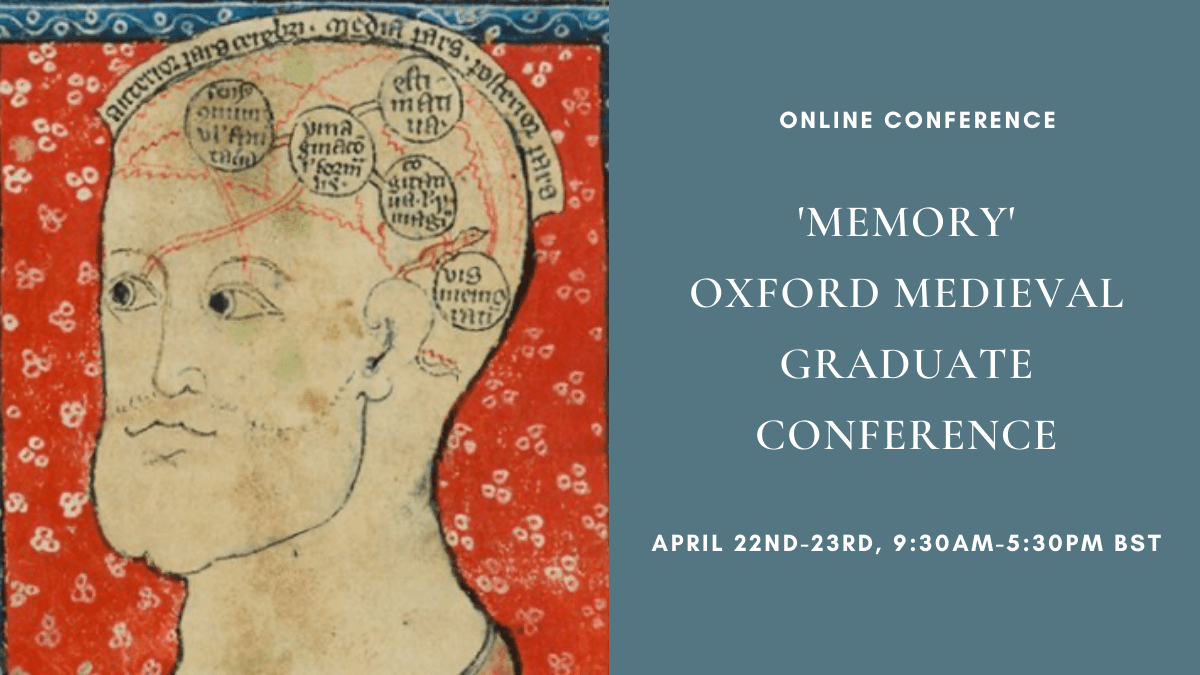
Online Conference: ‘Memory’, Oxford Medieval Graduate Conference, April 22nd-23rd, 9:30am-5:30pm BST

Organised by Anna Begley, Megan Bunce, James Cogbill, Sigrid Koerner, Mary O’Connor, Keoni O’Reilly, Martin Stuart and Eugenia Vorobeva

Sponsored by the Society for the Study of Medieval Languages and Literature and the Oxford Centre for Late Antiquity

Register here for free.

Thursday 22nd April 2021

09.30: Opening Remarks (Eugenia Vorobeva)

09.40: Session 1 – Memory of Other Lands (Chair: Keoni O’Reilly)

Benjamin Sharkey (Magdalen College, Oxford), Remembering Jerusalem: Christian Storytelling at a Silk Road Oasis, Ninth to Twelfth Centuries

Zainab Wani (Jawaharlal Nehru University), Remembering Iran, Valorising Kashmir: Different Ways of Memorialising Homeland

Matthew Firth (Flinders University), Memories of England in the ‘Sagas of Icelanders’

11.00: Break

12.00: Session 2 – Archives and Legal Memory (Chair: Mary O’Connor)

Harry Platts (Independent Scholar), Forgetting the Hundred Moots: How did the Practise and the Memory of Late-Saxon Assembly Transform in Late Medieval England?

John Merrington (All Souls College, Oxford), Forgetting the Archives? The Early Medieval Transmission of Gregory of Tours’ ‘Histories’ Reconsidered

Riya Gupta (Jawaharlal Nehru University), Dynastic Memory and Identity Experiments in Mughal Lower Bureaucracy: A Case Study of Qayamkhani Mansabdars

James Miller (University College, Oxford), ‘Haec carta, lecta atque audita’: Public Performance and Memory of Disputes in Twelfth-Century Brittany

13.40: Break

15.00: Keynote Lecture (Chair: Eugenia Vorobeva)

Professor Hannah Skoda (St. John’s College, Oxford), ‘The Former Age rebukes the new’: Genealogies of Nostalgia in the Long Fourteenth Century

16.00: Session 3 – National Memory (Chair: Martin Stuart)

Ruth Rimmer (University of York), Constructing Collective Memory in ‘The Ruin’

David Lees (Aberystwyth University), Geoffrey of Monmouth and the Construction of Cornwall in Twelfth-Century Literature

Sara Moure López (Universidad de Santiago de Compostela), Grieving, Mourning and Remembrance. The Role of Emotions in the Construction of Memory of Defeat in Castile around 1200

17.20: Break

19.00: Social Event

Friday 23rd April 2021

09.30: Session 4 – Memory and Physical Objects (Chair: Sigrid Koerner)

Rowan Wilson (St. Hilda’s College, Oxford), ‘Then he turnes to þe toumbe and talkes to þe corce’: Encountering the Bodies of Historical Memory in Medieval Literature

Woo Ree Heor (Graduate Center—City University of New York), ‘As freshe as any rose newe’: Hector’s Corpse and the Desire for the Past in the ‘Troy Book’

Hubert Leponika (Podlasie Museum, Białystok), Lost Memory Told Once More. Stele Cemeteries in the Podlasie Region (North-Eastern Poland)

George Beckett (University of Leeds), Manuscript Memory: Reading ‘Beowulf’ as ‘Intratext’

11.10: Break

12.00: Session 5 – Memory and the Church (Chair: Megan Bunce)

Joseph Hopper (University College London), Memory and Salvation in Hugh of St. Victor’s ‘De sacramentis christianae fidei’

Harry Spillane (Peterhouse, Cambridge), ‘A Matter Newly Seene?’: Matthew Parker, English Bibles, and the Anglo-Saxon Church

Richard Asquith (Royal Holloway, University of London), ‘Be yt remembred’: The Construction and Maintenance of Memory in the Records of London’s Pre-Reformation Parishes

13.20: Break

15.00: Keynote Lecture (Chair: James Cogbill)

Dr Graeme Ward (Jesus College, Oxford), Memory, Textual Authority, and the Distance of the Past: The Case of Amalarius of Metz, c. 800-1100

16.00: Session 6 – Interpretation of Memory (Chair: Anna Begley)

Aline Douma (Rijksuniversiteit Groningen), Forgotten, Not Forgiven? Repressed Memories of the Wars of the Roses in George Ashby’s ‘Active Policy of a Prince’

Brian Egede-Pedersen (Independent Scholar), ‘Templars, Fight or Fall!’ – Remembering the Knights Templar in Power Metal

Madeleine S. Killacky (Bangor University), Memory and Emotion in Malory’s ‘Tale of the Death of Arthur’

17.20: Closing Remarks (James Cogbill)

CFP: ICMA Sponsored Session Proposal, AAH Annual Conference 2022, Deadline 20th April 2021

London, 6-8 April 2022
Call for ICMA Sponsored Session Proposals due 20 April 2021

The International Center of Medieval Art (ICMA) seeks proposals for sessions to be held under the organization’s sponsorship at the Association for Art History Annual Conference to be held 6-8 April 2022 at Goldsmiths, University of London.

Proposals to the ICMA must include a session abstract and a CV of the organizer(s).

Please note the following:

  • The AAH does not require a slate of speakers; the AAH will generate a CFP once sessions have been selected. Therefore the ICMA will not request a slate of speakers.
  • The ICMA requires the CVs of the session organizers, but the AAH does not.
  • Session organizers and speakers must be ICMA members but are not required to become AAH members. However, AAH members receive a preferential conference rate.
  • Sessions at the AAH conference are built of 70-minute blocks, with a minimum of two blocks per session, up to four blocks in a day. Each block consists of two papers of 25 minutes plus 10 minutes of questions for each paper. The ICMA seeks to sponsor one session of two 70-minute blocks (four papers).


Upload your proposals here by 20 April 2021

Please direct all inquiries to the Chair of the Programs Committee: Bryan C. Keene, Riverside City College, USA, bryan.keene@rcc.edu 
 
The ICMA Programs and Lectures committee will select a session to sponsor and will notify the successful organizer(s) by 1 May 2021. The organizer(s) will then submit the ICMA-sponsored proposal to the AAH, which will make the final decision. Submit session proposals to the AAH by 7 May 2021 at Conference2022@forarthistory.org.uk following the guidelines posted on the AAH website: https://forarthistory.org.uk/our-work/conference/2022-annual-conference/ 

A NOTE ABOUT KRESS TRAVEL GRANTS


Thanks to a generous grant from the Kress Foundation, funds may be available to defray travel costs of speakers in ICMA sponsored sessions up to a maximum of $600 for domestic travel and of $1200 for overseas travel. If available, the Kress funds are allocated for travel and hotel only. Speakers in ICMA sponsored sessions will be refunded only after the conference, against travel receipts. In addition to speakers, session organizers delivering papers as an integral part of the session (i.e. with a specific title listed in the program) are now also eligible to receive travel funding.

Click here for more information.

Fellowship: A.G. Leventis Fellowship in Hellenic Studies, 2021-2024, British School at Athens, Deadline 7th May 2021

The British School at Athens is pleased to announce the A.G. Leventis Fellowship in Hellenic Studies. The Fellowship, funded by the A.G. Leventis Foundation, is tenable at post-doctoral level to support research into the anthropology, archaeology, architecture, arts, environment, geography, history, language, literature, religion and topography of Greece and Cyprus, and related areas, from prehistory to the late 19th century / early 20th century. The Fellowship is tenable for three years from 1 October 2021.

The A.G. Leventis Fellowship represents an important strengthening of the intellectual life of the BSA and of its relations with Greece and Cyprus. The BSA is looking for candidates of the highest potential who will make best use of the opportunity for a prolonged period of research in Greece and other Greek lands. If the Fellow is not fluent in Greek, it is essential that s/he become fluent within six months of taking up the Fellowship. Furthermore, any Fellow whose native language is other than English must be or become fluent in English, again within six months of taking up the Fellowship.

The A.G. Leventis Fellow will be expected to take a leading role in the life and work of the BSA. Teaching and other duties will be agreed with the Director at the beginning of each academic year. The Fellow will be expected to give one seminar per year and one public lecture during the term of the Fellowship. The Fellow may be asked to participate in courses taught by the BSA, and s/he may undertake a small amount of outside teaching with the approval of the Director. It is expected that the Fellow will take a lively interest in the research of BSA Students.

The Fellow must spend at least nine months a year in Greek lands, and has a duty to inform the Director of absences from Athens of more than four days between 1 October and 30 June.

Normally the Fellow will be expected to have satisfied all the requirements for his/her doctorate no more than five years and at least three months before taking up the post.

For more information, please click here.

Workshop: An Introduction to Arabic Manuscripts (23rd to 27th August 2021, Princeton-UCLA via Zoom), Deadline 22nd April 2021

A free, intensive online workshop featuring leading authorities on the study of Arabic manuscripts.

This week-long workshop features leading authorities on the study of Arabic manuscripts. The workshop will equip emerging scholars with the basic tools to conduct research with original handwritten texts in Arabic script.

Over the course of five days, participants will learn the basics of codicology, palaeography, and manuscript production and circulation, in the context of an expansive vision of current debates in Arabic manuscript research.

Topics include:

  • anatomy of the codex
  • canonical and informal scripts
  • colophons, audition notes, owners’ notes, readers’ notes
  • digital collections
  • ethics and best practices
  • scribes and other craftspeople
  • strategies for decipherment
  • supports, bindings
  • technical terminology
  • transmission practices and patterns

Enrollment is free of charge. Full participation is by application only. Others may observe via webinar.

Application deadline is 22 April 2021. Apply at https://ucla.in/3cpTpu2 (All applicants welcome, regardless of home institution; priority will be given to PhD students and untenured scholars with compelling need to use Arabic manuscripts in their research.)

Co-sponsored by Princeton and UCLA, which house the two largest repositories of Islamicate manuscripts in North America.

Organizers: Marina Rustow (Princeton) and Luke Yarbrough (UCLA)

For more information on the workshop programme and how to apply, please click here.

Call for Papers: MARGIN Graduate Student Symposium-Apocalypse and Revelation, Deadline: 18th April 2021

MARGIN are thrilled to announce their upcoming Graduate Student Symposium on this year’s theme, Apocalypse and Revelation on May 19/20!


They are seeking submissions that touch on this theme in the Medieval and Early Modern periods, as well as their reception in later periods. Given the contemporary interest in the apocalyptic — whether political, spiritual, or medical — they are looking for papers that speak to feeling, dread, or even longing for apocalypse and/or its power to reveal in the Medieval and Early Modern periods. From the Greek ἀποκάλυψις, an apocalypse is at root a “revelation,” and this year, they hope to explore how the relationship between the contemporary vision of apocalypse and revelation, divine or otherwise, intersect, coexist, and complicate one another. Speakers are invited to address this topic from a diversity of perspectives and methodologies.

Graduate students at all levels and in any discipline are encouraged to submit abstracts for conference papers of 15 minutes. Please submit an abstract of no more than 125 words along with a short bio to nyumargin@gmail.com no later than April 18. Graduate students doing work on non-Western material are highly encouraged to submit. All panels will be held virtually over Zoom.

Submissions may focus on topics including, but not limited to:

  • Christian, religious eschatologies
  • Upheaval, destruction & disaster
  • Plague and its consequences
  • Medieval and Early Modern iconography
  • Prophetic or historicist visions
  • Epistolary and/or prophetic modes of literature
  • Allegories of spiritual paths
  • Struggle between Christians and non-Christians
  • Pseudonymity and symbolic imagery
  • Christian and/or Jewish cosmologies
  • Unveilings, revolutions
  • The year 1000
  • Apocalypticism as driving social and political change

Job: Junior Professorship for Christian Archeology and Byzantine Art History, Johannes Gutenberg University Mainz, 9 May 2021

Johannes Gutenberg University Mainz invites applications for a Junior Professorship for Christian Archeology and Byzantine Art History. The position will be a joint appointment between the Institute for Art History and Musicology in the Department of History and Cultural Studies and the Römisch-Germanischen Zentralmuseums (RGZM).

Applicants whose research focuses on the material culture of the Eastern Mediterranean are welcome to apply. Knowledge of Greek is required. Competencies in iconography, art history, and historical cultural studies are also desirable. The willingness and ability to teach in German and English is required.

You can find the job advert here.

New Publication: Art and Material Culture in the Byzantine and Islamic Worlds – Studies in Honour of Erica Cruikshank Dodd , edited by Evanthia Baboula and Lesley Jessop

Dedicated to Erica Cruikshank Dodd, Art and Material Culture in the Byzantine and Islamic Worlds offers new perspectives on the Christian and Muslim communities of the east Mediterranean from medieval to contemporary times. The contributors examine how people from diverse religious backgrounds adapted to their changing political landscapes and show that artistic patronage, consumption, and practices are interwoven with constructed narratives. The essays consider material and textual evidence for painted media, architecture, and the creative process in Byzantium, Crusader-era polities, the Ottoman empire, and the modern Middle East, thus demonstrating the importance of the past in understanding the present. 

Contributors: Evanthia Baboula, Lesley Jessop, Anthony Cutler, Jaroslav Folda, John Osborne, Glenn Peers, Annemarie Weyl Carr, Mat Immerzeel, Bas Snelders, Angela Andersen, May Farhat, Marcus Milwright, Rico Franses.

Table of Contents:

Erica Cruikshank Dodd Passion, Serendipity, Curiosity, and the Making of an Art Historian
  Lesley Jessop

Bibliography of Erica Cruikshank Dodd
Note on Transliteration and Dates
List of Illustrations
Contributors

Introduction: Diversity and Identity in the Medieval Mediterranean and Beyond
  Evanthia Baboula and Lesley Jessop

The Anaphoric Icon Observations on Some Byzantine Metapictures
  Anthony Cutler

Two Icons of the Virgin and Child Hodegetria from St. Catherine’s Monastery on Mount Sinai Byzantine or Crusader?
  Jaroslav Folda

The Thirteenth-Century Expansion of the Narthex of San Marco, Venice A Space for Dead Doges?
  John Osborne

The Refectory of the Monastery of St. Mary in the Valley of Jehoshaphat, Jerusalem Crusader Painting at Crossroads
  Glenn Peers

Orthodox Monasteries under Lusignan Rule Relations with Others, Relations with Their Own
  Annemarie Weyl Carr

Church Embellishment in Medieval Egypt, Syria, and Cyprus Patronage and Identity
  Mat Immerzeel and Bas Snelders

The Tale of the Shared Church in Diyarbakir Narrative Traditions of the Co-Use of Places of Prayer by Muslims and Christians
  Angela Andersen

Beirut’s Great ʿUmari Mosque History, Memory and Post-War Reconstruction
  May Farhat

The Traditional Crafts of the Middle East and Central Asia in the Writings of European and North American Travellers
  Marcus Milwright

10 To Not Know God Geometrical Abstraction and Visual Theology in Islamic Art
  Rico Franses

Conference: The Virgin as Auctoritas: The Authority of the Virgin Mary and Female Moral-Doctrinal Authority in the Middle Ages, 15th April 2021, 9:30am

ORGANIZED BY Francesca Dell’Acqua, Università degli studi di Salerno

This session aims at exploring a fundamental issue: female authority through the lens of visual/material culture. It involves prominently the Virgin Mary – as well as figures of female authority in the medieval world – because in the late decades of the 20th century, feminist thinkers pointed at the ‘negative model’ offered by the Virgin Mary since for centuries she had been branded by the Catholic Church as a role model for modesty, submission and virginity. However, between late Antiquity and the Middle Ages, the Virgin Mary emerged as Queen of Heaven through preaching and liturgical texts, visual arts and public assemblies – that is, the ‘mass media’ of that time. Mary was pictured as a very strong, authoritative figure, rather than weak and compliant.

Already during late Antiquity, Mary was commonly perceived as the mighty protector and spiritual stronghold of capital cities in the Mediterranean. Between the 8th and the 11th centuries, the role of royal women came to the fore, especially in Byzantium and in Ottonian Germany. Very striking is also the case of a number of major Italian city-states between the 12th and the 15th centuries where the Virgin Mary came to be identified with political and economic supremacy.

In sum, these sessions can help understand what bearing the figure of the humble Virgin Mary eventually had on female leadership, and also how female leadership evolved or not.

MORNING PROGRAMME 

Chair: Francesca Dell’Acqua

09.30 – 09.45 GMT

Welcome
 
10.00 – 11.15 GMT
Introduction and Papers 1 and 2
Photios and the Image of the Mother of God in Hagia Sophia, Constantinople  Mary B. Cunningham (University of Nottingham)

The Theotokos and the Widow of Zarepta: women’s authority as widows and prophets  Barbara Crostini (University College Stockholm)
 
11.15 – 11.45 GMT
Refreshment Break

11.45 – 12.50 GMT
Papers 3 and 4
Elevation of Mary’s Authority in Late Antiquity: Her Depiction on the Jewelled Throne and the Footstool  Ernesto Mainoldi (FiTMU – Università degli Studi di Salerno) and Natalia Teteriatnikov (Independent Scholar)

The Coronation of the Virgin as the Queen of City-States  Kayoko Ichikawa (Japan Society for the Promotion of Science / University of Fribourg)

AFTERNOON PROGRAMME 

Chair: Mary B. Cunningham
 
14.30 – 15.35 GMT
Papers 5 and 6
Icons of Authority: new light on the competition between images and relics in Trecento RomeName of speaker(s): Claudia Bolgia  (Università di Udine)

“All glory is in the King’s Daughter”: depictions of the Virgin as Empress in the late Byzantine worldName of speaker(s): Andrei Dumitrescu (National University of Arts, Bucharest)
 
15.40 – 16.10 GMT
Refreshment Break
 
16.10 – 17.25 GMT
Papers 7 and 8 and closing comments
Sainte Foy and the Medieval Imaginary of Female Sacred Power  Bissera V. Pentcheva (Stanford University)

Female Authority, Ecclesiology, and Micro-Architecture in Scandinavian Medieval Art  Kristin B. Aavitsland (MF Centre for the Advanced Study of Religion (MF CASR), MF Norwegian School of Theology, Religion and Society, Oslo, Norway)

Speakers & Abstracts


Photios and the Image of the Mother of God in Hagia Sophia, Constantinople

Mary B Cunningham (University of Nottingham)

The sermon on the inauguration of the mosaic image of the Virgin Mary in the apse of Hagia Sophia, which Photios delivered from the ambo on 29 March 867, portrays its subject as a powerful and influential figure. As James and Webb have argued, Photios believes that the mosaic image reveals the nature, indeed the essence, of the Virgin. He describes her as a loving mother, who ‘fondly turns her eyes on her begotten Child in the affection of her heart’, but also as ‘detached and imperturbable’ in her contemplation of her divine offspring. This is thus a strong and silent kind of power: Mary, according to Photios, enables Christians to approach and venerate their divine Creator. She also symbolises ‘the guarantee of incarnation and salvation’. Although Photios refrains from describing the Virgin herself as ‘Wisdom’ (an epithet that was assigned to Christ, according to early Christian and Byzantine tradition), she is closely associated with this, and all other, aspects of divinity as a result of her birth-giving and nurturing of the Son and Word of God. The 9th-century preacher also juxtaposes the Virgin Mary with the Church in one section of his homily, describing the latter as the Bride of Christ (cf. Song 4–6). The association of such imagery with the majestic pose of the Virgin in the apse of Hagia Sophia is implicit but supported by a liturgical tradition of typology and metaphor that was frequently applied to the Theotokos. Mary’s power thus consists in her role as mediator between heaven and earth – a role that could once again be depicted in an image that helped to draw Christians closer to their God.


The Theotokos and the Widow of Zarepta: The authority of women as widows and prophets

Barbara Crostini (University College Stockholm)

In his 1939 study of the frescoes (Les Peintures de la synagogue de Doura-Europos, 245-256 après J.-C., Rome : Pontificio Istituto Biblico), Robert Du Mesnil du Buisson remarked in passing that the sequence of the miracle of the widow of Zarepta on the West wall of the synagogue at Dura presents this woman in a stance that was later replicated in images of the Virgin and child. The posture of the woman, standing with the baby sitting on the left arm, her hips adjusted sideways to balance the weight, and the right arm open to the side, is uncannily similar to later representations of the Virgin. Starting from this visual suggestion, and given the programmatic importance of these paintings for the development of Byzantine art, I examine the prophetic value of the widow’s testimony. Within the synagogue’s pictorial programme, she can be shown to proclaim the coming of the true Messiah, thus offering a template for understanding the Virgin’s role as ‘showing the way’ to Christ. Although the Virgin is not normally thought of as a widow, her husbandless stance makes her fit into this category where, according to early Christian practice, women enjoyed a particularly high regard and were given special privileges in the community. Combining this marital status with the prophetic license also accorded to women in special circumstances, the Virgin can stand as a fully approved authority in witnessing Christ to the world.


Elevation of Mary’s Authority in Late Antiquity: Her depiction on the jewelled throne and the footstool

Ernesto Mainoldi (FiTMU – Università degli Studi di Salerno) and Natalia Teteriatnikov (Independent Scholar)

Before the 6th century, wall paintings and artefacts in Byzantium and in the West depicted Mary with Christ Child seated on a plain chair or a backless stool. Starting from the first half of the 6th century, however, her representations with the Child changed. From this time onward, she was presented in frescoes, mosaics and artefacts seated on a jewelled throne or standing alone on a jewelled footstool as seen in the apse decorations of the Church of Panagia Kanakariá, Lythrankomi (520–30) or of the Panagia Angeloktistos, Kiti (second half of the 6th century), both in Cyprus. This change in iconography has not, however, been sufficiently investigated. This paper examines visual evidence as well as exegetical and homiletic literature which can explain the specifics of her depiction on a chair or on a footstool. This alone, however, cannot explain why the jewelled throne and footstool replaced the plain ones. The evaluation of iconography and social status of imperial thrones as well as the rising cult of the Virgin and her relics in Constantinople and the theology associated with it in the 5th and 6th centuries will contribute to further understanding the need to visually and socially elevate Mary’s image, as a legitimate authority in religious and social life.


The Coronation of the Virgin as the Queen of City-States

Kayoko Ichikawa (Japan Society for the Promotion of Science / University of Fribourg)

This paper will explore how the iconography and the political symbolism of the Coronation of the Virgin as the ultimate civic guarantor emerged, developed and circulated in northern Europe and the Mediterranean by tracing the origin of the relevant ideas in the early Christian period and their continuous evolution in the medieval period. Visual examples, including a few from the eastern side of the Mediterranean, will demonstrate the dynamics of the religious and political interactions between popes, emperors, kings, religious communities and civic authorities in the Mediterranean world extending to the north of the Alps. They appeared in a wide geographical area favoured by various communities who supported the ideal of a reform movement designating Mary as their leader. It will be argued that the association of the imagery of the Coronation of the Virgin with the autonomy of cities under her direct rulership probably emerged in northern Europe in the early 13th century, and the efficacy of this visual rhetoric was introduced to Italy by intellectuals who travelled north. Most notably in Siena after the miraculous intercession of the Virgin in the Battle of Montaperti in 1260, she was actually called the ruler (gubernatrix) in civic documents and praised as the most powerful queen with great lordship by the confraternity of the laudesi in their hymns (laude) sung before her image. It will be emphasised that the Dominicans played an important role in the dissemination of this Marian imagery and the notion of her authority in the context of ecumenical leadership.


Icons of Authority: New light on the competition between images and relics in Trecento Rome

Claudia Bolgia (Università di Udine)

Contrary to the idea of 20th-century feminist thinkers that the Catholic Church has traditionally used the Virgin Mary as a role model for modesty, submission and virginity, this paper explores how different images of the Virgin Mary were deployed to embody competing authorities in Trecento Rome, certainly including Church authority (but not limited to it). Whilst scholars have generally noted the alternating fortunes of a number of Marian images in Trecento Rome, none have so far fully uncovered the underlying motivations nor the competing claims for primacy with bust-reliquaries of traditional male saints. The discovery of hitherto unknown documentary evidence combined with a fresh analysis of different icons following recent cleaning campaigns will serve to identify these motivations and claims, whilst addressing a number of corollaries, namely: why, amongst the many icons of Rome, did certain of them rise to great popularity, whilst others almost suddenly disappeared? What spiritual and/or political forces lay behind such alternating fortunes? When, by whom and through which artistic and visual channel was the authority of the images promoted? How did the claim of attribution to St Luke fit into this revised picture?

Whilst confirming that images of the Virgin Mary were indeed a powerful expression of auctoritas in the Middle Ages, this paper demonstrates how the different powers fighting over the leadership of the Urbs had the need for different types of Marian images, each with their own specific histories (be these real or invented), to best embody their political strategies and idea of authority.


‘All Glory is in the King’s Daughter’: Depictions of the Virgin as Empress in the late Byzantine world

Andrei Dumitrescu (National University of Arts, Bucharest)

This paper examines the depictions of the Mother of God as Queen in the late Byzantine visual production, aiming to offer some new insights on the development of their iconographic articulation and theological content. Frequently placed alongside the figures Christ as ‘Emperor of emperors’ and King David, in a typological exegesis of Psalm 44/45, the earliest monumental versions of the Marian motif were encountered in the mid-14th-century Macedonian churches. Previous studies tend to interpret the depiction of the Theotokos with imperial insignia as an undeniable innovation, attributing its emergence in late Byzantine painting to a Western influence or to the agency of certain pre-eminent figures of the 14th-century Balkans. I intend to re-evaluate these conclusions in order to integrate the representations of the Virgin as Empress in a broader tradition of illustrating Psalm 44/45, taking into consideration some unexplored connections between wall paintings and manuscripts.


Sainte Foy and the Medieval Imaginary of Female Sacred Power

Bissera V. Pentcheva (Stanford University)

The small Carolingian foundation of the early 9th century at Conques took almost two centuries to transform into a centre of power, closely linked with the Gregorian reform movement and Reconquista of the Iberian peninsula at the turn of the 11th and early 12th centuries. This paper explores the liturgical rite, more specifically the music, poetry and prayers of Sainte Foy and how they codify the authority of the saint as stemming from her virginity, martyrdom and fidelitas to Christ. She is portrayed as second only to the Virgin Mary in the countless miracles she performs and in the efficacy of her prayer. The imagery expounded in the music and poetry will be put in conversation with the depictions of the saint in the sculpture, the miniatures and the treasury arts at Conques. At the core of this analysis will be the distinction between Mary’s power as the Mother of God versus Sainte Foy’s as the fidelis/druda/lover of Christ.


Female Authority, Ecclesiology and Micro-Architecture in Scandinavian Medieval Art

Kristin B. Aavitsland (MF Centre for the Advanced Study of Religion (MF CASR), MF Norwegian School of Theology, Religion and Society, Oslo, Norway)

In order to assess the spiritual – and political – authority of the Virgin Mary in medieval Scandinavia, this paper offers a close reading of one of the most spectacular monuments of Scandinavian medieval art, the so-called golden altar from Lisbjerg Church in Denmark. This sumptuous piece of ecclesiastical art, now a highlight of the National Museum in Copenhagen, is dated to the early 12th century and exhibits a carefully composed complex of gilt images, Latin verse inscriptions, variegated ornaments and detailed micro-architecture. The Lisbjerg altar frontal has as its centre the regal figure of the Virgin Mary, enthroned with her Child as sedes sapitentiae, the throne of wisdom, with female saints and virtue personifications surrounding her as a court of ladies-in-waiting. The paper aims to show how the altar’s iconography, inscriptions and architectural commonplaces together produce a ceremonial space in which the authority of the Virgin is solemnly represented. The connection between the altar’s micro-architecture and 12th-century Mariology is especially investigated. Furthermore, the paper intends to demonstrate how the altar’s dense fabric of visualised theological and liturgical meaning centres on the Virgin as Mother of God and prototype of the Church. This serves as a pretext for discussing the ideological and political implications of these visualised ideas in 12th century Denmark – a period of ecclesiastical consolidation in the Scandinavian kingdoms, realms that embraced Christianity at a later stage than most of Europe.

CFP: Materiality in the Medieval and Early Modern Worlds – Worlds Within Things: Ways of Knowing and Narrating (Special Issue of The Medieval History Journal), Deadline: 15th April 2021

Special Issue of The Medieval History Journal: Materiality in the Medieval and Early Modern Worlds – Worlds Within Things: Ways of Knowing and Narrating

Over the past twenty years a renewed interest in material culture, materialism, and materiality has shaped the practice of history in new ways moving the  discipline “beyond  words” to consider the worlds within things. Attention to the dynamics of materials and production have expanded ways of knowing the past and begun to reshape the kinds of narratives that historians craft. Objects and things can be said to constitute an additional archival repertoire, but they also require their own ways of reading, methods of analysis, and theoretical orientations, especially as we integrate materiality into the robust ways of writing history that have traditionally relied upon the written record. Most historians agree, it is not possible to offer a materialist reading in the absence of written sources. Yet, how do the two work together?  

This special issue is dedicated to exploring the following related questions: What does materiality’s methodology entail? What modes of investigation and  narration are deployed in a material analysis? How does a material focus shape and change the historian’s possibilities for narrative and argument? How does materiality give new voice and visibility to marginal social groups, make visible the movements of peoples and things long overlooked or simply not present in narrative texts or documentary sources? In what ways has materiality shaped an understanding of processes of memory and remembrance, emotional   encoding, haptic encounters, and mental narratives that are difficult to express through words? How does the study of objects and things in the medieval and the early modern epochs open new ways of writing about and conceptualizing a broader and more connected world? The essays gathered in this special issue will contribute to an understanding of materiality that seeks to facilitate a more convergent understanding of our medieval and early modern pasts. 

Possible themes include:

  • material memories and ways of knowing the past
  • material systems of values and use
  • material biographies and traditional chronologies
  • materiality, climate and periodization
  • haptic encounters and evocation
  • emotional frameworks of things
  • ritual uses of objects and things, objects as gifts
  • material archives and assemblages
  • ideological and knowledge systems
  • communications and networks of things
  • subjects, objects, and the ethics of materiality
  • global and trans-cultural connections

Abstracts written in English should be submitted by 15 April 2021; full papers should be submitted by 1 October 2021.

CFP: ICMA Sponsored Session Proposals (CAA Annual Conference, 16th-19th February 2022, Chicago), Deadline 15th April 2021

Chicago, 16-19 February 2022
Call for ICMA Sponsored Session Proposals
due 15 April 2021

The International Center of Medieval Art (ICMA) seeks proposals for sessions to be held under the organization’s sponsorship in 2020 at the annual meeting of the College Art Association. Session organizers and speakers must be ICMA members.  
 
Proposals must include the following in one single Doc or PDF with the organizer’s name in the title

  • Session abstract
  • CV of the organizer(s)
  • Session organizers may also include a list of potential speakers


Please upload all session proposals as a single DOC or PDF by 15 April 2021 here.

The organizer(s) will have until 30 April 2021 to upload their approved proposals on the CAA website here.

For inquiries, contact the Chair of the ICMA Programs and Lectures Committee: Bryan C. Keene, Riverside City College, USA, bryan.keene@rcc.edu