Online Lecture: Raphael 500: The Raphael Cartoons at the V&A, The Warburg Institute, 19 November 2020, 17:30-19:00 (GMT)

Dr Ana Debenedetti (Victoria and Albert Museum)

Ana Debenedetti talks to Warburg Deputy Director Michelle O’Malley about the V&A’s new installation of the celebrated Raphael Cartoons in the Museum’s Raphael Court.

Raphael’s work in painting, drawing, architecture and design had a profound effect on the arts, influencing not only his own time but also ours. Raphael 500 celebrates the painter’s life and marks the year of his death with a programme that considers elements of his approaches to the invention and production of works of art and looks at the way the study of Raphael widens our understanding of other Italian Renaissance artists. 

This event is also part of the Curatorial Conversations series, which brings to the Warburg curators of world-leading museums and galleries to discuss their work. The conversations, led by academics at the Warburg Institute, discuss the issues of setting the curatorial agenda and staging meaningful encounters with objects. The series is designed to draw out discussion of the discoveries made, challenges tackled and the lessons learned in installing objects in the permanent collection and putting together internationally renowned exhibitions. 

Supported by the Italian Cultural Institute in London 

FREE VIA ZOOM. PLEASE BOOK IN ADVANCE – BOOK HERE.

Find out more information here.

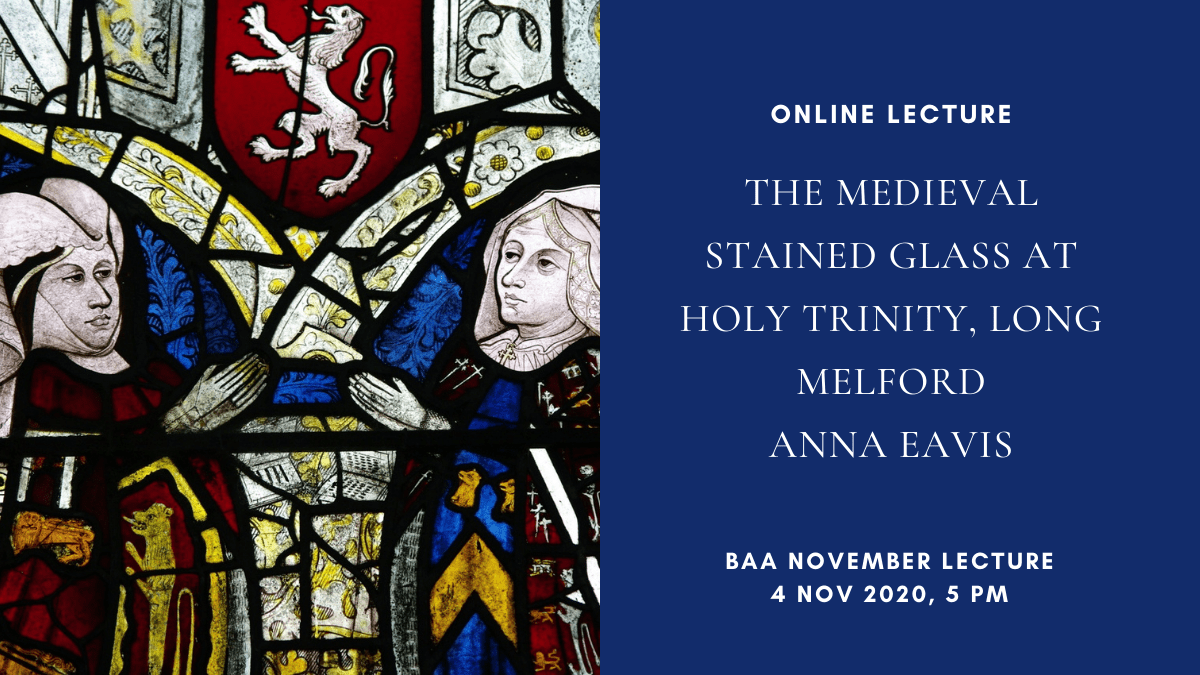
Online Lecture: ‘The medieval stained glass at Holy Trinity, Long Melford’, Anna Eavis, 4 Nov 2020, 5pm (GMT)

The November Lecture of the British Archaeological Association Lecture Series will be Anna Eavis, who will be presenting on ‘The medieval stained glass at Holy Trinity, Long Melford’.

Anna Eavis is Curatorial Director at English Heritage, with responsibility for the presentation of over four hundred historic sites and their collections.

The lecture will take place on Zoom on 4 November 2020 at 5pm (GMT).

Register here.

Funding: Clare College Junior Research Fellowships 2021, University of Cambridge, Deadline: 23rd November 2020

Clare College, University of Cambridge invites applications for Junior Research Fellowships in any arts and humanities discipline. It is expected that candidates will be either graduate students, in the latter stages of their research leading to a PhD, or equivalent, or post-doctoral researchers who have been awarded their PhD, or equivalent, within the last year. Candidates are expected to have completed less than five years’ full-time, post-graduate research, or part-time equivalent, by 1 October 2021.

Research Fellows carry out full-time research for 37.5 hours a week and may undertake a small amount of undergraduate teaching during term. They are members of the Governing Body and expected to participate in the governance and social life of the College.

For information on applying for a Junior Research Fellowship, please visit Information for Applicants

If you have any questions, contact the JRF Administrator at JRFadministrator@clare.cam.ac.uk

New Journal Publication: Gesta, Volume 59, Number 2 | Fall 2020

The latest issue of Gesta is now available to view online, edited by Diane J. Reilly and Susan L. Boynton. The journal is sponsored by the International Center of Medieval Art

Articles include:

Kathryn A. Smith, Found in Translation: Images Visionary and Visceral in the Welles-Ros Bible
Jonathan Andrew Turnock, The Earls of Hereford and Their Retinue: A Network of Architectural and Sculptural Patronage in Twelfth-Century England, ca. 1130–55
James Hillson, Villard de Honnecourt and Bar Tracery: Reims Cathedral and Processes of Stylistic Transmission, ca. 1210–40
Richard Gameson, Catherine Nicholson, and  Andrew Beeby, The Admiral, the Virgin, and the Spectrometer: Observations on the Coëtivy Hours (Dublin, Chester Beatty Library, MS W082)

To view the new edition of Gesta, please click here.

Exhibition: Architecture & Ornament, Sam Fogg Gallery, London, 22 October – 19 November 2020

The works of art in this exhibition provide an overview of the diversity that existed in Romanesque and Gothic architecture, which continually transformed across space and time. They range from the tenth century, when Lombard architecture and sculpture formed the so-called first Romanesque, to the late fifteenth century, when openwork spires towered over cities. The exhibition includes pieces from some of the most celebrated medieval buildings in Europe, such as the capital from Madinat al-Zahra, a palace-city complex just outside of Cordoba, built as a symbol of Umayyad power on the Iberian Peninsula. The group also includes a twelfth-century impost from Saint-Remi in Reims, one of the most important royal churches in France and the site where King Clovis was baptised in 508 by Bishop Remigius. The engineering progress of the Gothic period is represented by a 13th century gable from a buttress pinnacle of the York Minster Chapter House, a building designed to show-off technological advancements and a new kind of decorative character. Finally, the exhibition also features a tracery fragment from Canterbury Cathedral, one of England’s most renowned ecclesiastical buildings, and one of the most significant pilgrimage sites in Europe. In addition to these pieces there are many others and together they take us through architectural history that spans almost seven hundred years.

Catalogue can be found here.

Found out more information here.


Exploring the world of medieval architecture: In conversation with Zoë Opačić and Jana Gajdosova

An In Conversation with Zoë Opačić, which explored the world of medieval architecture. This interview celebrates our Architecture & Ornament exhibition, which opens on October 22nd 2020.

Online Lecture: University of Kent MEMS, Contemporary Portraiture & the Medieval Imagination, An Artist in Conversation with her Sitters: Lorna May Wadsworth, the Rt Rev & Rt Hon Dr Rowan Williams & Neil Gaiman, 29 October 2020, 6pm

The Centre for Medieval & Early Modern Studies at the University of Kent is excited to announce their up-coming seminar which is ‘Contemporary Portraiture & the Medieval Imagination, An Artist in Conversation with her Sitters’. Join portrait artist Lorna May Wadsworth with two of her former sitters the Rt Rev & Rt Hon Dr Rowan Williams & Neil Gaiman, for what will be a stimulating and fascinating conversation.

This event will take place on Zoom at 6pm on Thursday 29th October 2020.

Spaces are limited, so to avoid disappointment please register here.

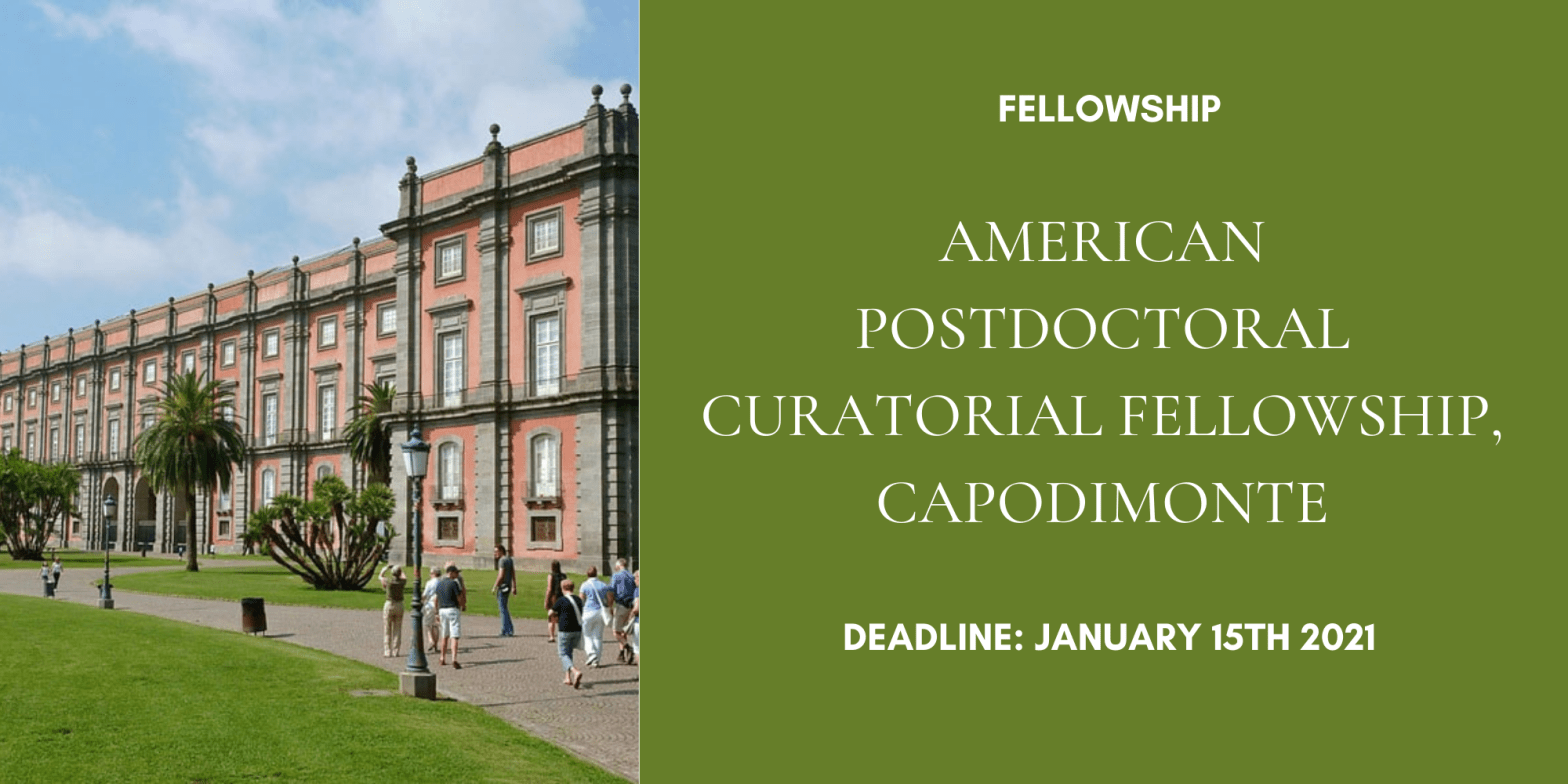
Fellowship: American Postdoctoral Curatorial Fellowship, Capodimonte, Deadline: January 15th 2021

The Capodimonte Museum, Naples, Italy, September 1, 2021 – August 31, 2022
Application deadline: Jan 15, 2021

The American Friends of Capodimonte Postdoctoral Curatorial Fellowship, 2021-2022

The American Friends of Capodimonte (AFC) and the Museum and Royal Park of Capodimonte welcome applicants for a Postdoctoral Curatorial Fellow funded by the AFC for the academic year commencing September 2021. The Fellow will be fully integrated into the Museum’s curatorial department and assist Director Sylvain Bellenger and his colleagues in a wide range of projects across the life of the Museum, including exhibitions, publications, interpretation and translations.

The mission of the AFC is to promote and raise awareness in an English-speaking audience of the Museum and Royal Park of Capodimonte, one of Europe’s greatest museums. The AFC is proud to be the only 501(c)(3) non-profit organization that funds and places promising young American curators directly into an Italian museum. In addition to curatorial responsibilities, the Fellow will also serve as an English-speaking ambassador from the Museum to visiting members of the AFC, international guests of honor, and members of the international press.

The demands and requirements of the job are, like Naples, not always straightforward and therefore a successful applicant will also need to demonstrate initiative, entrepreneurial skills and the ability to adapt to a variety of situations. Previous Fellows have worked on creating text for English and Italian wall labels for the permanent collection and temporary exhibitions, taken responsibility for curation of the Farnese collection of paintings and drawings, and written a catalogue for an exhibition of Capodimonte’s masterpieces that travelled to Seattle and Dallas in 2019-20.

The Fellow will have access to the rich cultural resources of Naples, including museums, opera and music at the Teatro di San Carlo, historic landmarks, and the Biblioteca Nazionale di Napoli, which is the largest Italian library after Florence and Rome. The Fellow will be encouraged to pursue areas of their own expertise within the Museum and may be able to define projects that will further their own research. Previous Fellows have gone on to be offered and to accept curatorial positions in major American museums. The unique access to the Museum and to Naples given to the Fellow during his or her tenure has been an important factor in securing these jobs.

The Fellow will be fully integrated into the inner workings of Capodimonte and is expected to focus on making the Capodimonte’s innumerable treasures more widely accessible to an international audience during this exciting period in the museum’s illustrious history.

Fellowship Period and Residency

The Fellowship period is from September 1, 2021 to August 31, 2022 during which the Fellow will be expected to reside in Naples and work full-time at the Museo di Capodimonte. The possibility of an extension for a second academic year may be reviewed by the AFC during the initial Fellowship.
The AFC Postdoctoral Curatorial Fellow will be provided with housing or a stipend towards housing for one person only in Naples.

Eligibility

Applicants for the 2021-2022 fellowship must hold a PhD degree in Art History not received before May 30, 2018. Pre-doctoral candidates may apply if the PhD degree will be awarded before commencement of the Fellowship. Applicants must be United States Citizens. Applications will be reviewed by the AFC Board and Director of Capodimonte. The applicant may not hold concurrent fellowships or awards during the fellowship period.

The applicant must also specialize in Early Modern European Art, preferably Italian Renaissance and/or Baroque art. A working knowledge of spoken and written Italian is essential.

Support

The American Friends of Capodimonte Postdoctoral Curatorial Fellowship award is $40,000 per year, in addition to housing or a housing stipend. Upon application to the Board, the Fellow may also be eligible for travel funds for targeted projects.

Applications and Deadline

Candidates for the American Friends of Capodimonte Postdoctoral Curatorial Fellowship must submit the enumerated materials below via email to americanfriendsofcapodimonte@gmail.com.

All materials must be submitted in PDF file format
All materials must be submitted in English

1. Cover letter addressing your interest in the Fellowship position and how you think you could contribute to the Museum and the AFC mission.
2. CV
3. 1 writing sample: PDF of published paper or recent writing sample (article, book chapter, dissertation chapter, etc.)
4. 3 references from professional art historians or museum professionals within the field.

For each reference (3) please indicate: 
– name
– title 
– institution (with address)
– email address
– phone number

The deadline for all materials is January 15, 2021, 5:00 pm (ET). Applications must be received on or before the deadline. Late applications will not be considered. Candidates will be contacted regarding the status of their application in early spring 2021.

Learn More about the AFC

http://www.americanfriendsofcapodimonte.info/

Online Lecture: ‘As We Heard from the Enemy Himself’: Intercultural Transmission in Early Medieval Armenia, lecture by Alison Vacca (University of Tennessee, Knoxville) October 21, 2020, 6:00–7:30 pm

University of Cambridge Byzantine Worlds Seminar via Zoom, October 21, 2020, 6:00–7:30 pm (UK) 

Alison Vaca is Associate Professor and Director of Graduate Studies in the Department of History at University of Tennessee, Knoxville. She is a historian of early Islam working on the caliphal provinces Armenia and Caucasian Albania. Her research explores intercultural transmission of historical texts, quick-changing alliances in moments of intercommunal violence, and intermarriage across ethnic and religious lines.

The Byzantine Worlds Seminar provides a venue for exploring the material and intellectual entanglements between the medieval worlds of the Middle East, North Africa, Central Asia and Eastern Europe. It is supported by the Centre for Research in the Arts, Social Sciences and Humanities (CRASSH) and Society for the Promotion of Byzantine Studies (SPBS).

Advance registration required. To register, please follow this link.

An event organised by Byzantine Worlds Research Network.

Administrative assistance: networks@crassh.cam.ac.uk

Online Lecture: ‘Go Forth and Learn’ The Artist Joel Ben Simeon and a Newly Discovered Hebrew Manuscript, Fordham University & Les Enluminures, October 22, 1:00 PM (ET)

Watch a short video here to see an introduction to the newly discovered manuscript.

Born in Germany, where he trained as an artist and scribe and from where he was probably expelled, Joel ben Simeon spent most of his itinerant career in the book arts in northern Italy.  We perhaps know more about him – from his colophons and his signed works – than any other illuminator-scribe, Jewish or Christian, in the fifteenth century.  He depicts himself as a traveler in one manuscript next to the words “Go forth and learn,” which we hope to accomplish in this Webinar. The discovery of a new manuscript with more than 300 drawings by his hand prompts a reassessment of his career at a time of great religious uncertainty, economic opportunity, and cultural exchange

Speakers: 

Keynote: Professor Katrin Kogman-Appel, University of Muenster, Institut fur Judische Studien, previously taught at Ben-Gurion University of the Negev (1996-2015). Professor Kogman-Appel has published extensively on medieval Jewish art and book culture and is particularly interested in Hebrew manuscript illumination and its cultural and social contexts. 

Professor Lucia Raspe, Goethe Universitaet, Frankfurt am Main. Professor Raspe has published widely on late medieval and early modern Jewish communities, including the migration of German Jews to Italy, on manuscript and print culture.  

This event is a joint program between Fordham Jewish Studies and Les Enluminures, organized by Sandra Hindman, Professor Emerita of Art History, Northwestern University, and President and Founder, Les Enluminures and Sharon Liberman Mintz, Curator of Jewish Art, The Library of the Jewish Theological Seminary, and Senior Consultant, Judaica, Sotheby’s

To register, follow this link.

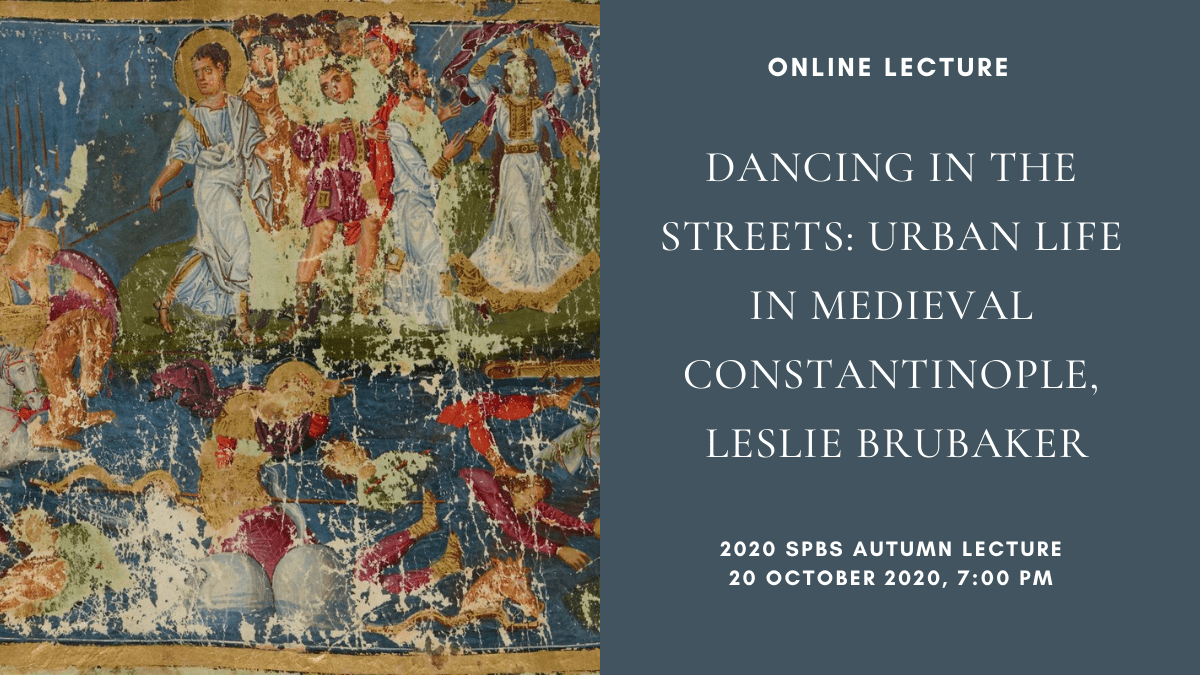
Online Lecture: Dancing in the Streets: Urban Life in Medieval Constantinople, Leslie Brubaker (University of Birmingham), 20 October 2020, 7:00 pm

Professor Leslie Brubaker will give the 2020 SPBS Autumn Lecture “Dancing in the Streets – Urban Life in Medieval Constantinople” on Zoom on October 20, 2020 at 7pm. The lecture is organized in association with the Hellenic Society

Leslie Brubaker is Professor of Byzantine Art and Director of Byzantine, Ottoman and Modern Greek Studies at University of Birmingham, Centre for Byzantine, Ottoman and Modern Greek Studies.

Advance registration required. To register, please click here.