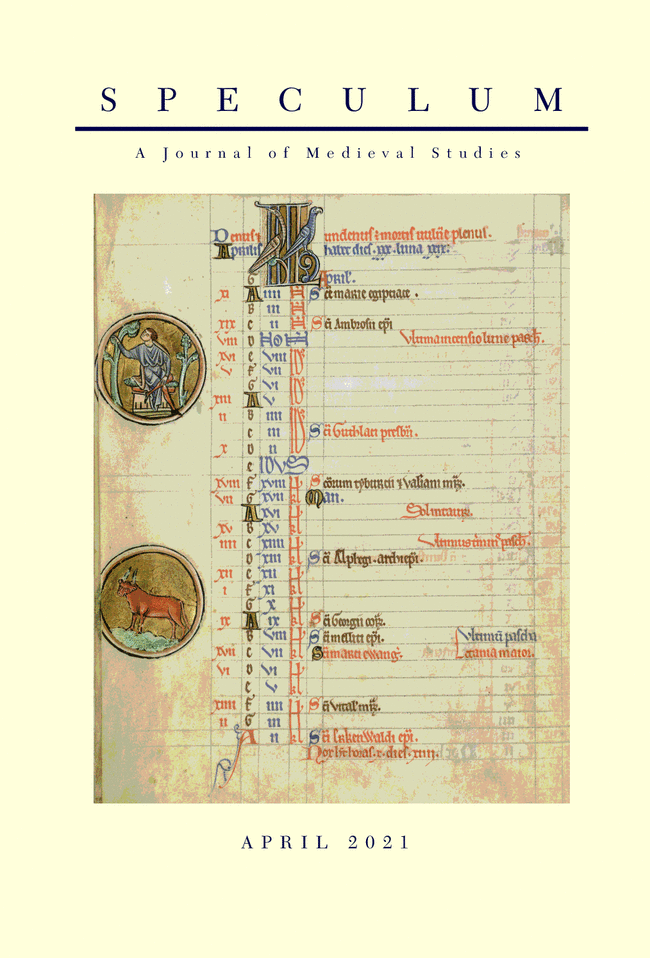
Find the new issue of Speculum here!
EDITOR Katherine L. Jansen
ASSOCIATE EDITOR Taylor McCall
ASSISTANT EDITOR Carol Anderson
EDITORIAL ASSISTANT Austin Powell
COPYEDITOR Anne Cherry
PROOFREADER Aaron Gies
EDITORIAL INTERNS Maia Driggers Paul Smith
ASSISTANT TO THE EDITOR Christopher Cole
Articles
287 Magical Charaktêres in the Carolingian World: A Ninth-Century Charm in MS Vat. lat. 5359 and Its Broader Cultural Context ▪ Ildar Garipzanov
309 Inventing Apostolic Impression Relics in Medieval Rome ▪ Erik Inglis
367 Tales of the Living Dead: Dealing with Doubt in Medieval English Law ▪ Elizabeth Papp Kamali
418 Eve, Mary, and Martha: Paintings for the Humiliati Nuns at Viboldone ▪ Julia I. Miller
Reviews
466 Abram, Christopher, Evergreen Ash: Ecology and Catastrophe in Old Norse Myth and Literature (Michael Bintley)
467 ‘Alı ̄ al-Tanu ̄khı ̄, Al-Muhassin ibn, Stories of Piety and Prayer: Deliverance Follows .Adversity, ed. and trans. Julia Bray (Nuha Alshaar)
469 Antonsson, Haki, Damnation and Salvation in Old Norse Literature (SvanhildurÓskarsdóttir)
470 Ashdowne, Richard and Carolinne White, eds., Latin in Medieval Britain (PádraicMoran)
472 Bailey, Matthew and Ryan D. Giles, eds., Charlemagne and his Legend in Early Spanish Literature and Historiography (Francisco Bautista)
474 Barr, Jessica, Intimate Reading: Textual Encounters in Medieval Women’s Visionsand Vitae (Barbara Newman)
475 Bayless, Martha, ed., Fifteen Medieval Latin Parodies (Katell Lavéant)
477 Blackmore, Lyn, Ian Blair, Sue Hirst, and Christopher Scull, The Prittlewell PrincelyBurial: Excavations at Priory Crescent, Southend-on-Sea, Essex, 2003 (Janet Kay)
478 Boulton, Maureen B. M., ed., Literary Echoes of the Fourth Lateran Council inEngland and France, 1215–1405 (Charles F. Briggs)
480 Bowersock, G. W., The Crucible of Islam (Suleyman Dost)
482 Butterfield, Ardis, Henry Hope, and Pauline Souleau, eds., Performing Medieval Texts (Anne Stone)
484 Chrissis, Nikolaos, Athina Kolia-Dermitzaki, and Angeliki Papageorgiou, eds.,Byzantium and the West: Perception and Reality (11th–15th c.) (Jonathan Harris)
485 Collins, David J., ed., The Sacred and the Sinister: Studies in Medieval Religion andMagic (Tabitha Stanmore)
487 DeGregorio, Scott and Rosalind Love, trans., Bede: On First Samuel (James T. Palmer)
488 Denissen, Diana, Middle English Devotional Compilations: Composing Imaginative Variations in Late Medieval England; Marleen, Cré, Diana Denissen, and Denis Renevey, eds., Late Medieval Devotional Compilations in England (Alastair Minnis)
491 Edgington, Susan B., Baldwin I of Jerusalem, 1100–1118 (Jay Rubenstein)
492 Emmerson, Richard K., Apocalypse Illuminated: The Visual Exegesis of Revelation in Medieval Illustrated Manuscripts (Jacqueline E. Jung)
494 Fear, Andrew and Jamie Wood, eds., A Companion to Isidore of Seville (Molly Lester)
496 Feller, Laurent and Ana Rodríguez, eds., Expertise et valeur des choses au Moyen Âge (Marta Madero)
498 Font, Márta and Gábor Barabás, Coloman, King of Galicia and Duke of Slavonia(1208–1241): Medieval Central Europe and Hungarian Power (Cameron Sutt)
499 Forrest, Ian, Trustworthy Men: How Inequality and Faith Made the Medieval Church(Fiona Somerset)
501 Fraenkel, Avraham and Abraham Gross, eds., Hebräische liturgische Poesien zu denJuderverfolgungen während des Ersten Kreuzzugs, with Peter Sh. Lehnardt (RainerJosef Barzen)
502 Franses, Rico, Donor Portraits in Byzantine Art: The Vicissitudes of Contact betweenHuman and Divine (Rossitza Schroeder)
504 Geisthardt, Constanze, Monster als Medien literarischer Selbstreflexion: Untersuchungenzu Hartmanns von Aue “Iwein,” Heinrichs von dem Türlin “Crône” und Johannsvon Würzburg “Wilhelm von Österreich” (Ruth Seifert)
505 Griffiths, Fiona and Kathryn Starkey, eds., Sensory Reflections: Traces of Experiencein Medieval Artifacts (Margaret Graves)
507 Hahn, Cynthia, Passion Relics and the Medieval Imagination: Art, Architecture, and Society (Anne E. Lester)
509 Hartley, Julia Caterina, Reading Dante and Proust by Analogy (Ilaria Serra)
510 Hill, Derek, Inquisition in the Fourteenth Century: The Manuals of Bernard Gui andNicholas Eymerich (Justine Trombley)
511 Hodapp, William F., The Figure of Minerva in Medieval Literature (Theresa Tinkle)
513 Hurlock, Kathryn, Medieval Welsh Pilgrimage, c. 1100–1500 (Jane Cartwright) 515 Jager, Katharine, ed., Vernacular Aesthetics in the Later Middle Ages: Politics, Performativity, and Reception from Literature to Music (Taylor Cowdery)
517 Jaynes, Jeffrey, Christianity beyond Christendom: The Global Christian Experienceon Medieval Mappaemundi and Early Modern World Maps (Alfred Hiatt)
518 Johannes de Hauvilla, Architrenius, trans. Winthrop Wetherbee (Greti Dinkova-Bruun)
519 Johnson, Tom, Law in Common: Legal Cultures in Late-Medieval England (Paul Brand)
521 Kesling, Emily, Medical Texts in Anglo-Saxon Literary Culture (Richard Scott Nokes)
522 Kuuliala, Jenni, and Jussi Rantala, eds., Travel, Pilgrimage and Social Interactionfrom Antiquity to the Middle Ages (Richard J. A. Talbert)
524 Leader, Anne, ed., Memorializing the Middle Classes in Medieval and RenaissanceEurope (Eleanor Hubbard)
525 Leidholm, Nathan, Elite Byzantine Kinship, ca. 950–1204: Blood, Reputation, andthe Genos (Shaun Tougher)
527 Lloyd-Morgan, Ceridwen, and Erich Poppe, eds., Arthur in the Celtic Languages: The Arthurian Legend in Celtic Literatures and Traditions (Daniel Helbert)
529 Maimonides, Moses, “On the Regimen of Health”: A New Parallel Arabic-English Translation, ed. and trans. Gerrit Bos, with critical editions of medieval Hebrew translations by Gerrit Bos and Latin translations by Michael R. McVaugh; Maimonides, Moses, “On the Elucidation of Some Symptoms and the Response to Them” (Formerly Known as “On the Causes of Symptoms”): A New Parallel Arabic-English Edition and Translation, with Critical Editions of the Medieval Hebrew Translations, ed. and trans. Gerrit Bos (Maud Kozodoy)
531 Makowski, Elizabeth, Apostate Nuns in the Later Middle Ages ( Tanya Stabler Miller)
533 Mancia, Lauren, Emotional Monasticism: Affective Piety in the Eleventh-Century Monastery of John of Fécamp (John Van Engen)
535 McGrady, Deborah, The Writer’s Gift or the Patron’s Pleasure?: The Literary Economy in Late Medieval France (Sarah Wilma Watson)
536 Meyer-Lee, Robert J., Literary Value and Social Identity in the Canterbury Tales (Roger A. Ladd)
538 Mulligan, Amy C., A Landscape of Words: Ireland, Britain and the Poetics of Space, 700–1250 (Aisling Byrne)
539 Niles, John D., God’s Exiles and English Verse: On the Exeter Anthology of Old English Poetry (Patrick W. Conner)
541 Odorico da Pordenone, Relatio de mirabilibus orientalium Tatarorum, ed. Annalia Marchisio (Peter Jackson)
543 Oftestad, Eivor Andersen, The Lateran Church in Rome and the Ark of the Covenant: Housing the Holy Relics of Jerusalem; with an Edition and Translation of the “Descriptio Lateranensis Ecclesiae” (BAV Reg. Lat. 712) (Lezlie Knox)
544 Palmer, James A., The Virtues of Economy: Governance, Power, and Piety in Late Medieval Rome (Steven A. Epstein)
545 Pettit, Edward, The Waning Sword: Conversion Imagery and Celestial Myth in “Beowulf” (Craig R. Davis)
547 Pluskowski, Aleksander, ed., Ecologies of Crusading, Colonization, and Religious Conversion in the Medieval Baltic: Terra Sacra II (Alan V. Murray)
548 Porck, Thijs, Old Age in Early Medieval England: A Cultural History (Alice Jorgensen)
550 Raffensperger, Christian, Conflict, Bargaining, and Kinship Networks in Medieval Eastern Europe; Raffensperger, Christian, Ties of Kinship: Genealogy and Dynastic Marriage in Kyivan Rus’ (Aleksandr Musin)
553 Rigby, Stephen H., ed., Historians on John Gower, with Siân Echard (Brian Gastle)
555 Russakoff, Anna, Imagining the Miraculous: Miraculous Images of the Virgin Maryin French Illuminated Manuscripts, ca. 1250–ca. 1450 (Tracy Chapman Hamilton)
556 Sabaté, Flocel, The Death Penalty in Late-Medieval Catalonia: Evidence and Significations(Adam J. Kosto)
558 Sadler, Donna L., Touching the Passion—Seeing Late Medieval Altarpieces throughthe Eyes of Faith (Gregory C. Bryda)
559 Schlotheuber, Eva and Anne Liewert, eds., Musik aus Paradiese: Die mittelalterlichenHandschriften der Dominikanerinnen aus Paradiese bei Soest (Cynthia J. Cyrus)
561 Schmidt, Ondrˇej, John of Moravia between the Czech Lands and the Patriarchate ofAquileia (ca. 1345–1394), trans. Graeme and Suzanne Dibble (Tomáš Velicˇka)
562 Staunton, Michael, ed., Herbert of Bosham: A Medieval Polymath ( Julian Haseldine)
564 Stern, David, Jewish Literary Cultures. Vol. 2, The Medieval and Early ModernPeriods (Katrin Kogman-Appel)
565 Stern, Sacha, The Jewish Calendar Controversy of 921/2 CE, with the collaborationof Marina Rustow, Nadia Vidro, and Ronny Vollandt (Elisheva Carlebach)
567 Thomson, R. M., The Fox and the Bees: The Early Library of Corpus ChristiCollege, Oxford. The Lowe Lectures 2017 (Micha Lazarus)
568 Timbert, Arnaud, ed., Qu’est-ce que l’architecture gothique?: Essais (Michael T. Davis)
570 Tolan, John V., Faces of Muhammad: Western Perceptions of the Prophet of Islam from the Middle Ages to Today (Nabil Matar)
572 Toner, Gregory and Xiwu Han, Language and Chronology: Text Dating by MachineLearning (Mike Kestemont)
573 Velasco, Jesús R., Dead Voice: Law, Philosophy, and Fiction in the Iberian MiddleAges (Teofilo F. Ruiz)
575 Vettori, Alessandro, Dante’s Prayerful Pilgrimage: Typologies of Prayer in the “Comedy”(George Corbett)
576 Wallenwein, Kirsten, Corpus subscriptionum: Verzeichnis der Beglaubigungen vonspätantiken und frühmittelalterlichen Textabschriften (saec. IV–VIII) (Markus Schiegg)
578 Wirth, Jean, La sculpture de la Cathédrale de Reims et sa place dans l’art du XIIIe siècle (Christoph Brachmann)
580 Wüsthof, Lucas, Schwabenspiegel und Augsburger Stadtrecht (Stephan Dusil)
581 Zeldenrust, Lydia, The Mélusine Romance in Medieval Europe: Translation, Circulation,and Material Contexts (S. C. Kaplan)
582 Zingesser, Eliza, Stolen Song: How the Troubadours Became French (Wendy Pfeffer)




 Medieval Art Research