Call for Papers: Mary of Burgundy The Reign, the ‘Persona’ and the Legacy of a European Princess

Image0001jpg8e76-3b5c8Call for Papers: Mary of Burgundy The Reign, the ‘Persona’ and the Legacy of a European Princess

International Colloquium (Brussels–Bruges, 5–7 March 2015)

Mary of Burgundy (1457–1482), daughter of Charles the Bold and heir to the Burgundian States, has received relatively little scholarly attention from specialists. Despite an exhibition held at Beaune from November 2000 to February 2001 (Bruges à Beaune. Marie, l’héritage de Bourgogne) as well as a number of biographies of varying merit, her brief reign remains overshadowed by those of her father, Charles the Bold, her husband, Maximilian of Hapsburg, and those of her son and grandson, Philip the Fair and Charles V. Mary’s reign, however short, is nevertheless important in the history of Europe and her absence from scholarly research is all the more surprising given the current interest in the role of women at the Burgundian court, particularly in Mary’s stepmother, Margaret of York, and her own daughter, Margaret of Austria.

On closer inspection, however, it is clear that Mary of Burgundy was a key player in the most important spheres of her day, notably politics, diplomacy, and the arts. On the political front, her involvement in the Great Privilege of 1477 and the crisis which sparked it is well known. However, the precise role played by the duchess and those close to her in this tangled series of events – especially the lessons that she learnt from the experience – are less well understood. More generally, the diplomatic negotiations and military campaigns which had an impact on her reign deserve greater attention from scholars, and the princess’s own role in these needs to be brought to light. Her role as a patron of the arts has recently started to receive more interest beyond the notoriety of the Hours of Mary of Burgundy. However, a number of important works of literature, history and iconography associated with the duchess have yet to be explored. Finally, it also important to consider the image of Mary in historiography, both in the collective memory of her own time and in that of subsequent generations, in order to understand the place that she occupies – or not – in the collective, historical, imagination.

This international colloquium aims to bring together specialists working on the fifteenth century and on Mary’s reign from across the disciplines – literature, manuscript studies, political, social, cultural and economic history, art history, and gender studies – in order to reassess the ‘persona’, the reign and the legacy of Mary of Burgundy in the history of Burgundian and European culture.

The colloquium will take place in Brussels and in Bruges, 5–7 March 2015. Proposals for papers (25 minutes maximum, in English or in French) might consider, but are not restricted to, the following themes:
– The political, diplomatic and military aspects of Mary’s reign and her role in these areas;

– Mary’s role as a patron of the arts (literature, history/historiography, painting, sculpture etc.);

– Her links to and relationships with towns and their culture;

– Her entourage and her education;

– Her impact on collective memory.

Proposals of about fifteen lines (200–300 words) should be sent by 15 May 2014 to the following address: jonathan.dumont@ulg.ac.be

Symposium: Christians and Muslims: Early Encounters

629px-Sednaya_MaryChristians and Muslims: Early Encounters
A Symposium at Brown University
Sunday, February 23, 2014|2-6pm|RI Hall108

The seventh-century rise of Islam opened a new era of religious “pluralism” in the Middle East. Yet, it would be more than a century before early Muslim scholars recorded the first Arabic accounts of the changes taking place. Syriac and Arabic-speaking Christians, however, were already producing and navigating their own responses to the new political and social order. Historically, linguistically and culturally rooted in the central lands of Islam, yet sorely understudied as sources for early Islamic history, late antique and medieval Middle Eastern Christians provide fresh perspectives for understanding the nature of religious and social change in a dynamic era of history.

Symposium Schedule

2pm: Sidney H. Griffith, Catholic University of America “Bible and Qur’an: Memory, Engagement and Difference”
Nancy Khalek, Brown University, Respondent

3:15pm: Break

3:45pm: Michael Penn, Mt. Holyoke College “Beyond Clashing Civilizations: Rethinking Early Christian-Muslim Relations”
Susan Ashbrook Harvey, Brown University, Respondent

5:00pm: New Questions in the study of early Muslim-Christian Relations
A roundtable discussion with Jonathan Conant, Brown University; Steven Judd, Southern- Connecticut State University; Sandra Toenies Keating, Providence College; Charles Stang, Harvard Divinity School; Anthony Watson, Brown University

Call for Papers: “Travel Accounts in Arabic Literature: New Perspectives and New Findings”

14-DC logo colorMiddle Eastern travelers have a rich history in writing about their interactions with other cultures. The authors, many of whom are Arabs, documented their encounters using various genres and forms, such as travel accounts, memoirs, and autobiographical histories.

This panel, to be proposed for the  Middle East Association Studies Annual Conference, (November 22-25, 2014 – Washington, DC) seeks papers that will shed new light on those texts, especially on papers that examine:
•     New archival findings.
•    Examination of less known travel accounts.
•    The circumstances of disseminating (copying, circulating or publishing) travel accounts.
•    The implications of patronage and authors’ agency.
While the focus of this panel is on Middle Easterners who write (or wrote) in Arabic, papers that examine texts written in other languages (e.g. Arab-Ottoman, Arab-Persian, Judeo-Arabic, Aljamiado, etc) are welcome. Comparative papers are also welcome.
Please e-mail your name, e-mail, academic affiliation and a 300-400 word abstract by Friday Jan 31, 2014 to: Suha Kudsieh [kudsieh@gmail.com].

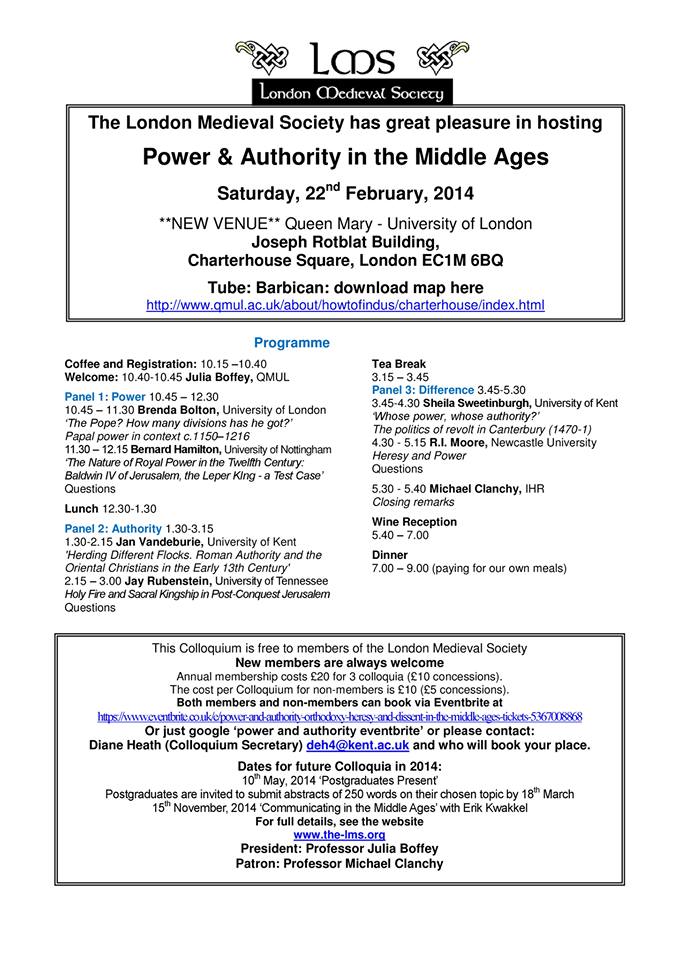
Conference: Power and Authority: Orthodoxy, Heresy and Dissent in the Middle Ages

logoThe London Medieval Society Colloquium, Power and Authority: Orthodoxy, Heresy and Dissent in the Middle Ages 

Saturday 22nd February from 10.15 – 6pm (followed by a wine reception until 7pm).

There could be a better line-up to discuss medieval power, authority, dissent and heresy: Robert I Moore, Bernard Hamilton, Brenda Bolton and, over from the States Jay Rubenstein, Sheila Sweetinburgh and our postgraduate speaker Jan Vandeburie discuss popes, kings, lepers, Canterbury, Crusades and Jerusalem. Proceedings will be drawn together with closing remarks by our patron Michael Clanchy.

Programme

Coffee and Registration: 10.15 –10.40

Welcome: 10.40-10.45 Julia Boffey, QMUL

Panel 1: Power 10.45 – 12.30
10.45 – 11.30 Brenda Bolton, University of London ‘The Pope? How many divisions has he got?’
Papal power in context c.1150–1216
11.30 – 12.15 Bernard Hamilton, University of Nottingham ‘The Nature of Royal Power in the Twelfth Century: Baldwin IV of Jerusalem, the Leper KIng – a Test Case’ Questions

Lunch 12.30-1.30

Panel 2: Authority 1.30-3.15
1.30-2.15 Jan Vandeburie, University of Kent ‘Herding Different Flocks. Roman Authority and the Oriental Christians in the Early 13th Century’
2.15 – 3.00 Jay Rubenstein, University of Tennessee Holy Fire and Sacral Kingship in Post-Conquest Jerusalem Questions

Tea Break 3.15 – 3.45

Panel 3: Difference 3.45-5.30
3.45-4.30 Sheila Sweetinburgh, University of Kent ‘Whose power, whose authority?’
The politics of revolt in Canterbury (1470-1)
4.30 – 5.15 R.I. Moore, Newcastle University Heresy and Power
Questions

5.30 – 5.40 Michael Clanchy, IHR Closing remarks

Wine Reception 5.40 – 7.00

Dinner 7.00 – 9.00 (paying for our own meals)

For further information and for booking visit the website.

Publication News: New Issue of Art History

unnamedThe latest issue of Art History, Volume 37, Issue 1 Pages 4 – 199, February 2014, is available on Wiley Online Library.

Abstracts & Authors’ Biographies (pages 4–7)

Editorial (page 9) Gavin Parkinson

Original Articles

Ladies-in-Waiting in Waiting: Picturing Adolescence in Dmitry Levitsky’s Smolny Portraits, 1772–76(pages 10–37) Rosalind P. Blakesley

The Motionless Look of a Painting: Jules Bastien-Lepage, Les Foins, and the End of Realism (pages 38–67) Marnin Young

Second Only to the Original: Rhetoric and Practice in the Photographic Reproduction of Art in Early Twentieth-Century China (pages 68–95) Yu-jen Liu

Hands on the Table: Ernst Ludwig Kirchner and the Expressionist Still Life (pages 96–125) William Sherwin Simmons

‘With an almost pathetic fatality doing what is right’: Late Sickert and his Critics (pages 126–147) Sam Rose

The Branding of the Museum (pages 148–165) Julian Stallabrass

Reviews

Water Worlds: Examining Mobility, Power and Civilization in the Islamic World (pages 166–169)
Zainab Cheema

Fragonard’s Reverse Whodunnit and Other Tales of Relocation (pages 169–174) Melissa Percival

Victorian Shock Value (pages 175–180) Ayla Lepine

Documents of American Art (pages 180–183) David Peters Corbett

Sladey Ladies and Femmes Modernes (pages 184–188) Brian Foss

Pop Art and Subjectivity: Diversification of Narrative Frameworks and Expansion of the Field’s Scope (pages 189–194) Elisa Schaar

Touched Photographs (pages 195–199) Jane Blocker

Call for Papers: Gender and Transgression in the Middle Ages

img01Gender and Transgression in the Middle Ages, 5-7 June 2014

We are pleased to announce the call for papers for Gender and Transgression in the Middle Ages 2014, an interdisciplinary conference hosted by the University of St Andrews Institute of Mediaeval Studies (SAIMS). Entering into its sixth year, this conference welcomes participation from postgraduate, postdoctoral and early career researchers interested in one or both of our focal themes of gender studies or more general ideas of transgression in the mediaeval period.

This year’s conference will have a keynote lecture by Dr Dion Smythe of the Queen’s University Belfast as well as an optional workshop focused on Interdisciplinary Approaches to Mediaeval Transgression.

We invite proposals for papers of approximately 20 minutes that engage with the themes of gender and/or transgression from various disciplinary standpoints, such as historical, linguistic, literary, archaeological, art historical, or others. Possible topics may include, but are by no means limited to:

 – Legal studies: men, women and the law, court cases, law-breaking, marriage

– Byzantine studies

– Masculinity and/or femininity in the Middle Ages: ideas of gender norms and their application within current historiography

– Ambiguous genders: eunuchs, transvestites, transgender

– Homosexuality and sexual deviancy

– Orthodoxy and Heresy: transgressing orthodox thought, portrayals of religious ‘outsiders’, monasticism, lay religion, mysticism

– Social outcasts

There will be three set strands of Medieval Law and Literature, Transgression in Byzantium, and Masculinity in the Middle Ages. In addition to these, there will be several other sessions within the broader conference theme.

Those wishing to participate should please submit an abstract of approximately 250 words to genderandtransgression@st-andrews.ac.uk by 10 February 2014. Please attach your abstract to your email as a Microsoft Word or PDF file and include you name, home institution and stage of your postgraduate or postdoctoral career. Registration for the conference will be £15, which will cover tea, coffee and lunch on two days and two wine receptions. All delegates are also warmly invited to the conference meal on Friday 6 June. Further details can be found on the website.

Conference: Naxos and the Byzantine Aegean

img_1667church_halkiNaxos and the Byzantine Aegean
Saturday 12th – Sunday 13th April 2014, Naxos Chora

Background
The Norwegian Institute at Athens has carried out field work on Naxos at the 7th century Byzantine urban fortress of Kastro Apalirou in collaboration with The 2nd Ephoria of Byzantine Antiquities since 2010. The project has recently been widened to include the Universities of Edinburgh and Newcastle. A conference is being arranged to bring together scholars who have worked on Naxos and other Byzantine sites in the Aegean

Focus
The conference focus will be Byzantine research on Naxos, though some aspects of Late Antique settlement will be included. Research from other insular sites with relevance to Naxos will also be presented. The following research areas will be covered: Archaeology, History, Landscape History, Ecclesiastical History, and Iconographic and Architectural development.

Location
The meeting will be held at the Ursuline School, Chora, Naxos Island, on Saturday 12th and Sunday 13th April with an optional excursion on the 14th. A preliminary programme will be published shortly.

Language
English

Participation
The following speakers have agreed to speak and will present papers on their work:
Vasso Penna, University of the Peloponnese
Ben Slot, University of Leiden
Haralambos Pennas, Athens
Thanassis Vionis, University of Cyprus
Natalia Poula- Papadimitriou, University of Thessaloniki
Vassilis Lambrinoudakis, University of Athens
Maria Xenaki, French School at Athens
Stavros Baltogiannis, Athens
Agathoniki Tsilipakou, Museum of Byzantine Culture, Thessaloniki
Georgios Mastoropoulos, Athens and Naxos
Georgios Deligiannakis, Open University, Cyprus
Klimis Aslanidis, University of Patras
Ian Begg, Trent University
David Hill, University of Oslo
Knut Ødegård University of Oslo
Håkon Ingvaldsen, University of Oslo
James Crow, University of Edinburgh
Sam Turner University of Newcastle

We welcome other potential speakers who have relevant work to contact the organizers with an abstract of their proposed communication.

Contact
For academic program: jim.crow@ed.ac.uk
For organizational matters: david.hill@khm.uio.no
For matters concerning arrangements on Naxos: sophiakaravias@yahoo.co.uk

Call for Proposals: Innovation and its Contestants

McGill_UniversityINNOVATION AND ITS CONTESTANTS

5th Annual Emerging Scholars Conference
McGill University Department of Art History and Communications Studies
18 April 2014

Keynote Speaker: Keith Moxey, Barbara Novak Professor of Art History
and Department Chair at Barnard College (Columbia University)

Deadline for Submissions: 24 January 2014

The concept of innovation buttresses a paradigmatically modern Western
belief in the possibility of infinite economic growth and technological
progress. It is in fact a buzzword with remarkable contemporary
currency, one that is instrumentalized as a constant search for new
technologies, means of production, market adaptations, scientific
discoveries and social changes. As a fundamental tenet in Western
systems of thought, it is also – and has long been – inscribed within
the West’s very view of itself as more successful and more
‘progressive’ than other societies. Note, for example, G.W.F. Hegel’s
famous juxtaposition of Europe’s ever- changing art against the
allegedly stagnant visual culture of India: the first modality
accounted for the privileged position of the West as the locus of the
emanation of universal Geist; while the latter stipulated an
essentially ‘un-progressive’ timelessness in India.

The Western valuation and definition of innovation has thereby been
mobilized as a justification for diverse colonial, post-colonial and
now neoliberal enterprises. It operates as a smoke screen to preserve
dominant power regimes both within the West and globally, concealing
simultaneously the biased valuation of cultural production, and the
unequal distribution of technological and scientific headway among
diverse social strata. This is the case even as the current global
financial crisis challenges the West’s ability to regenerate
perpetually. In fact, the stakes involved in the Western impetus to
innovate seem to intensify even as recent projections of economic
acceleration in several non-Western countries rouse fears that the West
is losing ground as innovation’s main stimulant.

The innovation paradigm is moreover implicit within the bulk of
humanistic academic production. As a case in point, the Greenbergian
approach to art history, which dominated much of the twentieth century,
revolves indisputably around a teleology of formal innovation.
Meanwhile, within a number of current academic discussions – for
instance those concerning experimentation and invention in the history
of science (Galison); global art history (Elkins); visual culture
studies (Moxey); history of ideas (Godin); the philosophy of
mondialisation (Nancy); media archaeology (Parikka); technological
obsolescence (Kittler); and the aesthetics of failure (Halberstam) –
innovation is tacitly treated with caution, if not skepticism.

Given this tangle of collusions and complexities, how are we to
approach and define innovation in academic discourse? Is the paradigm
purely a means of disarming social pressure for an all-inclusive
equalized prosperity; or might it be recuperated to provide a stimulus
for sustainable growth? Can we understand innovation in a broader
global spectrum without falling into the trap of cultural essentialism;
or does this concept perpetuate Western-centric views and mores? Can
the concept of innovation be used for the analysis of historical
periods; or does it figure too easily in teleological narratives?

With these questions in mind, we are opening an enquiry into the
concept of innovation. We invite paper proposals addressing a broad
range of academic disciplines and historical periods. Papers might
address, but are by no means restricted to, the following questions:
• Socio-economic implications of innovation. How do societies and
specific agents adapt to new conditions once their old ways of life
have been destroyed?
• The politics of innovation. Does innovation bring betterment or
deprivation?
• What are the criteria of innovation?
• Challenging the Western canon of art built on the notions of style,
progress, and originality
• Technological progress
• Patents
• Is Western-centrism pervasive in the concept of innovation?
• How does innovation affect personal identities (video games,
Facebook, etc.)?
• How is innovation different from change?
• The contestations of innovation; the discursive counterpoints to
innovation
• Centre vs. periphery; milieus of innovation
• Instances of anachronism masked as innovation in culture from the
Middle Ages to the present day. Recurring regimes: the old in the new,
the new in the old
• Does materiality matter in innovation?
• Temporality and innovation
• Commodity culture and innovation

We welcome proposals for 20-minute presentations. Please send your
submission in the form of a 300-word abstract and a brief CV to
ahcsconference@gmail.com. All candidates will be contacted by the first
week of February.

For more information, please visit the website.

Call for papers: Miracles and Wonders in Antiquity and Byzantium

Chora, Multiplication of the loaves (Underwood)INTERNATIONAL CONFERENCE: Miracles and Wonders in Antiquity and Byzantium University of Cyprus, 16-18 October 2014

Tales of miracle and wonder decorate both ancient and Byzantine literature and seem
to have had a great impact upon ancient and Byzantine thought. A strong interest in
the wondrous is already apparent in the works of Homer and Hesiod. However, a
more organized recording of marvels is detected much later, in Herodotus’s time,
when marvelous stories and travel accounts of exotic places and peoples are
increasingly produced. From the era of Alexander and onwards such stories are
recruited by historians and rhetors in an attempt to apotheose the ideal ruler. Between
the third century BC and the third century AD, the genre of paradoxography,
collections of stories relating strange events and phenomena, achieves great
popularity, and influences another new genre, the Hellenistic novel. At about the same
time, a number of stories circulate that relate the miraculous healings of suffering
people who practice incubation in Asclepian temples. Later the practice of incubation
is taken over by Christian pilgrims who are cured by saints. Miraculous healings and
other types of miracles that are associated with a particular Christian shrine become
the material of a new genre, the miracle collection which is cultivated throughout the
Byzantine era. Miracle stories are included in all Byzantine hagiographical genres,
since they constitute the strongest sign of holiness. Miracles and wonders are also
found in profane Byzantine genres, such as chronicles and romances. Despite the fact
that marvel literature enjoyed such a high popularity in antiquity and Byzantium, it
has been mostly dismissed by modern scholars as debased, boring and even
unintelligible, an attitude that has condemned this literature to obscurity.

The conference’s main aims are to bring to light miracle and wonder literature and to
open up new avenues of approach. Topics of exploration may include:
• Literary Theoretical Approaches
• Cultural Studies
• Psychological Approaches
• Comparative Literary Studies
• Linguistics

Specialists are invited to submit a thirty-minute paper in English on a relevant topic.
Due to budgetary constraints, the organizers cannot cover the speakers’ travel and
hotel costs. There is no registration fee for participation or attendance. Prospective
speakers are asked to submit by 30 April 2014 a title and a 400-word abstract to
Stavroula Constantinou (konstans@ucy.ac.cy) and Maria Gerolemou
(mariagerolemou@live.de).

Call for Papers: Military History of the Mediterranean

800px-The_troops_of_Thomas_attack_the_walls_of_ConstantinopleFati̇h Üni̇versi̇tesi̇ – Tari̇h Bölümü will present the International Conference on the Military History of the Mediterranean Sea, to be held 26-28 June 2015 at Buyukcekmece, Istanbul.

With an uninterrupted history of nearly 1,500 years, Istanbul has been the centre of the world and the capital of two great Empires. The confluence of the Sea of Marmara, the Bosphorus, and the Golden Horn, at the heart of present-day Istanbul, along with its striking Theodosian walls have deterred attacking forces for thousands of years and still remain a prominent feature of the city’s landscape.
Fatih University and the staff of the Department of History are delighted to invite session and paper proposals for its first international conference on military history to be held June 26-28, 2015. We welcome papers that explore any topic related to the study and teaching of the military history of the Mediterranean in the Middle Ages and Renaissance, from the fall of Rome to the nineteenth century.

We especially encourage papers that focus on the conference’s theme of military elites. Points of discussion could potentially, but not exclusively, include:
▪    Military elites and change of power
▪    Economic power and the social status of military elites
▪    Social and cultural interactions – hated, despised or admired?
▪    Recruitment policies
▪    Military tactics and technological innovations

Fee:
The conference fee of 50 Euros will include transportation to the University campus and complimentary lunch, coffee etc.

Deadlines:
The deadline for proposals is 1pm (Istanbul time, +2GMT) on May 30, 2014; late requests cannot be accommodated. Please submit an abstract of no more than 250 words and a brief CV to the conference organiser: Dr. Georgios Theotokis (georgios.theotokis@fatih.edu.tr). For further information visit the web page.