Online Workshop: The Textiles in Manuscripts Workshop organised by The Book and the Silk Road Project, May 4th-5th, 2021 (10-15:00 EDT)

The aim of this virtual workshop is to examine the vast use of textiles in manuscripts, both practical and ornamental: their uses within bindings, as wrappers, enclosures, and covering, as cloth used to protect images, and as symbolic or talismanic artefacts. Workshop sessions focus on the use of textiles in Armenian, Chinese, Ethiopian, Islamic, Kashmiri, and Syriac manuscripts from the middle ages through the early modern period. The workshop is not meant to be exhaustive, but to take a unique approach in beginning an interdisciplinary conversation about the production and use of manuscripts across the Silk Roads.

Each session explores content presented in pre-recorded videos that participants must watch in advance of the workshop. The workshop sessions will not be recorded, so register only if you are able to attend the workshop on May 4-5. The pre-recorded videos will be made live by April 20, and will be available both before and after the workshop itself.

For more information and to access the pre-recorded videos, visit the Textiles in Manuscripts Workshop website: http://booksilkroadstextiles.artsci.utoronto.ca/

To register, please click here.

The Book and the Silk Roads (2019–2021) is a large-scale collaborative project that aims to tell the story of the book in a new way. Global book history is often represented as a narrative of technological and societal progress — from the tablet and scroll to the biblical codex of late antiquity, to the early modern printing press of the Gutenberg Bible, to today’s “Digital Age.” By contrast, our team works with a diverse and wide-ranging network of collaborators to tell many stories of books, from multiple regions and periods, within a more capacious and less teleological account of the past.

Working across boundaries of geography, institution, and discipline, the distinctive methodology of The Book and the Silk Roads brings together humanities researchers, digital librarians, scientists, conservators, rare book librarians and curators, as well as local and diasporic community members for whom these books represent a precious part of their cultural heritage. By combining our different forms of expertise, we will develop a rich and global history of the book, aiming for interdisciplinary and collaborative breakthroughs in the areas of codicology, conservation and heritage science, and the protection and study of vulnerable and little-understood materials.

The Book and the Silk Roads is generously funded by the Andrew W. Mellon Foundation, with a team directed by co-Principal Investigators Alexandra Gillespie of the University of Toronto Mississauga, Sian Meikle of the University of Toronto Libraries, and Suzanne Akbari, of the Institute for Advanced Study in Princeton.

Call for Sessions: Mary Jaharis Center Sponsored Panel, 57th International Congress on Medieval Studies (9th-14th May 2022), Deadline 18th May 2021

To encourage the integration of Byzantine studies within the scholarly community and medieval studies in particular, the Mary Jaharis Center for Byzantine Art and Culture seeks proposals for a Mary Jaharis Center sponsored session at the 57th International Congress on Medieval Studies, Western Michigan University, Kalamazoo, May 9–14, 2022. We invite session proposals on any topic relevant to Byzantine studies.

PLEASE NOTE: The 57th International Congress on Medieval Studies will be virtual.

Session proposals must be submitted through the Mary Jaharis Center website (https://maryjahariscenter.org/sponsored-sessions/57th-international-congress-on-medieval-studies).

The deadline for submission is May 18, 2021. 

Applicants will be contacted by May 25, 2021, regarding the status of their proposal. The Mary Jaharis Center will submit the session proposal to the Congress and will keep the organizer informed about the status of the proposal.

If the proposed session is approved, the Mary Jaharis Center will reimburse up to 5 session participants (presenters and presider) for the cost of conference registration. Funding is through reimbursement only; advance funding cannot be provided. Receipts are required for reimbursement.

Please contact Brandie Ratliff (mjcbac@hchc.edu), Director, Mary Jaharis Center for Byzantine Art and Culture with any questions.

Funding: ICMA Whiting Foundation 2022-23 Public Engagement Grants, Deadline 30th April 2021

As a nominating body for the Whiting Foundation’s Public Engagement Programs in the humanities, the International Center of Medieval Art (ICMA) calls for proposals in public-facing scholarship to submit for the 2021–22 competition cycle (for funding in 2022–23). The foundation describes these funding opportunities as “designed to celebrate and empower humanities faculty who embrace public engagement” at an early-career stage, “to infuse the depth, historical richness, and nuance of the humanities into public life.”

We may nominate one or two proposals by full- or part-time faculty at accredited US institutions of higher learning. To be eligible for the grants, faculty must be full- or part-time faculty in both the 2020-21 and 2021-22 academic years. Faculty need not be on a tenure track to be eligible. Nominees must also be early-career: they should have received their doctorate between 2008 and 2020.

The Foundation welcomes proposals including collaborations between faculty and graduate students. Nominees may apply to either of the Whiting’s funding programs, depending on the stage of development of their project: 

A Fellowship of $50,000 for projects far enough into development or execution to present specific, compelling evidence that they will successfully engage the intended public.

A Seed Grant of up to $10,000 for projects at a somewhat earlier stage of development, where more modest resources are needed to test or pilot a project or to collaborate with partners to finalize the planning for a larger project and begin work.

The full application for nominees is due on 14 June 2021.

New Journal Issue: Gesta, Volume 60 2021

The Spring 2021 issue of Gesta, sponsored by the ICMA, has been published. Please click here to visit the journal page. The contents can be found below.

Editors: Diane J. Reilly and Susan L. BoyntonSponsored by the International Center of Medieval Art

CONTENTS
The King in the Manuscript: The Presentation Inscription of the Vienna Latin Bible moralisée-Katherine H. Tachau | 1

Holy, Holy, Holy: Hearing the Voices of Angels – Sharon E. J. Gerstel, Chris Kyriakakis, Spyridon Antonopoulos, Konstantinos T. Raptis, and James Donahue |31

(Re)Birth of a Seal: Power and Pretense at San Nicola, Bari, ca. 1300 Jill Caskey | 51

Space, Image, Light: Toward an Understanding of Moldavian Architecture in the Fifteenth CenturyAlice Isabella Sullivan, Gabriel-Dinu Herea, and Vladimir Ivanovici | 81

Into the Desert: Demons, Spiritual Focus, and the Eremitic Ideal in Morgan MS M.626 – Denva Gallant | 101

Call for Journal Submissions: Postmedieval, Special Issue Proposals (published 2022 & 2023), deadline 15 May 2021

Postmedieval publishes theoretically driven scholarship on premodernity and its ongoing reverberations. Contributions are characterised by conceptual adventure, stylistic experiment, political urgency, or surprising encounter. The editors are committed to expanding the fields of knowledge and geography represented in the journal, by showcasing scholarship that reaches across disciplines, language traditions, locales, modes of inquiry, and levels of access. The aim is to facilitate collaborative, ethical, and experimental engagements with the medieval—with its archives and art, its thought and practices, its traces and its enduring possibilities. Contributions on sources beyond Western Europe are warmly encouraged.

Postmedieval is looking for guest editors to conceptualise, organise, and edit special issues focused on specific topics of the guest editors’ choosing. Responsibilities for an issue include soliciting contributions, liaising with authors and helping them develop and polish their work, writing an introduction, and overseeing the overall shape of the issue. One person may act as a guest editor, though it often works better with two or three in a team. There are no editorial costs involved, and the guest editors will have the support of the Editors-in-Chief, the Managing Editor, the Palgrave Springer production team, and members of the Editorial Board. Guest Editors will receive a physical copy of the published issue, and their introduction will be permanently free-to-view online. Contributors will receive access to a digital version of their article. Palgrave Springer does not generally make their content Open Access (outside of a fee of $2780 USD per article or some other prior institutional arrangement). Authors are permitted to self-archive an accepted manuscript version of their article (prior to copyediting and typesetting).

To submit a proposal for the 2022 and 2023 special issues, please complete and return a proposal form to postmedievalED@gmail.com by May 15, 2021.

PhD Funding: JB Trapp Scholarship and Rubinstein Scholarship, The Warburg Institute – Deadline 1st May 2021

The Warburg Institute offers two scholarships for MPhil and PhD students. Applications close on the 1st May 2021. The Institute has an excellent record in securing external funding, and is happy to work with prospective students on their funding applications.

JB Trapp Scholarship 

The JB Trapp Scholarship is open to international students who have been offered a place on the Institute’s MPhil/PhD Programme. It will cover international fees and provide an annual £15,000 maintenance payment for a maximum of three years. This scholarship is not for those who wish to do distance learning. 

To be eligible to apply students must have been offered a place on the programme and be categorised as an International student. We particularly encourage applications from students from the Global South.

The scholarship will be awarded on the basis of academic merit.

To apply please download this form and return it to warburg@sas.ac.uk by 1 May 2021. 

Please note: If you are a current Warburg Student ( i.e. you started your PhD in October 2020 or earlier), you need to complete the form and also provide a short statement (up to 1000 words) which outlines what you have achieved so far with your PhD research, what you plan to do in the coming years, and any other relevant professional development achievements.  This can be provided in a word document.

Rubinstein Scholarship

The Rubinstein Scholarship is open to home students who have been offered a place on the Institute’s MPhil/PhD Programme. It will cover home fees and provide an annual £15,000 maintenance payment for a maximum of three years. This scholarship is not for those who wish to do distance learning.

To be eligible to apply students must have been offered a place on the programme and be categorised as an home student.

The scholarship will be awarded on the basis of academic merit.

To apply please download this form and return it to warburg@sas.ac.uk by 1 May 2021.

Please note: If you are a current Warburg Student ( i.e. you started your PhD in October 2020 or earlier), you need to complete the form and also provide a short statement (up to 1000 words) which outlines what you have achieved so far with your PhD research, what you plan to do in the coming years, and any other relevant professional development achievements.  This can be provided in a word document.

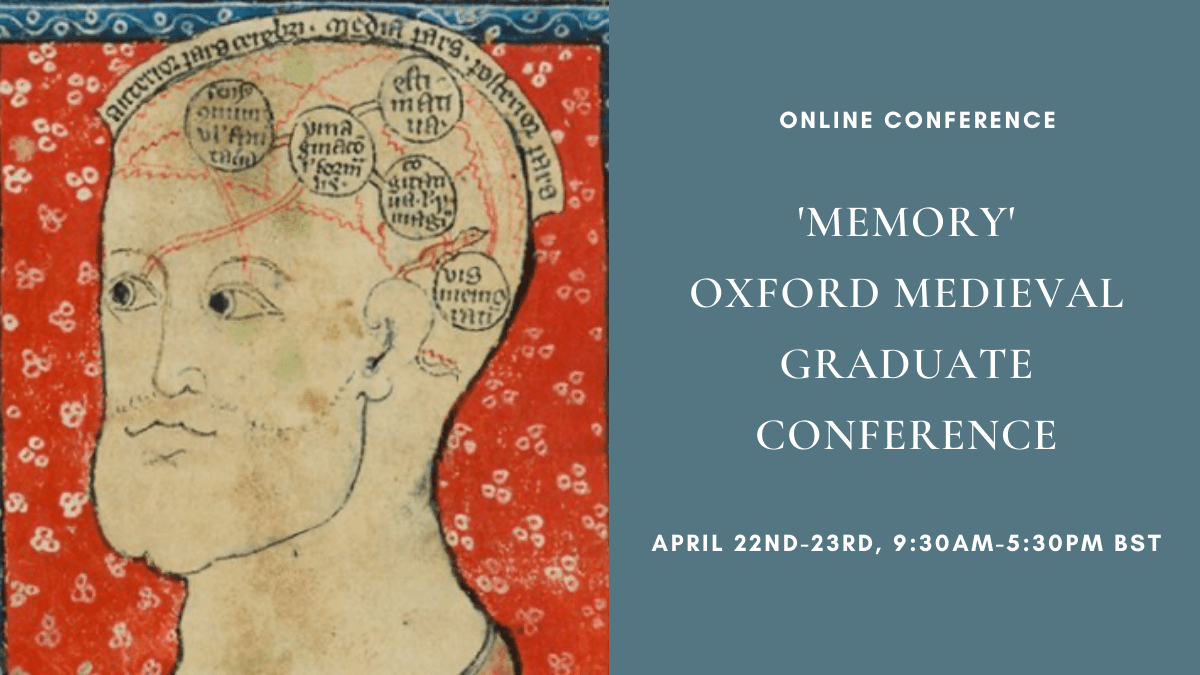
Online Conference: ‘Memory’, Oxford Medieval Graduate Conference, April 22nd-23rd, 9:30am-5:30pm BST

Organised by Anna Begley, Megan Bunce, James Cogbill, Sigrid Koerner, Mary O’Connor, Keoni O’Reilly, Martin Stuart and Eugenia Vorobeva

Sponsored by the Society for the Study of Medieval Languages and Literature and the Oxford Centre for Late Antiquity

Register here for free.

Thursday 22nd April 2021

09.30: Opening Remarks (Eugenia Vorobeva)

09.40: Session 1 – Memory of Other Lands (Chair: Keoni O’Reilly)

Benjamin Sharkey (Magdalen College, Oxford), Remembering Jerusalem: Christian Storytelling at a Silk Road Oasis, Ninth to Twelfth Centuries

Zainab Wani (Jawaharlal Nehru University), Remembering Iran, Valorising Kashmir: Different Ways of Memorialising Homeland

Matthew Firth (Flinders University), Memories of England in the ‘Sagas of Icelanders’

11.00: Break

12.00: Session 2 – Archives and Legal Memory (Chair: Mary O’Connor)

Harry Platts (Independent Scholar), Forgetting the Hundred Moots: How did the Practise and the Memory of Late-Saxon Assembly Transform in Late Medieval England?

John Merrington (All Souls College, Oxford), Forgetting the Archives? The Early Medieval Transmission of Gregory of Tours’ ‘Histories’ Reconsidered

Riya Gupta (Jawaharlal Nehru University), Dynastic Memory and Identity Experiments in Mughal Lower Bureaucracy: A Case Study of Qayamkhani Mansabdars

James Miller (University College, Oxford), ‘Haec carta, lecta atque audita’: Public Performance and Memory of Disputes in Twelfth-Century Brittany

13.40: Break

15.00: Keynote Lecture (Chair: Eugenia Vorobeva)

Professor Hannah Skoda (St. John’s College, Oxford), ‘The Former Age rebukes the new’: Genealogies of Nostalgia in the Long Fourteenth Century

16.00: Session 3 – National Memory (Chair: Martin Stuart)

Ruth Rimmer (University of York), Constructing Collective Memory in ‘The Ruin’

David Lees (Aberystwyth University), Geoffrey of Monmouth and the Construction of Cornwall in Twelfth-Century Literature

Sara Moure López (Universidad de Santiago de Compostela), Grieving, Mourning and Remembrance. The Role of Emotions in the Construction of Memory of Defeat in Castile around 1200

17.20: Break

19.00: Social Event

Friday 23rd April 2021

09.30: Session 4 – Memory and Physical Objects (Chair: Sigrid Koerner)

Rowan Wilson (St. Hilda’s College, Oxford), ‘Then he turnes to þe toumbe and talkes to þe corce’: Encountering the Bodies of Historical Memory in Medieval Literature

Woo Ree Heor (Graduate Center—City University of New York), ‘As freshe as any rose newe’: Hector’s Corpse and the Desire for the Past in the ‘Troy Book’

Hubert Leponika (Podlasie Museum, Białystok), Lost Memory Told Once More. Stele Cemeteries in the Podlasie Region (North-Eastern Poland)

George Beckett (University of Leeds), Manuscript Memory: Reading ‘Beowulf’ as ‘Intratext’

11.10: Break

12.00: Session 5 – Memory and the Church (Chair: Megan Bunce)

Joseph Hopper (University College London), Memory and Salvation in Hugh of St. Victor’s ‘De sacramentis christianae fidei’

Harry Spillane (Peterhouse, Cambridge), ‘A Matter Newly Seene?’: Matthew Parker, English Bibles, and the Anglo-Saxon Church

Richard Asquith (Royal Holloway, University of London), ‘Be yt remembred’: The Construction and Maintenance of Memory in the Records of London’s Pre-Reformation Parishes

13.20: Break

15.00: Keynote Lecture (Chair: James Cogbill)

Dr Graeme Ward (Jesus College, Oxford), Memory, Textual Authority, and the Distance of the Past: The Case of Amalarius of Metz, c. 800-1100

16.00: Session 6 – Interpretation of Memory (Chair: Anna Begley)

Aline Douma (Rijksuniversiteit Groningen), Forgotten, Not Forgiven? Repressed Memories of the Wars of the Roses in George Ashby’s ‘Active Policy of a Prince’

Brian Egede-Pedersen (Independent Scholar), ‘Templars, Fight or Fall!’ – Remembering the Knights Templar in Power Metal

Madeleine S. Killacky (Bangor University), Memory and Emotion in Malory’s ‘Tale of the Death of Arthur’

17.20: Closing Remarks (James Cogbill)

CFP: ICMA Sponsored Session Proposal, AAH Annual Conference 2022, Deadline 20th April 2021

London, 6-8 April 2022
Call for ICMA Sponsored Session Proposals due 20 April 2021

The International Center of Medieval Art (ICMA) seeks proposals for sessions to be held under the organization’s sponsorship at the Association for Art History Annual Conference to be held 6-8 April 2022 at Goldsmiths, University of London.

Proposals to the ICMA must include a session abstract and a CV of the organizer(s).

Please note the following:

  • The AAH does not require a slate of speakers; the AAH will generate a CFP once sessions have been selected. Therefore the ICMA will not request a slate of speakers.
  • The ICMA requires the CVs of the session organizers, but the AAH does not.
  • Session organizers and speakers must be ICMA members but are not required to become AAH members. However, AAH members receive a preferential conference rate.
  • Sessions at the AAH conference are built of 70-minute blocks, with a minimum of two blocks per session, up to four blocks in a day. Each block consists of two papers of 25 minutes plus 10 minutes of questions for each paper. The ICMA seeks to sponsor one session of two 70-minute blocks (four papers).


Upload your proposals here by 20 April 2021

Please direct all inquiries to the Chair of the Programs Committee: Bryan C. Keene, Riverside City College, USA, bryan.keene@rcc.edu 
 
The ICMA Programs and Lectures committee will select a session to sponsor and will notify the successful organizer(s) by 1 May 2021. The organizer(s) will then submit the ICMA-sponsored proposal to the AAH, which will make the final decision. Submit session proposals to the AAH by 7 May 2021 at Conference2022@forarthistory.org.uk following the guidelines posted on the AAH website: https://forarthistory.org.uk/our-work/conference/2022-annual-conference/ 

A NOTE ABOUT KRESS TRAVEL GRANTS


Thanks to a generous grant from the Kress Foundation, funds may be available to defray travel costs of speakers in ICMA sponsored sessions up to a maximum of $600 for domestic travel and of $1200 for overseas travel. If available, the Kress funds are allocated for travel and hotel only. Speakers in ICMA sponsored sessions will be refunded only after the conference, against travel receipts. In addition to speakers, session organizers delivering papers as an integral part of the session (i.e. with a specific title listed in the program) are now also eligible to receive travel funding.

Click here for more information.

Fellowship: A.G. Leventis Fellowship in Hellenic Studies, 2021-2024, British School at Athens, Deadline 7th May 2021

The British School at Athens is pleased to announce the A.G. Leventis Fellowship in Hellenic Studies. The Fellowship, funded by the A.G. Leventis Foundation, is tenable at post-doctoral level to support research into the anthropology, archaeology, architecture, arts, environment, geography, history, language, literature, religion and topography of Greece and Cyprus, and related areas, from prehistory to the late 19th century / early 20th century. The Fellowship is tenable for three years from 1 October 2021.

The A.G. Leventis Fellowship represents an important strengthening of the intellectual life of the BSA and of its relations with Greece and Cyprus. The BSA is looking for candidates of the highest potential who will make best use of the opportunity for a prolonged period of research in Greece and other Greek lands. If the Fellow is not fluent in Greek, it is essential that s/he become fluent within six months of taking up the Fellowship. Furthermore, any Fellow whose native language is other than English must be or become fluent in English, again within six months of taking up the Fellowship.

The A.G. Leventis Fellow will be expected to take a leading role in the life and work of the BSA. Teaching and other duties will be agreed with the Director at the beginning of each academic year. The Fellow will be expected to give one seminar per year and one public lecture during the term of the Fellowship. The Fellow may be asked to participate in courses taught by the BSA, and s/he may undertake a small amount of outside teaching with the approval of the Director. It is expected that the Fellow will take a lively interest in the research of BSA Students.

The Fellow must spend at least nine months a year in Greek lands, and has a duty to inform the Director of absences from Athens of more than four days between 1 October and 30 June.

Normally the Fellow will be expected to have satisfied all the requirements for his/her doctorate no more than five years and at least three months before taking up the post.

For more information, please click here.

Workshop: An Introduction to Arabic Manuscripts (23rd to 27th August 2021, Princeton-UCLA via Zoom), Deadline 22nd April 2021

A free, intensive online workshop featuring leading authorities on the study of Arabic manuscripts.

This week-long workshop features leading authorities on the study of Arabic manuscripts. The workshop will equip emerging scholars with the basic tools to conduct research with original handwritten texts in Arabic script.

Over the course of five days, participants will learn the basics of codicology, palaeography, and manuscript production and circulation, in the context of an expansive vision of current debates in Arabic manuscript research.

Topics include:

  • anatomy of the codex
  • canonical and informal scripts
  • colophons, audition notes, owners’ notes, readers’ notes
  • digital collections
  • ethics and best practices
  • scribes and other craftspeople
  • strategies for decipherment
  • supports, bindings
  • technical terminology
  • transmission practices and patterns

Enrollment is free of charge. Full participation is by application only. Others may observe via webinar.

Application deadline is 22 April 2021. Apply at https://ucla.in/3cpTpu2 (All applicants welcome, regardless of home institution; priority will be given to PhD students and untenured scholars with compelling need to use Arabic manuscripts in their research.)

Co-sponsored by Princeton and UCLA, which house the two largest repositories of Islamicate manuscripts in North America.

Organizers: Marina Rustow (Princeton) and Luke Yarbrough (UCLA)

For more information on the workshop programme and how to apply, please click here.