Online Summer School: 2021 Online Byzantine Greek Summer School, Boğaziçi University

The Byzantine Studies Research Center of Boğaziçi University is pleased to announce the organization of its fourth Byzantine Greek Summer School to be held online, from 29 July to 18 August, 2021. Students will have the chance to participate in an intensive program in Medieval Greek with Prof. Niels Gaul and Dr. Foteini Spingou. There is no fee for participation in the program, thanks to a generous grant from the Andrew W. Mellon Foundation.

The deadline to apply is 31st May 2021. To apply, visit http://byzantinestudies.boun.edu.tr/index.php?page=events&id=59.

Format
The program is designed for students who have completed at least two semesters of college-level Classical Greek or its equivalent. Students are expected to have knowledge of basic Greek grammar and to be able to read simple texts from ancient Greek or Byzantine literature. Daily classes are devoted to the reading of Byzantine texts with a focus on Constantinopolitan monuments and/or events that happened in the city; they will be held in two groups, at lower intermediate level and upper intermediate/advanced level, and last three hours Monday to Friday (15 hours per week). Students will be assigned to one of the two groups based on their performance in a prognostic test. The daily classes will be supplemented by shorter tutorial sessions (two to three per week) that offer revisions of grammar or a brief introduction to Greek paleography. The language of instruction is English, and the classes will be held online. The exact schedule will be agreed with those admitted to the course; no activities will be scheduled on weekends. Students will receive a certificate of participation upon successful completion of the program.

Eligibility
Graduate students and advanced undergraduates, as well as individuals with an academic interest in or a career relevant to Byzantine studies can apply, granted that they meet the requirements mentioned above. Priority will be given to graduate students in the field of Byzantine studies.

Niels Gaul is A. G. Leventis Professor of Byzantine Studies at the University of Edinburgh.

Foteini Spingou is currently a Research Fellow in Byzantine Cultural/Intelletual History at the University of Edinburgh; in 2022, she will take up an Associate Professorship in Medieval Greek Philology at the Aristotle University of Thessaloniki.

Online Lecture: Byzantine Ship Design and Its Legacy in the West: Transmission and Application of Shipbuilding Knowledge in Venice and Beyond, 17th May 2021 5:30 pm CST

The Wittgenstein Project Team will host a virtual lecture and discussion with Lilia Campana, featuring her current work on “Byzantine Ship Design and Its Legacy in the West: Transmission and Application of Shipbuilding Knowledge in Venice and Beyond”. After a 45-minute lecture by Dr. Campana, there will be time for discussion, moderated by Prof. Dr. Claudia Rapp.

In the Eastern Mediterranean, the period spanning from the 7th to the 11th century was a time of considerable progress in the technology of ship construction. Archeological data from Byzantine shipwrecks document the transition from shell–first to skeleton–first construction, suggesting the use of whole–moulding methods, a new, revolutionary ship design process devised by Byzantine shipwrights based on Euclidean geometry to produce superior vessels. Fourteenth–century Venetian maritime manuscripts provide the earliest textual and visual evidence for Byzantine whole–moulding methods, implying that, by the Late Middle Ages, they were adopted by the shipyards of European maritime states. Completely revolutionizing ship construction concepts, Byzantine whole–moulding methods created sturdier ships, able to safely cross oceans, eventually launching Europe into the Age of Exploration. 

Dr. Lilia Campana is a maritime and naval historian of the medieval and early modern Mediterranean, specializing in the history of shipbuilding technology, with a focus on the application of ancient mathematics, geometry, and mechanical arts in ship design. Her research on Byzantine shipbuilding and ship design is supported by the Archaeological Institute of America, the Dumbarton Oaks Research Library &  Collections, the American Council of Learned Societies, and the Gladys Krieble Delmas Foundation. She is currently an Affiliated Scholar at the Institute of Nautical Archaeology at Texas A&M University.

Advance registration required.

Call for Papers: History of Illuminated Manuscripts Online (Deadline 15th June 2021)

The International Society of History of Illuminated Manuscripts calls researchers of the discipline to communicate their ongoing investigations in a webinar that will take place on 17th and 18th September 2021. To participate, please send the title and an abstract to <storiadellaminiatura@gmail.com>. The deadline is 15th June 2021. The papers will be published, in synthetic form (max 2500 characters and 1 illustration) in a special section of “Rivista di storia della miniatura”. Presentations must not exceed 15 minutes.


The webinar is open to the members of the Society in compliance with the registration and to researchers of the discipline who meet the necessary registration requirements and wish to join the Society.

Scientific Committee: Susy Marcon, Giordana Mariani Canova, Massimo Medica, Giulia Orofino, Alessandra Perriccioli Saggese, Federica Toniolo, Giusi Zanichelli.

Below is the announcement in Italian:

La Società internazionale di storia della miniatura invita gli studiosi della disciplina a comunicare le ricerche in corso in un webinar che si svolgerà nelle date indicate. Per la partecipazione è necessario inviare, entro il 15 giugno 2021, titolo e abstract (max 300 caratteri) dell’intervento all’indirizzo <storiadellaminiatura@gmail.com>.


Le comunicazioni non dovranno superare i 15 minuti. Esse saranno pubblicate, in forma sintetica (max 2500 caratteri e 1 fotografia), in una apposita sezione della Rivista di Storia della miniatura.
Il Webinar è aperto ai membri della Società internazionale di storia della miniatura in regola con l’iscrizione e a studiosi della disciplina in possesso dei requisiti necessarî all’iscrizione che vorranno entrare a far parte della nostra Società.


Comitato Scientifico: Susy Marcon, Giordana Mariani Canova, Massimo Medica, Giulia Orofino, Alessandra Perriccioli Saggese, Federica Toniolo, Giusi Zanichelli.

Scholarships: Visualizations and Material Cultures of the Heavens in Eurasia and North Africa, Max Planck Institute for the History of Science (Deadline 31st May 2021)

The Max Planck Institute for the History of Science, Berlin, Department III: Artifacts, Action, Knowledge, directed by Prof. Dr. Dagmar Schäfer, offers several Visiting Scholarships (residential, 3–12 months) to take place in the period September 1, 2021 to August 31, 2023. The deadline to apply is 31st May 2021. To submit an application, visit the Max Planck Institute’s career page.

The centre invites scholars to apply for participation in the Working Group “Visualizations and Material Cultures of the Heavens in Eurasia and North Africa (4000 BCE–1700 CE)” of Department III. The Working Group’s research focuses on visual representations and material objects in the creation, change, and movement of astral knowledge across space and time. A growing image database serves as the main tool to collect and research the manifold objects and their imagery, the practices and relations of their production, reproduction and transmission, and their roles in organizing knowledge and creating meaning in different sociocultural contexts like politics, rituals, religion or medicine. We welcome scholars working on the visualization of astral knowledge in any time period before 1700 CE, preferably focused on one of the following geographical regions: East Asia, Southeast Asia, Indian Subcontinent, Central Asia, Asia Minor, Egypt, North Africa, and Europe (with an emphasis on Slavonic, Caucasian, Black Sea, or Celtic cultures).

The Max Planck Institute welcomes applications from scholars in every field within history, history of science and technology, art history, archaeology, philology, cultural history, religious studies, or museum studies, with a focus on visual representations or objects and some preference for research addressing the multilingual and transregional nature of the project. Successful applicants are expected to advance their own research project under the Working Group’s overall research agenda, and to actively contribute to the Working Group activities during their period of affiliation. In particular, they are expected to systematically and comparatively identify and discuss relevant visual materials in the framework of the Working Group’s protected image database. They are also encouraged to actively take part in the scientific life of the Institute with its many academic activities like conferences, workshops, seminars, and colloquia.

Visiting scholars receive a stipend commensurate with rank and experience for their period of residence, and reimbursement for a return ticket to and from their place of residence.
 

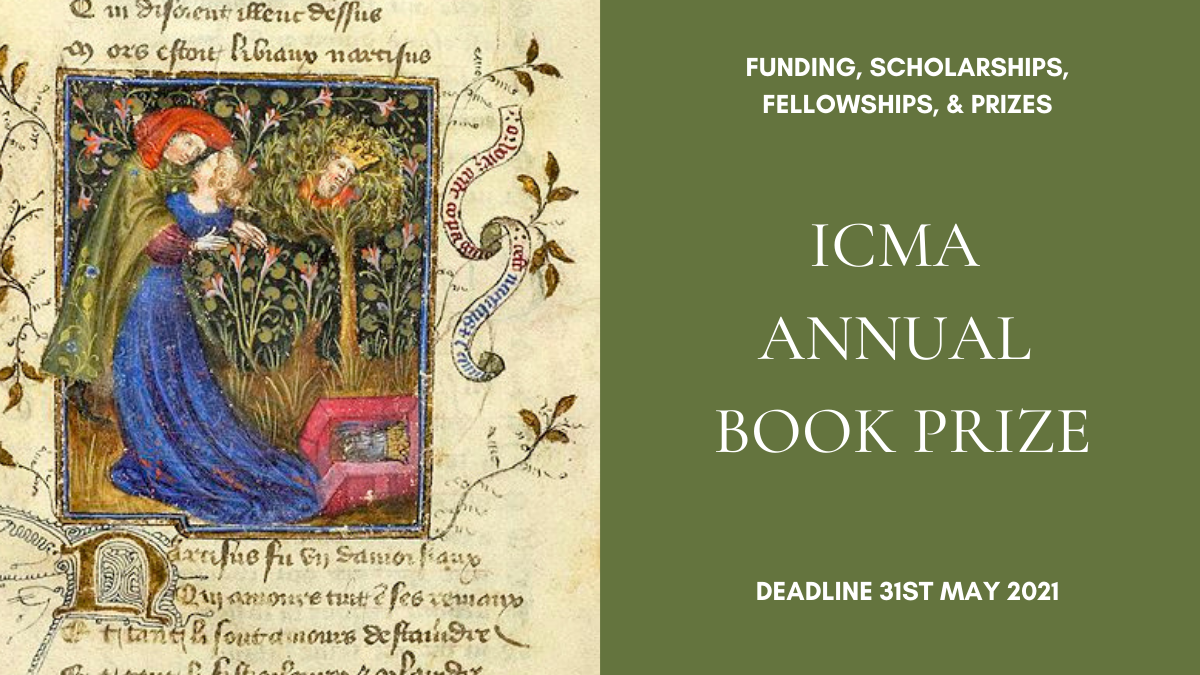
ICMA Annual Book Prize Submissions due 31st May 2021 – Notify your publisher!

Single or dual-authored books on any topic in medieval art printed in 2020 are eligible for the ICMA Annual Book Prize. No special issues of journals or anthologies or exhibition catalogues can be considered. The competition is international and open to all ICMA members. Languages of publication: English, French, German, Italian, or Spanish.

Prize: US $1,000 to a single author, or US $500 each to two co-authors. Recipients will be notified in early 2022.

Not a member yet? Go to www.medievalart.org/join to create your account and join!

For more information and to submit, visit https://www.medievalart.org/book-prize. Send questions to icma@medievalart.org.

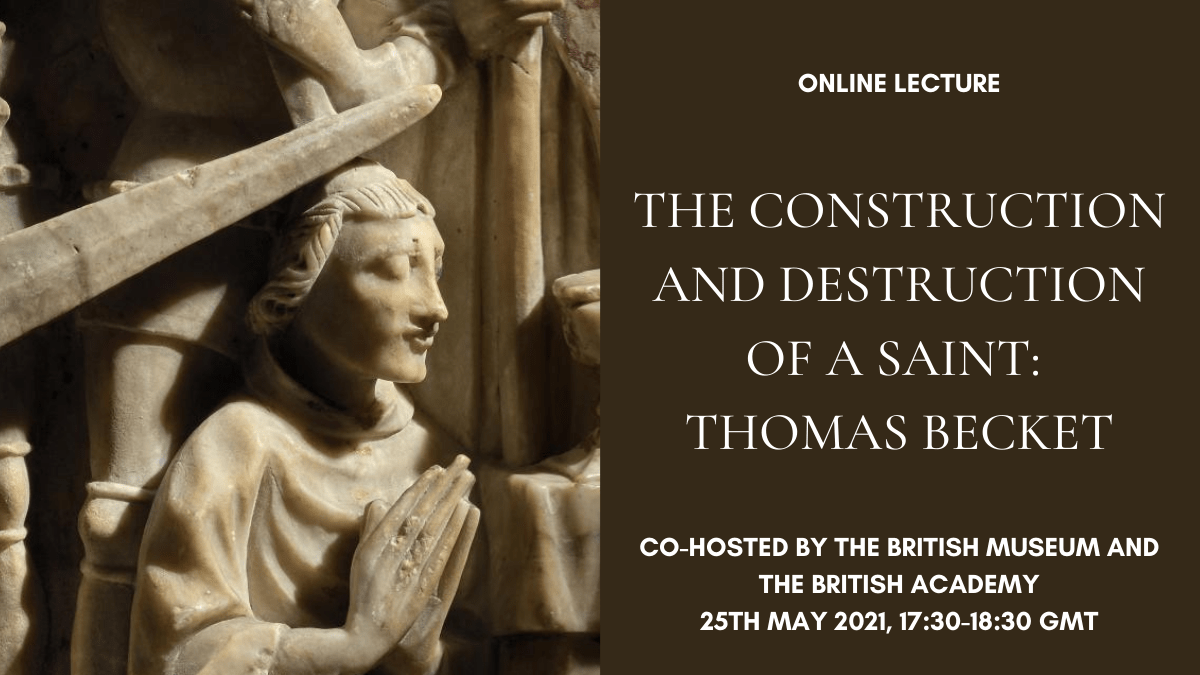
Online Lecture: The Construction and Destruction of a Saint: Thomas Becket, 25th May 2021, 17:30-18:30 GMT

This discussion explores the meteoric canonisation of Thomas Becket, his subsequent veneration and the destruction of his reputation during the Reformation of the Tudor period.

Join renowned historian of Christianity, Reverend Professor Diarmaid MacCulloch (University of Oxford), for a conversation with distinguished medievalist, Professor Nicholas Vincent (University of East Anglia). Both are Fellows of the British Academy. This lecture is hosted by the British Museum in conjunction with their exhibition ‘Thomas Becket: murder and the making of a saint’, on view from 20th May to 22nd August 2021.

The discussion is chaired by Dr Emily Guerry, Co-Director at the Centre for Medieval and Early Modern Studies at the University of Kent.

Register for free here.

About the Lecturers:

Reverend Professor Diarmaid MacCulloch Kt, FBA is Emeritus Professor of the History of the Church at Oxford University. Well known for his television work, he wrote the acclaimed History of Christianity: the first three thousand years and presented the related BBC TV series in 2009. In 2012, he wrote and presented How God Made the English for BBC Two. MacCulloch has written widely on English statesman Thomas Cromwell and the Reformation.

Professor Nicholas Vincent FBA is Professor of Medieval History at the University of East Anglia. The author of many books, including Brief History of Britain 1066–1485, last year he published a six-volume edition of The Letters and Charters of Henry II, documenting Becket’s former patron and subsequent nemesis. His study of Becket’s Murderers won the 2005 William Urry Prize.

Dr Emily Guerry is Senior Lecturer in Medieval European History and Co-Director of the Centre for Medieval and Early Modern Studies at the University of Kent at Canterbury.

This event is presented in partnership with the British Academy.

Post-Doctoral Fellowship: Migration and Mobility in Late Antiquity and the Early Middle Ages, University of Tübingen (Deadline 31st May 2021)

The Centre for Advanced Studies “Migration and Mobility in Late Antiquity and the Early Middle Ages” at the University of Tübingen, Germany invites applications for resident fellowships starting in the year 2021 and 2022. The fellowships are available for a duration between one and twelve months.

The Centre for Advanced Studies, funded by the German Research Foundation (DFG), brings together scholars from a wide range of disciplines working on migration and mobility in Europe and the Mediterranean between 250 and 900 CE. The overall aim of the Centre is to explore new approaches to migration and mobility in this period and to set the scholarly debate in the field on a new footing.

Fellowships are available for scholars at all stages of their academic career who have completed their doctoral degree and established an independent research profile. Applicants should be engaged in a research project in any relevant discipline that is related to the Centre’s interests in migration and mobility in the period and area in question. The Centre also welcomes applications from scholars working on migration and mobility in the contemporary world whose research has a strong focus on theoretical and methodological issues.

Fellows are required to reside in Tübingen, where they pursue their own research project while also participating in the colloquia held at the Centre. For the duration of their stay fellows receive a remuneration covering  accommodation, travel, and/or living expenses in accordance with their needs and the pertinent regulations of Tübingen University and the DFG.

The deadline to apply for the fellowship is 31st May 2021. Full information and the application form can be found on the university’s website.

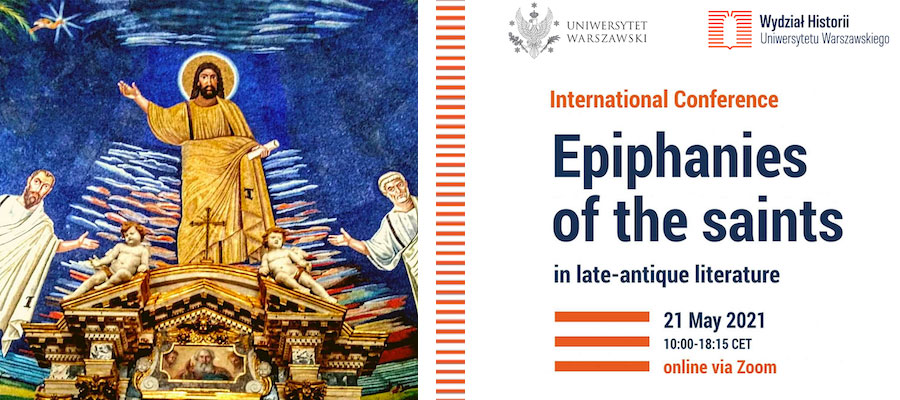
Online Conference: Epiphanies of the Saints in Late Antique Literature (University of Warsaw, 21st May 2021)

The international conference “Epiphanies of the Saints in Late-antique Literature”, hosted by the University of Warsaw, will take place on May 21, 2021. Keynote addresses will be given by Vincent Déroche, Stephanos Efthymiadis, Danuta Shanzer, and Bryan Ward-Perkins. 

Advanced registration is required; the deadline to do so is 16th May 2021. The link to register and to the zoom conference can be found here.

The complete programme is listed below:

10:00-10:15 WELCOME ADDRESS

10:15-11:15 PATTERNS AND MODES
Vincent Déroche (Paris; key note) /Modes of epiphany in early Byzantine hagiography: convictions, strategies and hesitations
Stavroula Constantinou (Nicosia) /Patterns of epiphany in Byzantine miracle stories
Robert Wiśniewski / Chair

11:30-13:00 DOUBTS AND QUESTIONS
Danuta Shanzer (Vienna; key note) / “Did I, or didn’t I (see him/her)?”
Bryan Ward-Perkins (Oxford; key note) /Why were Martin of Tours and Julian of Brioude so rarely seen by their devotees?
Przemysław Piwowarczyk (Katowice) /Bifurcated hagiography: epiphanies of Saint Menas in Greek and Coptic miracle collections
Stavroula Constantinou / Chair

14:30-15:30 TRICKS AND SECRETS
Stephanos Efthymiadis (Nicosia; key note) / The epiphany of „secret saints”: questions of cult and literary promotion for late-antique holy men and women who did not seize the glory of the day
Julia Doroszewska (Warsaw) / Saint tricksters: playful epiphanies in late-antique literature
Danuta Shanzer / Chair

15:45-16:45 DISPUTES AND DEFINITIONS
Efthymios Rizos (Thessaloniki) / „Not physical, but real”: debating and defining the apparitions of the saints in the Greek Fathers during the 5th and 6th centuries
Paweł Nowakowski (Warsaw) / „He judged it preposterous to oppose visions from God”. The know-how of the visions of living ascetics in late-antique Syria and Palestine
Bryan Ward-Perkins / Chair

17:00-18:00 ‘PAGANS’ AND PARALLELS
Darja Šterbenc Erker (Berlin/Vienna) / Epiphanies in ancient Roman literature
Krzysztof Pierzchalski (Cracow) / Epiphany dreams in antiquity: a cognitive approach
Julia Doroszewska / Chair

18:00-18:15 CLOSING REMARKS

Online Lecture: ”more busines to fynd out what should be read, then to read it when it was founde out’: A Material History of the Bible in Late Medieval and Early Modern England’ (11th May 2021, 17:30 pm GMT)

The final installment of the 2020-2021 London Medieval Manuscripts Seminar (hosted by the Institute of English Studies, University of London) is Tuesday 11th May 2021 at 17:30 pm GMT. Eyal Poleg from Queen Mary University London will delivering the lecture.

‘more busines to fynd out what should be read, then to read it when it was founde out’: A Material History of the Bible in late medieval and early modern England:

‘Introducing the Book of Common Prayer in 1549, Thomas Cranmer sought to highlight the break with the medieval past. This paper will explore the long history of the Bible in England, from the rise of the single-volume, mass-produced Bibles of the mid-thirteenth century to the death of Edward VI in 1553.  The prism of materiality and use would enable us to question Reformation paradigms, tracing continuities, as well as transformations, in the history of the Bible across the later Middle Ages and early modernity. Some changes to layout and design, such as the introduction of chapter division, took centuries to be implemented. The paper will end with reassessing the methodologies needed for such analysis, advocating a new approach which would combine book and religious histories with scientific analysis of manuscripts and early printed books.’

This event has been organised by Julia Crick, King’s College London, and David Rundle, University of Kent.

Registration and the link to the Zoom event can be found here.

Online Lecture: Across the Margin: Finding a New Page from Jean Bourdichon’s Hours of Louis XII (28th May 2021, 1 pm EST)

Presented by Nicholas Herman, Schoenberg Institute for Manuscript Studies, Penn Libraries

Friday, May 28, 2021, 1:00–2:15pm EST (via Zoom)

This talk will begin by revealing a stunningly beautiful and previously unknown detached miniature from a royal Book of Hours created by the court artist Jean Bourdichon around 1498. This chance find, which represents the Lamentation of the Virgin Mary, the Holy Women, and Saint John over the body of the dead Christ, is all the more momentous in that it completes a remarkable double-page opening: the folio, with its full-page miniature, originally faced the famous image of King Louis XII in prayer, surrounded by Saints Michael, Charlemagne, Louis, and Denis, now at the J. Paul Getty Museum in Los Angeles. The talk will examine the genesis of Louis XII’s sumptuous prayer book, its later history of dismemberment and dispersal, and its crucial place within the trajectory of Bourdichon, who served as official painter and illuminator to four successive French monarchs.

The second part of the talk will delve further into the genre of the double-page opening and its particular prevalence in manuscript illumination of the fifteenth century. Deceptively straightforward, images that run consecutively from a verso to a recto, thus forming a unified scene, are exceptional in the history of the hand-decorated book. More than mere diptychs, such images were used ingeniously by some of the most talented artists of the period to further the narrative force of their images, to interrogate the reader’s relationship with the page, and to create immersive environments that went well beyond the traditional, text-oriented bounds of book illumination.

This event is free and open to the public. To receive the zoom link, click on the link to registration.